
- Home
- »
- Catalysts & Enzymes
- »
-
Carbon Disulfide Market Size And Share Report, 2026-2033GVR Report cover

Carbon Disulfide Market (2026 - 2033)
Size, Share & Trends Analysis Report By Application (Rubber, Rayon, Fibre, Pharmaceuticals, Agriculture, Packaging), By Region (North America, Asia Pacific, Europe, Latin America, MEA), And Segment Forecasts
Market Size, 2025
$153.1MMarket Estimate, 2026
$157.9MMarket Forecast, 2033
$203.8MCAGR, 2026–2033
3.7%Carbon Disulfide Market Summary
The global carbon disulfide market size was valued at USD 153.1 million in 2025 and is projected to grow from USD 157.9 million in 2026 to USD 203.8 million by 2033, at a CAGR of 3.7% from 2026 to 2033. Asia Pacific dominated the market, accounting for a revenue share of 54.8% in 2025. This growth is attributed to the increasing demand for carbon disulfide in chemical manufacturing, especially in the production of cellulose-based products such as rayon and cellophane, which are used in textiles and packaging.
 Source: Grand View Research, IR Documents, Primary Interviews, Paid DatabasesTo learn more about this report,
 Download Free Sample Report
 Key Market Trends & Insights
- By application: Agriculture segment dominated the market, with a revenue share of 14.2% in 2025.
Regional Highlights
- Largest regional market: Asia Pacific (35.6% revenue share, 2025)
- By country: China held the largest market share in 2025.
Market Size & Forecast
- Market size in 2025: USD 153.1 Million
- Estimated market size in 2026: USD 157.9 Million
- Projected market size by 2033: USD 203.8 Million
- CAGR (2026-2033): 3.7%
Three ways to get this report
Buy it, customize it, or ask a question.Ask an Analyst
Analyst response in 1 business day
- AccessReport author, directly
- Reply timeWithin 1 working day
- No sales callDirect answer only
- FormatEmail reply
- CostFree, no cost
Get the Full Report
What the study covers
- FormatsPDF · Excel · Dashboard
- Timeline2026–2033 annual, 2025 base
- Coverage20+ countries, 5 regions
- Companies10+ key players profiled
Customize the Report
20% free customization
- IncludeCountries, segments, points
- TailorTo your product definition
- ExtendDeeper competitor detail
- OrA fully bespoke study
- Turnaround5–10 working days
In addition, the agricultural sector also contributes to the production of carbon disulfide, which is used in the production of biocides, fungicides, and fumigants. Furthermore, the rising demand for rubber in the automotive industry and the increasing use of carbon disulfide in the pharmaceutical sector are boosting market growth. Carbon Disulfide (CS2) is a chemical compound primarily used in various industrial processes. It plays a crucial role in the production of a wide range of products, including agricultural chemicals, pharmaceuticals, and textiles. One of the key applications of carbon disulfide is in the agricultural sector, where it is used to manufacture dithiocarbamates, compounds that serve as biocides, fungicides, and fumigants. Among these compounds, metam sodium is the most commonly produced and widely used for soil sterilization and fumigation, particularly in the cultivation of crops such as tomatoes and potatoes. As the need for pest control and soil health management grows, the demand for carbon disulfide in agriculture continues to rise, driving market growth. To learn more about this report, Download Free Sample Report
 Another important sector utilizing carbon disulfide is pharmaceuticals, which synthesize various drugs and intermediates. In addition, it serves as a fumigant to control insects in stored food products, such as pulses, cereals, and grains. carbon disulfide vapors are highly toxic to insects but not harmful to humans or animals, making them an effective solution for pest management in the food industry.
Furthermore, carbon disulfide is also widely used as a solvent for substances such as selenium, iodine, rubber, and resin. Its effectiveness as a cleaning agent, particularly in cleaning carbon nanotubes, is increasingly recognized. With the growing demand for nanomaterials and their applications, carbon disulfide is expected to increase usage, contributing to market expansion. Moreover, the rising demand for viscose rayon, driven by evolving global needs, is set to provide significant opportunities for further market growth during the forecast period.
Market Dynamics
The carbon disulfide market is experiencing steady growth, driven by its indispensable role as an intermediate in the production of rayon fibers, rubber chemicals, and agricultural formulations. Rising demand for regenerated cellulose fibers from the textile industry, coupled with increasing consumption of specialty rubber products in automotive and industrial applications, continues to strengthen market expansion. Growth in pharmaceutical manufacturing and agrochemical production further supports product utilization across diverse end-use sectors. At the same time, manufacturers are investing in process optimization, emission control technologies, and efficient production methods to enhance operational performance and comply with evolving environmental regulations. Expanding industrialization in emerging economies, particularly across Asia Pacific, is creating favorable opportunities through increased chemical manufacturing capacity and infrastructure development. However, stringent occupational safety standards, the hazardous nature of carbon disulfide handling, and fluctuations in sulfur-based raw material prices present ongoing challenges.
The increasing consumption of rayon fibers across the textile and apparel industry is a major factor driving the carbon disulfide market. Carbon disulfide serves as a critical raw material in the viscose process, where it is used to convert cellulose into regenerated fibers with desirable softness, breathability, and moisture absorption properties. The growing preference for sustainable and biodegradable textile materials over synthetic alternatives has accelerated the adoption of rayon in clothing, home furnishings, and nonwoven products. As consumer demand for comfort-oriented and eco-conscious fabrics continues to expand, manufacturers are increasing viscose production capacities, directly supporting the demand for carbon disulfide.
Rapid urbanization, rising disposable incomes, and the expansion of the global fashion industry have contributed to higher textile consumption, particularly in developing economies. Investments in modern textile manufacturing facilities and integrated fiber production plants have strengthened the supply chain for rayon production. As textile manufacturers focus on improving production efficiency and meeting evolving consumer preferences, the requirement for high-quality carbon disulfide remains significant, reinforcing its position as an essential industrial chemical within the regenerated cellulose value chain.
Stringent environmental regulations and occupational safety requirements remain the most significant restraint for the carbon disulfide market due to the chemical's hazardous characteristics and potential health risks associated with exposure. Carbon disulfide is highly volatile, flammable, and toxic, requiring specialized handling, storage, transportation, and emission control systems throughout the production and distribution process. Regulatory agencies across major economies have implemented strict workplace exposure limits, air emission standards, waste management protocols, and environmental compliance requirements, increasing operational complexity for manufacturers. Meeting these regulations often requires substantial investments in advanced pollution control equipment, continuous monitoring systems, worker safety programs, and process modifications. These additional compliance costs can reduce profit margins, particularly for small and medium-sized producers, while lengthy environmental approval processes may delay capacity expansions and new project developments.
The continued expansion of chemical manufacturing across emerging economies presents a substantial growth opportunity for the carbon disulfide market. Countries in Asia Pacific, Latin America, and parts of the Middle East are witnessing increasing investments in industrial infrastructure, specialty chemicals, and downstream manufacturing industries. Favorable government policies, competitive production costs, and improving supply chain capabilities are encouraging manufacturers to establish new production facilities, creating sustained demand for carbon disulfide across multiple industrial applications, including rubber processing, pharmaceuticals, and agrochemicals.
Increasing foreign direct investment and the relocation of manufacturing operations to cost-efficient regions are strengthening regional production capabilities. Growing domestic demand for industrial chemicals, combined with the expansion of export-oriented manufacturing, is creating opportunities for carbon disulfide producers to broaden their customer base and enhance production capacities. Companies that invest in advanced manufacturing technologies, regulatory compliance, and efficient distribution networks are well positioned to capitalize on the rising industrial activities and long-term economic development across these high-growth markets.
Analyst Perspective
The carbon disulfide market is expected to witness steady growth, supported by sustained demand from the rayon, rubber, and specialty chemical industries. Increasing investments in textile manufacturing and industrial production across emerging economies are strengthening long-term consumption patterns. Manufacturers are emphasizing process efficiency, product quality, and environmental compliance to remain competitive amid evolving regulatory standards. Technological advancements in production methods and expanding applications in pharmaceuticals and agrochemicals are creating additional growth opportunities. Although stringent safety regulations and raw material price fluctuations present challenges, the market is expected to maintain a stable outlook, driven by diversified end-use demand and continued industrial expansion.
Application Insights
By application, agriculture held a dominant position, contributing 14.2% of total revenue in 2025, primarily driven by its essential role in pest control, soil fumigation, and crop protection. carbon disulfide is widely used to eradicate harmful pests, fungi, and nematodes, helping improve soil quality and enhancing crop yields. In addition, it also finds use in seed treatment, preventing the spread of diseases. Furthermore, as agricultural practices become more focused on increasing productivity and minimizing crop losses, the demand for carbon disulfide continues to rise globally.
 To learn more about this report, Download Free Sample Report
 The packaging industry segment is expected to grow at a CAGR of 5.2% from 2025 to 2033, owing to its key role in the production of cellulose-based materials such as rayon and cellophane. These materials are valued for their flexibility, strength, and biodegradability, making them ideal for eco-friendly packaging solutions. In addition, carbon disulfide is used in the chemical processes that enhance the properties of these materials, contributing to the development of sustainable, high-performance packaging. Furthermore, as consumer preferences shift toward environmentally conscious packaging, the demand for carbon disulfide in this sector grows steadily.
Regional Insights
Asia Pacific dominated the carbon disulfide market with the highest revenue share of 35.6% in 2025, driven by robust demand from the textile and agricultural industries. The region’s significant production of rayon and other cellulose-based materials directly increases the need for carbon disulfide. Furthermore, North America’s agricultural sector heavily utilizes carbon disulfide for pest management, seed treatment, and soil sterilization, especially in the U.S. Moreover, the growing focus on agricultural productivity and environmentally friendly practices in the region continues to support the steady growth of carbon disulfide consumption in North America.
U.S. Carbon Disulfide Market Trends
The carbon disulfide market in the U.S. is expected to be driven by its applications in the textile and agriculture sectors. The demand for carbon disulfide in producing rayon and other synthetic fibers is increasing as the textile industry grows. Furthermore, U.S. agriculture relies on carbon disulfide for soil fumigation, pest control, and improving crop yields. The country’s focus on agricultural innovation and textile manufacturing has led to an increasing need for carbon disulfide, supporting its market expansion within the U.S.
Asia Pacific Carbon Disulfide Market Trends
The Asia Pacific carbon disulfide market dominated the global market and accounted for the largest revenue share of 35.5% in 2024. This growth is attributed to rapid industrialization, particularly in countries such as India and Japan. In addition, the demand for carbon disulfide is increasing due to its extensive use in the textile, agricultural, and chemical industries. As these sectors expand, the need for materials such as rayon and cellophane rises. Furthermore, the growth of the agricultural sector in the region, focusing on pest control and soil sterilization, further propels the consumption of carbon disulfide. China dominated the Asia Pacific carbon disulfide market in 2025.
 To learn more about this report, Download Free Sample Report
 The carbon disulfide market in China led the Asia Pacific market with the highest revenue share in 2024, driven by its large-scale industrialization, especially in textiles and chemicals. The country’s increasing demand for rayon, a key product made with carbon disulfide, contributes to this rise. Furthermore, the growing agricultural industry in China requires carbon disulfide for pest control, soil fumigation, and seed treatment. Moreover, as the country continues to urbanize and industrialize, the demand for carbon disulfide is expected to maintain an upward trajectory.
Latin America Carbon Disulfide Market Trends
The Latin America carbon disulfide market is expected to grow at a CAGR of 5.5% over the forecast period, due to expanding agricultural activities, particularly in countries such as Brazil and Argentina. In addition, the use of carbon disulfide in pest control and soil fumigation is crucial for improving crop yield and quality. Furthermore, the textile industry in the region is expanding, increasing the demand for products such as rayon, which are produced using carbon disulfide. Moreover, economic development and the growing need for sustainable agricultural practices further fuel the market’s growth in the region.
Europe Carbon Disulfide Market Trends
The carbon disulfide market in Europe is expected to witness a significant growth over the forecast period, owing to the region’s emphasis on sustainability and eco-friendly solutions. The demand for biodegradable packaging and textiles, such as rayon and cellophane, is rising, boosting the consumption of carbon disulfide. Furthermore, agricultural advancements in Europe rely on carbon disulfide for pest control and soil health. Moreover, the region's commitment to reducing environmental impacts encourages the adoption of more sustainable farming and industrial practices, driving the growth of carbon disulfide consumption in the European market.
Key Carbon Disulfide Company Insights
Key companies in the global carbon disulfide industry include GFS Chemicals Inc., PPG Industries, Inc., Alfa Aesar, and others. These companies implement strategies focused on expanding production capabilities, enhancing supply chain efficiency, and investing in sustainable technologies. Furthermore, they also emphasize product innovation, market diversification, and strengthening customer relationships to maintain competitive advantage and ensure long-term growth.
-
GFS Chemicals Inc. provides a wide range of chemicals for industrial applications, such as solvents, reagents, and specialty products. GFS Chemicals operates in various sectors, including agriculture, pharmaceuticals, and environmental analysis. Its focus on providing chemical solutions for research, manufacturing, and environmental industries positions it as a significant player in the global market for carbon disulfide and related compounds.
-
PPG Industries, Inc. serves a broad spectrum of industries, such as automotive, aerospace, industrial coatings, and chemicals. The company manufactures carbon disulfide for use in applications such as the production of viscose rayon, agricultural chemicals, and various chemical processes. Its diverse portfolio allows the company to cater to several market segments that require high-performance chemicals and materials, including carbon disulfide.
Key Carbon Disulfide Companies
The following key companies have been profiled for this study on the carbon disulfide market.
-
Akzo Nobel N.V.
-
Merck KGaA
-
GFS Chemicals Inc.
-
PPG Industries, Inc.
-
Alfa Aesar
-
Univar Solutions Inc.
-
Jiangsu Jinshan Chemical Co. Ltd.
-
Arkema
-
Shikoku Chemicals Corporation
-
Zhuzhou Jinyuan Chemical Industry Co.,Ltd.
-
Shanghai Baijin Chemical Group Co., Ltd.
-
Jiaonian Ruixing Chemical
-
Tedia
Competitive Benchmarking
Category
Operating Strategies
Competitive Edge
Weakness
Established Players (Akzo Nobel N.V., Merck KGaA, PPG Industries, Inc., Arkema, Univar Solutions Inc., Shikoku Chemicals Corporation, Alfa Aesar, GFS Chemicals Inc., Tedia)
- Maintain diversified product portfolios serving multiple chemical and industrial sectors.
- Invest in process optimization, automation, and environmental compliance to improve manufacturing efficiency.
- Strengthen global distribution networks and long-term supply agreements with downstream industries.
- Focus on high-purity and specialty-grade carbon disulfide products for value-added applications.
- Strong global brand recognition and established customer relationships.
- Advanced manufacturing technologies deliver consistent product quality.
- Extensive R&D capabilities supporting product innovation and regulatory compliance.
- Broad international sales and logistics infrastructure enabling reliable product availability.
- Higher operating expenses due to stringent sustainability and compliance requirements.
- Complex organizational structures may slow operational decision-making.
- Mature markets offer comparatively lower organic growth opportunities.
- Significant capital expenditure is required to maintain advanced production facilities and environmental standards.
Emerging Players (Jiangsu Jinshan Chemical Co. Ltd., Zhuzhou Jinyuan Chemical Industry Co., Ltd., Shanghai Baijin Chemical Group Co., Ltd., Jiaonian Ruixing Chemical
- Expand production capacity to address growing regional demand.
- Compete through cost-efficient manufacturing and localized supply chains.
- Increase penetration into textile, rubber, and agrochemical industries within domestic and neighboring markets.
- Invest selectively in plant modernization and product quality improvements to enhance competitiveness.
- Competitive pricing is supported by lower operating and production costs.
- Greater flexibility to respond quickly to regional customer requirements.
- Strategic proximity to key raw material sources and major manufacturing clusters.
- Ability to rapidly scale operations in high-growth emerging markets
- Limited international market presence and brand visibility.
- Lower investment capacity for advanced technologies and large-scale research initiatives.
- Greater dependence on regional demand and domestic economic conditions.
- Smaller distribution networks and fewer long-term strategic partnerships compared with established global competitors.
Carbon Disulfide Market Report Scope
Report Attribute
Details
Market size in 2025
USD 153.1 million
Estimated market size in 2026
USD 157.9 million
Projected market size by 2033
USD 203.8 million
Growth rate
CAGR of 3.7% from 2026 to 2033
Base year for estimation
2025
Historical data
2021 - 2024
Forecast period
2026 - 2033
Quantitative units
Revenue in USD million, Volume in Kilotons and CAGR from 2026 to 2033
Report coverage
Revenue forecast, company ranking, competitive landscape, growth factors, and trends
Segments covered
Application, Region
Regional scope
North America, Asia Pacific, Europe, Latin America, Middle East & Africa
Country scope
U.S., Canada, Germany, Russia, UK, Spain, Italy, China, Japan, South Korea, Australia, India, Brazil, UAE, Saudi Arabia
Key companies profiled
Akzo Nobel N.V.; Merck KGaA; GFS Chemicals Inc.; PPG Industries, Inc.; Alfa Aesar; Univar Solutions Inc.; Jiangsu Jinshan Chemical Co. Ltd.; Arkema; Shikoku Chemicals Corporation; Zhuzhou Jinyuan Chemical Industry Co.,Ltd.; Shanghai Baijin Chemical Group Co., Ltd.; Jiaonian Ruixing Chemical; Tedia.
Customization scope
Free report customization (equivalent up to 8 analysts' working days) with purchase. Addition or alteration to country, regional & segment scope.
Pricing and purchase options
Avail customized purchase options to meet your exact research needs. Explore purchase options
Global Carbon Disulfide Market Report Segmentation
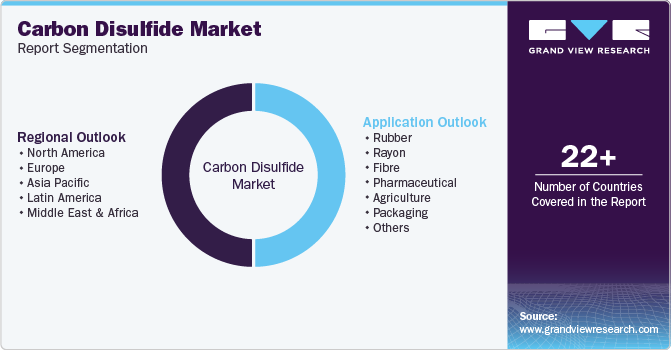
This report forecasts revenue growth at global, regional, and country levels and analyzes the latest industry trends in each sub-segment from 2021 to 2033. For this study, Grand View Research has segmented the global carbon disulfide market report based on application, and region:
 To learn more about this report, Download Free Sample Report
 -
Application Outlook (Volume, Million Kilograms; Revenue, USD Million, 2021 - 2033)
-
Rubber
-
Rayon
-
Fibre
-
Pharmaceutical
-
Agriculture
-
Packaging
-
Others
-
-
Regional Outlook (Volume, Million Kilograms; Revenue, USD Million, 2021 - 2033)
-
North America
-
U.S.
-
Canada
-
-
Europe
-
Germany
-
Russia
-
UK
-
Spain
-
Italy
-
-
Asia Pacific
-
China
-
Japan
-
South Korea
-
Australia
-
India
-
-
Latin America
-
Brazil
-
-
Middle East and Africa
-
UAE
-
Saudi Arabia
-
-
Research Methodology
The carbon disulfide market figures in this report are based on a proven research process that combines executive interviews with secondary research from proprietary databases, company filings, and recognized regulatory and institutional sources. Market size is built through value-chain sizing-reconciling supply-side and demand-side estimates-and triangulated with bottom-up and top-down approaches. Every estimate passes multiple levels of expert validation before publication, with each carbon disulfide segment quantified using the revenue-capture definitions in the table below.
Segment Definition
Application
Revenue capture definition
Rubber
Market earnings stem from the consumption of carbon disulfide in manufacturing vulcanization agents and rubber processing chemicals that improve product strength, flexibility, and performance. Expanding tire production and increasing demand for industrial rubber components continue to support this application.
Rayon
Income is primarily generated through the utilization of carbon disulfide during viscose processing, where natural cellulose is transformed into rayon for textile manufacturing. Growing preference for regenerated fibers and rising apparel production enhance commercial prospects for this segment.
Fibre
Financial returns originate from the application of carbon disulfide in producing regenerated cellulose fibers used in apparel, technical textiles, and nonwoven materials. Higher adoption of environmentally friendly fibers across consumer and industrial sectors contributes to segment expansion.
Pharmaceutical
Business value is created through the use of carbon disulfide in chemical synthesis processes associated with pharmaceutical intermediates and specialty compounds. Increasing research activities and expanding drug manufacturing capacity positively influence product consumption.
Agriculture
Revenue opportunities arise from the incorporation of carbon disulfide into the production of agricultural chemical intermediates and specialized crop protection products. Continuous efforts to improve agricultural productivity and crop quality sustain demand within this sector.
Packaging
Commercial growth is supported using carbon disulfide in manufacturing cellulose-derived films and sustainable packaging materials that offer improved mechanical properties. Rising emphasis on eco-friendly packaging solutions further strengthens this application area.
Other Applications
Economic gains are obtained from diverse industrial uses, including mineral flotation, laboratory chemicals, specialty synthesis, and process chemicals. Ongoing diversification of industrial applications and technological advancements continue to broaden the market potential of this segment.
Estimation Model
Layer No.
Layer Name
Key Question
Description
01
Raw Material & Production Layer
What forms the supply base?
Assess the global production of carbon disulfide manufactured primarily through the reaction of sulfur with carbon-based feedstocks such as natural gas, petroleum coke, charcoal, or coke at elevated temperatures. Evaluate the availability of sulfur, carbon sources, production technologies, manufacturing capacities, operational efficiency, trade flows, and key production centers that ensure a stable supply for downstream chemical industries.
02
Application Adoption Layer
Where is carbon disulfide consumed?
Examine the distribution of carbon disulfide across major application sectors including rayon manufacturing, rubber processing, regenerated cellulose fibers, pharmaceuticals, agriculture, packaging materials, and other industrial uses. Adoption trends are influenced by textile production, industrial chemical demand, agricultural development, pharmaceutical expansion, and increasing consumption of specialty chemicals in emerging economies.
03
Consumption Intensity Layer
How much carbon disulfide is utilized?
Evaluate carbon disulfide consumption by quantifying its usage in viscose rayon production, rubber chemical synthesis, cellulose fiber manufacturing, agrochemical intermediates, pharmaceutical compounds, and specialty industrial processes. The assessment considers production output, formulation requirements, process efficiency, industry-specific consumption rates, and regional manufacturing activity to determine annual market demand.
04
Revenue Layer
How is market revenue generated?
Market revenue is generated through commercial production and supply of carbon disulfide for industrial processing and chemical synthesis applications. Revenue performance is shaped by product purity, manufacturing scale, pricing trends, regulatory compliance, technological advancements, supply chain efficiency, and sustained demand from rayon, rubber, pharmaceutical, agricultural, and specialty chemical industries across global markets.
Delivered Customizations
This report has been delivered with the following In-depth customizations
Client Request
Customization Delivered
Value Adds
Regional Segmentation
The study provides detailed country-level assessment across major carbon disulfide production and consumption markets in key economies. The analysis covers sulfur and carbon feedstock availability, manufacturing capacities, production technologies, import-export activity, regulatory landscape, and demand across rayon, rubber, fibre, pharmaceutical, agriculture, packaging, and other industrial applications.
Enables stakeholders to identify high-growth regional opportunities, evaluate manufacturing competitiveness, understand supply-demand trends, assess feedstock accessibility, and prioritize strategic investments across rapidly expanding industrial and textile markets.
Trade Assessment
The report delivers an extensive evaluation of historical and current trade patterns for carbon disulfide, covering imports, exports, key producing and consuming countries, cross-border supply networks, pricing movements, and evolving market dynamics. The assessment further examines regional production concentration, sulfur sourcing, logistics infrastructure, and international supply chain dependencies affecting product availability.
Supports informed sourcing decisions, strengthens procurement strategies, identifies export potential, improves supply chain resilience, and helps companies mitigate risks associated with raw material procurement, transportation, and changing global trade conditions.
Opportunity Assessment
The study presents a comprehensive evaluation of growth prospects across rayon manufacturing, rubber chemicals, regenerated cellulose fibres, pharmaceuticals, agriculture, packaging materials, and specialty chemical applications. It further analyzes opportunities arising from expanding textile production, industrialization in emerging economies, advancements in chemical processing technologies, and increasing investments in downstream manufacturing sectors.
Assists organizations in identifying high-value growth avenues, evaluating future demand trends, aligning capacity expansion and product development strategies, and capturing emerging opportunities across industrial chemicals, specialty materials, and advanced manufacturing applications.
Frequently Asked Questions About This Report
The global carbon disulfide market size was estimated at USD 153.1 million in 2025 and is expected to reach USD 157.9 million in 2026.
The global carbon disulfide market is expected to grow at a compound annual growth rate of 3.7% from 2026 to 2033 to reach USD 203.8 million by 2033.
Asia Pacific dominated the carbon disulfide market with the highest revenue share of 35.6% in 2025.
Some key players operating in the carbon disulfide market include Akzo Nobel N.V.; Merck KGaA; GFS Chemicals Inc.; PPG Industries, Inc.; Alfa Aesar; Univar Solutions Inc. and others.
By application, agriculture held a dominant position, contributing 14.17% of total revenue in 2025. This dominance was supported by the widespread use of carbon disulfide in the production of agrochemical intermediates and soil treatment products, driven by the need to improve crop productivity and agricultural efficiency.
The carbon disulfide market is primarily driven by increasing demand from the rayon and regenerated cellulose fiber industry, supported by growing textile production worldwide. Rising consumption of rubber chemicals, expanding pharmaceutical and agrochemical manufacturing, and continuous industrialization in emerging economies are further accelerating market growth.
About the Author(s)
Catalysts & Enzymes Research Team
Specialty & Chemicals · Catalysts & EnzymesThis report was authored by the catalysts & enzymes research team at Grand View Research - comprising two research analysts, one senior research analyst, and one industry expert - with specialized expertise in the catalysts & enzymes segment of the specialty & chemicals industry. All findings are based on proprietary specialty & chemicals databases, executive interviews, and regulatory analysis, subject to internal peer review prior to publication.
Last Updated:
Speak to Analyst

Customize this report to your needs - add regions, segments, or data points, with 20% free customization.
Or view our licence options:


ISO 9001:2015 & 27001:2022 Certified
We are GDPR and CCPA compliant! Your transaction & personal information is safe and secure. For more details, please read our privacy policy.


