
- Home
- »
- Advanced Interior Materials
- »
-
Carbon-Negative Building Materials Market Size Report, 2033GVR Report cover
![Carbon-Negative Building Materials Market Size, Share & Trends Report]()
Carbon-Negative Building Materials Market (2025 - 2033) Size, Share & Trends Analysis Report By Material (Biomass-Based Materials, Carbon-Negative Concrete), By End Use (Industrial, Residential, Commercial), By Region, And Segment Forecasts
- Report ID: GVR-4-68040-791-2
- Number of Report Pages: 101
- Format: PDF
- Historical Range: 2018 - 2023
- Forecast Period: 2025 - 2033
- Industry: Advanced Materials
- Report Summary
- Table of Contents
- Segmentation
- Methodology
- Download FREE Sample
-
 Download Sample Report
Carbon-Negative Building Materials Market Summary
The global carbon-negative building materials market size was estimated at USD 16.44 billion in 2024 and is projected reach USD 37.51 billion by 2033, growing at a CAGR of 9.6% from 2025 to 2033, driven by the growing emphasis on sustainable construction practices and the global push to reduce greenhouse gas emissions. Governments and regulatory bodies are increasingly implementing stringent building codes and carbon reduction targets, encouraging the adoption of low- and negative-carbon materials.
Key Market Trends & Insights
- Asia Pacific dominated the global carbon-negative building materials industry with the largest revenue share of 33.4% in 2024.
- By material, the mycelium composites segment is expected to grow at the fastest CAGR of 9.9% over the forecast period.
- By end use, the residential segment is expected to grow at the fastest CAGR of 9.9% over the forecast period.
Market Size & Forecast
- 2024 Market Size: USD 16.44 Billion
- 2033 Projected Market Size: USD 37.51 Billion
- CAGR (2025-2033): 9.6%
- Asia Pacific: Largest market in 2024
- Asia Pacific: Fastest market
Developers and architects are actively seeking materials that contribute to net-zero or carbon-negative buildings, including bio-based composites, carbon-absorbing concrete, and recycled construction products. This shift toward sustainability is enhancing market demand across both residential and commercial sectors.Rising awareness among consumers and businesses regarding climate change and environmental responsibility is further propelling the market. Green building certifications such as LEED, BREEAM, and WELL are incentivizing the use of environmentally friendly materials. Property developers are integrating carbon-negative solutions to improve building performance, enhance marketability, and meet sustainability standards. In addition, increasing public and private investment in eco-friendly infrastructure projects is stimulating the adoption of these innovative materials across urban development and commercial construction initiatives.
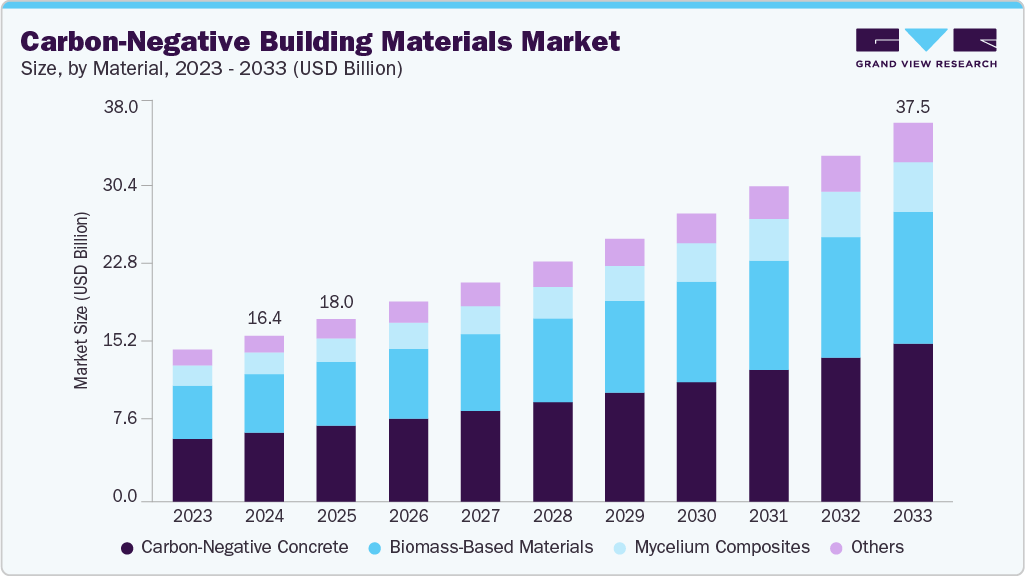
Technological advancements and material innovations are key drivers shaping market growth. Researchers and manufacturers are developing novel products, including engineered timber, carbon-sequestering cement, hempcrete, and recycled insulation materials, which reduce lifecycle emissions and enhance durability. Advanced manufacturing processes and 3D printing technologies allow for precise material optimization, reducing waste and energy consumption. These innovations not only improve the environmental footprint of construction projects but also enhance building performance and cost-efficiency, making carbon-negative materials increasingly attractive.
Market Concentration & Characteristics
The global carbon-negative building materials industry exhibits a high degree of innovation, driven by the need to develop materials that actively reduce or offset carbon emissions throughout their lifecycle. Companies are investing in advanced research to produce bio-based composites, carbon-sequestering cement, and recycled construction products with superior durability and sustainability. The market has witnessed a moderate level of mergers and acquisitions as established construction material firms collaborate with startups specializing in green technologies to expand their product portfolios and technological capabilities. Strategic partnerships with research institutions and sustainability-focused organizations further accelerate innovation and adoption of carbon-negative solutions.
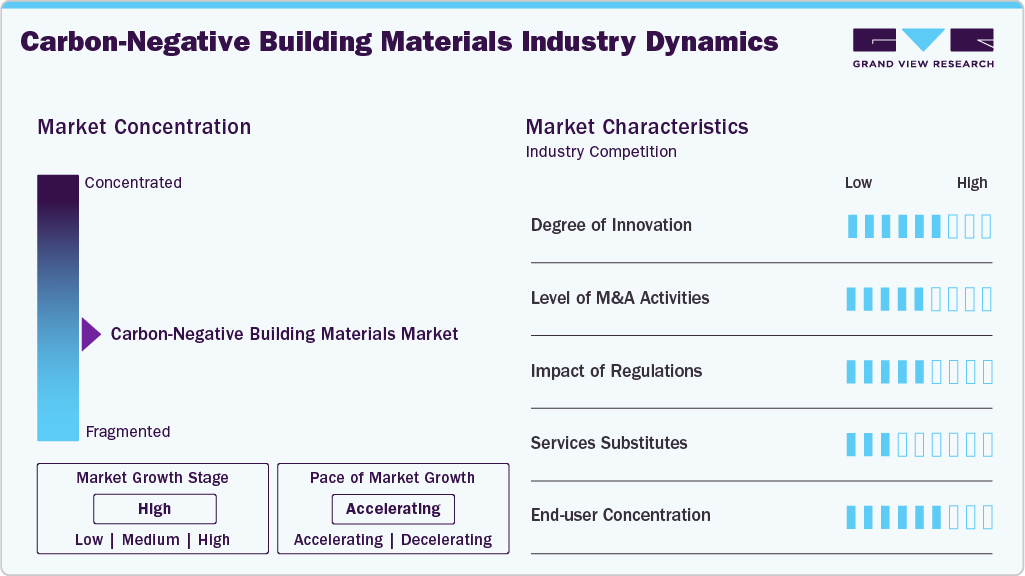
Regulatory frameworks and green building standards significantly influence market dynamics. Governments worldwide are implementing stringent environmental regulations and carbon emission reduction targets, which mandate the use of sustainable and carbon-negative construction materials. The threat of service substitutes remains moderate, as traditional building materials continue to dominate cost-sensitive projects, though their environmental impact is increasingly scrutinized. End-user concentration is high among commercial developers, infrastructure projects, and residential builders committed to sustainability and energy efficiency. These sectors prioritize long-term operational benefits, environmental compliance, and enhanced building performance, reinforcing the adoption of carbon-negative materials globally.
Material Insights
The carbon-negative concrete segment led the market and accounted for the largest revenue share of 41.3% in 2024, driven by increasing global emphasis on reducing greenhouse gas emissions and achieving net-zero targets in the construction industry. Rapid urbanization and government-backed green building initiatives are accelerating the adoption of carbon-negative concrete as an eco-friendly alternative to traditional materials. Moreover, advancements in mineralization and carbon capture utilization technologies have made large-scale production more feasible and cost-efficient, encouraging construction companies to transition toward sustainable materials that also enhance building durability and performance.
The mycelium composites segment is expected to grow significantly at a CAGR of 9.9% over the forecast period, driven by growing demand for biodegradable, lightweight, and renewable construction materials. The unique ability of mycelium to grow into customizable forms with minimal energy input makes it an attractive solution for reducing construction waste and carbon emissions. Increasing awareness of circular economy principles and sustainability certifications, coupled with R&D investments in bio-based building materials, has further propelled the use of mycelium composites in insulation, paneling, and interior applications.
End Use Insights
The residential segment dominated the market and accounted for the largest revenue share of 45.6% in 2024, driven by the surge in consumer preference for sustainable housing solutions and energy-efficient building materials. Rising disposable incomes, combined with growing environmental awareness, are encouraging homeowners to invest in carbon-negative materials that reduce lifetime carbon footprints. Government incentives for green homes, net-zero energy standards, and certification programs such as LEED and BREEAM have accelerated the use of carbon-negative concrete and bio-based materials in residential projects.
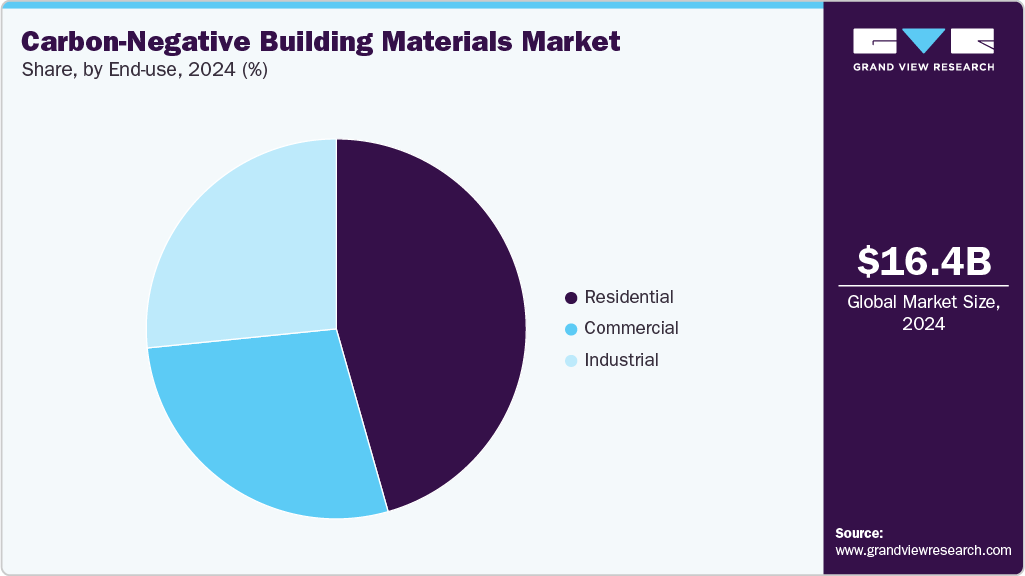
The industrial segment is expected to grow significantly at a CAGR of 9.7% over the forecast period, driven by the global shift toward decarbonization and sustainable infrastructure in manufacturing and logistics facilities. As corporations commit to ESG goals and carbon neutrality, carbon-negative building materials are being increasingly used in the construction of warehouses, plants, and industrial complexes. The superior strength and durability of these materials make them suitable for heavy-load structures while reducing embodied carbon. In addition, industrial players are integrating carbon capture and storage solutions into their material sourcing strategies, aligning with international climate frameworks and green industrial policies promoting low-emission construction practices.
Regional Insights
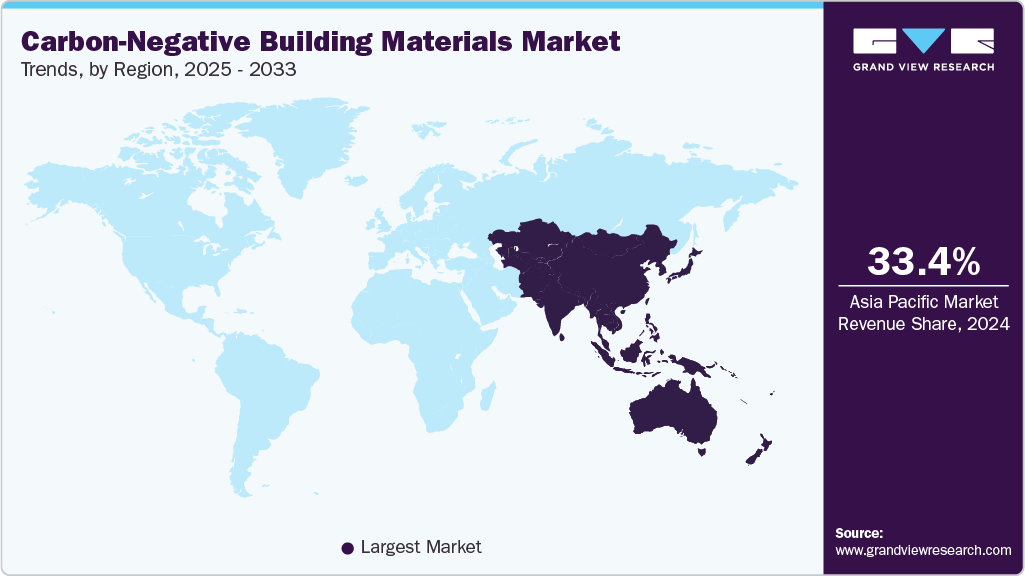
The Asia Pacific carbon-negative building materials industry held the largest revenue market share of 33.4% in 2024, experiencing rapid growth due to industrialization, urbanization, and increasing government initiatives for sustainable construction. Emerging economies such as India, Indonesia, and Vietnam are investing heavily in low-carbon infrastructure and smart city projects. Rising environmental awareness and stricter building codes are pushing developers to adopt eco-friendly materials. Local manufacturers are focusing on producing cost-effective, high-performance carbon-negative solutions, while technological collaborations with global firms enhance quality and innovation. The expansion of renewable energy projects and green building certifications further strengthens demand in the region.
China Carbon-Negative Building Materials Market Trends
China’s carbon-negative building materials industry is fueled by large-scale urbanization, infrastructure development, and strong governmental sustainability initiatives. Policies promoting green construction and carbon neutrality are encouraging the adoption of carbon-sequestering cement, hempcrete, and recycled materials. The rapid growth of the real estate and commercial sectors is creating strong demand for low-carbon solutions. Domestic manufacturers are advancing research in innovative materials and production techniques to meet international standards. In addition, the integration of eco-friendly practices in smart city developments and industrial zones is accelerating market expansion.
North America Carbon-Negative Building Materials Market Trends
The North America carbon-negative building materials industry is driven by strong government incentives, sustainability regulations, and a growing focus on green construction practices. Developers and architects are increasingly adopting carbon-negative solutions, including bio-based composites and carbon-sequestering concrete, to meet stringent environmental standards. The rise of LEED, WELL, and other green building certifications is boosting demand. In addition, increased awareness of climate change among consumers and businesses encourages investment in eco-friendly materials. Advancements in material technology and the availability of sustainable manufacturing processes further strengthen market adoption in the region.
U.S. Carbon-Negative Building Materials Market Trends
The carbon-negative building materials industry in the United States is propelled by significant infrastructure modernization programs and urban development projects emphasizing sustainability. Federal and state-level policies incentivize low-carbon construction materials, particularly for public buildings and commercial complexes. Corporate ESG initiatives are motivating developers to incorporate carbon-negative solutions in large-scale projects. The growing adoption of 3D-printed and prefabricated green construction components also supports market growth. In addition, collaboration between material manufacturers and construction firms is driving innovation and broader acceptance of carbon-negative building solutions.
Europe Carbon-Negative Building Materials Market Trends
The Europe carbon-negative building materials industry is driven by stringent environmental regulations, the EU Green Deal, and growing commitments to carbon neutrality in construction. High demand for sustainable and energy-efficient materials in residential, commercial, and industrial projects is fostering the adoption of carbon-negative building solutions. Technological advancements in bio-based composites, carbon-sequestering cement, and recycled construction products are further enhancing market growth. Moreover, the strong presence of green building certifications such as BREEAM and WELL incentivizes developers to integrate environmentally responsible materials. Consumer and corporate sustainability awareness reinforces the region’s focus on eco-friendly construction practices.
Germany carbon-negative building materials industry is a leading market in Europe due to its advanced engineering, stringent environmental regulations, and focus on sustainable urban development. The construction sector actively incorporates carbon-negative solutions such as low-carbon concrete, timber composites, and recycled materials. Government subsidies and incentives for green buildings further boost adoption. Strong R&D infrastructure enables the development of innovative, high-performance materials that meet both environmental and durability standards. Increasing demand in residential, commercial, and public infrastructure projects is supporting consistent market growth. Germany’s leadership in green technologies also drives regional market expansion.
Latin America Carbon-Negative Building Materials Market Trends
The Latin America carbon-negative building materials industry is growing with the expansion of infrastructure, urban housing, and commercial projects in countries such as Brazil and Mexico. Government initiatives promoting sustainable construction and environmental protection are encouraging the adoption of low-carbon and carbon-negative solutions. Rising awareness of climate change and eco-friendly practices among developers supports market growth. Cost-effective, durable, and locally sourced materials are increasingly preferred in construction projects. Collaborations with international manufacturers and technology providers help improve product quality and availability. In addition, renewable energy integration in buildings further stimulates demand for carbon-negative materials.
Middle East & Africa Carbon-Negative Building Materials Market Trends
The Middle East & Africa carbon-negative building materials industry is driven by rapid urbanization, large-scale infrastructure projects, and government-led sustainability initiatives. Carbon-negative building materials are increasingly adopted in residential complexes, commercial developments, and public infrastructure to reduce environmental impact. Rising investment in green construction and smart city projects is boosting market demand. Local manufacturers are exploring cost-efficient, high-performance eco-friendly materials. In addition, awareness campaigns on climate change and corporate sustainability commitments are encouraging the use of innovative carbon-negative solutions. The integration of energy-efficient and low-carbon practices in new developments continues to support regional market expansion.
Key Carbon-Negative Building Materials Company Insights
Some of the key players operating in the market include LafargeHolcim Ltd. and Kingspan Group plc
-
LafargeHolcim Ltd., headquartered in Switzerland, is a global leader in sustainable building solutions. The company offers carbon-negative cement and low-carbon concrete products that reduce CO₂ emissions during production and construction. LafargeHolcim emphasizes innovation in eco-friendly materials and lifecycle sustainability, targeting commercial and infrastructure projects worldwide.
-
Kingspan Group plc, based in Ireland, specializes in high-performance insulation and building envelope solutions. Its carbon-negative product portfolio includes advanced insulation panels and energy-efficient facades designed to minimize embodied carbon in construction. Kingspan focuses on sustainability, energy efficiency, and regulatory compliance across global building projects.
BASF SE, Cemex S.A.B. de C.V. are some of the emerging market participants in the market.
-
BASF SE, a German multinational chemical company, develops innovative building materials with reduced carbon footprints. Its offerings include bio-based polymers, carbon-sequestering composites, and insulation materials. BASF integrates advanced research in material science to enhance durability, energy efficiency, and environmental performance in construction applications.
-
Cemex, headquartered in Mexico, is a leading provider of cement, concrete, and aggregates with a focus on low-carbon and carbon-negative solutions. The company produces EcoConcrete and other environmentally friendly cementitious materials that reduce CO₂ emissions during production and usage. Cemex emphasizes sustainable construction practices and global adoption of green building standards.
Key Carbon-Negative Building Materials Companies:
The following are the leading companies in the carbon-negative building materials market. These companies collectively hold the largest market share and dictate industry trends.
- LafargeHolcim Ltd.
- Kingspan Group plc
- BASF SE
- Cemex S.A.B. de C.V.
- Saint-Gobain S.A.
- EcoCem Materials Ltd.
- Hempitecture, Inc.
- CarbonCure Technologies Inc.
- ArcelorMittal S.A.
Recent Developments
-
In January 2025, Soletair Power and Carbonaide announced a groundbreaking collaboration to produce the world’s first industrial-scale carbon-negative concrete. The initiative, titled “Breathing for the Planet: Turning CO₂ into a Building Solution,” integrates advanced carbon capture technology with innovative concrete formulation to achieve net-negative emissions.
Carbon-Negative Building Materials Market Report Scope
Report Attribute
Details
Market size value in 2025
USD 18.01 billion
Revenue forecast in 2033
USD 37.51 billion
Growth rate
CAGR of 9.6% from 2025 to 2033
Base year for estimation
2024
Historical data
2018 - 2023
Forecast period
2025 - 2033
Quantitative units
Revenue in USD million/billion and CAGR from 2025 to 2033
Report coverage
Revenue forecast, company ranking, competitive landscape, growth factors, and trends
Segments covered
Material, end use, region
Regional scope
North America; Europe; Asia Pacific; Central & South America; Middle East & Africa
Country scope
U.S.; Canada; Mexico; UK; Germany; France; Italy; Spain; China; India; Japan
Key companies profiled
LafargeHolcim Ltd.; Kingspan Group plc; BASF SE; Cemex S.A.B. de C.V.; Saint-Gobain S.A.; EcoCem Materials Ltd.; Hempitecture, Inc.; CarbonCure Technologies Inc.; ArcelorMittal S.A.
Customization scope
Free report customization (equivalent up to 8 analysts’ working days) with purchase. Addition or alteration to country, regional & segment scope.
Pricing and purchase options
Avail customized purchase options to meet your exact research needs. Explore purchase options
Global Carbon-Negative Building Materials Market Report Segmentation
This report forecasts revenue growth at global, regional, and country levels and provides an analysis of the latest industry trends in each of the sub-segments from 2018 to 2033. For this study, Grand View Research has segmented the global carbon-negative building materials market report based on material, end use, and region.
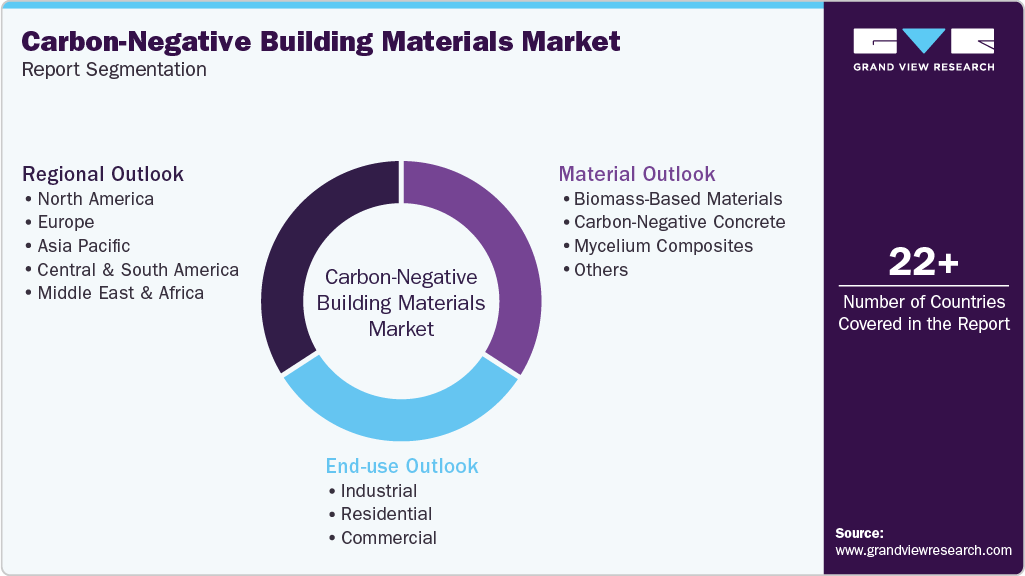
-
Material Outlook (Revenue, USD Million, 2021 - 2033)
-
Biomass-Based Materials
-
Carbon-Negative Concrete
-
Mycelium Composites
-
Others
-
-
End Use Outlook (Revenue, USD Million, 2021 - 2033)
-
Industrial
-
Residential
-
Commercial
-
-
Regional Outlook (Revenue, USD Million, 2021 - 2033)
-
North America
-
U.S.
-
Canada
-
Mexico
-
-
Europe
-
Germany
-
UK
-
France
-
Italy
-
Spain
-
-
Asia Pacific
-
China
-
Japan
-
India
-
-
Central & South America
-
Middle East & Africa
-
Frequently Asked Questions About This Report
The global carbon-negative building materials market size was estimated at USD 16.44 billion in 2024 and is expected to reach USD 18.01 billion in 2025.
The carbon-negative building materials market is expected to grow at a compound annual growth rate of 9.6% from 2025 to 2033 to reach USD 37.51 billion by 2033.
The carbon-negative concrete segment led the market and accounted for the largest revenue share of 41.3% in 2024, driven by increasing global emphasis on reducing greenhouse gas emissions and achieving net-zero targets in the construction industry.
Some of key players in the carbon-negative building materials market include LafargeHolcim Ltd., Kingspan Group plc, BASF SE, Cemex S.A.B. de C.V., Saint-Gobain S.A., EcoCem Materials Ltd., Hempitecture, Inc., CarbonCure Technologies Inc., and ArcelorMittal S.A..
The key factors driving the carbon-negative building materials market include increasing global focus on decarbonizing the construction sector, advancements in carbon capture and utilization technologies, rising green building initiatives, government incentives for sustainable infrastructure, and growing consumer demand for eco-friendly construction materials.
About the authors:
Author: GVR Advanced Interior Materials Research Team | Last Updated:


Share this report with your colleague or friend.
Need a Tailored Report?
Customize this report to your needs — add regions, segments, or data points, with 20% free customization.


ISO 9001:2015 & 27001:2022 Certified
We are GDPR and CCPA compliant! Your transaction & personal information is safe and secure. For more details, please read our privacy policy.












