
- Home
- »
- Advanced Interior Materials
- »
-
Carbon Neutral Mining Market Size Report, 2026-2033GVR Report cover
![Carbon Neutral Mining Market (2026 - 2033)Report]()
Carbon Neutral Mining Market (2026 - 2033)
Size, Share & Trends Analysis Report By Commodity (Base Metals, Precious Metals, Industrial Minerals), By Mine Type (Surface, Underground), By Region (North America, Europe, Asia Pacific, Latin America, Middle East & Africa), And Segment Forecasts
Market Size, 2025
$4.3BMarket Estimate, 2026
$4.6BMarket Forecast, 2033
$7.7BCAGR, 2026–2033
7.6%Carbon Neutral Mining Market Summary
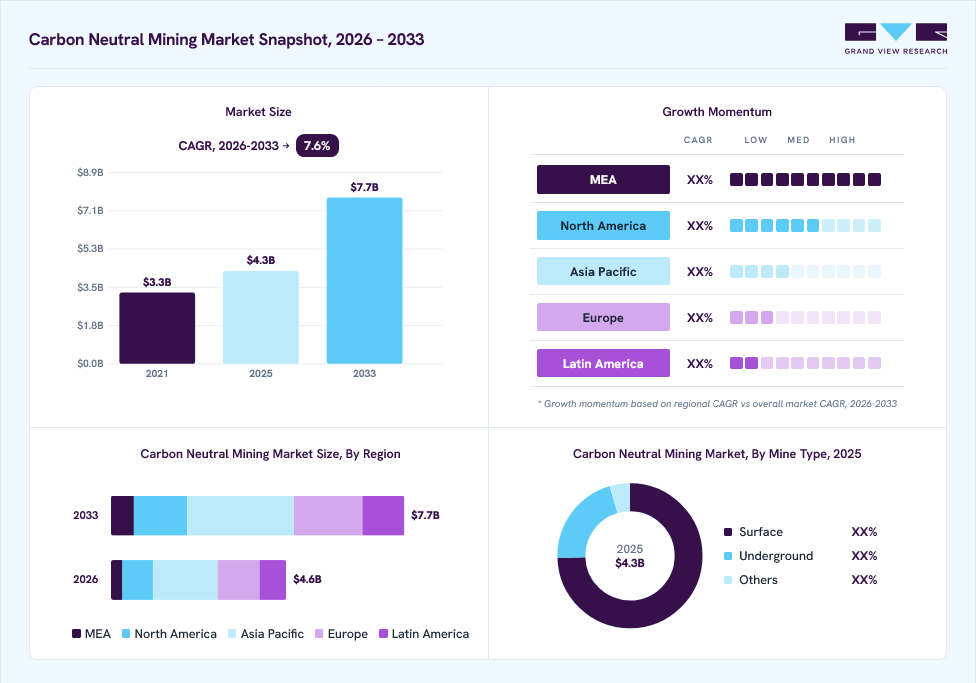
The global carbon neutral mining market size was valued at USD 4.3 billion in 2025 and is projected to grow from USD 4.6 billion in 2026 to USD 7.7 billion by 2033, at a CAGR of 7.6% from 2026 to 2033. Asia Pacific dominated the carbon neutral mining market with the largest revenue share of 36.9% in 2025. The growth is driven by the increasing adoption of renewable energy in mining operations, stringent government regulations on carbon emissions, rising investments in sustainable mining technologies, and the growing commitment of major mining companies toward achieving net-zero emission targets.
Key Market Trends & Insights
- By mine type: Surface mining segment held the largest market share of 73.9% in 2025.
- By commodity: Base metals segment held the largest market share of 44.6% in 2025.
Regional Highlights
- Largest regional market: Asia Pacific (36.9% revenue share, 2025)
- Fastest-growing regional market: MEA (highest CAGR, 2026-2033)
- By country: Australia held the largest market share in 2025.
Market Size & Forecast
- Market size in 2025: USD 4.3 Billion
- Estimated market size in 2026: USD 4.6 Billion
- Projected market size by 2033: USD 7.7 Billion
- CAGR (2026-2033): 7.6%
Sustainability and decarbonization are key factors driving the market growth, as industries worldwide intensify efforts to achieve net-zero emission targets. Organizations are increasingly adopting renewable energy solutions, low-emission fuels, and efficient resource management practices to minimize their environmental footprint. The global shift toward responsible production and sustainable resource utilization, particularly in sectors supporting clean energy and circular economy initiatives, is reinforcing long-term commitments to carbon neutrality and environmentally conscious growth.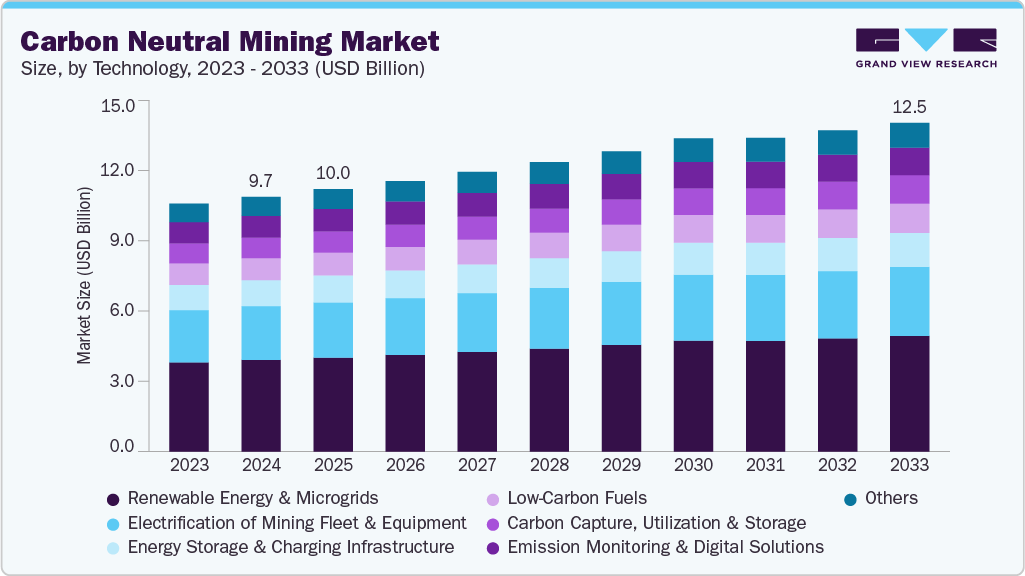
On the technological front, the market is witnessing significant advancements in automation, electrification, and the integration of renewable energy sources. The deployment of electric haul trucks, hydrogen-powered equipment, carbon capture systems, and AI-based monitoring solutions is transforming conventional mining operations into low-emission ecosystems. In addition, the use of smart grids, IoT-enabled energy management, and blockchain for carbon tracking enables transparency and efficiency across the value chain. These innovations are not only reducing operational carbon footprints but also enhancing productivity, positioning technology as a key enabler of the global shift toward carbon-neutral mining.
Market Dynamics
Stringent climate regulations, corporate net-zero commitments, and investor focus on environmental, social, and governance (ESG) performance are major drivers accelerating the carbon-neutral mining market. Governments in key mining regions are introducing stricter emissions standards, carbon pricing mechanisms, and sustainability reporting requirements, compelling mining companies to reduce greenhouse gas emissions across their operations. At the same time, leading mining companies are investing in renewable energy systems, battery-electric mining equipment, hydrogen-powered vehicles, and carbon capture technologies to achieve long-term decarbonization goals while improving operational efficiency and reducing fuel costs.
The expansion of renewable energy integration across mining operations is a key driver of the carbon-neutral mining market, as companies seek to reduce their dependence on diesel generators and fossil-fuel-based electricity. Mining firms are increasingly deploying solar photovoltaic plants, wind farms, hydropower, and hybrid renewable energy systems at mine sites to lower carbon emissions, stabilize long-term energy costs, and improve energy security. Remote mining operations are particularly benefiting from renewable microgrids that reduce fuel transportation costs while ensuring a reliable power supply.
Growing investments in renewable energy infrastructure are further accelerating the transition toward carbon-neutral mining. Governments, investors, and downstream industries are encouraging mining companies to adopt clean energy solutions through financial incentives, sustainability requirements, and low-carbon procurement policies. The integration of renewable power with battery energy storage systems and smart energy management technologies enables continuous mine operations while supporting corporate net-zero targets and enhancing the environmental competitiveness of mining projects.
High capital investment requirements remain a significant restraint on the carbon-neutral mining market, as the transition to low-carbon operations requires substantial spending on renewable energy systems, battery-electric and hydrogen-powered mining equipment, energy storage solutions, carbon capture technologies, and digital energy management platforms. Many mining companies, particularly small and mid-sized operators, face financial constraints in funding these large-scale infrastructure upgrades while maintaining profitability. The long payback periods and uncertainty regarding technology performance, carbon pricing, and return on investment further slow the adoption of carbon-neutral mining solutions across the industry.
The growing demand for low-carbon critical minerals from clean energy industries presents a significant opportunity for the carbon-neutral mining market. Rapid expansion of electric vehicles, renewable energy generation, battery energy storage systems, and power grid infrastructure is driving demand for sustainably produced minerals such as lithium, copper, nickel, cobalt, and rare earth elements. Manufacturers and governments are increasingly prioritizing low-emission supply chains to meet climate commitments, thereby encouraging mining companies to invest in renewable energy, mine electrification, and carbon-reduction technologies. This shift enables producers of low-carbon minerals to strengthen market competitiveness, secure long-term supply agreements, and access premium markets focused on sustainable sourcing.
Analyst Perspective
The carbon-neutral mining market is transitioning from a sustainability initiative to a core business strategy as mining companies respond to stricter climate regulations, investor expectations, and growing demand for responsibly sourced minerals. The industry is accelerating investments in renewable energy, mine electrification, battery-electric and hydrogen-powered equipment, carbon capture technologies, and digital energy management systems to reduce emissions while improving operational efficiency. Demand for low-carbon critical minerals used in electric vehicles, renewable energy, and energy storage systems is further strengthening the business case for decarbonized mining operations.
Commodity Insights
Base Metals accounted for the largest share of the carbon neutral mining market in 2025, at 44.6%. The segment is supported by strong demand for copper, nickel, zinc, and lead across electrification, renewable energy, batteries, and infrastructure. The energy-intensive nature of base-metal mining is also encouraging investments in renewable power, fleet electrification, and energy-efficient processing technologies.Industrial Minerals are projected to register the highest CAGR of 8.0% during the forecast period.

Growth is driven by increasing adoption of energy-efficient equipment, renewable power, electrification, and digital technologies across mining and quarrying operations. Rising environmental requirements and decarbonization targets are further encouraging industrial-mineral producers to reduce the carbon intensity of extraction and processing.
Mine Type Insights
Based on mine type, surface mining segment led the market with the largest revenue share of 73.9% in 2025. The surface mining segment holds the dominant share in the global carbon neutral mining market, driven by its large-scale operations, higher production output, and easier integration of renewable energy systems. Surface mines, which account for a significant portion of global mineral extraction, offer greater flexibility for deploying solar farms, wind turbines, and microgrid infrastructure due to their open layouts and accessibility. Mining giants operating in regions such as Australia, Chile, and South Africa have increasingly transitioned to renewable-powered surface operations, substantially reducing Scope 1 emissions. The availability of space and favorable environmental conditions make surface mining the most suitable option for integrating renewable energy into and implementing large-scale electrification initiatives. For instance, Rio Tinto’s Gudai-Darri iron ore mine in Western Australia operates with a 34 MW solar plant that supplies nearly one-third of its energy needs, while Anglo American’s Los Bronces mine in Chile sources 100% of its electricity from renewable sources. The availability of space and favorable climatic conditions make surface mining the most suitable platform for integrating renewable energy and implementing large-scale electrification initiatives.
In addition to the adoption of renewable energy, surface mines are rapidly embracing the electrification of equipment and low-carbon fuel alternatives to achieve near-term emission reduction targets. The introduction of battery-electric haul trucks, autonomous electric drills, and hybrid conveyor systems has allowed operators to cut fuel consumption and lower operational costs. These technologies are particularly impactful in open-pit and strip-mining operations, where large mobile fleets are traditionally major contributors to carbon emissions.
Conversely, the underground mining segment, while smaller in share, is expected to witness steady growth over the next decade as electrification technologies become more compact and cost-efficient. The confined nature of underground environments presents challenges for integrating renewable energy, but also creates opportunities for reducing energy ventilation and monitoring emissions. Hybrid systems that combine low-carbon fuels with digital emission controls are gaining traction in underground mines as they seek partial decarbonization. Overall, while underground and other mine types are gradually progressing toward sustainability, surface mining is expected to continue dominating the carbon-neutral mining market due to its scale, adaptability, and faster transition potential toward net-zero operations.
Regional Insights
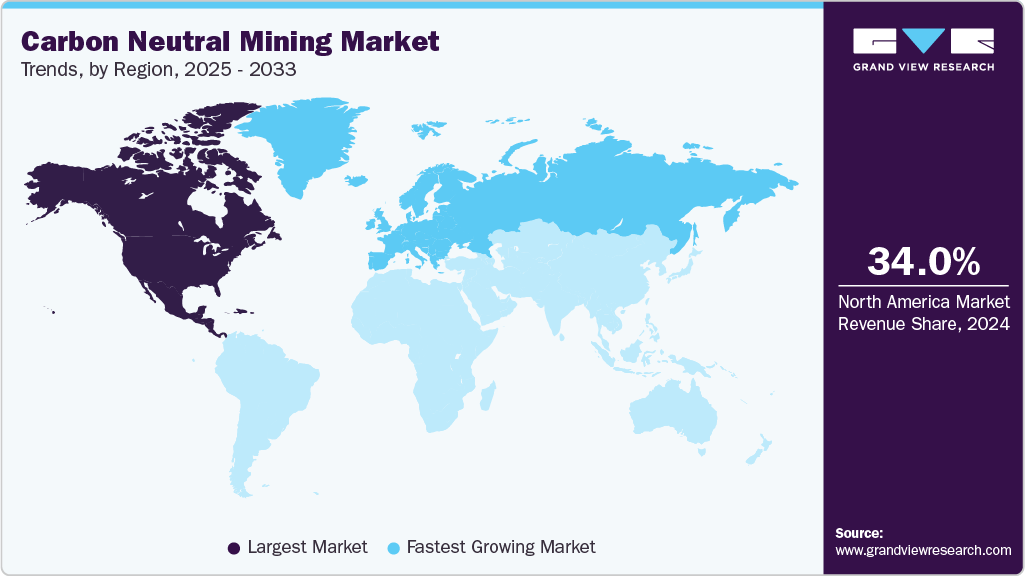
North America carbon neutral mining marketcontinues to lead the global market, driven by strong policy support, advanced technologies, and growing ESG commitments across the mining industry. The region’s progress is evident through recent projects such as IAMGOLD Corporation’s Côté Gold Mine in Ontario (Canada), which received approximately USD 1.1 million in federal funding under the Low Carbon Economy Fund to electrify key mining equipment and infrastructure expected to reduce over 7,500 tons of CO₂ emissions by 2030.
U.S. Carbon Neutral Mining Market Trends
The U.S. carbon neutral mining market is gaining momentum as part of the nation’s broader clean energy and net-zero agenda. Federal incentives such as the Inflation Reduction Act (IRA) have accelerated the adoption of renewable microgrids, carbon capture systems, and low-emission fleet technologies. A recent milestone, announced in March 2025, is Taseko Mines’ Florence Copper Project in Arizona, which employs in-situ recovery and solvent extraction/electrowinning (SX/EW) methods. This innovative approach has resulted in a reduction of up to 71% in carbon emissions compared to traditional open-pit copper mining, marking a significant advancement in sustainable extraction practices within the North American mining industry.
Asia Pacific Carbon Neutral Mining Market Trends
Asia Pacific dominated the carbon neutral mining market with the largest revenue share of 36.9% in 2025. Asia Pacific remains the most significant and fastest-growing region in the carbon neutral mining market, led by China, Australia, and India, where governments and corporations are investing heavily in renewable-based mining solutions. In a notable example, Rio Tinto announced a USD 143 million investment in February 2025 to support the development of battery-electric haul trucks and renewable power infrastructure at its Pilbara iron ore operations. This initiative is part of the company’s broader decarbonization strategy aimed at cutting Scope 1 and 2 emissions by 50% by 2030, reinforcing its commitment to achieving net-zero operations by 2050.
Europe Carbon Neutral Mining Market Trends
The European market is growing at a substantial rate of carbon-neutral mining innovation, backed by stringent EU environmental regulations and green industrial policies. The continent’s leadership is reflected in projects such as Stegra AB’s (formerly H2 Green Steel) decarbonized steel mill in Boden, Sweden, which is likely to utilize renewable hydrogen instead of coal to reduce emissions by approximately 95%. Operations are expected to begin in 2026. Mining operators in Germany, Finland, and Sweden are also investing in electric mining equipment, carbon capture, utilization, and storage (CCUS) technologies, as well as digital emission monitoring systems, in line with the EU Green Deal.
Middle East And Africa Carbon Neutral Mining Market Trends
The Middle East and Africa market is witnessing increasing adoption as mining companies face growing pressure to reduce emissions and meet ESG and decarbonization targets. The region’s abundant solar, wind, and hydropower resources provide favorable conditions for integrating renewable energy into mining operations. Companies are increasingly investing in solar power, battery storage, renewable power purchase agreements, electrified equipment, and energy-efficient technologies. Growing interest in green hydrogen and low-carbon fuels is further supporting the transition away from diesel-intensive mining operations.
Key Carbon Neutral Mining Company Insights
Some of the key players operating in the market include BHP Group Ltd., Rio Tinto Group, and Fortescue Metals Group Ltd., among others.
-
BHP Group Ltd., established in 1885 and headquartered in Melbourne, Australia, is one of the world’s largest diversified mining companies engaged in the production of iron ore, copper, coal, and nickel. The company has committed over USD 4 billion to decarbonization initiatives through 2030, focusing on the adoption of renewable energy, the electrification of mining operations, and the integration of low-carbon fuels to achieve net-zero operational emissions by 2050.
-
Rio Tinto Group, founded in 1873 and headquartered in London, United Kingdom, operates globally in the extraction and processing of minerals, including aluminum, copper, iron ore, and lithium. The company is investing heavily in renewable energy projects and battery-powered mining equipment to achieve a 50% reduction in Scope 1 and 2 emissions by 2030 and net-zero by 2050. Rio Tinto’s innovative decarbonization roadmap, which includes solar farms and hydrogen-based smelting, positions the company among the most advanced mining companies in their pursuit of carbon neutrality.
-
Fortescue Metals Group Ltd., established in 2003 and headquartered in Perth, Australia, is a leading producer of iron ore with a strong focus on clean energy transformation. The company aims to achieve zero emissions across its operations by 2030 through the electrification of its haul trucks, the development of hydrogen-powered mining fleets, and the integration of large-scale renewable energy sources. Fortescue’s Green Energy division is pioneering hydrogen and ammonia projects to decarbonize both its own operations and the broader resources sector, making it a key global driver in carbon-neutral mining.
Key Carbon Neutral Mining Companies:
The following key companies have been profiled for this study on the carbon neutral mining market.
-
Anglo American plc.
-
BHP Group Ltd.
-
Boliden AB
-
Fortescue Metals Group Ltd.
-
Glencore plc.
-
Newmont Corporation
-
Rio Tinto Group
-
Sibanye-Stillwater Limited
-
Teck Resources Limited
-
Vale S.A.
Competitive Benchmarking
Category
Operating Strategies
Competitive Edge
Weakness
Established Players (e.g. Anglo American plc, BHP Group Ltd)
- Mature participants in the carbon neutral mining market primarily focus on integrating decarbonization initiatives across their mining value chains through renewable energy adoption, fleet electrification, energy efficiency improvements, and low emission mineral processing technologies.
- These companies develop long term carbon reduction roadmaps aligned with corporate sustainability targets while investing in solar, wind, battery storage, and hydrogen powered mining operations.
- Established players possess significant competitive advantages through their extensive financial resources, global mining operations, and ability to invest in large scale decarbonization projects.
- Their ownership of multiple mining assets enables them to deploy renewable energy systems, electrified equipment, and advanced emissions reduction technologies across diverse operations.
- Despite their leadership positions, mature players face significant challenges related to the high capital expenditure required for mine electrification, renewable energy integration, and low carbon processing infrastructure.
- Transitioning large scale mining operations away from diesel powered equipment and fossil fuel based energy systems requires substantial investment and lengthy implementation timelines.
Emerging & Regional Players (e.g. Sibanye Stillwater Limited)
- Emerging participants in the carbon neutral mining market generally focus on developing mining projects designed around low carbon principles from the outset.
- Their strategies emphasize renewable powered mining operations, electrified equipment, modular processing facilities, and digital technologies that optimize energy consumption and emissions performance.
- Emerging companies benefit from operational flexibility and the ability to design mining operations using the latest low carbon technologies.
- Without legacy assets, they can integrate renewable energy generation, electrified machinery, smart mine management systems, and efficient processing technologies from the earliest stages of project development.
- Emerging participants face significant challenges related to financing requirements, technology commercialization risks, and infrastructure limitations.
- Developing carbon neutral mining operations requires substantial investment in renewable energy systems, electrified equipment, energy storage, and digital technologies before commercial production begins.
Recent Developments
-
BHP Group Ltd, in June 2025, announced the launch of a large-scale solar and battery storage project at its Nickel West operations in Western Australia. The initiative aims to supply over 50% of the site’s electricity demand through renewable sources, significantly cutting Scope 2 emissions and supporting BHP’s goal of achieving net-zero operational emissions by 2050.
-
Rio Tinto Group, in April 2025, partnered with Caterpillar Inc. to deploy a fleet of fully electric haul trucks at its Gudai-Darri iron ore mine in Australia. This milestone marks one of the world’s first large-scale implementations of battery-electric mining trucks, projected to reduce annual CO₂ emissions by up to 30,000 tons, reinforcing Rio Tinto’s 2030 emission reduction targets.
-
Fortescue Metals Group Ltd, in January 2025, successfully commenced operations of its 100% renewable-powered hydrogen plant in Western Australia under Fortescue Energy. The facility will produce green hydrogen for use in mining trucks and heavy equipment, enabling Fortescue to progress toward its ambitious “real zero” target by 2030 and set a benchmark for decarbonization in the global mining industry.
Carbon Neutral Mining Market Report Scope
Report Attribute
Details
Market definition
The market size represents annual sales value of mined materials produced from carbon-neutral mining operations.
Market size in 2025
USD 4.3 billion
Estimated market size in 2026
USD 4.6 billion
Projected market size by 2033
USD 7.7 billion
Growth rate
CAGR of 7.6% from 2026 to 2033
Base year for estimation
2025
Historical data
2021 - 2024
Forecast period
2026 - 2033
Quantitative units
Revenue in USD million and CAGR from 2026 to 2033
Report coverage
Revenue forecast, company ranking, competitive landscape, growth factors, and trends
Segments covered
Mine type, commodity, and region.
Regional scope
North America; Europe; Asia Pacific; Latin America; Middle East & Africa
Country scope
U.S., Canada, Mexico, Finland, Sweden, Russia, Norway, India, China, Indonesia, Australia, Brazil, Chile, Peru, Zambia, South Africa, Saudi Arabia, Ghana
Key companies profiled
Anglo American plc; BHP Group Ltd; Boliden AB; Fortescue Metals Group Ltd; Glencore plc; Newmont Corporation; Rio Tinto Group; Sibanye-Stillwater Limited; Teck Resources Limited; Vale S.A.
Customization scope
Free report customization (equivalent up to 8 analysts' working days) with purchase. Addition or alteration to country, regional & segment scope.
Pricing and purchase options
Avail customized purchase options to meet your exact research needs. Explore purchase options
Global Carbon Neutral Mining Market Report Segmentation
This report forecasts global, country, and regional revenue growth and analyzes the latest trends in each sub-segment from 2021 to 2033. For this study, Grand View Research has segmented the global carbon neutral mining market report based on commodity, mine type, and region.
-
Commodity Outlook (Revenue, USD Million; 2021 - 2033)
-
Base Metals
-
Precious Metals
-
Industrial Minerals
-
Others
-
-
Mine Type Outlook (Revenue, USD Million, 2021 - 2033)
-
Surface
-
Underground
-
Others
-
-
Regional Outlook (Revenue, USD Million, 2021 - 2033)
-
North America
-
U.S.
-
Canada
-
Mexico
-
-
Europe
-
Germany
-
UK
-
France
-
Russia
-
-
Asia Pacific
-
China
-
India
-
Japan
-
-
Latin America
-
Australia
-
Brazil
-
-
Middle East & Africa
-
South Africa
-
Iran
-
-
Research Methodology
The carbon neutral mining market figures in this report are based on a proven research process that combines executive interviews with secondary research from proprietary databases, company filings, and recognized regulatory and institutional sources. Market size is built through value-chain sizing - reconciling supply-side and demand-side estimates - and triangulated with bottom-up and top-down approaches. Every estimate passes multiple levels of expert validation before publication, with each carbon neutral mining segment quantified using the revenue-capture definitions in the table below.
Segment Definition
Mine Type
Revenue Capture Definition
Surface
The market for this segment includes the annual value of metals and minerals produced through carbon neutral surface mining operations. It covers commodities extracted from open-pit and other surface mines where production is supported by renewable energy, electrified mining equipment, low-emission haulage systems, and other decarbonization technologies that reduce greenhouse gas emissions across mining operations.
Underground
This segment includes the annual value of metals and minerals produced through carbon neutral underground mining operations. It covers production from underground mines utilizing battery-electric equipment, renewable energy, ventilation optimization systems, and other low-carbon technologies that enable sustainable mineral extraction while minimizing operational emissions.
Others
This segment includes the annual value of metals and minerals produced through other carbon neutral mining methods, including placer mining, in-situ leaching, solution mining, and hybrid mining operations. It covers commodities extracted using renewable energy, carbon management solutions, and sustainable mining practices that support low-emission production.
Commodity
Revenue Capture Definition
Base Metals
The market for this segment includes the annual value of base metals such as copper, aluminum, zinc, lead, and nickel produced through carbon neutral mining operations. Market value is derived from the production of these metals using renewable energy, mine electrification, low-emission equipment, and other decarbonization measures that reduce the carbon footprint of mining activities.
Precious Metals
This segment includes the annual value of precious metals such as gold, silver, platinum, and palladium produced through carbon neutral mining operations. Market value is generated from the production of these metals using clean energy, low-carbon mining technologies, and sustainable operational practices that minimize greenhouse gas emissions.
Industrial Minerals
This segment includes the annual value of industrial minerals such as limestone, phosphate, potash, gypsum, and silica produced through carbon neutral mining operations. Market value is based on the production of these minerals using renewable energy, energy-efficient mining processes, and other low-carbon technologies that support sustainable extraction.
Others
This segment includes the annual value of other commodities, including rare earth elements, uranium, gemstones, and specialty minerals, produced through carbon neutral mining operations. Market value is derived from the production of these commodities using sustainable mining infrastructure, renewable energy systems, and decarbonization technologies that reduce emissions throughout mining operations.
Estimation Model
Layer Name
Key Question
Description
Mining Operations & Emissions Demand Base Layer
What forms the demand base?
Identify global mining activities across base metals, precious metals, industrial minerals, and critical minerals. Assess greenhouse gas emissions from mining operations, including extraction, hauling, processing, power consumption, and logistics. Evaluate regulatory commitments, corporate decarbonization targets, and sustainability initiatives that drive demand for carbon neutral mining solutions. This layer establishes the total addressable market for mining decarbonization technologies and services.
Carbon Neutral Technology Penetration Layer
Where are carbon neutral mining solutions utilized?
Estimate the penetration of low carbon technologies across mining operations, including renewable energy integration, mine electrification, battery electric and hydrogen powered mining equipment, carbon capture, energy efficiency systems, and digital optimization solutions. Analyze adoption across surface mines, underground mines, and mineral processing facilities in different regions.
Decarbonization Intensity Layer
How much carbon reduction is achieved?
Analyze decarbonization intensity based on renewable energy utilization, equipment electrification rates, fuel substitution, energy efficiency improvements, and carbon capture implementation. Evaluate reductions in Scope 1, Scope 2, and operational emissions achieved through carbon neutral mining initiatives. Decarbonization intensity varies according to mine type, commodity, energy mix, mining technology, and regulatory requirements.
Revenue Layer
How is market revenue generated?
Market size represents the annual value of metals and minerals produced through carbon neutral mining operations. It includes the production value of commodities extracted using renewable energy, electrified mining equipment, hydrogen-powered systems, low-emission mining processes, and other decarbonization technologies that minimize greenhouse gas emissions throughout mining operations. Market value is influenced by commodity prices, production volumes, the adoption of carbon neutral mining practices, investments in mine decarbonization, government incentives, carbon pricing mechanisms, and sustainability initiatives across the global mining industry.
Delivered Customizations
This report has been delivered with the following In-depth customizations
Client Request
Customization Delivered
Value Adds
Regional Segmentation
Detailed regional analysis of the carbon neutral mining market across North America, Europe, Asia Pacific, Latin America, and Middle East & Africa. Included evaluation of mining decarbonization initiatives, renewable energy integration, carbon emission regulations, electrification of mining equipment, green hydrogen adoption, carbon pricing mechanisms, and government policies supporting low carbon mining operations.
Identified leading regions advancing mine decarbonization and emerging investment hotspots. Enabled strategic expansion planning based on climate policies, renewable energy availability, and mining sector sustainability initiatives. Supported regional demand forecasting and investment prioritization.
Cross Segmentation
Comprehensive cross segmentation analysis by technology, mine type, commodity, and region, including renewable energy integration, mine electrification, carbon capture technologies, energy efficiency solutions, and digital optimization across surface and underground mines producing base metals, precious metals, industrial minerals, and critical minerals. Evaluated technology adoption rates, operational benefits, and regional implementation trends.
Enabled identification of the most attractive technology commodity combinations and high growth decarbonization opportunities. Supported technology selection, capital allocation, and sustainability planning across mining operations.
Opportunity Assessment
Identification of high growth opportunities across renewable powered mining operations, battery electric vehicle fleets, green hydrogen applications, carbon capture and storage, mine energy management systems, digital mine optimization, sustainable mineral certification, and critical mineral production supporting the global energy transition. Assessed future demand potential driven by net zero commitments, ESG investments, climate regulations, and increasing customer preference for responsibly sourced minerals.
Enabled prioritization of high return investment opportunities and emerging decarbonization technologies. Supported long term strategic planning, sustainability investments, operational transformation, and business development initiatives aligned with global net zero objectives.
Frequently Asked Questions About This Report
The global carbon neutral mining market size was estimated at USD 9.72 billion in 2024 and is expected to reach USD 10.00 billion in 2025.
The global carbon neutral mining market is expected to grow at a compound annual growth rate of 2.9% from 2025 to 2033, reaching USD 12.53 billion by 2033.
By technology, renewable energy & microgrids dominated the market with a revenue share of over 35.0% in 2024.
Some of the key vendors in the global carbon-neutral mining market include Anglo American plc, BHP Group Ltd., Boliden AB, Fortescue Metals Group Ltd., Glencore plc, Newmont Corporation, Rio Tinto Group, Sibanye-Stillwater Limited, Teck Resources Limited, and Vale S.A.
The global carbon neutral mining market is driven by the increasing push for sustainability and net-zero commitments across the mining industry. Growing adoption of renewable energy, electrification of mining fleets, and carbon capture technologies are accelerating the transition toward low-emission operations.
About the Author(s)
Advanced Interior Materials Research Team
Advanced Materials · Advanced Interior MaterialsThis report was authored by the advanced interior materials research team at Grand View Research - comprising two research analysts, one senior research analyst, and one industry expert - with specialized expertise in the advanced interior materials segment of the advanced materials industry. All findings are based on proprietary advanced materials databases, executive interviews, and regulatory analysis, subject to internal peer review prior to publication.
Last Updated:
Speak to Analyst


Customize this report to your needs — add regions, segments, or data points, with 20% free customization.
Or view our licence options:


ISO 9001:2015 & 27001:2022 Certified
We are GDPR and CCPA compliant! Your transaction & personal information is safe and secure. For more details, please read our privacy policy.


