
- Home
- »
- Medical Devices
- »
-
Cardiovascular & Soft Tissue Repair Patches Market Report 2033GVR Report cover

Cardiovascular And Soft Tissue Repair Patches Market (2026 - 2033)
Size, Share & Trends Analysis Report By Application (Cardiac Repair, Vascular Repair, Pericardial Repair, Dural Repair, Soft Tissue Repair), By Raw Material, By Region, And Segment Forecasts
Market Size, 2025
$5.2BMarket Estimate, 2026
$5.6BMarket Forecast, 2033
$9.7BCAGR, 2026–2033
8.4%Cardiovascular And Soft Tissue Repair Patches Market Summary
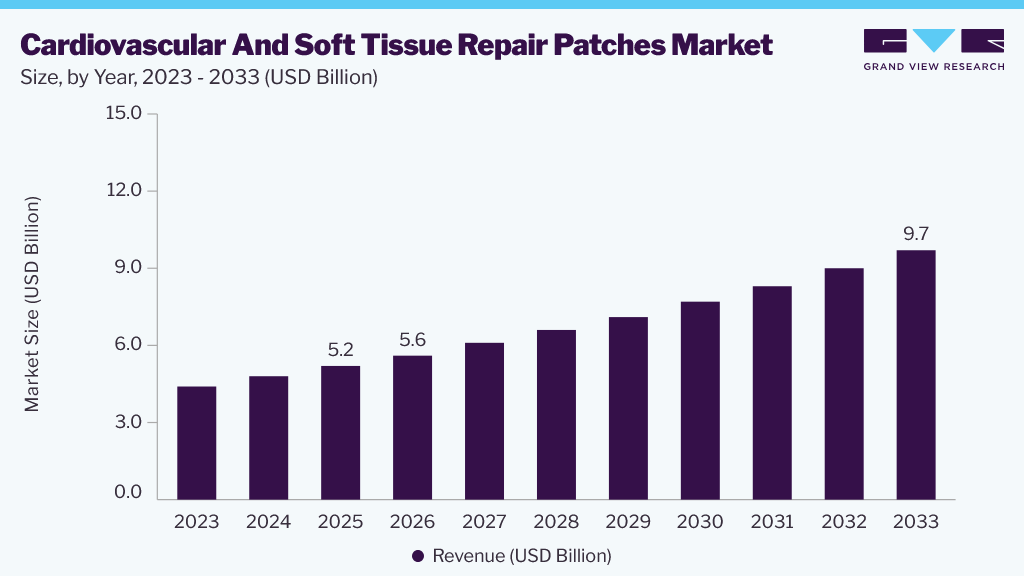
The global cardiovascular and soft tissue repair patches market size was valued at USD 5.2 billion in 2025 and is projected to grow from USD 5.6 billion in 2026 to USD 9.7 billion by 2033, at a CAGR of 8.4% from 2026 to 2033. North America dominated the global market, accounting for a revenue share of 35.0% in 2025. A substantial congenital heart disease burden continues to support demand for surgical repair materials. The WHO reported in June 2026 that congenital heart disease affects approximately 1.35 million newborns globally each year, while about 25% of affected individuals require surgical or catheter-based intervention during infancy.
 Source: Grand View Research, IR Documents, Primary Interviews, Paid DatabasesTo learn more about this report,
 Download Free Sample Report
Key Market Trends & Insights
- By application: Soft tissue segment accounted for the largest revenue share of 47.5% in 2025.
- By raw material: ePTFE segment accounted for the largest revenue share of 56.7% in 2025.
Regional Highlights
- Largest regional market: North America (35.0% revenue share, 2025)
- Fastest growing regional market: Asia Pacific (highest CAGR of 11.0%, 2026-2033)
- By country: The U.S. held the largest market share in 2025.
Market Size & Forecast
- 2025 Market Size: USD 5.2 Billion
- Estimated market size in 2026: USD 5.6 Billion
- 2033 Projected Market Size: USD 9.7 Billion
- CAGR (2026 - 2033): 8.4%
Three ways to get this report
Buy it, customize it, or ask a question.Ask an Analyst
Analyst response in 1 business day
- AccessReport author, directly
- Reply timeWithin 1 working day
- No sales callDirect answer only
- FormatEmail reply
- CostFree, no cost
Get the Full Report
What the study covers
- FormatsPDF · Excel · Dashboard
- Timeline2026–2033 annual, 2025 base
- Coverage20+ countries, 5 regions
- Companies10+ key players profiled
Customize the Report
20% free customization
- IncludeCountries, segments, points
- TailorTo your product definition
- ExtendDeeper competitor detail
- OrA fully bespoke study
- Turnaround5–10 working days
The ongoing need for surgical reconstruction and tissue reinforcement drives demand for cardiovascular and soft-tissue repair patches. Cardiovascular applications include repair of congenital and acquired defects, while soft tissue applications include hernia repair and reconstruction. Material selection remains important, with collagen-based biological materials, synthetic polymers, and newer biomaterial approaches offering different combinations of strength, flexibility, biocompatibility, and tissue integration.Product development is increasingly shifting toward patches that integrate more effectively with native tissue and provide improved durability, controlled degradation, and regenerative properties. Advances in biomaterials, surface modification, and tissue-engineering approaches are broadening the range of repair options while improving anatomical adaptability and long-term performance. This evolution is supporting differentiation across cardiovascular and soft-tissue repair applications.
Market Dynamics
The growth of the cardiovascular and soft tissue repair patches market is driven by the ongoing need for cardiac, vascular, and soft tissue reconstruction procedures, as well as advances in biomaterials and surgical techniques. Demand is shifting toward patches that provide mechanical reinforcement while supporting tissue integration, healing, and, in selected applications, controlled resorption. Manufacturers are expanding biologic, bioabsorbable, and tissue-engineered portfolios to address these requirements. The market is also benefiting from high procedure volumes in soft tissue repair, particularly hernia repair, while an aging population and persistent cardiovascular disease burden continue to support the underlying surgical base.
Cardiovascular disease remains the largest underlying disease burden relevant to the cardiovascular segment of the market. WHO reported in July 2025 that cardiovascular diseases caused an estimated 19.8 million deaths globally in 2022, representing approximately 32% of all deaths. Importantly for the patch market, the WHO specifically identifies patches for closing holes in the heart among the medical devices used in cardiovascular care, alongside procedures such as coronary artery bypass and valve repair or replacement. The continuing burden of cardiovascular disease, therefore, supports a broad clinical base for surgical reconstruction and repair materials.
The opportunity extends beyond disease incidence to the growing need for durable repair solutions across congenital and acquired cardiac conditions. Congenital heart defects remain particularly relevant because surgical patches are used to correct septal defects and other structural abnormalities, with pediatric procedures creating additional requirements around tissue compatibility and growth. Teijin's SYNFOLIUM illustrates this specialized demand: the company developed the patch with a structure intended to accommodate patient growth and received Japanese manufacturing and marketing approval in July 2023 before launching the product in June 2024. Teijin subsequently reported that use of SYNFOLIUM had steadily increased, providing a current commercial indication of adoption of newer cardiovascular patch technology.
The occurrence of postoperative complications can limit the adoption of certain repair-patch and mesh technologies, particularly in soft tissue applications. The FDA identifies pain, infection, recurrence, adhesions, obstruction, fistula, seroma, and bleeding among complications associated with hernia repair, while mesh-specific complications can include migration and contraction. Its review of adverse-event reports associated with hernia mesh identified more than 55,000 reports over 22 years. However, the FDA cautions that passive adverse-event reporting cannot by itself establish causation. These safety considerations increase the importance of long-term clinical evidence, material selection, product surveillance, and regulatory compliance for manufacturers developing new patch technologies.
The development of patches that integrate with native tissue while maintaining adequate structural support presents an opportunity for product differentiation. Conventional permanent materials can provide durable reinforcement but may remain as foreign material, whereas absorbable components are designed to lose strength as new tissue develops gradually. This has encouraged research and commercialization efforts around hybrid structures that combine temporary support with tissue regeneration. Teijin's SYNFOLIUM demonstrates this approach commercially, with the company reporting that the patient's own tissue replaces its absorbable portion and that the structure is designed to accommodate growth.
Similar material development opportunities exist in soft tissue repair, where manufacturers can differentiate products by absorption profile, tissue integration, handling characteristics, and the balance between reinforcement and foreign-body response. The FDA recognizes both synthetic and animal-derived materials, including absorbable, non-absorbable, and combination constructions, within surgical mesh used for hernia repair. This material diversity creates scope for manufacturers to develop application-specific patches and reinforcement products rather than relying on a single material architecture across different anatomical sites and procedures.
Analyst Perspective
The cardiovascular and soft tissue repair patches market is evolving as surgeons seek biomaterials that provide reliable tissue reinforcement, promote healing, and reduce complications. Demand spans cardiovascular reconstruction, vascular repair, hernia repair, and other soft tissue procedures, with product selection influenced by durability, biocompatibility, handling, and infection resistance. Manufacturers are developing advanced synthetic and biologic patches with improved flexibility, tissue integration, and application-specific performance. Growing cardiovascular and reconstructive procedures, along with advances in minimally invasive surgery, are supporting market development. Clinical evidence, regulatory requirements, cost, and surgeon familiarity remain important adoption factors. Future competition will increasingly focus on biomaterial innovation, tissue compatibility, procedure-specific designs, consistent clinical outcomes, and ease of surgical handling.
Application Insights
The soft tissue repair segment dominated the cardiovascular and soft tissue repair patches industry, accounting for an estimated revenue share of 47.5% in 2025, supported by the large and recurring volume of hernia and other soft tissue reconstruction procedures. The FDA estimates that up to 1 million hernia repairs are performed annually in the U.S., with surgical mesh used in most repairs to reinforce weakened tissue. Demand spans inguinal, ventral, incisional, and umbilical hernia procedures, while product development increasingly focuses on balancing mechanical reinforcement with tissue integration, resorption, and postoperative complication profiles.
The cardiac repair segment is expected to grow at a significant CAGR of 18.5% over the forecast period, as surgical treatment of congenital and acquired structural heart conditions sustains demand for materials used in defect closure and cardiovascular reconstruction. Congenital heart disease remains an important application area, particularly in pediatric surgery, although treatment approaches vary by defect and may include direct suture closure, surgical patches, or transcatheter devices. Material innovation is also broadening the range of cardiac repair patches. For example, Teijin’s SYNFOLIUM, launched in Japan in June 2024 following approval in July 2023, combines bioabsorbable and non-bioabsorbable yarns with cross-linked gelatin and was developed to support tissue regeneration while accommodating physiological growth.
Raw Material Insights
The ePTFE segment accounted for an estimated 56.7% of market revenue in 2025, supported by the material’s combination of tensile strength, durability, chemical stability, and established use in medical-device applications. Its processing flexibility allows manufacturers to produce ePTFE products with different thicknesses, pore structures, and configurations for cardiovascular repair and tissue reinforcement. The material is also used in other medical-device applications, supporting an established manufacturing and supply base. However, biomaterials and tissue-engineered materials are expected to grow faster as manufacturers develop patches designed to improve tissue integration, enable controlled degradation, and promote regenerative healing.
Biomaterials and tissue-engineered materials are expected to grow at a CAGR of 10.0% over the forecast period. Bovine pericardium remains a widely used biological material for cardiovascular and soft tissue repair patches. Its collagen-rich structure provides flexibility, strength, and good conformability to different anatomical sites. After processing and decellularization, the tissue can be shaped into patches of different sizes for various surgical applications. Ongoing biomaterial development focuses on improving durability, biocompatibility, tissue integration, and resistance to calcification and other complications.
Regional Insights
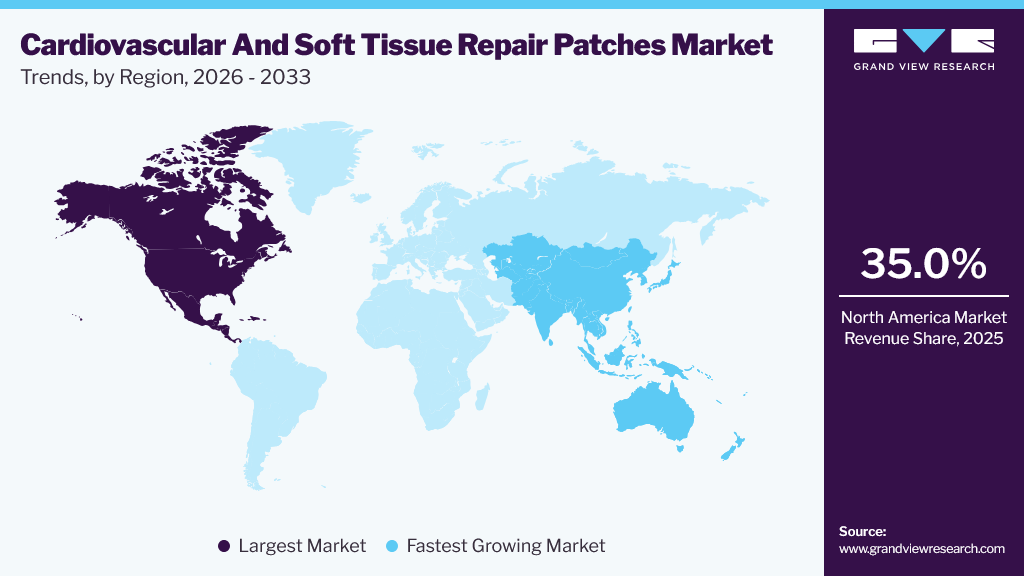
North America accounted for an estimated 35.0% of the cardiovascular and soft tissue repair patches market revenue in 2025, supported by a substantial procedural base, advanced healthcare infrastructure, and availability of specialized surgical technologies. The U.S. alone performs as many as 1 million hernia repairs annually, with surgical mesh used in most repairs, providing a sizeable application base for soft tissue repair products. The region also has an established cardiovascular care ecosystem and continued demand for congenital and acquired heart repair procedures—availability of advanced biomaterials, established medical-device manufacturing capabilities, and ongoing product development further support regional adoption.
 To learn more about this report, Download Free Sample Report
The U.S. is a major demand center in the North America cardiovascular and soft tissue repair patches industry, due to its high volume of hernia procedures and sustained need for cardiovascular interventions. The rising procedural volumes, along with access to specialized surgical products and a mature regulatory and healthcare infrastructure, create broad commercial demand for cardiovascular and soft-tissue repair patches.
Asia Pacific Cardiovascular And Soft Tissue Repair Patches Market Trends
The Asia Pacific cardiovascular and soft tissue repair patches industry is anticipated to grow at the fastest CAGR of 11.0% over the forecast period, supported by expanding healthcare infrastructure, a large and aging population, a rising burden of cardiovascular disease, and improving access to specialized surgical care. The WHO South-East Asia Region recorded more than 4.25 million cardiovascular disease deaths in 2021, with nearly half occurring prematurely among people aged 30–69 years, highlighting the substantial regional need for cardiovascular diagnosis and treatment.
Growing adoption of advanced surgical technologies, improvements in congenital heart disease detection, and expanding treatment capacity in countries such as China, India, and Japan are also supporting demand for cardiovascular repair products. As healthcare systems strengthen their ability to provide timely diagnosis and intervention, opportunities for surgical patches used in cardiac reconstruction and soft tissue repair are expected to broaden.
Key Cardiovascular And Soft Tissue Repair Patches Company Insights
Companies operating in the cardiovascular and soft tissue repair patches market are focusing on material innovation, portfolio expansion, and commercial partnerships to address different surgical requirements and broaden geographic reach. Product development is increasingly centered on improving tissue compatibility, mechanical performance, handling characteristics, and integration with existing surgical techniques. These activities reflect broader efforts by manufacturers to strengthen complementary surgical portfolios and expand access to specialized cardiovascular repair technologies.
Key Cardiovascular And Soft Tissue Repair Patches Companies
The following key companies have been profiled in this study of the cardiovascular and soft tissue repair patches market.
-
Abbott Laboratories
-
Artivion, Inc.
-
B. Braun
-
Baxter International Inc.
-
CorMatrix Cardiovascular, Inc.
-
Edwards Lifesciences Corporation
-
Glycar SA
-
GUNZE LIMITED
-
Integra LifeSciences
-
Labcor
-
LeMaitre Vascular, Inc.
-
Maverick Biosciences Pty Ltd
-
Terumo Medical Corporation
-
W. L. Gore & Associates, Inc.
Recent Developments
-
In May 2026, Artivion received U.S. FDA PMA approval for the NEXUS Aortic Arch System, expanding its portfolio of technologies for the treatment of complex aortic arch disease, including chronic aortic dissections.
Cardiovascular And Soft Tissue Repair Patches Market Report Scope
Report Attribute
Details
Market size in 2025
USD 5.2 billion
Estimated market size in 2026
USD 5.6 billion
Projected market size by 2033
USD 9.7 billion
Growth rate
CAGR of 8.4% from 2026 to 2033
Base year
2025
Historical data
2021 - 2024
Forecast period
2026 - 2033
Quantitative units
Revenue in USD million/billion and CAGR from 2026 to 2033
Report coverage
Revenue forecast, company ranking, competitive landscape, growth factors, and trends
Segments covered
Application, raw materials, region
Country scope
U.S.; Canada; UK; Germany; France; Spain; Italy; Russia; China; Japan; India; South Korea; Singapore; Australia; Brazil; Mexico; Argentina; South Africa; Saudi Arabia; UAE
Key companies profiled
Abbott Laboratories; Artivion, Inc.; B. Braun; Baxter International Inc.; CorMatrix Cardiovascular, Inc.; Edwards Lifesciences Corporation; Glycar SA; GUNZE LIMITED; Integra LifeSciences; Labcor; LeMaitre Vascular, Inc.; Maverick Biosciences Pty Ltd; Terumo Medical Corporation; W. L. Gore & Associates, Inc.
Customization scope
Free report customization (equivalent up to 8 analysts' working days) with purchase. Addition or alteration to country, regional & segment scope.
Pricing and purchase options
Avail customized purchase options to meet your exact research needs. Explore purchase options
Global Cardiovascular And Soft Tissue Repair Patches Market Report Segmentation
This report forecasts revenue growth and provides an analysis of the latest trends in each of the sub-segments from 2021 to 2033. For this study, Grand View Research has segmented the cardiovascular and soft tissue repair patches market report based on application, raw materials, and region:
- Application Outlook (Revenue, USD Million, 2021 - 2033)
- Cardiac repair
- Atrial Septal Defect
- Common Atrium
- Defects of the Endocardial Cushion
- Ventricular Septal Defect
- Tetralogy of Fallot
- Right Ventricular Outflow Tract Reconstruction
- Suture Bleeding
- Vascular Repair & Reconstruction
- Carotid Endarterectomy
- Anomalous Connection of the Pulmonary Veins
- Transposition of the Great Vessels
- Reconstruction of Portal and Superior Mesenteric Veins
- Others
- Pericardial Repair
- Dural Repair
- Soft Tissue Repair
- Defects of the Abdominal Wall
- Defects of the Thoracic Wall
- Gastric Binding
- Hernias
- Cardiac repair
- Raw Material Outlook (Revenue, USD Million, 2021 - 2033)
- ePTFE
- Biomaterial & Tissue Engineered Material
- Others
- Regional Outlook (Revenue, USD Million, 2021 - 2033)
- North America
- U.S.
- Canada
- Europe
- UK
- Germany
- Spain
- France
- Italy
- Russia
- Asia Pacific
- China
- Japan
- India
- South Korea
- Singapore
- Australia
- Latin America
- Brazil
- Mexico
- Argentina
- Middle East & Africa
- Saudi Arabia
- UAE
- South Africa
- North America
Frequently Asked Questions About This Report
North America dominated with a 35.0% revenue share in 2025.
The global cardiovascular and soft tissue repair patches market size was estimated at USD 5.2 billion in 2025 and is expected to reach USD 5.6 billion in 2026.
Soft tissue repair dominated the cardiovascular and soft tissue repair patches market with a share of 47.5% in 2025.
Some key players operating in the cardiovascular and soft tissue repair patches market include Abbott Laboratories; Artivion, Inc.; B. Braun; Baxter International Inc.; CorMatrix Cardiovascular, Inc.; Edwards Lifesciences Corporation; Glycar SA; GUNZE LIMITED; Integra LifeSciences; Labcor; LeMaitre Vascular, Inc.; Maverick Biosciences Pty Ltd; Terumo Medical Corporation; W. L. Gore & Associates, Inc.
The global cardiovascular and soft tissue repair patches market is expected to grow at a compound annual growth rate of 8.4% from 2026 to 2033 to reach USD 9.7 billion by 2033.
About the Author(s)
Medical Devices Research Team
Healthcare · Medical DevicesThis report was authored by the medical devices research team at Grand View Research - comprising two research analysts, one senior research analyst, and one industry expert - with specialized expertise in the medical devices segment of the healthcare industry. All findings are based on proprietary healthcare databases, executive interviews, and regulatory analysis, subject to internal peer review prior to publication.
Last Updated:
Speak to Analyst

Customize this report to your needs - add regions, segments, or data points, with 20% free customization.
Or view our licence options:


ISO 9001:2015 & 27001:2022 Certified
We are GDPR and CCPA compliant! Your transaction & personal information is safe and secure. For more details, please read our privacy policy.


