
- Home
- »
- Homecare & Decor
- »
-
Cast Iron Cookware Market Size & Share Report, 2026-2033GVR Report cover

Cast Iron Cookware Market (2026 - 2033)
Size, Share & Trends Analysis Report By Type (Unseasoned, Seasoned, Enamel Coated), By Product, By Application, By Distribution Channel, By Region, And Segment Forecasts
Market Size, 2025
$4.8BMarket Estimate, 2026
$5.2BMarket Forecast, 2033
$9.6BCAGR, 2026–2033
9.0%Cast Iron Cookware Market Summary
The global cast iron cookware market size was valued at USD 4.8 billion in 2025 and is projected to grow from USD 5.2 billion in 2026 to USD 9.6 billion by 2033, at a CAGR of 9.0% from 2026 to 2033. North America dominated the market, accounting for a revenue share of 35.0% in 2025. One of the primary driving factors behind the popularity of cast iron cookware is its low maintenance requirements following the initial seasoning process.
 Source: Grand View Research, IR Documents, Primary Interviews, Paid DatabasesTo learn more about this report,
 Download Free Sample Report
Key Market Trends & Insights
- By type: Seasoned type segment dominated the market, with a revenue share of 43.9% in 2025.
- By product: Skillets/fryers segment held the largest market share of 43.5% in 2025.
- By application: Residential segment held the largest revenue share of 70.3% in 2025.
- By distribution channel: Supermarkets/hypermarkets segment accounted for the largest revenue share of 43.6% in 2025.
Regional Highlights
- Largest regional market: North America (35.0% revenue share, 2025)
- Fastest-growing regional market: Asia Pacific (highest CAGR, 2026-2033)
- By country: The U.S. held the largest market share in 2025.
Market Size & Forecast
- Market size in 2025: USD 4.8 Billion
- Estimated market size in 2026: USD 5.2 Billion
- Projected market size by 2033: USD 9.6 Billion
- CAGR (2026-2033): 9.0%
Three ways to get this report
Buy it, customize it, or ask a question.Ask an Analyst
Analyst response in 1 business day
- AccessReport author, directly
- Reply timeWithin 1 working day
- No sales callDirect answer only
- FormatEmail reply
- CostFree, no cost
Get the Full Report
What the study covers
- FormatsPDF · Excel · Dashboard
- Timeline2026–2033 annual, 2025 base
- Coverage20+ countries, 5 regions
- Companies10+ key players profiled
Customize the Report
20% free customization
- IncludeCountries, segments, points
- TailorTo your product definition
- ExtendDeeper competitor detail
- OrA fully bespoke study
- Turnaround5–10 working days
In addition, its affordability sets it apart from other materials of similar quality. Cast iron ensures even heating and reduces the need for added fats such as oil or butter, promoting healthier cooking practices. Its versatility allows for use on various cooking surfaces including kitchen stovetops, outdoor grills, and campfires. Several renowned companies such as Staub, Le Creuset, Lodge Cast Iron, Victoria, Kuhn Rikon, and Stellar offer a wide range of products in this market, catering to diverse consumer preferences.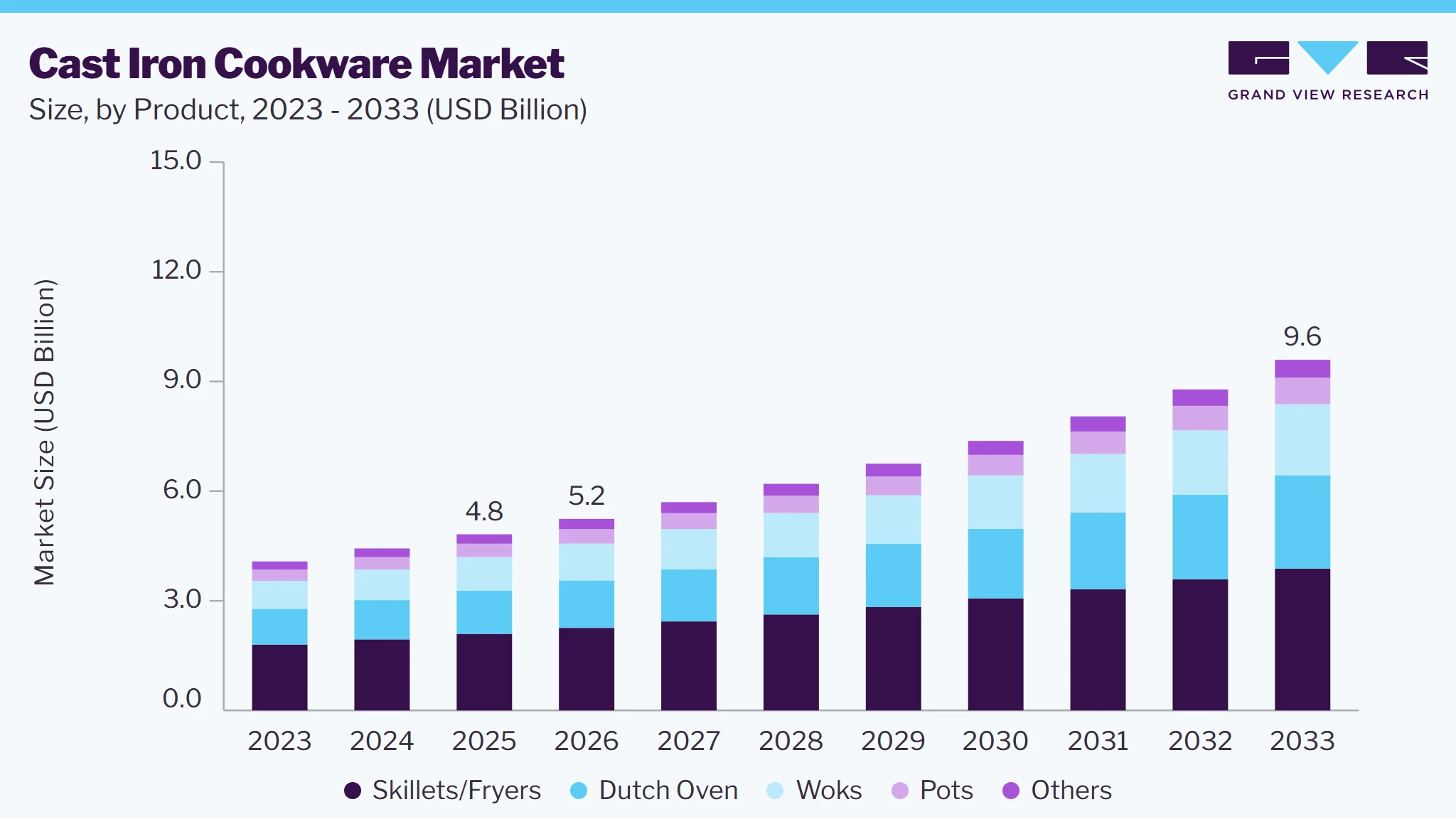 To learn more about this report, Download Free Sample Report
The surge in home cooking spurred by the COVID-19 lockdown, along with evolving consumer preferences, has significantly contributed to the growth of the cast iron cookware market. As more people experiment with cooking at home, there is a heightened demand for reliable and versatile cookware options like cast iron.
Pascal Glorieux, a representative from the International Housewares Association (IHA) in September 2020, noted that approximately 37% of the French population explored new recipes during the lockdown period. This increased interest in home cooking is expected to persist, driven by a preference for culinary experiences within the comfort of one's home.
Cast iron cookware aligns perfectly with these trends due to its durability, even heating, and suitability for various cooking methods. As a result, manufacturers and retailers in the cast iron market are likely to see continued growth as consumers prioritize high-quality cookware for their home culinary experiments.
The demand for cookware made from cast iron has been increasing in the commercial sector. The quick-heating properties and affordability of these materials are boosting product penetration as the industry requires cookware in bulk.
Matfer Bourgeat USA offers cookware made of cast iron, including a pan with a spatula and spreader, a casserole pot with a lid, and a rectangular terrine. The products are suitable for a variety of cooking styles and temperatures. Cast iron cookware products are a natural mineral material promoting healthy cooking, making the products free of any harsh chemicals, coatings, PTFE, and PFOA.
Market Dynamics
Cast iron cookware is witnessing growing demand due to its exceptional durability, superior heat retention, and versatility across a wide range of cooking methods, including frying, baking, roasting, and grilling. Consumers are increasingly favoring cast iron cookware as it offers long service life, natural non-stick properties when seasoned, and compatibility with various heat sources, including induction cooktops and ovens. The rising popularity of home cooking, growing interest in healthy and sustainable kitchen products, and increasing demand for premium cookware are further supporting market expansion.
The increasing consumer preference for durable, high-performance, and sustainable kitchen products is a major factor driving demand for cast iron cookware. Unlike many conventional cookware materials that require frequent replacement, cast iron cookware is valued for its exceptional longevity, heat retention, and ability to withstand high cooking temperatures. Growing awareness regarding product durability and long-term value has encouraged consumers to invest in cookware that offers extended service life and consistent cooking performance.
The rising popularity of home cooking and meal preparation has further strengthened demand for cast-iron skillets, Dutch ovens, and grill pans. Consumers are increasingly seeking cookware that supports a variety of cooking techniques, including searing, roasting, baking, and slow cooking. In addition, growing interest in healthier cooking methods has boosted adoption, as well-seasoned cast iron cookware can reduce reliance on synthetic non-stick coatings while providing a naturally non-stick cooking surface. As households continue to prioritize quality, sustainability, and multifunctionality in kitchen equipment, demand for cast iron cookware is expected to grow steadily over the forecast period.
The widespread availability and growing popularity of alternative cookware materials remain a key restraint for the cast iron cookware market. Consumers today can choose from a broad range of cookware options, including stainless steel, aluminum, ceramic-coated, and non-stick cookware, many of which offer advantages such as lighter weight, easier handling, and lower maintenance requirements. Compared to these alternatives, traditional cast iron cookware is relatively heavy and requires regular seasoning and proper care to prevent rust and maintain performance.
In addition, some consumers perceive cast iron cookware as less convenient for everyday use due to its weight and longer maintenance process. Modern non-stick and ceramic cookware products continue to attract consumers seeking ease of cleaning and quick cooking solutions. The availability of technologically advanced cookware featuring enhanced coatings, scratch resistance, and dishwasher-safe properties further intensifies market competition. As a result, consumer preference for lightweight and low-maintenance cookware products may limit the adoption of cast iron cookware, particularly among first-time buyers and younger households.
The increasing consumer preference for premium kitchenware and aesthetically appealing cookware is creating significant growth opportunities in the cast iron cookware market. Modern consumers are increasingly willing to invest in high-quality cookware that combines functionality, durability, and design appeal. This trend has fueled demand for premium cast iron products, particularly enamel-coated cookware, which offers the cooking benefits of traditional cast iron while requiring less maintenance and providing enhanced visual appeal.
The growing influence of cooking shows and social media food content is further encouraging consumers to upgrade their kitchen equipment. In addition, the expansion of e-commerce platforms and direct-to-consumer sales channels has improved access to premium cookware brands, enabling manufacturers to reach a broader customer base. Rising interest in artisanal cooking and outdoor cooking activities is also supporting demand for specialized cast iron products such as Dutch ovens, grill pans, and camp cookware. As consumers continue to prioritize quality, sustainability, and premium kitchen experiences, manufacturers have substantial opportunities to expand their product portfolios and capture higher-value market segments.
Market Concentration & Characteristics
The expansion of this market stems from rising consumer investment in multifunctional cast iron cookware. Designed with versatility in mind, these products feature interchangeable lids and modular components, offering users a range of options for diverse cooking methods and recipes.
 To learn more about this report, Download Free Sample Report
In the forthcoming years, prominent global corporations are anticipated to prioritize strategic acquisitions to strengthen their market position and expand their international presence. The emphasis is expected to be on acquiring small and medium-sized enterprises within the industry to facilitate regional expansion efforts.
Stringent regulations ensure that cast iron cookware products adhere to safety standards, addressing concerns regarding harmful substances or materials. Compliance requirements could impact manufacturing processes and material selections, influencing product development and design.
Competitive dynamics are shaped by end-user concentration, prompting manufacturers to vie for relationships with key customers. Companies may need to differentiate their products and services to secure and sustain partnerships with major retailers or distributors.
Analyst Perspective
The cast iron cookware market benefits from a unique combination of durability-driven consumer demand, growing interest in home cooking, and increasing preference for sustainable kitchen products. Unlike disposable or short-life cookware alternatives, cast iron products offer decades of usability, creating a strong value perception among consumers. The key competitive advantage will belong to manufacturers that successfully blend traditional cast iron performance with modern features such as enamel coatings, lightweight designs, and premium aesthetics. As premiumization trends accelerate globally, brands that combine functionality, convenience, and design appeal are likely to capture the greatest long-term market value.
Type Insights
Based on type, the seasoned type segment led the market with the largest revenue share of 43.9% in 2025, and the unseasoned type is expected to grow at the fastest CAGR over the forecast period. The relatively lower price point of unseasoned cast iron compared to pre-seasoned options makes it an attractive choice for budget-conscious shoppers. As consumers become more conscious of health and environmental factors, the simplicity and longevity of unseasoned cast iron align with sustainability trends, further driving its appeal in the market.
The seasoned segment is projected to grow at a fastest CAGR of 9.5% over the forecast period. Seasoned cast iron develops a natural non-stick surface over time, reducing the need for additional fats and oils during cooking. This property, combined with its ability to retain and evenly distribute heat, ensures consistent and flavorful results across various cooking techniques. In addition, the low maintenance requirements and long lifespan of seasoned cast iron make it a cost-effective and sustainable choice for home cooks, further fueling its demand in the market.
Application Insights
Based on application, the residential segment led the market with the largest revenue share of 70.3% in 2025. The introduction of new cooking shows on television and social media platforms, fosters interest in new cuisines and with it, new cookware, among consumers. The trend of experimenting with cooking and a preference for aesthetically appealing utensils, such as seasoned, and enameled-coated cast iron cookware, have positively impacted the market.
The commercial segment is projected to grow at a fastest CAGR of 9.4% during the forecast period. The increasing inclination for dining out at restaurants, bars, hotels, and similar establishments has led to a higher demand for robust and heat-resistant cast iron cookware essential for cooking and keeping food warm for patrons. Furthermore, the flourishing restaurant industry in the country, emphasizing top-notch cuisine and service, has prompted restaurant proprietors to make substantial investments in contemporary and high-quality cast iron cookware.
Distribution Channel Insights
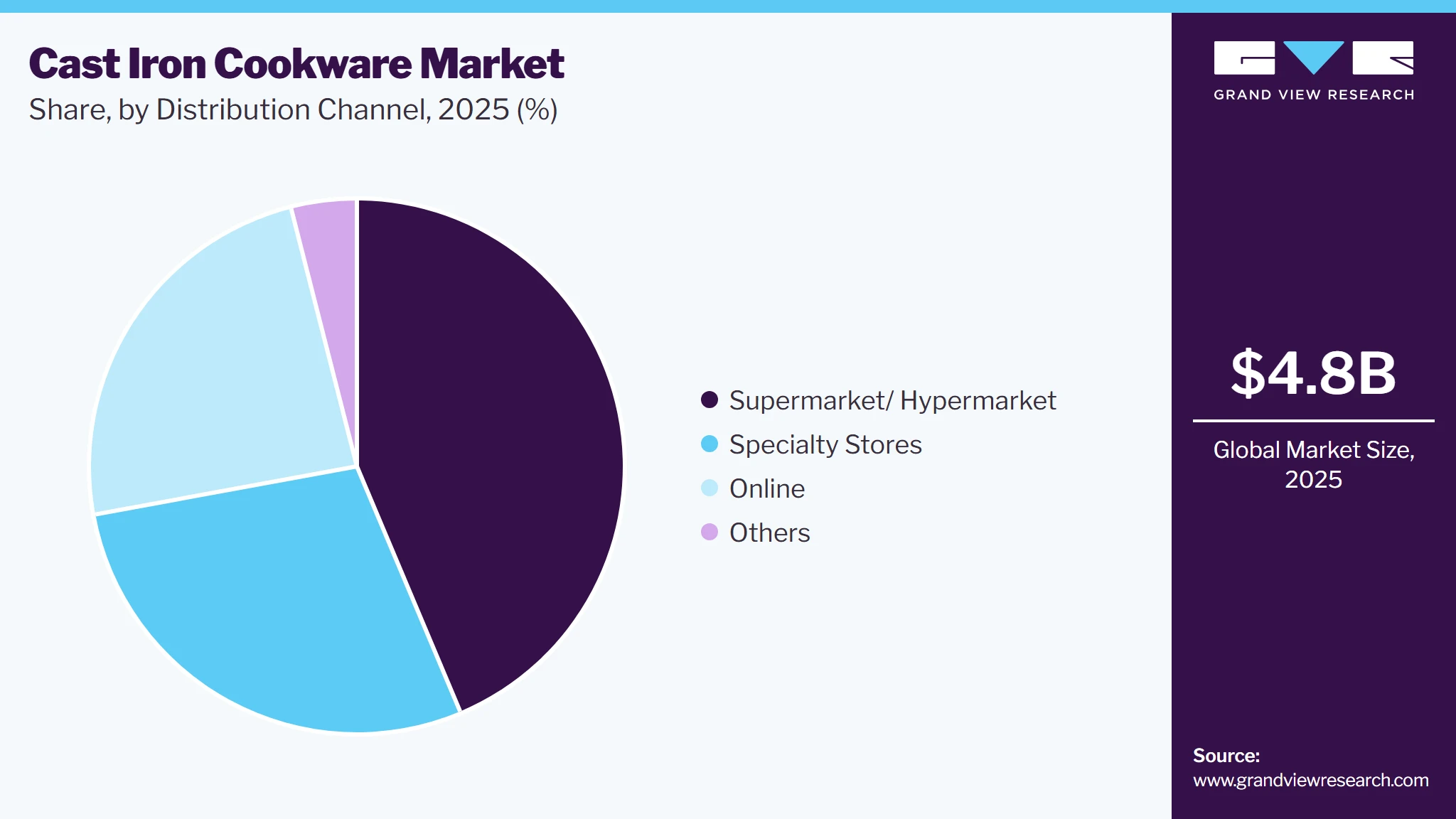
Based on distribution channel, the supermarkets/hypermarkets segment led the market with the largest revenue share of 43.6% in 2025. Many consumers opt to buy nonstick cookware alongside their grocery purchases at supermarkets and hypermarkets. The convenience of finding a wide range of product options across various price points in these stores is appealing to shoppers. In addition, consumers tend to be more selective and attentive when shopping in such environments, as they can easily compare products from different brands before making a purchase decision.
 To learn more about this report, Download Free Sample Report
The online segment is projected to grow at a fastest CAGR of 10.6% over the forecast period. Online channels provide manufacturers with the opportunity to connect with potential customers, improve communication, streamline financial tracking, and boost brand visibility in a cost-effective manner. The market has experienced significant advantages from digitalization, as it has unlocked numerous growth prospects for industry players. This has enabled them to access an engaged consumer base that favors online shopping.
Product Insights
Based on product, the skillets/Fryers segment led the market with the largest revenue share of 43.5% in 2025. The increasing preference for skillets/fryers is closely linked to the market growth due to their durability and ability to enhance flavor. Cast iron skillets/fryers develop a natural non-stick surface over time, making them ideal for frying, searing, and browning foods. This characteristic, combined with their ability to retain and evenly distribute heat, enhances the flavor and texture of dishes, contributing to the expansion of the cast iron cookware market.
The wok segment is projected to grow at a fastest CAGR of 9.9% over the forecast period. The rising demand for woks highlight the growth of the cast iron cookware market, with these versatile pans becoming essential tools for modern cooking enthusiasts. It is mainly utilized for stir-frying, steaming, deep-frying, and more, cast iron woks excel in evenly distributing heat and accommodating various cooking techniques. This versatility caters to the evolving preferences of home cooks, further propelling the expansion of the global market.
Regional Insights
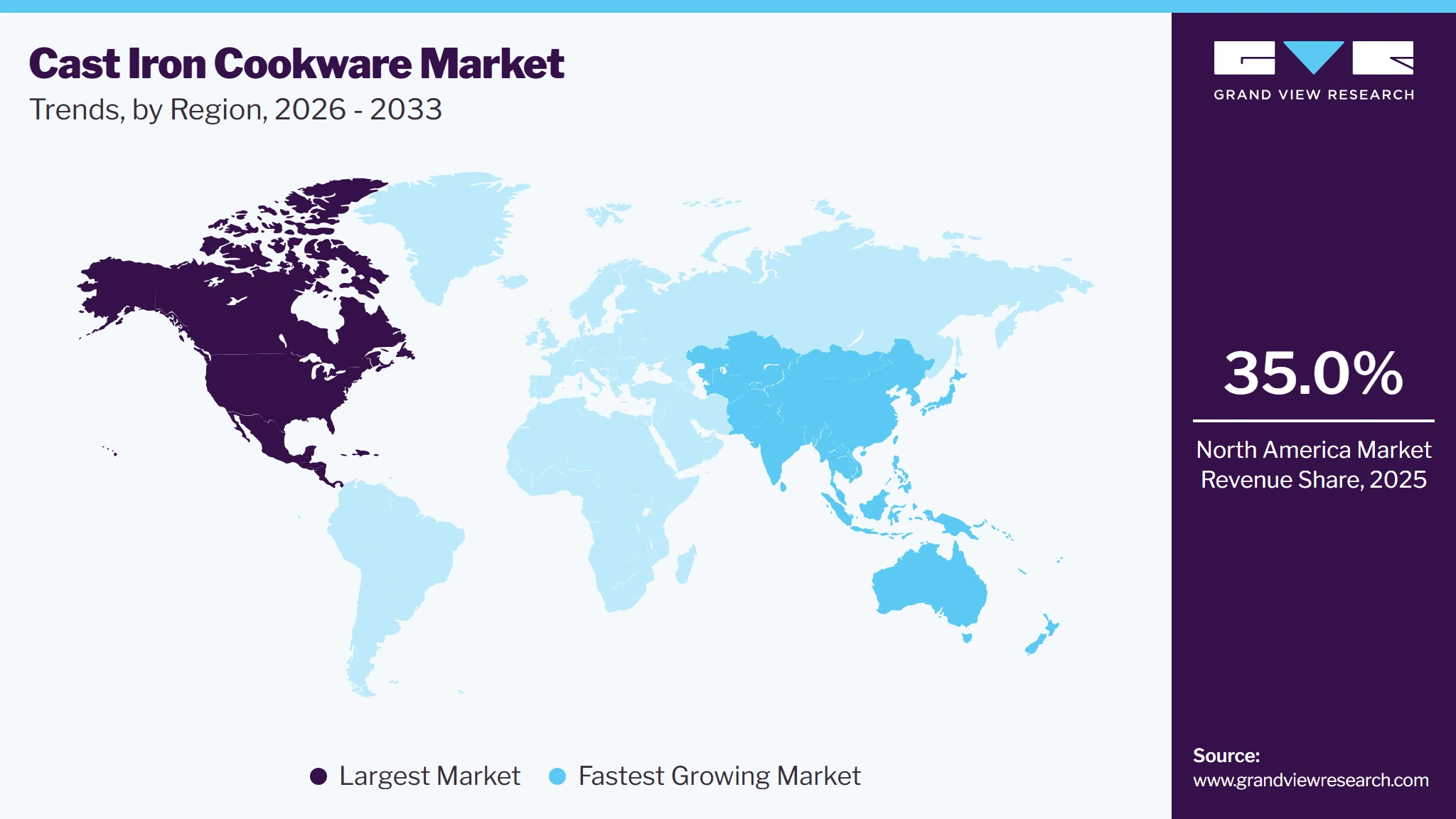
North America dominated the cast iron cookware market with the largest revenue share of 35.0% in 2025. Cast iron cookware, such as skillets and Dutch ovens, holds a deep cultural significance in North American culinary traditions, especially in Southern and Midwestern cooking. This cultural tie drives the demand for cast iron cookware as consumers seek to preserve and continue culinary traditions.
 To learn more about this report, Download Free Sample Report
U.S. Cast Iron Cookware Market Trends
The cast iron cookware market in the U.S. held the largest share in the North America region in 2025. The trend towards home cooking and wellness in the U.S. has also fueled the demand for cast iron cookware. Consumers are looking for reliable, versatile cookware that enhances their cooking experience at home, and cast iron fulfills these requirements well.
Asia Pacific Cast Iron Cookware Market Trends
The cast iron cookware industry in the Asia Pacific is anticipated to grow at the fastest CAGR from 2026 to 2033. The evolving dining culture, characterized by the popularity of social and casual dining, has driven an increased demand for innovative cookware products, including cast iron cookware, in the region. The growing influence of Southern European culinary trends, such as French and Italian cuisine, and the preference for high-quality kitchenware, has extended to cast iron cookware in Northern Europe. Consequently, more consumers are investing in cast iron cookware to elevate their food preparation and dining experiences with family and friends.
Europe Cast Iron Cookware Market Trends
The cast iron cookware market in Europe is projected to grow at a fastest CAGR of 8.3% from 2025 to 2033. Shifting trends in eating culture, such as the rising prominence of social and casual dining, have resulted in an increased demand for innovative cast iron cookware products in the region. The growing influence of trends in Southern Europe, such as French cuisine, Italian food culture, and the use of high-end kitchenware products, has fueled the application of cast iron cookware products in Northern Europe as well.
Key Cast Iron Cookware Company Insights
The market features both established global firms and emerging players. Key industry leaders prioritize product innovation, differentiation, and distinctive designs in line with evolving consumer preferences. Leveraging extensive global distribution networks, these major players effectively reach diverse customer bases and tap into emerging markets.
Key Cast Iron Cookware Companies:
The following key companies have been profiled for this study on the cast iron cookware market.
-
Groupe SEB
-
Werhahn Group
-
Target
-
Meyer Corporation
-
Fissler
-
Tramontina
-
Newell Brands Inc.
-
SCANPAN
-
TTK Prestige Ltd.
-
The Vollrath Co.
-
L.L.C.
Competitive Benchmarking
Category
Operating Strategies
Competitive Edge
Weakness
Established Players (Groupe SEB, Meyer Corporation, Tramontina, TTK Prestige Ltd.)
- Expand premium and enamel-coated cast iron cookware portfolios through continuous product innovation and design enhancements. Invest in omnichannel distribution, direct-to-consumer platforms, and international retail expansion. Strengthen brand positioning through sustainability initiatives, chef collaborations, and premium kitchenware collections.
- Strong brand recognition and consumer trust built over decades. Extensive global distribution networks across retail and e-commerce channels. Large-scale manufacturing capabilities, product diversification, and established relationships with hospitality and foodservice customers.
- Higher manufacturing and logistics costs due to global operations. Slower response to niche consumer trends and emerging cookware preferences. Greater exposure to raw material price fluctuations and supply chain disruptions.
Emerging & Specialty Players (Fissler, SCANPAN, The Vollrath Co., L.L.C.)
- Focus on premium craftsmanship, artisanal manufacturing, and heritage-inspired cookware designs. Leverage social media marketing, cooking communities, influencer partnerships, and direct-to-consumer sales models. Introduce lightweight cast iron, specialty cookware, and limited-edition product lines targeting cooking enthusiasts.
- Faster product innovation and the ability to address niche consumer preferences. Strong engagement with home chefs and outdoor cooking communities. An authentic brand premium positioning supports higher margins.
- Limited financial resources and smaller distribution footprints compared to multinational competitors. Lower brand awareness in international markets. Greater dependence on e-commerce and specialty retail channels for growth.
Recent Developments
-
In May 2023, Groupe SEB completed the acquisition of Pacojet, a Swiss family-owned company renowned for its distinctive culinary appliance, highly favored by chefs for over three decades. This strategic move aligns with Groupe SEB's objective of bolstering its footprint in the cast iron cookware market
-
In April, 2023, Meyer Corporation, U.S. unveiled Rachael Beam NITRO Cast Iron, an innovative range incorporating advanced NITRO heat treatment technology to address common issues found in traditional and plated cast iron cookware
Cast Iron Cookware Market Report Scope
Report Attribute
Details
Market size in 2025
USD 4.8 billion
Estimated market size in 2026
USD 5.2 billion
Projected market size by 2033
USD 9.6 billion
Growth rate
CAGR of 9.0% from 2026 to 2033
Base year for estimation
2025
Historical data
2021 - 2024
Forecast period
2026 - 2033
Quantitative units
Revenue in USD million/billion and CAGR from 2026 to 2033
Report coverage
Revenue forecast, company ranking, competitive landscape, growth factors, and trends
Segments covered
Type, product, application, distribution channel, region
Regional scope
North America; Europe; Asia Pacific; Central & South America; Middle East & Africa
Country scope
U.S.; Canada; Mexico; UK; Germany; France; Italy; Spain; China; India; Japan; Australia & New Zealand; South Korea; Brazil; South Africa
Key companies profiled
Groupe SEB; Werhahn Group; Target; Meyer Corporation; Fissler; Tramontina; Newell Brands Inc.; SCANPAN; TTK Prestige Ltd.; The Vollrath Co.; L.L.C.
Customization scope
Free report customization (equivalent up to 8 analysts' working days) with purchase. Addition or alteration to country, regional & segment scope.
Pricing and purchase options
Avail customized purchase options to meet your exact research needs. Explore purchase options
Global Cast Iron Cookware Market Report Segmentation
This report forecasts revenue growth at global, regional & country levels and provides an analysis on the latest trends and opportunities in each of the sub-segments from 2021 to 2033. For this study, Grand View Research has segmented the global cast iron cookware market report based on type, product, application, distribution channel, and region:
-
Type Outlook (Revenue, USD Billion, 2021 - 2033)
-
Unseasoned
-
Seasoned
-
Enamel Coated
-
-
Product Outlook (Revenue, USD Billion, 2021 - 2033)
-
Skillets/Fryers
-
Woks
-
Dutch Oven
-
Camp Pots
-
Others
-
-
Application Outlook (Revenue, USD Billion, 2021 - 2033)
-
Residential
-
Commercial
-
-
Distribution Channel Outlook (Revenue, USD Billion, 2021 - 2033)
-
Supermarket/ Hypermarket
-
Specialty Stores
-
Online
-
Others
-
-
Regional Outlook (Revenue, USD Billion, 2021 - 2033)
-
North America
-
U.S.
-
Canada
-
Mexico
-
-
Europe
-
UK
-
Germany
-
France
-
Italy
-
Spain
-
-
Asia Pacific
-
China
-
India
-
Japan
-
Australia & New Zealand
-
South Korea
-
-
Central & South America
-
Brazil
-
-
Middle East & Africa (MEA)
-
South Africa
-
-
Research Methodology
The cast iron cookware market figures in this report are based on a proven research process that combines executive interviews with secondary research from proprietary databases, company filings, and recognized regulatory and institutional sources. Market size is built through value-chain sizing - reconciling supply-side and demand-side estimates - and triangulated with bottom-up and top-down approaches. Every estimate passes multiple levels of expert validation before publication, with each cast iron cookware segment quantified using the revenue-capture definitions in the table below.
Segment Definition
Segment - Product
Revenue capture definition
Skillets/Fryers
This segment covers the revenues generated through the cast iron cookware market from skillets and fryers. These are shallow, flat-bottomed cooking vessels designed for frying, searing, sauteing, browning, and pan roasting. Cast iron skillets are valued for their excellent heat retention, even heat distribution, and versatility across stovetops, ovens, grills, and open-fire cooking environments.
Woks
This segment covers the revenues generated through the cast iron cookware market from woks. Cast-iron woks are deep, bowl-shaped cooking vessels primarily used for stir-frying, deep-frying, steaming, and other high-heat cooking techniques. Their superior heat retention and durability make them suitable for both traditional cuisine and a variety of modern cooking applications.
Dutch Oven
This segment covers the revenues generated through the cast iron cookware market from Dutch ovens. These are heavy-duty, thick-walled cooking pots, often equipped with tight-fitting lids, designed for slow cooking, baking, roasting, and simmering. Dutch ovens are widely used in residential kitchens, outdoor cooking, and professional foodservice settings due to their ability to maintain consistent cooking temperatures.
Pots
This segment covers the revenues generated through the cast iron cookware market from cast iron pots. These products include a variety of cooking pots used for boiling, simmering, soup preparation, stock making, and other liquid-based cooking applications. Cast iron pots are valued for their durability and ability to retain heat over extended cooking periods.
Others
This segment covers the revenues generated through the cast iron cookware market from other cast iron cookware products not included in the above categories. These may include grill pans, griddles, camp ovens, casserole dishes, roasting pans, specialty bakeware, and multifunctional cookware designed for specific cooking and serving applications.
Estimation Model
Name
Key Question
Description
Household Kitchenware Layer
Who owns cookware?
Identify the total number of households across target countries and regions. Apply household penetration rates for cookware ownership to determine the potential user base for cooking utensils and kitchen equipment.
Cast Iron Adoption Layer
Who uses cast iron cookware?
Apply region-specific adoption rates for cast iron cookware among cookware-owning households. Factors include cooking culture, preference for durable cookware, and awareness of cast iron benefits.
Purchase & Replacement Layer
Who actively purchases cast iron cookware?
Apply annual purchase and replacement rates based on consumer behavior, cookware lifespan, gifting trends, new household formation, and premium cookware upgrades. This converts the installed base into annual unit demand.
Monetisation Layer
How much revenue is gene
Multiply annual unit demand by average selling prices (ASP), adjusted for product mix, including skillets/fryers, woks, Dutch ovens, pots, and premium enamel-coated cookware. Add commercial foodservice demand where applicable.
Delivered Customizations
This report has been delivered with the following In-depth customizations
Client Request
Customization Delivered
Value Adds
Product Type Analysis (Skillets/Fryers, Woks, Dutch Ovens, Pots & Others)
Conducted a focused analysis of cast iron cookware demand across product categories, evaluating consumer preferences, usage patterns, cooking applications, premiumization trends, and adoption across residential and commercial end users.
Helps stakeholders identify high-growth product categories, optimize product portfolios, and evaluate opportunities for innovation, premium positioning, and category expansion.
Distribution Channel & Consumer Purchasing Trends
Assessed sales trends across supermarkets/hypermarkets, specialty stores, online channels, and other retail formats, including the impact of e-commerce growth, direct-to-consumer strategies, and omnichannel retail expansion.
Provides insights into evolving purchasing behavior, channel performance, and customer acquisition opportunities to support distribution and go-to-market strategies.
Premium Cookware & Commercial Demand Opportunity Assessment
Evaluated demand for premium cast iron products, hospitality and foodservice applications, outdoor cooking trends, and sustainable cookware preferences across key regional markets.
Supports investment and expansion strategies by identifying high-value growth segments, emerging consumer trends, and long-term opportunities in premium and commercial cookware markets.
Frequently Asked Questions About This Report
Some of the key players operating in the cast iron cookware market include Procter & Gamble; Kimberly-Clark Corporation; Johnson & Johnson Services, Inc.; Essity AB; Unicharm Corporation; Ontex Group NV; Domtar Corporation; Kao Corporation; Edgewell Personal Care Company; Hengan International Group Co. Limited.
Key factors that are driving the cast iron cookware market growth include an increasing surge in demand for high-quality kitchenware, expansion of the food service industry, and demand for aesthetically pleasing cookware.
Asia Pacific is the fastest-growing region over the forecast period.
The global cast iron cookware market size was valued at USD 4.8 billion in 2025 and is estimated at USD 5.2 billion for 2026.
The global cast iron cookware market is expected to grow at a CAGR of 9.0% from 2026 to 2033, reaching USD 9.6 billion by 2033.
North America dominated the market, accounting for a revenue share of 35.0% in 2025.
Seasoned type segment dominated the market, with a revenue share of 43.9% in 2025 while seasoned segment is expected to be the fastest-growing market.
Based on product, the skillets/Fryers segment led the market with the largest revenue share of 43.5% in 2025. The increasing preference for skillets/fryers is closely linked to the market growth due to their durability and ability to enhance flavor.
Residential dominated the market, accounting for a revenue share of 70.3% in 2025 and commercial segment is second fastest growing market
About the Author(s)
Homecare & Decor Research Team
Consumer Goods · Homecare & DecorThis report was authored by the homecare & decor research team at Grand View Research - comprising two research analysts, one senior research analyst, and one industry expert - with specialized expertise in the homecare & decor segment of the consumer goods industry. All findings are based on proprietary consumer goods databases, executive interviews, and regulatory analysis, subject to internal peer review prior to publication.
Last Updated:
Speak to Analyst

Customize this report to your needs - add regions, segments, or data points, with 20% free customization.
Or view our licence options:


ISO 9001:2015 & 27001:2022 Certified
We are GDPR and CCPA compliant! Your transaction & personal information is safe and secure. For more details, please read our privacy policy.


