
- Home
- »
- Biotechnology
- »
-
Cell Culture Matrices Market Size, Growth Report, 2026-2033GVR Report cover

Cell Culture Matrices Market (2026 - 2033)
Size, Share & Trends Analysis Report By Product Type (Natural Matrices, Synthetic Matrices, Hybrid Matrices), By Form (Liquid/Solution Hydrogels, Pre-formed Solid Scaffolds), By Application, By End Use, By Region, And Segment Forecasts
Market Size, 2025
$1.2BMarket Estimate, 2026
$1.3BMarket Forecast, 2033
$2.2BCAGR, 2026–2033
8.0%Cell Culture Matrices Market Summary
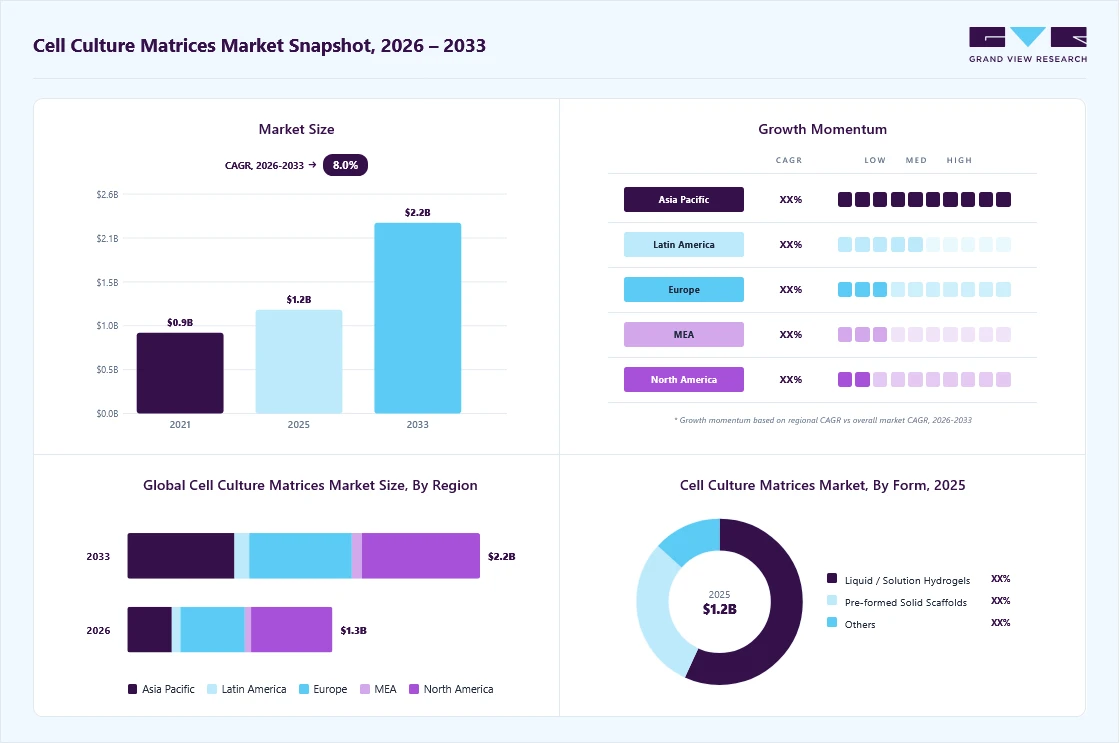
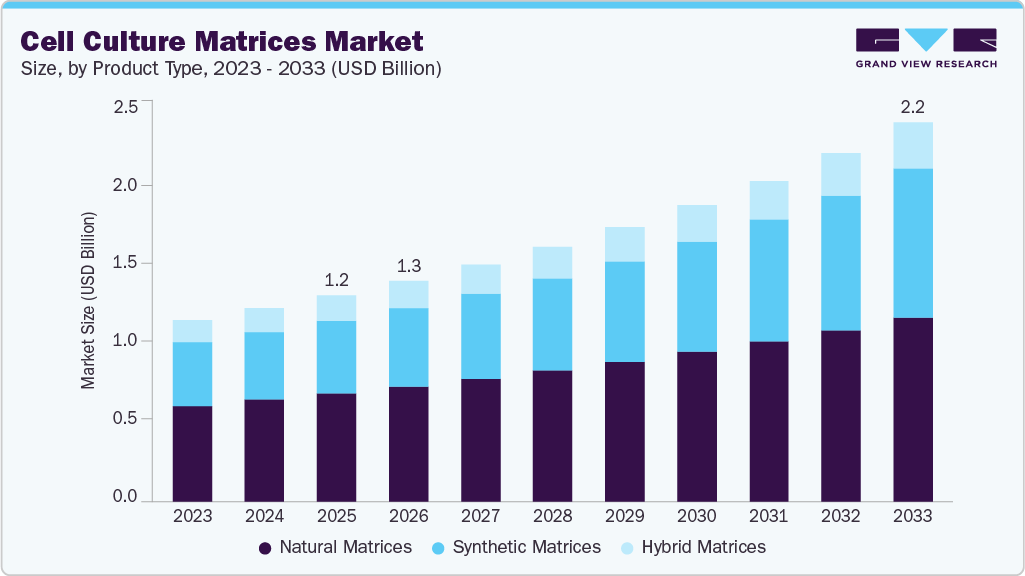
The global cell culture matrices market size was valued at USD 1.2 billion in 2025 and is projected to grow from USD 1.3 billion in 2026 to USD 2.2 billion by 2033, at a CAGR of 8.0% from 2026 to 2033. North America dominated the global market, accounting for the largest revenue share of 40.2% in 2025. This growth is primarily driven by increasing demand for 3D cell culture models, rising adoption of cell-based assays in drug discovery and regenerative medicine, expanding applications in cancer research and tissue engineering, and the growing focus on biologics development and personalized medicine.
 Source: Grand View Research, IR Documents, Primary Interviews, Paid DatabasesTo learn more about this report,
 Download Free Sample Report
Key Market Trends & Insights
- By product type: Natural matrices segment held the largest market share by product type.
- By form: Liquid/solution hydrogels segment held the highest market share of 56.8% in 2025.
- By application: Drug discovery & toxicology testing application segment held the largest market share in 2025.
Regional Highlights
- Largest regional market: North America (40.2% revenue share, 2025)
- Fastest-growing regional market: Asia Pacific (highest CAGR, 2026-2033)
- By country: The U.S. cell culture matrices industry is a major contributor to the global market.
Market Size & Forecast
- Market size in 2025: USD 1.2 Billion
- Estimated market size in 2026: USD 1.3 Billion
- Projected market size by 2033: USD 2.2 Billion
- CAGR (2026-2033): 8.0%
Three ways to get this report
Buy it, customize it, or ask a question.Ask an Analyst
Analyst response in 1 business day
- AccessReport author, directly
- Reply timeWithin 1 working day
- No sales callDirect answer only
- FormatEmail reply
- CostFree, no cost
Get the Full Report
What the study covers
- FormatsPDF · Excel · Dashboard
- Timeline2026–2033 annual, 2025 base
- Coverage20+ countries, 5 regions
- Companies10+ key players profiled
Customize the Report
20% free customization
- IncludeCountries, segments, points
- TailorTo your product definition
- ExtendDeeper competitor detail
- OrA fully bespoke study
- Turnaround5–10 working days
 To learn more about this report, Download Free Sample Report
Rising Demand for 3D Cell Culture Models
The rising demand for 3D cell culture models is a major driver of the cell culture matrices market. Unlike traditional 2D cultures, 3D systems such as spheroids and organoids more accurately replicate the structural and functional complexity of the in vivo cellular microenvironment. This has increased their adoption across drug discovery, cancer research, and tissue engineering applications, where physiological relevance and predictive accuracy are critical. As a result, there is a growing need for advanced cell culture matrices, including hydrogels and extracellular matrix (ECM)-based scaffolds, that can support cell adhesion, proliferation, and differentiation in three-dimensional environments.
Design Criteria and Multi-Scale Structural Characteristics of 3D Cell Culture Matrices
Scale
Structure Type
Key Features
Functional Benefits
Macro-scale (10^-1-10^-3 m)
Designed & Mold-based 3D Matrices
Custom geometry, scalable design, compatibility with lab systems
Supports tissue-level architecture; enables integration with bioreactors and well plates
Micro-scale (10^-3-10^-6 m)
Fibrous & Porous (Sponge-like) Structures
Interconnected porosity, mechanical strength, ECM-like architecture
Enhances cell attachment, proliferation, and nutrient transport; supports 3D cell organization
Nano-scale
(10^-6-10^-9 m)
Nanomaterial-based & Surface-modified Matrices
Surface topography, biofunctionalization, tunable nano-features
Regulates cell signaling and initial cell responses; improves bioactivity and cell adhesion
Source: TISSUE ENGINEERING, Secondary Research, Grand View Research
Moreover, as highlighted in multi-scale matrix design approaches, structural features at macro-, micro-, and nano-levels play a crucial role in enabling effective 3D cell growth. Properties such as pore architecture, surface topography, and mechanical strength directly influence cell behavior, reinforcing the importance of optimized matrix design in supporting advanced 3D culture systems.
Increasing Adoption of Advanced Cell-Based Assay Systems Across Drug Development and Manufacturing
The increasing adoption of advanced cell-based assay systems across drug discovery, toxicity testing, and biopharmaceutical manufacturing is a key driver of the cell culture matrices market. Pharmaceutical and biotechnology companies are increasingly using stable, reproducible cell-based models for applications such as potency testing, assay development, and quality control in regulated environments. This shift reflects the growing need for consistent, high-throughput, and standardized in vitro systems that can deliver reliable results throughout the drug development lifecycle.
Moreover, the shift toward routine and GMP-compliant workflows is increasing the need for robust culture environments that ensure long-term cell stability and reproducibility. Cell culture matrices support these systems by enhancing cell functionality and consistency. For instance, in August 2025, INDIGO Biosciences launched stable reporter cell lines to support reproducible and standardized cell-based assays for quality control, GMP workflows, and manufacturing applications.
Market Concentration & Characteristics
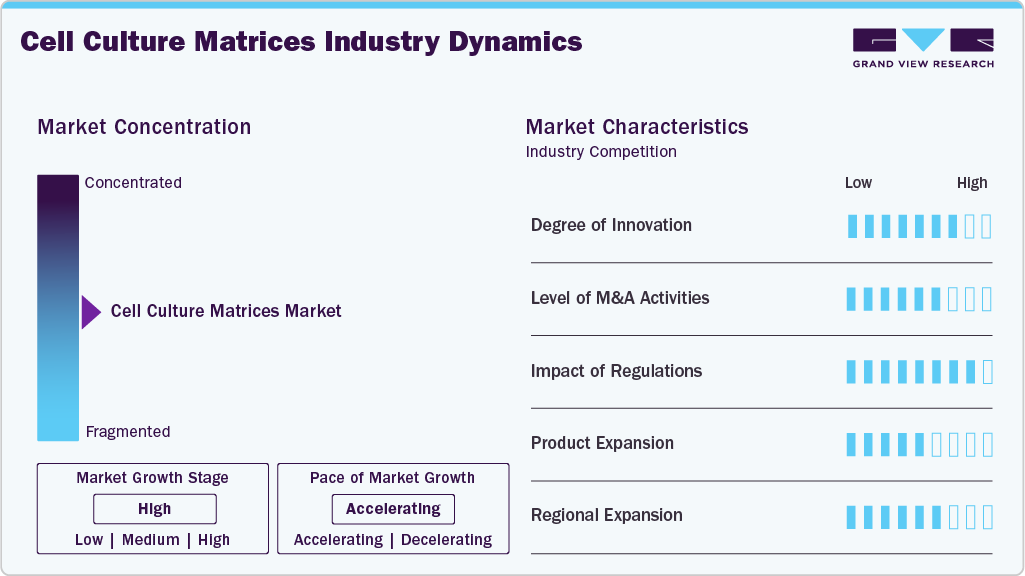
The cell culture matrices industry is witnessing a high level of innovation driven by advancements in biomaterials and 3D culture technologies. Developments in synthetic hydrogels, ECM-mimicking materials, and nanostructured scaffolds are improving the physiological relevance, reproducibility, and scalability of cell culture systems. In addition, innovations such as tunable matrices and bioprinting-compatible scaffolds enable greater control over cell behavior and support the development of complex tissue models. These advancements are enhancing research efficiency, reducing variability, and driving adoption across drug discovery and regenerative medicine applications.
The cell culture matrices industryis experiencing moderate to high levels of mergers and acquisitions, driven by efforts to expand biomaterial capabilities, strengthen product portfolios, and enhance global presence. Companies are increasingly pursuing strategic deals to access advanced scaffold technologies, ECM-based materials, and 3D culture platforms for applications in drug discovery and regenerative medicine. For instance, in January 2025, MilliporeSigma acquired HUB Organoids Holding B.V., strengthening its organoid capabilities and expanding its next-generation 3D cell culture portfolio for advanced drug development. This development underscores the increasing emphasis on organoid-based models, driving demand for advanced cell culture matrices that support physiologically relevant 3D environments.
 To learn more about this report, Download Free Sample Report
Regulations play a crucial role in the cell culture matrices industry by influencing product development, material selection, and manufacturing standards. Compliance with GMP, ISO, and regulatory guidelines ensures the safety, consistency, and biocompatibility of matrices used in research and clinical applications. Regulatory oversight also extends to raw materials, particularly for animal-derived and xeno-free matrices, as well as to validation and traceability requirements. While stringent regulations may increase production costs and approval timelines, they enhance product reliability, support clinical translation, and encourage the development of standardized and high-quality matrix solutions.
Product expansion in the cell culture matrices industry is driven by rising demand for application-specific, scalable, and high-performance culture systems. Companies are expanding portfolios with advanced hydrogels, ECM-mimicking scaffolds, and ready-to-use 3D kits, while focusing on improved consistency, ease of use, and compatibility with automated, high-throughput workflows. This trend is further supported by increasing investments in advanced biomaterials and efforts to scale manufacturing capabilities, particularly for technologies such as collagen-based scaffolds used in tissue engineering. For instance, in July 2023, 3D BioFibR raised USD 3.52 million to expand manufacturing capabilities and commercialize collagen fiber scaffolds for tissue engineering using automated dry-spinning technology.
Regional expansion in the cell culture matrices industry is driven by the growing adoption of 3D cell culture, regenerative medicine, and advanced drug discovery across both developed and emerging regions. Key players are strengthening their presence in high-growth markets such as Asia-Pacific, Latin America, and the Middle East & Africa through partnerships and distribution networks to meet increasing demand. This expansion enables companies to leverage improved research infrastructure, rising life science investments, and the growing presence of biopharmaceutical and research organizations, while ensuring better product accessibility and support.
Product Type Insights
The natural matrices segment accounted for the largest market share of 52.5% in 2025 and is expected to maintain its dominance over the forecast period. Growth is driven by their high biocompatibility, ability to mimic the native extracellular matrix, and widespread use in cell culture, tissue engineering, and regenerative medicine. Materials such as collagen, gelatin, and matrigel support cell adhesion, proliferation, and differentiation, while increasing adoption in 3D cell culture and organoid development further strengthens segment growth. Moreover, the expanding microbiome therapeutics market is supporting demand for natural matrices, as these biomaterials provide physiologically relevant environments for studying host-microbiome interactions, gut tissue modeling, and microbial therapeutic responses in advanced in vitro research systems.
The synthetic matrices segment is expected to grow at the fastest CAGR over the forecast period, driven by increasing demand for tunable, reproducible, and scalable cell culture environments. Synthetic materials, including PEG-based hydrogels and polyacrylamide hydrogels, offer precise control over mechanical and chemical properties, enabling customization for specific research and therapeutic applications. Moreover, reduced batch-to-batch variability, improved stability, and compatibility with advanced bioengineering techniques such as 3D bioprinting are accelerating their adoption. The growing emphasis on standardized, defined culture conditions is also driving rapid growth in this segment.
Form Insights
The liquid/solution hydrogels segment accounted for the largest market share of 56.8% in 2025 and is expected to maintain its dominance over the forecast period. This growth is primarily driven by their ease of use, injectability, and ability to uniformly encapsulate cells, making them highly suitable for 3D cell culture and tissue engineering applications. These hydrogels closely mimic the natural extracellular matrix, supporting cell viability, proliferation, and differentiation. In addition, their global adoption in regenerative medicine and drug discovery, along with compatibility with various cell types, further strengthens their leading market position. The growth of the matrices for the 3D cell culture market is further driving segment expansion, as liquid/solution hydrogels are globally used to create physiologically relevant 3D cell culture environments for biomedical research and drug discovery applications.
The pre-formed solid scaffolds segment is expected to grow at the fastest CAGR over the forecast period, driven by increasing demand for structurally stable and mechanically robust cell culture systems. These scaffolds provide defined architecture and enhanced support for long-term cell growth, making them ideal for applications in tissue engineering and organ regeneration. Moreover, advancements in fabrication technologies, including 3D bioprinting and electrospinning, enable precise control over scaffold properties, accelerating their adoption.
Application Insights
The drug discovery & toxicology testing segment accounted for the largest market share of 42.2% in 2025. This growth is primarily driven by the widespread use of cell culture matrices in preclinical research for drug screening, efficacy evaluation, and toxicity assessment. These matrices provide physiologically relevant environments that enhance the predictive accuracy of in vitro models, reducing reliance on animal testing. In addition, increased R&D investments by pharmaceutical and biotechnology companies, along with the growing need for high-throughput screening platforms, further support the segment’s leading position.
The disease & pathophysiology modeling segment is expected to grow at the fastest CAGR over the forecast period, driven by the rising demand for advanced in vitro models to study complex disease mechanisms. Cell culture matrices play a critical role in developing 3D cell culture systems, organoids, and tissue models that closely replicate in vivo conditions. Advancements in biomaterials and bioengineering, along with the growing focus on precision medicine, are enabling more accurate disease modeling and accelerating segment adoption.
End Use Insights
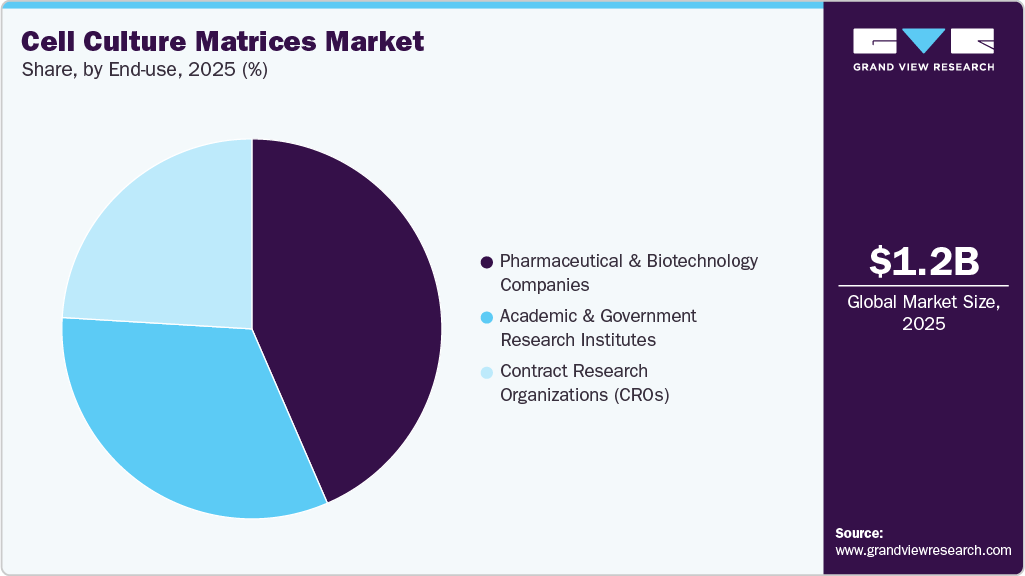
The pharmaceutical & biotechnology companies segment accounted for the largest market share of 43.5% in 2025. This growth is primarily driven by extensive utilization of cell culture matrices in drug discovery, regenerative medicine, and biologics development. These companies rely on advanced cell culture systems to enhance the accuracy and efficiency of preclinical research and therapeutic development. Increasing R&D investments and focus on advanced therapies, including cell and gene therapies, further support the segment’s dominance.
 To learn more about this report, Download Free Sample Report
The contract research organizations (CROs) segment is expected to grow at the fastest CAGR over the forecast period, driven by the rising trend of outsourcing research and development activities by pharmaceutical and biotechnology companies. CROs increasingly adopt advanced cell culture matrices to offer specialized services in drug screening, toxicity testing, and disease modeling. Moreover, the need for cost-effective, scalable solutions and expanding service capabilities is accelerating adoption in this segment.
Regional Insights
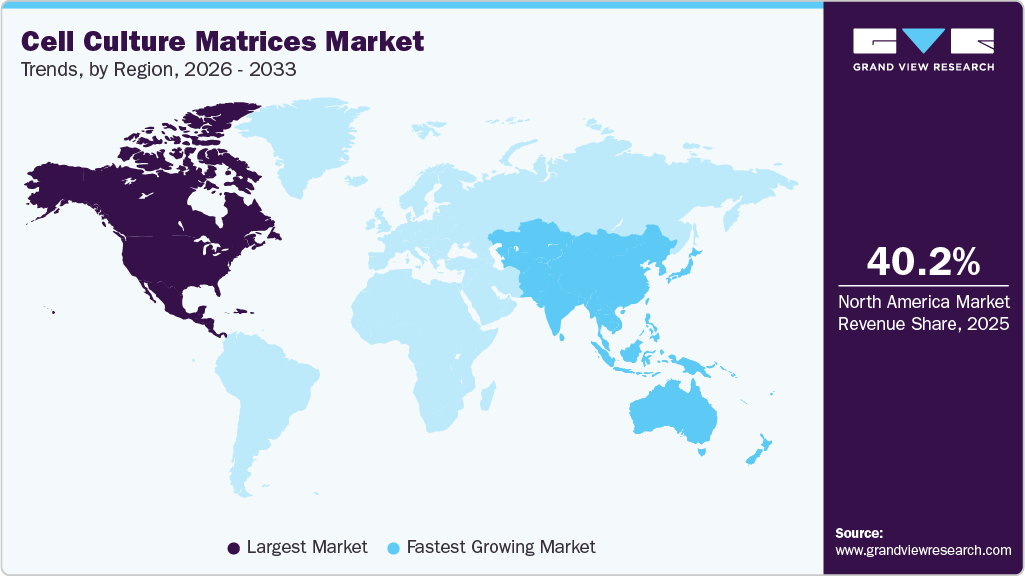
North America cell culture matrices market dominated the global market, accounting for 40.2% in 2025, driven by advanced research infrastructure, strong investments in biotechnology and life sciences, and the presence of leading biopharmaceutical companies with well-established supply chains. The high adoption of 3D cell culture technologies, the increasing focus on regenerative medicine and cell-based therapies, and the expanding applications in cancer research and drug discovery have strengthened the U.S. position as a key innovation hub.
 To learn more about this report, Download Free Sample Report
U.S. Cell Culture Matrices Market Trends
The U.S. cell culture matrices market is highly competitive and innovation-driven, supported by a strong biotechnology and life sciences ecosystem and global adoption of 3D cell culture and advanced drug discovery models. The market is increasingly focused on the development of biomimetic, scalable, and xeno-free matrices, particularly for applications in cancer research, stem cell studies, and tissue engineering. Increasing focus on chronic disease management, supported by robust investments in life sciences and cell-based innovations, continues to drive the country’s prominence in the global market.
Europe Cell Culture Matrices Market Trends
Cell culture matrices market in Europe is witnessing steady growth, supported by strong government funding for life science research, advanced healthcare infrastructure, and a well-established biotechnology and pharmaceutical industry. The increasing adoption of 3D cell culture models in drug discovery and regenerative medicine is driving demand for advanced matrices, such as hydrogels and ECM-based scaffolds. In addition, the growing focus on personalized medicine, organoid development, and reducing animal testing, along with the rising prevalence of chronic diseases, is further supporting market expansion in the region.
The UK cell culture matrices market is driven by a strong focus on advanced biomedical research and the increasing adoption of 3D cell culture technologies across academic and clinical settings. Collaborations among academic institutions, research organizations, and biotechnology companies are fostering innovation in biomaterials and scaffold design, expanding the application of cell culture matrices across both research and translational applications.
Cell culture matrices market in Germany is driven by the country’s strong emphasis on translational research and precision medicine. The presence of leading research institutes and increasing collaborations between academia and biopharmaceutical companies are accelerating the adoption of advanced 3D culture platforms.
Asia Pacific Cell Culture Matrices Market Trends
Asia-Pacific is expected to witness the fastest growth, with a CAGR of 13.4% during the forecast period, driven by expanding biopharmaceutical manufacturing, increasing research outsourcing, and strong government support for biotechnology. The region is also gaining momentum as an innovation center, with advancements in biomaterials, hydrogel-based matrices, and regenerative scaffolds. The growing adoption of single-use systems, automation, and scalable bioprocessing technologies is further driving demand for advanced cell culture matrices across research and manufacturing applications.
Cell culture matrices market in China is expanding steadily, driven by expanding biopharmaceutical manufacturing capabilities and increasing focus on advanced in vitro models for drug development. The rising adoption of organoid-based research and personalized medicine is driving demand for more specialized, application-specific matrices. Growing emphasis on locally produced, cost-effective, and scalable solutions is also supporting market expansion, particularly in high-throughput and industrial applications.
Cell culture matrices market in Japan is driven by increasing adoption of 3D cell culture systems, particularly for drug discovery and tissue engineering applications. The market is poised for strong growth, with 3D culture gaining traction amid rising demand for advanced, predictive research models.
MEA Cell Culture Matrices Market Trends
The MEA cell culture matrices market is experiencing steady growth, supported by the gradual expansion of biotechnology capabilities and increasing focus on advanced research models. Improving laboratory infrastructure and rising investments in life sciences are encouraging the adoption of 3D cell culture systems across academic and research institutions. In addition, demand for cost-effective, scalable cell culture solutions is further supporting market expansion, particularly in emerging economies across the region.
Cell culture matrices market in Kuwait is witnessing gradual expansion, supported by increasing collaborations between research institutions and healthcare providers. The growing use of advanced in vitro models for translational research is driving the adoption of specialized matrices.
Key Cell Culture Matrices Company Insights
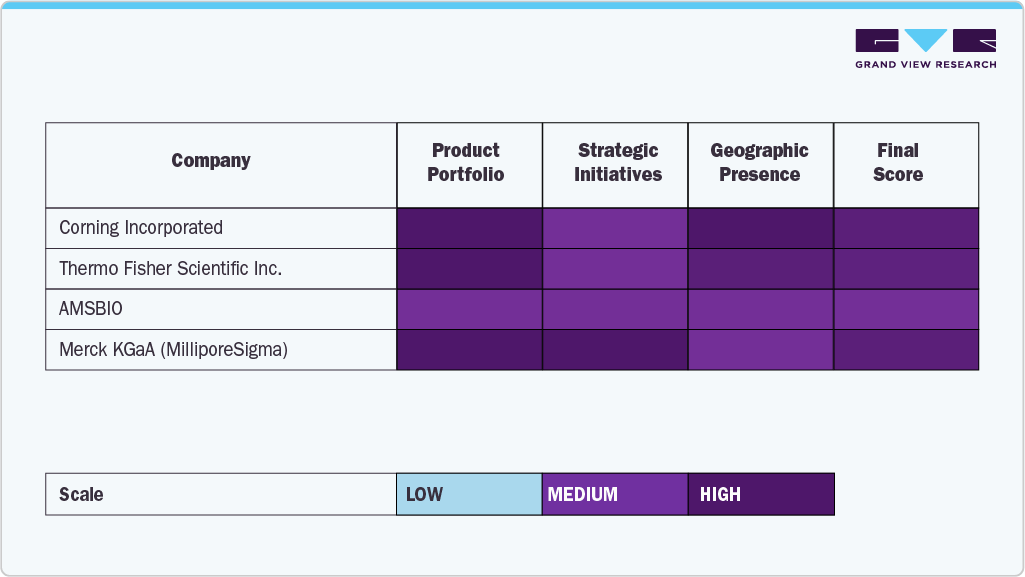
The cell culture matrices market is characterized by several established players competing through diversified product portfolios, strong global reach, and continuous innovation in biomaterials and scaffold technologies. Leading companies such as Corning Incorporated, Thermo Fisher Scientific Inc., Merck KGaA (MilliporeSigma), and Sartorius AG maintain significant market presence through extensive product offerings, advanced manufacturing capabilities, and well-established distribution networks across the research and biopharmaceutical sectors.
In addition to these key players, companies such as Bio-Techne Corporation, 3D Biotek LLC, and Cellendes GmbH are strengthening their market position by offering specialized, customizable, and cost-effective matrix solutions. Their emphasis on niche applications, such as 3D cell culture, stem cell research, and organoid development, enables them to meet evolving research needs and gain traction alongside established players.
 To learn more about this report, Download Free Sample Report
Market leaders in the cell culture matrices market maintain their competitive edge by leveraging advanced technologies such as ECM-mimicking hydrogels, nanostructured scaffolds, and bioprinting-compatible matrices. Their dominance is further supported by continuous investments in research and development, strong quality standards, and strategic collaborations, enabling the development of physiologically relevant and reproducible cell culture systems for life sciences and clinical research applications.
Key Cell Culture Matrices Companies:
The following key companies have been profiled for this study on the cell culture matrices market.
- Corning Incorporated
- Thermo Fisher Scientific Inc.
- Merck KGaA (MilliporeSigma)
- Bio‑Techne Corporation
- 3D Biotek LLC
- AMSBIO
- Sartorius AG
- ReproCELL
- Advanced BioMatrix Inc.
- Cellendes GmbH
Recent Developments
-
In September 2025, TheWell Bioscience Inc. launched VitroGel NEURON, a synthetic, xeno-free hydrogel designed to support 2D and 3D neuronal cell culture, enabling reproducible environments for neurobiology research, disease modeling, drug screening, and regenerative medicine applications.
-
In December 2023, Inventia Life Science announced the Third Dimension Grant, providing researchers with its RASTRUM bioprinting platform, materials, and training to advance 3D cell culture research for applications in drug discovery and fundamental biological studies.
Cell Culture Matrices Market Report Scope
Report Attribute
Details
Market size in 2025
USD 1.2 billion
Estimated Market size in 2026
USD 1.3 billion
Projected Market size by 2033
USD 2.2 billion
Growth rate
CAGR of 8.0% from 2026 to 2033
Base year for estimation
2025
Historical data
2021 - 2024
Forecast period
2026 - 2033
Quantitative units
Revenue in USD million/billion and CAGR from 2026 to 2033
Report coverage
Revenue forecast, company ranking, competitive landscape, growth factors, and trends
Segments covered
Product type, form, application, end use, region
Regional scope
North America; Europe; Asia Pacific; Latin America; MEA
Country scope
U.S.; Canada; Mexico; UK; Germany; France; Italy; Spain; Denmark; Sweden; Norway; India; China; Japan; Australia; South Korea; Thailand; Brazil; Argentina; Saudi Arabia; UAE; South Africa; Kuwait
Key companies profiled
Corning Incorporated; Thermo Fisher Scientific Inc.; Merck KGaA (MilliporeSigma); Bio‑Techne Corporation; 3D Biotek LLC; AMSBIO; Sartorius AG; ReproCELL; Advanced BioMatrix Inc.; Cellendes GmbH
Customization scope
Free report customization (equivalent up to 8 analyst’s working days) with purchase. Addition or alteration to country, regional & segment scope.
Global Cell Culture Matrices Market Report Segmentation
This report forecasts revenue growth and provides an analysis on the latest trends in each of the sub-segments from 2021 to 2033. For this report, Grand View Research has segmented the global cell culture matrices market based on product type, form, application, end use, and region.
-
Product Type Outlook (Revenue, USD Million, 2021 - 2033)
-
Natural Matrices
-
Basement Membrane Extracts (including Matrigel)
-
Fibrin-based Matrices
-
Hyaluronic Acid (HA)-based Matrices
-
Others
-
-
Synthetic Matrices
-
PEG-based Hydrogels
-
Polyacrylamide Hydrogels
-
PVA-based Hydrogels
-
Others
-
-
Hybrid Matrices
-
-
Form Outlook (Revenue, USD Million, 2021 - 2033)
-
Liquid/Solution Hydrogels
-
Pre-formed Solid Scaffolds
-
Others
-
-
Application Outlook (Revenue, USD Million, 2021 - 2033)
-
Drug Discovery & Toxicology Testing
-
Disease & Pathophysiology Modeling
-
Cell Biology & Mechanistic Research
-
Others
-
-
End Use Outlook (Revenue, USD Million, 2021 - 2033)
-
Academic & Government Research Institutes
-
Pharmaceutical & Biotechnology Companies
-
Contract Research Organizations (CROs)
-
-
Regional Outlook (Revenue, USD Million, 2021 - 2033)
-
North America
-
U.S.
-
Canada
-
Mexico
-
-
Europe
-
Germany
-
UK
-
France
-
Italy
-
Spain
-
Denmark
-
Sweden
-
Norway
-
-
Asia Pacific
-
China
-
India
-
Japan
-
South Korea
-
Australia
-
Thailand
-
-
Latin America
-
Brazil
-
Argentina
-
-
Middle East and Africa (MEA)
-
South Africa
-
Saudi Arabia
-
UAE
-
Kuwait
-
-
Frequently Asked Questions About This Report
The market growth is primarily driven by increasing demand for 3D cell culture models, rising adoption of cell-based assays in drug discovery and regenerative medicine, expanding applications in cancer research and tissue engineering, and the growing focus on biologics development and personalized medicine.
Asia Pacific is the fastest-growing region over the forecast period.
The natural matrices segment led with a 52.5% revenue share in 2025, while synthetic matrices is the fastest-growing type.
The liquid/solution hydrogels segment led with a 56.8% revenue share in 2025, while pre-formed solid scaffolds is the fastest-growing form.
Drug discovery & toxicology testing segment led with a 42.2% revenue share in 2025, while disease & pathophysiology modeling is the fastest-growing application.
Pharmaceutical & biotechnology companies segment held the largest share (over 43.0%) in 2025, while contract research organizations (CROs) is the fastest-growing segment.
The global cell culture matrices market size was valued at USD 1.2 billion in 2025 and is estimated at USD 1.3 billion for 2026.
The global cell culture matrices market is expected to grow at a CAGR of 8.0% from 2026 to 2033, reaching USD 2.2 billion by 2033.
North America dominated the cell culture matrices market, accounting for 40.2% in 2025, driven by advanced research infrastructure, strong investments in biotechnology and life sciences, and the presence of leading biopharmaceutical companies with well-established supply chains.
Key players include Corning Incorporated; Thermo Fisher Scientific Inc.; Merck KGaA (MilliporeSigma); Bio‑Techne Corporation; 3D Biotek LLC; AMSBIO; Sartorius AG; ReproCELL; Advanced BioMatrix Inc.; Cellendes GmbH.
About the Author(s)
Biotechnology Research Team
Healthcare · BiotechnologyThis report was authored by the biotechnology research team at Grand View Research - comprising two research analysts, one senior research analyst, and one industry expert - with specialized expertise in the biotechnology segment of the healthcare industry. All findings are based on proprietary healthcare databases, executive interviews, and regulatory analysis, subject to internal peer review prior to publication.
Last Updated:
Speak to Analyst

Customize this report to your needs - add regions, segments, or data points, with 20% free customization.
Or view our licence options:


ISO 9001:2015 & 27001:2022 Certified
We are GDPR and CCPA compliant! Your transaction & personal information is safe and secure. For more details, please read our privacy policy.


