
- Home
- »
- Advanced Interior Materials
- »
-
Central & South America Iron Casting Market Size, Growth Report, 2026-2033GVR Report cover

Central & South America Iron Casting Market (2026 - 2033)
Size, Share & Trends Analysis Report By Product (Gray Iron, Ductile Iron, Malleable Iron), By Application (Automotive, Machinery & Tools, Pipes & Fittings, Railways, Power Generation), And Segment Forecasts
Market Size, 2025
$2.5BMarket Estimate, 2026
$2.6BMarket Forecast, 2033
$3.4BCAGR, 2026–2033
3.6%Central & South America Iron Casting Market Summary
The Central & South America iron casting market size was valued at USD 2.5 billion in 2025 and is projected to grow from USD 2.6 billion in 2026 to USD 3.4 billion in 2033, at a CAGR of 3.6% from 2026 to 2033. Developments in end-use industries, such as railways and power generation, along with increasing demand from the automotive sector, are expected to drive market growth.
Key Market Trends & Insights
- By product: The gray iron segment dominated the market, with a revenue share of about 58.0% in 2025.
- By application: The automotive segment held the largest market share of over 30.0% in 2025.
Regional Insights
- By country: Brazil held the largest market share of over 80.0% in 2025.
Market Size & Forecast
- Market size in 2025: USD 2.5 Billion
- Estimated market size in 2026: USD 2.6 Billion
- Projected market size by 2033: USD 3.4 Billion
- CAGR (2026 - 2033): 3.6%
Prism AI by Grand View Research Free to tryAsk a question about the central & south america iron casting marketTry asking✓Every figure cited from GVR research Prefer the report? Download free sample →
Rising investments in railways and increasing demand for power, which drives the need for large-scale power generation, are anticipated to fuel the market's growth in the region in the coming years. For instance, backed by a proposed USD 50 billion Chinese investment, the Transoceanic Railway aims to connect Peru’s Port of Chancay with Brazilian ports. The project is expected to cut export routes to China by about 10,000 kilometers. It will improve trade efficiency, boost regional connectivity, and support economic development.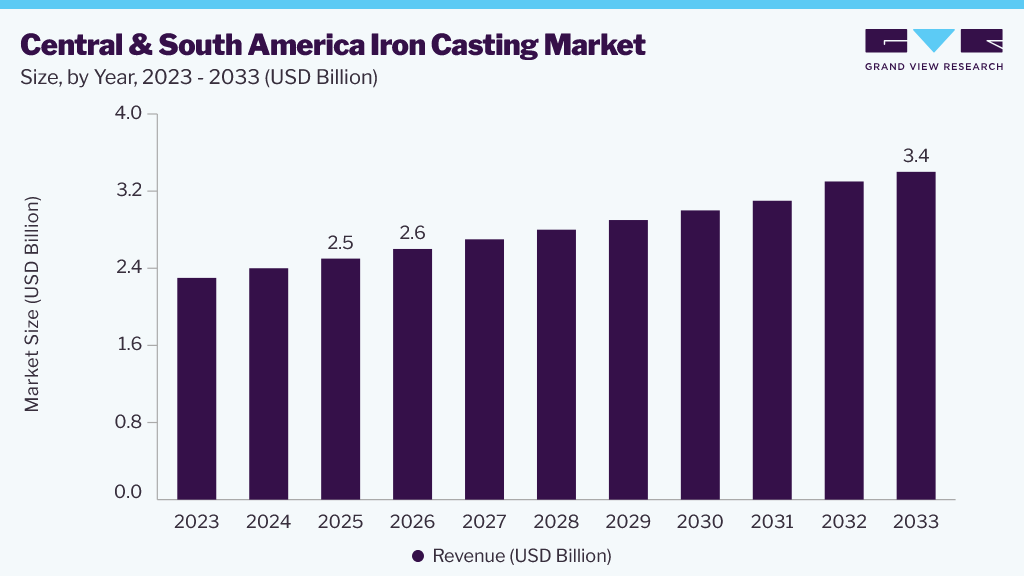 Source: Grand View Research, IR Documents, Primary Interviews, Paid DatabasesTo learn more about this report,
 Download Free Sample Report
Brazil's rising demand for iron castings can be attributed to increasing infrastructure development projects, the rapidly growing energy generation sector, and surging investments by automobile manufacturers. According to the Brazilian Ministry of Transport, the investments in railway and highway infrastructure are expected to reach USD 80 billion by 2030. This major investment plan is expected to increase demand for iron castings used in railway parts, construction machinery, heavy equipment, and transportation infrastructure. Ongoing industrial growth and modernization efforts are also likely to boost the use of cast iron products in important sectors in Brazil.
The increasing number of projects in Brazil for sanitation, sewage, and wastewater treatment is expected to fuel market growth. For instance, the lack of sewerage and sanitation systems in Brazil has compelled the country to secure a USD 128 billion loan from IDB to improve water, sewerage, and sanitation services in Joinville, one of its municipalities. Furthermore, the demand for iron castings is expected to rise in Central & South America due to rising vehicle production, driven by a growing population and higher per capita income among the younger generation.
Iron castings are used to manufacture engine blocks, cylinder heads, brake rotors, and steering knuckles. According to OICA, in 2025, automotive production in South America increased from 2,970,253 in 2023 to 3,169,476, representing a growth of around 6.3%. The increase in automotive production serves as a growth driver for the market; however, regulatory pressure to improve vehicle efficiency and reduce greenhouse gas emissions obstructs this driver. Aluminum is considered a sustainable material, and its use instead of iron & steel prevents around 70 million tons of unwanted CO2 from entering the atmosphere. The various advantages of aluminum in the automotive industry are likely to act as a restraining factor on the use of iron castings in the region over the forecast period.
Market Dynamics
The market in Central and South America is growing steadily. This growth is driven by rising investments in infrastructure projects, more industrial activities, and increased demand from the automotive, construction, mining, and energy sectors. Higher government spending on transportation networks, railways, roads, and public infrastructure is increasing the need for iron castings used in heavy machinery, structural components, and industrial equipment. In addition, the region’s expanding manufacturing base and ongoing modernization of industrial facilities are boosting demand for durable, affordable casting solutions.
The growth of the automotive and machinery industries is a key factor driving the market in Central and South America. Iron castings are widely used to make engine blocks, transmission housings, brake systems, steering components, agricultural equipment, construction machinery, and mining equipment because of their strength, durability, wear resistance, and cost-effectiveness. As automotive manufacturers increase production capacity and demand for machinery rises in the mining, construction, and agriculture sectors, the need for high-quality gray and ductile iron castings also grows. The region is attracting significant investment from global automakers, boosting demand for locally sourced cast components. For instance, in February 2026, BYD announced plans to localize 50% of the components for vehicles produced at its new Brazilian facility by January 2027, through a mix of in-house production and local sourcing. Similarly, in March 2026, GAC Group confirmed plans to start vehicle production in Brazil in 2027 and announced investments of about USD 1.3 billion by 2030 to set up and expand its operations. During the same time, Jetour began operations in Brazil and announced plans to start local vehicle manufacturing in 2027, with an initial annual production capacity of up to 50,000 units. These investments are expected to increase demand for locally manufactured automotive components and industrial equipment, supporting market growth across Central and South America.
The Central and South American market faces challenges due to high energy demands from casting operations and rising production costs. Iron casting processes consume significant amounts of electricity and fuel for melting, molding, heat treatment, and finishing. This makes energy one of the largest expenses for foundries. Also, stricter environmental regulations aimed at reducing industrial emissions are pushing foundries to invest in cleaner and more energy-efficient production technologies. While modern furnaces, automated systems, and emission-control equipment can boost efficiency and sustainability, implementing these solutions requires significant investment. As a result, many small- and medium-sized foundries struggle with financial constraints, limiting their ability to upgrade their facilities. This limits productivity improvements and increases cost pressure across the industry. These issues remain significant obstacles to market growth.
Analyst Perspective
The market in Central and South America is experiencing steady long-term growth. This growth is driven by increasing industrialization, the expansion of the automotive and construction sectors, and a rising demand for robust, durable metal components for heavy machinery, infrastructure, and energy applications. Countries including Brazil and Argentina are seeing increased investment in manufacturing and infrastructure, leading to higher demand for iron castings for automotive parts, pipelines, machinery, and structural components. The market is also shaped by improvements in casting technologies, including better molding processes, automation, and energy-efficient melting systems. These advances improve production efficiency, product quality, and cost competitiveness.
Application Insights
The automotive application segment held the largest revenue share of over 30.0% in 2025. Iron castings are commonly used to make automotive parts, including engine blocks, gear housing, elbows, manifolds, crankshafts, flywheels, differential cases, front axle supports, lift arms, knuckles, and gear carrier assemblies. The automotive industry is getting a boost from government funding and policies throughout Central and South America. For instance, in June 2024, the Brazilian Government launched the Green Mobility and Innovation Program (MOVER). This program aims to support the growth of Brazil’s national automotive industry by encouraging improvement in the energy efficiency of vehicles sold in the country and the development of new technologies. In addition to financial incentives, MOVER sets mandatory requirements for the sale of new light- and heavy-duty vehicles, along with energy-efficiency and carbon-emission targets. Through this program, the government seeks to attract new investments in industry, strengthen its supply chain, and enhance the industry's export-focused nature. As a result, these initiatives are expected to foster growth in the automotive sector.
The railway segment is expected to register the fastest CAGR from 2026 to 2033, owing to the high investments to meet the rising demand for mass mobility. For instance, in May 2026, Argentina’s state operator SOFSE signed a contract worth USD 324 million. This order includes 36 three-car DMUs for 1,676 mm gauge and 7 six-car DMUs for 1,000 mm gauge, with delivery required within 18 months. These projects are likely to increase the demand for iron castings in the region in the coming years.
Product Insights
The gray iron segment held the largest revenue share of about 58.0% of the overall market in 2025, and this trend is anticipated to continue over the forecast period. In this type of casting, the carbon and silicon content of gray cast iron ranges from 2.5-4% and 1-3%, respectively, and possesses a graphitic microstructure. Gray iron castings are widely used in machinery & tools due to their high compressive strength, good machinability and damping capacity, high thermal conductivity, low-cost production, and excellent wear resistance. Machine tool vibration results in poor part accuracy & surface finish and accelerates the failure of components like bearings. To tackle this problem, grey iron casting is used.
The ductile iron segment is anticipated to register the fastest growth rate over the forecast period. Compared to gray iron, it offers higher toughness and strength. It finds applications in various products, such as switch boxes, crankshafts, electrical fittings, cylinder heads, motor frames, flywheels, drive pulleys, work rolls, and circuit breakers. Its ductile nature makes it suitable for pipes as well. Hence, growing investments in the water treatment and sewage industry are anticipated to boost segment growth over the coming years.
Country Insights
Brazil held the largest share of revenue in 2025. Brazil's iron casting market is being notably influenced by large-scale infrastructure projects and the expansion of transportation networks across the country. Government-driven investments in highways, railways, urban transit systems, ports, and logistics infrastructure are driving strong demand for durable, affordable iron cast components used in construction machinery, rail fittings, bridges, structural frameworks, and heavy transport equipment. Iron castings, especially gray and ductile grades, are popular owing to their strength, wear resistance, and ability to bear heavy loads in challenging infrastructure projects. Furthermore, the ongoing modernization of Brazil's logistics and freight corridors to enhance trade efficiency is also increasing the need for heavy-duty machinery and equipment, thus supporting iron casting consumption.
Argentina Iron Casting Market Trends
The iron casting market in Argentina is anticipated to register the fastest revenue growth over the forecast period. The market is benefiting from rising investments in the energy, mining, and agricultural sectors, which are major users of heavy machinery and industrial equipment. The country's growing mining activities, especially in lithium, copper, and other essential minerals, are driving demand for robust cast components used in mining equipment and processing machinery. In addition, investments in oil and gas development, including the growth of the Vaca Muerta shale formation, are increasing demand for industrial equipment, pumps, valves, and pipeline parts. These trends are likely to promote long-term growth in iron casting demand across Argentina.
Key Central and South America Iron Casting Company Insights
The landscape is very competitive. As a result, key players have been devising strategies to enhance their capacities through product development, innovations, and mergers & acquisitions.
Key Central and South America Iron Casting Companies
-
Boherdi Foundry
-
CALMET
-
Castertech (Randon Companies)
-
Fagor Ederlan
-
Fundição Regali Brasil
-
Fundición Callao S.A.
-
Funvesa
-
Grupo Industrial Saltillo (GIS)
-
Industrias Ascheri & Cia.
-
ISOFUND
-
LEPE
-
Teksid SpA
-
WHB Brasil
Recent Developments
-
In October 2024, Tupy, a producer of cast iron structural components and capital goods, announced a capacity expansion for Compacted Graphite Iron (CGI) production in Mexico. The expansion of the existing SinterCast process control system aims to support the increasing demand for CGI from the heavy-duty commercial vehicle sectors in Europe and North America.
Central & South America Iron Casting Market Report Scope
Report Attribute
Details
Market size in 2025
USD 2.5 billion
Estimated market size in 2026
USD 2.6 billion
Projected market size by 2033
USD 3.4 billion
Growth rate
CAGR of 3.6% from 2026 to 2033
Historical data
2021 - 2025
Forecast period
2026 - 2033
Quantitative units
Revenue in USD billion, and CAGR from 2026 to 2033
Report coverage
Revenue forecast, company ranking, competitive landscape, growth factors, and trends
Segments covered
Product, application, country
Country scope
Brazil; Argentina; Chile
Key companies profiled
Boherdi Foundry; CALMET; Fundición Callao SA; Funvesa; Industrias Ascheri & Cia; Grupo Industrial Saltillo (GIS); ISOFUND; LEPE; WHB Brasil; Fagor Ederlan; Teksid SpA; Fundição Regali Brasil; Castertech (Randon Companies)
Customization scope
Free report customization (equivalent up to 8 analysts working days) with purchase. Addition or alteration to country, regional & segment scope.
Pricing and purchase options
Avail of customized purchase options to meet your exact research needs. Explore purchase options
Central & South America Iron Casting Market Report Segmentation
This report forecasts revenue growth at the regional and country levels and provides an analysis of the latest industry trends and opportunities in each of the sub-segments from 2021 to 2033. For this study, Grand View Research has segmented the global Central & South America iron casting market report based on product, application, and country:
-
Product Outlook (Volume, Kilotons; Revenue, USD Billion, 2021 - 2033)
-
Gray Iron
-
Ductile Iron
-
Malleable Cast Iron
-
-
Application Outlook (Volume, Kilotons; Revenue, USD Billion, 2021 - 2033)
-
Automotive
-
Machinery & Tools
-
Pipes & Fittings
-
Railways
-
Power Generation
-
Others
-
-
Country Outlook (Volume, Kilotons; Revenue, USD Billion, 2021 - 2033)
-
Central & South America
-
Brazil
-
Argentina
-
Chile
-
-
Frequently Asked Questions About This Report
The global Central & South America iron casting market size was valued at USD 2.5 billion in 2025 and is estimated at USD 2.6 billion for 2026.
The global Central & South America iron casting market is expected to grow at a CAGR of 3.6% from 2026 to 2033, reaching USD 3.4 billion.
Key players include Boherdi Foundry; CALMET; Fundición Callao SA; Funvesa; Industrias Ascheri & Cia; Grupo Industrial Saltillo (GIS); ISOFUND; LEPE; WHB Brasil; Fagor Ederlan; Teksid SpA; Fundição Regali Brasil; Castertech (Randon Companies)
The growing demand for pipes & fittings in sewage projects, and in the oil & distribution network, along with increasing investment in railway infrastructure is anticipated to drive the Central & South America iron casting market.
Based on application segment, automotive held the largest revenue share of more than 30.0% in 2025 owing to increasing production of vehicles in the region.
About the Author(s)
Advanced Interior Materials Research Team
Advanced Materials · Advanced Interior MaterialsThis report was authored by the advanced interior materials research team at Grand View Research - comprising two research analysts, one senior research analyst, and one industry expert - with specialized expertise in the advanced interior materials segment of the advanced materials industry. All findings are based on proprietary advanced materials databases, executive interviews, and regulatory analysis, subject to internal peer review prior to publication.
Last Updated:
Speak to Analyst

Customize this report to your needs - add regions, segments, or data points, with 20% free customization.
Or view our licence options:


ISO 9001:2015 & 27001:2022 Certified
We are GDPR and CCPA compliant! Your transaction & personal information is safe and secure. For more details, please read our privacy policy.


