
- Home
- »
- Advanced Interior Materials
- »
-
Cleanroom Consumables Market Size & Share Report, 2033GVR Report cover
![Cleanroom Consumables Market (2026 - 2033)Report]()
Cleanroom Consumables Market (2026 - 2033)
Size, Share & Trends Analysis Report By Type (Cleanroom PPE, Cleaning Products), By Sterility (Sterile, Non Sterile), By End-use (Medical Device Companies, Hospitals & Diagnostic Laboratories), By Region, And Segment Forecasts
Market Size, 2025
$4.6BMarket Estimate, 2026
$4.9BMarket Forecast, 2033
$8.2BCAGR, 2026–2033
7.7%Cleanroom Consumables Market Summary
The global cleanroom consumables market size was valued at USD 4.6 billion in 2025 and is projected to grow from USD 4.9 billion in 2026 to USD 8.2 billion by 2033, at a CAGR of 7.7% from 2026 to 2033. North America dominated the market, accounting for a revenue share of 30.3% in 2025. The market is driven by increasing adoption across pharmaceutical, biotechnology, semiconductor, and healthcare industries, where stringent contamination control requirements are critical for maintaining product quality and compliance.

Key Market Trends & Insights
- By type: The cleaning products segment accounted for 33.5% of the market revenue in 2025.
- By sterility: Thenon-sterile segment dominated the market in 2025, accounting for 54.2% market share.
- By end use: The pharmaceutical & biotechnology companies segment accounted for the largest share of 39.1% in 2025.
Regional Highlights
- Largest regional market: North America (30.3% revenue share, 2025)
- Fastest-growing regional market: Asia Pacific (highest CAGR, 2026-2033)
- By country: The U.S. held the largest market share in 2025.
Market Size & Forecast
- Market Size in 2025: USD 4.6 Billion
- Estimated Market Size in 2026: USD 4.9 Billion
- Projected Market Size by 2033: USD 8.2 Billion
- CAGR (2026-2033): 7.7%

Growth in sterile manufacturing, advanced semiconductor production, and research facilities is fueling demand for cleanroom apparel, gloves, wipes, and other consumables. In addition, expanding investments in pharmaceutical manufacturing, biotechnology research, semiconductor fabrication, and medical device production are reinforcing demand for cleanroom consumables. The increasing emphasis on contamination control, regulatory compliance, and product quality in controlled manufacturing environments continues to support market expansion. Ongoing capacity additions in cleanroom facilities and the adoption of stricter operational standards are further contributing to sustained demand worldwide.Market Dynamics
The global market is driven by increasing contamination control requirements across pharmaceutical, biotechnology, semiconductor, medical device, and healthcare industries. The expansion of sterile manufacturing and cleanroom facilities is accelerating demand for consumables such as gloves, apparel, wipes, masks, and disinfectants. Stringent regulatory standards governing controlled environments continue to support product adoption. The recurring need to replace disposable consumables ensures consistent demand across end-use industries. Ongoing investments in cleanroom infrastructure are further strengthening market growth.
The growing production of sterile pharmaceuticals, biologics, medical devices, and semiconductor components is increasing the consumption of cleanroom consumables. Compliance with GMP, ISO cleanroom standards, and other regulatory requirements is driving the adoption of certified contamination-control products. Expansion of aseptic manufacturing and laboratory operations is further supporting demand. The increasing focus on product quality and process integrity is encouraging the routine replacement of cleanroom consumables. Capacity expansion across life sciences and electronics manufacturing continues to reinforce market growth.The continuous replacement of disposable cleanroom consumables increases operating expenses for manufacturers and research facilities. Compliance with stringent quality standards also raises procurement and validation costs. The disposal of single-use garments, gloves, wipes, and masks poses environmental and waste-management challenges. The adoption of sustainable alternatives often involves additional investment and qualification processes. These factors can limit adoption among cost-sensitive end users.Increasing investments in biopharmaceutical manufacturing, vaccine production, semiconductor fabrication, and medical device manufacturing are creating significant market opportunities. New cleanroom construction and facility expansion are increasing the demand for contamination control products. Growing adoption of advanced manufacturing technologies is further supporting consumable usage. Manufacturers are also introducing sustainable and application-specific consumables to address evolving customer requirements. These trends are expected to support long-term market expansion.Market Concentration & Characteristics
The global market is characterized by established international manufacturers and specialized regional suppliers competing across the pharmaceutical, biotechnology, semiconductor, medical device, and electronics industries. Competition is based on product quality, regulatory compliance, manufacturing capabilities, and comprehensive contamination control solutions. Companies are strengthening their market position through portfolio expansion, geographic diversification, mergers and acquisitions, and strategic partnerships to enhance production capacity and broaden their customer base.
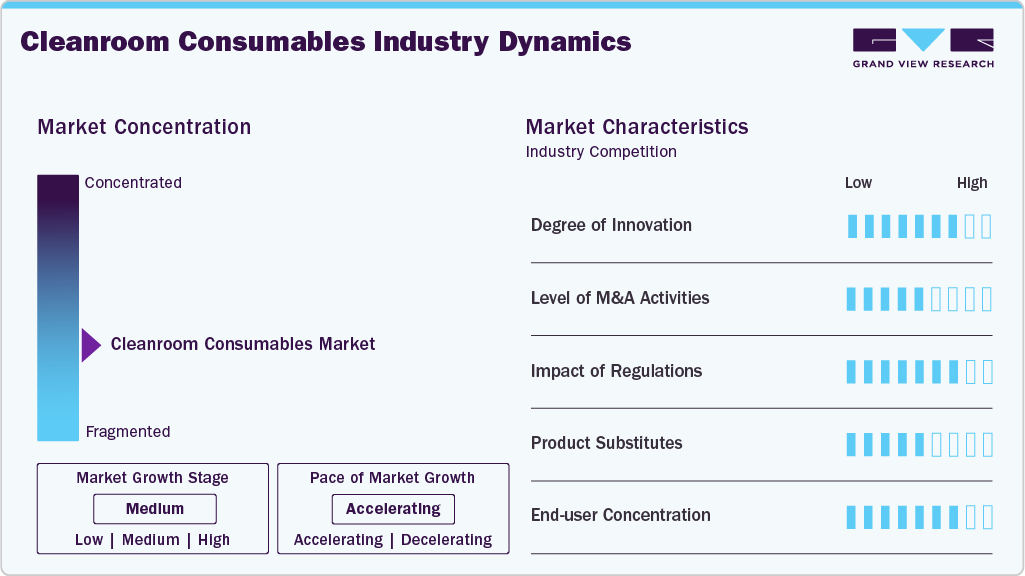
Innovation in the market is focused on developing advanced cleanroom consumables with enhanced particle control, material compatibility, and operational efficiency. Manufacturers are investing in research and development to introduce low-lint, high-performance, and sustainable products that comply with evolving industry standards. Continuous technological advancements are supporting product differentiation and improving contamination control across critical manufacturing environments.
The market is shaped by stringent regulatory requirements, increasing adoption of controlled manufacturing environments, and expanding investments in pharmaceutical, biotechnology, semiconductor, and medical device manufacturing. Companies are prioritizing quality assurance, supply chain resilience, automation, and long-term customer partnerships to strengthen their competitive position. Ongoing capacity expansion and strategic acquisitions continue to reinforce market competitiveness while supporting sustained global demand for cleanroom consumables.
Analyst Perspective
The market is experiencing robust growth as industries continue to prioritize contamination control, product quality, and regulatory compliance across highly controlled manufacturing environments. Increasing investments in semiconductor fabrication, pharmaceutical production, biotechnology research, medical device manufacturing, and advanced healthcare facilities are driving sustained demand for high-performance cleanroom gloves, apparel, wipes, masks, and other disposable consumables. In addition, the rapid expansion of semiconductor manufacturing capacity, the growth of biologics production, and stricter Good Manufacturing Practice (GMP) and ISO cleanroom standards are accelerating the adoption of sterile, low-particle, and single-use consumables. Manufacturers are also focusing on developing sustainable and high-performance materials that offer enhanced protection, reduced particle generation, and improved user comfort.
Type Insights
The cleaning products segment accounted for 33.5% of the market revenue in 2025, driven by the recurring consumption of cleanroom wipes, disinfectants, mops, and specialized cleaning agents used to maintain controlled manufacturing environments. Their high replacement frequency and indispensable role in routine sanitation protocols drive consistent demand across industries that require strict particulate and microbial control.
The cleanroom PPE segment is expected to register the fastest CAGR over the forecast period, fueled by expanding semiconductor fabrication capacity, biologics production, and medical device manufacturing. Increasing adoption of disposable gloves, coveralls, masks, and shoe covers, coupled with growing focus on worker protection, product integrity, and single-use contamination prevention solutions, is expected to support strong market growth.
Sterility Insights
The non-sterile segment accounted for the largest revenue market share of 54.2% in 2025, owing to its widespread use in routine contamination control activities where sterile conditions are not required. Products such as non-sterile gloves, wipes, apparel, face masks, and cleaning materials are consumed in high volumes due to their lower cost, broad applicability, and frequent replacement, making them the primary revenue contributor across cleanroom operations.
The sterile segment is projected to register the fastest CAGR of 8.1% over the forecast period, driven by increasing demand for consumables that meet stringent sterility and regulatory requirements. The growing use of sterile gloves, garments, wipes, and other disposable products in aseptic manufacturing and other critical cleanroom environments, along with the expansion of high-value manufacturing processes, is expected to support strong segment growth.
End-use Insights
The pharmaceutical & biotechnology companies segment accounted for the largest revenue market share of 39.1% in 2025, owing to stringent regulatory requirements and the extensive use of disposable consumables in aseptic manufacturing, biologics production, and laboratory environments. The high consumption of cleanroom gloves, apparel, masks, and wipes, coupled with their frequent replacement to maintain controlled environments, continues to support the segment's revenue leadership.

The semiconductor & electronics manufacturers segment is projected to expand at a CAGR of 8.0% over the forecast period. Growth is driven by increasing investments in advanced chip fabrication, rising production of high-performance electronic devices, and the need for ultra-clean manufacturing environments. The growing complexity of semiconductor processes and stricter particle control requirements are expected to sustain demand for high-performance cleanroom consumables.
Regional Insights
North America dominated the market, accounting for a revenue share of 30.3% in 2025. The cleanroom consumables market in North America is supported by a well-established life sciences ecosystem, advanced semiconductor manufacturing, and stringent quality standards across regulated industries. Continued investments in pharmaceutical production, biotechnology, medical devices, and high-value electronics are driving the adoption of cleanroom consumables. The expansion of advanced manufacturing facilities and increasing emphasis on contamination control are further supporting market growth. In addition, ongoing modernization of production infrastructure and automation initiatives are creating sustained demand for high-performance consumables.

U.S. Cleanroom Consumables Market Trends
The U.S. cleanroom consumables marketis driven by strong investments in pharmaceutical manufacturing, biotechnology research, and semiconductor fabrication. The increasing production of biologics, advanced therapeutics, and high-performance chips continues to drive demand for cleanroom consumables in regulated environments. Government initiatives to strengthen domestic manufacturing and ongoing investments in research and development are further contributing to market expansion.
The cleanroom consumables market in Canada is supported by the expansion of biopharmaceutical manufacturing, life sciences research, and medical device production. Investments in research laboratories, healthcare infrastructure, and advanced manufacturing facilities are contributing to the growing adoption of cleanroom consumables. The increasing focus on product quality, regulatory compliance, and contamination prevention continues to drive demand across controlled environments. Government initiatives promoting innovation and domestic manufacturing capacity are expected to create additional growth opportunities.
Asia Pacific Cleanroom Consumables Market Trends
Asia Pacific is driven by the continued expansion of semiconductor manufacturing, pharmaceutical production, biotechnology research, and medical device manufacturing. Growing investments in advanced manufacturing facilities, increasing automation, and the implementation of stringent quality and contamination control standards are supporting the adoption of cleanroom consumables across diverse industrial and healthcare applications. In addition, favorable government policies and ongoing capacity expansions in high-value manufacturing sectors continue to strengthen market demand.
The cleanroom consumables market in China is supported by significant investments in semiconductor fabrication, electronics manufacturing, pharmaceutical production, and biotechnology. Government initiatives to enhance domestic semiconductor capabilities, expansion of biologics manufacturing, and continuous modernization of advanced manufacturing facilities are expected to sustain demand for cleanroom gloves, apparel, wipes, masks, and other consumables.
India cleanroom consumables market is benefiting from the rapid growth of pharmaceutical manufacturing, contract development and manufacturing organizations (CDMOs), biotechnology research, and medical device production. Increasing investments in healthcare infrastructure, expanding life sciences research, and government initiatives to strengthen domestic electronics and semiconductor manufacturing are expected to support the adoption of cleanroom consumables throughout the forecast period.
Europe Cleanroom Consumables Market Trends
The cleanroom consumables market in Europe benefits from a well-established base of regulated manufacturing industries that require controlled production environments. Stringent quality standards, ongoing modernization of cleanroom facilities, and increasing adoption of contamination control practices continue to support demand for cleanroom consumables. Growth in biologics manufacturing, precision electronics, and medical technologies is further driving demand for gloves, apparel, wipes, masks, and other cleanroom products. Continuous investments in advanced manufacturing are expected to sustain market development.
Germany cleanroom consumables market is supported by its advanced pharmaceutical, semiconductor, and medical technology industries. Expansion of precision manufacturing and research facilities continues to increase the use of cleanroom consumables across production and quality control operations. The country's emphasis on process reliability, automation, and high manufacturing standards is expected to sustain product demand throughout the forecast period.
The cleanroom consumables market in France is characterized by expanding pharmaceutical production, biotechnology research, and medical device manufacturing. Increasing cleanroom capacity, laboratory modernization, and the adoption of advanced manufacturing practices are driving demand for cleanroom consumables in regulated production environments. Growing emphasis on quality assurance and compliance with international standards is expected to support steady market growth.
Middle East & Africa Cleanroom Consumables Market Trends
The cleanroom consumables market in MEA is supported by the expansion of controlled manufacturing environments across the pharmaceutical, biotechnology, medical device, and electronics industries. The growing adoption of cleanroom standards, increasing investment in regulated production facilities, and rising emphasis on contamination control are driving demand for cleanroom gloves, apparel, wipes, masks, and other consumables. The modernization of manufacturing infrastructure and strengthening quality assurance practices are expected to support market growth over the forecast period.
Saudi Arabia cleanroom consumables market is supported by the expansion of pharmaceutical manufacturing and life sciences under Vision 2030. Investments in regulated production facilities, laboratory infrastructure, and medical device manufacturing are increasing the demand for cleanroom consumables. The country's focus on strengthening domestic manufacturing capabilities, improving quality standards, and expanding advanced industrial facilities is expected to support continued market growth. The rising adoption of cleanroom protocols across high-value manufacturing sectors is expected to further drive product demand.
Latin America Cleanroom Consumables Market Trends
The cleanroom consumables market in Latin America is characterized by the increasing adoption of controlled manufacturing environments across the pharmaceutical, biotechnology, medical device, and electronics industries. The growing adoption of cleanroom standards, the modernization of production facilities, and a greater emphasis on contamination control are driving demand for cleanroom consumables. Rising compliance with international quality standards and expanding cleanroom capacity continue to drive the consumption of gloves, apparel, wipes, masks, and other disposable cleanroom products across regulated manufacturing operations.
Brazil cleanroom consumables market is supported by the expansion of regulated manufacturing and laboratory facilities that require controlled production environments. Investments in pharmaceutical manufacturing, biotechnology, and medical device production are increasing demand for cleanroom consumables to prevent contamination and ensure process reliability. The continued adoption of international quality standards, together with the modernization of cleanroom infrastructure, is expected to sustain product demand over the forecast period.
Key Cleanroom Consumables Company Insights
Some of the key players operating in the market include Kimberly-Clark Corporation and Ansell Ltd., among others.
-
Kimberly-Clark Corporation is a global manufacturer of personal care, professional hygiene, and contamination control products. Through its Kimtech portfolio, the company offers a comprehensive range of cleanroom consumables, including gloves, apparel, face masks, and wipes designed for controlled environments. Its products serve the pharmaceutical, biotechnology, semiconductor, electronics, and laboratory industries. The company focuses on product innovation, regulatory compliance, and contamination prevention to support critical manufacturing processes.
-
Ansell Ltd. is a global manufacturer of personal protective equipment specializing in hand, body, and respiratory protection solutions. The company provides a broad portfolio of cleanroom consumables, including sterile and non-sterile gloves, garments, sleeves, and other protective apparel for contamination-controlled environments. Its products are widely used across the pharmaceutical, biotechnology, medical devices, semiconductor, and electronics manufacturing industries. Ansell emphasizes continuous product innovation, material advancements, and compliance with international quality standards.
Key Cleanroom Consumables Companies:
The following key companies have been profiled for this study on the cleanroom consumables market
-
Kimberly-Clark Corporation
-
Ansell Ltd.
-
DuPont de Nemours, Inc.
-
Contec, Inc.
-
Berkshire Corporation
-
Valutek Inc.
-
Texwipe
-
KM Corporation
-
Micronclean Ltd.
-
STERIS plc
-
Ecolab Inc.
-
Nitritex Ltd.
-
Micronova Manufacturing, Inc.
-
Dastex Reinraumzubehör GmbH & Co. KG
-
Riverstone Holdings Limited
Competitive Benchmarking
Category
Operating Strategies
Competitive Edge
Weakness
Established Players (e.g., Kimberly-Clark Corporation, Ansell Ltd., DuPont de Nemours, Inc., Contec, Inc., Berkshire Corporation, Texwipe, STERIS plc, Ecolab Inc.)
- Expand the portfolios of cleanroom gloves, apparel, wipes, disinfectants, and other contamination-control consumables.
- Invest in product innovation, regulatory compliance, manufacturing expansion, and strategic acquisitions.
- Broad product portfolios with strong regulatory compliance and global distribution networks.
- Strong brand recognition and long-term relationships with pharmaceutical, biotechnology, semiconductor, and healthcare customers.
- High manufacturing and regulatory compliance costs.
- Dependence on raw material availability and increasing sustainability requirements for disposable consumables.
Emerging & Regional Players (e.g., Alutek Inc., KM Corporation, Micronclean Ltd., Nitritex Ltd., Micronova Manufacturing, Inc., Dastex Reinraumzubehör GmbH & Co. KG, Riverstone Holdings Limited)
- Focus on specialized cleanroom consumables and application-specific product development.
- Expand regional presence through localized manufacturing, distributor partnerships, and customer-focused technical support.
- Strong customization capabilities and flexibility in meeting customer-specific contamination control requirements.
- Competitive pricing and specialized product offerings for regional and niche cleanroom applications.
- Limited global presence and narrower product portfolios than multinational manufacturers.
- Smaller production capacity and lower investment capability for large-scale expansion and acquisitions.
Recent Developments
-
In March 2025, Ansell expanded its cleanroom consumables portfolio by introducing the Kimtech and KleenGuard brands across North America and Europe following the integration of Kimberly-Clark's Personal Protective Equipment business. The expansion strengthened the company's portfolio of cleanroom gloves, apparel, and contamination control products for pharmaceutical, biotechnology, semiconductor, and laboratory applications.
-
In June 2025, Ansell launched the KIMTECH scientific PPE range in Japan, expanding its portfolio of cleanroom gloves, apparel, and protective products for laboratory and controlled environment applications. The launch strengthened the company's presence in the Asia-Pacific market while enhancing contamination control solutions for pharmaceutical, biotechnology, semiconductor, and research industries.
Cleanroom Consumables Report Scope
Report Attribute
Details
Market Size in 2025
USD 4.6 billion
Estimated Market Size in 2026
USD 4.9 billion
Projected Market Size by 2033
USD 8.2 billion
Growth rate
CAGR of 7.7% from 2026 to 2033
Historical data
2021 - 2025
Forecast period
2026 - 2033
Quantitative units
Revenue in USD billion and CAGR from 2026 to 2033
Report coverage
Revenue forecast, company market position analysis, competitive landscape, growth factors, and trends
Segments covered
Type, sterility, end-use, region
Regional scope
North America; Europe; Asia Pacific; Latin America; MEA
Country Scope
U.S.; Canada; Mexico; Germany; UK; Italy; Spain; France; China; Japan; India; Australia; South Korea; Brazil; Argentina; Saudi Arabia; UAE; South Africa
Key companies profiled
Kimberly-Clark Corporation; Ansell Ltd.; DuPont de Nemours, Inc.; Contec, Inc.; Berkshire Corporation; Valutek Inc.; Texwipe; KM Corporation; Micronclean Ltd.; STERIS plc; Ecolab Inc.; Nitritex Ltd.; Micronova Manufacturing, Inc.; Dastex Reinraumzubehör GmbH & Co. KG; Riverstone Holdings Limited
Customization scope
Free report customization (equivalent up to 8 analysts working days) with purchase. Addition or alteration to country, regional & segment scope.
Pricing and purchase options
Avail customized purchase options to meet your exact research needs. Explore purchase options
Global Cleanroom Consumables Market Report Segmentation
This report forecasts revenue growth at global, regional & country levels and provides an analysis of the industry trends in each of the sub-segments from 2021 to 2033. For this study, Grand View Research has segmented the global cleanroom consumables market based on type, sterility, end-use, and region:

-
Type Outlook (Revenue, USD Billion, 2021 - 2033)
-
Cleanroom PPE
-
Gloves
-
Coveralls
-
Shoe Covers
-
Face Masks
-
Others
-
-
Cleaning Products
-
Wipes
-
Mops
-
Disinfectants
-
Others
-
-
-
Sterility Outlook (Revenue, USD Billion, 2021 - 2033)
-
Sterile
-
Non Sterile
-
-
End-use Outlook (Revenue, USD Billion, 2021 - 2033)
-
Pharmaceutical & Biotechnology Companies
-
Medical Device Companies
-
Semiconductor & Electronics Manufacturers
-
Hospitals & Diagnostic Laboratories
-
Research Institutes & Academic Laboratories
-
Others
-
-
Regional Outlook (Revenue, USD Billion, 2021 - 2033)
-
North America
-
U.S.
-
Canada
-
Mexico
-
-
Europe
-
Germany
-
France
-
UK
-
Spain
-
Italy
-
-
Asia Pacific
-
China
-
India
-
Japan
-
South Korea
-
Australia
-
-
Latin America
-
Brazil
-
Argentina
-
-
Middle East & Africa
-
Saudi Arabia
-
UAE
-
South Africa
-
-
Research Methodology
The cleanroom consumables market figures in this report are based on a proven research process that combines executive interviews with secondary research from proprietary databases, company filings, and recognized regulatory and institutional sources. Market size is built through value-chain sizing-reconciling supply-side and demand-side estimates-and triangulated with bottom-up and top-down approaches. Every estimate passes multiple levels of expert validation before publication, with eachcleanroom consumables segment quantified using the revenue-capture definitions in the table below.
Segment Definition
Segment - Type
Revenue Capture Definition
Cleanroom PPE
Revenue is generated from the sale of cleanroom personal protective equipment, including gloves, coveralls, shoe covers, face masks, sleeves, hoods, goggles, and other protective apparel designed to minimize particle shedding and maintain contamination control in cleanroom environments.
Cleaning Products
Revenue is generated from the sale of cleanroom personal protective equipment, including gloves, coveralls, shoe covers, face masks, sleeves, hoods, goggles, and other protective apparel designed to minimize particle shedding and maintain contamination control in cleanroom environments.
Segment - Sterility
Revenue Capture Definition
Sterile
Revenue is generated from the sale of sterile cleanroom consumables that undergo validated sterilization processes and are supplied ready for use in aseptic and contamination-sensitive manufacturing environments.
Non Sterile
Revenue is generated from the sale of non-sterile cleanroom consumables intended for controlled environments where sterilization is not required, but particulate and contamination control remain essential.
Segment - End Use
Revenue Capture Definition
Pharmaceutical & Biotechnology Companies
Revenue is generated from the sale of cleanroom consumables directly to pharmaceutical and biotechnology manufacturers through product sales, supply agreements, and distribution channels.
Medical Device Companies
Revenue is generated from the sale of cleanroom consumables to medical device manufacturers through direct procurement, contract supply, and distribution partnerships.
Semiconductor & Electronics Manufacturers
Revenue is generated from the sale of cleanroom consumables to semiconductor and electronics manufacturers through direct sales and industrial distribution networks.
Hospitals & Diagnostic Laboratories
Revenue is generated from the sale of cleanroom consumables to hospitals and diagnostic laboratories through healthcare procurement contracts, distributors, and institutional purchasing channels.
Research Institutes & Academic Laboratories
Revenue is generated from the sale of cleanroom consumables to research institutes and academic laboratories through laboratory supply distributors, procurement contracts, and direct sales by manufacturers.
Others
Revenue is generated from the sale of cleanroom consumables to other industrial, government, aerospace, food-processing, and specialty-manufacturing organizations that require controlled-environment products.
Estimation Model
Layer Name
Key Question
Description
Cleanroom Operations Demand Layer
Where are cleanroom consumables required?
Analyze demand across semiconductor manufacturing, pharmaceuticals, biotechnology, medical devices, hospitals, food & beverage, aerospace, and research laboratories. Assess contamination control requirements, cleanroom classifications, production volumes, and operational protocols to establish the addressable demand for cleanroom consumables.
Cleanroom Infrastructure & Capacity Expansion Layer
Where is new product demand being created?
Evaluate investments in semiconductor fabs, pharmaceutical manufacturing facilities, biotechnology laboratories, healthcare infrastructure, and electronics production plants. Assess greenfield projects, facility expansions, cleanroom upgrades, and regulatory compliance initiatives that drive procurement of new cleanroom consumables.
Product Adoption Layer
Which cleanroom consumables are being deployed?
Segment demand by product type, cleanroom class, application, end-use industry, and distribution channel. Apply adoption rates based on contamination control standards, replacement frequency, production intensity, and regulatory requirements. Assess the increasing adoption of low-lint, sterile, and single-use consumables to improve cleanliness, product quality, and operational efficiency.
Revenue Generation Layer
How much market revenue is generated?
Estimate annual consumption of cleanroom consumables by product type, application, end-use industry, and region. Quantify revenues generated exclusively from the sale of new cleanroom consumables supplied to manufacturers, healthcare facilities, laboratories, and research institutions. The scope excludes cleanroom equipment, installation, maintenance services, facility validation, and aftermarket services.
Delivered Customizations
This report has been delivered with the following In-depth customizations
Client Request
Customization Delivered Value Adds Competitive Benchmarking
A comprehensive competitive benchmarking analysis was conducted by evaluating leading cleanroom consumables manufacturers based on product portfolio, consumable categories (gloves, apparel, wipes, masks, cleaning products, stationery, and others), sterility offerings, material composition, regulatory certifications, manufacturing capabilities, distribution network, strategic initiatives, and market positioning.
The benchmarking provided a clear understanding of product differentiation, innovation trends, supplier capabilities, and competitive positioning, enabling stakeholders to assess market competitiveness and formulate effective growth strategies.
Regional Segmentation
A detailed regional assessment was conducted across North America, Europe, Asia Pacific, Latin America, and the Middle East & Africa by analyzing the adoption of cleanroom consumables across pharmaceutical & biotechnology, semiconductor & electronics, medical devices, healthcare, food processing, and research facilities. The analysis incorporated cleanroom infrastructure development, regulatory compliance, contamination control requirements, and procurement trends influencing regional demand.
The regional assessment enabled stakeholders to identify high-potential markets, evaluate regional demand patterns, optimize expansion strategies, and align product portfolios with evolving cleanroom requirements and industry standards.
Opportunity Assessment
A comprehensive opportunity assessment was conducted by evaluating the adoption of disposable cleanroom consumables, advancements in low-lint and high-performance materials, increasing demand for sterile consumables, expansion of ISO-classified cleanrooms, and evolving contamination control requirements across regulated manufacturing environments. The assessment also examined opportunities arising from sustainable product development and next-generation cleanroom materials.
The assessment enabled stakeholders to identify emerging product opportunities, prioritize innovation initiatives, support strategic investment decisions, and align product development with evolving regulatory requirements, contamination control standards, and end-user preferences.
Frequently Asked Questions About This Report
The global cleanroom consumables market size was valued at USD 4.6 billion in 2025 and is expected to reach USD 4.9 billion in 2026.
The global cleanroom consumables market, in terms of revenue, is projected to grow at a CAGR of 7.7% from 2026 to 2033, reaching USD 8.2 billion by 2033.
The pharmaceutical & biotechnology companies segment accounted for the largest revenue share of 39.3% in 2025, driven by expanding biologics production, sterile manufacturing operations, and stringent contamination control requirements.
Asia Pacific is the fastest-growing region over the forecast period.
Key players include Kimberly-Clark Corporation, Ansell Ltd., DuPont de Nemours, Inc., Contec, Inc., Berkshire Corporation, Valutek Inc., Texwipe, KM Corporation, Micronclean Ltd., STERIS plc, Ecolab Inc., Nitritex Ltd., Micronova Manufacturing, Inc., Dastex Reinraumzubehör GmbH & Co. KG, and Riverstone Holdings Limited.
Key factors include expanding pharmaceutical and biotechnology manufacturing, increasing semiconductor production, stringent contamination control requirements, growing demand for sterile manufacturing environments, and stricter regulatory standards across healthcare and life sciences industries.
North America dominated the cleanroom consumables market with the largest revenue share of 30.3% in 2025.
The non-sterile segment dominated the market with a revenue share of 54.2% in 2025, supported by its widespread use in semiconductor, electronics, and industrial manufacturing applications where particulate control is essential.
The cleaning products segment accounted for 33.5% of the market revenue in 2025, while the cleanroom PPE segment is the fastest growing type.
About the Author(s)
Advanced Interior Materials Research Team
Advanced Materials · Advanced Interior MaterialsThis report was authored by the advanced interior materials research team at Grand View Research - comprising two research analysts, one senior research analyst, and one industry expert - with specialized expertise in the advanced interior materials segment of the advanced materials industry. All findings are based on proprietary advanced materials databases, executive interviews, and regulatory analysis, subject to internal peer review prior to publication.
Last Updated:
Speak to Analyst


Customize this report to your needs — add regions, segments, or data points, with 20% free customization.
Or view our licence options:


ISO 9001:2015 & 27001:2022 Certified
We are GDPR and CCPA compliant! Your transaction & personal information is safe and secure. For more details, please read our privacy policy.


