
- Home
- »
- Communications Infrastructure
- »
-
Co-Packaged Optics (CPO) Market Size Report, 2026-2033GVR Report cover

Co-Packaged Optics (CPO) Market (2026 - 2033)
Size, Share, & Trends Analysis Report By Component (Optical Engine, PIC, Laser Source, Modulator, Photodetector), By Data Rate, By Architecture, By Application, By Region, and Segment Forecasts
Market Size, 2025
$138.6MMarket Estimate, 2026
$172.8MMarket Forecast, 2033
$1,220.6MCAGR, 2026–2033
32.2%Co-Packaged Optics (CPO) Market Summary
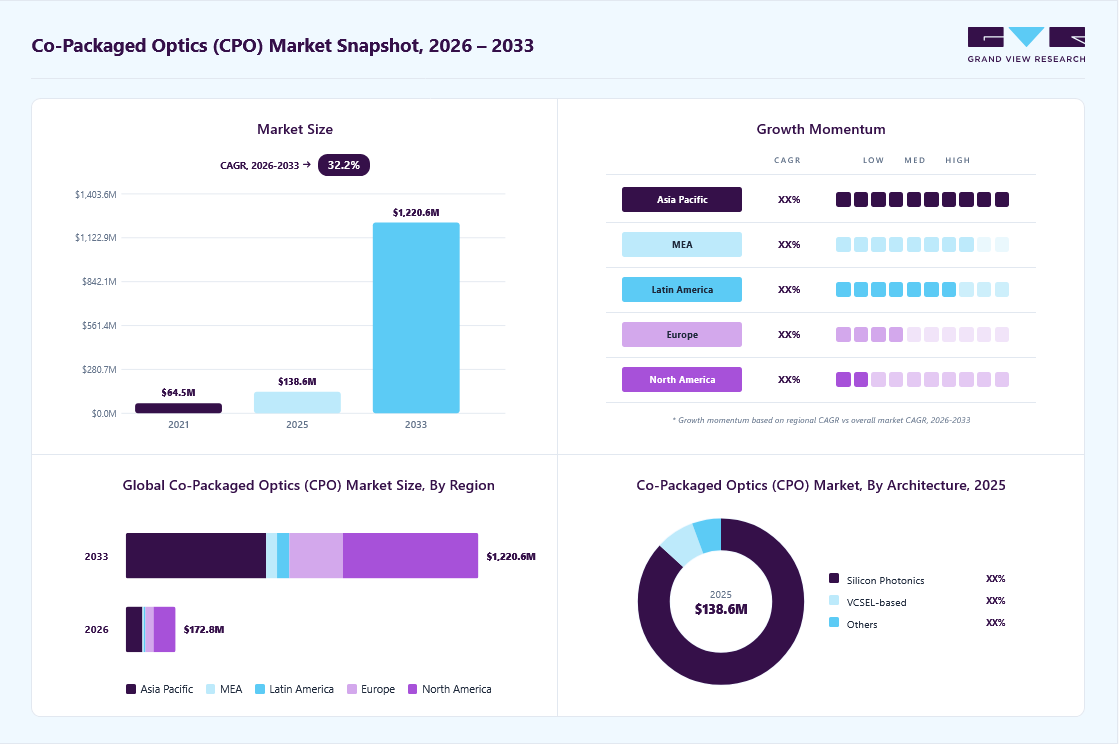
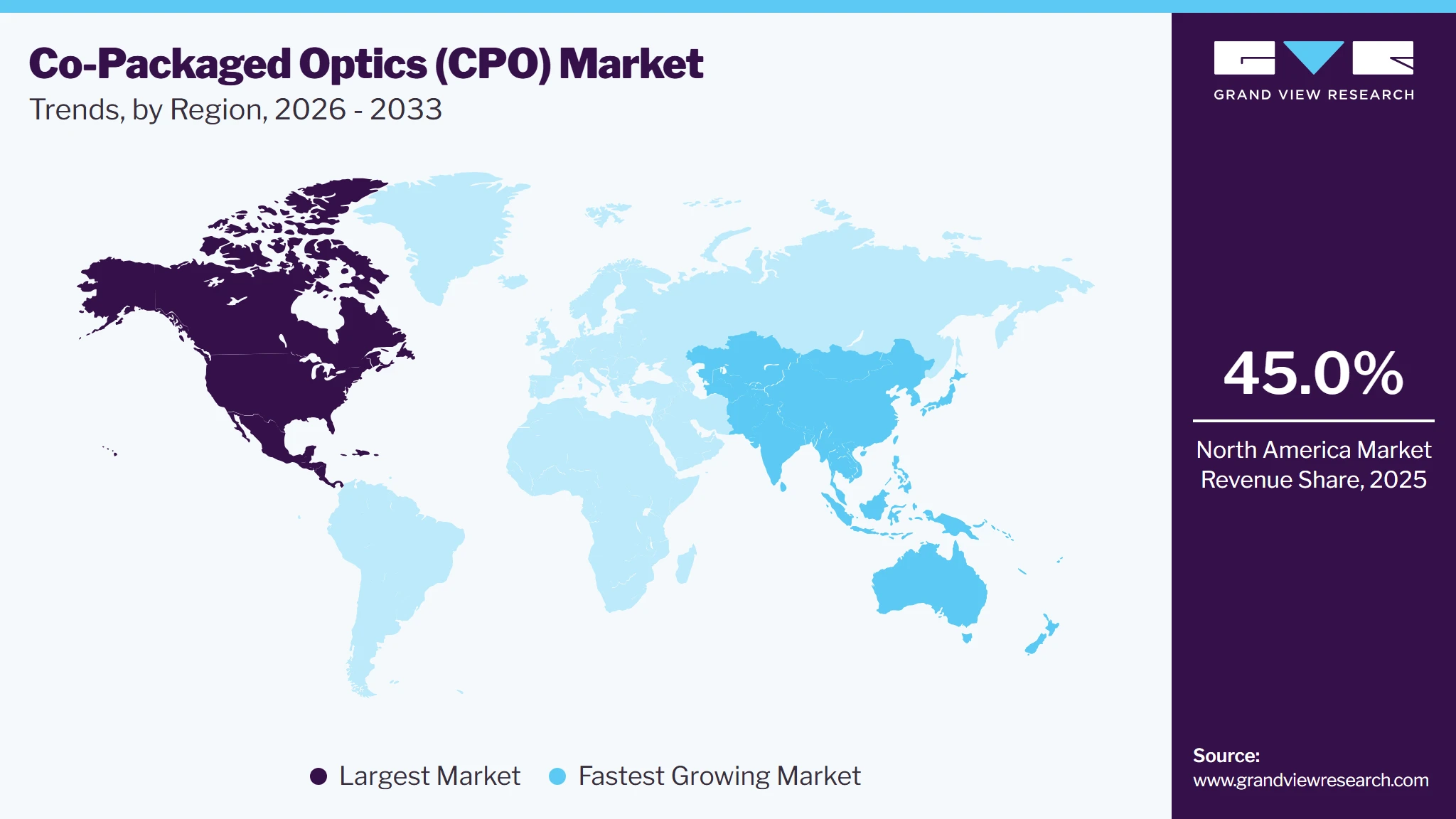
The global co-packaged optics (CPO) market size was valued at USD 138.6 million in 2025 and is projected to grow from USD 172.8 million in 2026 to USD 1,220.6 million by 2033, at a CAGR of 32.2% from 2026 to 2033. North America dominated the market, accounting for a revenue share of 45.0% in 2025. The global market is entering a transition from technology development and early deployments toward broader commercialization, primarily driven by the rapid scaling of AI workloads and hyperscale data centers.
 Source: Grand View Research, IR Documents, Primary Interviews, Paid DatabasesTo learn more about this report,
 Download Free Sample Report
 Key Market Trends & Insights
- By Component: Optical engine segment held the largest market share of around 51.0% in 2025.
- By Data Rate: 800G segment held the largest market revenue share of 39.4% in 2025.
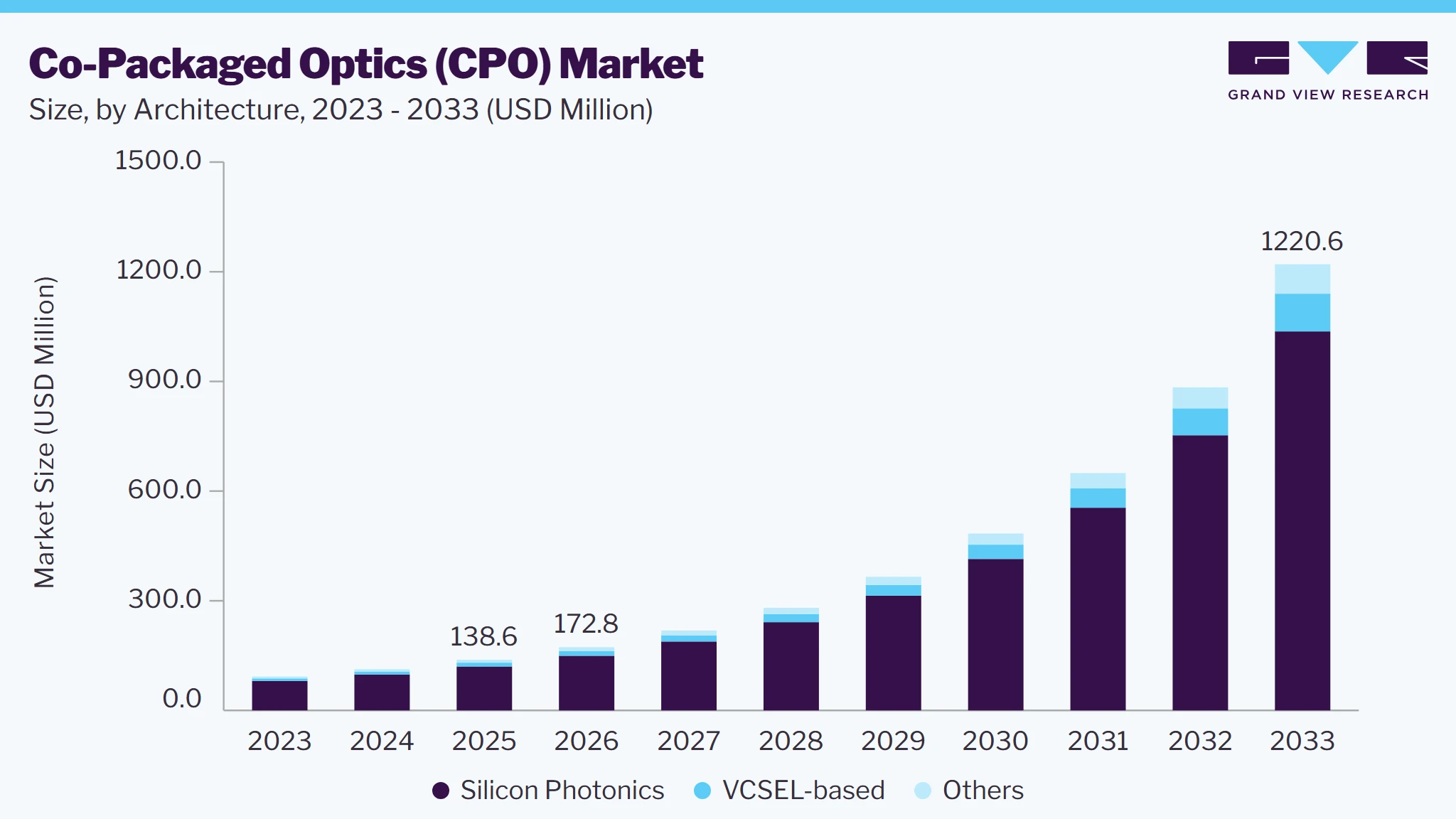
- By Architecture: Silicon Photonics segment led the market with the largest revenue share of 86.7% in 2025.
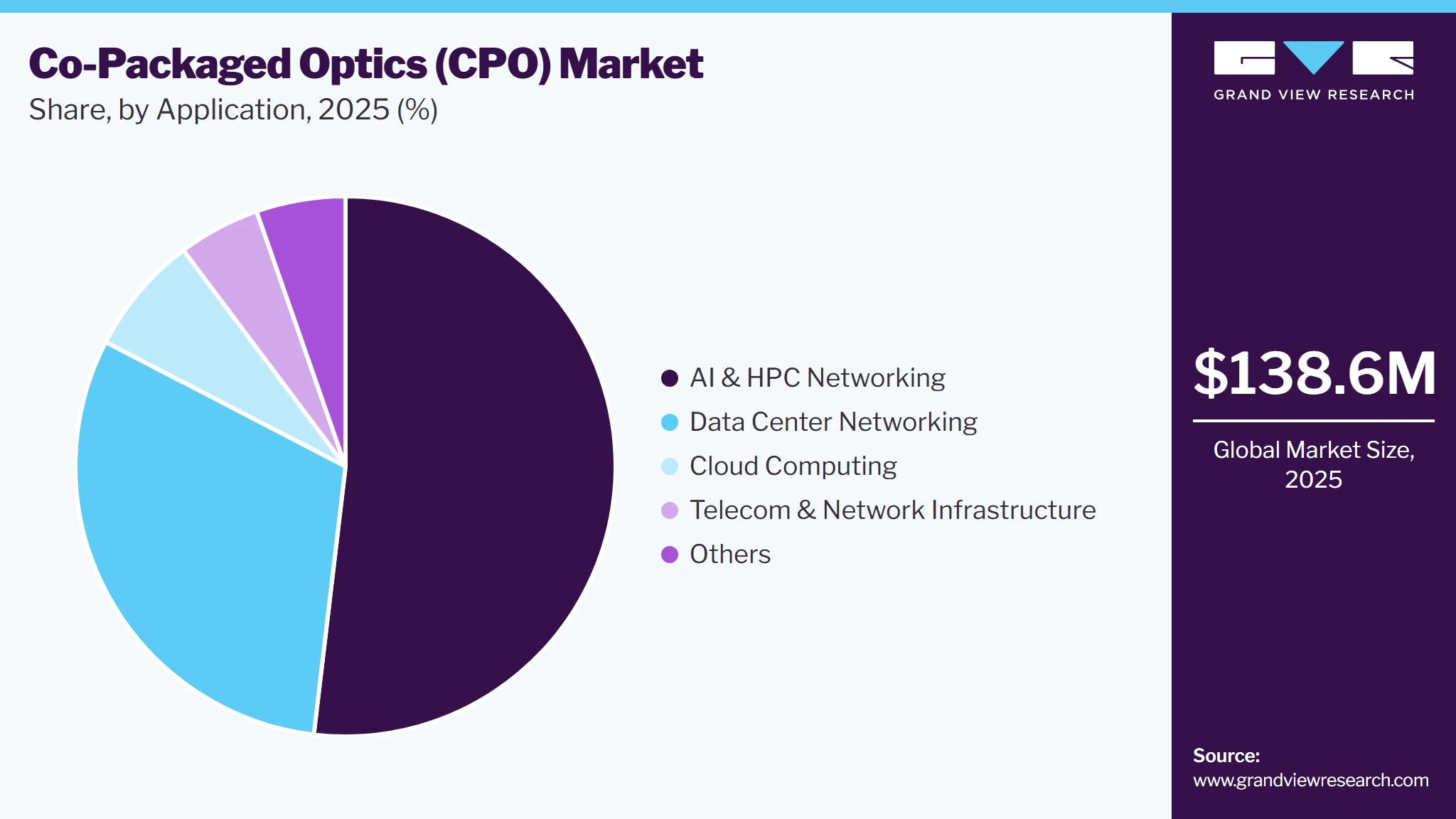
- By Application: AI & HPC Networking segment held the largest market revenue share of 51.8% in 2025.
Regional Highlights
- Largest regional market: North America (45.0% revenue share, 2025)
- Fastest-growing regional market: Asia Pacific (highest CAGR, 2026-2033)
- By country: The U.S. held the largest share in 2025.
Market Size & Forecasts
- Market size in 2025: USD 138.6 Million
- Estimated market size in 2026: USD 172.8 Million
- Projected market size by 2033: USD 1,220.6 Million
- CAGR (2026-2033): 32.2%
Three ways to get this report
Buy it, customize it, or ask a question.Ask an Analyst
A direct answer, usually in 1 working day
- AccessReport author, directly
- Reply timeWithin 1 working day
- No sales callDirect answer only
- FormatEmail reply
- CostFree, no cost
Get the Full Report
What the study covers
- FormatsPDF · Excel · Dashboard
- Timeline2026–2033 annual, 2025 base
- Coverage20+ countries, 5 regions
- Companies10+ key players profiled
Customize the Report
20% free customization
- IncludeCountries, segments, points
- TailorTo your product definition
- ExtendDeeper competitor detail
- OrA fully bespoke study
- Turnaround5–10 working days
Increasing GPU and accelerator densities are creating substantial bandwidth, latency, thermal, and power challenges within data center networks, increasing interest in integrating optical engines directly with switch ASICs and other high-performance processors.AI infrastructure expansion is expected to remain the principal demand catalyst for CPO. As data center architectures move toward 800G, 1.6T, and higher-speed interconnects, conventional electrical links and pluggable optical modules face increasing power and thermal constraints. CPO addresses these challenges by shortening electrical interconnect paths and placing optical engines closer to high-speed switching and computing silicon, supporting higher bandwidth density and improved energy efficiency. For instance, Broadcom is developing CPO platforms based on silicon photonics for Ethernet switches and AI-oriented XPUs, reflecting the industry's movement toward optical connectivity being designed into the compute and networking architecture rather than treated solely as a removable module.
 To learn more about this report, Download Free Sample Report
 The market is also witnessing increasing ecosystem development across semiconductor, photonics, packaging, and optical-component suppliers. For instance, in May 2026, GlobalFoundries introduced its SCALE optical module solution to support CPO adoption in advanced AI data centers, while industry initiatives increasingly emphasize open ecosystems and standardized approaches to address integration, manufacturing, thermal management, testing, and supply-chain requirements. At the same time, advances in silicon photonics and optical-engine architectures are pushing CPO beyond conventional switch connectivity toward increasingly integrated AI accelerator and scale-up networking architectures.
Market Dynamics
The rapid expansion of AI training and inference workloads is increasing the number of GPUs, XPUs, and accelerators that must communicate at extremely high speeds within data centers. As data rates move toward 800G, 1.6T, and beyond, conventional electrical interconnects and pluggable optical architectures face increasing challenges related to power consumption, signal loss, thermal management, and bandwidth density. CPO addresses these constraints by integrating optical engines directly alongside switch ASICs or other high-performance processing chips, substantially shortening the electrical signal path and reducing the need for power-intensive signal conditioning. Broadcom reports that its CPO architecture can reduce optical interconnect power consumption by around 70% compared with pluggable solutions, highlighting CPO's potential to improve energy efficiency in high-density AI infrastructure. The increasing deployment of large-scale AI clusters and demand for higher-radix networking are therefore accelerating investments in CPO-based architectures.
Integrating optical components and high-performance switching silicon into a single package introduces significant manufacturing and operational complexities. CPO requires precise optical alignment, advanced 2.5D/3D packaging, high-quality fiber attachment, thermal management, and reliable integration between photonic and electronic components. Unlike pluggable optics, where an individual optical module can be replaced relatively easily, failures within a CPO assembly can potentially require intervention at the system or package level, increasing concerns regarding maintenance, repair, and lifecycle management. In addition, maintaining signal integrity and reliability becomes more difficult as SerDes speeds increase, while manufacturers must achieve high assembly yields to make CPO economically competitive at volume. Industry developments are consequently focusing on external laser sources, blind-mate optical connectors, improved fiber-attach technologies, and other approaches to improve serviceability and reliability. These technical and manufacturing requirements can increase initial implementation costs and slow CPO adoption among data center operators that prioritize modularity and ease of maintenance.
The increasing size of AI clusters creates an opportunity for CPO to move beyond conventional switch connectivity into scale-up and scale-out networking architectures connecting large numbers of GPUs, XPUs, and accelerators. As AI models become more computationally intensive, communication between processors can become a significant constraint on overall cluster utilization. CPO can provide high bandwidth density while reducing the electrical distance between processing and optical components, making it suitable for architectures requiring high throughput and low latency. Broadcom's 2026 portfolio includes a 102.4-Tbps CPO Ethernet switch designed for AI scale-up and scale-out applications, while its roadmap is progressing toward higher per-lane speeds. This creates opportunities for CPO suppliers across optical engines, silicon photonics, lasers, advanced packaging, fiber coupling, and optical interconnect components as hyperscalers and AI infrastructure providers develop increasingly dense and energy-efficient computing clusters.
Market Concentration & Characteristics
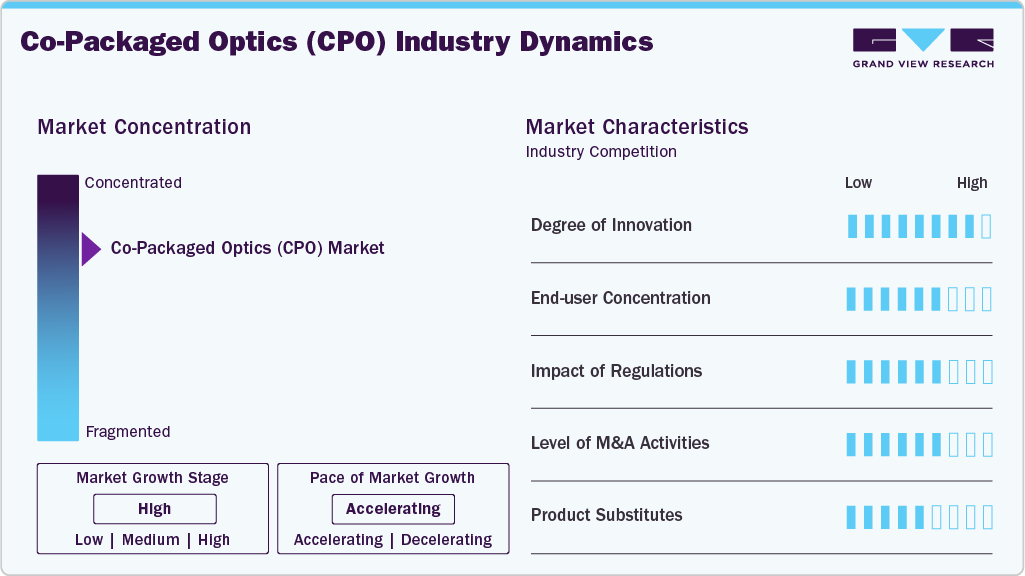
The global co-packaged optics (CPO) market is moderately concentrated, with participation from semiconductor, networking, optical components, photonics, and advanced packaging companies. Leading players such as Broadcom, NVIDIA, Marvell Technology, Cisco Systems, Intel, Coherent, Lumentum, Ayar Labs, Lightmatter, Ranovus, POET Technologies, TSMC, and GlobalFoundries are developing CPO switches, optical engines, silicon photonics, optical I/O, lasers, and related packaging technologies. The competitive landscape includes vertically integrated semiconductor and networking companies with established data center relationships, alongside specialized photonics companies focused on optical engines and optical interconnects. Increasing collaboration among chip designers, photonics suppliers, foundries, system manufacturers, and hyperscale infrastructure providers is also shaping the market, with ecosystem initiatives increasingly focused on interoperable and scalable CPO architectures.
 To learn more about this report, Download Free Sample Report
 The market is witnessing increasing technological development centered on silicon photonics, optical engines, higher-speed optical interconnects, advanced packaging, and optical I/O for AI infrastructure. Vendors are expanding CPO applications from high-speed data center switching toward AI scale-up and scale-out networks, rack-scale systems, and accelerator connectivity. Developments in 800G, 1.6T, and higher-bandwidth architectures, along with external laser sources, 2.5D/3D packaging, and optical chiplets, are supporting greater bandwidth density and power efficiency. At the same time, customer acceptance, thermal management, manufacturing yield, reliability, serviceability, and interoperability remain important areas of industry development as CPO moves from demonstrations toward volume deployment.
Analyst Perspective
From an analyst perspective, the global CPO market is transitioning from technology development toward early commercial deployment, supported by rising AI infrastructure requirements and increasing demand for high-bandwidth, power-efficient interconnects. The market is expected to remain closely linked to advancements in silicon photonics, advanced packaging, optical engines, and higher-speed Ethernet architectures. Increasing investments by semiconductor and photonics companies, along with ecosystem standardization initiatives, are improving the commercial readiness of CPO solutions. However, manufacturing complexity, thermal management, serviceability, and interoperability will remain important considerations influencing the pace of adoption across data center and AI infrastructure applications.
Component Insights
The optical engine segment accounted for the largest market share of 51.0% in the global co-packaged optics market, driven by its critical role in converting electrical signals to optical signals while enabling high-bandwidth, low-power communication within CPO architectures. Increasing deployment of AI and hyperscale data center infrastructure is further driving demand for compact, high-performance optical engines capable of supporting higher data rates and greater bandwidth density. The growing focus on integrating optical engines with switching and computing silicon is also encouraging vendors to expand their product portfolios and manufacturing capabilities. For instance, in March 2026, Ayar Labs raised USD 500 million in Series E funding to accelerate volume production of its optical interconnect solutions, including its TeraPHY optical engine technology, highlighting increasing industry investment in scalable optical-engine architectures. These developments are expected to strengthen the adoption of optical engines as a core building block of next-generation CPO systems.
The photodetector segment is projected to register the fastest CAGR during the forecast period, driven by the increasing requirement for high-speed optical-to-electrical signal conversion as CPO architectures move toward higher bandwidths and greater optical lane densities. Growing AI and HPC workloads are further increasing demand for photodetectors that can support high data rates while maintaining low power consumption, low signal loss, and compact integration within photonic packages. Advancements in high-speed photodetector technologies are further supporting this growth by enabling higher data transmission rates within next-generation CPO architectures. For instance, in May 2026, researchers demonstrated a reconfigurable Ge-Si photodetector capable of supporting data transmission of up to 336 Gbps per wavelength, specifically targeting high-speed optical interconnects for AI data centers. These developments are expected to accelerate the integration of advanced photodetectors into CPO platforms and support their growing role in next-generation AI data center connectivity.
Data Rate Insights
The 800G segment accounted for the largest market share by data rate in the global co-packaged optics market, driven by the rapid expansion of AI and hyperscale data center infrastructure requiring higher-bandwidth, lower-power optical connectivity. The transition from 400G toward 800G networking is increasing demand for CPO architectures capable of supporting high-density data transmission while reducing electrical interconnect losses and power consumption. The increasing deployment of 800G connectivity in next-generation AI networking is further supporting the adoption of CPO solutions. For instance, in January 2026, NVIDIA introduced its Spectrum-X Ethernet switches with co-packaged optics, supporting up to 800G Ethernet ports for scaling AI data center infrastructure. The continued migration toward 800G and subsequent progression toward 1.6T architectures is expected to reinforce the importance of high-speed CPO platforms during the forecast period.
The >1.6T segment is projected to register the fastest CAGR during the forecast period, driven by the rapid growth of AI and hyperscale data center workloads requiring substantially higher bandwidth, lower latency, and improved energy efficiency. As network architectures progress beyond 800G and 1.6T, CPO provides a pathway to support increasing bandwidth density while reducing the electrical distance between optical engines and switching or computing silicon. The accelerating development of 3.2T and higher-speed optical interfaces is further supporting the growth of this segment. For instance, in October 2025, an IEEE-hosted industry presentation citing Omdia forecasts indicated that demand for 3.2T optical modules is expected to begin emerging from 2028 and accelerate toward 2030, reflecting the industry's shift toward higher-speed AI networking. This progression toward ultra-high-speed connectivity is expected to increase the adoption of >1.6T CPO architectures across next-generation AI and hyperscale data center infrastructure.
Architecture Insights
The silicon photonics segment accounted for the largest market share by architecture in the global co-packaged optics market, driven by its ability to support high-speed optical communication while enabling compact integration, lower power consumption, and improved bandwidth density. The increasing adoption of silicon photonics in AI and hyperscale data center architectures is further strengthening its position as CPO systems scale toward higher data rates. The growing integration of silicon photonics with advanced CPO switch platforms is further supporting segment growth. For instance, in May 2025, Broadcom announced its third-generation CPO technology using 200G/lane optical connectivity, designed for next-generation high-radix scale-up and scale-out AI networks. These developments are expected to reinforce silicon photonics as a key architecture for the commercialization and scaling of CPO solutions.
The VCSEL-based segment is projected to register the fastest CAGR during the forecast period, driven by the increasing requirement for cost-efficient, low-power, and high-bandwidth optical interconnects in AI and high-performance data center environments. VCSEL technology offers advantages in short-reach connectivity, compact integration, energy efficiency, and scalability, making it increasingly relevant for CPO architectures supporting dense accelerator and switch interconnections. The growing focus on VCSEL-based CPO for AI scale-up networks is further supporting segment growth. For instance, in January 2026, researchers highlighted VCSEL technology as a potential solution for AI data center scale-up networks, citing its low cost, low latency, high reliability, and energy efficiency across high-speed applications. These developments are expected to encourage further integration of VCSEL-based optical technologies into next-generation CPO platforms.
Application Insights
The AI & HPC networking segment accounted for the largest market share by application in the global co-packaged optics market, driven by the growing deployment of GPU and accelerator clusters that require high-bandwidth, low-latency, and power-efficient interconnects. Increasing AI model sizes and the expansion of hyperscale computing environments are creating greater demand for optical connectivity within scale-up and scale-out networks, where CPO can reduce electrical path losses and improve bandwidth density. The increasing integration of CPO into next-generation AI networking platforms is further supporting segment growth. For instance, in March 2026, Broadcom introduced a 102.4T Ethernet switch with CPO as part of its portfolio for scaling AI infrastructure, alongside 800G AI networking and 200G/lane optical technologies. These developments are expected to reinforce AI and HPC networking as a major application area for CPO as AI clusters continue to scale in size and connectivity requirements.
 To learn more about this report, Download Free Sample Report
 The cloud computing segment is projected to register the fastest CAGR during the forecast period, driven by the rapid expansion of cloud-based AI workloads, hyperscale data centers, and distributed computing environments that require high-bandwidth and energy-efficient optical interconnects. Increasing demand for AI training and inference capacity is encouraging cloud providers to scale data center infrastructure and upgrade internal networking architectures, creating greater requirements for CPO solutions. The increasing investments by cloud and AI infrastructure providers in high-speed optical connectivity are further supporting segment growth. For instance, in September 2026, Qualcomm and Amazon announced a long-term collaboration covering AI data center chips and high-speed optical connectivity technologies extending to 1.6 Tbps, aimed at addressing growing bandwidth requirements in AI data centers. This continued expansion of cloud-based AI infrastructure is expected to create significant opportunities for CPO adoption across next-generation cloud data centers.
Regional Insights
The North America co-packaged optics market is witnessing increasing adoption, driven by the rapid expansion of AI infrastructure, hyperscale data centers, and high-performance computing environments across the U.S. The growing deployment of large-scale AI clusters is increasing demand for high-bandwidth, low-latency, and power-efficient interconnect technologies, strengthening the relevance of CPO architectures. Broadcom has highlighted CPO as an approach for addressing bandwidth density, power consumption, and thermal challenges in next-generation AI networking.
 To learn more about this report, Download Free Sample Report
 U. S. Co-Packaged Optics Market Trends
The U.S. co-packaged optics market is experiencing increasing momentum, driven by the rapid expansion of AI data centers, hyperscale computing infrastructure, and high-performance networking. The growing scale of AI clusters is increasing requirements for high-bandwidth, low-latency, and power-efficient interconnects, supporting the transition toward CPO architectures that integrate optical components closer to switching and computing silicon. Broadcom's 102.4T Ethernet switch with CPO, showcased in March 2026, reflects the increasing integration of CPO into next-generation AI networking infrastructure
Asia Pacific Co-Packaged Optics Market Trends
The Asia Pacific co-packaged optics market is witnessing increasing adoption, supported by the rapid expansion of AI infrastructure, hyperscale data centers, and high-performance computing across China, Japan, South Korea, Singapore, and other major technology hubs. Growing AI workloads are increasing demand for high-bandwidth and energy-efficient optical interconnects, encouraging data center operators to evaluate CPO for scale-up and scale-out networks. Broadcom's CPO ecosystem includes Asian technology partners and is increasingly focused on high-density AI networking applications. In addition, advancements in silicon photonics, advanced packaging, and higher-speed optical technologies are strengthening the regional CPO ecosystem. These developments are expected to support greater commercialization of CPO solutions across next-generation AI and data center infrastructure in Asia Pacific.
The China co-packaged optics market is witnessing increasing interest, supported by the rapid expansion of AI computing infrastructure, hyperscale data centers, and high-performance networking. Growing demand for higher bandwidth and improved energy efficiency is encouraging Chinese data center and networking ecosystem participants to explore CPO and silicon photonics technologies for next-generation AI infrastructure. The development of domestic optical components, photonic integrated circuits, and advanced packaging capabilities is further supporting the regional CPO ecosystem. Increasing investments in AI data center infrastructure and the transition toward 800G and higher-speed optical connectivity are expected to create opportunities for CPO adoption in China.
The co-packaged optics market in Japan is gaining momentum as increasing AI and high-performance computing workloads drive demand for high-bandwidth and energy-efficient data center connectivity. Japanese technology companies are advancing photonic-electronic integration and CPO architectures to address power consumption and electrical interconnect limitations in next-generation computing systems. For instance, in February 2026, NTT highlighted its PEC-2 photonic-electronic convergence technology, which incorporates CPO to reduce high-speed electrical wiring and support high-capacity Ethernet switching. In addition, Japanese companies including NTT, NEC, Fujitsu, KDDI, and Sumitomo Electric are collaborating on energy-efficient photonic networking technologies, strengthening the country's broader photonics ecosystem. These developments are expected to support the increasing adoption of CPO across AI, data center, and high-performance computing applications in Japan.
The India co-packaged optics market is at an emerging stage, supported by the rapid expansion of AI infrastructure, data centers, and high-speed optical networking. Growing requirements for higher bandwidth and lower-power interconnects are encouraging investments in silicon photonics, advanced packaging, and CPO technologies. In April 2026, MeitY and IIT Madras launched an indigenously developed silicon photonics PDK and photonic IC test engine, while the next phase of the program includes advanced CPO packaging and heterogeneous integration capabilities. India is also attracting CPO-related industry investment, with Ayar Labs announcing a new Bengaluru design center in September 2026 as part of its expansion toward high-volume CPO manufacturing. These developments are strengthening India's photonics and semiconductor ecosystem and are expected to support the gradual adoption of CPO for AI, cloud, and data center applications.
Europe Co-Packaged Optics Market Trends
The Europe co-packaged optics market is gaining momentum, supported by the expansion of AI, cloud computing, and high-performance data center infrastructure, which is increasing demand for high-bandwidth and energy-efficient optical interconnects. The European Union is strengthening its photonics ecosystem through investments in silicon photonics, heterogeneous integration, advanced packaging, and open-access pilot lines, with CPO for AI data centers identified among planned technology demonstrators. In addition, European research initiatives such as the ADOPTION project are developing 2.5D/3D CPO architectures, optical switching, and dense photonic transceiver engines for AI and cloud computing applications. The growing focus on domestic photonics capabilities and energy-efficient AI infrastructure is expected to support the commercialization of CPO technologies across Europe.
Key Co-Packaged Optics (CPO) Company Insights
Key players operating in the Co-Packaged Optics (CPO) market include Ayar Labs Inc.; Broadcom Inc.; Cisco Systems, Inc.; Coherent Corp., among others.
-
In September 2026, Lightmatter joined the Open CPX MSA and introduced the Passage L20 CPX, a bidirectional optical engine that combines transmission and reception over a single fiber, reducing fiber and connector requirements for AI scale-up networks. The solution delivers up to 12.8 Tbps of total bandwidth and is designed to support high-density, low-latency optical connectivity near AI accelerators and switches.
-
In March 2026, Lightmatter introduced vClick Optics, a detachable fiber array unit designed to improve the manufacturability, yield, and serviceability of CPO systems for high-volume production. The technology enables detachable fiber connections with less than 1.5 dB insertion loss and supports next-generation 3D CPO architectures targeting 32-100+ Tbps optical interconnects.
-
In March 2025, NVIDIA presented its Co-Packaged Silicon Photonics Switches for Gigawatt AI Factories, highlighting CPO as a technology for addressing the bandwidth, power, and scaling requirements of next-generation AI infrastructure. The session focuses on integrating silicon photonics with high-speed switching to enable energy-efficient, high-bandwidth connectivity for large-scale AI data centers.
Key Co-Packaged Optics (CPO) Companies
The following key companies have been profiled for this study on the co-packaged optics (CPO) market.
-
Ayar Labs Inc.
-
Broadcom Inc.
-
Cisco Systems, Inc.
-
Coherent Corp.
-
Intel Corporation
-
Lumentum Holdings Inc.
-
Marvell Technology, Inc.
-
NVIDIA Corporation
-
POET Technologies Inc.
-
Ranovus Inc.
-
Sumitomo Electric Industries, Ltd.
-
TE Connectivity Ltd.
Competitive Benchmarking
Operating Strategies
Competitive Edge
Weaknesses
Mature Players: Cisco Systems, Inc.; Coherent Corp.; Intel Corporation; Lumentum Holdings Inc.; Marvell Technology, Inc.; NVIDIA Corporation
- Developing and expanding CPO portfolios covering optical engines, silicon photonics, CPO switches, optical connectivity, advanced packaging, and high-speed Ethernet/AI networking solutions.
- Increasing investments in higher-speed optical architectures, silicon photonics, optical I/O, advanced packaging, and AI-focused scale-up and scale-out connectivity to address growing bandwidth and power requirements.
- Strong semiconductor, networking, optical, and data center ecosystems, with established relationships across hyperscalers, cloud providers, and enterprise infrastructure customers.
- Ability to integrate CPO technologies with switch ASICs, GPUs/XPUs, optical components, networking platforms, and broader data center infrastructure, supporting end-to-end deployment.
- CPO solutions require complex integration of photonics, ASICs, lasers, packaging, thermal management, and fiber connectivity, increasing manufacturing and deployment complexity.
- Large established product ecosystems can involve longer technology qualification cycles and interoperability requirements as customers transition from conventional pluggable optics toward CPO architectures.
Emerging Players: Ayar Labs Inc.; Lightmatter Inc.; POET Technologies Inc.; Ranovus Inc.
- Focusing on specialized CPO and optical I/O technologies, including optical engines, silicon photonics, external light sources, optical chiplets, detachable fiber connectivity, and high-density photonic architectures for AI scale-up.
- Increasing partnerships with semiconductor companies, hyperscalers, system manufacturers, foundries, and ecosystem organizations to accelerate commercial deployment and high-volume manufacturing.
- Greater specialization in photonic integration and CPO architectures enables focused development of high-bandwidth, low-power optical connectivity for AI and HPC applications.
- Agile product development and ecosystem partnerships enable emerging companies to address specific CPO requirements such as optical engines, optical I/O, serviceable fiber connections, and rack-scale AI connectivity.
- Comparatively smaller manufacturing scale, installed bases, and financial resources can constrain the ability to compete for large-scale deployments against established semiconductor and networking vendors.
- Greater reliance on strategic partnerships, foundries, packaging providers, system integrators, and hyperscalers can increase commercialization and production-scaling dependencies.
Co-Packaged Optics (CPO) Market Report Scope
Report Attribute
Details
Market size in 2025
USD 138.6 million
Estimated market size in 2026
USD 172.8 million
Projected market size by 2033
USD 1,220.6 million
Growth rate
CAGR of 32.2% from 2026 to 2033
Actual data
2021 - 2025
Forecast period
2026 - 2033
Quantitative units
Revenue in USD million and CAGR from 2026 to 2033
Report coverage
Revenue forecast, company share, competitive landscape, growth factors, and trends
Segments covered
Component, data rate, architecture, application, and region
Regional scope
North America; Europe; Asia Pacific; Latin America; Middle East and Africa
Country scope
U.S.; Canada; Mexico; UK; Germany; France; China; Japan; India; South Korea; Australia; Brazil; UAE; KSA; South Africa
Key companies profiled
Ayar Labs Inc.; Broadcom Inc.; Cisco Systems, Inc.; Coherent Corp.; Intel Corporation; Lumentum Holdings Inc.; Marvell Technology, Inc.; NVIDIA Corporation; POET Technologies Inc.; Ranovus Inc.; Sumitomo Electric Industries, Ltd.; TE Connectivity Ltd.
Customization scope
Free report customization (equivalent to up to 8 analyst working days) with purchase. Addition or alteration to country, regional & segment scope.
Pricing and purchase options
Avail customized purchase options to meet your exact research needs. Explore purchase options
Global Co-Packaged Optics (CPO) Market Report Segmentation
This report forecasts revenue growth at global, regional, and country levels and provides an analysis of the latest industry trends in each of the sub-segments from 2021 to 2033. For this study, Grand View Research has segmented the global co-packaged optics (CPO) market report based on component, data rate, architecture, application, and region.
-
Component Outlook (Revenue, USD Million, 2021 - 2033)
-
Optical Engine
-
PIC (Photonic Integrated Circuit)
-
Laser Source
-
Modulator
-
Photodetector
-
Electronic IC/Driver
-
Others
-
-
Data Rate Outlook (Revenue, USD Million, 2021 - 2033)
-
≤400G
-
800G
-
1.6T
-
>1.6T
-
-
Architecture Outlook (Revenue, USD Million, 2021 - 2033)
-
Silicon Photonics
-
VCSEL-based
-
Others
-
-
Application Outlook (Revenue, USD Million, 2021 - 2033)
-
Data Center Networking
-
AI & HPC Networking
-
Cloud Computing
-
Telecom & Network Infrastructure
-
Others
-
-
Regional Outlook (Revenue, USD Million, 2021 - 2033)
-
North America
-
U.S.
-
Canada
-
Mexico
-
-
Europe
-
UK
-
Germany
-
France
-
-
Asia Pacific
-
China
-
Japan
-
India
-
South Korea
-
Australia
-
-
Latin America
-
Brazil
-
-
Middle East and Africa
-
UAE
-
KSA
-
South Africa
-
-
Research Methodology
The co-packaged optics (CPO) market figures in this report are based on a proven research process that combines executive interviews with secondary research from proprietary databases, company filings, and recognized regulatory and institutional sources. Market size is built through value-chain sizing - reconciling supply-side and demand-side estimates - and triangulated with bottom-up and top-down approaches. Every estimate passes multiple levels of expert validation before publication, with each co-packaged optics (CPO) segment quantified using the revenue-capture definitions in the table below.
Segment Definition
Component
Revenue Capture Definition
Optical Engine
Revenue generated from optical engine modules and integrated optical engine assemblies specifically designed for co-packaged optics applications. Includes assemblies integrating optical transmit and receive functions, optical coupling, photonic components, and associated interfaces that are co-packaged with switch ASICs, processors, or AI accelerators to enable high-speed optical communication.
PIC (Photonic Integrated Circuit)
Revenue generated from photonic integrated circuits designed for CPO architectures to perform optical signal generation, routing, modulation, multiplexing, demultiplexing, switching, or detection functions. Includes silicon photonic and other PIC technologies integrated into CPO optical engines or directly with electronic processing or switching silicon.
Laser Source
Revenue generated from laser sources used to provide optical signals for CPO systems, including continuous-wave (CW) lasers, externally supplied laser sources, distributed laser sources, and other laser technologies used with CPO optical engines. Includes field-replaceable or pluggable laser modules specifically designed for CPO architectures. Broadcom, for example, uses external pluggable laser sources with its CPO switch platforms.
Modulator
Revenue generated from optical modulators used within CPO systems to convert electrical signals into modulated optical signals. Includes silicon photonic modulators, electro-optic modulators, electro-absorption modulators, and other integrated modulation technologies designed for high-speed CPO optical links.
Photodetector
Revenue generated from photodetectors used in CPO optical engines and photonic integrated circuits to convert received optical signals into electrical signals. Includes PIN photodiodes, avalanche photodiodes, and other high-speed photodetection technologies supporting CPO architectures.
Electronic IC/Driver
Revenue generated from electronic integrated circuits and driver components specifically used to control, amplify, condition, or interface electrical signals within CPO systems. Includes linear drivers, transimpedance amplifiers, control ICs, retimers, signal-conditioning ICs, and related electronic circuitry associated with CPO optical engines.
Others
Revenue generated from CPO components not classified under optical engines, PICs, laser sources, modulators, photodetectors, or electronic IC/drivers. Includes fiber coupling components, optical connectors, micro-optics, wavelength multiplexing components, thermal interface components, substrates, packaging elements, monitoring components, and other specialized components used in CPO assemblies.
Data Rate
Revenue Capture Definition
≤400G
Revenue generated from CPO solutions and associated optical engines designed to support aggregate data rates of up to and including 400G. Includes CPO architectures supporting 100G, 200G, 400G, and comparable lower-speed configurations used in data center and networking applications.
800G
Revenue generated from CPO solutions, optical engines, and associated systems supporting 800G aggregate connectivity. Includes CPO platforms designed around 800G Ethernet and comparable high-speed optical interfaces for data center, cloud, and AI networking applications.
1.6T
Revenue generated from CPO solutions and optical architectures supporting aggregate data rates of 1.6 terabits per second. Includes 1.6T CPO platforms and architectures using higher-speed optical lanes to support next-generation AI, HPC, cloud, and data center networking. Broadcom's 200G/lane CPO developments are aligned with the progression toward higher-speed optical connectivity and future 1.6T/3.2T architectures.
>1.6T
Revenue generated from CPO solutions supporting aggregate data rates exceeding 1.6 terabits per second. Includes 3.2T and higher-speed CPO architectures designed for next-generation AI clusters, hyperscale data centers, high-performance computing, and other bandwidth-intensive networking applications.
Architecture
Revenue Capture Definition
Silicon Photonics
Revenue generated from CPO solutions based on silicon photonics architectures, where optical functions such as modulation, detection, multiplexing, and optical routing are integrated using silicon photonic technologies and combined with electronic switching or processing silicon. Includes silicon photonic optical engines, PICs, and CPO platforms.
VCSEL-based
Revenue generated from CPO solutions incorporating vertical-cavity surface-emitting laser (VCSEL) technology for optical signal transmission. Includes VCSEL-based optical engines, arrays, and associated photonic components integrated into CPO architectures, particularly for short-reach and high-density interconnect applications. Broadcom identifies VCSELs as a key optical technology for compact, low-power, high-density AI interconnects.
Others
Revenue generated from CPO architectures not classified as silicon photonics or VCSEL-based. Includes CPO solutions based on alternative optical technologies such as InP, EML, hybrid photonic integration, and other optical architectures used for high-speed data transmission.
Application
Revenue Capture Definition
Data Center Networking
Revenue generated from CPO solutions deployed within data center networking infrastructure to provide high-bandwidth, low-latency, and power-efficient connectivity between switches, servers, racks, and network aggregation layers. Includes CPO-enabled Ethernet switches, optical engines, and interconnect systems used in hyperscale and enterprise data centers.
AI & HPC Networking
Revenue generated from CPO solutions used to interconnect GPUs, AI accelerators, XPUs, switches, and high-performance computing systems within AI and HPC clusters. Includes CPO architectures supporting scale-up, scale-out, and scale-across networks where high bandwidth density, low latency, and reduced optical interconnect power consumption are critical. Broadcom's 102.4T CPO switch and 200G/lane optical technologies specifically target large-scale AI infrastructure.
Cloud Computing
Revenue generated from CPO solutions deployed within cloud computing infrastructure operated by cloud service providers and hyperscale operators. Includes CPO-enabled networking equipment and optical interconnects supporting cloud data centers, distributed computing, AI cloud infrastructure, and high-density server and accelerator connectivity. CPO platforms have been developed specifically for cloud infrastructure and next-generation cloud networking environments.
Telecom & Network Infrastructure
Revenue generated from CPO solutions deployed in telecommunications and network infrastructure, including carrier networks, high-capacity routing and switching systems, optical transport infrastructure, network aggregation, and other high-bandwidth communications applications requiring integrated optical connectivity.
Others
Revenue generated from CPO solutions used in applications not classified under data center networking, AI & HPC networking, cloud computing, or telecom and network infrastructure. Includes research computing, specialized computing systems, industrial high-performance computing, defense-related computing, and other emerging applications requiring high-bandwidth optical interconnects.
Estimation Model
Layer
Key Questions
Description
CPO Infrastructure Layer (TAM)
Who might require CPO solutions?
Data center operators, hyperscalers, cloud providers, AI/HPC infrastructure providers, and networking equipment manufacturers requiring high-bandwidth, low-power optical connectivity.
CPO Requirement Layer (SAM)
Who can technically adopt CPO solutions?
Organizations deploying high-speed switch ASICs, AI accelerators, GPUs/XPUs, and data center networks where optical integration can address bandwidth, power, latency, and signal-integrity requirements.
Active CPO Adoption Layer (SOM)
Who actively deploys CPO today?
Data center and AI infrastructure operators, networking vendors, and hyperscale customers currently deploying or validating CPO-based switches and optical interconnects, particularly for AI scale-up and scale-out networks. Broadcom, for example, has reported CPO deployments and production-volume CPO switches.
Revenue Realization Layer
How is revenue generated?
Revenue is generated through the sale of CPO optical engines, PICs, laser sources, modulators, photodetectors, electronic ICs/drivers, and complete CPO-enabled switches or optical systems, along with associated packaging, integration, and connectivity solutions.
Delivered Customizations
This report has been delivered with the following in-depth customizations
Client Request
Customization Delivered
Value Adds
CPO market strategy and AI/data center optical architecture assessment
Assessment of CPO adoption across AI/HPC networking, data center networking, cloud computing, and high-speed network infrastructure.
Evaluation of optical engines, PICs, laser sources, modulators, photodetectors, and electronic ICs/drivers across emerging CPO architectures.
Developed a CPO market strategy and technology roadmap aligned with AI infrastructure growth, higher data-rate requirements, power-efficiency needs, and evolving optical integration architectures.
Identified key opportunities across 800G, 1.6T, and >1.6T CPO applications and next-generation AI networking environments.
CPO technology and vendor benchmarking
Comparative assessment of leading CPO providers based on optical engine technology, silicon photonics, optical I/O, advanced packaging, data-rate support, and CPO switch capabilities.
Benchmarking of established and emerging players across AI/HPC, hyperscale data centers, cloud infrastructure, and networking applications.
Delivered a structured vendor evaluation and technology benchmarking framework to support CPO technology and investment decisions.
Identified vendors based on technology maturity, data-rate scalability, ecosystem partnerships, manufacturing capabilities, interoperability, and application alignment.
CPO use-case, technology, and adoption assessment
Assessment of key CPO use cases across AI scale-up/scale-out networks, hyperscale data centers, cloud infrastructure, and high-performance computing.
Evaluation of adoption drivers and technology requirements, including bandwidth density, power consumption, thermal management, signal integrity, serviceability, and optical integration.
Provided actionable recommendations for prioritizing CPO opportunities based on data-rate requirements, AI infrastructure expansion, deployment maturity, ecosystem readiness, and technical requirements.
Identified high-priority CPO opportunities across optical architectures, component technologies, and application segments.
Frequently Asked Questions About This Report
The global co-packaged optics market size was estimated at USD 138.6 million in 2025 and is expected to reach USD 172.8 million in 2026.
The global co-packaged optics market is expected to grow at a compound annual growth rate of 32.2% from 2026 to 2033 to reach USD 1,220.6 million by 2033.
Asia Pacific is the fastest-growing region over the forecast period.
North America dominated with 45.0% revenue share in 2025.
Key factors include the transition from technology development and early deployments toward broader commercialization, primarily driven by the rapid scaling of AI workloads and hyperscale data centers.
Key players operating in the co-packaged optics market include Ayar Labs Inc.; Broadcom Inc.; Cisco Systems, Inc.; Coherent Corp.; Intel Corporation; Lumentum Holdings Inc.; Marvell Technology, Inc.; NVIDIA Corporation; POET Technologies Inc.; Ranovus Inc.; Sumitomo Electric Industries, Ltd.; TE Connectivity Ltd.
The optical engine segment held the largest share (over 51.0%) in 2025, while the photodetector segment is the fastest-growing segment.
The silicon photonics segment held the largest share (over 86.7%) in 2025, while VCSEL-based segment is the fastest-growing segment.
The AI & HPC networking segment held the largest share (over 51.8%) in 2025 and is also the fastest-growing segment.
About the Author(s)
Communications Infrastructure Research Team
Technology · Communications InfrastructureThis report was authored by the communications infrastructure research team at Grand View Research - comprising two research analysts, one senior research analyst, and one industry expert - with specialized expertise in the communications infrastructure segment of the technology industry. All findings are based on proprietary technology databases, executive interviews, and regulatory analysis, subject to internal peer review prior to publication.
Last Updated:
Speak to Analyst

Customize this report to your needs - add regions, segments, or data points, with 20% free customization.
Or view our licence options:


ISO 9001:2015 & 27001:2022 Certified
We are GDPR and CCPA compliant! Your transaction & personal information is safe and secure. For more details, please read our privacy policy.


