
- Home
- »
- Advanced Interior Materials
- »
-
Cobalt Market Size, Share & Trends Report, 2026-2033GVR Report cover

Cobalt Market (2026 - 2033)
Size, Share & Trends Analysis Report By Product (Cobalt Sulfate, Cobalt Oxide, Cobalt Metal), By End-use (EV, Other Batteries, Industrial Metals, Industrial Chemicals, Superalloys), By Region (Asia Pacific, Europe), And Segment Forecasts
Market Size, 2025
$18.7BMarket Estimate, 2026
$20.5BMarket Forecast, 2033
$27.2BCAGR, 2026–2033
4.1%Cobalt Market Summary
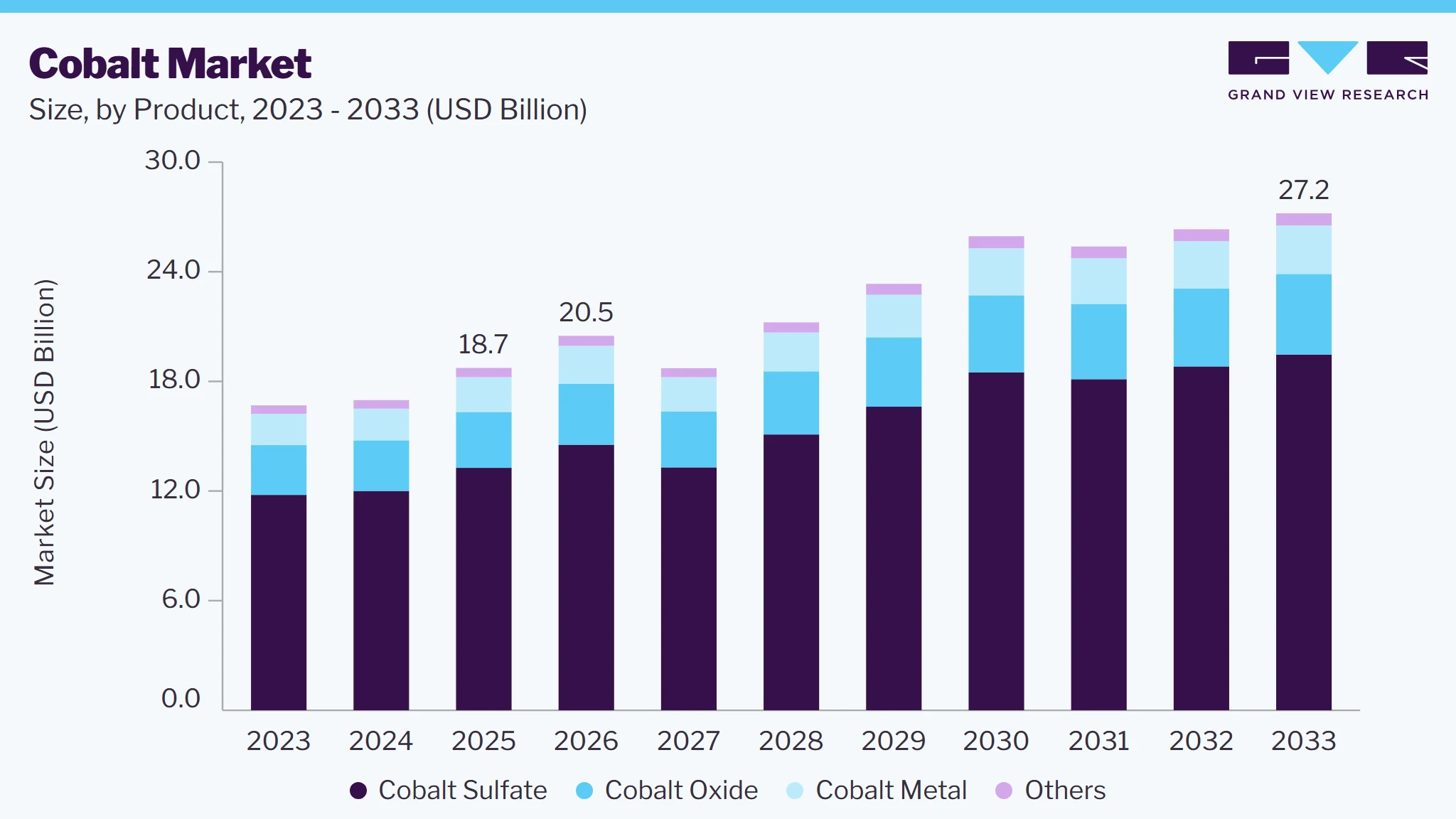
The global cobalt market size was valued at USD 18.7 billion in 2025 and is projected to grow from USD 20.5 billion in 2026 to USD 27.2 billion by 2033, at a CAGR of 4.1% from 2026 to 2033. Asia Pacific dominated the market, accounting for a revenue share of 76.0% in 2025. The rising production of electric vehicles (EVs) is expected to increase cobalt consumption during the forecast period.
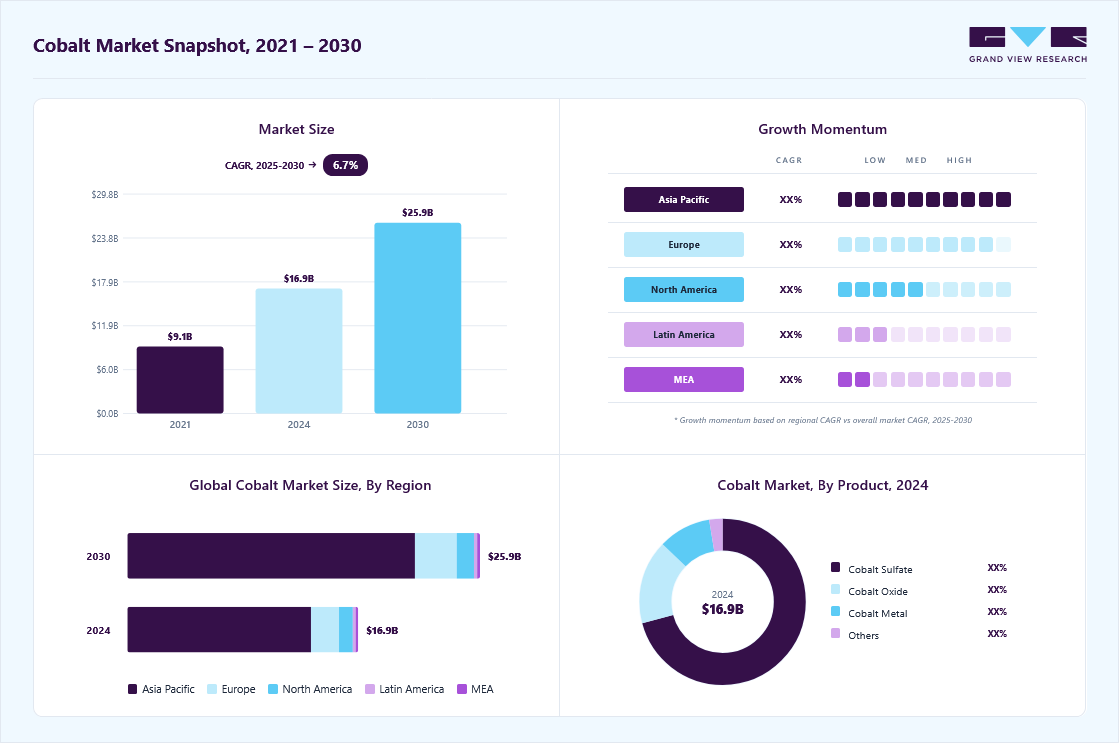 Source: Grand View Research, IR Documents, Primary Interviews, Paid DatabasesTo learn more about this report,
 Download Free Sample Report
 Key Market Trends & Insights
- By product: Cobalt sulfate segment led the market with the largest revenue share of 70.8% in 2025.
- By end use: Electric vehicles segment led the market with the largest revenue share of 35.5% in 2025.
Regional Highlights
- Largest regional market: Asia Pacific (76.0% revenue share, 2025)
- By country: The China held the largest market share in 2025.
Market Size & Forecast
- Market size in 2025: USD 18.7 Billion
- Estimated market size in 2026: USD 20.5 Billion
- Projected market size by 2033: USD 27.2 Billion
- CAGR (2026-2033): 4.1%
Three ways to get this report
Buy it, customize it, or ask a question.Ask an Analyst
Analyst response in 1 business day
- AccessReport author, directly
- Reply timeWithin 1 working day
- No sales callDirect answer only
- FormatEmail reply
- CostFree, no cost
Get the Full Report
What the study covers
- FormatsPDF · Excel · Dashboard
- Timeline2026–2033 annual, 2025 base
- Coverage20+ countries, 5 regions
- Companies10+ key players profiled
Customize the Report
20% free customization
- IncludeCountries, segments, points
- TailorTo your product definition
- ExtendDeeper competitor detail
- OrA fully bespoke study
- Turnaround5–10 working days
 To learn more about this report, Download Free Sample Report
 Lithium-nickel-manganese-cobalt-oxide (NMC) batteries, which have a cathode containing 10-20% cobalt, are the most common battery chemistries currently used in EVs. The metal forms a significant part of li-ion battery as it aids in the range and durability of EVs. These batteries find use in power tools and e-bikes as well. The U.S. is one of the key markets, due to its extensive production of vehicles and aircraft.
 To learn more about this report, Download Free Sample Report
 Market Dynamics
The growing adoption of electric vehicles (EVs) worldwide is one of the most significant drivers of growth for the cobalt market. Cobalt is a key raw material used in lithium-ion batteries, particularly in nickel-manganese-cobalt (NMC) and nickel-cobalt-aluminum (NCA) chemistries, where it enhances battery stability, energy density, and overall performance. Governments worldwide are promoting vehicle electrification through stringent emission regulations, incentives, and investments in charging infrastructure, leading to a substantial increase in EV production and sales. As automotive manufacturers continue to expand their electric vehicle portfolios and battery manufacturing capacity, demand for cobalt is expected to remain strong throughout the forecast period.
The growing adoption of EVs worldwide is a major driver of cobalt demand, as the metal plays a crucial role in enhancing the performance, safety, and lifespan of rechargeable batteries. Many vehicle manufacturers continue to prioritize high-energy-density battery chemistries containing cobalt to improve driving range and thermal stability. Government policies promoting zero emission transportation, stricter fuel economy regulations, and investments in charging infrastructure have accelerated the shift toward electric mobility across both developed and emerging economies. This trend has significantly increased the requirement for battery raw materials, positioning cobalt as a strategic component in the global EV value chain.
The strong growth in EV sales further highlights this demand. According to the International Energy Agency, global EV sales surpassed 17 million units in 2024 and 20.7 million in 2025, accounting for more than one-quarter of total new vehicle sales worldwide. China continues to lead the market, while Europe and North America are witnessing substantial growth driven by supportive policies and expanding model availability. Major automakers such as Tesla, BYD, and Volkswagen Group are increasing EV production capacities to meet rising consumer demand. As global EV penetration continues to expand, cobalt consumption is expected to grow in parallel, supporting long term market development.
Volatility in cobalt prices is a significant restraint for the cobalt market, as fluctuations in supply and demand can create uncertainty for battery manufacturers, alloy producers, and other end users. The market is highly sensitive to changes in mining output, geopolitical developments, trade policies, and shifts in demand from the EV and electronics sectors. Since a large portion of global cobalt production is concentrated in a few regions, disruptions such as operational challenges, regulatory changes, or export restrictions can lead to sudden price swings. These fluctuations increase procurement costs, complicate long-term supply agreements, and encourage manufacturers to reduce cobalt usage or explore alternative materials, thereby limiting the market's growth potential.
The expansion of grid-scale energy storage systems presents a significant opportunity for the cobalt market as countries increasingly invest in renewable energy infrastructure and power grid modernization. Large-scale battery storage installations are essential for managing the intermittent nature of renewable energy sources such as solar and wind, enabling a reliable electricity supply and improved grid stability. Cobalt-containing batteries are valued for their high energy density, thermal stability, and long operational life, making them suitable for demanding energy storage applications. As governments and utilities worldwide accelerate investments in clean energy projects and energy security initiatives, the deployment of large-scale battery storage systems is expected to increase substantially, creating new avenues for cobalt demand beyond the automotive and consumer electronics sectors.
Analyst Perspective
The cobalt market is entering a phase of sustained growth driven primarily by the global transition toward electrification, renewable energy, and advanced battery technologies. Cobalt remains a critical material in lithium ion batteries, particularly for electric vehicles and energy storage systems, where it enhances battery stability, safety, and energy density. Rapid growth in EV adoption, expanding battery manufacturing capacity, and increasing investments in grid scale energy storage projects are expected to support long term demand across major markets.
Product Insights
Based on product, cobalt sulfate segment led the market with the largest revenue share of 70.8% in 2025. Cobalt sulfate is used in a variety of industries, such as agriculture, dyeing, batteries, and catalysts. In addition, it is a key material used in the production of lithium batteries, which are used in many electronic devices, such as smartphones, laptops, and EVs. It helps improve the performance and lifespan of these batteries. Thus, increasing investment in the production of lithium batteries is expected to propel product demand over the forecast period. For instance, in August 2024, General Motors Company and Samsung SDI announced their plans to build a 36 GWH battery manufacturing plant with an investment of USD 3.5 billion.
The cobalt oxide segment is expected to register a CAGR of 6.1% in terms of revenue over the forecast period. It produces magnetic materials, such as magnetic recording media for hard drives. It is also used in other industries, such as ceramics, glass, and batteries. Metal is another vital market segment, with potential growth opportunities. The unique properties of cobalt metal, such as high-temperature resistance, biocompatibility, strength, and durability, make it a valuable product in many industries. Cobalt is treated as a strategic metal in the U.S. as its shortage would impact the economy.
End-use Insights
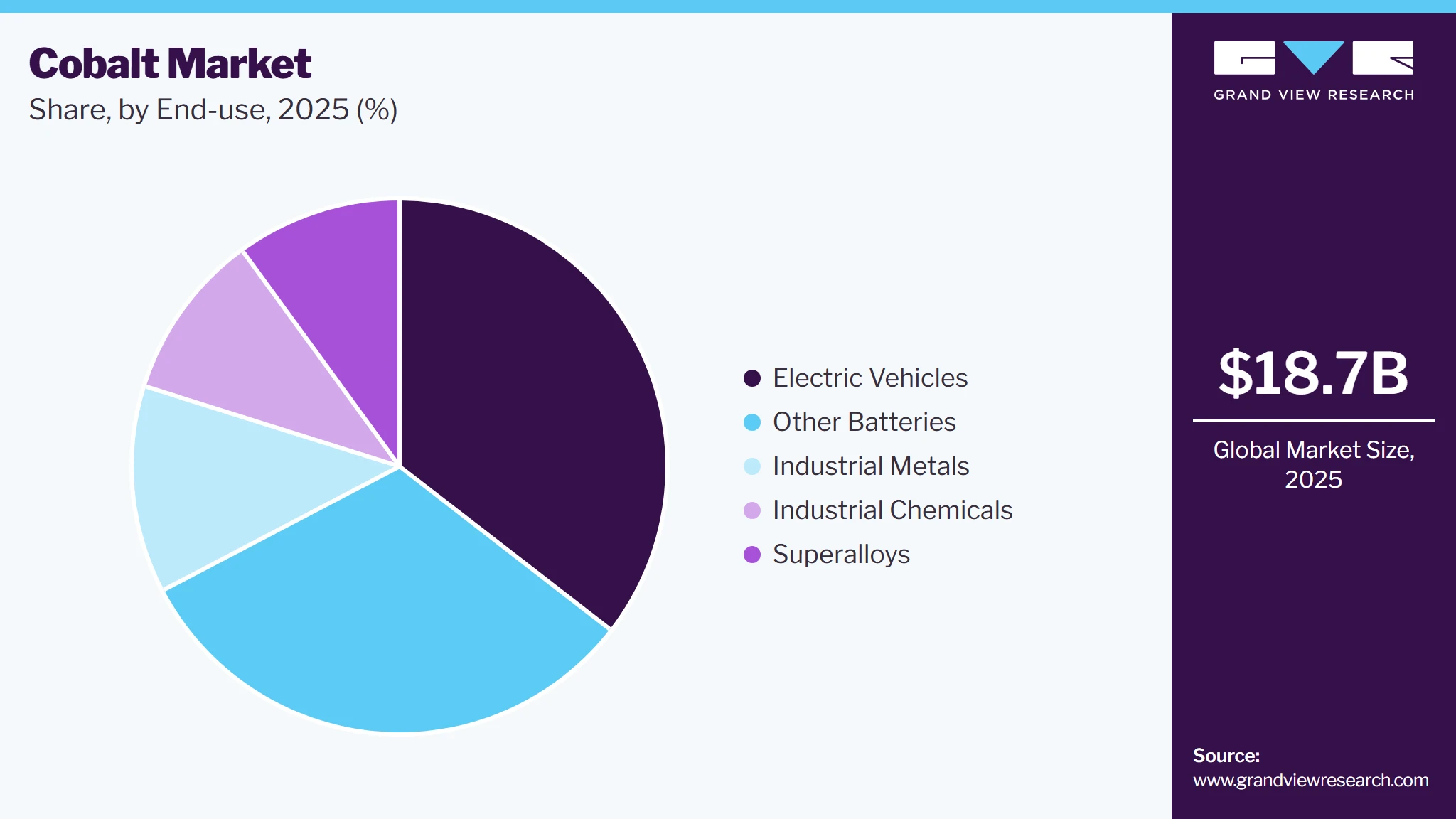
Based on end use, electric vehicles segment led the market with the largest revenue share of 35.5% in 2025. Growing emphasis on EV manufacturing is propelling battery production, which is supporting market growth. For instance, in April 2023, GM and Samsung SDI announced plans to build a new EV battery plant in the U.S., worth an investment of USD 3 billion. Also, in October 2022, LG Energy Solution and Honda mutually announced that they would invest USD 3.5 billion to construct a new battery manufacturing plant in Ohio, U.S. The mass production from the facility is expected to begin by the end of 2025. The Japanese automaker anticipates North American EV production and sales in 2026.
 To learn more about this report, Download Free Sample Report
 In terms of revenue, the superalloys segment is anticipated to register a CAGR of 5.4% over the forecast period. Cobalt-based superalloys are particularly useful for applications where the materials are exposed to extreme temperatures, pressures, and stresses. They are commonly used in gas turbines for power generation and aircraft engines, where the materials must withstand temperatures up to 1200°C (2192°F) without degrading or melting.
Regional Insights
The cobalt market North American market is expected to benefit from cobalt use in the high-tech and healthcare sectors. Demand is anticipated to grow in applications like medical implants and magnetic alloys, bolstered by the region’s robust research and development efforts.
U.S. Cobalt Market Trends
The U.S. cobalt market is likely to witness increased cobalt demand in sectors such as aerospace and defense and advanced manufacturing. Growing investments in renewable energy may further drive cobalt usage in high-performance magnets and components for energy infrastructure.
Asia Pacific Cobalt Market Trends
Asia Pacific dominated the cobalt market with the largest revenue share of 76.0% in 2025. The EV industry in the Asia Pacific is expanding rapidly, with China and India emerging as major players. As more consumers switch to EVs to reduce their carbon footprint, the demand for products is expected to increase. Thus, key automotive manufacturers are setting up new EV and battery plants.
 To learn more about this report, Download Free Sample Report
 The cobalt market in the China held the largest share in the Asia Pacific region in 2025.
The cobalt market in India is anticipated to see rising cobalt demand in industries like electronics and medical devices, fueled by rapid industrialization and urbanization. In addition, India's focus on infrastructure and manufacturing is likely to drive further cobalt consumption in specialty alloys and advanced materials.
Europe Cobalt Market Trends
The cobalt market in Europe is expected to register a revenue CAGR of 6.3% over the forecast period. Cobalt consumption is increasing in the region due to several factors, including growing production & demand for EVs, expansion of the aerospace industry, and increasing use of metal in the production of high-strength alloys & other advanced materials.
Germany cobalt market is expected to grow significantly over the forecast period. Advanced manufacturing and automotive industries are expected to sustain cobalt demand, especially in high-performance alloys and precision tooling. The country’s renewable energy projects may also create new uses for cobalt in wind turbines and other green technologies.
The cobalt market in Russia a significant player in cobalt production, is anticipated to strengthen its domestic and export markets. Focusing on the aerospace and defense industries, Russia is likely to drive demand for cobalt-based superalloys and high-strength materials.
Key Cobalt Company Insights
Some of the key players operating in the market include Umicore, Sumitomo Metal Mining Co., Ltd., and Glencore
-
Umicore is a global materials technology company headquartered in Belgium. It specializes in sustainable materials and recycling and is known for its leadership in catalysis, battery metals, and precious metal refining. Umicore also focuses on clean mobility solutions and resource efficiency.
-
Sumitomo Metal Mining Co., Ltd. is a Japan-based mining and smelting company with core operations in advanced materials, metal refining, and battery components. The company is also focused on copper, nickel, and cobalt production.
Key Cobalt Companies
The following key companies have been profiled for this study on the cobalt market.
-
China Molybdenum Co., Ltd.
-
Eurasian Resources Group
-
Freeport-McMoRan
-
Umicore
-
Glencore
-
Sumitomo Metal Mining Co., Ltd.
-
Norilsk Nickel
-
Huayou Cobalt
-
Jinchuan Group
Competitive Benchmarking
Category
Operating Strategies
Competitive Edge
Weakness
Established Players (e.g. China Molybdenum Co., Ltd., Eurasian Resources Group)
- Mature participants in the cobalt market primarily focus on securing long term access to cobalt resources through mining ownership, strategic joint ventures, and vertically integrated refining operations.
- These companies operate across multiple stages of the value chain, from cobalt extraction and concentrate processing to the production of cobalt chemicals used in batteries, superalloys, catalysts, and industrial applications.
- Established players possess significant competitive advantages through ownership of mining assets, integrated refining facilities, and extensive expertise in cobalt processing.
- Their control over upstream and downstream operations allows better management of raw material supply, production costs, and product quality.
- Despite their strong market positions, mature players face challenges associated with cobalt price volatility and heavy dependence on a limited number of mining regions.
- Changes in supply conditions, geopolitical developments, and shifts in battery chemistry can significantly impact profitability and long term planning.
Emerging & Regional Players (e.g., Huayou Cobalt, Norilsk Nickel)
- Emerging participants in the cobalt market generally focus on developing new mining projects, expanding refining capabilities, and establishing alternative supply chains outside traditionally dominant production regions.
- Their strategies emphasize resource development, strategic partnerships, and market diversification to capitalize on growing demand from electric vehicles, renewable energy storage, and advanced industrial applications.
- Emerging companies benefit from operational flexibility and the ability to implement modern mining, refining, and recycling technologies from the beginning of project development.
- Without extensive legacy infrastructure, they can design operations around current efficiency standards, environmental requirements, and customer expectations.
- Emerging participants face significant challenges related to financing requirements, project development timelines, and commercialization risks.
- Developing cobalt mining and refining operations requires substantial capital investment, regulatory approvals, technical expertise, and infrastructure development.
Recent Developments
-
In August 2024, the Pentagon announced a USD 20 million grant to construct a cobalt refinery in Ontario province, Canada. The U.S. government plans to diversify the cobalt supply chain from China to other countries.
Cobalt Market Report Scope
Report Attribute
Details
Market definition
The market represents the apparent consumption of cobalt-in end uses.
Market size in 2025
USD 18.7 billion
Estimated market size in 2026
USD 20.5 billion
Projected market size by 2033
USD 27.2 billion
Growth rate
CAGR of 4.1% from 2026 to 2033
Base year for estimation
2025
Historical data
2021 - 2024
Forecast period
2026 - 2033
Quantitative units
Revenue in USD million, volume in kilotons, and CAGR from 2026 to 2033
Report coverage
Revenue forecast, volume forecast, company ranking, competitive landscape, growth factors, and trends
Segments covered
Product, end use, and region.
Regional scope
North America; Europe; Asia Pacific; Latin America; Middle East & Africa
Country scope
U.S., Germany, UK, France, China, Japan, South Korea
Key companies profiled
China Molybdenum Co., Ltd., Eurasian Resources Group, Freeport-McMoRan, Umicore, Glencore, Sumitomo Metal Mining Co., Ltd., Norilsk Nickel, Huayou Cobalt, Jinchuan Group.
Customization scope
Free report customization (equivalent up to 8 analysts' working days) with purchase. Addition or alteration to country, regional & segment scope.
Pricing and purchase options
Avail customized purchase options to meet your exact research needs. Explore purchase options
Global Cobalt Market Report Segmentation
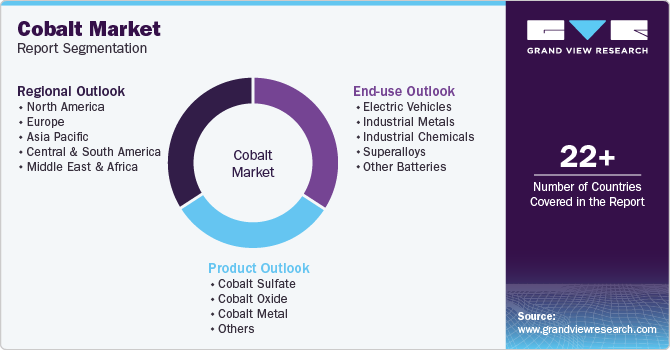
This report forecasts volume and revenue growth at country levels and provides an analysis of the latest industry trends in each of the sub-segments from 2021 to 2033. For this study, Grand View Research has segmented the global cobalt market report based on product, end-use, and region:
 To learn more about this report, Download Free Sample Report
 -
Product Outlook (Volume, Kilotons; Revenue, USD Million, 2021 - 2033)
-
Cobalt Sulfate
-
Cobalt Oxide
-
Cobalt Metal
-
Others
-
-
End-use Outlook (Volume, Kilotons; Revenue, USD Million, 2021 - 2033)
-
Electric Vehicles
-
Other Batteries
-
Industrial Metals
-
Industrial Chemicals
-
Superalloys
-
-
Regional Outlook (Volume, Kilotons; Revenue, USD Million, 2021 - 2033)
-
North America
-
U.S.
-
-
Europe
-
Germany
-
UK
-
France
-
-
Asia Pacific
-
China
-
Japan
-
South Korea
-
-
Central & South America
-
Middle East & Africa
-
Research Methodology
The cobalt market figures in this report are based on a proven research process that combines executive interviews with secondary research from proprietary databases, company filings, and recognized regulatory and institutional sources. Market size is built through value-chain sizing - reconciling supply-side and demand-side estimates - and triangulated with bottom-up and top-down approaches. Every estimate passes multiple levels of expert validation before publication, with each cobalt segment quantified using the revenue-capture definitions in the table below.
Segment Definition
Product
Revenue Capture Definition
Cobalt Sulfate
Cobalt sulfate is a refined cobalt chemical primarily used in the production of lithium ion battery cathodes for electric vehicles and energy storage systems. It is valued for its high purity and ability to enhance battery energy density and performance.
Cobalt Oxide
Cobalt oxide refers to cobalt based compounds used in rechargeable batteries, ceramics, pigments, catalysts, and magnetic materials. The segment benefits from growing demand in electronics and advanced industrial applications requiring thermal and chemical stability.
Cobalt Metal
Cobalt metal includes high purity metallic cobalt used in superalloys, aerospace components, cutting tools, magnets, and defense applications. Its exceptional strength, corrosion resistance, and high temperature performance make it critical for demanding industrial environments.
Others
The others segment comprises cobalt chemicals and intermediates such as cobalt chloride, cobalt carbonate, cobalt acetate, and specialty cobalt compounds. These products serve niche applications across catalysts, animal feed additives, pigments, electroplating, and chemical manufacturing industries.
End Use
Revenue Capture Definition
Electric Vehicles
This segment includes cobalt used in lithium ion batteries powering electric passenger cars, buses, trucks, and two wheelers. Cobalt enhances battery stability, energy density, safety, and overall performance, making it a critical material for the electric mobility industry.
Other Batteries
Other batteries comprise cobalt consumption in consumer electronics, portable devices, power tools, and stationary energy storage systems. The material helps improve battery lifespan, charge retention, and operational reliability across various battery technologies.
Industrial Metals
The industrial metals segment covers cobalt used in the production of hard metals, cemented carbides, magnetic materials, and wear resistant alloys. These materials are widely utilized in manufacturing, mining, machinery, and tooling applications.
Industrial Chemicals
This segment includes cobalt compounds employed as catalysts, pigments, drying agents, and chemical intermediates in various industrial processes. Demand is driven by applications in petrochemicals, paints and coatings, plastics, and chemical manufacturing.
Superalloys
Cobalt is extensively used in superalloys designed for extreme temperature and high stress environments. These alloys are essential in aerospace engines, gas turbines, power generation equipment, and defense systems due to their superior strength and corrosion resistance.
Estimation Model
Layer Name
Key Question
Description
Battery & Industrial Demand Base Layer
What forms the demand base?
Identify global demand from major cobalt consuming industries including electric vehicles, consumer electronics, energy storage systems, aerospace, superalloys, catalysts, and industrial chemicals. Assess battery production volumes, EV manufacturing, and industrial output to establish the total addressable demand for cobalt globally.
Cobalt Application Penetration Layer
Where is cobalt utilized?
Estimate the penetration of cobalt across key applications including lithium ion batteries, superalloys, hard metals, catalysts, pigments, magnetic materials, and industrial chemicals. Analyze the adoption of cobalt containing battery chemistries and advanced material applications across end use industries and regions.
Cobalt Consumption Intensity Layer
How much cobalt is consumed?
Analyze cobalt consumption intensity based on battery capacity, EV production, energy storage deployment, aerospace component manufacturing, and industrial processing requirements. Evaluate the utilization of cobalt sulfate, cobalt oxide, cobalt metal, and other cobalt products across applications. Consumption intensity varies according to technology selection, battery chemistry, recycling rates, and material efficiency improvements.
Revenue Layer
How is market revenue generated?
Market revenue is quantified through sales of cobalt products including cobalt sulfate, cobalt oxide, cobalt metal, and specialty cobalt chemicals. Revenue generation is driven by demand from batteries, superalloys, industrial chemicals, and advanced manufacturing sectors. Market value is influenced by cobalt prices, mining output, refining capacity, battery demand growth, geopolitical supply dynamics, and regional consumption trends.
Delivered Customizations
This report has been delivered with the following In-depth customizationsCustomization Table
Client Request
Customization Delivered
Value Adds
Regional Segmentation
Detailed regional analysis of the cobalt market across North America, Europe, Asia Pacific, Latin America, and Middle East & Africa. Included evaluation of cobalt mining activities, refining capacities, battery manufacturing investments, electric vehicle production, energy storage deployments, industrial demand, and government initiatives supporting critical mineral supply chains.
Identified key production hubs, refining centers, and high growth demand regions. Enabled strategic expansion planning based on battery manufacturing growth, EV adoption, and critical mineral security initiatives. Supported regional demand forecasting and sourcing strategies.
Trade Assessment
Evaluation of global cobalt trade flows, export import trends, country level trade balances, refining and processing trade routes, supply concentration risks, and geopolitical influences. Included assessment of cobalt concentrate trade, refined cobalt products, battery precursor materials, and international sourcing patterns across major consuming industries.
Highlighted supply security risks, export opportunities, and sourcing diversification options. Supported strategic procurement decisions, supply chain resilience planning, and international market expansion initiatives.
Opportunity Assessment
Identification of high growth opportunities across electric vehicles, grid scale energy storage systems, consumer electronics, aerospace superalloys, industrial catalysts, and advanced chemical applications.
Enabled prioritization of high return growth segments and emerging regional opportunities. Supported long term investment planning, capacity expansion decisions, and strategic business development initiatives aligned with the global energy transition.
Frequently Asked Questions About This Report
Middle East & Africa is anticipated to register the fastest CAGR over the forecast period.
Based on product, cobalt sulfate accounted for largest revenue share of 70.8% in 2025.
Based on end use, electrical vehicles accounted for largest revenue share of 35.5% in 2025.
The key players operating in the cobalt market are China Molybdenum Co., Ltd., Eurasian Resources Group, Freeport-McMoRan, Umicore, Glencore, Sumitomo Metal Mining Co., Ltd., Norilsk Nickel, Huayou Cobalt, Jinchuan Group.
The cobalt market size was estimated at USD 18.7 billion in 2025 and is expected to reach USD 20.5 billion in 2026.
The cobalt market is expected to grow at a compound annual growth rate of 4.1% from 2026 to 2033 to reach USD 27.2 billion by 2033.
The cobalt market is primarily driven by the rising production of batteries, particularly in electric vehicles (EVs) and other electronic devices.
Asia Pacific dominated the market with revenue share of 76.0% in 2025.
China dominated the Asia Pacific market with revenue share of 63.6% in 2025.
About the Author(s)
Advanced Interior Materials Research Team
Advanced Materials · Advanced Interior MaterialsThis report was authored by the advanced interior materials research team at Grand View Research - comprising two research analysts, one senior research analyst, and one industry expert - with specialized expertise in the advanced interior materials segment of the advanced materials industry. All findings are based on proprietary advanced materials databases, executive interviews, and regulatory analysis, subject to internal peer review prior to publication.
Last Updated:
Speak to Analyst

Customize this report to your needs - add regions, segments, or data points, with 20% free customization.
Or view our licence options:


ISO 9001:2015 & 27001:2022 Certified
We are GDPR and CCPA compliant! Your transaction & personal information is safe and secure. For more details, please read our privacy policy.


