
- Home
- »
- Consumer F&B
- »
-
Coffee Roaster Market Size And Share Report, 2026-2033GVR Report cover

Coffee Roaster Market (2026 - 2033)
Size, Share & Trends Analysis Report By Type (Direct Fire, Half Hot Air, Hot Air), By Application (Industrial, Commercial, Residential), By Region (North America, Europe, Asia Pacific, CSA, Middle East & Africa), And Segment Forecasts
Market Size, 2025
$1.5BMarket Estimate, 2026
$1.6BMarket Forecast, 2033
$2.7BCAGR, 2026–2033
7.8%Coffee Roaster Market Summary
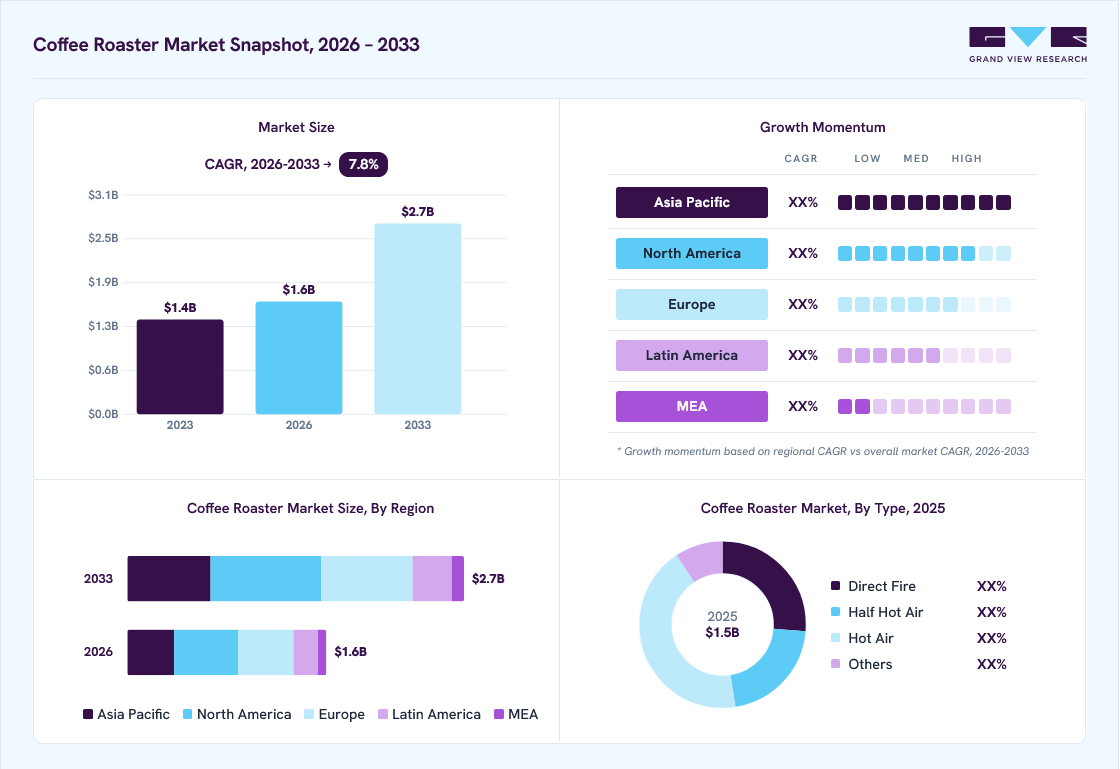
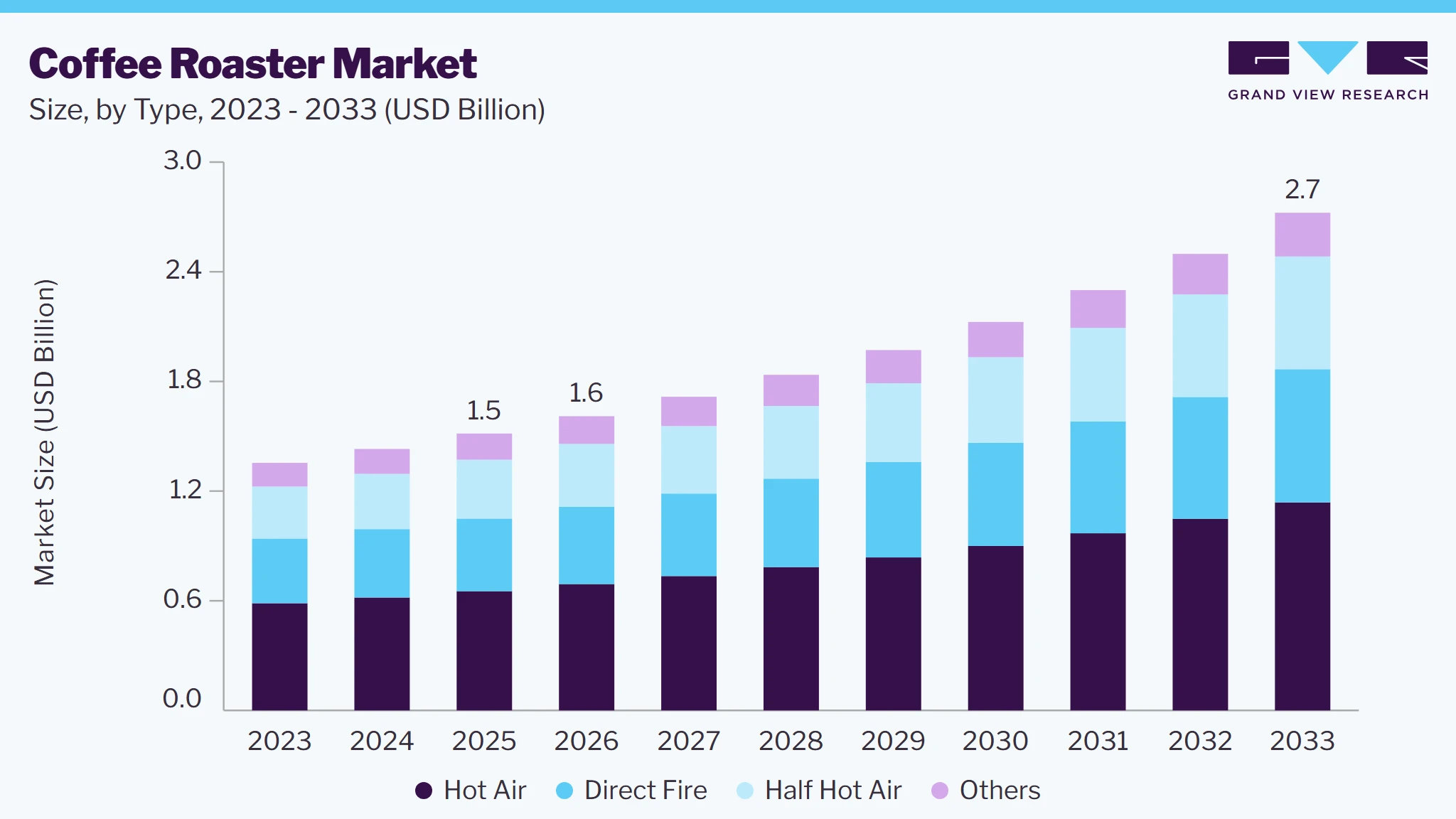
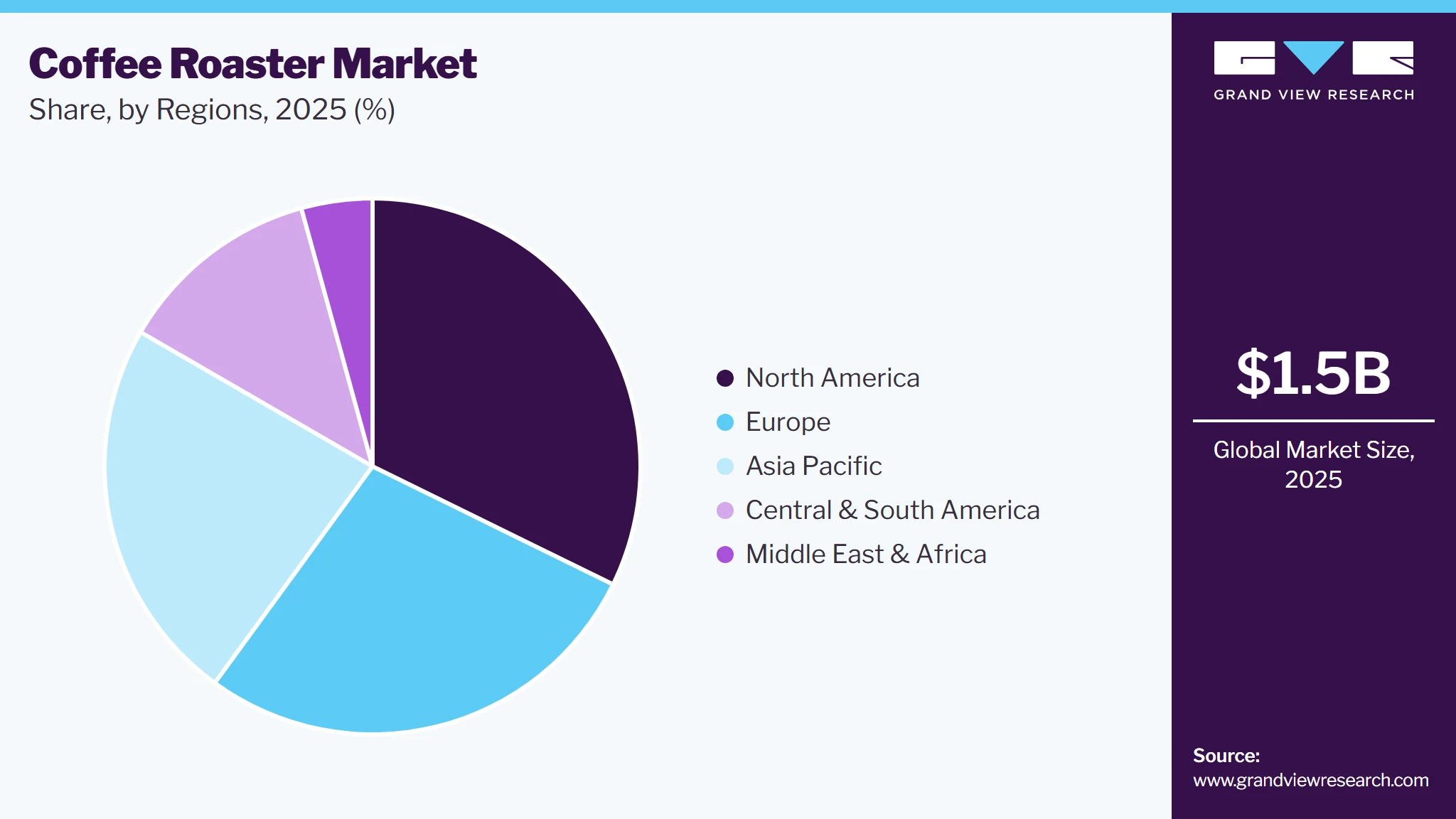
The global coffee roaster market size was valued at USD 1.5 billion in 2025 and is projected to grow from USD 1.6 billion in 2026 to USD 2.7 billion by 2033, growing at a CAGR of 7.8% from 2026 to 2033. North America dominated the market, accounting for a revenue share of 32.3% in 2025. The rising demand and inclination of consumers towards the consumption of coffee across the globe is a primary factor driving the market growth.
 Source: Grand View Research, IR Documents, Primary Interviews, Paid DatabasesTo learn more about this report,
 Download Free Sample Report
 Key Market Trends & Insights
- By type: Hot air segment led the market with the largest revenue share of 43.1% in 2025.
- By application: Industrial segment led the market with the largest share of 45.6% in 2025.
Regional Highlights
- Largest regional market: North America (32.3% revenue share, 2025)
- By country: The U.S. is expected to grow significantly from 2026 to 2033
Market Size & Forecast
- Market size in 2025: USD 1.5 Billion
- Estimated market size in 2026: USD 1.6 Billion
- Projected market size by 2033: USD 2.7 Billion
- CAGR (2026-2033): 7.8%
Three ways to get this report
Buy it, customize it, or ask a question.Ask an Analyst
Analyst response in 1 business day
- AccessReport author, directly
- Reply timeWithin 1 working day
- No sales callDirect answer only
- FormatEmail reply
- CostFree, no cost
Get the Full Report
What the study covers
- FormatsPDF · Excel · Dashboard
- Timeline2026–2033 annual, 2025 base
- Coverage20+ countries, 5 regions
- Companies10+ key players profiled
Customize the Report
20% free customization
- IncludeCountries, segments, points
- TailorTo your product definition
- ExtendDeeper competitor detail
- OrA fully bespoke study
- Turnaround5–10 working days
Moreover, consumers from the Asia Pacific region play a major role in the increasing consumption of coffee. In addition, the rising demand for fresh coffee is expected to fuel market growth in the coming years. As per the International Coffee Council, the preference of consumers in East and South Asia has been shifting towards fresh coffee consumption.The COVID-19 pandemic negatively impacted various industries including the food & beverage industry. A fall in the coffee roaster industry has been observed during this period owing to a reduction in the consumption of coffee among consumers. The reduction in the consumption of coffee through the food service industry occurred due to various measures taken by the government such as the shutdown of cafes and restaurants along with maintaining social distancing due to the implementation of the lockdown. However, due to such factors, the sales of home roasters grew due to the preference of consumers to stay at home and roast their coffee. In addition, the online sale of coffee roasters also grew due to the pandemic.
 To learn more about this report, Download Free Sample Report
 The increasing number of coffee shop chains coupled with the rising trend of the culture of visiting cafés are other key factors anticipated to propel the market growth in the coming years. In addition to the rising consumption of coffee, the production of coffee has also been growing. For instance, as per the International Coffee Organization, the production of coffee across the globe has increased by 6.3% from 2019 to 2020. Furthermore, development in retail sections is also anticipated to drive the growth of coffee rosters in the residential segment.
The solubility of green coffee beans increases when it is roasted. This method also enhances the aroma and flavor of the coffee. Coffee, when roasted at the right temperature for a dedicated amount of time, provides perfect solubility that helps in achieving the right extraction of coffee. An interest in quality coffee among numerous consumers has been prompted by roasted coffee. Brewing coffee through innovative ways and experimenting with it has been made easy by coffee roasters. This has also been made more convenient to consumers by the availability of brewing and coffee machines and remains widely accessible on domestic as well as commercial platforms. Thus, the aforementioned factors are expected to boost market growth worldwide.
The growth of the global market is also attributed to the launch of new and innovative products by the key players operating in the market. The launches of products with better characteristics by manufacturers have been increasing resulting in attracting more consumers thus fueling the market growth over the forecast period. For instance, in January 2021, a new coffee roaster IKAWA Pro100 was introduced by IKAWA Ltd. The coffee roaster is easy to use, consistent, and has a capacity of 120 grams. Moreover, in May 2020 Revelation F5, a new solution for heat-circulating was launched by U.S. Roasters Corp.
The coffee roasters produce high heat and cause an intense working environment which pushes commercial coffee shops to avoid keeping coffee roasters in their places which are anticipated to challenge the market growth over the forecast period. However, investing in the development of rosters in compact sizes equipped with advanced technology is expected to offer lucrative opportunities in the market. Moreover, establishing the presence of the company in countries with roasters in both commercial and residential applications, especially in thriving coffee-consuming regions such as Asia Pacific is estimated to provide further key opportunities to the manufacturers.
Market Dynamics
The coffee roaster market is witnessing steady expansion as global coffee consumption continues to evolve toward higher-quality, freshly roasted, and specialty-grade offerings. Coffee roasting plays a critical role in shaping flavor profiles, aroma, aeond overall product differentiation, making it an essential step in the coffee value chain. Expansion of cafe culture, particularly in urban regions, and the popularity of third-wave coffee movements are further accelerating equipment adoption across commercial and small-scale segments. In addition, the expansion of specialty coffee shops, micro-roasters, and artisanal brands is further strengthening demand for precision roasting equipment and consistent roast quality. Automation and digital control systems are improving roasting consistency and operational efficiency.
The shift toward specialty coffee and high-quality brewed beverages is a key factor driving the coffee roaster market. Consumers are becoming more aware of coffee origins, roast levels, and flavor profiles, leading to strong demand for freshly roasted and premium-grade coffee. This trend is supporting the growth of specialty coffee shops, artisanal roasters, and micro-roasting businesses that depend on advanced roasting equipment to deliver consistent and differentiated flavor outputs. Expansion of café culture, particularly in urban regions, and the popularity of third-wave coffee movements are further accelerating equipment adoption across commercial and small-scale segments.
Rising disposable incomes, changing lifestyle preferences, and stronger at-home coffee consumption are also supporting market growth. Consumers are investing in home brewing equipment and seeking freshly roasted beans, prompting roasters to enhance production flexibility and customization capabilities. Demand for single-origin coffee, customized blends, and consistent roast quality is further pushing manufacturers to adopt technologically advanced roasting systems with higher control, automation, and precision.
The coffee roaster market faces constraints due to the significant investment required for modern roasting equipment, particularly automated and industrial-scale systems. Small and medium roasting businesses often find it challenging to adopt advanced machines because of limited financial capacity and longer return-on-investment cycles. This limits market penetration of advanced roasting technologies, especially in fragmented and price-sensitive segments. Alongside this, fluctuations in green coffee bean prices create instability across the value chain. Coffee beans are subject to variations in agricultural output, weather patterns, logistics disruptions, and trade conditions, which lead to inconsistent input costs for roasters. These fluctuations directly impact planning, pricing strategies, and profit margins. Additional operational expenses, such as maintenance requirements, energy consumption, and the need for a skilled workforce, further increase the overall cost burden and restrict scalability for many market participants.
The coffee roaster market presents significant opportunities driven by automation, sustainability initiatives, and expansion into emerging economies. Next-generation solutions such as AI-driven roasting systems and IoT-enabled monitoring are creating opportunities for precision and process optimization. Increasing focus on sustainability is also encouraging the development of energy-efficient roasters, low-emission systems, and eco-friendly production processes, aligning with global environmental goals. Furthermore, rapid growth in coffee consumption across Asia-Pacific, Latin America, and parts of Africa is opening new avenues for market expansion. Rising investments in specialty coffee culture, local roasting businesses, and café infrastructure in these regions are expected to create strong demand for mid-range and entry-level roasting equipment, driving long-term growth opportunities for manufacturers and suppliers.
Analyst Perspective
The coffee roaster market is shaped by demand from specialty coffee roasters as well as industrial coffee producers, creating requirements for both controlled small-batch roasting and large-scale production systems. Independent cafes and roasters focus on roast consistency and flavor variation, while large manufacturers supply equipment for packaged coffee production. Energy-efficient roasting systems and lower-emission technologies are also becoming part of equipment design. Over time, companies that provide industrial roasting machines along with flexible, technology-based control systems are better placed in the market.
Type Insights
Based on type, the hot air segment led the market with the largest revenue share of 43.1% in 2025. Hot air coffee roasters do not generate smoke and roast the coffee beans efficiently and evenly as it has a hot air circulation system. The coffee beans are roasted at perfect temperature due to the automatic constant temperature system of hot air coffee roasters. Moreover, various features are associated with residential hot air coffee roasters such as manual adjustment of the roasting time of coffee along with dual function for roasting and cooling coffee beans. Due to such factors, hot air coffee roasters are highly used thus contributing to the higher share of the segment.
The half hot air coffee roasters are estimated to grow with the fastest CAGR of 7.3% over the forecast period. The roasting time of coffee in half hot air roasters is shorter as the heat inside such roasters are fully utilized by circulating the heat internally. Such roasters are majorly used for both residential and commercial purposes. The consumption of coffee is significantly increasing with increasing commercial offices which is propelling the segment growth over the forecast period. In addition, the trend for consuming coffee by roasting coffee at home is growing which is further driving the growth of the segment.
Application Insights
Based on application, the industrial segment led the market with the largest revenue share of 45.6% in 2025. The rising awareness among consumers regarding the benefits of consumption of coffee-derived products and coffee coupled with its growing consumption in various emerging economies due to rapid urbanization is contributing to the segment growth. Moreover, coffee roasters used at the industrial level majorly benefitted from the rising demand for roasted coffee in the commercial and residential segments in various forms such as beans and powdered form.
The commercial segment is estimated to grow with the highest CAGR of 6.8% over the forecast period from 2023 to 2030. The increasing number of cafes or coffee shops and outlets across the globe is surging the adoption of commercial coffee roasters. Additionally, manufacturers operating in the market are launching coffee roasters suitable especially for commercial use. For instance, in February 2022 Bellwether Coffee, a manufacturer of commercial coffee roasters launched Series 2 Bellwether Automated Roasting System, the second generation of foundational machine and technology.
Regional Insights
North America dominated the coffee roaster market with the largest revenue share of 32.3% in 2025. The market in the region is significantly driven by the high consumption and rising popularity of roasted coffee among consumers. For instance, as per the statistics provided by the International Coffee Organization, per day approximately 1.4 billion cups of coffee are consumed and approximately 45% are consumed by U.S. consumers alone. This number totals more than 400 million cups of coffee per day. Moreover, coffee chains such as Starbucks provide roasted coffee to customers as per their preferences which is further driving the market growth in the region.
 To learn more about this report, Download Free Sample Report
 U.S. Coffee Roaster Market Trends
The coffee roaster market in the U.S. held the largest share in the North America region in 2025.
Europe Coffee Roaster Market Trends
The coffee roaster market in the Germany held the largest share in the Europe region in 2025.
Asia Pacific Coffee Roaster Market Trends
Asia Pacific is expected to grow with the fastest CAGR of 7.3% over the forecast period from 2023 to 2030. The growth of the market in the region is attributed to the increasing consumption of coffee by consumers in the region. As per the International Coffee Organization, as of 2022, coffee consumption in Asia has increased by 1.5% in the past five years. Moreover, the high consumption of roasted coffee in various countries in the Asia Pacific such as China and Japan is also contributing to the growth of the market in the region. According to an article published by Monin, as of 2022, the country in the Asia Pacific with the highest roasted coffee consumption is Japan followed by China.
Key Coffee Roaster Company Insights
Key players operating in the market are adopting various steps to increase their presence in the market. These steps include strategies such as partnerships, mergers & acquisitions, development & launch of new products, global expansion, and others. Some of the initiatives include:
-
In January 2023, PROBAT AG launched the P12e electric coffee roaster, an addition to its P series of roasters that uses electrical hot air technology. The P12e has a roasting capacity of 40kg/h and offers consistent and reproducible roasting results.
-
In March 2022, Scolari Engineering S.p.A. introduced the e-Roaster, an industrial coffee roasting system that reduces gas usage by 25% and curbs carbon emissions at roasteries. The roaster has a heat recovery system, which can divert the recovered heat to other applications such as HVAC or refrigeration units.
-
In January 2022, Diedrich Manufacturing Inc launched a new roaster machine, Diedrich DR-3, replacing the older IR-1 and IR-2.5. The DR-3 has a capacity range of 1-3kg and is designed to fulfill all the functions of the older IR machines.
Key Coffee Roaster Companies
The following key companies have been profiled for this study on the coffee roaster market.
-
Nestlé
-
Bühler Group
-
PROBAT AG
-
Scolari Engineering S.p.A.
-
Genio Roasters
-
Cia. Lilla de Máquinas Ind. e Com
-
COFFEE HOLDING
-
Diedrich Manufacturing Inc.
-
Giesen Coffee Roasters B.V.
-
Toper
Competitive Benchmarking
Category
Operating Strategies
Competitive Edge
Weakness
Established Players (PROBAT, Petroncini, Diedrich Roasters, Buhler Group)
- Focus on large-scale industrial roasting systems for global coffee chains and packaged coffee manufacturers
- Invest in automation, energy-efficient roasting technologies, and integrated production lines
- Strong global installed base and long-term industrial contracts
- High reliability, precision engineering, and strong after-sales service networks
- High capital cost and slower product innovation cycles
- Less flexibility for small-batch specialty roasting requirements
merging Players (Loring Smart Roast, Giesen Coffee Roasters, regional small-scale manufacturers)
- Focus on compact, flexible roasting machines for specialty cafés and micro-roasters
- Adopt low-emission technology, digital roast profiling, and direct-to-customer sales models
- High innovation speed and strong alignment with specialty coffee trends
- Greater customization and user-friendly roasting control systems
- Limited global scale and weaker distribution/service networks
- Higher dependence on niche specialty coffee demand cycles.
Coffee Roaster Market Report Scope
Report Attribute
Details
Market size value in 2025
USD 1.5 billion
Market size value in 2026
USD 1.6 billion
Revenue forecast in 2033
USD 2.7 billion
Growth rate
CAGR of 7.8% from 2026 to 2033
Base year for estimation
2025
Historical data
2021 - 2024
Forecast period
2026 - 2033
Quantitative units
Revenue in USD million/billion and CAGR from 2026 to 2033
Report coverage
Revenue forecast, company ranking, competitive landscape, growth factors, and trends
Segments covered
Type, application, region
Regional scope
North America; Europe; Asia Pacific; Latin America; MEA
Country scope
U.S.; Canada; Mexico; Germany; UK; France; Italy; Spain; Norway; Denmark; Sweden; Russia; Iceland; Finland; China; Japan; India; South Korea; Australia; Thailand; Singapore; Brazil; Argentina; Saudi Arabia; South Africa; UAE; Kuwait; Israel
Key companies profiled
Probat; Diedrich Roasters; Giesen Coffee Roasters; Loring Smart Roast; Toper; IMF Roasters; Petroncini; Joper Roasters; Neuhaus Neotec and Brambati.
Customization scope
Free report customization (equivalent up to 8 analysts' working days) with purchase. Addition or alteration to country, regional & segment scope.
Pricing and purchase options
Avail customized purchase options to meet your exact research needs. Explore purchase options
Global Coffee Roaster Market Report Segmentation
This report forecasts revenue growth at global, regional & country levels and provides an analysis of the latest trends and opportunities in each of the sub-segment from 2021 to 2033. For the purpose of this study, Grand View Research has segmented the coffee roaster market on the basis of type, application, and region.
-
Type Outlook (Revenue, USD Million, 2021 - 2033)
-
Direct Fire
-
Half Hot Air
-
Hot Air
-
Others
-
-
Application Outlook (Revenue, USD Million, 2021 - 2033)
-
Industrial
-
Commercial
-
Residential
-
-
Regional Outlook (Revenue, USD Million, 2021 - 2033)
-
North America
-
U.S.
-
Canada
-
Mexico
-
-
Europe
-
Germany
-
U.K.
-
France
-
Italy
-
Spain
-
-
Asia Pacific
-
China
-
Japan
-
India
-
Australia & New Zealand
-
-
Central & South America
-
Brazil
-
-
Middle East & Africa
-
South Africa
-
Saudi Arabia
-
-
Research Methodology
The coffee roaster market figures in this report are based on a proven research process that combines executive interviews with secondary research from proprietary databases, company filings, and recognized regulatory and institutional sources. Market size is built through value-chain sizing - reconciling supply-side and demand-side estimates - and triangulated with bottom-up and top-down approaches. Every estimate passes multiple levels of expert validation before publication, with each coffee roaster segment quantified using the revenue-capture definitions in the table below.
Segment Definition
Segment - Type
Revenue capture definition
Direct Fire
This segment includes the sales of coffee roasting systems that use direct flame contact with the roasting drum, with revenue generated through equipment sales, installation services, and maintenance contracts for high-intensity roasting applications.
Half Hot Air
This segment includes the sales of hybrid coffee roasting systems that combine direct heating and hot air circulation, with revenue generated through machine sales, customization services, and long-term service agreements.
Hot Air
This segment includes the sales of convection-based coffee roasting systems that use heated air for uniform roasting, with revenue generated through equipment sales, efficiency upgrade solutions, and digital control integration services.
Others
This segment includes the sales of alternative and specialty roasting systems, such as fluid bed and infrared technologies, with revenue generated through niche equipment sales and customized roasting solution offerings.
Segment -Application
Revenue capture definition
Industrial
This segment includes the sales of large-scale coffee roasting systems used in high-volume production facilities, with revenue generated through bulk equipment sales, automation integration, and long-term maintenance contracts.
Commercial
This segment includes the sales of medium-scale coffee roasting machines used by cafés, coffee chains, and specialty roasters, with revenue generated through equipment sales, customization services, and recurring servicing agreements.
Residential
This segment includes the sales of compact coffee roasting machines designed for home use, with revenue generated through direct-to-consumer sales, online retail channels, and accessory upgrades.
Estimation Model
Layer
Key Question
Description
Demand Identification Layer
Who drives demand for coffee roasting equipment?
Identify demand from cafés, roasteries, and producers based on coffee consumption growth, sourcing patterns, and preference for freshly roasted coffee products.
Digital Access Layer
Who can access roasting equipment digitally?
Apply regional digital penetration and e-commerce adoption trends to determine accessibility of roasting machinery among cafés and commercial roasters.
Behavioural Layer
Who actively uses coffee roasting systems?
Apply usage patterns across industrial and commercial roaster segments driven by specialty coffee demand, production frequency, and adoption of automated roasting technologies.
Monetisation Layer
How much revenue is generated?
Measure revenue generated through equipment sales, service contracts, maintenance, and software-enabled roasting solutions across industrial and commercial applications.
Delivered Customizations
This report has been delivered with the following In-depth customizations
Client Request
Customization Delivered
Value Adds
Specialty Coffee Consumption & Roasting Demand Trends
Conducted a focused assessment of specialty coffee consumption, café expansion, artisanal roasting growth, premium bean demand, and shifting consumer preferences toward fresh and customized coffee products.
Helps stakeholders identify demand drivers, evaluate growth opportunities, and understand purchasing trends influencing coffee roasting equipment and services.
Commercial Roasting Technology & Automation Adoption
Evaluated adoption of automated roasting systems, smart controls, batch consistency solutions, energy-efficient equipment, and data-driven roasting technologies across commercial operations.
Provides insights into technology adoption, operational efficiency improvements, and investment opportunities supporting competitive differentiation.
Roasting Infrastructure & Supply Chain Opportunity Assessment
Assessed demand for roasting facilities, contract roasting services, green coffee sourcing networks, equipment upgrades, and regional production capabilities across key coffee-consuming markets.
Supports expansion planning by identifying underserved markets, infrastructure requirements, and long-term growth opportunities within the coffee roasting ecosystem.
Frequently Asked Questions About This Report
The global coffee roaster market size was estimated at USD 1.5 billion in 2025 and is expected to reach USD 1.6 billion in 2026.
North America dominated with a 32.3% revenue share in 2025.
Key players include Probat, Diedrich Roasters, Giesen Coffee Roasters, Loring Smart Roast, Toper, IMF Roasters, Petroncini, Joper Roasters, Neuhaus Neotec, and Brambati.
Asia Pacific is the fastest-growing region over the forecast period.
The hot air segment led with a 43.1% revenue share in 2025, while half hot air is the fast-growing segment.
The industrial segment held the largest revenue share in 2025, while the commercial segment is the fastest-growing area.
The global coffee roaster market is expected to grow at a CAGR of 7.8% from 2026 to 2033 to reach USD 2.7 billion by 2033.
Key factors include rising coffee consumption, growing specialty coffee demand, expansion of cafe chains, and adoption of advanced roasting technologies.
About the Author(s)
Consumer F&B Research Team
Consumer Goods · Consumer F&BThis report was authored by the consumer f&b research team at Grand View Research - comprising two research analysts, one senior research analyst, and one industry expert - with specialized expertise in the consumer f&b segment of the consumer goods industry. All findings are based on proprietary consumer goods databases, executive interviews, and regulatory analysis, subject to internal peer review prior to publication.
Last Updated:
Speak to Analyst

Customize this report to your needs - add regions, segments, or data points, with 20% free customization.
Or view our licence options:


ISO 9001:2015 & 27001:2022 Certified
We are GDPR and CCPA compliant! Your transaction & personal information is safe and secure. For more details, please read our privacy policy.


