
- Home
- »
- Advanced Interior Materials
- »
-
Collated Screw Market Size And Share Report, 2026-2033GVR Report cover

Collated Screw Market (2026 - 2033)
Size, Share & Trends Analysis Report By Product (Collated Drywall Screws, Collated Sub-Floor Screws, Collated Self-Drilling Screw, Collated Chipboard Screws, Collated Deck Screws), By Application (Construction), By Region, And Segment Forecasts
Market Size, 2025
$548.5MMarket Estimate, 2026
$569.0MMarket Forecast, 2033
$770.2MCAGR, 2026–2033
4.4%Collated Screw Market Summary
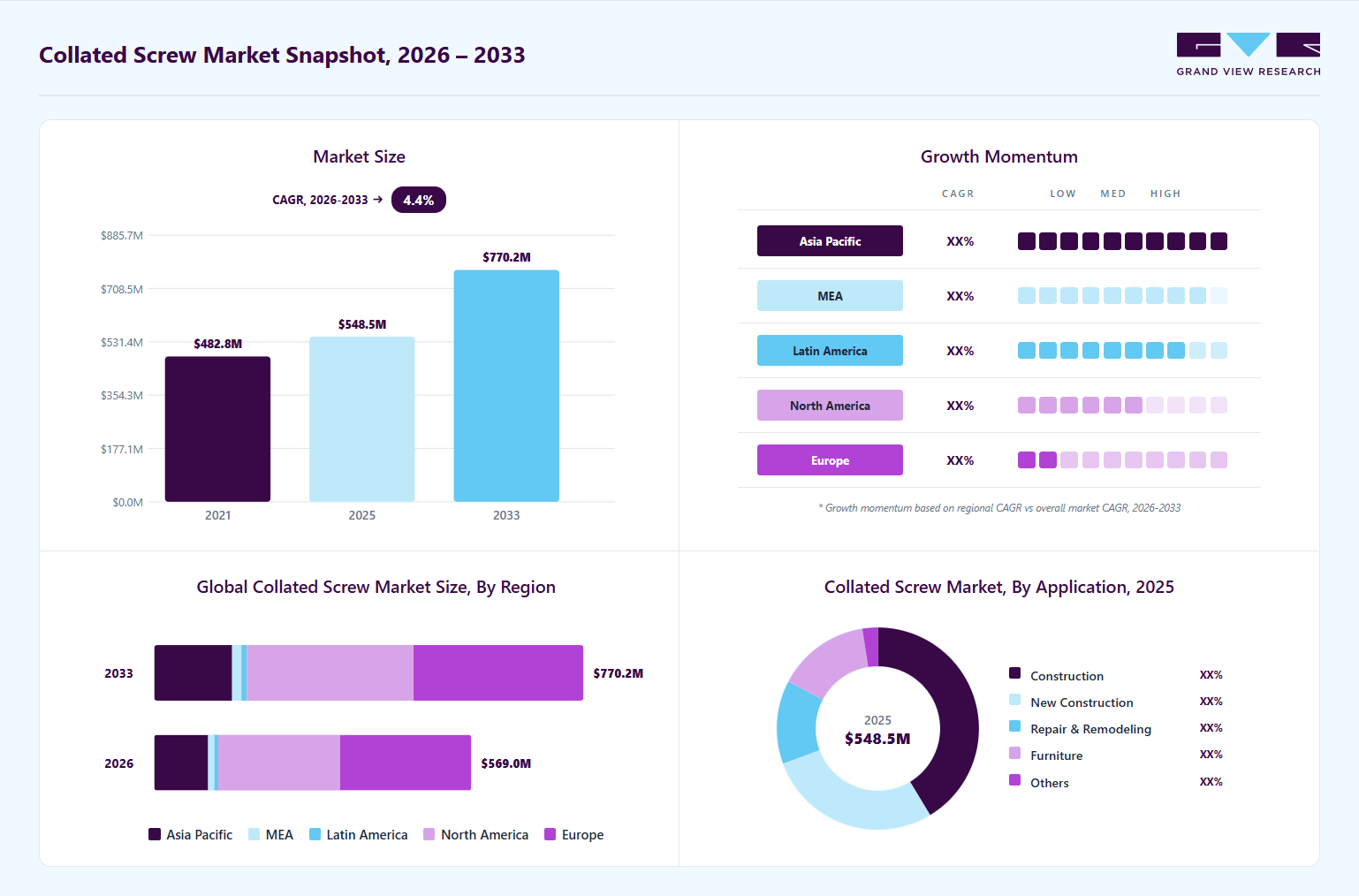
The global collated screw market size was valued at USD 548.5 million in 2025 and is projected to grow from USD 569.0 million in 2026 to USD 770.2 million by 2033, at a CAGR of 4.4% from 2026 to 2033. Europe dominated the market, accounting for a revenue share of 41.6% in 2025. The global market is driven by increasing construction and infrastructure development activities across residential, commercial, and industrial sectors.
 Source: Grand View Research, IR Documents, Primary Interviews, Paid DatabasesTo learn more about this report,
 Download Free Sample Report
 Key Market Trends & Insights
- By product: Collated drywall screws segment dominated the market, with a revenue share of 38.1% in 2025.
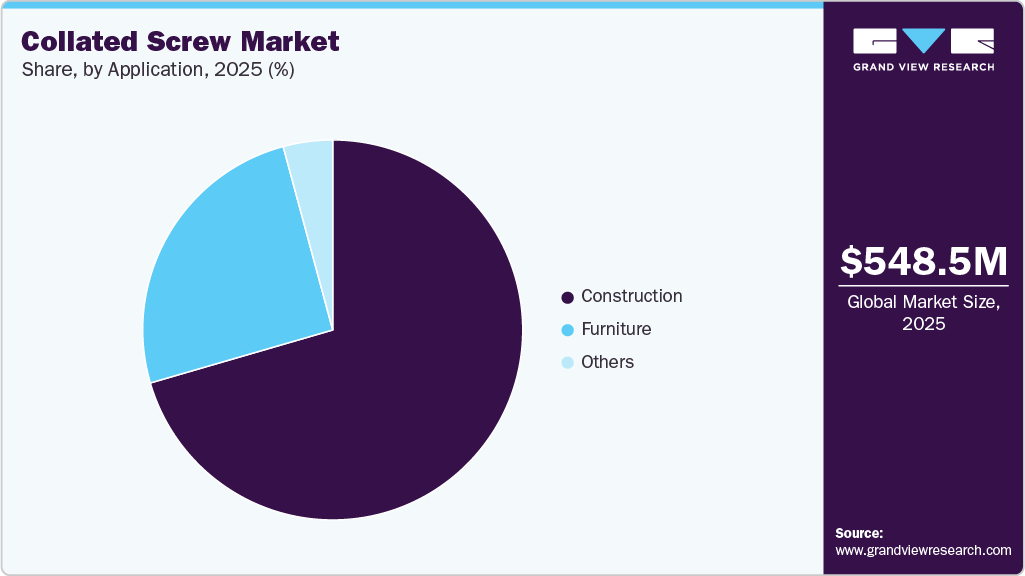
- By application: Construction applications segment held the largest market share of 70.2% in 2025.
Regional Highlights
- Largest regional market: Europe (41.6% revenue share, 2025)
- By country: Germany held the largest market share in 2025.
Market Size & Forecast
- Market size in 2025: USD 548.5 Million
- Estimated market size in 2026: USD 569.0 Million
- Projected market size by 2033: USD 770.2 Million
- CAGR (2026-2033): 4.4%
Three ways to get this report
Buy it, customize it, or ask a question.Ask an Analyst
A direct answer, usually in 1 working day
- AccessReport author, directly
- Reply timeWithin 1 working day
- No sales callDirect answer only
- FormatEmail reply
- CostFree, no cost
Get the Full Report
What the study covers
- FormatsPDF · Excel · Dashboard
- Timeline2026–2033 annual, 2025 base
- Coverage20+ countries, 5 regions
- Companies10+ key players profiled
Customize the Report
20% free customization
- IncludeCountries, segments, points
- TailorTo your product definition
- ExtendDeeper competitor detail
- OrA fully bespoke study
- Turnaround5–10 working days
Rising demand for efficient and time-saving fastening solutions in drywall installation, decking, flooring, and modular construction is supporting product adoption. Growth in furniture manufacturing, expanding renovation, and remodeling projects, and increasing use of automated screw-driving tools are further contributing to market expansion.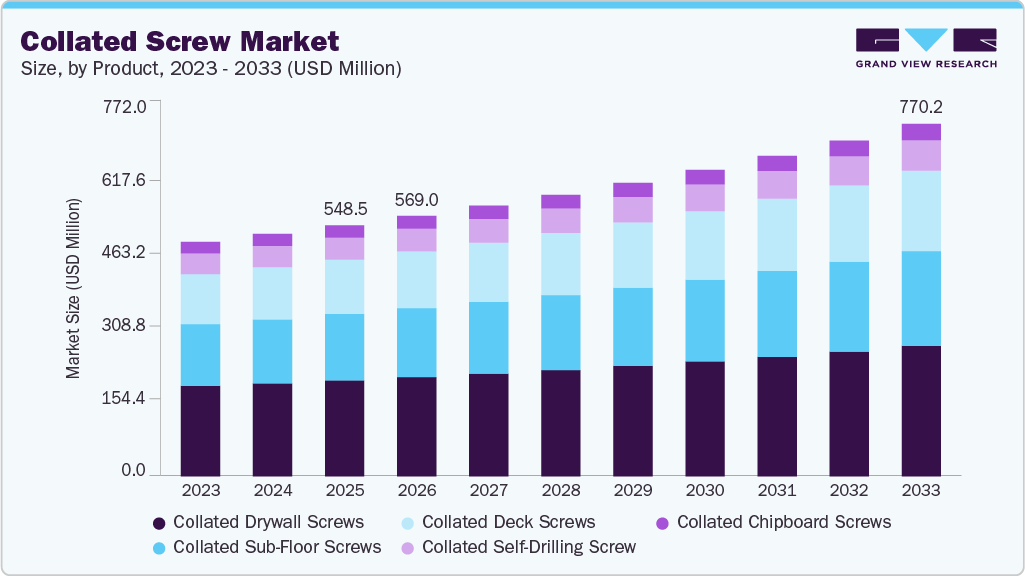 To learn more about this report, Download Free Sample Report
 The global collated screw market is experiencing growth due to increasing demand for high-efficiency fastening solutions in modern construction and woodworking applications. Rapid urbanization, expansion of residential and commercial building projects, and rising adoption of prefabricated construction methods are supporting market demand. The growing use of collated screws in drywall assembly, roofing, sub-flooring, and decking applications is improving installation productivity and reducing manual labor requirements. Furthermore, technological advancements in screw manufacturing, improved coating technologies for corrosion resistance, and increasing integration of collated fastening systems with power tools are further contributing to the growth of the global collated screw market.
Market Dynamics
The collated screw market is driven by construction activity across residential, commercial, and infrastructure development projects. Demand is also influenced by the shift toward faster installation methods that reduce project timelines and improve workforce efficiency. Applications in drywall, decking, flooring, and modular construction support consistent product usage across end-use sectors. Advancements in auto-feed fastening systems and improved screw designs are enhancing operational convenience and performance. Pricing trends are affected by fluctuations in steel and coating material costs, impacting overall production economics. Investment cycles in the construction industry and infrastructure spending patterns also shape procurement volumes. Increasing adoption of prefabricated building methods is strengthening the need for standardized fastening solutions.
The collated screw market is significantly driven by robust growth in global construction activities across residential, commercial, and infrastructure sectors. Increasing urbanization, population growth, and continuous investments in housing and public infrastructure are generating sustained demand for efficient fastening solutions. Collated screws are widely utilized in drywall, framing, flooring, and decking applications, where speed and consistency are essential for large-scale project execution.
In addition, ongoing renovation and redevelopment projects in mature markets are further supporting product demand. Contractors increasingly prefer collated fastening systems to improve workflow efficiency and reduce dependency on manual labor. This consistent construction pipeline across both developed and emerging economies continues to reinforce long-term market growth.
The adoption of collated screws is constrained by the requirement for dedicated auto-feed screw driving systems. This increases initial investment costs, making the solution less attractive for small and mid-sized contractors. In many price-sensitive regions, users continue to rely on traditional fastening methods due to lower upfront expenditure.
This equipment dependency also creates entry barriers in emerging markets where access to advanced tools is limited. As a result, penetration of collated screw systems remains uneven across different geographies and contractor segments.
The increasing shift toward modular and prefabricated construction is creating strong opportunities for collated screw adoption. These construction methods rely on standardized, high-speed assembly processes where efficiency and repeatability are critical. Collated fastening systems align well with these requirements, offering improved productivity and reduced assembly time.
As off-site construction gains traction globally, demand for reliable and consistent fastening solutions is expected to rise. This trend is particularly strong in regions facing labor shortages and tight project timelines, further enhancing market potential.
Market Concentration & Characteristics
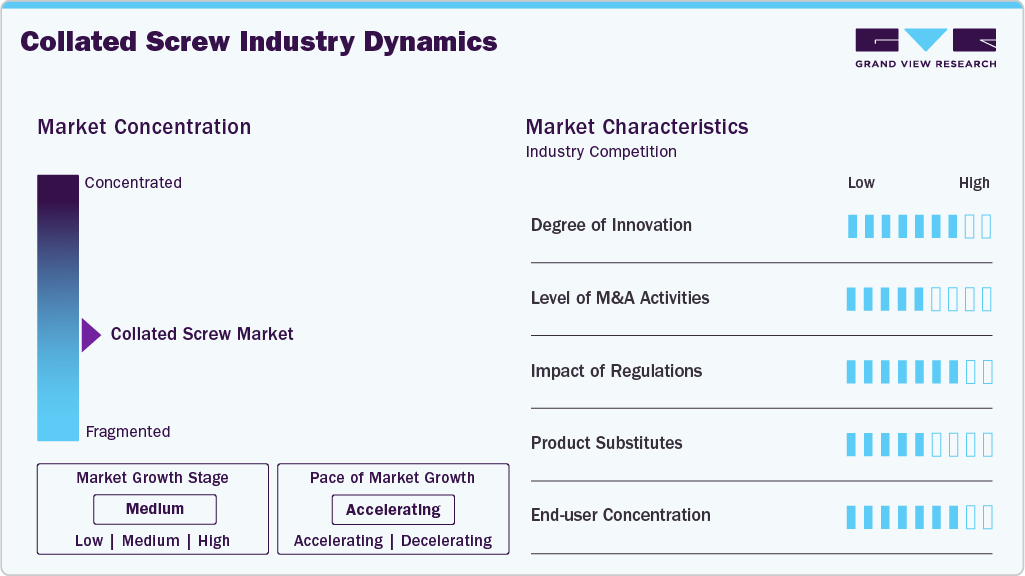
Presence of established fastening manufacturers and regional suppliers has created a moderately competitive environment within the global collated screw market. Companies compete through product durability, fastening efficiency, coating quality, thread design, pricing strategies, and compatibility with automated screw-driving systems used across residential, commercial, and industrial construction applications. Large manufacturers continue to strengthen their market positions through extensive distribution networks, broad fastening product portfolios, and long-term relationships with contractors, distributors, and construction material suppliers, while regional companies focus on cost-effective production and application-specific fastening solutions.
Product innovation remains a major characteristic influencing competition and development activities across the market. Manufacturers are increasingly introducing collated screws with improved corrosion resistance, enhanced holding strength, precision thread configurations, and compatibility with high-speed auto-feed installation systems. Growing demand for faster installation processes, reduced labor dependency, and improved fastening consistency is encouraging the development of advanced collated screw solutions suitable for drywall installation, decking, roofing, flooring, and prefabricated construction applications. Suppliers are also focusing on packaging efficiency, product reliability, and material optimization to support large-scale construction requirements.
 To learn more about this report, Download Free Sample Report
 Variation in end-user requirements across construction, furniture manufacturing, remodeling, and industrial assembly applications continues to influence purchasing patterns and product demand. Contractors and industrial users increasingly prefer fastening solutions that support high-volume installation work with consistent performance and reduced installation time. Expansion of regional distribution partnerships, localized inventory management, manufacturing capacity improvements, and customized fastening solutions remain an important strategy for companies seeking to strengthen their presence across both developed and emerging construction markets.
Analyst Perspective
The collated screw market is evolving beyond a traditional fastening products segment into a value-added construction efficiency market driven by productivity, speed, and installation consistency. Demand is being supported by growing adoption of drywall systems, modular construction, prefabricated building components, and engineered wood applications that require high-volume fastening solutions. The increasing focus on labor optimization and project schedule reduction is encouraging contractors to invest in collated fastening systems and compatible auto-feed technologies. Product innovation, including enhanced coatings, improved durability, and application-specific screw designs, is further strengthening market competitiveness. Growth opportunities remain particularly attractive in regions experiencing infrastructure development and modernization of construction practices. While raw material cost fluctuations and equipment investment requirements may influence short-term adoption rates, these factors are unlikely to alter long-term demand fundamentals.
Product Insights
Based on product, the collated drywall screws segment led the market with the largest revenue share of 38.1% in 2025, due to their extensive use in residential and commercial interior construction activities. High demand for drywall installation in offices, housing projects, institutional buildings, and renovation applications continues to support segment growth. These screws are widely preferred for their ability to provide faster installation, consistent fastening performance, and compatibility with automated screw-driving systems used by contractors to improve productivity and reduce labor time on large-scale projects. Increasing adoption of lightweight construction materials and prefabricated interior systems is further contributing to the dominance of the collated drywall screws segment.
Collated deck screws are expected to register a CAGR of 5.1% from 2026 to 2033, supported by growing demand for outdoor construction and wood decking applications across residential and commercial sectors. Expansion of landscaping projects, outdoor living spaces, and renovation activities is increasing the use of deck fastening solutions designed for durability and weather resistance. Manufacturers are focusing on corrosion-resistant coatings, improved thread designs, and high-strength materials to enhance fastening performance in exterior environments. Rising preference for efficient installation systems and pressure-treated wood applications is further supporting growth of the collated deck screws segment.
Application Insights
Based on application, the construction segment led the market with the largest revenue share of 70.2% in 2025, due to extensive usage in drywall installation, roofing, decking, flooring, and wood framing activities across residential, commercial, and industrial projects. Increasing infrastructure development, growth in prefabricated construction, and rising renovation activities are supporting demand for collated fastening solutions that improve installation speed and labor efficiency. The growing adoption of automated screw-driving systems by contractors and builders is further contributing to segment dominance across large-scale construction operations.
 To learn more about this report, Download Free Sample Report
 The furniture segment is expected to register the fastest CAGR during the forecast period, supported by increasing demand for modular furniture, ready-to-assemble products, and mass wood furniture production across residential and commercial sectors. Expansion of interior furnishing activities, rising urban housing development, and growing consumer preference for customized furniture designs are increasing the use of efficient fastening systems in furniture assembly applications. In addition, manufacturers are adopting collated screws to improve assembly productivity, fastening consistency, and operational efficiency within high-volume furniture manufacturing environments.
Regional Insights
North America Collated Screw Market Trends
Strong residential renovation activities and advanced construction practices are supporting the demand for collated screws across North America. The region has a well-established market for drywall systems, wooden flooring, decking, and modular construction, which is driving increased use of collated screws across both residential and commercial projects. Contractors and builders are increasingly adopting collated screw systems to improve installation efficiency, reduce labor time, and support faster project execution. Growing investments in infrastructure modernization, commercial real estate development, and prefabricated construction methods are further contributing to market growth
Rising residential construction activities and robust commercial infrastructure development are supporting the demand for collated screws across the U.S. construction industry. The country continues to witness significant investments in housing projects, office spaces, healthcare facilities, warehouses, and public infrastructure, increasing the use of drywall systems, flooring structures, decking, and metal framing applications. Contractors and builders are increasingly adopting collated screws to improve installation speed, reduce labor dependency, and enhance overall construction efficiency.
Europe Collated Screw Market Trends
Europe dominated the collated screw market with the largest revenue share of 41.6% in 2025, sustainable building initiatives, and increasing adoption of modern construction methods. For instance, BNP Paribas has set a target of supporting 400,000 energy-efficient home renovations in Europe by the end of 2026, highlighting the growing emphasis on sustainable housing upgrades. Such renovation activities are increasing demand for drywall screws, flooring screws, and interior construction applications across the region.
 To learn more about this report, Download Free Sample Report
 The collated screw market in Germany held the largest share in the Europe region in 2025. Increasing demand from residential, commercial, and infrastructure projects continues to drive the adoption of collated screws across a wide range of applications. The country continues to invest in modern housing projects, transportation infrastructure, industrial facilities, and energy-efficient buildings, increasing the use of drywall systems, flooring structures, and metal framing solutions. Construction companies are increasingly adopting collated screws to improve installation accuracy, reduce labor time, and support efficient project execution in large-scale developments.
Collated screws market in France Increasing renovation and residential modernization activities are supporting the growth. Demand for drywall installation, interior partition systems, flooring applications, and ceiling renovation projects continues to rise across residential and commercial buildings. Contractors are increasingly adopting collated screws to improve installation speed, reduce labor effort, and support efficient execution of renovation and interior construction work. The country growing emphasis on sustainable construction and energy-efficient building upgrades is further contributing to product demand. Government initiatives promoting the refurbishment of older buildings and the improvement of insulation systems are increasing the use of drywall and wood-based construction materials that require efficient fastening solutions.
Asia Pacific Collated Screw Market Trends
Rapid urbanization, expanding population, and large-scale infrastructure development are driving strong demand for collated screws across Asia Pacific. The region is witnessing significant growth in residential housing, commercial construction, industrial facilities, and public infrastructure projects, increasing the need for efficient fastening solutions in drywall systems, flooring, and metal framing applications. Growing construction activities in developing economies are also supporting the collated screw systems. The increasing shift toward high-rise buildings, smart city developments, and prefabricated construction methods is accelerating market expansion across the region. Contractors are increasingly using collated screws to improve installation speed, reduce labor costs, and enhance construction productivity in large-scale projects
Collated screws market in China is witnessing strong demand, supported by large-scale urbanization initiatives and increasing infrastructure investments. Growth in residential, commercial, and infrastructure construction activities continues to drive the adoption of collated screws across various applications. The country is witnessing extensive usage of drywall systems, flooring structures, roofing solutions, and metal framing in residential, commercial, and industrial projects. Growing adoption of automated fastening tools and prefabricated construction methods is further increasing the use of collated screw systems that improve installation speed and construction productivity.
India collated screws market is supported by expanding metro cities, rising industrial development, and growing residential housing construction, which continue to drive demand for collated screws across the country. These fastening solutions are increasingly used in drywall installation, flooring systems, roofing structures, and modular construction applications where faster assembly and improved labor productivity are essential. Growing preference for modern construction techniques and automated installation tools is further supporting the adoption of collated screw systems across commercial and infrastructure projects.
Latin America Collated Screw Market Trends
Increasing urban development and gradual expansion of residential and commercial construction activities are supporting the growth of the collated screws market in Latin America. Demand for collated screws is rising in drywall installation, flooring, and renovation projects as construction companies focus on improving labor efficiency and reducing installation time. Growth in housing development projects and commercial infrastructure investments is also contributing to market expansion across the region.
The Brazil collated screws market is witnessing steady demand, driven by growing residential construction and increasing renovation activities. The use of collated screws is expanding across drywall, flooring, roofing, and woodworking applications due to their efficiency and ease of installation. Increasing urban housing developments and commercial infrastructure investments are encouraging contractors to adopt automated screws that improve installation efficiency and reduce project completion time. The country’s gradual shift toward modern construction methods and modular interior solutions is also contributing to rising demand for collated fastening products.
Middle East & Africa Collated Screw Market Trends
Large-scale infrastructure projects, commercial developments, and urban expansion activities are driving the demand for collated screws across the Middle East & Africa. The increasing construction of hotels, commercial complexes, transportation facilities, and residential communities is creating strong demand for drywall, flooring, and metal fastening applications. Collated screw systems are increasingly preferred in the region due to their ability to support faster installation and improve labor efficiency in large construction projects. Growing investments in smart cities, tourism infrastructure, industrial facilities, and real estate development are further supporting market growth. Construction companies are increasingly adopting automated fastening tools and advanced installation systems to accelerate project completion and improve operational productivity.
Collated screws market in Saudi Arabia is supported by strong demand due to the ongoing expansion of residential, commercial, tourism, and industrial projects. Increasing use of drywall systems, metal framing, flooring applications, and prefabricated building components is supporting the adoption of advanced fastening solutions in modern construction activities. Contractors are increasingly utilizing collated screw systems and automated installation tools to improve productivity and accelerate project completion across large-scale developments.
Key Collated Screw Company Insights
Some of the key players operating in the market include Grip-Rite (PrimeSource Building), BECK Group and CAMO Fasteners, among others.
-
Grip-Rite is a construction fastener and building products brand owned by PrimeSource Building Products. The company manufactures nails, screws, collated fasteners, anchors, wire products, and other construction accessories used in residential and commercial building applications. Grip-Rite products are widely utilized in framing, drywall, decking, roofing, and general construction projects. The brand operates through an extensive distribution network serving contractors, builders, retailers, and construction supply channels across North America and other regional markets.
-
The BECK Group is a global manufacturer of fastening systems and innovative fastening solutions for construction, industrial, and woodworking applications. This family-owned company operates in its fourth generation and serves customers in more than 50 countries. The group includes seven companies across six locations in Austria, Germany, Italy, Poland, and the U.S. Headquartered in Mauerkirchen, Austria, BECK specializes in collated nails, fastening technology, and high-performance fastening equipment for professional applications worldwide.
Key Collated Screw Companies
The following key companies have been profiled for this study on the collated screw market.
-
Grip-Rite (PrimeSource Building)
-
BECK Fastening GmbH
-
CAMO Fasteners
-
Zen-Young Industrial Co., Ltd.
-
Grabber Construction Products
-
Metabo HPT
-
Huttig-Grip
-
Interchange Brands LLC
-
Hilti AG
-
British Gypsum (Saint-Gobain)
-
Simpson Strong-Tie
-
KYOCERA SENCO
-
MURO CORPORATION
-
Würth Group
Competitive Benchmarking
Category
Operating Strategies
Competitive Edge
Weakness
Established Players (e.g., Hilti AG, Simpson Strong-Tie, Würth Group, KYOCERA SENCO, Grip-Rite (PrimeSource Building Products), BECK Fastening GmbH
- Focus on comprehensive fastening portfolios including collated screws, auto-feed screw systems, and construction accessories.
- Invest in product innovation, advanced coatings, and fastening technologies to improve installation efficiency and durability.
- Expand market presence through global distribution networks, contractor partnerships, and long-term customer relationships.
- Strong brand recognition and established credibility among professional contractors and construction companies.
- Extensive distribution, technical support, and after-sales service capabilities across multiple regions.
- Financial strength supports continuous R&D investment, product development, and large-scale market expansion initiatives.
- Premium pricing can limit adoption among budget-conscious customers and smaller contractors.
- Larger organizational structures may result in slower response to niche market requirements and emerging trends.
- Higher dependence on mature construction markets can restrict growth during periods of reduced building activity.
Emerging & Regional Players (e.g., CAMO Fasteners, Zen-Young Industrial Co., Ltd., Grabber Construction Products, Huttig-Grip, Interchange Brands LLC, MURO CORPORATION, Metabo HPT)
- Focus on specialized applications such as decking, drywall installation, furniture assembly, and regional construction projects.
- Compete through flexible manufacturing, customized product offerings, and application-specific fastening solutions.
- Strengthen market position through local distributor networks, targeted sales efforts, and competitive pricing strategies.
- Greater flexibility in addressing customer-specific requirements and specialized application needs.
- Competitive pricing enables effective participation in cost-sensitive markets and regional projects.
- Strong niche expertise and focused product development support differentiation within targeted segments.
- Limited geographic presence and smaller distribution networks compared to global market leaders.
- Lower financial resources may constrain research, marketing, and international expansion activities.
- Higher reliance on specific regions or application segments increases exposure to localized market fluctuations.
Recent Developments
-
In April 2026, Technogips Pro introduced collated drywall screws designed for compatibility with auto-feed screw guns. The product supports faster and more consistent fastening during drywall installation and overhead applications. The collated format reduces manual handling and installation time while improving fastening efficiency and consistency for construction and interior finishing projects.
-
In January 2026, Simpson Strong-Tie opened a new 496,000-square-foot facility in Gallatin, Tennessee, to expand its manufacturing and distribution operations. The site supports production, warehousing, and logistics for construction fastening and structural products. The expansion strengthens the company’s supply chain capacity and supports growing demand from residential and commercial construction markets in North America.
Collated Screw Market Report Scope
Report Attribute
Details
Market size in 2025
USD 548.5 million
Estimated market size in 2026
USD 569.0 million
Projected market size by 2033
USD 770.2 million
Growth rate
CAGR of 4.4% from 2026 to 2033
Base year for estimation
2025
Historical data
2021 - 2024
Forecast period
2026 - 2033
Quantitative units
Revenue in USD million and CAGR from 2026 to 2033
Report coverage
Revenue forecast, company ranking, competitive landscape, growth factors, and trends
Segments covered
Product, application, region
Regional scope
North America; Europe; Asia Pacific; Latin America; Middle East & Africa
Country scope
U.S.; Canada; Mexico; Germany; UK; France; Italy; Russia; Japan; China; India; Australia; Brazil; Argentina; Saudi Arabia; South Africa; Egypt
Key companies profiled
Grip-Rite (PrimeSource Building); BECK Fastening GmbH; CAMO Fasteners; Zen-Young Industrial Co., Ltd.; Grabber Construction Products; Metabo HPT; Huttig-Grip; Interchange Brands LLC; Hilti AG; British Gypsum (Saint-Gobain); Simpson Strong-Tie; KYOCERA SENCO; MURO CORPORATION; Würth Group
Customization scope
Free report customization (equivalent up to 8 analysts' working days) with purchase. Addition or alteration to country, regional & segment scope.
Pricing and purchase options
Avail customized purchase options to meet your exact research needs. Explore purchase options
Global Collated Screw Market Report Segmentation
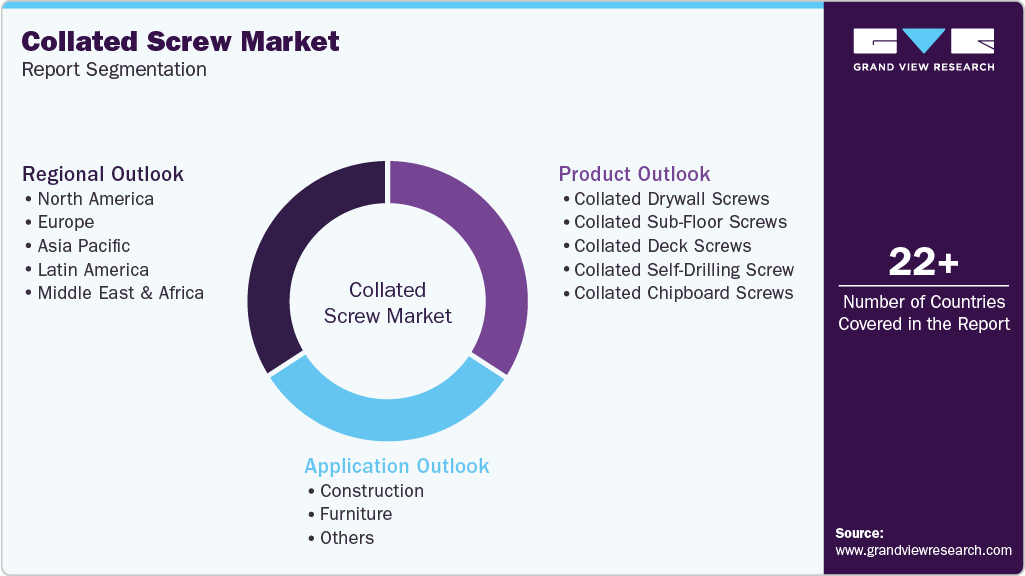
This report forecasts revenue growth at global, regional & country levels and provides an analysis on the industry trends in each of the sub-segments from 2021 to 2033. For this study, Grand View Research has segmented the global collated screw market based on product, application, and region:
 To learn more about this report, Download Free Sample Report
 -
Product Outlook (Revenue, USD Million, 2021 - 2033)
-
Collated Drywall Screws
-
Collated Sub-Floor Screws
-
Collated Deck Screws
-
Collated Self-Drilling Screw
-
Collated Chipboard Screws
-
-
Application Outlook (Revenue, USD Million, 2021 - 2033)
-
Construction
-
New Construction
-
Repair & Remodeling
-
-
Furniture
-
Others
-
-
Regional Outlook (Revenue, USD Million, 2021 - 2033)
-
North America
-
U.S.
-
Canada
-
Mexico
-
-
Europe
-
Germany
-
UK
-
France
-
Russia
-
Italy
-
-
Asia Pacific
-
China
-
India
-
Japan
-
Australia
-
-
Latin America
-
Brazil
-
Argentina
-
-
Middle East & Africa
-
Saudi Arabia
-
South Africa
-
Egypt
-
-
Research Methodology
The collated screw market figures in this report are based on a proven research process that combines executive interviews with secondary research from proprietary databases, company filings, and recognized regulatory and institutional sources. Market size is built through value-chain sizing - reconciling supply-side and demand-side estimates - and triangulated with bottom-up and top-down approaches. Every estimate passes multiple levels of expert validation before publication, with each collated screw segment quantified using the revenue-capture definitions in the table below.
Segment Definition
Segment - Product
Revenue Capture Definition
Collated Drywall Screws
Revenue includes sales of screws used for fastening gypsum boards to wood or metal studs, supporting efficient and high-speed drywall assembly applications.
Collated Sub-Floor Screws
This segment includes revenue derived from sale of collated screws used for securing sub-flooring materials to structural floor systems. It covers products designed to provide strong holding power, minimize floor movement, and improve installation efficiency across new construction and renovation projects.
Collated Deck Screws
Revenue in this segment is generated from sale of collated screws used in decking and outdoor construction applications. The segment includes corrosion-resistant fastening solutions designed for wood, composite decking, and exterior structures where durability, weather resistance, and installation speed are essential.
Collated Self-Drilling Screws
This segment captures revenue from collated self-drilling screws that eliminate the need for pre-drilling during installation. It includes products used in metal-to-metal, metal-to-wood, and light structural fastening applications across construction, industrial, and manufacturing environments.
Collated Chipboard Screws
This segment comprises revenue generated from collated screws designed for fastening chipboard, particleboard, MDF, and other engineered wood materials.
Segment - Application
Revenue Capture Definition
Construction
This segment captures revenue generated from collated screws used across residential, commercial, industrial, and infrastructure construction activities. It includes fastening solutions utilized in both new construction projects and repair, renovation, maintenance, and remodeling applications for drywall, flooring, decking, framing, and related structural installations.
Furniture
Revenue generated from collated screw systems utilized in chemical manufacturing and processing facilities.
Others
This segment captures revenue from collated screw applications outside core construction and furniture markets. It includes usage across industrial manufacturing, packaging systems, interior fixtures, prefabricated components, specialty woodworking, and various maintenance and repair activities requiring automated fastening solutions.
Estimation Model
Layer Name
Key Question
Description
Fastening Demand Base Layer
Which applications generate demand for collated screws?
Quantify fastening-intensive activities across drywall installation, sub-flooring, decking, framing, modular construction, furniture manufacturing, and engineered wood applications. Model construction volumes, furniture production output, and assembly activities require high-volume fastening solutions.
Collated Screw Applicability Layer
Which fastening applications are suitable for collated screws?
Assess the proportion of fastening tasks where collated screws offer productivity, consistency, and labor-efficiency advantages over conventional screws. Incorporate application-specific requirements, installation speed considerations, material compatibility, and project scale across end-use sectors.
Product Adoption Layer
Which collated screw types are being adopted?
Segment demand by screw type, material, coating, application, and end-use industry. Apply adoption rates based on fastening speed, labor efficiency, corrosion resistance, substrate compatibility, and construction practices.
Revenue Conversion Layer
How is market revenue generated?
Estimate annual collated screw consumption by product type, application, and region. Quantify market revenues generated from sales across construction contractors, distributors, and industrial manufacturers. Validate estimates through manufacturer shipments, distributor sales, construction activity, and industry procurement trends.
Delivered Customizations
This report has been delivered with the following In-depth customizations
CLIENT REQUEST
CUSTOMIZATION DELIVERED
VALUE ADDS
Competitive Benchmarking
Benchmarked leading collated screw manufacturers based on product portfolio, technological capabilities, financial strength, geographic presence, distribution reach, and strategic positioning, while distinguishing established and emerging market participants.
Enabled the client to assess competitive positioning, identify differentiation opportunities, and monitor key market competitors effectively.
Regional Segmentation
Refined regional analysis by evaluating construction activity, infrastructure investments, furniture manufacturing output, labor trends, and adoption of automated fastening systems across key regions.
Supported identification of high-growth markets, regional demand drivers, and strategic expansion opportunities.
Opportunity assessment
Assessed growth opportunities across modular construction, drywall installation, decking, sub-flooring, furniture manufacturing, and advanced fastening technologies.
Helped prioritize high-potential application areas and investment opportunities with strong future demand prospects.
Frequently Asked Questions About This Report
Europe dominated the collated screw market with the largest revenue share of 41.6% in 2025.
The collated drywall screws segment led the market with the largest revenue share of 38.1% in 2025.
The global collated screw market, in terms of revenue, is expected to grow at a compound annual growth rate of 4.4% from 2026 to 2033 to reach USD 770.2 million by 2033.
Some of the key players operating in the collated screw include Grip-Rite (PrimeSource Building), BECK Fastening GmbH, CAMO Fasteners, Zen-Young Industrial Co., Ltd., Grabber Construction Products, Metabo HPT, Huttig-Grip, Interchange Brands LLC, Hilti [KAG], British Gypsum (Saint-Gobain), Simpson Strong-Tie, KYOCERA SENCO, MURO CORPORATION, Würth Group.
Key factors driving the collated screw market include increasing residential, commercial, and industrial construction activities, rising infrastructure development projects, and growing demand for efficient and time-saving fastening solutions. Expansion of renovation and Remodeling activities, increasing adoption of prefabricated and modular construction methods, and growing use of automated screw-driving systems are further supporting market growth
The global collated screw market size was valued at USD 548.5 million in 2025 and is estimated at USD 569.0 million in 2026.
The construction segment accounted for the largest revenue share of 70.5% in 2025 while furniture segment is expected to be the fastest-growing market.
About the Author(s)
Advanced Interior Materials Research Team
Advanced Materials · Advanced Interior MaterialsThis report was authored by the advanced interior materials research team at Grand View Research - comprising two research analysts, one senior research analyst, and one industry expert - with specialized expertise in the advanced interior materials segment of the advanced materials industry. All findings are based on proprietary advanced materials databases, executive interviews, and regulatory analysis, subject to internal peer review prior to publication.
Last Updated:
Speak to Analyst

Customize this report to your needs - add regions, segments, or data points, with 20% free customization.
Or view our licence options:


ISO 9001:2015 & 27001:2022 Certified
We are GDPR and CCPA compliant! Your transaction & personal information is safe and secure. For more details, please read our privacy policy.


