
- Home
- »
- Power Generation & Storage
- »
-
Commercial Boiler Market Size & Share Report, 2026-2035GVR Report cover

Commercial Boiler Market (2026 - 2035)
Size, Share & Trends Analysis Report By Fuel (Natural Gas, Oil, Coal, Electric), By Technology (Condensing, Non-Condensing), By Application, By Region, And Segment Forecasts
Market Size, 2025
$4.8BMarket Estimate, 2026
$5.0BMarket Forecast, 2035
$6.9BCAGR, 2026–2035
4.7%Commercial Boiler Market Summary
The global commercial boiler market size was valued at USD 4.8 billion in 2025 and is projected to grow from USD 5.0 billion in 2026 to USD 6.9 billion by 2035, at a CAGR of 4.7% from 2026 to 2035. Europe dominated the global market, accounting for the largest revenue share of 35.0% in 2025.The global market has been experiencing significant growth, driven by increasing demand for energy-efficient heating systems, the expansion of commercial infrastructure, and a growing focus on reducing carbon emissions across regions.
Key Market Trends & Insights
- By fuel: Natural gas segment held the largest market share of around 55.0% in 2025.
- By technology: Condensing segment held the largest market share of more than 60.0% in 2025.
- By application: Educational institutions segment held the largest market share of around 25.0% in 2025.
Regional Highlights
- Largest regional market: Europe (35.0% revenue share, 2025)
- Fastest-growing regional market: Asia Pacific (highest CAGR, 2026-2035)
Market Size & Forecast
- Market size in 2025: USD 4.8 Billion
- Estimated market size in 2026: USD 5.0 Billion
- Projected market size by 2035: USD 6.9 Billion
- CAGR (2026-2035): 4.7%
Prism AI by Grand View Research Free to tryAsk a question about the commercial boiler marketTry asking✓Every figure cited from GVR research Prefer the report? Download free sample →
Commercial boilers are critical to the seamless operations of various commercial spaces and infrastructure establishments such as offices, schools, hospitals, hotels, and retail outlets, especially in regions such as Europe and North America. The increasing adoption of high-efficiency condensing boilers, along with the electrification of home and building heating, is expected to redefine the commercial boiler industry as building owners continue to develop systems that minimize energy use and comply with sustainability mandates.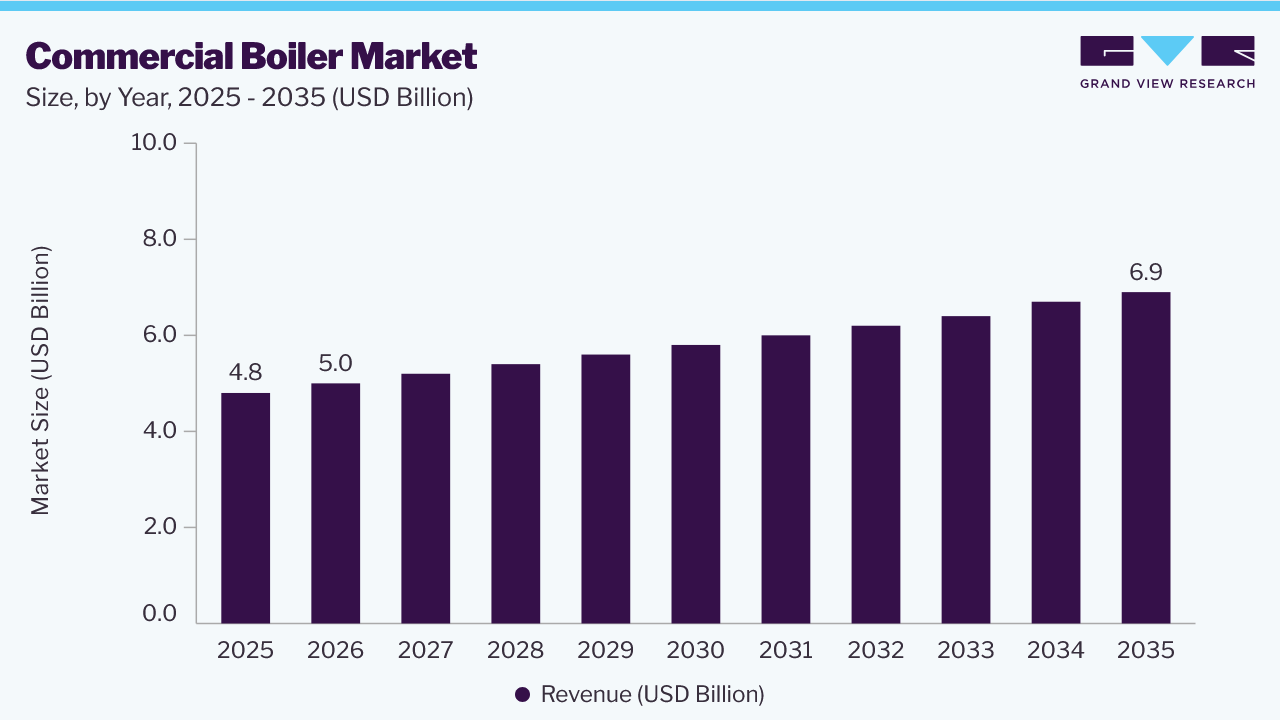 Source: Grand View Research, IR Documents, Primary Interviews, Paid DatabasesTo learn more about this report,
 Download Free Sample Report
Energy efficiency and sustainability government-led initiatives to improve building energy performance and to reduce overall emissions globally continue to be the primary market drivers of the demand for modern commercial boilers. The increasing adoption of smart building technology, in which smart controls and building management systems monitor and control building equipment to facilitate boiler control, is improving the efficiency of commercial and industrial boilers.
Opportunities in the market are driven by increased replacement of obsolete heating infrastructure, particularly in commercial structures in developed regions undergoing modernization. Asia Pacific and the Middle East are key growth markets benefiting from economic progress, urban expansion, growth in hotel, hospital & institute projects, and rising commercial construction projects. The growing commercial and noncommercial construction activity, as well as the development of smart cities, are the most promising future growth drivers. Technological enhancements such as the development of hybrid heating solutions, electric heaters, or boilers, as well as the use of low-carbon fuel, are expected to provide additional growth opportunities for the market.
Analyst Perspective
The overall commercial boiler market worldwide seems set for continued upward growth, driven by increased use of energy-efficient heating systems, growing commercial infrastructure development, and greater consideration of sustainable building approaches. Various market research organizations predict strong growth, driven by government and industry attention to emissions reduction and increased adoption of energy-efficient processes, in sales of electric and condensing technology boilers. Boiler retrofits that replace old equipment, along with significant investments in healthcare, hospitality, and institutional establishments, are expected to contribute to this upward trend in boiler demand. Emerging smart building technology and Building Management System (BMS) solutions, alongside energy-reducing, low-emission systems, are likely to present lucrative growth opportunities for this market in the coming years.
Fuel Insights
The natural gas segment led the market with the largest revenue share of around 55.0% in 2025. The segment is growing due to the wider distribution of gas pipe networks, the lowest per-unit price, and the high heating value compared to oil and coal boilers. Most offices, schools, hotels, and hospitals use natural gas for boilers, it proves consistent efficiency of work and satisfies the increasingly high standards of emissions regulation. Moreover, the infrastructure construction in existing commercial buildings also supports the constant need for natural gas boilers.
The electric segment is expected to grow at the fastest CAGR over the forecast period, driven by widespread electrification in commercial buildings to achieve net-zero carbon targets. Growth in electric boilers, especially for new commercial builds and retrofit projects focused on decarbonization, is being further stimulated by government grants, tighter carbon emissions standards, and greater availability of clean electricity.
Technology Insights
The condensing segment led the market with the largest revenue share of more than 60.0% and is expected to grow at the fastest CAGR during the forecast period. Owing to higher energy efficiency, reduced fuel input, and lower carbon footprint relative to non-condensing boilers. Governmental impetus for stricter energy-efficiency codes for commercial facilities, reductions in greenhouse gas emissions, and the implementation of green building design to facilitate greater sustainability are expected to foster the transition to newer, more efficient systems. Commercial real estate renovation/new building investment is spurring the demand to the higher side in the global market for a number of residential units that can meet the needs in both segments, commercial as well as residential.
The non-condensing segment is expected to grow at a significant CAGR over the forecast period. Owing to the demand from established commercial buildings and from those that operate on old conventional heating systems. The non-condensing boiler is favorable for building the initial infrastructure, has simple maintenance needs, and can be applied to existing heating infrastructure. While interest is slowly changing in the direction of condensing models, demand for non-condensing models remains to come into buildings where retrofitting in price-sensitive countries, economic circumstances do not permit investment in new, modern systems, or for existing conventional units, it is often quite prohibitive to buy and install one.
Application Insights
The educational institutions segment led the market with the largest revenue share of over 35.0% in 2025. The segment is witnessing growth owing to the wide usage of boilers for heating the schools, colleges, and the universities' premises. Ongoing efforts in campus modernization and the installation of energy-efficient campuses would fuel demand for commercial boiler systems in the years ahead.
The healthcare facilities segment is expected to grow at the fastest CAGR over the forecast period, due to rising expenditure on hospital infrastructure, outpatient clinics, and general healthcare facilities globally. The continuous high demand for reliable heating, hot water, sterilization, and sterile conditions remain significant driver of efficient and high-performance boiler systems. For instance, in July 2026, Zurn Elkay Water Solutions Corporation announced the acquisition of Intellihot, Inc., expanding its portfolio in healthcare related commercial boiler industry.
Regional Insights
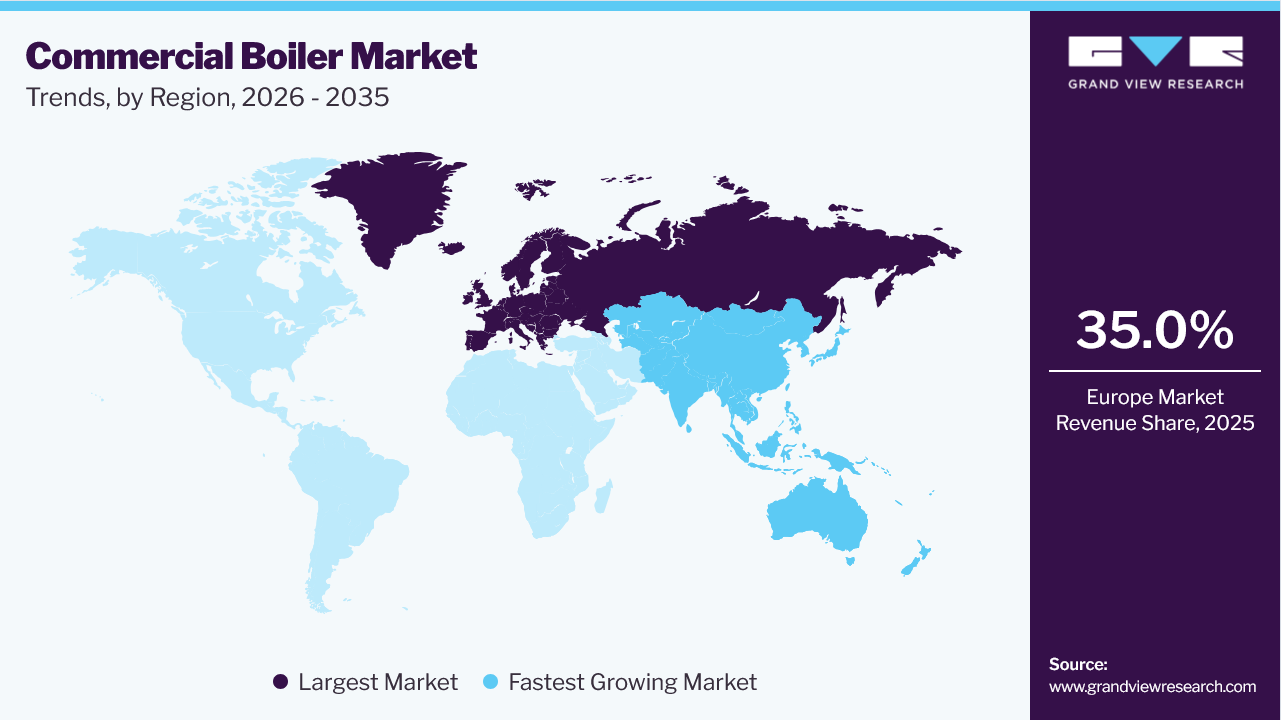
Europe dominated the global commercial boiler market with the largest revenue share of over 35.0% in 2025. The market growth is primarily driven by the widespread adoption of high-efficiency condensing technology and strict decarbonization policies in the EU. The Medium Combustion Plant Directive (MCPD) and its implementation have influenced the commercial building boilers between 1 megawatt (MWth) and 50 megawatt (MWth). This has increased due to the purchase of premium-range systems in the region. In addition, the fundamental choice of hydronic (water-based) distribution infrastructure over pneumatic (air-based) distribution also contributes to the region’s dominance in this market.
 To learn more about this report, Download Free Sample Report
Asia Pacific Commercial Boiler Market Trends
The commercial boiler market in the Asia Pacific is expected to grow at the fastest CAGR over the forecast period. The growth of the region is spurred by its rapid urbanization, growth in commercial construction activity, and its investment in more efficient and eco-friendly infrastructure, particularly in China, India, and Southeast Asia. Promotion of low-emission heating technologies by government authorities and growing demand for smart commercial buildings across the region are supporting this trajectory.
Key Commercial Boiler Company Insights
The presence of global and regional-level market participants characterizes the commercial boiler industry. Some of the major companies in this industry have been investing in advanced, energy-efficient, and low-emission boiler technologies to expand their product portfolios. For instance, in November 2025, Watts Water Technologies, Inc., announced the acquisition of Superior Boiler, a steam and hot-water boiler manufacturer, thereby expanding its portfolio in the global market.
Key Commercial Boiler Companies
The following key companies have been profiled for this study on the commercial boiler market.
-
Robert Bosch GmbH
-
Viessmann Climate Solutions SE
-
Cleaver-Brooks, Inc.
-
A. O. Smith Corporation
-
Fulton Boiler Works, Inc.
-
Babcock Wanson Group
-
Rheem Manufacturing Company
-
Ferroli S.p.A.
-
Hurst Boiler & Welding Company, Inc.
Recent Developments
-
In December 2025, Robert Bosch GmbH announced the strategic collaboration with A.E.P. Thermal Inc., a power-to-heat technology provider, aiming to develop its electrode boilers.
-
In November 2025, AERCO announced the expansion of its hot water boiler series, Sequoia, through the launch of the Sequoia S and Sequoia J models, specifically designed for commercial applications.
-
In April 2025, Bradford White Corporation announced the acquisition of Bock Water Heaters, a consortium of Universal Technologies of Wisconsin, Inc., Bock Water Heaters, Inc., and Tank Technology, Inc., expanding its portfolio in the commercial boilers industry.
Commercial Boiler Market Report Scope
Report Attribute
Details
Market size in 2025
USD 4.8 billion
Estimated market size in 2026
USD 5.0 billion
Projected market size by 2035
USD 6.9 billion
Growth rate
CAGR of 4.7% from 2026 to 2035
Base year for estimation
2025
Historical data
2021 - 2024
Forecast period
2026 - 2035
Quantitative units
Revenue in USD million/billion, and CAGR from 2026 to 2035
Report coverage
Revenue forecast, company ranking, competitive landscape, growth factors, and trends
Segments covered
Fuel, capacity, technology, product, application, region
Regional scope
North America; Europe; Asia Pacific; Latin America; Middle East & Africa
Country scope
U.S.; Canada; Mexico; UK; Germany; France; Italy; Spain; China; India; Japan; Australia, South Korea; Brazil; Argentina; Saudi Arabia; UAE; South Africa
Key companies profiled
Robert Bosch GmbH; Viessmann Climate Solutions SE; Cleaver-Brooks, Inc.; A. O. Smith Corporation; Fulton Boiler Works, Inc.; Babcock Wanson Group; Rheem Manufacturing Company; Ferroli S.p.A.; Hurst Boiler & Welding Company, Inc.
Customization scope
Free report customization (equivalent up to 8 analysts working days) with purchase. Addition or alteration to country, regional & segment scope.
Pricing and purchase options
Avail of customized purchase options to meet your exact research needs. Explore purchase options
Global Commercial Boiler Market Report Segmentation
This report forecasts revenue growth at global, regional, and country levels and provides an analysis of the latest industry trends and opportunities in each of the sub-segments from 2021 to 2035. For this study, Grand View Research has segmented the global commercial boiler market report based on fuel, capacity, technology, product, application, and region:
-
Fuel Outlook (Revenue, USD Billion, 2021 - 2035)
-
Natural Gas
-
Oil
-
Coal
-
Electric
-
Others
-
-
Technology Outlook (Revenue, USD Billion, 2021 - 2035)
-
Condensing
-
Non-Condensing
-
-
Application Outlook (Revenue, USD Billion, 2021 - 2035)
-
Offices
-
Healthcare Facilities
-
Educational Institutions
-
Lodgings
-
Retail Stores
-
Others
-
-
Regional Outlook (Revenue, USD Billion, 2021 - 2035)
-
North America
-
U.S.
-
Canada
-
Mexico
-
-
Europe
-
UK
-
France
-
Germany
-
Italy
-
Spain
-
-
Asia Pacific
-
China
-
Japan
-
India
-
Australia & New Zealand
-
South Korea
-
-
Latin America
-
Brazil
-
Argentina
-
-
Middle East and Africa
-
South Africa
-
Saudi Arabia
-
UAE
-
-
Frequently Asked Questions About This Report
The global commercial boiler market size was valued at USD 4.8 billion in 2025 and is estimated at USD 5.0 billion in 2026.
The global commercial boiler market is expected to grow at a CAGR of 4.7% from 2026 to 2035, reaching USD 6.9 billion by 2035.
Europe dominated with over 35.0% revenue share in 2025.
The natural gas segment accounted for the largest revenue share of around 55.0% in 2025.
Key players in the market include Robert Bosch GmbH, Viessmann Climate Solutions SE, Cleaver-Brooks, Inc., A. O. Smith Corporation, Fulton Boiler Works, Inc., Babcock Wanson Group, Ariston Holding N.V., Rheem Manufacturing Company, Ferroli S.p.A., Hurst Boiler & Welding Company, Inc., and others.
About the Author(s)
Power Generation & Storage Research Team
Energy & Power · Power Generation & StorageThis report was authored by the power generation & storage research team at Grand View Research - comprising two research analysts, one senior research analyst, and one industry expert - with specialized expertise in the power generation & storage segment of the energy & power industry. All findings are based on proprietary energy & power databases, executive interviews, and regulatory analysis, subject to internal peer review prior to publication.
Last Updated:
Speak to Analyst

Customize this report to your needs - add regions, segments, or data points, with 20% free customization.
Or view our licence options:


ISO 9001:2015 & 27001:2022 Certified
We are GDPR and CCPA compliant! Your transaction & personal information is safe and secure. For more details, please read our privacy policy.


