- Home
- »
- Advanced Interior Materials
- »
-
Commercial Catering Equipment Market Size Report, 2033GVR Report cover
![Commercial Catering Equipment Market Size, Share & Trends Report]()
Commercial Catering Equipment Market (2026 - 2033) Size, Share & Trends Analysis Report By Type (Cooking Equipment, Refrigeration Equipment, Food Preparation Equipment, Hot Holding Equipment), By Distribution Channel (Online, Offline), By End User, And Segment Forecasts
- Report ID: GVR-4-68040-873-1
- Number of Report Pages: 100
- Format: PDF
- Historical Range: 2021 - 2024
- Forecast Period: 2026 - 2033
- Industry: Advanced Materials
- Report Summary
- Table of Contents
- Segmentation
- Methodology
- Download FREE Sample
-
 Download Sample Report
Commercial Catering Equipment Market Summary
The global commercial catering equipment market size was estimated at USD 23.13 billion in 2025 and is projected to reach USD 34.18 billion by 2033, growing at CAGR of 5.1% from 2026 to 2033. The growth of the global foodservice and hospitality industry, along with the expansion of cloud kitchens and food delivery services, is driving demand for commercial catering equipment.
Key Market Trends & Insights
- The Asia Pacific commercial catering equipment market is projected to be the fastest growing regional market, with a CAGR of 6.5% from 2026 to 2033.
- By type, the cooking equipment segment represented the largest segment holding 35.7% of the market revenue in 2025.
- By end user, the hospitality segment is estimated to register a CAGR of 5.5% during the forecast period.
- By distribution channel, the offline segment accounted for the majority market share in 2025, holding a revenue share of 69.5%.
Market Size & Forecast
- 2025 Market Size: USD 23.13 Billion
- 2033 Projected Market Size: USD 34.18 Billion
- CAGR (2026-2033): 5.1%
- Asia Pacific: Largest Market in 2025
The increasing number of restaurants, quick-service restaurants (QSRs), and delivery-focused kitchens is encouraging foodservice operators to invest in efficient and high-capacity kitchen equipment. The adoption of energy-efficient and technologically advanced catering equipment is supporting market growth.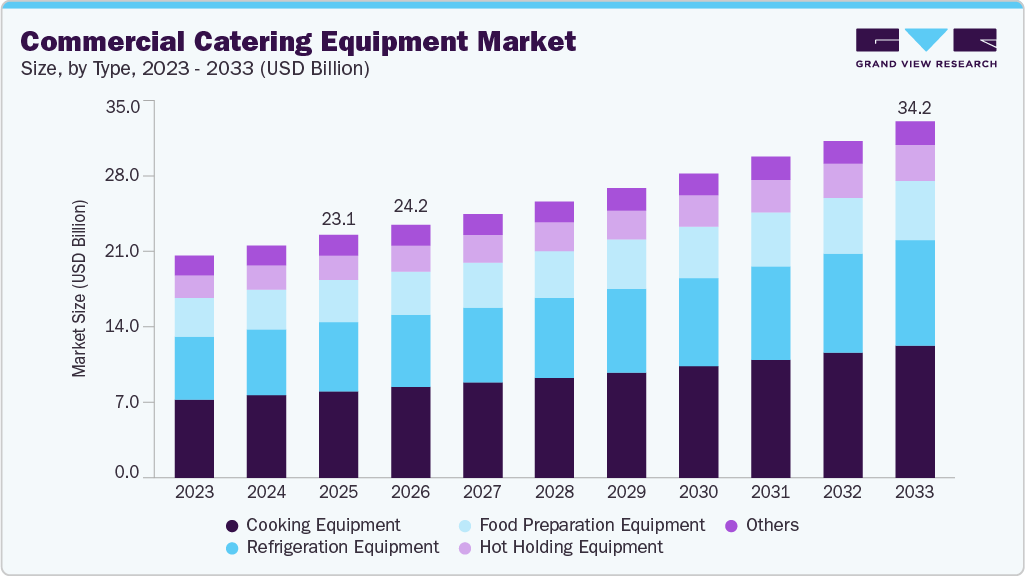
Foodservice establishments are increasingly investing in equipment that offers improved energy efficiency, automation, and digital controls to reduce operating costs and enhance productivity. Innovations such as smart kitchen systems, programmable cooking equipment, and energy-efficient refrigeration units optimize kitchen operations while complying with sustainability goals and energy regulations, thereby accelerating equipment upgrades and replacements.
Market Concentration & Characteristics
The commercial catering equipment market is fragmented, with the presence of several global manufacturers as well as numerous regional and local suppliers. Large international companies offer a broad portfolio of cooking, refrigeration, and food preparation equipment and benefit from strong distribution networks and established brand recognition. At the same time, regional manufacturers remain competitive by providing cost-effective products and catering to local regulatory requirements and customer preferences.
Market participants are focusing on product innovation, energy-efficient designs, and smart kitchen technologies to strengthen their market position. Companies are increasingly introducing equipment with advanced automation, digital controls, and connectivity features that improve operational efficiency for foodservice establishments. In addition, strategic partnerships, acquisitions, and expansion of distribution networks are commonly adopted to enhance market reach and product offerings.

Regulations related to food safety, energy efficiency, and environmental standards significantly influence the commercial catering equipment market. Foodservice establishments must comply with strict hygiene and safety requirements, which drives demand for equipment designed to meet regulatory standards for sanitation, temperature control, and material safety. In addition, energy efficiency regulations and sustainability initiatives in many regions are encouraging manufacturers to develop equipment that reduces energy and water consumption. Compliance with these standards often requires continuous product innovation and certification, shaping equipment design, manufacturing practices, and market competitiveness.
Drivers, Opportunities & Restraints
The growth of the global foodservice and hospitality industry is a key factor driving demand for commercial catering equipment. The increasing number of restaurants, hotels, cafes, quick-service restaurants (QSRs), and institutional kitchens is creating sustained demand for efficient and high-capacity kitchen equipment. Rising urbanization, changing consumer dining habits, and the expansion of organized foodservice chains are further encouraging foodservice operators to invest in advanced cooking, refrigeration, and food preparation equipment to improve operational efficiency and service quality.
Growing demand for automated and smart kitchen solutions presents significant opportunities in the commercial catering equipment market. Foodservice operators are increasingly adopting equipment with digital controls, connectivity, and automation features to improve kitchen efficiency, reduce labor dependency, and maintain consistent food quality. In addition, the expansion of quick-service restaurant (QSR) chains, institutional kitchens, and cloud kitchens across emerging markets is creating new opportunities for equipment manufacturers to introduce advanced and energy-efficient catering solutions.
High initial investment and maintenance costs associated with commercial catering equipment can limit market growth, particularly for small and medium-sized foodservice establishments. Advanced equipment such as automated cooking systems, high-capacity refrigeration units, and energy-efficient appliances often require significant upfront capital and specialized maintenance. Moreover, fluctuations in raw material prices and the need to comply with strict safety and energy regulations can increase manufacturing costs, which may affect equipment affordability and adoption rates.
Type Insights
The cooking equipment segment represented the largest segment in 2025 with a majority revenue share of 35.7% due to its critical role in large-scale food preparation across restaurants, hotels, and institutional kitchens. This category includes ovens, fryers, grills, ranges, and steamers designed to support high-volume cooking operations. The increasing number of restaurants, quick-service restaurants (QSRs), and cloud kitchens is driving demand for efficient and high-performance cooking systems, while growing adoption of energy-efficient and programmable appliances is further supporting segment growth.
The refrigeration segment is expected to gain significant prominence with a projected CAGR of 5.4% during the forecast period, due to the need for proper food storage and temperature control in commercial kitchens. It includes commercial refrigerators, freezers, walk-in coolers, and refrigerated display units used to preserve raw and prepared food. Rising food safety regulations and hygiene standards, along with the expansion of restaurants, hotels, and institutional kitchens, are driving demand for reliable and energy-efficient refrigeration systems.
End User Insights
Restaurants are key end users of commercial catering equipment due to the large number of foodservice establishments worldwide, with the segment registering a majority revenue share of 45.9% in 2025. Restaurants, including quick-service restaurants (QSRs), casual dining outlets, and fine dining establishments, rely on specialized cooking, refrigeration, and preparation equipment to ensure efficient kitchen operations and consistent food quality. The continuous expansion of restaurant chains, changing consumer dining habits, and increasing demand for fast and convenient food services are supporting equipment adoption in this segment.
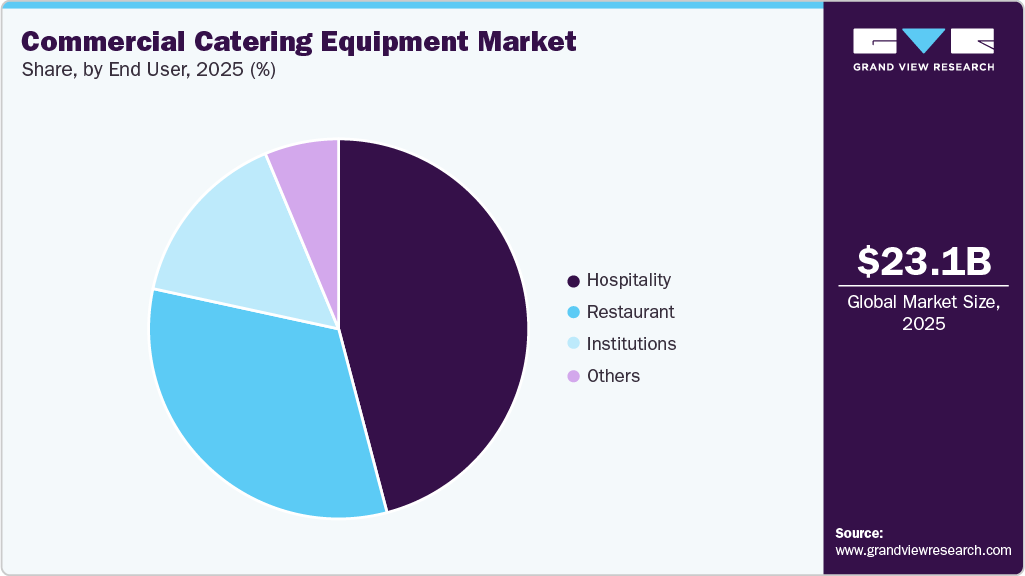
The hospitality segment represents an emerging end user, with a projected CAGR of 5.5% from 2026 to 2033. The segment is driven by the operational requirements of hotels, resorts, and large-scale catering services. These establishments require a wide range of cooking, refrigeration, and food preparation equipment to support high-volume food production for restaurants, banquets, and room service operations. Growth in global tourism and the expansion of hotel chains are increasing investments in modern and energy-efficient kitchen equipment within the hospitality sector.
Distribution Channel Insights
The offline segment dominated the commercial catering equipment market in 2025 with a share of 69.5% due to the prevailing significance of direct supplier relationships, product demonstrations, and after-sales support. Many foodservice operators prefer purchasing equipment through authorized distributors, specialty stores, and direct sales channels to ensure proper installation, maintenance services, and technical guidance. Established distribution networks and the need for customized equipment solutions further support the strong presence of offline sales channels in the market.
The online sales channel is expected to gain considerable traction during the forecast period with an estimated CAGR of 5.5%. This growth is supported by the growing trend of businesses increasingly purchasing equipment through digital platforms and e-commerce marketplaces. Online channels provide buyers with easy access to a wide range of products, competitive pricing, and the ability to compare specifications from multiple suppliers. The growing adoption of digital procurement practices and the expansion of e-commerce platforms are supporting the gradual growth of online sales in the market.
Regional Insights
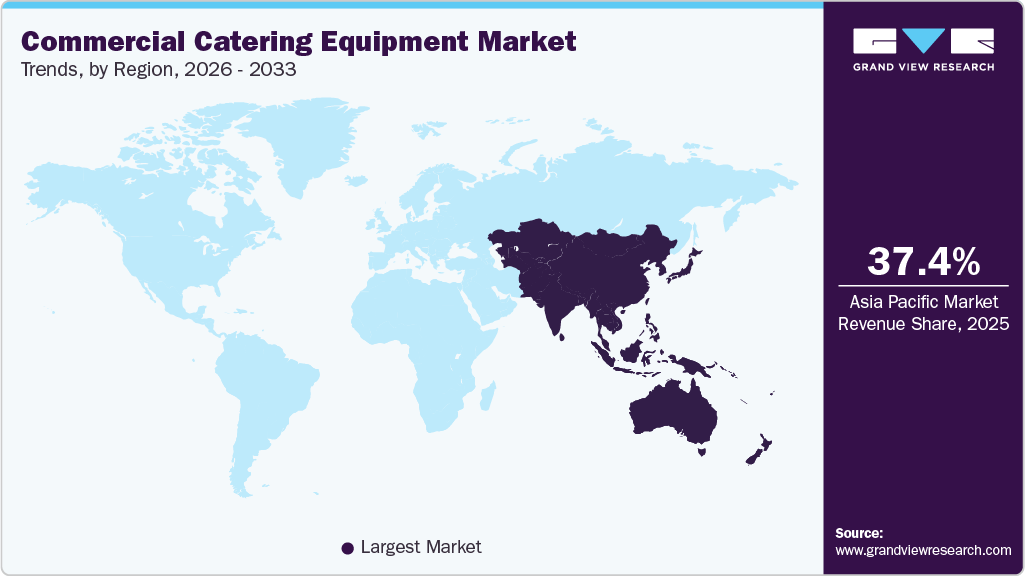
The Asia Pacific commercial catering equipment market held the largest regional share in 2025, accounting for 37.4%. The region is also the fastest-growing region due to rapid urban expansion, increasing foodservice establishments, and strong growth in organized hospitality infrastructure. Rising consumer spending on dining out and the expansion of quick-service and casual dining formats are driving demand for advanced kitchen equipment. In addition, increasing investments in commercial kitchens, cloud kitchens, and large-scale foodservice operations are supporting the adoption of modern, energy-efficient catering equipment across the region.
Commercial catering equipment market in China is experiencing robust growth, driven by the rapid expansion of high-end hospitality developments. Numerous high end hotel projects are currently under construction, including the Crowne Plaza Jingjiang, Upper House Xi’an, Sheraton Wenling Hotel, and The Ritz-Carlton Wenzhou. These large-scale developments typically feature multiple restaurants, banquet halls, and extensive commercial kitchens, significantly increasing the demand for advanced cooking, refrigeration, and food preparation equipment within the nation's expanding hospitality sector.
India commercial catering equipment market is emerging as a rapidly due to the growth of organized foodservice and hospitality sectors. According to the India Brand Equity Foundation (IBEF), the country’s food services industry is projected to reach USD 120-125 billion by 2030, reflecting about 60% growth from USD 78 billion in 2025. The expansion of quick-service restaurants, cloud kitchens, and large catering operations is increasing demand for modern commercial kitchen infrastructure, supporting the adoption of advanced catering equipment across the country.
North America Commercial Catering Equipment Market Trends
North America represents a mature, yet steadily growing market supported by a well-established foodservice industry and strong presence of commercial kitchens across hospitality, institutional, and quick-service segments. Continuous upgrades of professional kitchen infrastructure, increasing focus on energy-efficient appliances, and the adoption of smart cooking technologies are contributing to market expansion. High demand for automated and multifunctional equipment that improves operational efficiency is further supporting regional growth.
U.S. Commercial Catering Equipment Market Trends
The U.S. dominates the regional market due to the scale of its foodservice industry and continuous investments in professional kitchen infrastructure. According to the U.S. Department of Agriculture, foodservice outlets generated around USD 1.52 trillion in sales in 2024, reflecting strong consumer demand for dining and prepared food services. In addition, employment in food services and drinking places exceeded 12 million workers, highlighting the large operational base of restaurants, institutional kitchens, and catering facilities that require commercial kitchen equipment.
Europe Commercial Catering Equipment Market Trends
Europe holds a significant share of the commercial catering equipment market due to its strong hospitality culture and extensive network of restaurants, hotels, and catering services. Demand for technologically advanced, sustainable, and energy-efficient kitchen solutions is increasing as foodservice operators focus on reducing operational costs and improving productivity. The region also benefits from strict energy efficiency standards and strong emphasis on high-quality professional kitchen equipment.
The commercial catering equipment market in Germany is driven by the expansion of the foodservice and hospitality sectors. Increasing numbers of restaurants, hotels, and quick-service restaurants (QSRs), along with rising tourism and business travel, are supporting demand for advanced kitchen equipment across the country. In addition, the growing adoption of energy-efficient and technologically advanced appliances in commercial kitchens is contributing to market expansion.
The UK commercial catering equipment market is primarily driven by the expansion of the hospitality and foodservice sectors, alongside a critical shift toward operational efficiency and sustainability. Moreover, high energy prices and labour shortages are compelling operators to invest in automated, multifunctional, and energy-efficient equipment such as combi-ovens and induction cooktops to reduce utility costs and reliance on skilled kitchen staff.
Latin America Commercial Catering Equipment Market Trends
The commercial catering equipment market in Latin America is gradually expanding with the growth of urban foodservice businesses and increasing investments in hospitality and tourism infrastructure. The rising popularity of casual dining establishments, expanding catering services, and the modernization of commercial kitchens are creating opportunities for equipment manufacturers. Growing demand for cost-effective and durable kitchen equipment is also shaping purchasing decisions in the region.
Brazil represents a key market for commercial catering equipment in Latin America, supported by the growth of its hospitality and foodservice sector. The country has a large network of restaurants, catering services, and hotel establishments that require professional kitchen infrastructure to manage high food preparation volumes. Growing tourism activities, increasing investments in hotel development, and the modernization of commercial kitchens are driving demand for advanced catering equipment, particularly in large hospitality venues and institutional foodservice operations.
Middle East & Africa Commercial Catering Equipment Market Trends
The Middle East & Africa market is witnessing steady growth driven by expanding hospitality projects, increasing tourism activities, and the development of large-scale commercial foodservice facilities. The construction of hotels, restaurants, and institutional kitchens is creating consistent demand for modern catering equipment.
Commercial catering equipment in Saudi Arabia is witnessing demand due to the ambitious Saudi Vision 2030 initiative, which is transforming the country into a global tourism and entertainment hub. The rapid development of giga-projects such as NEOM, the Red Sea Project, and Qiddiya has triggered a massive wave of construction for luxury hotels, resorts, and themed entertainment venues, all requiring high-capacity, sophisticated kitchen infrastructures.
Key Commercial Catering Equipment Company Insights
Some of the key players operating in the market include Middleby Corporation and Illinois Tool Works (ITW).
-
The Middleby Corporation operates across three business segments, each supported by multiple brands. Its food service and beverage segment include bakery equipment, broilers, and combi ovens, and these products are sold under various brands including, but not limited to, Anets, APW Wyott, Lincat Limited and Bakers Pride. The company draws sales from multiple countries in different regions, such as Europe, North America, Asia, the Middle East, and Latin America, wherein North America is the company’s highest-performing region in terms of sales.
-
Illinois Tool Works (ITW) designs and produces engineered fasteners, components, equipment, consumable systems, and specialty products for diverse industries worldwide. With operations in over 50 countries and, ITW emphasizes innovation, a decentralized business model, and customer‑focused solutions, making its products integral in sectors such as automotive, construction, testing, welding, and more. Illinois Tool Works (ITW) owns a vast portfolio of well-known brands, including Hobart, Miller Electric, Paslode, Permatex, Tapcon, Red Head, Ramset, Teks, Rain-X, Gumout, Black Magic, E-Z Ancor, Brooks Instrument, and Avery Weigh-Tronix. Serving industries such as construction, automotive, food equipment, welding, and specialty products, ITW provides a wide range of tools, fasteners, chemicals, and equipment.
Key Commercial Catering Equipment Companies:
The following key companies have been profiled for this study on the commercial catering equipment market.
- Middleby Corporation
- Electrolux Professional AB
- ITW
- Ali Group
- Meiko UK Limited
- Hoshizaki Corporation
- Rational AG
- Maschinenfabrik Kurt Neubauer GmbH & Co. KG
- Buffalo
- Parry Catering and Fabrication
- Alto-Shaam, Inc
- Henny Penny
- The Vollrath Company
- UNOX S.p.A.
- Robot-Coupe
Recent Developments
-
In November 2025, ITW Food Equipment Group announced it plans to launch the ITW Total Kitchen Solutions Project & Design Team. The new team likely to assist foodservice consultants and relevant partners by providing coordinated project design assistance and integrated solutions across ITW’s foodservice equipment portfolio.
-
In January 2025, Ali Group completed the acquisition of JIPA, a manufacturer of advanced electrical multifunctional equipment for commercial kitchens. The acquisition expands Ali Group’s portfolio and strengthens its capabilities in multifunctional cooking technologies, supporting its global presence in the commercial catering equipment market.
Commercial Catering Equipment Market Report Scope
Report Attribute
Details
Market size value in 2026
USD 24.16 billion
Revenue forecast in 2033
USD 34.18 billion
Growth rate
CAGR of 5.1% from 2025 to 2033
Base year for estimation
2025
Historical data
2021 - 2024
Forecast period
2026 - 2033
Quantitative units
Revenue in USD million/billion and CAGR from 2026 to 2033
Report coverage
Revenue forecast, company market position analysis, competitive landscape, growth factors, and trends
Segments covered
Type, distribution channel, end use, region
Regional scope
North America; Europe; Asia Pacific; Latin America; and Middle East & Africa
Country Scope
U.S.; Canada; Mexico; UK; Germany; France; Italy; Spain; China; India; Japan; South Korea; Australia; Brazil;
Argentina; South Africa; Saudi Arabia; UAE
Key companies profiled
Middleby Corporation; Electrolux Professional AB; ITW; Ali Group; Meiko UK Limited; Hoshizaki Corporation; Rational AG; Maschinenfabrik Kurt Neubauer GmbH & Co. KG; Buffalo; Parry Catering and Fabrication; Alto-Shaam, Inc.; Henny Penny; The Vollrath Company; UNOX S.p.A.; Robot-Coupe
Customization scope
Free report customization (equivalent up to 8 analysts working days) with purchase. Addition or alteration to country, regional & segment scope.
Pricing and purchase options
Avail customized purchase options to meet your exact research needs. Explore purchase options
Global Commercial Catering Equipment Market Report Segmentation
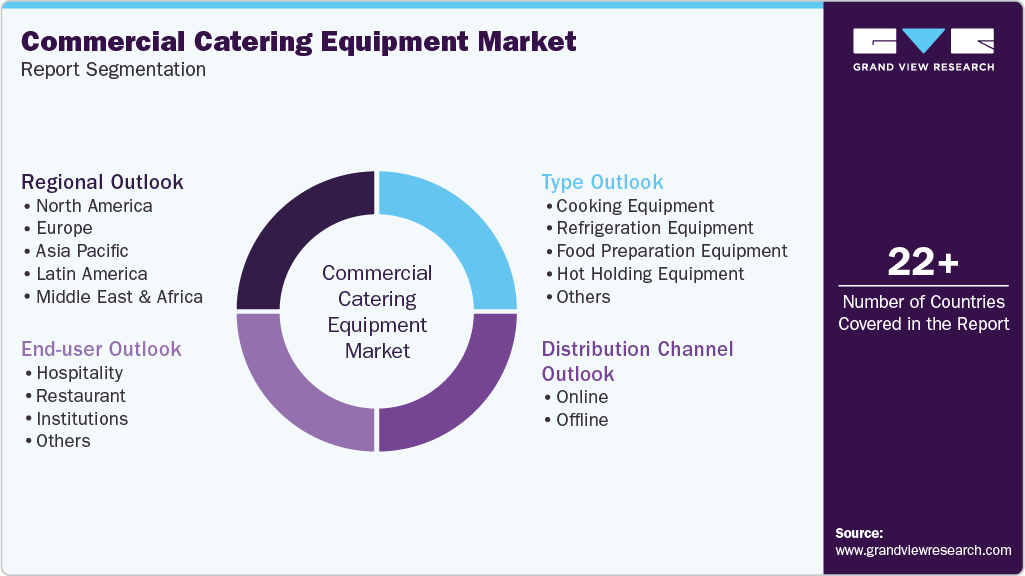
This report forecasts revenue growth at global, regional, and country levels and provides an analysis of the latest industry trends in each of the sub-segments from 2021 to 2033. For this study, Grand View Research has segmented the global commercial catering equipment market report based on type,distribution channel, end user, and region.
-
Type Outlook (Revenue, USD Billion, 2021 - 2033)
-
Cooking Equipment
-
Refrigeration Equipment
-
Food Preparation Equipment
-
Hot Holding Equipment
-
Others
-
-
Distribution Channel Outlook (Revenue, USD Billion, 2021 - 2033)
-
Online
-
Offline
-
-
End User Outlook (Revenue, USD Billion, 2021 - 2033)
-
Hospitality
-
Restaurant
-
Institutions
-
Others
-
-
Regional Outlook (Revenue, USD Billion, 2021 - 2033)
-
North America
-
U.S.
-
Canada
-
Mexico
-
-
Europe
-
UK
-
Germany
-
France
-
Italy
-
Spain
-
-
Asia Pacific
-
China
-
India
-
Japan
-
South Korea
-
Australia
-
-
Latin America
-
Brazil
-
Argentina
-
-
Middle East & Africa
-
South Africa
-
Saudi Arabia
-
UAE
-
-
Frequently Asked Questions About This Report
b. The global commercial catering equipment market size was estimated at USD 23.13 billion in 2025 and is expected to be USD 24.16 billion in 2026.
b. The market in Asia Pacific dominated the global revenue share in 2025 and accounting for 37.4% in 2025, driven by rapid urbanization, rising disposable incomes, and the expansion of the foodservice and hospitality industries.
b. Some of the key players operating in the commercial catering equipment market include Middleby Corporation, Electrolux Professional AB, ITW, Ali Group, Meiko UK Limited, Hoshizaki Corporation, Rational AG, Maschinenfabrik Kurt Neubauer GmbH & Co. KG, Buffalo, Parry Catering and Fabrication, Alto-Shaam, Inc., Henny Penny, The Vollrath Company, UNOX S.p.A., and Robot-Coupe.
b. The commercial catering equipment market is driven by the expansion of the foodservice and hospitality industries, increasing number of restaurants and quick-service restaurants (QSRs), and rising demand for efficient, energy-efficient commercial kitchen solutions.
b. The global commercial catering equipment market, in terms of revenue, is expected to grow at a compound annual growth rate of 5.1% from 2026 to 2033 to reach USD 34.18 billion by 2033.


Share this report with your colleague or friend.
Need a Tailored Report?
Customize this report to your needs — add regions, segments, or data points, with 20% free customization.


ISO 9001:2015 & 27001:2022 Certified
We are GDPR and CCPA compliant! Your transaction & personal information is safe and secure. For more details, please read our privacy policy.
Trusted market insights - try a free sample
See how our reports are structured and why industry leaders rely on Grand View Research. Get a free sample or ask us to tailor this report to your needs.