
- Home
- »
- Automotive & Transportation
- »
-
Compact Agricultural Tractor Market Size Report, 2026-2033GVR Report cover

Compact Agricultural Tractor Market (2026 - 2033)
Size, Share & Trends Analysis Report By Engine Power (Below 30HP, 31 HP To 40 HP), By Driveline (2WD, 4WD), By Propulsion (ICE, Electric), By Region, And Segment Forecasts
Market Size, 2025
$19.0BMarket Estimate, 2026
$20.3BMarket Forecast, 2033
$30.5BCAGR, 2026–2033
6.0%Compact Agricultural Tractors Market Summary
The global compact agricultural tractor market size was valued at USD 19.0 billion in 2025 and is projected to grow from USD 20.3 billion in 2026 to USD 30.5 billion by 2033, at a CAGR of 6.0% from 2026 to 2033. Asia Pacific dominated the market, accounting for the largest global share of 40.7% in 2025. This growth is driven by the growing adoption of compact tractors in landscaping and grounds maintenance applications.
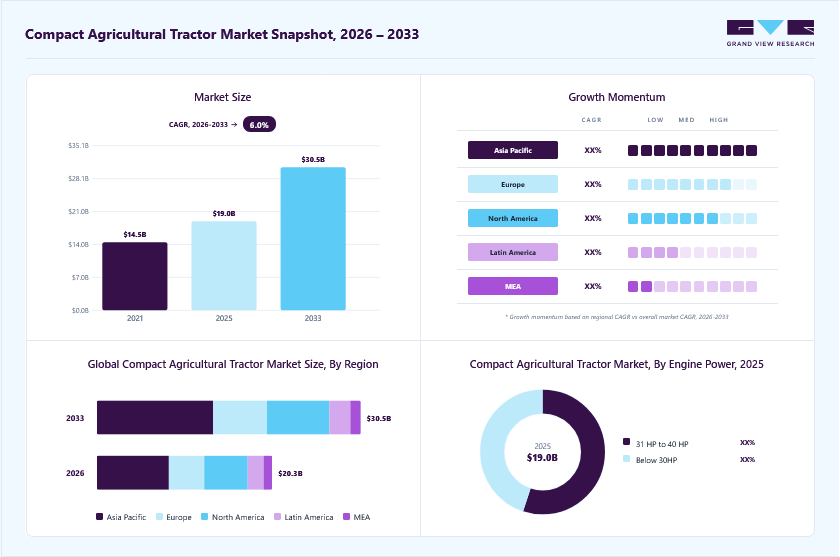 Source: Grand View Research, IR Documents, Primary Interviews, Paid DatabasesTo learn more about this report,
 Download Free Sample Report
Key Market Trends & Insights
- By engine power: 31 HP to 40 HP segment dominated the market, with a revenue share of 55.0% in 2025.
- By driveline: 2WD segment held the largest market share of 87.1% in 2025.
- By propulsion: ICE segment held the largest revenue share in 2025.
Regional Highlights
- Largest regional market: Asia Pacific (40.7% revenue share, 2025).
- By country: China held the largest market share in 2025.
Market Size & Forecast
- Market size in 2025: USD 19.0 Billion.
- Estimated market size in 2026: USD 20.3 Billion.
- Projected market size by 2033: USD 30.5 Billion.
- CAGR (2026-2033): 6.0%.
Three ways to get this report
Buy it, customize it, or ask a question.Ask an Analyst
Analyst response in 1 business day
- AccessReport author, directly
- Reply timeWithin 1 working day
- No sales callDirect answer only
- FormatEmail reply
- CostFree, no cost
Get the Full Report
What the study covers
- FormatsPDF · Excel · Dashboard
- Timeline2026–2033 annual, 2025 base
- Coverage20+ countries, 5 regions
- Companies10+ key players profiled
Customize the Report
20% free customization
- IncludeCountries, segments, points
- TailorTo your product definition
- ExtendDeeper competitor detail
- OrA fully bespoke study
- Turnaround5–10 working days
As agricultural land holdings shrink due to urbanization and land division among heirs, farmers are increasingly adopting compact tractors that are more suitable for managing small plots of land efficiently. These tractors are easier to maneuver, require less fuel, and are ideal for tasks like tilling, plowing, and hauling within tight field boundaries. The affordability and versatility of compact tractors make them highly attractive to smallholder farmers who seek to increase productivity without investing in large-scale machinery.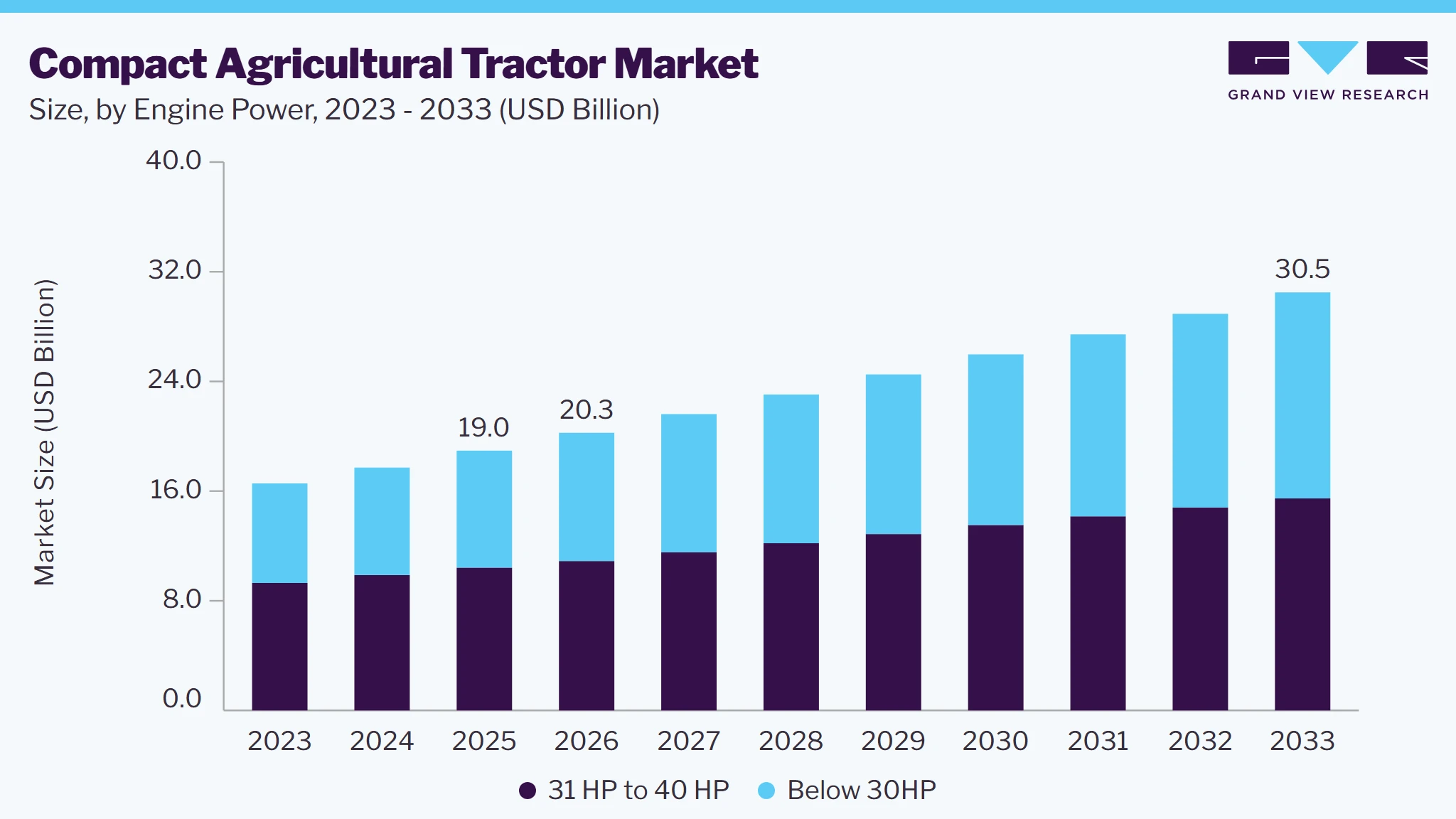 To learn more about this report, Download Free Sample Report
The increased mechanization of farming in developing countries, particularly in Asia and Africa, is driving the adoption of compact agricultural tractors. Governments in these regions are actively promoting farm mechanization to address labor shortages and enhance food security. Compact tractors are often subsidized or supported through rural development schemes, making them accessible to a broader base of farmers. These tractors also require less infrastructure for operation and maintenance, which is particularly beneficial in rural areas with limited access to service centers. As more countries focus on agricultural modernization, the demand for compact tractors is expected to rise.
The growing use of compact tractors for non-agricultural applications is also boosting the market. Compact agricultural tractors are being increasingly used in landscaping, municipal maintenance, snow removal, and construction activities. Their compact size, ease of attachment to multiple implements, and fuel efficiency make them suitable for a wide variety of tasks beyond traditional farming. Municipal bodies and contractors prefer these machines for their ability to work in confined spaces, such as parks, gardens, and roadside maintenance areas. This cross-industry usage is diversifying the customer base and expanding the overall market demand.
The increased demand for horticulture and organic farming, particularly in peri-urban and semi-urban areas, is driving market growth. As consumer preferences shift toward healthier food options, farmers and agribusinesses are focusing on high-value crops such as fruits, vegetables, and herbs. These crops often require more precise and frequent cultivation, which is well-suited to compact tractors due to their agility and compatibility with various specialized implements. Compact tractors can easily navigate between closely planted rows and operate in greenhouses or polyhouses, where larger machines would be impractical.
Moreover, dealer network expansion and digital sales platforms are making compact tractors more accessible to rural and semi-urban customers. Manufacturers are investing in wider dealership coverage, especially in underserved regions, and engine power demo programs that allow farmers to test equipment before purchasing. The rise of online sales and digital financing tools has also reduced barriers to purchase, particularly for tech-savvy younger farmers. This expanded access, coupled with improved after-sales service and spare parts availability, is strengthening consumer confidence and accelerating market penetration.
Market Dynamics
The compact agricultural tractor market is gaining momentum as small- and medium-sized farmers increasingly seek versatile, cost-effective mechanization solutions for a wide range of farming activities. Compact tractors are particularly well-suited for operations on small landholdings, orchards, vineyards, horticulture farms, and livestock facilities where maneuverability and operational flexibility are critical. Rising labor shortages, increasing farm mechanization initiatives, and growing demand for multi-purpose equipment capable of performing tillage, planting, hauling, mowing, and material-handling tasks are driving market growth. Additionally, government support programs, accessible financing options, and the expansion of specialty crop cultivation are encouraging farmers to invest in compact tractors as an affordable alternative to larger agricultural machinery.
The expansion of protected agriculture and greenhouse farming is supporting market growth. Greenhouses, shade-net houses, polyhouses, and controlled-environment farming systems are becoming more common as growers seek higher yields, improved crop quality, and year-round production capabilities. These environments often have limited operating space that cannot accommodate large agricultural machinery. Compact tractors offer the maneuverability necessary to perform soil preparation, material handling, crop maintenance, and transportation activities within these confined structures. Their ability to operate efficiently in restricted environments makes them highly suitable for modern horticultural production systems. As protected cultivation continues expanding worldwide, demand for compact agricultural tractors is expected to grow significantly.
The high acquisition cost of compact agricultural tractors is one of the most significant constraints on market growth, particularly for small and marginal farmers with limited financial resources. Although compact tractors are generally less expensive than large agricultural machinery, their purchase price can still represent a substantial investment for farmers managing small landholdings and generating modest annual farm income. In many agricultural regions, small farmers prioritize expenditures on seeds, fertilizers, irrigation, labor, and crop protection products before considering machinery purchases. As a result, investing in a compact tractor may be viewed as financially challenging despite the potential productivity benefits it offers. The gap between the cost of modern compact tractors and the purchasing power of small-scale farmers often delays mechanization decisions and limits overall market penetration. This affordability challenge continues to restrict adoption, particularly in developing agricultural economies.
The increasing demand for autonomous and semi-autonomous compact tractors presents a major opportunity for the compact agricultural tractor market, as farmers seek to improve productivity while reducing reliance on manual labor. Agricultural labor shortages have become a persistent challenge in many regions, particularly in horticulture, orchards, vineyards, and specialty crop farming, where compact tractors are extensively used. Autonomous and semi-autonomous technologies enable tractors to perform repetitive tasks such as cultivation, spraying, mowing, seeding, and material transport with minimal operator intervention. This capability allows farmers to maintain operational efficiency even when skilled labor is scarce or expensive. By reducing labor requirements and increasing working hours beyond traditional limitations, autonomous compact tractors offer significant economic benefits. As labor-related challenges intensify, manufacturers have substantial opportunities to introduce advanced automation solutions tailored to compact tractor applications.
Analyst Perspective
The compact agricultural tractor market occupies a unique position within the broader agricultural machinery industry because its growth is closely tied to the economics of small-scale farming rather than large commercial agricultural operations. Competitive success depends not only on horsepower and technical specifications but also on affordability, ease of operation, fuel efficiency, and compatibility with a wide range of implements. Manufacturers that can provide durable, multifunctional machines tailored to the needs of small landowners, horticultural producers, and emerging-market farmers are likely to capture the greatest demand. As agricultural mechanization expands beyond large farms and into fragmented farming landscapes, compact tractors are expected to serve as the primary entry point for technology adoption and productivity enhancement among smaller farming enterprises.
Engine Power Insights
Based on engine power, the 31 HP to 40 HP segment led the market with the largest revenue share of 55.0% in 2025. The development of rental and sharing platforms for agricultural equipment is boosting the utilization of 31-40 HP tractors. These models are often the preferred choice for rental businesses due to their wide applicability, ease of maintenance, and lower acquisition costs compared to higher-horsepower machines. In markets where smallholder farmers cannot afford to buy machinery outright, the ability to rent or lease these tractors through digital platforms or cooperatives is creating new demand streams and contributing to the segment’s sustained growth.
The below 30HP segment is anticipated to register at the fastest CAGR during the forecast period. The growing trend of inter-row cultivation and horticultural farming, where tractors with smaller turning radii and lower ground pressure are essential, is driving the adoption of below 30HP. Crops like sugarcane, grapes, bananas, and vegetables require equipment that can operate between narrow rows without damaging the plants or compacting the soil. The under-30 HP tractors meet these requirements effectively and are being increasingly used in precision tasks such as weeding, tilling, and spraying. Their compatibility with various mini and specialized implements further enhances their utility for such high-value crops.
Driveline Insights
Based on driveline, the 2WD segment led the market with the largest revenue share of 87.1% in 2025. The use of compact 2WD tractors in non-agricultural applications such as landscaping, light construction, and municipal maintenance has broadened their adoption. These tractors are used in institutions, schools, and public gardens where small-scale earth-moving or grass-cutting operations are needed. Their simple design, maneuverability, and affordability make them a practical choice for multi-purpose use, extending their utility beyond traditional farming.
The 4WD segment is anticipated to grow at the fastest CAGR of 7.8% during the forecast period. The growing demand for high-performance compact tractors among commercial and progressive farmers is driving market growth. As small and mid-sized farms increasingly adopt precision farming practices, they require machinery that can handle a diverse array of tasks year-round. 4WD compact tractors are more adaptable for operations such as rotavating, spraying, and transport, even under load-intensive conditions. Their improved traction makes them effective in wet paddy fields, orchards, and during monsoon seasons, where lighter or 2WD models would falter. This adaptability is prompting more farmers to invest in 4WD variants despite the higher initial cost.
Propulsion Insights
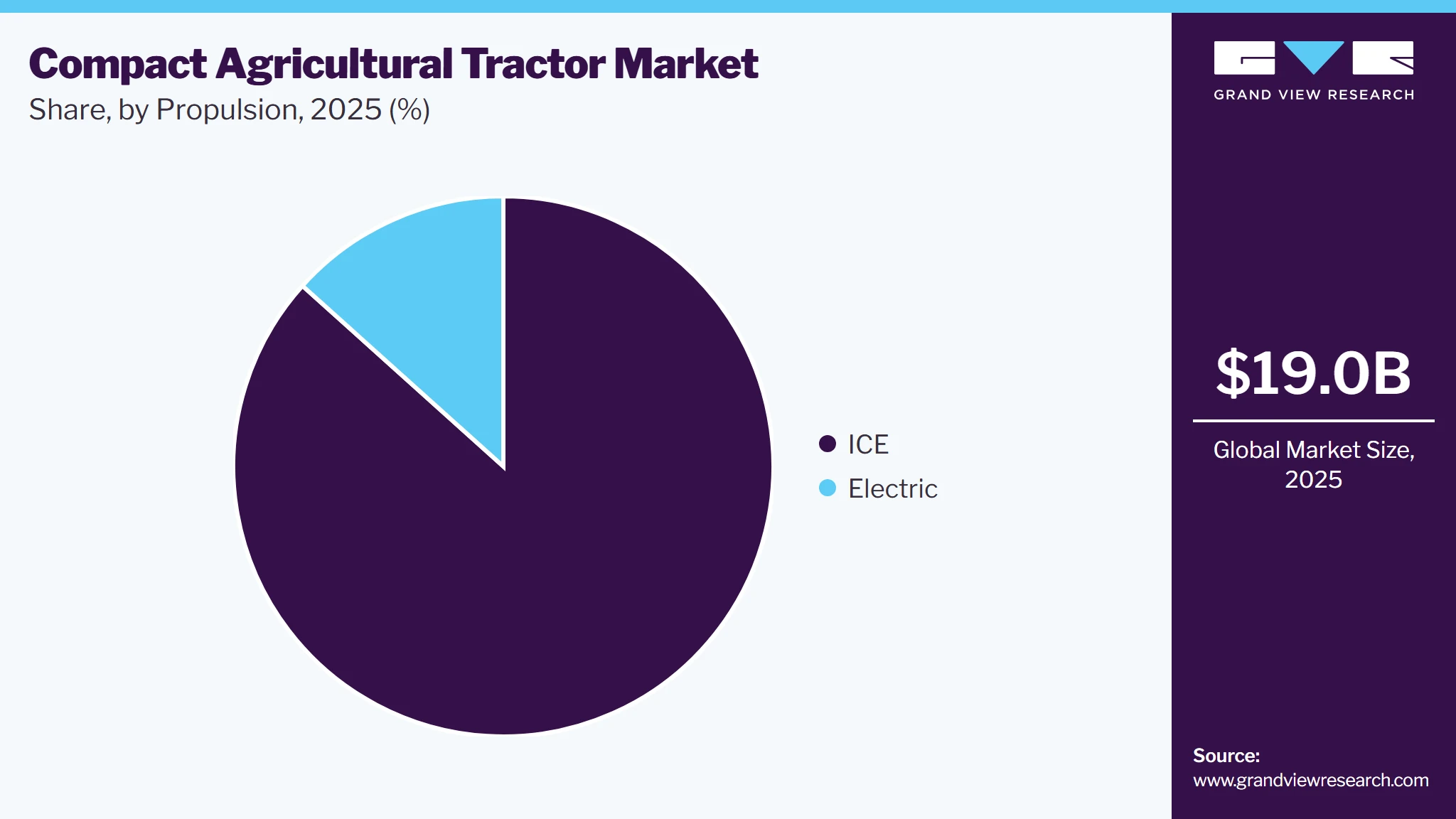
Based on propulsion, the ICE segment led the market with the largest revenue share of 86.7% in 2025. ICE tractors offer higher load-bearing capacity and endurance, which is essential for multitasking across long operational hours. Many compact tractors are used not only for farming but also for hauling, irrigation system towing, and other auxiliary duties on farms. The ability of ICE engines to maintain high torque and performance under sustained workloads and over rough terrain makes them more suitable for these multifunctional tasks. Electric tractors, while emerging, still often face limitations in battery range and load management, especially under high-stress conditions.
 To learn more about this report, Download Free Sample Report
The electric segment is anticipated to register at the fastest CAGR over the forecast period. The rising integration of smart farming technologies supports the electric segment. Many electric compact tractors come equipped with IoT connectivity, GPS guidance, and remote diagnostics, allowing farmers to monitor and optimize performance in real-time. This level of automation and precision not only boosts productivity but also aligns with the broader trend toward digital agriculture. Tech-savvy younger farmers, in particular, are showing growing interest in electrified, smart farming equipment that enhances efficiency while reducing environmental impact.
Regional Insights
The compact agricultural tractors market in the North America is estimated to grow at a significant CAGR over the forecast period. The rising popularity of urban and suburban farming in North America is driving the demand for compact tractors. With the increasing interest in local food production, urban farms, community gardens, and even backyard farming, the need for small, easy-to-manage, and versatile farming equipment has grown. These areas often have limited space, so compact tractors are ideal for efficiently working smaller plots of land. In addition, urban farming practices often emphasize sustainability, further increasing the demand for electric or hybrid models, which can be operated in noise-sensitive or urban environments.
U.S. Compact Agricultural Tractors Market Trends
The compact agricultural tractors market in the U.S. accounted for the largest market revenue share in 2025. The growing trend of mechanization in small-scale and organic farming is also driving the demand for compact agricultural tractorss. Small and organic farms often face challenges related to labor, productivity, and environmental sustainability. Compact tractors help these farmers maintain their operations by providing an efficient way to manage soil preparation, planting, and harvesting. The versatility of compact tractors, which can be equipped with various attachments such as seeders, tillers, and sprayers, enables organic farmers to reduce labor while adhering to organic farming standards. The need for equipment that can support diverse farming practices and boost productivity in small-acreage operations is thus a key factor pushing the adoption of compact tractors in the U.S.
Asia Pacific Compact Agricultural Tractors Market Trends
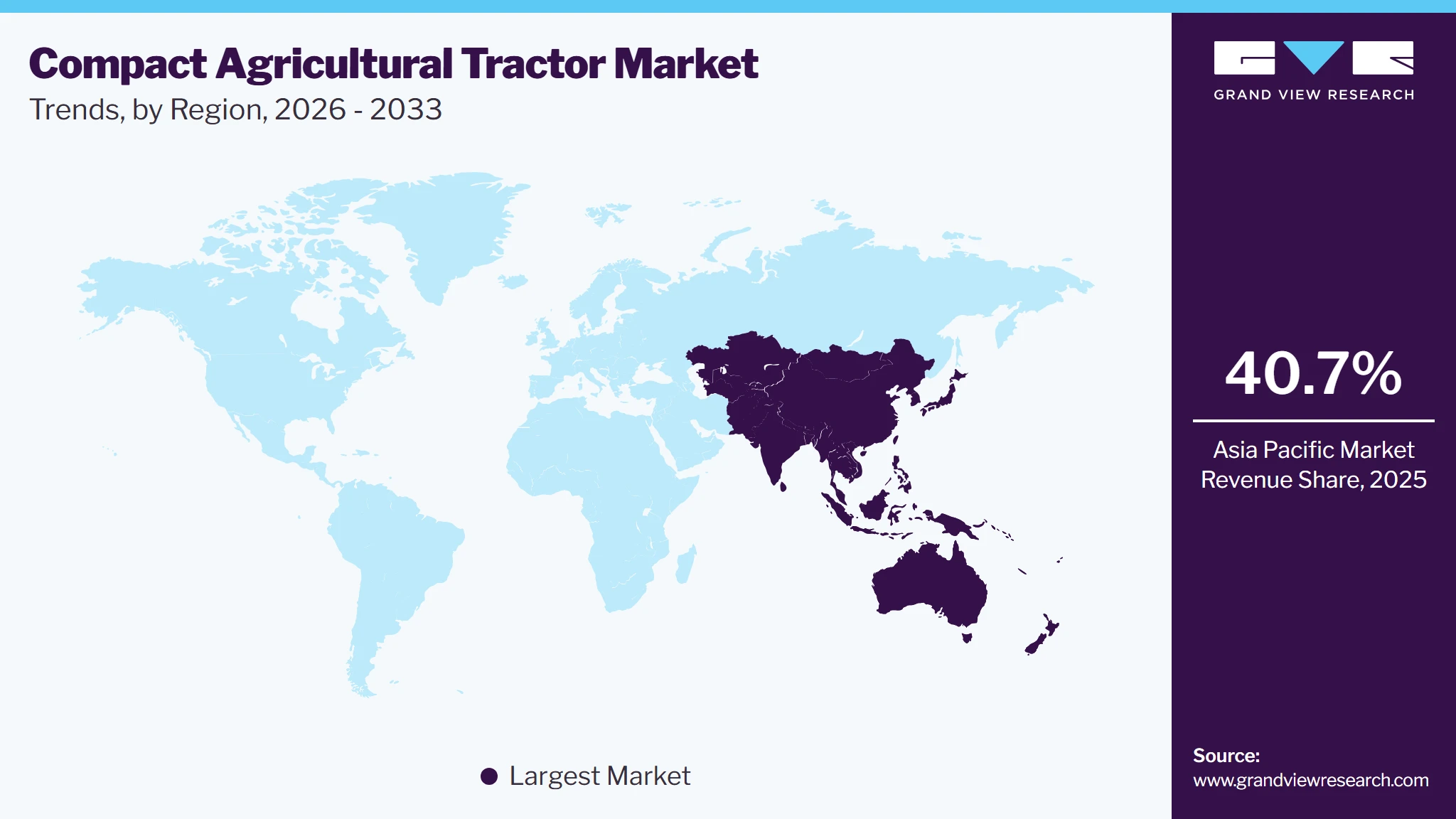
Asia Pacific dominated the global compact agricultural tractor market with the largest revenue share of 40.7% in 2025. The growth of contract farming is another significant driver in the Asia Pacific market. The compact agricultural tractor market in China held the largest share in the Asia Pacific region in 2025. Contract farming, where large agricultural firms or cooperatives enter into agreements with small farmers, is becoming increasingly popular in countries like India, Indonesia, and Thailand. These arrangements often involve providing small farmers with access to modern equipment, including compact tractors, in exchange for producing crops for large-scale buyers. The rise of contract farming is pushing the adoption of mechanization, as compact tractors are essential for meeting the efficiency and productivity requirements of these contracts. As the practice expands, the demand for compact tractors is expected to continue growing.
 To learn more about this report, Download Free Sample Report
The compact agricultural tractors market in India is projected to grow at the fastest CAGR during the forecast period. The rise of farm-to-table and organic farming in India is also influencing the market. As consumer preferences shift towards organic and locally grown produce, there is an increasing emphasis on sustainable and eco-friendly farming practices. Compact tractors, especially electric or hybrid models, align with the goals of organic farming by engine power reduced carbon emissions and lower environmental impact. The growth of the organic farming sector is pushing farmers to adopt more sustainable farming practices, including the use of compact tractors that can support eco-friendly operations, thus expanding the market for these tractors.
Europe Compact Agricultural Tractors Market Trends
The compact agricultural tractors market in Europe is growing at a significant CAGR of 6.2% over the forecast period. The rise of precision livestock farming (PLF) is a major factor contributing to the demand for compact tractors in Europe. As livestock farming becomes more data-driven and precision-focused, compact tractors are being equipped with technologies that can assist in feeding, moving, and managing livestock. These tractors are increasingly used in tasks such as distributing feed, managing pastureland, and even performing health checks on livestock through the integration of IoT devices and sensors. The adoption of precision livestock farming is helping farmers enhance animal welfare, reduce costs, and improve productivity. Compact tractors play an essential role in these operations by engine power efficient and easy-to-use machinery that can handle various livestock management tasks.
The UK compact agricultural tractors market is expected to grow at a substantial CAGR during the forecast period. The increased focus on crop diversification is contributing to the market growth in the UK Farmers are diversifying their crops to reduce risks associated with monoculture and to meet changing consumer preferences. Compact tractors are versatile and can be easily adapted to different drivelines of crops, making them ideal for farmers who are shifting towards a wider variety of crops. Whether it’s for cultivating vegetables, fruits, or other specialty crops, compact tractors provide the flexibility needed to handle a variety of farming tasks across different crop drivelines. This trend toward crop diversification is driving the adoption of compact tractors, as they offer the flexibility and adaptability needed to work with diverse farming practices.
Key Compact Agricultural Tractors Company Insights
Some of the key companies operating in the market are AGCO Corporation, CNH Industrial N.V., and Deere & Company, among others are some of the leading participants in the compact agricultural tractors industry.
-
AGCO Corporation is engaged in the design, manufacturing, and distribution of agricultural tractors and replacement parts worldwide. The company’s compact tractors are used for cultivating row crops in large farms; utility tractors primarily for livestock, dairy, vineyards, and orchards; and compact tractors for small farms, landscaping, specialty agricultural applications, and residential use. The company offers its agricultural tractors under various brands, including Challenger, Fendt, Massey Ferguson, and Valtra. The company’s compact tractors are offered under the Massey Ferguson brand.
-
CNH Industrial N.V. designs, manufactures, markets, sells, and finances agricultural & construction equipment and commercial vehicles. The company also offers transmissions, engines, and axles for these vehicles. The company operates primarily through five business segments, namely ICE, Construction, Commercial and Specialty Vehicles, and Powertrain. The Agriculture segment offers farm machinery and implements, including four-wheeled and two-wheeled drive tractors, combines, crawler tractors, hay and forage equipment, grape & sugarcane harvesters, soil preparation & cultivation implements, planting & seeding equipment, and material handling equipment.
TYM Corporation and International Tractors Limited are some of the emerging market participants in the compact agricultural tractors industry.
-
TYM Corporation specializes in agricultural machinery, particularly tractors, as well as attachments, engines, and tractor parts. The company has categorized its tractors under Series 1, Sub-Compact, Series 2, Compact, Series 3, Compact, and Series 4, compact utility. These tractor models cater to diverse farming needs, from small-scale operations to large commercial farms. These tractors can be used in various applications, including arable farming, cleaning, construction, land clearing & forestry, landscaping, livestock & poultry, and material handling.
-
International Tractors Limited manufactures tractors, multi-utility vehicles, and pick-and-carry cranes. The company also offers engines, diesel gensets, farm machinery attachments, and auto components. The company markets its products through two brands, namely Sonalika and SOLIS. The company has a global presence spanning over 130 countries.
Key Compact Agricultural Tractors Companies:
The following key companies have been profiled for this study on the compact agricultural tractor market.
-
AGCO Corporation
-
CLAAS KGaA mbH
-
CNH Industrial N.V.
-
Daedong Corporation
-
Deere & Company
-
International Tractors Limited
-
Kubota Corporation
-
Mahindra & Mahindra Ltd.
-
TYM Corporation
-
YANMAR HOLDINGS CO., LTD.
Competitive Benchmarking
Category
Operating Strategies
Competitive Edge
Weakness
Established Players (Kubota; John Deere; Mahindra & Mahindra; Yanmar; CNH Industrial)
- Mature players in the compact agricultural tractor market focus on versatile machines designed for small farms, orchards, vineyards, and landscaping applications. They emphasize multi-purpose functionality through compatibility with loaders, mowers, tillers, and other attachments. Their strategy includes expanding dealer networks in rural and semi-urban regions to improve accessibility. They also introduce fuel-efficient and operator-friendly models to attract first-time mechanization users.
- Mature players benefit from strong brand loyalty and extensive dealer support infrastructure. Their tractors are known for reliability, durability, and broad compatibility with attachments. Large production volumes help maintain competitive pricing across multiple regions. Established financing options also make equipment purchases more accessible to farmers.
- These companies face margin pressure due to intense competition in the lower-horsepower segment. Demand is closely linked to farm income levels and agricultural subsidies. Managing extensive product ranges can increase manufacturing and inventory costs. Market growth may also be constrained in regions with fragmented landholdings and limited mechanization budgets.
Emerging Players (Solectrac; Monarch Tractor; Sonalika Group; TAFE; Farmtrac)
- Emerging players focus on compact tractors tailored for niche farming operations and sustainability-focused users. They emphasize electric powertrains, smart controls, and lower operating costs. Their strategy targets smallholders, specialty crop growers, and environmentally conscious customers. Many also focus on regional markets where demand for affordable mechanization is increasing rapidly.
- Emerging players offer differentiated products that address evolving farming requirements. Their compact tractors often have lower fuel and maintenance costs than conventional alternatives. Greater flexibility in product development allows them to respond quickly to customer feedback. They also capitalize on growing interest in sustainable and precision farming practices.
- Emerging players have smaller dealer networks and limited after-sales support coverage. Production capacity may be insufficient to meet the growth in large-scale demand. Building customer trust can be challenging in markets dominated by established brands. Access to capital for product development and expansion may also be more limited.
Recent Developments
-
In September 2024, Kubota Corporation, via its subsidiary, Kubota North America Corporation, acquired Bloomfield Robotics, Inc. The acquisition aimed to enable the company to integrate AI-driven technology into its legacy of high-quality products, addressing real challenges in agricultural applications. The acquisition represented a significant milestone in the company’s strategic vision to deliver comprehensive smart agriculture solutions.
-
In August 2024, YANMAR HOLDINGS Co., Ltd., a subsidiary of Yanmar America Corporation, launched the SM series tractors in the North American market. The launch included three new models, namely the SM240, SM475, and SM240H. Powered by a fuel-efficient Yanmar TNV engine, the SM240 was designed to deliver 36.9 horsepower, making it ideal for handling heavy loads and demanding tasks. With a front-end loader capable of lifting over 2,000 lbs, the SM240 emphasized safety and ease of use, featuring a foldable ROPS, joystick-operated front loader, and an ergonomic operator station designed for comfort and style.
-
In August 2024, TYM Corporation announced that TYM North America, the company’s North American subsidiary, opened the TYM Northeast Campus in Bloomsburg, in the U.S. state of Pennsylvania. The initiative marked a strategic investment to strengthen the company’s position in the North American regional market, which accounts for the largest share of the company’s international sales.
-
In June 2024, CNH Industrial N.V. brand New Holland Agriculture partnered with Bluewhite, an autonomous technology company, to distribute, manufacture, and integrate Bluewhite's autonomous solutions for New Holland Agriculture tractors in North America. The collaboration aimed to enable New Holland Agriculture tractors to function autonomously in vineyards, orchards, and other specialty crop operations. Plane envisaged the strategic partnership being carried out through a 3-phase, multi-year plan aimed at advancing the development and integration of Bluewhite technology across New Holland Agriculture's product portfolio.
Compact Agricultural Tractors Market Report Scope
Report Attribute
Details
Market size value in 2025
USD 19.0 billion
Market size value in 2026
USD 20.3 billion
Revenue forecast in 2033
USD 30.5 billion
Growth rate
CAGR of 6.0% from 2026 to 2033
Base year for estimation
2025
Historical data
2021 - 2024
Forecast period
2026 - 2033
Quantitative units
Revenue in USD million/billion, and CAGR from 2026 to 2033
Report coverage
Revenue forecast, company market share analysis, competitive landscape, growth factors, and trends
Segments covered
Engine power, driveline, propulsion, region
Regional scope
North America; Europe; Asia Pacific; Latin America; MEA
Country scope
U.S.; Canada; Mexico; Germany; UK; France; China; Japan; India; South Korea; Australia; Brazil; Saudi Arabia; South Africa; UAE
Key companies profiled
AGCO Corporation; CLAAS KGaA mbH; CNH Industrial N.V.; Daedong Corporation; Deere & Company; International Tractors Limited; Kubota Corporation; Mahindra & Mahindra Ltd.; TYM Corporation; YANMAR HOLDINGS CO., LTD.
Customization scope
Free report customization (equivalent up to 8 analysts' working days) with purchase. Addition or alteration to country, regional & segment scope.
Pricing and purchase options
Avail customized purchase options to meet your exact research needs. Explore purchase options
Global Compact Agricultural Tractors Market Report Segmentation
This report forecasts revenue growth at global, regional, and country levels and provides an analysis of the latest industry trends in each of the sub-segments from 2021 to 2033. For this study, Grand View Research has segmented the global compact agricultural tractors market report based on engine power, driveline, propulsion, and region.
 To learn more about this report, Download Free Sample Report
-
Engine Power Outlook (Revenue, USD Million, 2021 - 2033)
-
Below 30HP
-
31 HP to 40 HP
-
-
Driveline Outlook (Revenue, USD Million, 2021 - 2033)
-
2WD
-
4WD
-
-
Propulsion Outlook (Revenue, USD Million, 2021 - 2033)
-
ICE
-
Electric
-
-
Regional Outlook (Revenue, USD Million, 2021 - 2033)
-
North America
-
U.S.
-
Canada
-
Mexico
-
-
Europe
-
Germany
-
UK
-
France
-
-
Asia Pacific
-
China
-
India
-
Japan
-
South Korea
-
Australia
-
-
Latin America
-
Brazil
-
-
Middle East & Africa
-
UAE
-
Saudi Arabia
-
South Africa
-
-
Research Methodology
The compact agricultural tractors market figures in this report are based on a proven research process that combines executive interviews with secondary research from proprietary databases, company filings, and recognized regulatory and institutional sources. Market size is built through value-chain sizing - reconciling supply-side and demand-side estimates - and triangulated with bottom-up and top-down approaches. Every estimate passes multiple levels of expert validation before publication, with each compact agricultural tractors segment quantified using the revenue-capture definitions in the table below.
Segment Definition
Segment - Engine Power
Revenue capture definition
Below 30HP
Demand is concentrated among small farms, orchards, vineyards, landscaping operators, and hobby farmers that require compact machinery for light-duty operations. Manufacturers benefit from high unit volumes, affordability-focused product positioning, and growing mechanization in emerging agricultural markets.
31 HP to 40 HP
This segment captures value through tractors capable of handling a broader range of farm activities, including tillage, spraying, hauling, mowing, and loader operations. Buyers are typically willing to invest in higher-performance models that offer greater versatility and attachment compatibility, supporting stronger average selling prices.
Segment - Driveline
Revenue capture definition
2WD
Market activity is driven by cost-conscious farmers operating on relatively flat terrain and performing routine agricultural tasks. The segment benefits from lower acquisition costs, simplified maintenance requirements, and strong demand from small and medium-sized agricultural operations.
4WD
Premium positioning is supported by superior traction, maneuverability, and performance in challenging field conditions. Equipment suppliers capitalize on growing demand from operators working on uneven terrain, specialty crop farms, and applications requiring enhanced pulling power and operational stability.
Segment - Propulsion
Revenue capture definition
ICE
The dominant propulsion category continues to benefit from an established fueling infrastructure, extensive dealer networks, and proven reliability across diverse farming environments. Purchases are supported by the ability to deliver sustained power output for demanding agricultural applications while accommodating a wide range of implements and attachments.
Electric
Growth is being fueled by increasing interest in sustainable farming practices, lower operating costs, and reduced maintenance requirements. Manufacturers are targeting specialty farming, greenhouse operations, municipalities, and environmentally conscious users with compact electric models that offer quiet operation and zero on-site emissions.
Estimation Model
Layer
Question
Analysis
Small-Scale Farm Suitability Layer
Where are compact agricultural tractors most effective?
Identify agricultural environments where maneuverability, versatility, and lower horsepower requirements are more important than heavy-duty field operations. These include small farms, orchards, vineyards, horticulture fields, dairy farms, nurseries, and mixed-crop operations. This layer focuses on agricultural settings where large tractors may be economically impractical or operationally inefficient due to limited acreage, narrow row spacing, or specialized cultivation requirements.
Ownership & Affordability Layer
Who can acquire and operate compact agricultural tractors?
Evaluate the purchasing capability of small and medium-sized farmers, cooperatives, rural entrepreneurs, and agricultural service providers. Adoption is influenced by equipment affordability, financing programs, government subsidy schemes, fuel efficiency, maintenance costs, and the availability of dealer and service networks. Compact tractors often serve as an entry point to mechanization for farmers transitioning from manual or animal-powered farming practices.
Multi-Function Utilization Layer
How are compact tractors integrated into daily farm operations?
Analyze the use of compact tractors across diverse tasks including land preparation, seeding, spraying, mowing, hauling, cultivation, irrigation support, and material handling. Their ability to operate with multiple attachments and implements increases equipment utilization rates throughout the year, allowing farmers to perform a broad range of agricultural and non-agricultural activities using a single machine platform.
Farm Efficiency & Equipment Value Layer
How is economic value generated through compact tractor deployment?
Assess value creation through improved labor productivity, reduced dependence on manual work, lower operational costs, and increased timeliness of farm activities. Revenue within the market is generated from tractor sales, implement attachments, spare parts, maintenance services, financing solutions, and equipment rental programs. Additional economic benefits arise from higher farm output, improved land utilization, and the growing demand for versatile machinery capable of serving both agricultural and rural utility applications.
Delivered Customizations
This report has been delivered with the following In-depth customizations
CLIENT REQUEST
CUSTOMIZATION DELIVERED
VALUE ADDS
Small Farm Mechanization & Specialty Crop Farming Trends
Conducted a focused analysis of compact tractor adoption across orchards, vineyards, horticulture farms, dairy operations, and small-to-medium agricultural holdings, focusing on maneuverability, versatility, and suitability for space-constrained farming environments.
Helps stakeholders identify high-growth end-user segments, evaluate mechanization trends among smaller farms, and assess commercialization opportunities for compact and multi-purpose tractor platforms.
Multi-Attachment Utility Operations & Farm Productivity Adoption Trends
Evaluated adoption trends for compact tractors used with loaders, mowers, tillers, seeders, sprayers, and material handling attachments, including demand for year-round utility applications beyond traditional field operations.
Provides insights into equipment utilization patterns, customer purchasing preferences, and commercially attractive product configurations supporting higher operational efficiency.
Compact Farm Equipment Ecosystem & Rural Modernization Opportunity Assessment
Assessed demand for operator-friendly tractors featuring hydrostatic transmissions, telematics, precision guidance capabilities, and low-maintenance designs, along with challenges related to affordability, financing access, and replacement of aging equipment fleets.
Supports investment and expansion strategies by identifying underserved farming segments, evaluating technology adoption readiness, and strengthening long-term growth opportunities in compact farm mechanization and rural productivity enhancement.
Frequently Asked Questions About This Report
The 31 HP to 40 HP segment led with a 55.0% revenue share in 2025, while below 30HP segment is the fastest-growing segment.
The 2WD segment led with a 87.1% revenue share in 2025, while 4WD segment is the fastest-growing segment.
The ICE held the largest share (over 86%) in 2025, while electric segment is the fastest-growing segment.
Key players operating in the compact agricultural tractor market include AGCO Corporation; CLAAS KGaA mbH; CNH Industrial N.V.; Daedong Corporation; Deere & Company; International Tractors Limited; Kubota Corporation; Mahindra & Mahindra Ltd.; TYM Corporation; YANMAR HOLDINGS CO., LTD.
Asia Pacific is the fastest-growing region over the forecast period.
The global compact agricultural tractors market size was valued at USD 19.0 billion in 2025 and is estimated at USD 20.3 billion for 2026.
Key factors include growing adoption of compact tractors in landscaping and grounds maintenance applications, expansion of protected agriculture and greenhouse farming, and increasing demand for autonomous and semi-autonomous compact tractors.
The global compact agricultural tractors market is expected to grow at a CAGR of 6.0% from 2025 to 2030, reaching USD 30.5 billion by 2033.
Asia Pacific dominated with a 40.7% revenue share in 2025.
About the Author(s)
Automotive & Transportation Research Team
Technology · Automotive & TransportationThis report was authored by the automotive & transportation research team at Grand View Research - comprising two research analysts, one senior research analyst, and one industry expert - with specialized expertise in the automotive & transportation segment of the technology industry. All findings are based on proprietary technology databases, executive interviews, and regulatory analysis, subject to internal peer review prior to publication.
Last Updated:
Speak to Analyst

Customize this report to your needs - add regions, segments, or data points, with 20% free customization.
Or view our licence options:


ISO 9001:2015 & 27001:2022 Certified
We are GDPR and CCPA compliant! Your transaction & personal information is safe and secure. For more details, please read our privacy policy.


