
- Home
- »
- Next Generation Technologies
- »
-
Computer Vision AI in Retail Market Size Report, 2025-2033GVR Report cover

Computer Vision AI in Retail Market (2025 - 2033)
Size, Share & Trends Analysis Report By Application, By Technology, By Deployment (On-premises, Cloud-based, Edge Computing), By End Use, By Region, And Segment Forecasts
Market Size, 2024
$1.7BMarket Estimate, 2026
$2.5BMarket Forecast, 2033
$12.6BCAGR, 2025–2033
25.4%Computer Vision AI in Retail Market Summary
The global computer vision AI in retail market size was valued at USD 1.7 billion in 2024 and is projected to grow from USD 2.5 billion in 2026 to USD 12.6 billion by 2033, at a CAGR of 25.4% from 2025 to 2033. North America dominated the market, accounting for a revenue share of 37.0% in 2024. This growth is driven by the rising demand for real-time customer behavior analytics, automated checkout systems, and enhanced inventory management powered by advanced visual recognition technologies.
 Source: Grand View Research, IR Documents, Primary Interviews, Paid DatabasesTo learn more about this report,
 Download Free Sample Report
 Key Market Trends & Insights
- The computer vision AI in retail market in the U.S. led the North America market and held the largest revenue share in 2024.
- By technology, object detection & tracking led the market, holding the largest revenue share of 29.5% in 2024.
- By end use, the supermarkets & hypermarkets segment held the dominant position in the market and accounted for the leading revenue share of 34.7% in 2024.
- By end use, the specialty stores segment is expected to grow at the fastest CAGR of 28.4% from 2025 to 2033.
Market Size & Forecast
- 2024 Market Size: USD 1.7 Billion
- 2033 Projected Market Size: USD 12.6 Billion
- CAGR (2025-2033): 25.4%
- North America: Largest market in 2024
- Asia Pacific: Fastest growing market
Three ways to get this report
Buy it, customize it, or ask a question.Ask an Analyst
Analyst response in 1 business day
- AccessReport author, directly
- Reply timeWithin 1 working day
- No sales callDirect answer only
- FormatEmail reply
- CostFree, no cost
Get the Full Report
What the study covers
- FormatsPDF · Excel · Dashboard
- Timeline2025–2033 annual, 2024 base
- Coverage20+ countries, 5 regions
- Companies10+ key players profiled
Customize the Report
20% free customization
- IncludeCountries, segments, points
- TailorTo your product definition
- ExtendDeeper competitor detail
- OrA fully bespoke study
- Turnaround5–10 working days
Retailers are increasingly utilizing computer vision for inventory management, loss prevention, and real-time monitoring of store activities. The technology supports automated checkout systems, reduces wait times, and enhances convenience. Its integration with AI technologies, such as machine learning, facilitates personalized product recommendations and targeted marketing. Additionally, the rise of smart devices and IoT sensors in stores generates vast amounts of visual data, which computer vision AI analyzes to optimize store layouts and improve customer engagement.The growth of computer vision AI in retail industry is driven by ongoing advancements in AI algorithms and hardware, enabling more accurate and faster image and video processing. Retailers are focused on expanding cashier-less store concepts and automated shelf monitoring to reduce labor costs and enhance stock availability. The integration of edge computing facilitates real-time analytics at the store level, minimizing latency and boosting responsiveness. An increasing demand for personalized shopping experiences drives the adoption of AI-powered customer behavior analysis and dynamic pricing strategies.
For instance, in February 2025, Zebra Technologies’ 17th Annual Global Shopper Study revealed that 77% of Indian shoppers prefer retailers offering personalized recommendations, highlighting a strong demand for AI-driven shopping experiences. In response, 52% of retailers in India and the APAC region plan to implement AI-based loss prevention solutions within the next three years to enhance security and operational efficiency. Furthermore, as retailers expand omnichannel strategies, computer vision AI helps unify online and offline data to deliver seamless customer journeys.
 To learn more about this report, Download Free Sample Report
 Ongoing investments in AI research and supportive government initiatives accelerate the adoption of computer vision AI in retail by enabling smarter, data-driven operations. Retailers increasingly combine AI with big data analytics and IoT technologies to enhance predictive maintenance, optimize supply chains, and strengthen fraud detection capabilities. Cloud-based AI platforms provide scalable and cost-effective solutions, allowing retailers to implement advanced computer vision applications without significant infrastructure investments. Additionally, the growing emphasis on sustainability encourages retailers to adopt AI solutions that reduce energy consumption and minimize waste throughout their operations.
Application Insights
The customer experience enhancement segment led the computer vision AI in retail market in 2024, accounting for over 27% of global revenue as retailers increasingly focus on delivering personalized and seamless shopping journeys. Computer vision AI enables real-time analysis of shopper behavior, allowing retailers to tailor recommendations and provide interactive assistance. This technology supports virtual try-ons and smart displays, which engage customers and improve satisfaction. Retailers optimize store layouts and service delivery by gaining deeper insights into preferences and foot traffic. As competition intensifies, enhancing the customer experience remains a top priority, driving adoption in this segment. For instance, in February 2025, Everseen Limited released Everseen Insights: The Future of artificial intelligence (AI) in Retail, a survey highlighting that 63% of retailers consider AI essential for maintaining a competitive advantage and anticipate an average return on investment of 51% within three years of AI deployment.
The checkouts & payments recognition segment is expected to grow at the fastest CAGR during the forecast period, as retailers seek to streamline transaction processes and reduce friction at points of sale. Computer vision facilitates cashier-less checkout systems that speed up purchases and minimize human errors. The technology also enhances payment security by accurately recognizing payment methods and detecting fraudulent activities. With consumers favoring contactless and convenient shopping options, retailers invest in these solutions to improve throughput and reduce operational costs. The drive for faster, more secure checkouts supports ongoing expansion in this area.
Technology Insights
The object detection & tracking segment accounted for the largest revenue share of the computer vision AI in retail industry in 2024, due to its fundamental role in retail automation. These technologies enable precise product movement monitoring, helping retailers maintain accurate inventory and reduce losses from theft or misplacement. Real-time tracking supports automated shelf replenishment and stock audits, improving operational efficiency. The versatility of object detection across various retail formats, from supermarkets to specialty stores, makes it indispensable. Retailers rely on this technology to ensure product availability and streamline supply chain management.
The gesture recognition segment is expected to grow at the fastest CAGR over the forecast period as retailers adopt touchless interfaces to enhance hygiene and user convenience. This technology allows customers to interact with digital kiosks and displays without physical contact, aligning with health and safety concerns. Gesture-based controls also improve accessibility for diverse customer groups. Integration with augmented and virtual reality creates immersive shopping experiences. These factors contribute to growing interest and deployment of gesture recognition in retail. Retailers also use gesture recognition to facilitate contactless self-service options, reducing staff workload and improving operational efficiency, especially in high-traffic environments.
Deployment Insights
The on-premises segment accounted for the prominent revenue share in 2024 as many retailers prefer local data processing to ensure data privacy, security, and low latency. On-premises solutions provide greater control over sensitive customer and operational data, facilitating compliance with data protection regulations. They reduce reliance on internet connectivity, ensuring uninterrupted store operations. Retailers with established IT infrastructure find on-premises deployments effective for delivering real-time analytics and rapid decision-making at the store level. In addition, on-premises systems allow customization to meet specific operational needs and integrate seamlessly with legacy retail systems, providing flexibility in deployment.
 To learn more about this report, Download Free Sample Report
 The edge computing segment is anticipated to grow at the fastest CAGR during the forecast period, driven by enabling data processing near the source, which reduces latency and bandwidth demands. Retailers deploy edge devices to analyze video and sensor data in real time, allowing immediate responses to customer behavior and inventory changes. This decentralized approach enhances system reliability and supports data privacy by limiting cloud data transmission. The need for fast, autonomous store operations drives the growing adoption of edge computing solutions. Edge computing also facilitates offline functionality, ensuring complex AI applications continue operating during network disruptions, which is vital for maintaining seamless retail operations.
End Use Insights
The supermarkets & hypermarkets segment accounted for the market revenue share of the computer vision AI in retail industry in 2024 due to their large scale and operational complexity, which benefits significantly from automation. Computer vision AI assists in managing vast inventories, monitoring checkout lanes, and analyzing customer flow to optimize staffing and store layout. These retailers require efficient loss prevention and shelf management to maintain profitability amid high product volumes. AI-driven solutions enable faster restocking and reduce shrinkage, improving overall store efficiency and customer convenience. Moreover, large-format retailers leverage computer vision to conduct detailed shopper behavior analysis, enabling targeted marketing and personalized promotions that increase basket size and customer retention.
The specialty stores segment is anticipated to grow at the fastest CAGR during the forecast period, driven by leveraging computer vision to provide highly personalized services and unique shopping experiences. These stores focus on niche markets where detailed customer profiling and targeted marketing are essential. Computer vision supports inventory accuracy and product authenticity verification, which is important for specialty goods. The technology also enables interactive and immersive experiences that help differentiate specialty retailers. Increasing digital transformation efforts in this segment drive greater AI adoption. Specialty retailers also use computer vision to monitor customer engagement with premium products, optimize merchandising strategies, and enhance brand loyalty.
Regional Insights
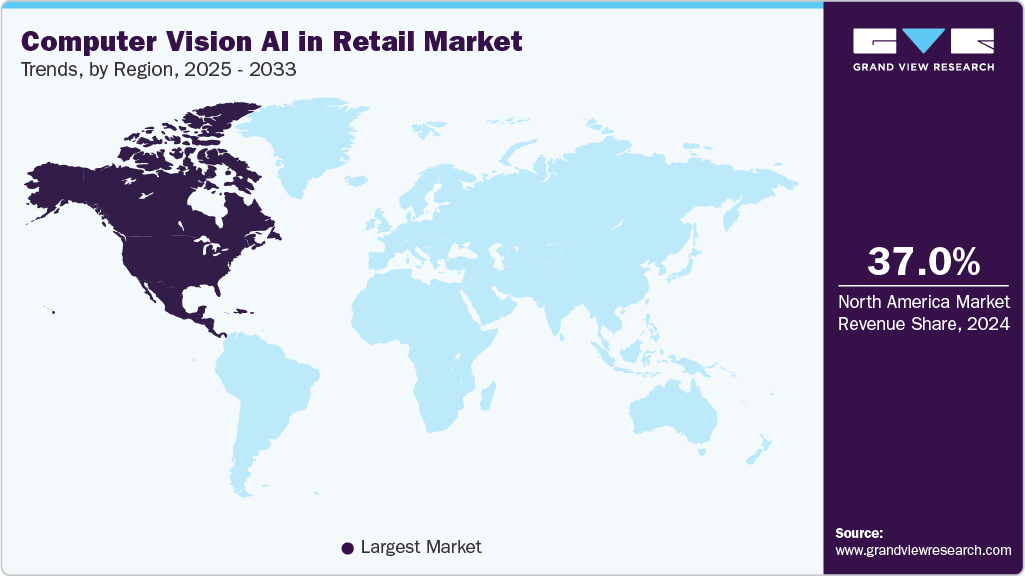
North America dominated the computer vision AI in retail industry with a revenue share of over 37% in 2024 due to early adoption of AI technologies and substantial investments in retail innovation. The presence of major technology providers and large retail chains accelerates the deployment of computer vision applications. Strong digital infrastructure and high consumer expectations encourage retailers to implement AI solutions that enhance omnichannel experiences and operational efficiency. Supportive regulatory frameworks and government initiatives further facilitate technology integration.
 To learn more about this report, Download Free Sample Report
 U.S. Computer Vision AI in Retail Market Trends
The U.S. computer vision AI in retail industry is expected to grow significantly in 2024 as retailers integrate computer vision AI to meet evolving consumer demands and improve profitability. Leading retailers implement cashier-less stores, smart shelves, and personalized marketing powered by AI technologies. The country’s advanced digital infrastructure and innovation ecosystem support rapid adoption. Government initiatives and programs promoting digital transformation and innovation in retail provide strong support for the widespread adoption and growth of computer vision AI technologies across the country.
Europe Computer Vision AI in Retail Market Trends
The computer vision AI in retail industry in Europe is expected to grow significantly over the forecast period, driven by strong data privacy regulations and sustainability goals. Retailers emphasize ethical AI use and secure data management while leveraging computer vision for customer insights and operational automation. The region prioritizes enhancing in-store experiences and supply chain transparency. Collaboration between governments, academia, and industry fosters responsible AI development and innovation. Growth in e-commerce and omnichannel retail further stimulates demand.
Asia Pacific Computer Vision AI in Retail Market Trends
The computer vision AI in retail industry in Asia Pacific is anticipated to register the fastest CAGR over the forecast period, driven by rapid urbanization, retail modernization, and widespread smartphone penetration. Retailers adopt computer vision AI to address labor shortages and improve customer engagement. Supportive government policies and investments in smart city initiatives contribute to market expansion. Rising middle-class populations and changing consumer preferences encourage technology adoption across diverse retail formats. The dynamic retail environment creates strong demand for AI-powered solutions that enhance efficiency and service quality.
Key Computer Vision AI in Retail Company Insights
Some key companies in the computer vision AI in retail industry are IBM Corporation, Google LLC, Amazon Web Services, Inc., and Microsoft.
-
Google LLC offers advanced computer vision AI solutions through its Google Cloud platform to help retailers improve operations and customer experiences. Its Vision AI tools enable real-time image and video analysis for applications such as inventory management, loss prevention, and customer behavior insights. Partnerships with companies like Everseen Limited leverage Google LLC’s edge computing and AI platforms to deliver instant alerts and actionable data in physical stores, enhancing operational efficiency and reducing shrinkage.
-
Amazon Web Services, Inc. provides a broad range of computer vision and AI services for retail. Amazon Rekognition offers image and video analysis capabilities in cashier less checkout systems, inventory tracking, and security monitoring. Amazon Web Services, Inc.’s scalable cloud infrastructure supports real-time data processing and AI model deployment, enabling retailers to enhance customer experience and operational workflows. Through solutions such as Amazon Go stores, Amazon Web Services, Inc. demonstrates practical applications of computer vision AI that automate checkout, reduce friction, and optimize store management.
Key Computer Vision AI in Retail Companies:
The following are the leading companies in the computer vision AI in retail market. These companies collectively hold the largest market share and dictate industry trends.
- Intel Corporation
- Amazon Web Services, Inc.
- Clarifai, Inc.
- Google LLC
- IBM Corporation
- Basler AG
- Everseen Limited
- Microsoft
- NVIDIA Corporation
- Cognex Corporation
Recent Developments
-
For instance, in March 2025, Old Navy, Gap Inc.’s largest brand, partnered with Radar to implement AI-powered RFID technology across its store network. This multi-year initiative aims to equip store associates with real-time inventory visibility, enabling them to quickly locate products anywhere in the store and enhance the overall customer experience. By integrating RFID, artificial intelligence, and computer vision, Radar’s platform provides continuous product tracking that supports optimized inventory replenishment, reduces shrinkage, and delivers actionable insights to improve store operations and product innovation.
-
In January 2025, Vision AI provider Everseen Limited partnered with Google LLC to advance physical retail operations by applying Vision AI technology. This collaboration aims to help retailers reduce inventory shrinkage, optimize operational efficiency, and enhance overall customer experience. By leveraging Google Cloud’s scalable infrastructure and Everseen’s expertise in computer vision, the partnership seeks to deliver real-time insights and automation solutions that address key challenges in the retail sector.
-
In January 2025, Everseen Limited launched Everseen Vision Agents, an advanced AI solution designed to optimize and transform business processes across various industries, including retail. These Vision Agents enhance operational efficiency by autonomously learning, reasoning, and adapting in real time to streamline workflows such as warehouse receiving, back-of-store waste management, and checkout shrink reduction. The technology continuously improves operational performance by detecting patterns and identifying process inefficiencies, offering significant potential value for global retailers and supply chain operations.
Computer Vision AI in Retail Market Report Scope
Report Attribute
Details
Market size in 2024
USD 1.7 billion
Estimated market size in 2026
USD 2.5 billion
Projected market size by 2033
USD 12.6 billion
Growth rate
CAGR of 25.4% from 2025 to 2033
Actual data
2021 - 2023
Forecast period
2025 - 2033
Quantitative units
Revenue in USD billion/million and CAGR from 2025 to 2033
Report coverage
Revenue forecast, company ranking, competitive landscape, growth factors, and trends
Segments covered
Deployment, end use, technology, application, region
Regional scope
North America; Europe; Asia Pacific; Latin America; MEA
Country scope
U.S.; Canada; Mexico; Germany; UK; France; China; India; Japan; Australia; South Korea; Brazil; UAE; South Africa; KSA
Key companies profiled
Intel Corporation; Amazon Web Services, Inc.; Clarifai, Inc.; Google LLC; IBM Corporation; Basler AG; Everseen Limited; Microsoft; NVIDIA Corporation; Cognex Corporation
Customization scope
Free report customization (equivalent up to 8 analysts working days) with purchase. Addition or alteration to country, regional & segment scope.
Pricing and purchase options
Avail customized purchase options to meet your exact research needs. Explore purchase options
Global Computer Vision AI in Retail Market Report Segmentation
This report forecasts revenue growth at the global, regional, and country levels and provides an analysis of the latest industry trends in each of the sub-segments from 2021 to 2033. For this study, Grand View Research has segmented the global computer vision AI in retail market report based on application, technology, deployment, end use, and region:
-
Application Outlook (Revenue, USD Million, 2021 - 2033)
-
Customer Experience Enhancement
-
Inventory Management
-
Checkout and Payments
-
Marketing and Merchandising
-
Operations Optimization
-
-
Technology Outlook (Revenue, USD Million, 2021 - 2033)
-
Image Recognition
-
Facial Recognition
-
Gesture Recognition
-
Object Detection & Tracking
-
Optical Character Recognition (OCR)
-
-
Deployment Outlook (Revenue, USD Million, 2021 - 2033)
-
On-premises
-
Cloud-Based
-
Edge Computing
-
-
End Use Outlook (Revenue, USD Million, 2021 - 2033)
-
Supermarkets & Hypermarkets
-
Convenience Stores
-
E-commerce Warehouses
-
Specialty Stores
-
Quick-Service Restaurants (QSR)
-
Others
-
-
Regional Outlook (Revenue, USD Million, 2021 - 2033)
-
North America
-
U.S.
-
Canada
-
Mexico
-
-
Europe
-
Germany
-
UK
-
France
-
-
Asia Pacific
-
China
-
Japan
-
India
-
South Korea
-
Australia
-
-
Latin America
-
Brazil
-
-
Middle East and Africa (MEA)
-
UAE
-
KSA
-
South Africa
-
-
About the Author(s)
Next Generation Technologies Research Team
Technology · Next Generation TechnologiesThis report was authored by the next generation technologies research team at Grand View Research - comprising two research analysts, one senior research analyst, and one industry expert - with specialized expertise in the next generation technologies segment of the technology industry. All findings are based on proprietary technology databases, executive interviews, and regulatory analysis, subject to internal peer review prior to publication.
Last Updated:
Speak to Analyst

Customize this report to your needs - add regions, segments, or data points, with 20% free customization.
Or view our licence options:


ISO 9001:2015 & 27001:2022 Certified
We are GDPR and CCPA compliant! Your transaction & personal information is safe and secure. For more details, please read our privacy policy.


