Conductive Polymer Fibers Market Summary
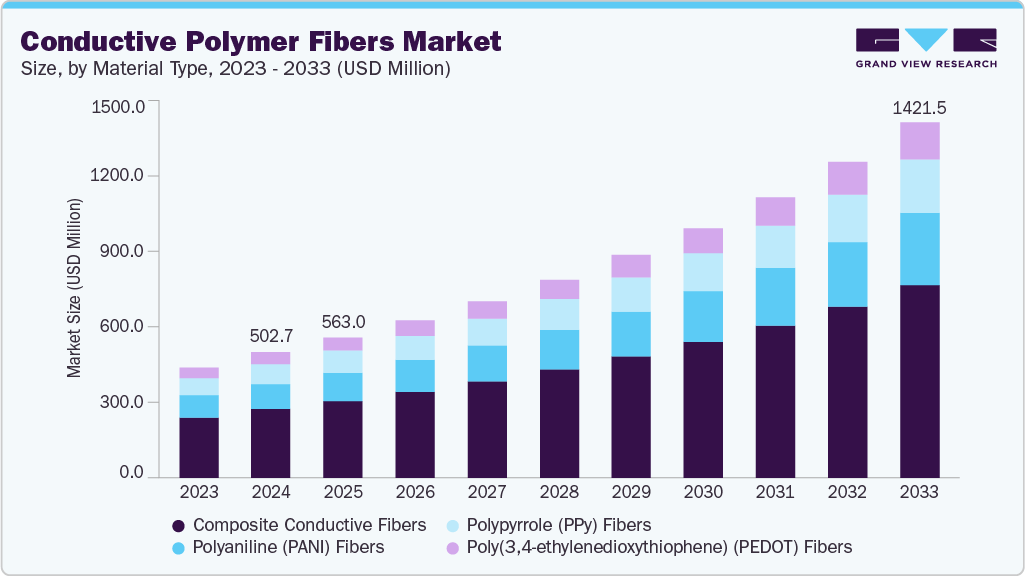
The global conductive polymer fibers market size was estimated at USD 502.7 million in 2024 and is projected to reach USD 1,421.5 million by 2033, growing at a CAGR of 12.3% from 2025 to 2033. The growing use of smart fabrics in sportswear and healthcare is driving demand for conductive polymer fibers that can monitor body temperature, movement, and heart rate in real time.
Key Market Trends & Insights
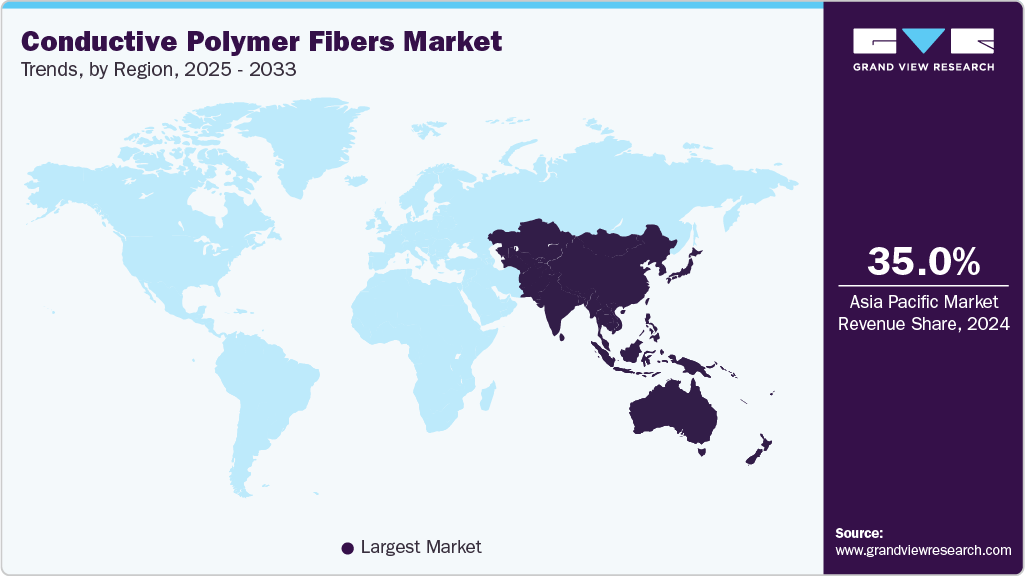
- Asia Pacific dominated the conductive polymer fibers market with the largest revenue share of 35.03% in 2024.
- The conductive polymer fibers market in India is expected to grow at a substantial CAGR of 14.3% from 2025 to 2033.
- By material type, the poly (3,4-ethylenedioxythiophene) (PEDOT) fibers segment is expected to grow at a considerable CAGR of 13.6% from 2025 to 2033 in terms of revenue.
- By application, the smart textiles & wearable electronics segment is expected to grow at a considerable CAGR of 13.1% from 2025 to 2033 in terms of revenue.
Market Size & Forecast
- 2024 Market Size: USD 502.7 Million
- 2033 Projected Market Size: USD 1,421.5 Million
- CAGR (2025-2033): 12.3%
- Asia Pacific: Largest market in 2024
The increasing consumer interest in connected and performance-enhancing clothing is further driving market growth. Adoption of conductive polymer fibers is shifting from niche prototyping to commercialized functional textiles. Manufacturers and apparel brands are embedding fibers based on PEDOT:PSS, polyaniline, and polypyrrole into garments and industrial textiles to deliver sensing, heating, and EMI shielding capabilities. Volume production techniques such as fiber coating and core-sheath spinning are improving yield and uniformity. This is shortening the time to market for smart wearables and technical fabrics.
Drivers, Opportunities & Restraints
Growth is driven by strong end-user demand for lightweight, flexible, and washable conductive textiles. Consumer electronics and healthcare segments require integrated sensors for biometric monitoring. Industrial sectors seek embedded sensing for asset monitoring and safety applications. These needs increase the willingness to pay for higher-performing conductive fibers and support investment in scaling up manufacturing.
There is a clear opening to develop certified conductive fiber systems for medical, military, and automotive applications. Regulatory clearance and robust durability tests command price premiums, creating high entry barriers for competitors. Suppliers that can demonstrate repeatable washability, stable conductivity over time, and compliance with safety standards can secure long-term contracts. Licensing of proprietary chemistries and co-development with OEMs can further entrench market position.
High raw material and processing costs constrain the margin for mainstream apparel applications. Many conductive polymers struggle to retain conductivity after repeated washing and mechanical stress. Integration with existing textile manufacturing requires process changes that raise capital expenditure for converters and brands. These factors slow adoption outside premium use cases and force producers to balance performance with price.
Market Concentration & Characteristics
The conductive polymer fibers market is experiencing high growth, with an accelerating pace. The market exhibits slight consolidation, with key players dominating the industry landscape. Major companies, including Chromatic Technologies Inc., LCR Hallcrest, RTP Company, Val Creations, BASF SE, Kiran Holographics, 3M Company, and others, play a significant role in shaping the market dynamics. These leading players often drive innovation within the market, introducing new products, technologies, and applications to meet the evolving demands of the industry.
Innovation in conductive polymer fibers is concentrated at the intersection of polymer chemistry, nanomaterials, and fiber engineering. New formulations and post-treatment methods are improving baseline conductivity and adhesion to textile substrates, enabling washability and mechanical resilience that were previously limited. At the same time, hybrid architectures that combine conductive polymers with carbon nanotubes or metal nanowires are creating fibers with tunable electrical and mechanical properties for specific use cases. Scale-aware manufacturing methods such as solution spinning and coated yarn processes are moving lab results closer to commercial volumes.
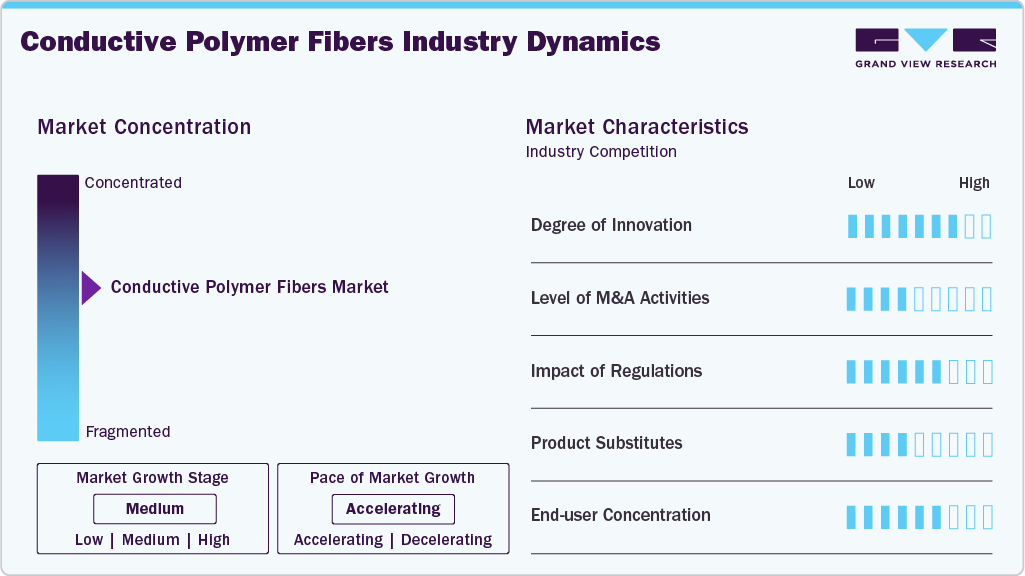
Conductive polymer fibers face competition from several established and emerging alternatives. Metal-based yarns and silver-coated threads offer higher conductivity and proven reliability in EMI and grounding applications, but they add weight and compromise textile comfort. Carbon-based conductors, including carbon nanotube and graphene fibers, offer excellent strength-to-conductivity ratios and a path to metal-free wiring; yet they remain constrained by production costs and scale. Conductive inks and coatings offer a low-cost retrofit solution for many smart textile applications, but they can struggle with long-term durability and repeated laundering.
Material Type Insights
Composite conductive fibers dominated the conductive polymer fibers market across the material type segmentation in terms of revenue, accounting for a market share of 54.94% in 2024, and are forecasted to grow at a 12.1% CAGR from 2025 to 2033. The demand for composite conductive fibers is driven by industries that require both mechanical strength and electrical performance simultaneously. Automotive and aerospace designers favour core-sheath and fiber-reinforced formats because they replace metal wiring with lighter integrated paths. This lowers system weight and simplifies assembly while meeting durability requirements for harsh environments. Suppliers able to scale composite processing and demonstrate predictable long-term performance, capture OEM interest, and larger contracts.
The poly(3,4-ethylenedioxythiophene) (PEDOT) fibers segment is anticipated to grow at a substantial CAGR of 13.6% through the forecast period. PEDOT-based fibers are gaining traction because the polymer delivers stable conductivity, combined with flexibility and film processability, making them suitable for textile coating and printing. Recent advances in coating chemistry and post-treatments have improved electrical stability and adhesion on fiber substrates, reducing a critical barrier to commercialization. As manufacturers target wearable electronics and transparent conductive layers, PEDOT supply chains and formulation IP become strategic assets.
Application Insights
Antistatic & ESD protection fabrics dominated the conductive polymer fibers market across the application segmentation in terms of revenue, accounting for a market share of 35.12% in 2024, and are forecasted to grow at a 12.4% CAGR from 2025 to 2033. Growth in electronics assembly and stricter ESD control policies are creating steady demand for certified antistatic textiles in production and cleanroom settings. Brands and contract manufacturers prefer textile solutions that retain anti-static performance after repeated laundering and handling. This pushes raw material suppliers to invest in long-lasting conductive treatments and testable compliance, generating recurring revenue from qualification and replacement cycles.
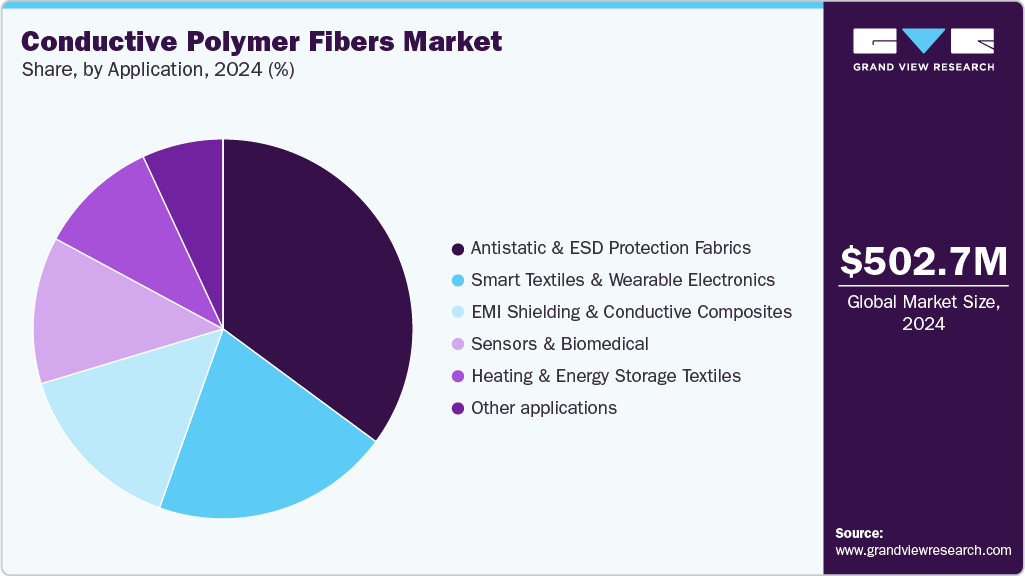
The smart textiles & wearable electronics segment is expected to expand at a substantial CAGR of 13.1% through the forecast period. The wearable device boom is accelerating demand for conductive fibers that integrate sensing, energy routing, and data interconnects directly into fabric. The healthcare and sports segments, in particular, prioritize lightweight, comfortable solutions that enable continuous monitoring and edge processing. This demand is encouraging partnerships between fiber producers, electronics integrators, and apparel brands to co-develop textile modules that meet user experience and regulatory needs.
Regional Insights
The Asia Pacific held the largest share of 35.03% in the conductive polymer fibers market in 2024 and is expected to grow at the fastest CAGR of 14.3% over the forecast period. Asia Pacific growth is anchored in the scale of textile manufacturing, aggressive commercial adoption in sportswear, and the fast-growing integration of local electronics. Large apparel clusters and regional OEMs are embedding conductive fibers to offer value-added smart garments at competitive price points. “China plus one” sourcing trends are shifting production to India and Southeast Asia, expanding demand for adaptable conductive yarns and processing services. Regional contract manufacturers are investing in qualification workflows to meet the specifications of global brands.
North America Conductive Polymer Fibers Market Trends
North America is driven by the rapid commercialization of smart textiles across healthcare, defense, and industrial monitoring. Adoption by medical device manufacturers and hospitals is driving an increase in demand for washable, biocompatible conductive fibers for patient monitoring and wearable diagnostics. Defense and aerospace programs require lightweight EMI shielding and embedded wiring to minimize weight and reduce assembly time. Venture funding and pilot production capacity are accelerating the scale-up from prototypes to small-scale production.
U.S. Conductive Polymer Fibers Market Trends
The U.S. market is driven by defense procurement, the expansion of telehealth, and strong venture-backed innovation in wearables. Defense modernization programs and procurement standards create high-value contracts for certified conductive fiber solutions. Reimbursement growth for remote monitoring and tighter supply-chain resilience initiatives favour domestic suppliers and R&D investment. Large technology OEMs and textile incumbents are partnering to convert lab-scale chemistries into manufacturable yarns.
Europe Conductive Polymer Fibers Market Trends
Europe’s driver is regulatory-led demand for certified, durable conductive materials in automotive, medical, and industrial applications. Tight vehicle electrification targets and rigorous medical device standards force OEMs to specify tested conductive fibers for EMI control and sensor integration. Public and private sustainability programs also favour lower-weight, recyclable textile solutions that reduce life-cycle emissions. EU funding for the scale-up of advanced materials supports pilot lines and cross-sectoral consortiums.
China’s driver is its dense electronics and textile ecosystem that shortens development cycles from material to product. Strong domestic capacity for conductive polymers, coatings, and fiber processing supports rapid prototyping and cost-competitive scale production. Local firms are increasing their investment in IP for PEDOT and polyaniline formulations to supply both consumer wearables and industrial sensor markets. Government support for advanced materials and strategic materials self-sufficiency further accelerates supplier expansion.
Key Conductive Polymer Fibers Company Insights
The Conductive Polymer Fibers Market is highly competitive, with several key players dominating the landscape. Major companies include Chromatic Technologies Inc., LCR Hallcrest Ltd., OliKrom SAS, Matsui International Chromatic Technologies Inc., LCR Hallcrest, RTP Company, Val Creations, BASF SE, Kiran Holographics, and 3M Company. The conductive polymer fibers market is characterized by a competitive landscape with several key players driving innovation and market growth. Major companies in this sector are investing heavily in research and development to enhance the performance, cost-effectiveness, and sustainability of their products.
Key Conductive Polymer Fibers Companies:
The following are the leading companies in the conductive polymer fibers market. These companies collectively hold the largest market share and dictate industry trends.
- Chromatic Technologies Inc
- OliKrom
- LCR Hallcrest
- Matsui International
- BASF SE
- Ranbar Pigment
- 3M Company
Recent Developments
-
In November 2024, Chalmers University researchers unveiled a silk thread coated with a conductive plastic that can harvest body heat and generate electricity. The thread retained significant conductivity after washing, pointing to scalable, textile-friendly thermoelectric applications.
-
In June 2024, Nautilus Defense demonstrated direct die attach of semiconductor chiplets to embroidered conductive yarns at a 180 µm pitch. The milestone enables higher-density, scalable textile-integrated electronics and accelerates the commercialization of garment-level sensor systems.
Conductive Polymer Fibers Market Report Scope
|
Report Attribute
|
Details
|
|
Market size value in 2025
|
USD 563.0 million
|
|
Revenue forecast in 2033
|
USD 1,421.5 million
|
|
Growth rate
|
CAGR of 12.3% from 2025 to 2033
|
|
Historical data
|
2021 - 2023
|
|
Forecast period
|
2025 - 2033
|
|
Quantitative units
|
Revenue in USD million, volume in tons, and CAGR from 2025 to 2033
|
|
Report coverage
|
Revenue forecast, competitive landscape, growth factors, and trends
|
|
Report segmentation
|
Material type, application, region
|
|
Regional scope
|
North America; Europe; Asia Pacific; Latin America; Middle East & Africa
|
|
Country scope
|
U.S.; Canada; Mexico; Germany; France; UK; Spain; Italy; China; Japan; India; South Korea; Brazil; Argentina; Saudi Arabia; South Africa; UAE
|
|
Key companies profiled
|
Chromatic Technologies Inc.; LCR Hallcrest; RTP Company; Val Creations; BASF SE; Kiran Holographics; 3M Company
|
|
Customization scope
|
Free report customization (equivalent up to 8 analyst’s working days) with purchase. Addition or alteration to country, regional & segment scope
|
|
Pricing and purchase options
|
Avail customized purchase options to meet your exact research needs. Explore purchase options
|
Global Conductive Polymer Fibers Market Report Segmentation
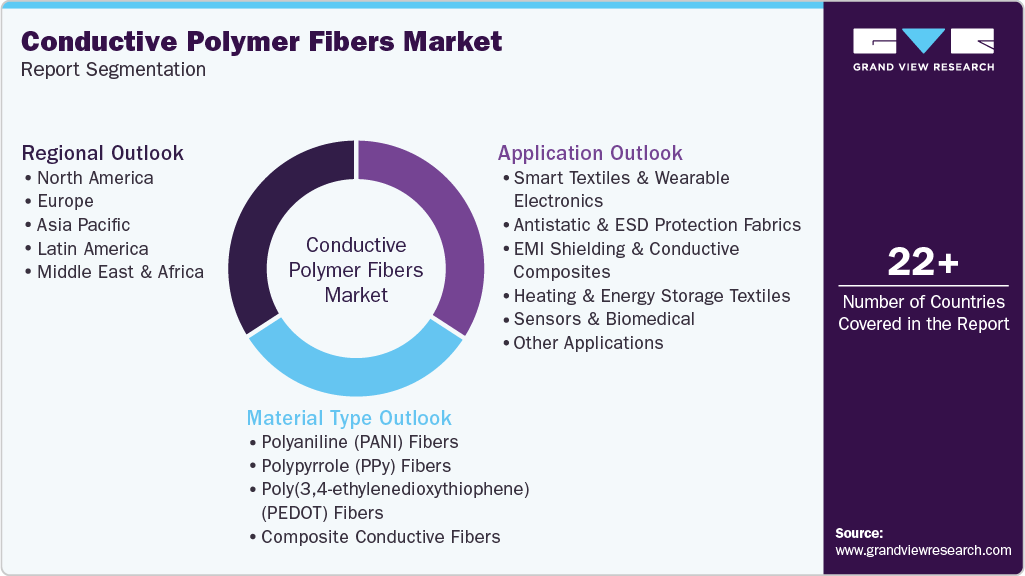
This report forecasts revenue growth at the global, regional, and country levels, providing an analysis of the latest industry trends in each sub-segment from 2021 to 2033. For the purpose of this study, Grand View Research has segmented the conductive polymer fibers market report on the basis of material type, application, and region:
-
Material Type Outlook (Volume, Tons; Revenue, USD Million, 2021 - 2033)
-
Polyaniline (PANI) Fibers
-
Polypyrrole (PPy) Fibers
-
Poly(3,4-ethylenedioxythiophene) (PEDOT) Fibers
-
Composite Conductive Fibers
-
Application Outlook (Volume, Tons; Revenue, USD Million, 2021 - 2033)
-
Smart Textiles & Wearable Electronics
-
Antistatic & ESD Protection Fabrics
-
EMI Shielding & Conductive Composites
-
Heating & Energy Storage Textiles
-
Sensors & Biomedical
-
Other Applications
-
Regional Outlook (Volume, Tons; Revenue, USD Million, 2021 - 2033)
-
North America
-
Europe
-
Germany
-
UK
-
France
-
Italy
-
Spain
-
Asia Pacific
-
China
-
India
-
Japan
-
South Korea
-
Latin America
-
Middle East & Africa
-
Saudi Arabia
-
South Africa
-
UAE
Frequently Asked Questions About This Report

 Download Sample Report
















