
- Home
- »
- Advanced Interior Materials
- »
-
Construction Material Testing Equipment Market Report 2033GVR Report cover
![Construction Material Testing Equipment Market (2026 - 2033)Report]()
Construction Material Testing Equipment Market (2026 - 2033)
Size, Share & Trends Analysis Report By Mode of Operation (Manual, Automatic), By Type (Compression Testing Machines, Universal Testing Machines), By End Use, By Region, And Segment Forecasts
Market Size, 2025
$2.9BMarket Estimate, 2026
$3.1BMarket Forecast, 2033
$4.8BCAGR, 2026–2033
6.6%Construction Material Testing Equipment Market Summary
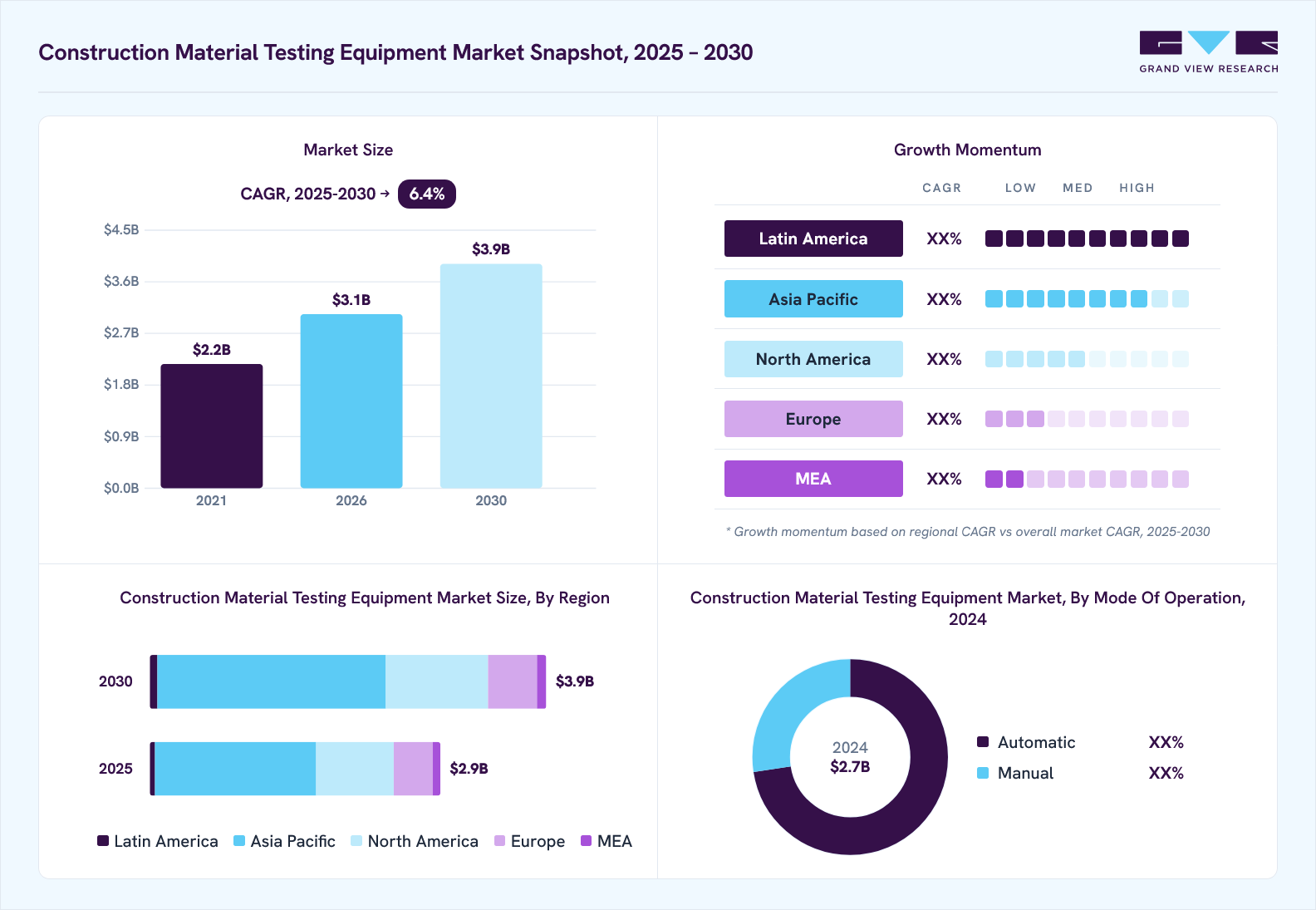
The global construction material testing equipment market size was valued at USD 2.9 billion in 2025 and is projected to grow from USD 3.1 billion in 2026 to USD 4.8 billion by 2033, at a CAGR of 6.6% from 2026 to 2033. The market in Asia Pacific dominated with a revenue share of 55.5% in 2025. The increasing demand for infrastructure development worldwide, especially in emerging economies, plays a pivotal role.
Key Market Trends & Insights
- By type: Compression testing machines segment held the largest market share of 37.1% in 2025.
- By mode of operation: Automatic segment held the largest market share of 72.7% in 2025.
- By end use: Construction companies segment held the largest market share of 37.8% in 2025.
Regional Highlights
- Largest regional market: Asia Pacific (55.5% revenue share, 2025)
- By country: China held the largest market share in 2025
Market Size & Forecast
- Market size in 2025: USD 2.9 Billion
- Estimated market size in 2026: USD 3.1 Billion
- Projected market size by 2033: USD 4.8 Billion
- CAGR (2026-2033): 6.6%
Three ways to get this report
Buy it, customize it, or ask a question.Ask an Analyst
A direct answer, usually in 1 working day
- AccessReport author, directly
- Reply timeWithin 1 working day
- No sales callDirect answer only
- FormatEmail reply
- CostFree, no cost
Get the Full Report
What the study covers
- FormatsPDF · Excel · Dashboard
- Timeline2026–2033 annual, 2025 base
- Coverage20+ countries, 5 regions
- Companies10+ key players profiled
Customize the Report
20% free customization
- IncludeCountries, segments, points
- TailorTo your product definition
- ExtendDeeper competitor detail
- OrA fully bespoke study
- Turnaround5–10 working days
As countries invest heavily in infrastructure projects like roads, bridges, and buildings, the need for quality control and testing of construction materials becomes more critical to ensure safety and durability. Stricter building regulations and a growing focus on material performance are driving the construction material testing equipment market.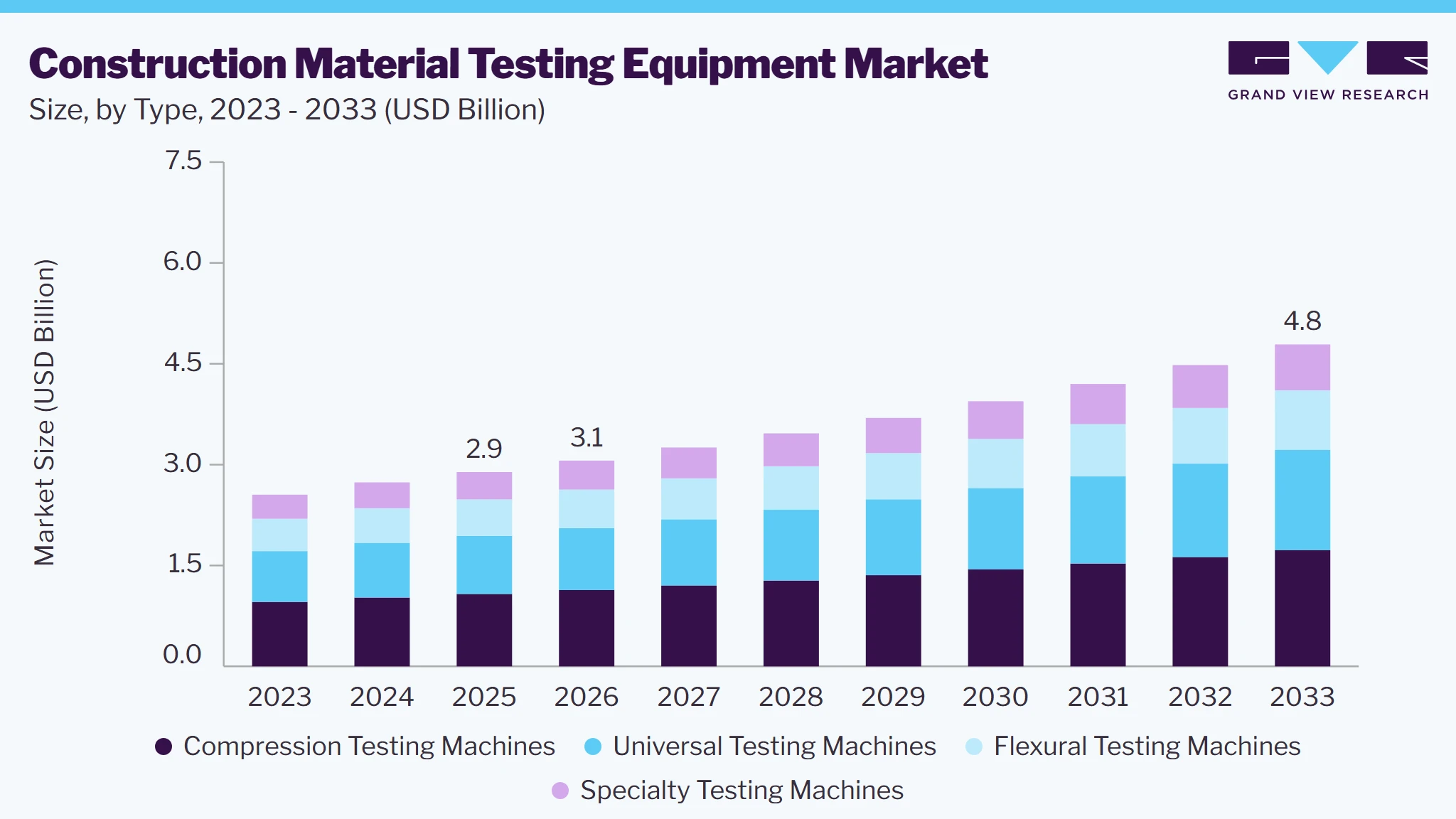
As compliance with international standards becomes essential, demand for advanced testing solutions is rising to ensure quality, durability, and safety in construction projects.
Market Dynamics
The construction material testing equipment market is driven by increasing infrastructure development, rapid urbanization, and stringent quality and safety regulations governing construction materials. Rising investments in transportation, residential, commercial, and industrial construction projects are fueling the demand for advanced testing equipment. However, the high cost of testing equipment and its limited adoption among small-scale laboratories and contractors may restrain market growth. Technological advancements in automated and digital testing systems, coupled with the growing emphasis on sustainable construction materials and rigorous quality assurance practices, are expected to create significant growth opportunities for equipment manufacturers and testing service providers.
Increasing infrastructure development and construction activities are major drivers for the construction material testing equipment market. Governments and private investors are expanding transportation networks, residential complexes, commercial buildings, and industrial facilities, creating demand for reliable material quality assessment. Construction material testing equipment is essential for evaluating the strength, durability, and performance of concrete, asphalt, soil, aggregates, and other building materials. Growing investments in smart cities, public infrastructure modernization, and large-scale construction projects are encouraging the adoption of advanced testing equipment to ensure compliance with safety and quality standards.
High equipment costs and the need for skilled operators remain significant restraints for the construction material testing equipment market. Advanced testing systems require substantial investment in precision instruments, calibration, and maintenance, which can be challenging for small laboratories and contractors. In addition, accurate testing procedures require trained personnel to operate equipment and interpret results according to industry standards. Regular calibration, certification, and compliance with evolving testing regulations further increase operational costs, limiting adoption in cost-sensitive markets and smaller construction projects.
The increasing adoption of automated and digital testing solutions presents a significant opportunity for the construction material testing equipment market. Construction companies and testing laboratories are integrating advanced technologies to improve testing accuracy, reduce manual errors, and enhance operational efficiency. Automated data collection, digital reporting, and real-time monitoring support faster decision-making and regulatory compliance. Rising demand for sustainable construction materials and performance-based quality assessments is further encouraging investment in innovative testing technologies, creating growth opportunities for manufacturers offering intelligent and connected testing equipment.
Market Concentration & Characteristics
The global construction material testing equipment industry is moderately concentrated, with a mix of large multinational corporations and regional players competing for market share. Leading manufacturers focus on diverse testing solutions tailored for construction, infrastructure, and industrial applications. The market is driven by technological advancements, with companies prioritizing automation, real-time data analysis, and integrated testing systems to enhance accuracy, efficiency, and ease of use. These innovations are crucial for meeting stringent regulatory standards and addressing the evolving quality assurance needs of the construction industry.
Regulatory bodies, such as ISO (International Organization for Standardization) and ASTM International, play a crucial role by setting stringent standards for testing accuracy, reliability, and safety. Companies must adhere to these regulations to maintain product quality and ensure the safety and compliance of the materials tested, which is essential for successful project execution.
The competitive landscape of the construction material testing equipment market is increasingly shaped by the growing emphasis on sustainable construction. This trend has created opportunities for manufacturers to develop advanced testing solutions that assess the environmental impact and performance of materials used in green building projects. As demand for eco-friendly construction materials rises, companies are innovating to ensure compliance with sustainability standards like LEED certification.
Additionally, the integration of digital technologies and smart systems is enhancing testing efficiency by enabling real-time data analysis and seamless connectivity with building management systems. However, the market faces competition from alternative testing methods that may offer cost-effective or streamlined solutions. To stay ahead, manufacturers must prioritize continuous innovation, align with industry trends, and meet the growing demand for sustainability, quality assurance, and regulatory compliance.
Analyst Perspective
The construction material testing equipment market is expected to witness growth, supported by increasing infrastructure investments and stringent construction quality standards. Rising urbanization, transportation projects, and commercial and residential construction activities are driving demand for reliable material testing solutions. The adoption of automated and digital testing equipment is improving testing accuracy and operational efficiency across laboratories and construction sites. In addition, growing emphasis on sustainable construction materials and regulatory compliance is expected to create long-term opportunities for manufacturers offering advanced and integrated testing technologies.
Mode of Operation Insights
Based on mode of operation, the automatic segment led the market with the largest revenue share of 72.7% in 2025. The growing adoption of automated testing machines is driven by their high efficiency, precision, and ability to process large test volumes with minimal human intervention. Automation enhances accuracy, reduces human error, and accelerates testing workflows, making it the preferred choice for large-scale construction and infrastructure projects that demand consistent and reliable results.
Conversely, manual testing equipment remains relevant, particularly for small-scale operations and budget-conscious businesses. Lower upfront costs, ease of use, and flexibility make manual systems a practical choice for laboratories and construction firms that do not require high-throughput testing. While automation is reshaping the industry, the demand for cost-effective manual solutions continues in segments where simplicity and affordability outweigh the need for high-speed precision testing.
End Use Insights
Based on end use, the construction companies segment led the market with the largest revenue share of 37.8% in 2025. Construction firms are key consumers of testing machines, as they require precise and reliable testing solutions to ensure the structural integrity of materials like concrete, steel, and asphalt. The surge in large-scale infrastructure projects and stringent quality assurance mandates continues to drive the adoption of high-performance material testing equipment, reinforcing its critical role in modern construction practices.
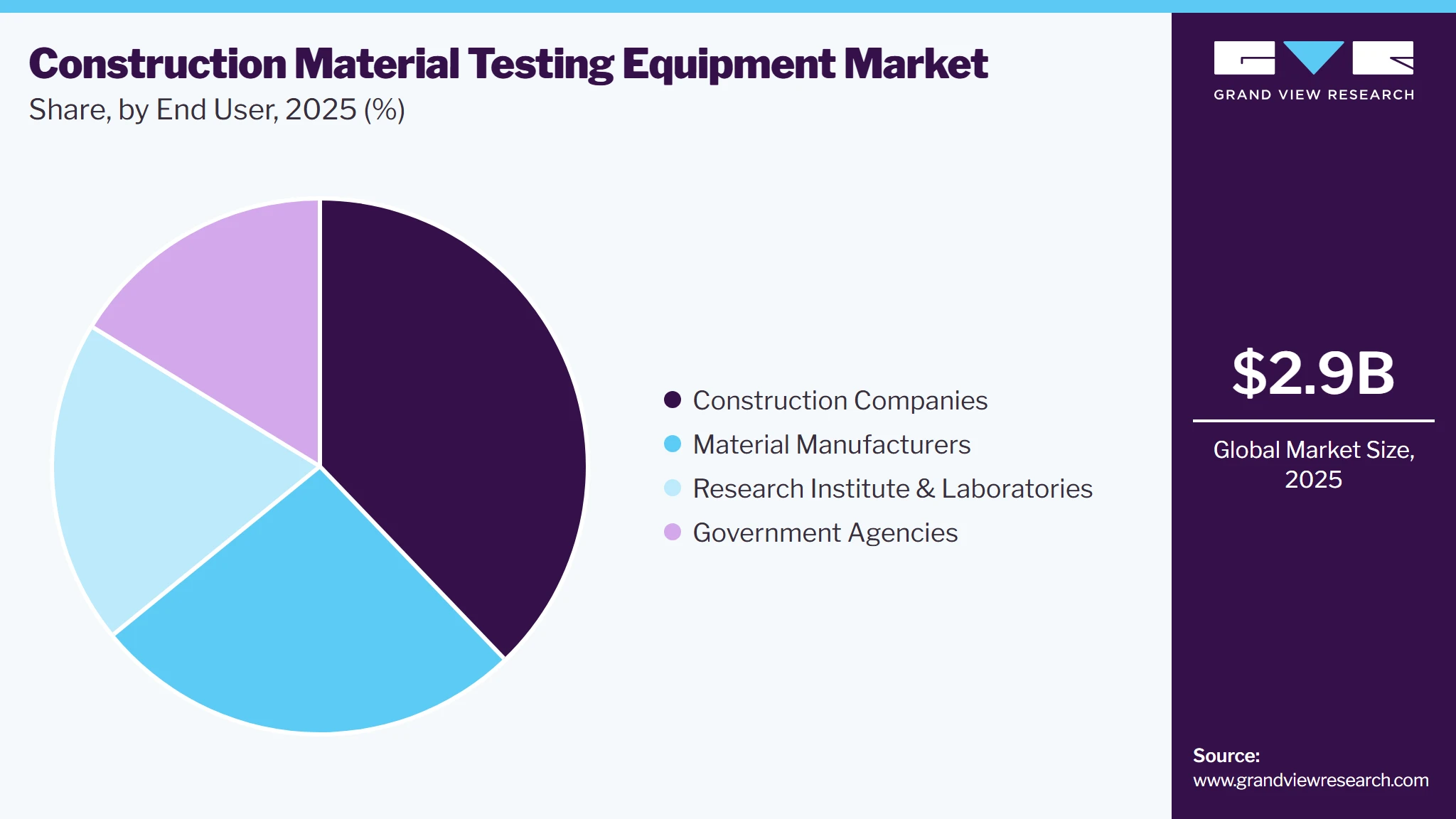
The government agencies segment in the construction material testing equipment industry is projected to grow at a CAGR of 8.0% from 2026 to 2033, driven by increasing regulatory standards and quality control measures in construction projects. Government bodies play a crucial role in enforcing compliance with safety, durability, and environmental standards, fueling demand for advanced testing equipment across public infrastructure developments.
Type Insights
Based on type, the compression testing machines segment led the market with the largest revenue share of 37.1% in 2025. Compression testing machines are crucial for evaluating the compressive strength of materials like concrete, which is fundamental in construction and civil engineering. As construction projects continue to grow globally, the demand for these machines to ensure material quality and safety increases significantly.
Universal Testing Machines (UTMs) are experiencing rising demand due to their ability to perform a broad spectrum of tests, including tensile, compression, and flexural tests, making them highly versatile for use across various industries. In the construction material testing equipment market, UTMs are particularly sought after for their flexibility in testing different material types, such as concrete, steel, and composites, which are critical for ensuring the quality and performance of construction materials.
Regional Insights
Asia Pacific Construction Material Testing Equipment Market Trends
Asia Pacific dominated the construction material testing equipment market with the largest revenue share of 55.5% in 2025. Asia Pacific experiences rapid growth due to booming industrialization, infrastructure development, and urbanization. Increasing manufacturing activities, coupled with rising investment in construction and research sectors, drives the demand for advanced testing machines.
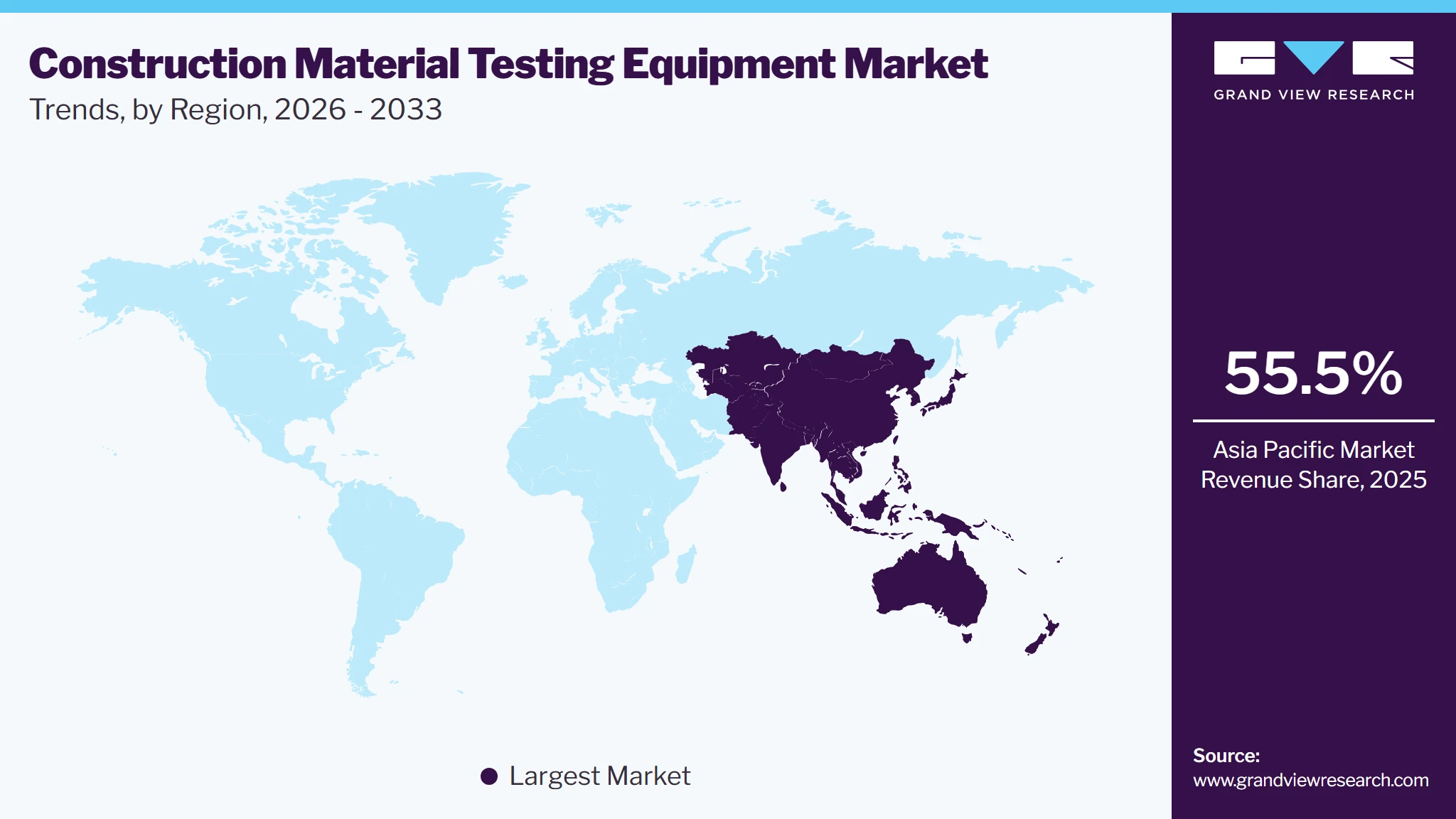
The construction material testing equipment market in the China held the largest share in the Asia Pacific region in 2025. Rapid industrialization, booming construction, and significant investments in manufacturing and infrastructure are key drivers for testing equipment demand, particularly in the construction and automotive sectors.
The construction material testing equipment market in India is expected to grow at a rapid CAGR of 7.9% over the forecast period. India’s fast-growing infrastructure and construction sectors, coupled with rising industrial manufacturing, are increasing the need for reliable and efficient testing machines to meet quality standards.
Europe Construction Material Testing Equipment Market Trends
Europe's construction material testing equipment industry is driven by a strong industrial base, rigorous regulatory frameworks, and a focus on quality control within manufacturing and construction sectors. The region's emphasis on innovation and sustainability further accelerates the demand for precision testing machinery to ensure compliance with evolving standards.
Germany construction material testing equipment market is expected to grow at a CAGR of 4.5% over the forecast period. Germany’s established industrial foundation, commitment to high-quality manufacturing, and continuous push for technological innovation significantly contribute to the demand for precision testing machines, especially in the automotive and engineering sectors.
The construction material testing equipment market in the UK is forecasted to expand at a CAGR of 5.2% during the forecast period. Growth in the UK is primarily driven by investments in infrastructure, construction, and research sectors, alongside stringent quality control regulations in industries such as construction and material testing. This environment fosters the need for advanced testing equipment to meet the region's high standards for quality assurance and performance evaluation.
North America Construction Material Testing Equipment Market Trends
The growth in North America is driven by stringent regulatory standards, the booming construction sector, and increasing investment in infrastructure. Advancements in technology and strong research and development capabilities also fuel the demand for advanced testing equipment.
The construction material testing equipment industry in the U.S. is projected to expand at a CAGR of 5.5% over the forecast period. Strong demand for advanced testing equipment in sectors like construction, aerospace, and manufacturing, coupled with stringent regulatory standards and increasing automation in industries.
Middle East & Africa Construction Material Testing Equipment Market Trends
The Middle East and Africa are witnessing growth in the construction material testing equipment industry, driven by large-scale infrastructure projects, particularly in the construction and energy sectors. Increasing investments in industrial development and a heightened focus on safety and regulatory compliance are major factors fueling the demand for advanced testing equipment in the region.
The construction material testing equipment market in Saudi Arabia is projected to grow at a CAGR of 4.1% over the forecast period. Saudi Arabia’s market growth is propelled by large-scale construction and energy projects, coupled with government investments in quality testing for safety and compliance in materials
Latin America Construction Material Testing Equipment Market Trends
Market growth in Latin America is fueled by expanding construction projects, growing manufacturing sectors, and rising government initiatives to improve infrastructure. The region’s emphasis on quality assurance and standard compliance also drives the demand for testing equipment.
The Brazil construction material testing equipment market is expected to expand at a CAGR of 8.0% over the forecast period. In Brazil, increasing infrastructure development and the expansion of industrial sectors, along with growing regulations for material testing, contribute to market growth.
Key Construction Material Testing Equipment Company Insights
Some of the key players operating in the market include Safariland, LLC and Point Blank Enterprises, Inc.
-
Matest S.p.A. is a global company manufacturing material testing equipment for the construction industry. Offering an extensive and growing range of advanced products, the company provides solutions for both on-site and laboratory testing of materials such as concrete, cement, mortar, bitumen, asphalt, soil, aggregates, rocks, and steel.
-
Olson Instruments, Inc. is a manufacturer of Nondestructive Testing (NDT) equipment for the construction industry. Specializing in testing structures, pavements, and foundations, the company offers a range of products including deflectometers, resonance test systems, and borehole seismic instrumentation.
Key Construction Material Testing Equipment Companies:
The following are the leading companies in the construction material testing tquipment market.
-
Aimil
-
Controls S.p.A.
-
ELE International
-
Humboldt Mfg. Co.
-
Matest S.p.A.
-
Applied Test Systems
-
Shimadzu Corporation
-
Olson Instruments
-
Illinois Tool Works (Instron)
-
Canopus Instruments
-
Qualitest International
-
Tinius Olsen Testing Machine Company
-
Wirsam Scientific
-
Zwick Roell Group
-
MTS Systems
-
GlobalGilson
-
IMP Scientific
-
NL Scientific Instruments
Competitive Benchmarking
Category
Operating Strategies
Competitive Edge
Weakness
Established Players (e.g. Controls S.p.A.; ELE International; Humboldt Mfg. Co.; Matest; Shimadzu Corporation; Illinois Tool Works (Instron); Zwick Roell Group; MTS Systems; Tinius Olsen Testing Machine Company)
- Focus on expanding comprehensive construction material testing equipment portfolios for concrete, asphalt, soil, aggregates, cement, and steel testing applications.
- Invest in automated testing technologies, digital data acquisition systems, and advanced software for laboratory and field testing.
- Strengthen collaborations with construction companies, material manufacturers, research institutions, and government agencies to support quality assurance and regulatory compliance.
- Strong technological expertise in material testing and precision measurement systems.
- Broad product portfolios with advanced engineering capabilities and integrated testing solutions.
- Established global manufacturing, distribution, and after-sales service networks with long-standing customer relationships.
- High research, development, and manufacturing costs associated with advanced testing equipment.
- Dependence on construction activity, infrastructure investments, and regulatory standards.
- Long product development and certification cycles to meet evolving industry requirements.
Emerging & Regional Players (e.g Aimil; Applied Test Systems; Olson Instruments; Canopus Instruments; Qualitest International; GlobalGilson; IMP Scientific; NL Scientific Instruments; Wirsam Scientific)
- Focus on specialized and application-specific construction material testing solutions for laboratory and on-site testing requirements.
- Expand market presence through customized equipment development and regional distribution partnerships.
- Emphasize cost-effective designs, flexible testing capabilities, and user-friendly equipment for diverse construction applications.
- Competitive pricing and greater flexibility in customized testing solutions.
- Ability to address regional construction standards and specialized customer requirements.
- Agile operations enabling quicker adaptation to changing testing regulations and market demands.
- Limited financial resources for large-scale technology development and international expansion.
- Smaller manufacturing, sales, and after-sales service networks compared with established competitors.
- Lower participation in large infrastructure and government testing projects due to limited production capacity and global market presence.
Recent Developments
-
In January 2024, CONTROLS S.p.A. announced the launch of the Automax ULTIMATE, their latest Automatic Computerized Control Console designed for testing concrete, cement, and steel rebar. Featuring a modular design, it offers flexibility for both basic and advanced testing, including Fiber Reinforced Concrete characterization.
-
In January 2024, Humboldt Mfg. Co. introduced the Asphalt Mixture Automated Testing System, a solution designed to eliminate human error and improve efficiency in asphalt testing. The system offers automated Balanced Mix Design (BMD) and comprehensive testing to industry-leading standards. With capabilities including ASTM D3549, D2726, D6927, D6931, D8225, and D8360, it emphasizes precision and reliability in asphalt mixture testing.
Construction Material Testing Equipment Market Report Scope
Report Attribute
Details
Market size in 2025
USD 2.9 billion
Estimated market size in 2026
USD 3.1 billion
Projected market size by 2033
USD 4.8 billion
Growth rate
CAGR of 6.6% from 2026 to 2033
Base year for estimation
2025
Historical data
2021 - 2024
Forecast period
2026 - 2033
Quantitative units
Revenue in USD billion and CAGR from 2026 to 2033
Report coverage
Revenue forecast, company ranking, competitive landscape, growth factors, and trends
Segments covered
Type, mode of operation, end use, region
Regional scope
North America; Europe; Asia Pacific; Latin America; Middle East & Africa
Country scope
U.S., Canada, Mexico, Germany, France, Italy, Spain, UK, China, India, Japan, Australia, South Korea, Brazil, Argentina, Saudi Arabia, UAE
Key companies profiled
Aimil, Controls S.p.A.; ELE International; Humboldt Mfg. Co.; Matest; Applied Test Systems; Shimadzu Corporation; Olson Instruments; Illinois Tool Works (Instron); Canopus Instruments; Qualitest International; Tinius Olsen Testing Machine Company; Wirsam Scientific; Zwick Roell Group; MTS Systems; GlobalGilson; IMP Scientific; NL Scientific Instruments.
Customization scope
Free report customization (equivalent up to 8 analysts' working days) with purchase. Addition or alteration to country, regional & segment scope.
Pricing and purchase options
Avail customized purchase options to meet your exact research needs. Explore purchase options
Global Construction Material Testing Equipment Market Report Segmentation
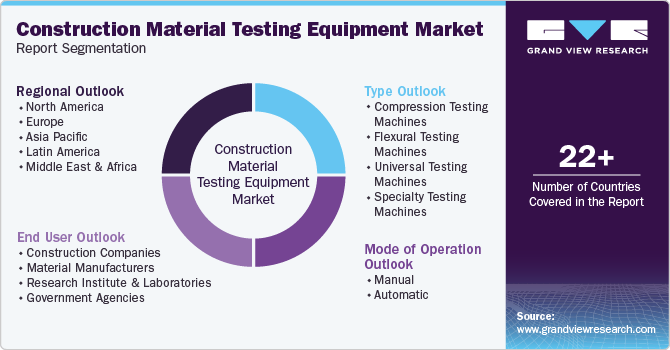
This report forecasts revenue growth at global, regional & country levels and provides an analysis on the industry trends in each of the sub-segments from 2021 to 2033. For the purpose of this study, Grand View Research, Inc. has segmented the global construction material testing equipment market report based on mode of operation, end user, type, and region:
-
Mode of Operation Outlook (Revenue, USD Million, 2021 - 2033)
-
Manual
-
Automatic
-
-
End User Outlook (Revenue, USD Million, 2021 - 2033)
-
Construction Companies
-
Material Manufacturers
-
Research Institute & Laboratories
-
Government Agencies
-
-
Type Outlook (Revenue, USD Million, 2021 - 2033)
-
Compression Testing Machines
-
Flexural Testing Machines
-
Universal Testing Machines
-
Specialty Testing Machines
-
-
Regional Outlook (Revenue, USD Million, 2021 - 2033)
-
North America
-
U.S.
-
Canada
-
Mexico
-
-
Europe
-
UK
-
Germany
-
France
-
Spain
-
Italy
-
-
Asia Pacific
-
China
-
India
-
Japan
-
South Korea
-
Australia
-
-
Latin America
-
Brazil
-
Argentina
-
-
Middle East & Africa
-
Saudi Arabia
-
UAE
-
-
Research Methodology
The construction material testing equipment market figures in this report are based on a proven research process that combines executive interviews with secondary research from proprietary databases, company filings, and recognized regulatory and institutional sources. Market size is built through value-chain sizing - reconciling supply-side and demand-side estimates - and triangulated with bottom-up and top-down approaches. Every estimate passes multiple levels of expert validation before publication, with each construction material testing equipment segment quantified using the revenue-capture definitions in the table below.
Segment Definition
Segment - Mode of Operation
Revenue Capture Definition
Manual
Revenue is generated from the sale of manually operated construction material testing equipment used for evaluating the physical and mechanical properties of construction materials with operator-controlled testing procedures.
Automatic
Revenue is derived from the sale of automated construction material testing equipment equipped with digital controls, data acquisition systems, and automated testing functions for improved accuracy and efficiency.
Segment - End Use
Revenue Capture Definition
Construction Companies
Revenue is generated from the sale of construction material testing equipment used by construction companies for quality control, site inspections, and compliance with construction standards.
Material Manufacturers
Revenue is derived from the sale of construction material testing equipment supplied to manufacturers of cement, concrete, asphalt, aggregates, steel, and other construction materials for product development and quality assurance.
Research Institute & Laboratories
Revenue is earned from the sale of construction material testing equipment used by research institutions, academic organizations, and independent laboratories for material analysis, testing, and innovation activities.
Government Agencies
Revenue is obtained from the sale of construction material testing equipment used by government agencies and public sector organizations for infrastructure quality assessment, regulatory compliance, and standards enforcement.
Segment - Type
Revenue Capture Definition
Compression Testing Machines
Revenue is generated from the sale of compression testing machines used to determine the compressive strength and load-bearing capacity of concrete, cement, bricks, blocks, and other construction materials.
Flexural Testing Machines
Revenue is derived from the sale of flexural testing machines designed to evaluate the bending strength and structural performance of construction materials under applied loads.
Universal Testing Machines
Revenue is earned from the sale of universal testing machines capable of performing tensile, compression, flexural, shear, and other mechanical tests on a wide range of construction materials.
Specialty Testing Machines
Revenue is obtained from the sale of specialized construction material testing equipment developed for specific testing applications, including impact, fatigue, abrasion, hardness, permeability, and customized material performance evaluations.
Estimation Model
Layer Name
Key Question
Description
Construction and Infrastructure Demand Layer
Which industries generate demand for construction material testing equipment?
The estimation begins by evaluating construction activity across residential, commercial, industrial, and infrastructure sectors. Demand is supported by investments in transportation, urban development, public infrastructure, energy projects, and the increasing emphasis on construction quality, safety, and regulatory compliance.
Equipment Type and Operation Adoption Layer
Which equipment types and operating modes drive market demand?
This layer refines demand by assessing the adoption of compression testing machines, flexural testing machines, universal testing machines, and specialty testing machines across manual and automatic operating modes. Technological advancements, automation trends, testing standards, and laboratory modernization influence equipment adoption.
End-user and Testing Deployment Layer
What determines construction material testing equipment installations?
Market demand is estimated through the deployment of testing equipment across construction companies, material manufacturers, research institutes and laboratories, and government agencies. Infrastructure expansion, construction material quality requirements, laboratory upgrades, equipment replacement cycles, and regulatory testing mandates further support equipment installations.
Revenue Layer
How is total market revenue calculated?
Revenue is estimated by aggregating sales of construction material testing equipment across equipment types, operating modes, end-user sectors, and regional markets. Construction spending, infrastructure development projects, equipment pricing, laboratory modernization, replacement demand, regulatory compliance requirements, and manufacturer revenues are incorporated to validate the total market size.
Delivered Customizations
This report has been delivered with the following In-depth customizations
CLIENT REQUEST
CUSTOMIZATION DELIVERED
VALUE ADDS
Regional Segmentation
Detailed regional analysis covered North America, Europe, Asia Pacific, Latin America, and the Middle East & Africa, with country-level assessment of key markets. The study evaluated construction activity, infrastructure investments, urbanization trends, government spending on public works, building regulations, laboratory modernization, and demand from residential, commercial, and industrial projects influencing construction material testing equipment demand.
Helped identify high-growth regions, country-specific opportunities, and evolving construction trends, supporting market entry strategies, regional expansion planning, and identification of emerging infrastructure development hubs.
Competitive Benchmarking
Comprehensive benchmarking assessed major participants based on product portfolio, construction material testing technologies, precision engineering capabilities, manufacturing strength, automation features, testing accuracy, regional presence, pricing strategies, aftermarket services, and distribution networks. The study also compared established and emerging players in the construction material testing equipment market.
Assisted clients in evaluating competitor positioning, technological capabilities, and market gaps while supporting strategic planning, partnership opportunities, product differentiation, and investment decisions across construction quality assurance and material testing applications.
Opportunity Assessment
In-depth opportunity assessment analyzed infrastructure modernization initiatives, smart city developments, sustainable construction practices, laboratory upgrades, and government investments in transportation and public infrastructure. The study identified emerging opportunities in automated testing systems, digital data management solutions, portable field testing equipment, and advanced testing technologies for innovative and sustainable construction materials.
Enabled clients to identify high-growth investment areas, prioritize regional expansion, and evaluate future revenue opportunities while supporting product development, technology adoption, and long-term growth strategies in the construction material testing equipment market.
Frequently Asked Questions About This Report
Some of the key players operating in the market are Aimil, Controls S.p.A., ELE International, Humboldt Mfg. Co., Matest, Applied Test Systems, Shimadzu Corporation, Olson Instruments, Illinois Tool Works (Instron), Canopus Instruments, Qualitest International, Tinius Olsen Testing Machine Company, Wirsam Scientific, Zwick Roell Group, MTS Systems, GlobalGilson, IMP Scientific, and NL Scientific Instruments.
The construction material testing equipment market is driven by the growing demand for high-quality infrastructure, strict regulatory standards, and increased construction activities globally. Advancements in technology and automation also significantly improve testing efficiency and accuracy.
Asia Pacific dominated with a 55.5% revenue share in 2025.
The global construction material testing equipment market is expected to grow at a CAGR of 6.6% from 2026 to 2033, reaching USD 4.8 billion by 2033.
The compression testing machines segment led with a 37.1% revenue share in 2025.
The automatic segment dominated the market with the largest revenue share of 72.7% in 2025.
Construction companies segment led the market with the largest revenue share of 37.8% in 2025.
The global construction material testing equipment market size was valued at USD 2.9 billion in 2025 and is estimated at USD 3.1 billion for 2026.
About the Author(s)
Advanced Interior Materials Research Team
Advanced Materials · Advanced Interior MaterialsThis report was authored by the advanced interior materials research team at Grand View Research - comprising two research analysts, one senior research analyst, and one industry expert - with specialized expertise in the advanced interior materials segment of the advanced materials industry. All findings are based on proprietary advanced materials databases, executive interviews, and regulatory analysis, subject to internal peer review prior to publication.
Last Updated:
Speak to Analyst


Customize this report to your needs - add regions, segments, or data points, with 20% free customization.
Or view our licence options:


ISO 9001:2015 & 27001:2022 Certified
We are GDPR and CCPA compliant! Your transaction & personal information is safe and secure. For more details, please read our privacy policy.


