
- Home
- »
- Next Generation Technologies
- »
-
Consumer Drone Market Size, Share & Trends Report, 2033GVR Report cover

Consumer Drone Market (2026 - 2033)
Size, Share & Trends Analysis Report By Product (Multi-Rotor, Nano), By Application (Prosumer, Toy/Hobbyist, Photogrammetry), By Region (North America, Europe, Asia Pacific, Latin America, Middle East & Africa), And Segment Forecasts
Market Size, 2025
$6.0BMarket Estimate, 2026
$7.3BMarket Forecast, 2033
$18.3BCAGR, 2026–2033
14.1%Consumer Drone Market Summary
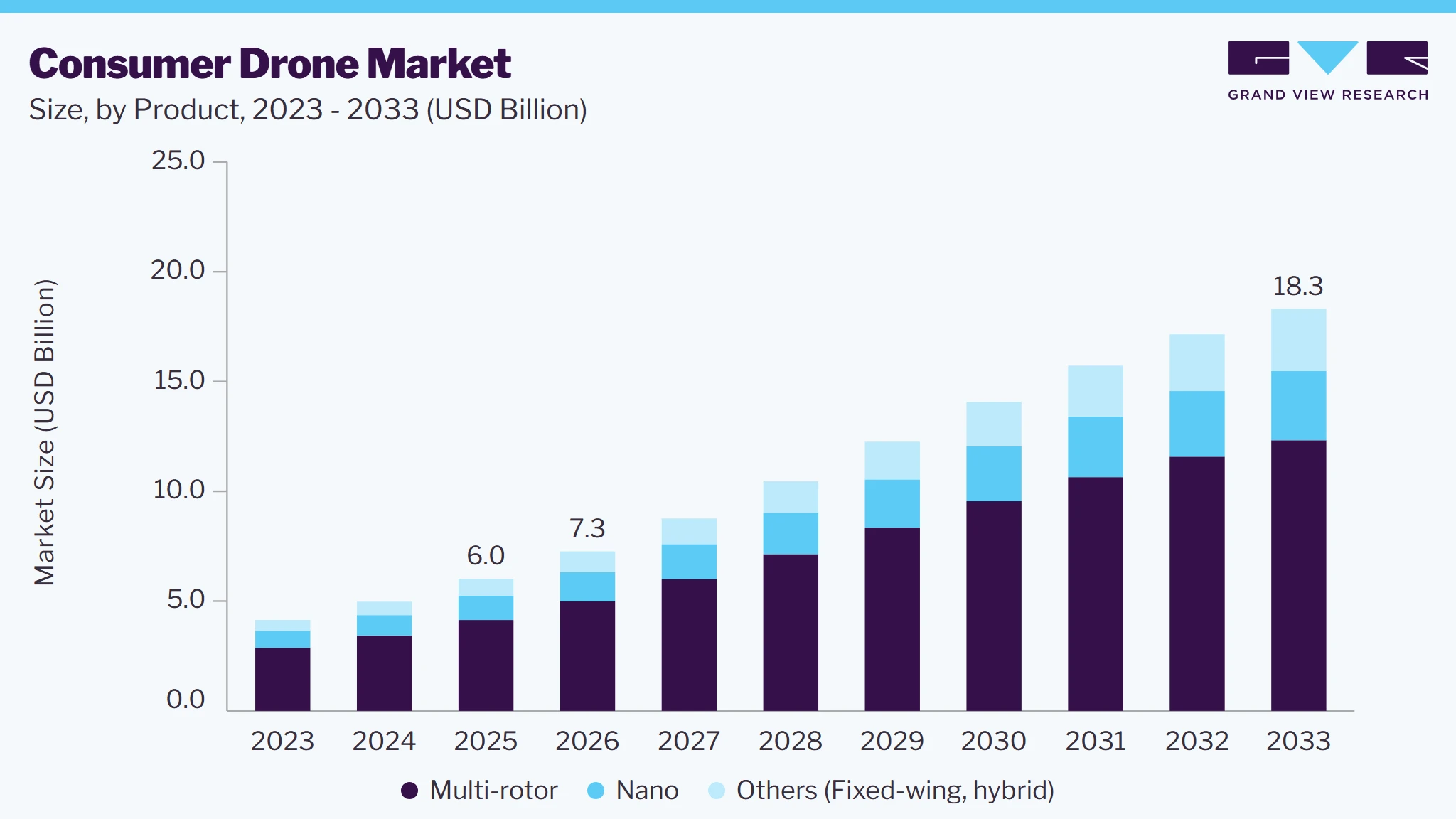
The global consumer drone market size was valued at USD 6.0 billion in 2025 and is projected to grow from USD 7.3 billion in 2026 to USD 18.3 billion by 2033, at a CAGR of 14.1% from 2026 to 2033. North America dominated the market, accounting for a revenue share of 36.7% in 2025. The consumer drone market is driven by the increasing adoption of drones for aerial photography, videography, recreational flying, and content creation, the growing integration of AI, computer vision, GPS navigation, and autonomous flight technologies, and the rising demand for high-performance, user-friendly unmanned aerial vehicles (UAVs).
 Source: Grand View Research, IR Documents, Primary Interviews, Paid DatabasesTo learn more about this report,
 Download Free Sample Report
Key Market Trends & Insights
- By product: Multi-rotor segment dominated the market, with a share of 69.4% in 2025.
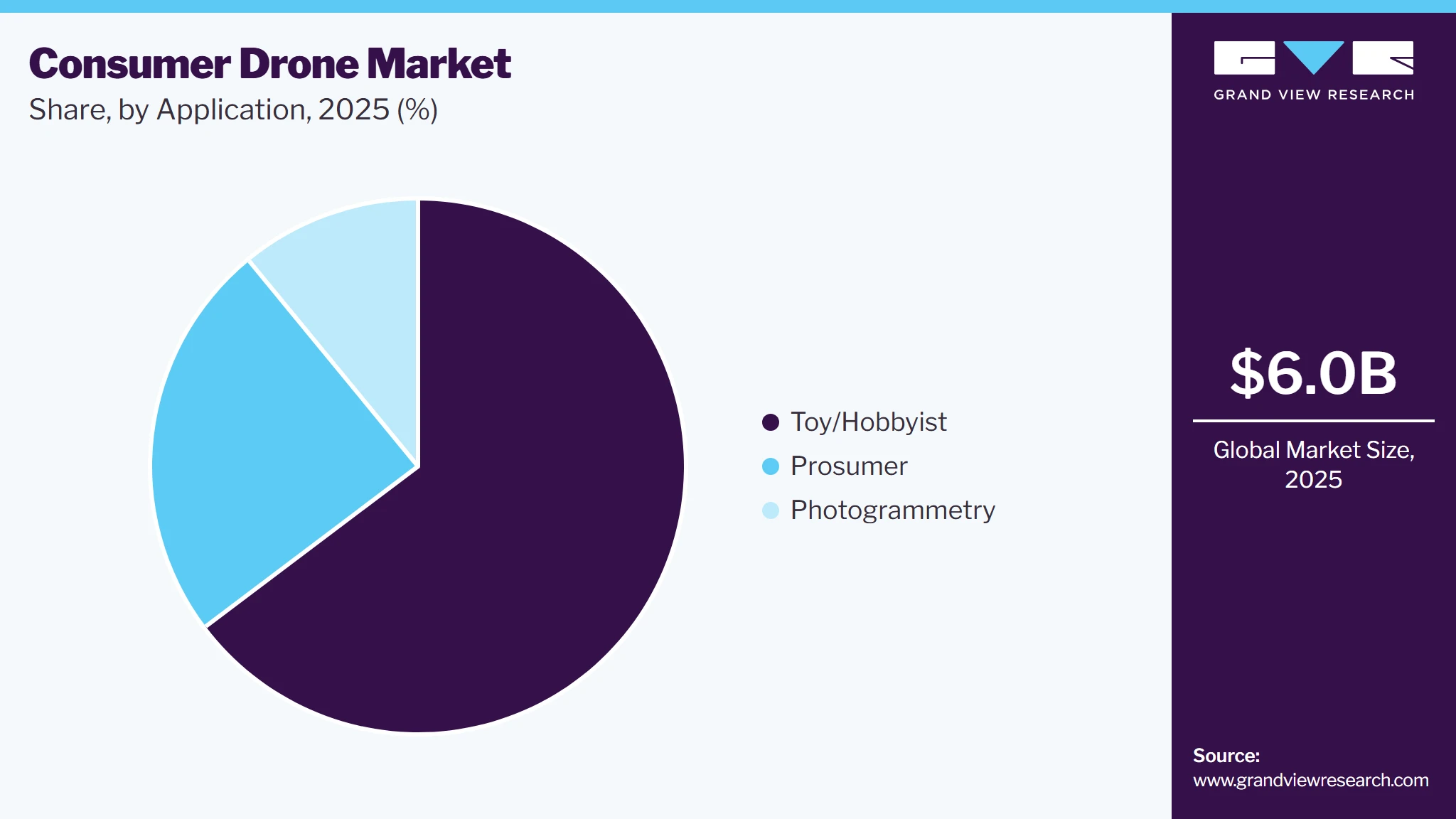
- By application: Toy/hobbyist segment accounted for the largest market share of 65.1% in 2025.
Regional Highlights
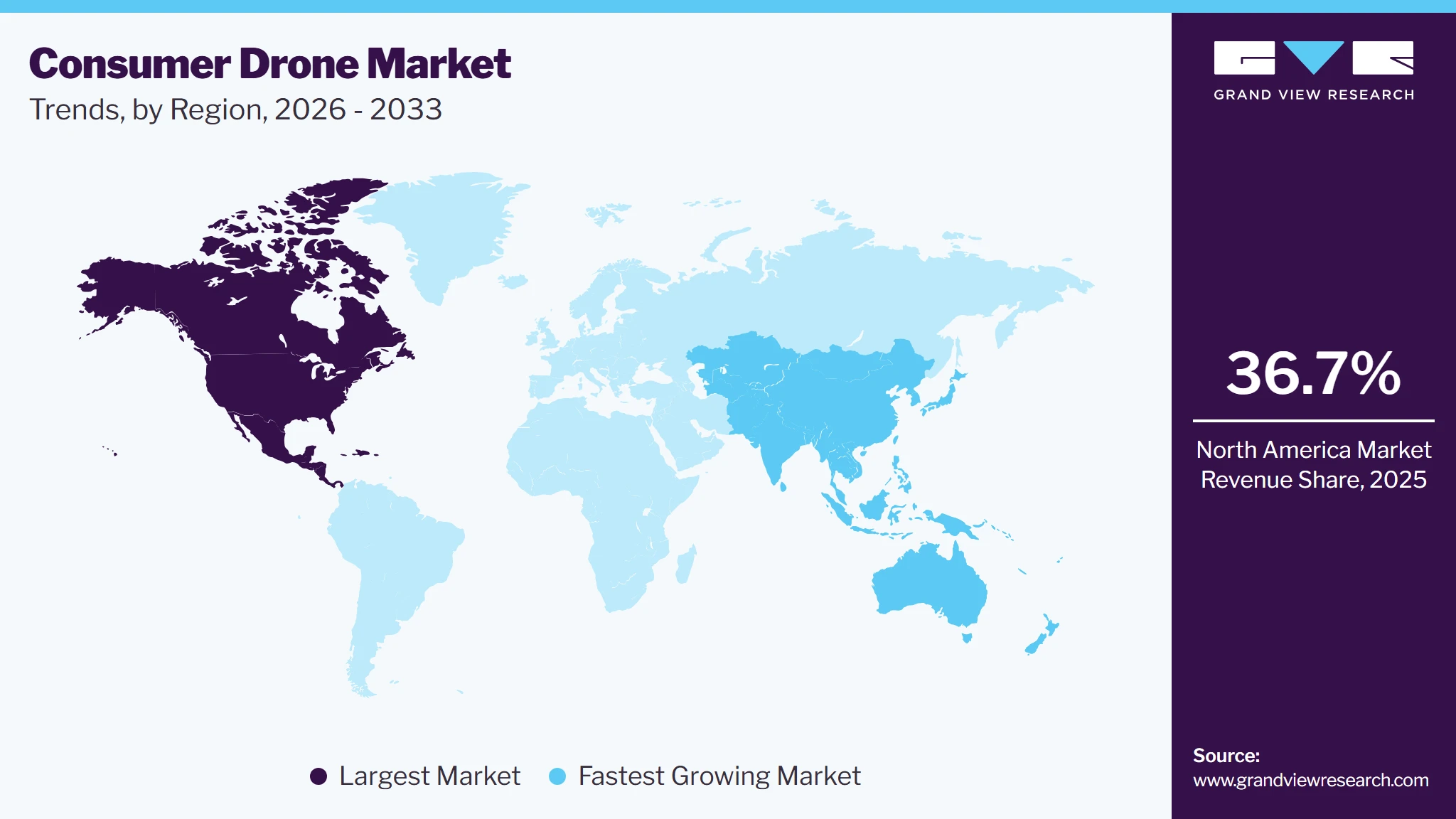
- Largest regional market: North America (36.7% revenue share in 2025)
- Fastest growing regional market: Asia Pacific (highest CAGR 16.2%, 2026-2033)
- By Country: The U.S. held the largest market share in 2025
Market Size & Forecast
- Market size in 2025: USD 6.0 Billion
- Estimated market size in 2026: USD 7.3 Billion
- Projected market size by 2033: USD 18.3 Billion
- CAGR (2026-2033): 14.1%
Three ways to get this report
Buy it, customize it, or ask a question.Ask an Analyst
Analyst response in 1 business day
- AccessReport author, directly
- Reply timeWithin 1 working day
- No sales callDirect answer only
- FormatEmail reply
- CostFree, no cost
Get the Full Report
What the study covers
- FormatsPDF · Excel · Dashboard
- Timeline2026–2033 annual, 2025 base
- Coverage20+ countries, 5 regions
- Companies10+ key players profiled
Customize the Report
20% free customization
- IncludeCountries, segments, points
- TailorTo your product definition
- ExtendDeeper competitor detail
- OrA fully bespoke study
- Turnaround5–10 working days
The increasing adoption of lightweight foldable drones, AI-powered subject tracking, extended battery life, and seamless mobile application connectivity is enhancing user experience, improving flight safety, and creating new growth opportunities in the consumer drone market.Customers are increasingly exploring the benefits of drones for enriching leisure activities and interests, driving a significant increase in global consumer drone sales. Furthermore, technological innovations in consumer drones are driving the market growth, and this trend is expected to continue over the forecast period as well. Customers are increasingly exploring the benefits of drones in enriching leisure activities and interests, resulting in a significant increase in global consumer drone sales. Furthermore, technological innovations in consumer drones are driving the market growth and this trend is expected to continue over the forecast period as well. For instance, in February 2022, Skyfish, a U.S. drone manufacturer, announced a technical collaboration with Sony Electronics to deliver drones with high-quality data gathering and photogrammetry capabilities
 To learn more about this report, Download Free Sample Report
The integration with Sony Electronics’ mirrorless cameras enabled Skyfish drones to gather the data required to generate precise 3D models of large infrastructures among other applications. Similarly, DJI launched the Mini 3 Pro drone in May 2022, which weighs 249 grams and provides additional flight control capabilities along with a high-quality picture and video recording functionality. This product was specifically targeted toward the consumer/enthusiast category, with a special focus on portability and affordability.
Several organizations in different industries have started to invest in drones as a result of rapid growth in the market for drone services. Companies who invest in drones anticipate that the analysis of the data that drones collect will result in cost reductions, revenue growth, and better decision-making. Drones are being used by the media and entertainment industries for aerial photography, cinematography, and special effects. More changes will emerge as drones start collaborating with other technologies and drones. For instance, road and railroad operators can benefit from using drones and 3D modeling software during the design stage.
Additionally, the integration of artificial intelligence (AI) enables drone suppliers to gather and utilize visual and environmental data by using information from sensors attached to the drone. Computer vision is a crucial element of drones powered by AI. With this technology, drones can identify objects in the air and analyze and record data on the ground. Artificial Intelligence (AI), analyzing sensors, data processing, and drone network capabilities would help them collaborate with 3D printers, robots, and other technologies. For instance, in July 2022, Microsoft launched a simulator to train AI systems in drones. The simulator would help in software development and training, and also allow them to track how winds may affect the battery life and how the drones would fly in the rain. The advantages of employing drones are similar to adopting any new technology.
Consumer drone demand is expected to increase due to the growing popularity of steady aerial capturing, photography, and videography. The market for consumer drones has surged due to new manufacturing innovations for the product. The latest drone model technologies offer navigation systems linked to the user's device, high range, and control systems that are reliable, safe, efficient, and provide better speed. The consumer drone industry in North America is the leading region globally, driven by a high demand for drones in Canada and the U.S. Furthermore, the considerable investment in the market for drone technology across the region, is driving the growth further. For instance, in February 2022, Phystech Ventures, a U.S.-based venture capital firm, stated that there had been a USD 5 billion investment in drone technology in the past two years.
Market Dynamics
The consumer drone market is experiencing robust growth driven by rising demand for aerial photography and videography, rapid advances in drone technology, and the growing adoption of unmanned aerial vehicles (UAVs) for recreational and personal applications. Rising investments in AI-powered flight systems, high-resolution camera technologies, lightweight drone designs, and battery innovations are encouraging manufacturers to develop more intelligent, affordable, and user-friendly consumer drones. The expanding use of consumer drones for content creation, travel, outdoor recreation, drone racing, personal surveillance, and hobbyist activities is broadening market adoption across both developed and emerging economies. Continuous innovations in autonomous flight, obstacle avoidance, computer vision, real-time image transmission, GPS-based navigation, and cloud-connected drone ecosystems are enhancing flight performance, improving user safety, and unlocking new opportunities for market expansion across the global consumer drone industry.
The growing preference for high-quality aerial photography and videography is becoming a major factor accelerating consumer drone adoption worldwide. Consumers increasingly seek drones equipped with ultra-high-definition cameras, advanced image stabilization, optical zoom, and intelligent shooting modes to capture professional-grade visuals during travel, outdoor activities, family events, and personal projects. This rising emphasis on superior imaging capabilities is encouraging manufacturers to continuously enhance camera performance and flight stability.
The rapid expansion of social media platforms, digital storytelling, and creator-driven content has further increased demand for compact drones capable of producing cinematic aerial footage with minimal effort. Consumers value drones that combine powerful imaging systems with easy operation, longer flight duration, and intelligent automation features. Manufacturers are investing in advanced camera technologies, improved stabilization systems, and enhanced image processing capabilities to deliver a premium aerial imaging experience for a broader consumer base.
Strict aviation regulations governing drone registration, maximum flight altitude, no-fly zones, remote identification requirements, and operator compliance continue to restrict consumer drone adoption in many countries. Regulatory authorities have implemented comprehensive frameworks to address concerns related to aviation safety, privacy protection, and unauthorized drone operations, creating operational limitations for recreational users unfamiliar with evolving compliance requirements.
Frequent regulatory updates, location-specific flying restrictions, and varying certification standards across different regions increase complexity for consumers and manufacturers alike. Many users face uncertainty regarding permissible flight locations and operational procedures, reducing confidence in drone ownership. Compliance costs, software updates for regulatory compatibility, and restricted access to popular tourist destinations further limit recreational usage, slowing broader consumer adoption despite continuous technological advancements.
The rapid expansion of digital content creation across social media platforms, travel blogging, live streaming, and independent filmmaking is creating significant opportunities for advanced consumer drones. Increasing demand for cinematic aerial footage, ultra-high-definition imaging, automated tracking capabilities, and stabilized video recording encourages manufacturers to develop feature-rich drones capable of delivering professional-quality visual content for everyday users.
Emerging technologies such as AI-assisted editing, cloud-based media sharing, augmented reality integration, first-person-view experiences, and intelligent flight automation are further expanding consumer use cases. The creators seek innovative ways to capture unique perspectives for digital storytelling, manufacturers have opportunities to introduce compact, affordable, and highly portable drones with enhanced imaging capabilities, extended flight endurance, and intuitive software ecosystems to address evolving consumer preferences.
Market Concentration & Characteristics:
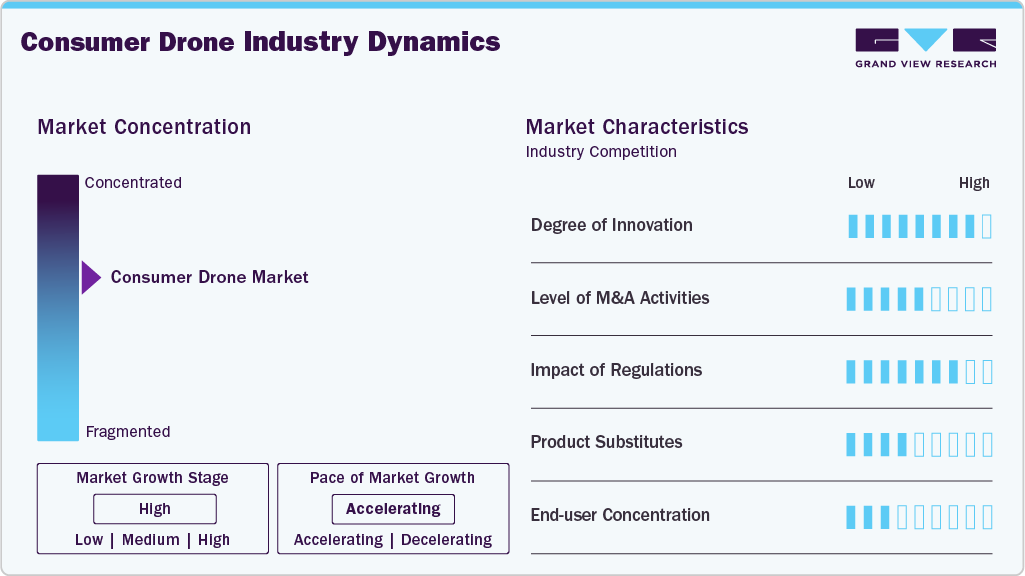
The consumer drone market is moderately concentrated, with leading drone manufacturers, imaging technology providers, flight control system developers, and UAV software companies competing across a broad range of recreational and prosumer applications. The market is expanding steadily due to rising consumer demand for aerial photography, videography, recreational flying, and creator-focused content production. Companies are focusing on AI-powered autonomous flight, advanced obstacle avoidance, intelligent imaging capabilities, and compact foldable designs to strengthen their product portfolios and enhance customer experience. Vendors are also investing in longer battery life, lightweight airframes, high-resolution camera systems, real-time video transmission, and integrated mobile software ecosystems to improve flight performance, imaging quality, and ease of operation.
 To learn more about this report, Download Free Sample Report
The market is characterized by a high degree of innovation, driven by continuous advancements in artificial intelligence, computer vision, autonomous navigation, battery technologies, and intelligent flight automation. Merger and acquisition activity remains moderate, with established drone manufacturers and technology companies acquiring specialized firms focused on AI software, imaging systems, sensor technologies, and drone navigation solutions to expand their technological capabilities. The threat from substitutes remains moderate, as smartphones, action cameras, handheld gimbals, and 360-degree cameras offer alternative content creation tools but cannot replicate the unique aerial perspective and flight versatility provided by consumer drones. Regulatory impact remains high due to evolving aviation regulations, remote identification requirements, airspace restrictions, drone registration policies, and privacy standards governing recreational UAV operations. Increasing investments in AI-enabled flight intelligence, next-generation imaging technologies, lightweight drone platforms, and connected drone ecosystems are expected to further advance the consumer drone market.
Analyst Perspective
The consumer drone market is experiencing rapid expansion, driven by rising demand for aerial photography, recreational flying, and digital content creation, as well as ongoing advancements in artificial intelligence, autonomous flight technologies, and high-resolution imaging systems. The growing adoption of AI-powered flight assistance, obstacle avoidance, intelligent tracking, and compact, foldable drone designs is enhancing flight safety, user experience, and accessibility for both hobbyists and prosumers. Consumers increasingly prioritize high-quality aerial imaging, smart flight capabilities, and seamless mobile connectivity. Drone manufacturers are well-positioned to capitalize on evolving consumer preferences, thereby reinforcing long-term market expansion and sustained revenue generation across the global consumer drone ecosystem.
Product Insights
Based on product, the multi-rotor segment led the market with the largest revenue share of 69.4% in 2025 and is expected to grow at a considerable CAGR over the forecast period. Multi-rotors are increasingly used in aerial photography and filming, and the devices leverage the advantage of vertical take-off and landing, which is unavailable in their counterparts. The multi-rotor drone has a higher payload capacity, making it suitable for a wide range of applications. Furthermore, multi-rotor drones are significantly used in law enforcement in various regions. These have been viewed as a better alternative to inspection and payload-carrying applications, which require higher-precision maneuvering, the ability to fly over challenging terrain, and extended operational time.
The other segment, comprising fixed-wing and hybrid-type drones, is projected to experience at the fastest CAGR during the forecast period. Small fixed-wing and rotary-wing aircraft are often employed for filming and still photography, with drone types available in various sizes and configurations. The ability of drones to carry a variety of sensors and gadgets accounts for their popularity. The most effective mix of aerial platform and payload depends on the application's scope.
Application Insights
Based on application, the toy/hobbyist segment dominated the market with the largest revenue share of 65.1% in 2025. Drones are experiencing the most advancements of any contemporary technical development. Some toy drones now fly autonomously as autonomous flight technology becomes widespread. Nano drones are being increasingly used in toy/hobbyist applications by aviation enthusiasts across the world for recreational purposes. In addition, a rise in the need for lightweight drones is anticipated to fuel the market's expansion for toy drones.
 To learn more about this report, Download Free Sample Report
The prosumer segment is anticipated to experience at the fastest CAGR over the forecast period. Steep growth in this segment can be attributed to the emergence of technology in electronics, which has attracted gaming enthusiasts to accept drones as their new source of recreation. Drone racing in the form of a recreational hobby is being promoted at a large scale in various geographies, boosting the adoption of drones for prosumer applications. In addition, drones and unmanned aerial vehicles are quickly replacing regularly inhabited aircraft to approach wildlife from the air for various applications. The use of prosumer drones can, however, disrupt wildlife to varying degrees, though less so than the use of occupied aircraft.
Regional Insights
NNorth America dominated the consumer drone market with the largest revenue share of 36.7% in 2025, owing to increased technological adoption. The Federal Aviation Administration's (FAA) positive initiatives and rising government spending on the advancement of drones are likely to drive business growth in the region. The market for civilian drones used for both recreational and commercial purposes has steadily expanded in recent years as a result of the rapid emergence of consumer electronics, the shrinking cost of the server, bandwidth consumption, the emergence of cloud technologies, and an enhancing price-to-performance ratio of hardware components, as well as a sharp increase in demand for "bird's-eye" views of the earth. The expanding drone market in the U.S., driven by diverse applications across sectors, is expected to offer profitable business opportunities in the coming years.
 To learn more about this report, Download Free Sample Report
U.S. Consumer Drone Market Trends
The consumer drone market in the U.S. held the largest share in the North America region in 2025.
Asia Pacific Consumer Drone Market Trends
The consumer drone market in the Asia Pacific is expected to experience at a significant CAGR from 2021 to 2033. This growth is attributed to China’s thriving electronics and semiconductor industry, the established consumer electronics market in Japan, and increasing demand for drones in developing countries such as India and Southeast Asia. In addition, the Chinese government has been offering various subsidy programs and other favorable domestic policies to encourage the development of the sector's technical capabilities. Their expanding application fields are driving drone demand in China. The region intends to establish a drone manufacturing base to capitalize on the expanding market.
Key Consumer Drone Company Insights
The competitive environment of the global consumer drone industry is highly fragmented, with the presence of multiple companies. The industry has a high risk of new entrants. New developers in start-up businesses have been able to enter the market due to minimal entry barriers and easy access to existing technology. New and innovative drone applications have yet to be commercially promoted, thus limiting the threats from existing competitors. The competition will eventually intensify during the projected period as new entrants establish consumer bases and gain their trust as core producers. Moreover, the presence of many global and regional players has increased the level of competitive rivalry. Some of the major players in the global consumer drone market.
Key Consumer Drone Companies
The following key companies have been profiled for this study on the consumer drone market.
-
3DR, Inc.
-
DJI
-
eachine
-
Zero Zero Robotics.
-
Autel Robotics.
-
Potensic
-
Yuneec.
-
Skytech UAV
-
Horizon Hobby, LLC
Competitive Benchmarking
Category
Operating Strategies
Competitive Edge
Weakness
Established Players (SZ DJI Technology Co., Ltd., Parrot Drone SAS, Yuneec International Co., Ltd.)
- Focus on expanding AI-powered drone ecosystems through advanced imaging, software integration, and strategic technology partnerships.
- Invest heavily in R&D to deliver intelligent, high-performance consumer drones with enhanced autonomous flight capabilities.
- Strong global brand recognition, extensive distribution networks, and advanced drone technologies support sustained market leadership.
- Ability to provide reliable, feature-rich consumer drones with integrated software ecosystems and superior imaging performance.
- Dependence on premium product segments limits affordability across price-sensitive consumer markets.
- Large organizational structures may reduce responsiveness to rapidly changing consumer preferences and emerging drone innovations.
Emerging Players (SkyTech Drone Sp. z o. o, JIANJIAN TECHNOLOGY CO., LTD., Eachine)
- Emerging players focus on affordable consumer drones through compact designs, online distribution, and feature-focused product development.
- Invest in AI flight features, camera enhancements, and battery technologies to strengthen competitive positioning.
- Competitive pricing, agile product development, and niche market focus attract budget-conscious drone consumers.
- Ability to rapidly introduce innovative consumer drones tailored for hobbyists, creators, and first-time buyers.
- Limited global distribution networks and lower brand recognition restrict international market penetration.
- Smaller R&D budgets constrain the development of advanced autonomous technologies and premium imaging capabilities.
Recent Developments
-
In March 2026, Insta360, a manufacturer of AI-powered, 360-degree cameras, announced the launch of Antigravity A1, the drone integrated with built-in 8K 360 capture, enabling an immersive aerial photography and videography experience. This newly launched product features proprietary FreeMotion technology, 8K resolution recording capabilities, lightweight (249 grams), and a dual-lens setup.
-
In January 2025, DJI, one of the key companies engaged in design and manufacturing of unmanned aerial vehicles (drones), camera gimbals, action cameras, and more, announced the launch of DJI Flip. This newly designed vlog camera drone is equipped with various innovation-based features such as foldable full-coverage propeller guards, a 1/1.3-inch CMOS sensor, and more.
Consumer Drone Market Report Scope
Report Attribute
Details
Market size in 2025
USD 6.0 billion
Estimated market size in 2026
USD 7.3 billion
Projected market size by 2033
USD 18.3 billion
Growth rate
CAGR of 14.1% from 2026 to 2033
Base year for estimation
2025
Historical data
2021 - 2024
Forecast period
2026 - 2033
Quantitative units
Revenue in USD million, volume in thousand units, and CAGR from 2026 to 2033
Report coverage
Revenue forecast, company ranking, competitive landscape, growth factors, and trends
Segments covered
Product, application, region
Regional scope
North America; Europe; Asia Pacific; Latin America; MEA
Country scope
U.S.; Canada; Mexico; U.K.; Germany; France; Italy; Spain; China; Japan; India; South Korea; Australia; Brazil; Saudi Arabia; UAE; South Africa
Key companies profiled
3D Robotics; Inc. (Kitty Hawk); SZ DJI Technology Co., Ltd.; Eachine; Guangdong Cheerson Hobby Technology Co., Ltd.; Guangdong Syma Model Aircraft Industrial Co., Ltd (Syma); Guangzhou Walkera Technology Co., Ltd. (Walker); Yuneec International Co., Ltd.; SkyTech Drone Sp. z o. o; Horizon Hobby, LLC; Parrot Drone SAS; Shantou Chenghai Weili Toys Industrial Co., Ltd;. (WL Toys); JIANJIAN TECHNOLOGY CO., LTD.; Hubsan
Customization scope
Free report customization (equivalent up to 8 analysts' working days) with purchase. Addition or alteration to country, regional & segment scope.
Pricing and purchase options
Avail customized purchase options to meet your exact research needs. Explore purchase options
Global Consumer Drone Market Report Segmentation
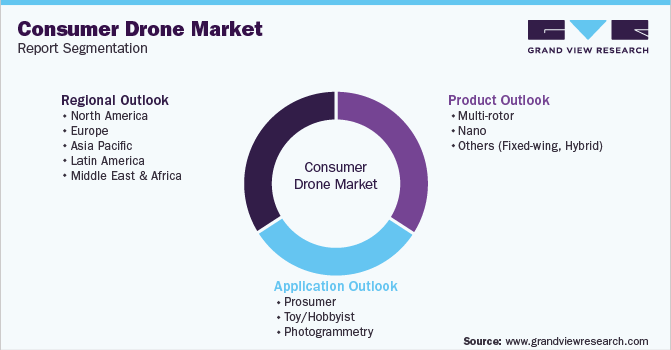
This report forecasts revenue growth at the regional and country levels and provides an analysis on the latest industry trends and opportunities in each of the sub-segments from 2021 to 2033. For this study, Grand View Research has segmented the global consumer drone market report based on the product, application, and region:
 To learn more about this report, Download Free Sample Report
-
Product Outlook (Volume, Thousand Units; Revenue, USD Million, 2021 - 2033)
-
Multi-rotor
-
Nano
-
Others (Fixed-wing, Hybrid)
-
-
Application Outlook (Volume, Thousand Units; Revenue, USD Million, 2021 - 2033)
-
Prosumer
-
Toy/Hobbyist
-
Photogrammetry
-
-
Regional Outlook (Volume, Thousand Units; Revenue, USD Million, 2021 - 2033)
-
North America
-
U.S.
-
Canada
-
Mexico
-
-
Europe
-
Germany
-
UK
-
France
-
Italy
-
Spain
-
-
Asia Pacific
-
China
-
Japan
-
India
-
South Korea
-
Australia
-
-
Latin America
-
Brazil
-
-
Middle East & Africa
-
Saudi Arabia
-
UAE
-
South Africa
-
-
Research Methodology
The consumer drone market figures in this report are based on a proven research process that combines executive interviews with secondary research from proprietary databases, company filings, and recognized regulatory and institutional sources. Market size is built through value-chain sizing-reconciling supply-side and demand-side estimates-and triangulated with bottom-up and top-down approaches. Every estimate passes multiple levels of expert validation before publication, with each consumer drone segment quantified using the revenue-capture definitions in the table below.
Segment Definition
Segment - Product
Revenue capture definition
Multi-rotor
Revenue is generated from multi-rotor drones designed for aerial photography, videography, recreational flying, and professional content creation. This segment is driven by increasing demand for easy-to-operate drones, AI-enabled flight features, advanced camera systems, and intelligent stabilization technologies.
Nano
Revenue is generated from compact, lightweight nano drones intended for indoor flying, beginner training, educational activities, and recreational use. This segment is driven by growing consumer interest in affordable entry-level drones, improved portability, and simplified flight controls for first-time users.
Others (Fixed-wing, Hybrid)
Revenue is generated from fixed-wing and hybrid consumer drones that offer extended flight endurance, higher travel range, and specialized aerial imaging capabilities. This segment is driven by increasing demand for long-duration flights, outdoor exploration, aerial surveying, and advanced recreational drone applications.
Segment - Application
Revenue capture definition
Prosumer
Revenue is generated from consumer drones used by professional photographers, videographers, digital content creators, and independent filmmakers requiring high-performance imaging and intelligent flight capabilities. This segment is driven by rising demand for cinematic aerial content, AI-powered automation, ultra-high-definition cameras, and advanced flight control systems.
Toy/Hobbyist
Revenue is generated from consumer drones purchased for recreational flying, entertainment, drone racing, and hobby activities. This segment is driven by increasing interest in outdoor recreation, affordable drone models, beginner-friendly features, and growing participation in drone enthusiast communities.
Photogrammetry
Revenue is generated from consumer drones equipped with high-resolution cameras and imaging software used to capture aerial photographs for creating maps, 3D models, and digital surface representations. This segment is driven by increasing adoption of cost-effective drone-based mapping, land measurement, construction site documentation, agricultural monitoring, and infrastructure inspection applications.
Estimation Model
Layer Name
Key Question
Description
Consumer Demand Layer
Who are the potential adopters?
Identifies the total addressable customer base for consumer drones, including hobbyists, recreational users, photographers, videographers, travel enthusiasts, social media content creators, drone racing participants, independent filmmakers, outdoor adventurers, and technology enthusiasts seeking aerial imaging, entertainment, and personal flying experiences.
Technology Enablement Layer
Who can deploy Consumer Drones?
Adoption is influenced by the availability of AI-powered flight control systems, GPS and GNSS technologies, high-resolution imaging sensors, lightweight materials, battery innovations, obstacle avoidance systems, mobile application ecosystems, wireless communication technologies, and manufacturing capabilities that enable safe, intelligent, and user-friendly drone operations.
Application Deployment Layer
Where are Consumer Drones actively utilized?
Applies adoption levels across environments requiring location intelligence and spatial analysis, including land surveying, urban planning, transportation networks, utility asset management, environmental monitoring, agriculture, mining operations, disaster management, defense surveillance, construction sites, smart city initiatives, and infrastructure development projects.
Revenue Generation Layer
How is revenue generated?
Revenue is generated through the sale of consumer drones, replacement batteries, propellers, cameras, accessories, drone software applications, repair and maintenance services, cloud storage subscriptions, premium flight features, and aftermarket upgrades that enhance drone performance, imaging capabilities, and user experience.
Delivered Customizations
This report has been delivered with the following In-depth customizations
Client Request
Customization Delivered
Value Adds
Consumer Drone Product Portfolio Optimization & Technology Performance Assessment
Conducted detailed evaluation of consumer drone product portfolios across photography, recreational, FPV, nano, and prosumer drones, integrating AI-powered flight control, intelligent obstacle avoidance, advanced imaging systems, and battery technologies to optimize product competitiveness and user experience.
Improves product differentiation, enhances user experience, optimizes technology investments, and strengthens competitive positioning.
Autonomous Flight Capability Deployment & Smart Connectivity Strategy
Assessed deployment of autonomous flight technologies across consumer drones, integrating GPS navigation, computer vision, real-time video transmission, mobile application connectivity, intelligent tracking, and cloud-enabled flight management to improve operational performance and usability.
Enhances flight efficiency, improves operational safety, enables seamless connectivity, and supports superior consumer experiences.
AI-Powered Imaging Systems & Intelligent Flight Feature Assessment
Evaluated implementation of AI-powered imaging technologies, automated flight modes, obstacle avoidance, subject tracking, high-resolution cameras, and intelligent stabilization systems to improve aerial photography performance, flight precision, and overall consumer satisfaction.
Enables superior imaging quality, improves flight accuracy, enhances consumer satisfaction, and accelerates product innovation.
Frequently Asked Questions About This Report
The global consumer drone market is expected to grow at a CAGR of 14.1% from 2026 to 2033, reaching USD 18.3 billion by 2033.
The consumer drone market's significant growth prospects can be attributed to the increasing prominence of drone flying as a hobby activity, such as UAV photography and racing.
The global consumer drone market size was valued at USD 6.0 billion in 2025 and is estimated at USD 7.3 billion for 2026.
The multi-rotor segment dominated with a 69.0% revenue share in 2025 and is the fastest-growing product.
Key players include 3D Robotics; Inc. (Kitty Hawk); SZ DJI Technology Co., Ltd.; Eachine; Guangdong Cheerson Hobby Technology Co., Ltd.; Guangdong Syma Model Aircraft Industrial Co., Ltd (Syma); Guangzhou Walkera Technology Co., Ltd. (Walker); Yuneec International Co., Ltd.; SkyTech Drone Sp. z o. o; Horizon Hobby, LLC; Parrot Drone SAS; Shantou Chenghai Weili Toys Industrial Co., Ltd;. (WL Toys); JIANJIAN TECHNOLOGY CO., LTD.; Hubsan
The toy/hobbyist segment dominated the market with a share of 65.1% in 2025.
North America dominated the market, accounting for a revenue share of 36.7% in 2025.
Asia Pacific is the fastest-growing region over the forecast period.
About the Author(s)
Next Generation Technologies Research Team
Technology · Next Generation TechnologiesThis report was authored by the next generation technologies research team at Grand View Research - comprising two research analysts, one senior research analyst, and one industry expert - with specialized expertise in the next generation technologies segment of the technology industry. All findings are based on proprietary technology databases, executive interviews, and regulatory analysis, subject to internal peer review prior to publication.
Last Updated:
Speak to Analyst

Customize this report to your needs - add regions, segments, or data points, with 20% free customization.
Or view our licence options:


ISO 9001:2015 & 27001:2022 Certified
We are GDPR and CCPA compliant! Your transaction & personal information is safe and secure. For more details, please read our privacy policy.


