
- Home
- »
- Advanced Interior Materials
- »
-
Containerboard Market Size, Growth Report, 2026-2033GVR Report cover
![Containerboard Market (2026 - 2033)Report]()
Containerboard Market (2026 - 2033)
Size, Share & Trends Analysis Report By Material (Recycled, Virgin), By End Use (Food & Beverage, Automotive, Consumer Goods, Industrial), By Region (North America, Europe, Asia Pacific), And Segment Forecasts
Market Size, 2025
$112.3BMarket Estimate, 2026
$120.5BMarket Forecast, 2033
$197.3BCAGR, 2026–2033
7.3%Containerboard Market Summary
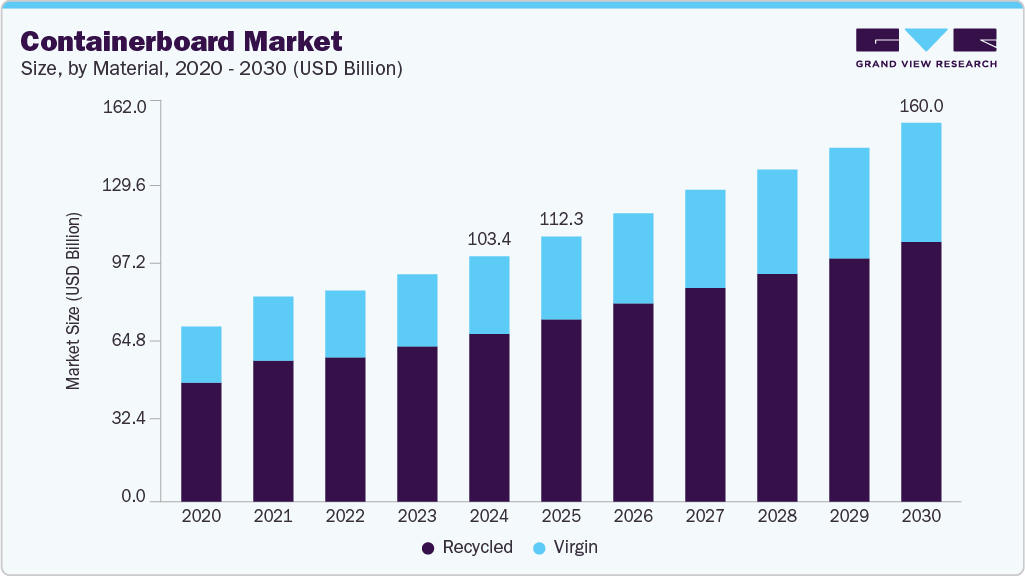
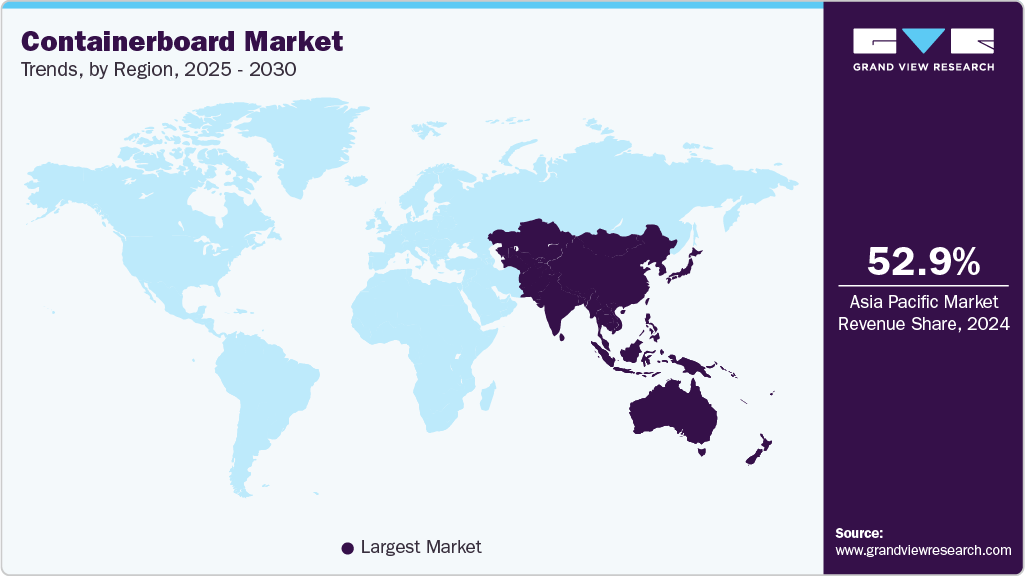
The global containerboard market size was valued at USD 112.3 billion in 2025 and is projected to grow from USD 120.5 billion in 2026 to USD 197.3 billion by 2033, at a CAGR of 7.3% from 2026 to 2033. Asia Pacific dominated the market with the largest revenue share of approximately 55% in the global market in 2025. The market is expected to expand due to the increasing demand for lightweight and eco-friendly packaging materials.
Key Market Trends & Insights
- By material: The recycled material segment held the largest market share of more than 65% in 2025.
- By end use: The food & beverage segment accounted for the largest market revenue share in 2025.
Regional Highlights
- Largest regional market: Asia Pacific (55% revenue share, 2025)
- Fastest-growing regional market: Asia Pacific (highest CAGR, 2026-2033)
- By country: The U.S. held the largest market share in 2025.
Market Size & Forecast
- Market size in 2025: USD 112.3 Billion
- Estimated market size in 2026: USD 120.5 Billion
- Projected market size by 2033: USD 197.3 Billion
- CAGR (2026-2033): 7.3%
Containerboard is made from renewable materials and can be recycled after use. These materials present qualities such as strength, lightness, and flexibility. They are used across multiple sectors, including food & beverage, consumer products, industrial, agriculture, healthcare, and e-commerce, for packaging purposes. A key factor driving the market’s growth is the growing popularity of sustainability. Fabricated from renewable, recyclable materials, containerboard closely aligns with the principles of a circular economy. The capacity to reuse old corrugated materials as the primary material for new paperboard makes it highly valued for businesses looking to improve their circularity and environmental responsibility.The global containerboard industry is projected to experience substantial growth during the forecast period, driven by the expansion of end-use sectors such as e-commerce and the food and beverage industry. The increasing popularity of packaged, frozen, and ready-to-eat meals has increased demand for durable, moisture-resistant containerboard packaging. For example, the growing e-commerce market, driven by the increasing popularity of online shopping, boosts demand for corrugated boxes, thereby propelling the industry's growth.
The formation of a containerboard with multiple layers of paper makes it highly durable and strong. The lightweight nature of containerboard helps reduce overall shipping costs. In addition, the product's ability to offer protection & cushioning during transportation is further increasing its demand for transporting delicate and electronic products in industries such as food & beverage and consumer goods.
Corrugated medium and linerboard make up two basic components of the containerboard industry. The linerboard was created from virgin fiber and called a kraft liner, while the term testliner refers to a linerboard made from recycled fibers. Depending on the type of pulp utilized, the corrugated medium might be virgin, semi-chemical, or recycled. The production of containerboard accounts for more than 50% of the recovered fiber used to make paper & paperboard, according to the American Forest & Paper Association.
High-quality graphic printing is possible on containerboard, making it an ideal option for packaging used for marketing and branding purposes. Furthermore, technological developments in digital printing are anticipated to create several business opportunities for market players. In addition, the expanding demand for high-volume liners and post-print products, coupled with the growing use of advanced processes, is expected to increase market potential over the coming years.
The market value chain consists of raw material suppliers, manufacturers, distributors, and end users. The strength of the product depends heavily on the quality of the raw material used. Major raw materials for the production of containerboard include recycled paper and wood fiber. Furthermore, value is added during the production process by applying the coating and treating the product in accordance with the customers' requirements. After that, the containerboard is used to manufacture various packaging products, such as cartons and corrugated boxes.
The government's strict restrictions on the use of natural resources are the main driver of market expansion. Virgin wood fiber must be used in the production of virgin containerboards, adding to the environmental load. These boards' production uses up natural resources and creates hazardous greenhouse gases, which raises the final prices. In addition, the government's restrictions on tree-cutting are also expected to limit the market growth.
Merger and acquisition activity is high, as evidenced by recent major deals aimed at accelerating growth and expanding geographic reach. In April 2025, Mondi acquired Schumacher Packaging’s Western Europe operations, including its assets. This acquisition added over 1 billion square meters of packaging capacity. It expanded Mondi’s product portfolio with solid board solutions, offering greater choice and tailored solutions for e-commerce, FMCG, and other sectors.
Market Dynamics
The containerboard industry is experiencing growth, driven by rising demand for sustainable, recyclable packaging solutions, particularly from the expanding e-commerce, retail, and logistics sectors. Growing environmental regulations and consumer preference for eco-friendly packaging are further accelerating the shift from plastic to paper-based materials. However, market growth is challenged by fluctuations in raw materials and energy costs, which impact production expenses and profitability. Despite these challenges, ongoing investments in sustainable packaging and recycling infrastructure continue to support the market's long-term expansion.
The rapid growth of e-commerce and online retail is a major driver of the containerboard industry. The increasing demand for boxes and protective packaging solutions for shipping consumer goods has significantly boosted containerboard consumption worldwide. The material’s durability, lightweight nature, and recyclability make it highly preferred for transportation and logistics applications.
Furthermore, growing environmental concerns and regulatory pressure to reduce plastic packaging usage are encouraging industries to shift toward paper-based and recyclable packaging materials. Brand owners and packaging manufacturers are increasingly adopting sustainable packaging solutions to meet consumer preferences and corporate sustainability goals. This transition is expected to create long-term growth opportunities for the containerboard market.
In addition, the expansion of last-mile delivery networks and rapid urbanization in emerging economies are further strengthening demand for efficient secondary and tertiary packaging formats. Major e-commerce and retail players such as Amazon and Walmart are relying on corrugated packaging to ensure product safety during high-volume shipments and reverse logistics.
The global market is significantly affected by fluctuations in the prices of recycled paper, virgin pulp, and energy, which directly impact manufacturing costs and profit margins. Variations in waste paper availability, transportation expenses, and global supply chain disruptions create uncertainty in raw material procurement, while rising electricity and fuel costs further increase operational expenditures. In addition, stringent environmental regulations on emissions and waste management require ongoing investments in sustainable production technologies, further pressuring manufacturers.
Furthermore, price volatility in key raw materials often leads to unstable production planning and affects long-term contract pricing with customers. Manufacturers may face challenges maintaining consistent margins, especially during periods of high inflation in input costs. As a result, companies are focusing on recycling efficiency, alternative fiber sources, and process optimization to reduce dependence on volatile raw material markets and improve cost stability.
Exchange rate volatility in import-dependent regions also impacts the cost of pulp and recovered paper, thereby increasing overall procurement risk. Moreover, the growing shift toward sustainable, certified raw materials limits sourcing flexibility, often leading to higher compliance-related costs and tighter constraints on supplier selection.
Analyst Perspective
The containerboard market is supported by several strong long-term growth drivers, including the rapid expansion of e-commerce, increasing demand for packaged food and consumer goods, and growing regulations aimed at reducing plastic packaging. As businesses and consumers increasingly prefer sustainable, recyclable packaging materials, demand for containerboard continues to rise across industries. In addition, ongoing investments in recycling, lightweight packaging, and operational efficiency are helping manufacturers improve sustainability and reduce costs. As a result, containerboard is becoming an important component of the global shift toward environmentally responsible packaging solutions.
Material Insights
The recycled segment led the market with the largest revenue share of more than 65% in 2025. This growth can be attributed to rising environmental concerns, which are driving the adoption of sustainable packaging materials. Recycled fiber can be reused 6 to 7 times while maintaining durability and performance, helping reduce waste generation. Furthermore, recycled materials are preferred due to their cost-effectiveness and compliance with government sustainability regulations. Supporting this trend, in September 2025, Mondi commenced commercial operations at its recycled containerboard mill in Duino, Italy, expanding its production capacity for high-quality recycled containerboard and reinforcing its commitment to sustainable packaging solutions in the European market.
The virgin material segment is expected to grow at a significant CAGR over the forecast period. Wood fibers from cut trees are the primary raw material used to make containerboards. These wood fibers are used to make pulp, the primary component in containerboard production. Furthermore, the ability of virgin materials to offer consistent durability, strength, and printability is expected to drive the segment growth. Virgin containerboards are ideal for packaging delicate and heavy objects due to their excellent stacking strength and ability to handle heavy weights. However, growing concerns among the government and consumers about the depletion of natural resources are expected to limit the use of virgin materials in containerboard production.
End Use Insights
The food & beverage segment accounted for the largest market revenue share in 2025 and is expected to grow rapidly over the forecast period. This growth can be attributed to increasing demand for sustainable, durable, and cost-efficient packaging solutions in the food & beverage sector. The food and beverage industry uses corrugated boxes made from containerboard for storage and transportation because of their qualities, including toughness, light weight, vibration resistance, and crush resistance. In addition, the above properties further help decrease the overall cost of packing and shipping.The growing focus on innovative, sustainable packaging is further driving market growth. For instance, in April 2025, Stora Enso launched Performa Nova, a next-generation folding boxboard for food and beverage packaging applications, including dry, chilled, and frozen foods, confectionery, and beverage multipacks, reinforcing the industry's shift toward high-performance and recyclable packaging materials.
The consumer goods sector is projected to experience at the fastest CAGR during the forecast period. The rise in purchasing power, improved standard of living, and rapid urbanization across developed and developing nations are expected to drive the consumer goods containerboard segment, thereby boosting market demand in the coming years. Packaging plays a crucial role in shaping a brand image and changing consumer perceptions of a consumer goods brand. Branded, well-designed packaging made from containerboard can enhance a product's appearance and appeal, making it stand out from competitors. Therefore, the rising competition in the consumer goods industry is expected to increase the market demand for branding.
Regional Insights
The containerboard market in North America accounted for a significant revenue share of approximately 20% in 2025. Consumer concerns about environmental issues in North America and growing regulations on environmental impact are driving the adoption of sustainable packaging materials. Containerboard provides lightweight, durable packaging and an appealing display of products, resulting in increased use of these products in the region.
U.S. Containerboard Market Trends
The containerboard market in the U.S. accounted for the largest market revenue share in North America in 2025, due to the increasing popularity of packaged food. The food and beverage industry is a significant consumer of containerboard, as corrugated boxes are commonly used to package products such as food, chemicals, glass, and various consumer items. The expansion of this market is driven by changes in consumer habits and a growing preference for packaged meals.
Asia Pacific Containerboard Market Trends
Asia Pacific dominated the global containerboard market with the largest revenue share of approximately 55% in 2025 and is expected to grow at the fastest CAGR over the forecast period. The penetration of several end-use sectors, such as the food & beverage, consumer goods, and agricultural industries, and the high level of consumerism, contribute to increased demand for containerboard in the region.
The containerboard market in China held a significant share in the Asia Pacific in 2025. Rising consumer spending, rapid urbanization, industrial trade, and production in China boost the demand for packaging materials. The increase in e-commerce, a growing middle class, and rising urbanization have further impelled the demand for packaged products, particularly in industries such as food, electronics, and personal care.
The India containerboard market is expected to grow rapidly during the forecast period, fueled by government efforts toward sustainability and advancements in the domestic industry. For instance, in January 2025, Silverton Pulp and Paper, a paper manufacturing facility in North India, along with Worthwell Papers, introduced a new White Kraft Liner (WKL) containerboard solution. This initiative addresses the growing need for high-quality packaging in India and reduces dependence on imports, facilitating the Indian packaging sector's shift toward creative solutions.
Europe Containerboard Market Trends
The containerboard market in Europe held the significant market share in 2025. It is experiencing growth due to a major focus on eco-friendly, sustainable alternatives, primarily driven by rising regulations requiring more recyclable, environmentally friendly materials. The growing demand for packaging materials in the food, beverage, and retail industries is a significant driver of market expansion. Germany stands out as the dominant country in the European market.
Key Containerboard Company Insights
Some key players in the global containerboard industry include International Paper, OJI FIBRE SOLUTIONS (NZ) LTD, Smurfit WestRock, and Mondi.
-
International Paper transforms renewable materials into everyday essentials. Its product range includes packaging solutions that safeguard and showcase goods, facilitate international trade, and enhance consumer safety. It is dedicated to circular solutions to promote recycling, minimize waste, and create a more sustainable future.
-
Smurfit WestRock is a global packaging leader operating across 40 countries with over 100,000 employees. It specializes in designing, producing, and supplying a wide range of paper-based packaging products. Its portfolio includes corrugated packaging, consumer packaging, Bag-in-Box solutions, and point-of-sale displays.
Key Containerboard Companies
The following key companies have been profiled for this study on the global containerboard market:
-
International Paper
-
Smurfit Westrock
-
Mondi
-
OJI FIBRE SOLUTIONS (NZ) LTD
-
Nine Dragons Worldwide (China) Investment Group Co., Ltd
-
Sappi Ltd
-
Cascades Inc.
-
Stora Enso
-
Georgia-Pacific
-
Greif
-
Packaging Corporation of America
Recent Development
-
In January 2025, International Paper acquired London-based DS Smith. This merger aims to establish a leading global entity in sustainable packaging solutions, significantly enhancing its presence in the growing North American and European markets.
-
In December 2024, Mondi Group expanded its capacity by successfully launching a new kraft paper machine in Štětí mill, Czech Republic, with a state-of-the-art paper machine worth around USD 400 million.
-
In July 2024, Smurfit Kappa and WestRock finalized their merger, creating Smurfit Westrock, a global leader in sustainable packaging. The newly formed company aims to harness its collective strengths and unmatched geographic presence across 40 countries to establish itself as a premier global packaging partner, leveraging complementary product offerings and advanced sustainability features.
Containerboard Market Report Scope
Report Attribute
Details
Market size in 2025
USD 112.3 billion
Estimated market size in 2026
USD 120.5 billion
Projected market size by 2033
USD 197.3 billion
Growth rate
CAGR of 7.3% from 2026 to 2033
Base year for estimation
2025
Historical data
2021 - 2024
Forecast period
2026 - 2033
Quantitative units
Revenue in USD million/billion, and CAGR from 2026 to 2033
Report coverage
Revenue forecast, company ranking, competitive landscape, growth factors, and trends
Segments covered
Material, end use, region
Regional scope
North America; Europe; Asia Pacific; Latin America; Middle East & Africa
Country scope
U.S.; Canada; Mexico; Germany; UK; France; China; Japan; India; South Africa; Saudi Arabia
Key companies profiled
International Paper; OJI FIBRE SOLUTIONS (NZ) LTD; Nine Dragons Worldwide (China) Investment Group Co., Ltd; Smurfit Westrock; Mondi; Sappi Ltd; Cascades Inc.; Stora Enso Oyj; Georgia-Pacific; Greif; Packaging Corporation of America (PCA)
Customization scope
Free report customization (equivalent up to 8 analysts working days) with purchase. Addition or alteration to country, regional & segment scope.
Pricing and purchase options
Avail of customized purchase options to meet your exact research needs. Explore purchase options
Global Containerboard Market Report Segmentation
This report forecasts revenue growth at the regional, and country levels and provides an analysis on the latest industry trends and opportunities in each of the sub-segments from 2021 to 2033. For this study, Grand View Research has segmented the global containerboard market report based on the material, end use, and region.

-
Material Outlook (Revenue, USD Billion, 2021 - 2033)
-
Recycled
-
Virgin
-
-
End Use Outlook (Revenue, USD Billion, 2021 - 2033)
-
Food & Beverage
-
Automotive
-
Consumer Goods
-
Industrial
-
Other
-
-
Regional Outlook (Revenue, USD Billion, 2021 - 2033)
-
North America
-
U.S.
-
Canada
-
Mexico
-
-
Europe
-
Germany
-
UK
-
France
-
-
Asia Pacific
-
India
-
China
-
Japan
-
-
Central & South America
-
Middle East & Africa
-
Saudi Arabia
-
South Africa
-
-
Frequently Asked Questions About This Report
The global containerboard market size was valued at USD 112.3 billion in 2025 and is estimated at USD 120.5 billion for 2026.
The global containerboard market is expected to grow at a CAGR of 7.3% from 2026 to 2033, reaching USD 197.3 billion.
Asia Pacific dominated with a 55% revenue share in 2025, driven by its large manufacturing base, expanding e-commerce sector, growing consumer goods production, and strong demand for sustainable corrugated packaging in countries such as China, India, and Japan.
Consumer Goods is the fastest growing end use segment in the containerboard market.
The recycled segment is the fastest growing material segment in the containerboard market.
The food & beverage segment accounted for the largest revenue share of 40.9% in 2025, due to high demand for corrugated packaging for processed foods, beverages, fresh produce, and takeaway products, supported by expanding retail and e-commerce distribution networks.
The recycled segment held the highest revenue market share of 68.5% in 2025, owing to its widespread adoption in corrugated packaging, high recovery rates, lower production costs, and growing demand for sustainable and recyclable packaging solutions across major end-use industries.
Some of the key players operating in the containerboard market include International Paper; OJI FIBRE SOLUTIONS (NZ) LTD, Nine Dragons Worldwide (China) Investment Group Co., Ltd; Smurfit Westrock, Mondi, Sappi Ltd; Cascades Inc.; Stora Enso Oyj; Georgia-Pacific; Greif, and Packaging Corporation of America (PCA).
Key factors driving the containerboard market include the rapid growth of e-commerce, increasing demand for sustainable and recyclable packaging, expansion of the food & beverage industry, and stringent regulations promoting paper-based packaging over plastics.
About the Author(s)
Advanced Interior Materials Research Team
Advanced Materials · Advanced Interior MaterialsThis report was authored by the advanced interior materials research team at Grand View Research - comprising two research analysts, one senior research analyst, and one industry expert - with specialized expertise in the advanced interior materials segment of the advanced materials industry. All findings are based on proprietary advanced materials databases, executive interviews, and regulatory analysis, subject to internal peer review prior to publication.
Last Updated:
Speak to Analyst


Customize this report to your needs — add regions, segments, or data points, with 20% free customization.
Or view our licence options:


ISO 9001:2015 & 27001:2022 Certified
We are GDPR and CCPA compliant! Your transaction & personal information is safe and secure. For more details, please read our privacy policy.


