
- Home
- »
- Advanced Interior Materials
- »
-
Conveyor Oven Market Size, Share & Trends Report, 2033GVR Report cover
![Conveyor Oven Market (2026 - 2033)Report]()
Conveyor Oven Market (2026 - 2033)
Size, Share & Trends Analysis Report By Type (Belt Conveyor Ovens, Overhead Conveyor Ovens), By Heating Technology (Infrared, Convection), By Heating Source (Electric, Gas), By End-use, By Region And Segment Forecasts
Market Size, 2025
$1,100.3MMarket Estimate, 2026
$1,155.4MMarket Forecast, 2033
$1,674.2MCAGR, 2026–2033
5.4%Conveyor Oven Market Summary
The global conveyor oven market size was valued at USD 1,100.3 million in 2025 and is projected to grow from USD 1,155.4 million in 2026 to USD 1,674.2 million by 2033, at a CAGR of 5.4% from 2026 to 2033. Asia Pacific dominated the market, accounting for the largest revenue share of 41.1% in 2025. The growing adoption of automated and continuous thermal-processing systems is supporting the conveyor oven market as manufacturers seek higher throughput, consistent product quality, and reduced dependence on manual handling.

Key Market Trends & Insights
- By type: The belt conveyor ovens segment led the market with the largest revenue share of 38.1% in 2025.
- By end-use: The food processing segment led the market with the largest revenue share of 42.7% in 2025.
- By heating technology: The infrared segment led the market with the largest revenue share of 51.7% in 2025.
- By heating source: The electric segment led the market with the largest revenue share of 50.8% in 2025.
Regional Highlights
- Largest Regional Market: Asia Pacific (41.1% revenue share, 2025)
- By Country: China held the largest market share in 2025.
Market Size & Forecast
- Market size in 2025: USD 1,100.3 Million
- Estimated market size in 2026: USD 1,155.4 Million
- Projected market size by 2033: USD 1,674.2 Million
- CAGR (2026-2033): 5.4%
The increasing production of processed, frozen, bakery, ready-to-eat, and convenience food products is also creating demand for continuous oven systems. Food manufacturers are investing in equipment capable of handling higher volumes while maintaining uniform cooking, baking, roasting, and drying results.
At the same time, industrial manufacturers are using conveyor-based thermal systems for applications such as coating curing, drying, and heat treatment. Improvements in infrared, convection, and impingement technologies are enhancing heating uniformity and process control, making conveyor ovens suitable for a broader range of high-volume applications.
Market Dynamics
The conveyor oven market is being shaped by the increasing need for high-throughput, consistent, and automated thermal processing across food service, food processing, and industrial manufacturing. Continuous conveyor operation enables users to control processing time through belt speed while maintaining consistent heating conditions, making these systems suitable for applications requiring repeatable output at high volumes. At the same time, manufacturers are focusing on energy efficiency, improved heat distribution, and advanced controls as users increasingly evaluate equipment based on operating costs, production capacity, and process consistency.
The expansion of quick-service restaurants, bakeries, prepared-food production, and food processing facilities is driving demand for conveyor ovens that can handle continuous production with limited manual intervention. These ovens allow multiple products to be processed simultaneously and provide relatively consistent cooking times and temperatures, supporting faster throughput during peak production periods. The food processing and manufacturing segment is also expected to remain an important application area as producers increasingly prioritize scalable and automated thermal-processing equipment.
Increasing production of pizza, bakery products, snacks, frozen foods, prepared meals, and other convenience foods is further supporting adoption. Conveyor systems can be integrated into broader production lines, allowing products to move continuously between preparation, thermal processing, cooling, and packaging stages. This makes conveyor ovens particularly attractive to high-volume operators seeking to standardize output while reducing bottlenecks associated with batch-based cooking processes.
The relatively high upfront cost of conveyor oven systems can limit adoption, particularly among small foodservice operators and smaller manufacturers. In addition to the oven itself, users may need to invest in electrical or gas infrastructure, ventilation, space, conveyor integration, and production-line modifications. Larger industrial systems can also require application-specific engineering and commissioning, increasing the overall capital requirement. Consequently, businesses with lower production volumes may continue to use conventional or batch ovens rather than invest in continuous conveyor systems.
The shift toward energy-efficient, automated, and digitally controlled heating equipment presents an important opportunity for market participants. Improvements in insulation, heating-zone control, variable-speed conveyors, infrared heating, impingement airflow, and programmable controls can help reduce unnecessary energy consumption while maintaining processing consistency. Performance evaluation of conveyor ovens already considers parameters such as preheating energy, idle energy consumption, cooking efficiency, and production capacity, highlighting the importance of energy performance in equipment selection.
Further integration of sensors, automated temperature monitoring, remote controls, and production-line connectivity could allow operators to optimize conveyor speed and heating conditions according to product requirements. Such capabilities can improve process consistency and provide better visibility into energy use and production performance, creating opportunities for higher-value conveyor oven systems across both food processing and industrial applications.
Market Concentration & Characteristics
The conveyor oven market is fragmented, with competition distributed among large equipment manufacturers, specialized oven producers, and industrial thermal-processing suppliers. Market participants serve diverse applications across food processing, food service, and industrial manufacturing, with many companies offering customized systems based on heating technology, conveyor configuration, production capacity, and operating requirements.
The conveyor oven industry has a moderate to high degree of innovation, particularly in heating efficiency, process control, automation, and heat distribution. Manufacturers are developing systems that combine infrared, convection, and impingement technologies with variable conveyor speeds, multi-zone temperature controls, sensors, and automated monitoring to improve cooking uniformity and production efficiency. Energy consumption and cooking performance are also important areas of technical development, with established performance-testing methods evaluating parameters such as preheating energy, idle energy use, cooking efficiency, and production capacity.
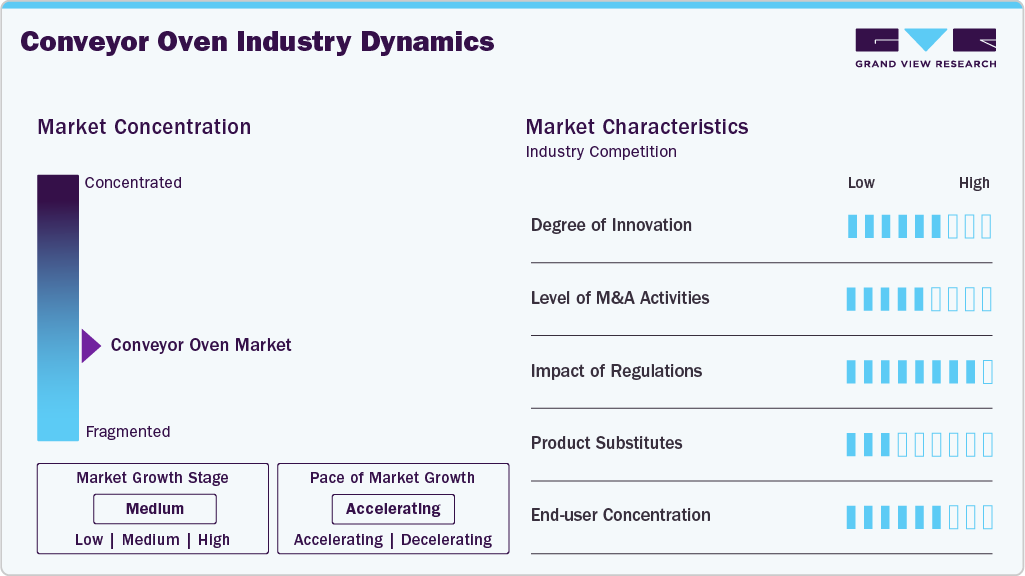
Regulations have a moderate impact on the conveyor oven market, with requirements varying according to application and geography. Food-processing and food-service installations must generally address food hygiene, equipment cleanability, material safety, electrical and gas safety, and energy-efficiency requirements. For example, food-processing equipment in the U.S. must be designed to allow adequate cleaning and prevent contamination, while energy-performance requirements and testing methods influence equipment selection and design.
The conveyor oven market has relatively low to moderate end-user concentration because demand comes from a broad range of food processors, restaurants, bakeries, commercial kitchens, and industrial manufacturers. Large food-processing facilities and food service chains can account for significant equipment purchases because of their high-volume production requirements, but the market also includes numerous smaller and mid-sized establishments. This diverse customer base reduces dependence on a limited number of buyers, while application-specific requirements for capacity, conveyor configuration, heating method, and product type create opportunities for specialized equipment solutions.
Analyst Perspective
The conveyor oven market is driven by rising demand for continuous processing, automation, consistent output, and energy efficiency. Belt conveyor ovens and infrared heating currently lead adoption, while impingement technology and electric heating offer strong growth potential. Food processing remains the largest end-use segment, with foodservice expected to expand rapidly as commercial kitchens increasingly adopt high-throughput cooking solutions.
Type Insights
The belt conveyor ovens segment led the market with the largest revenue share of 38.1% in 2025, owing to their flexibility, scalability, and ability to support continuous, high-volume processing across food processing and foodservice applications. The continuous belt enables products to move through controlled heating zones at a consistent speed, helping maintain uniform cooking and baking results. Their ability to accommodate different product sizes and integrate easily with automated production lines makes them suitable for pizzas, bakery products, snacks, and other high-volume food applications.
The chain-on-edge conveyor ovens segment are expected to register significant growth over the forecast period at CAGR of 6.4%, supported by their suitability for continuous processing of high volumes of similar products and components. These systems use posts or spindles attached to a chain to securely carry products through the heating chamber, providing repeatable positioning and efficient use of production-line space. Their application in drying, curing, coating, and other thermal-processing operations, particularly where products require secure handling or higher-load capacity, is expanding their use across industrial manufacturing.
Heating Technology Insights
The infrared heating dominated the conveyor oven market with the largest revenue share of 51.7% in 2025, supported by its ability to transfer heat directly to the product surface, enabling rapid heating and shorter processing times. The technology offers high heat-transfer rates and can provide relatively uniform heating, making it suitable for applications such as baking, roasting, drying, and cooking. Its compact design and potential for lower energy consumption further support its use in continuous food-processing operations where production speed and process efficiency are important.
The impingement heating segment is expected to witness significant growth at CAGR of 5.3%, driven by its ability to deliver high-velocity streams of heated air directly onto products moving through the conveyor oven. This enhances heat transfer and allows faster cooking while supporting uniform browning and consistent product quality across the conveyor width. The technology is particularly suitable for high-throughput applications such as pizza, bakery products, meat, and prepared foods, where rapid and consistent thermal processing is important.
Heating Source Insights
electric segment led the market with the largest revenue share of 50.8% in 2025, supported by its ease of installation, precise temperature control, and compatibility with automated commercial and industrial cooking systems. Electric ovens do not require dedicated gas pipelines or combustion-related infrastructure, making them suitable for foodservice locations with space or infrastructure constraints. The growing emphasis on energy management and cleaner cooking operations is also driving the adoption of electric systems, while conveyor oven performance standards assess energy input, preheating, idle consumption, cooking efficiency, and production capacity.
The gas heating segment is expected to grow at a moderate CAGR of 3.7%, particularly in high-volume and industrial applications where high thermal loads and rapid heat recovery are important. Gas systems can offer operating-cost advantages in applications with substantial heating requirements, especially where natural-gas infrastructure is readily available. Their continued use is supported by demand for high-temperature, continuous processing, although energy-efficiency considerations and the gradual shift toward electrification may moderate their growth compared with electric systems.
End-use Insights
The food processing segment dominated the conveyor oven market with the largest revenue share of 42.7% in 2025, driven by the need for continuous, high-volume, and consistent thermal processing across bakery products, prepared foods, snacks, frozen foods, and other processed food categories. Conveyor ovens enable manufacturers to maintain controlled cooking conditions while moving products continuously through heating zones, supporting high production throughput and standardized product quality. Their ability to integrate with automated processing and packaging lines further strengthens adoption among large-scale food manufacturers.

The food service segment is expected to register the fastest growth over the forecast period at CAGR of 6.0%, supported by the expansion of quick-service restaurants, pizza chains, bakeries, cafes, and other high-volume commercial food outlets. Conveyor ovens help foodservice operators handle peak-hour demand through continuous cooking, shorter processing cycles, and consistent results with limited manual intervention. Growing emphasis on kitchen automation, labor efficiency, and standardized food preparation is further encouraging adoption across modern foodservice establishments.
Regional Insights
Asia Pacific dominated the market accounting for the largest revenue share of 41.1% in 2025, supported by rapid urbanization, expansion of foodservice networks, and increasing consumption of processed and convenience foods. China and India represent important demand centers, while Japan and other developed Asian markets are supporting adoption through established bakery, restaurant, and food-processing industries. The growing presence of QSRs, cafés, bakery chains, and organized food manufacturing is increasing demand for high-throughput cooking and baking equipment.

China Conveyor Oven Market Trends
The China conveyor oven marketdominated the Asia Pacific market, supported by its extensive food-processing and manufacturing base. China’s National Bureau of Statistics reported that the value added of food processing from agricultural and sideline products increased by 2.2% in 2024, indicating continued expansion of industrial food-processing activity. The country’s large-scale production environment, growing demand for processed foods, and development of automated manufacturing facilities support the use of continuous thermal-processing equipment, including conveyor ovens.
The India conveyor oven market is expected to register strong growth, driven by the expansion and modernization of its food-processing industry. According to India’s Ministry of Food Processing Industries, processed food accounted for 23.4% of India’s agri-food exports in 2023-24, compared with 13.7% in 2014-15. The ministry also reported that food processing represented 12.4% of employment in the registered manufacturing sector based on the 2022-23 Annual Survey of Industries. These developments, along with increasing investment in processing and preservation infrastructure, are creating a favorable environment for automated cooking and baking equipment such as conveyor ovens.
North America Conveyor Oven Market Trends
North America represents a mature and well-established market, supported by extensive use of conveyor ovens across QSRs, pizza chains, bakeries, and food-processing facilities. High replacement activity and the willingness of foodservice operators to invest in automated equipment are supporting continued demand. The region's focus on labor efficiency, standardized food preparation, and high-volume operations also favors conveyor-based cooking systems.
The U.S. foodservice market represents a major demand base for conveyor ovens, supported by the continued expansion of food-away-from-home consumption. According to the U.S. Department of Agriculture Economic Research Service (USDA ERS), foodservice sales reached USD 1.41 trillion in 2025. Full-service and limited-service restaurants together accounted for 71.0% of total food-away-from-home spending in 2025, highlighting the scale of commercial food preparation activity in the country. This large and growing foodservice base supports demand for high-throughput cooking equipment, including conveyor ovens, particularly in establishments focused on consistent output and faster food preparation.
Europe Conveyor Oven Market Trends
Europe is characterized by strong demand from industrial bakeries, convenience-food producers, and commercial foodservice establishments. Increasing automation in bakery and food manufacturing operations is encouraging the use of continuous thermal-processing equipment, while energy-efficiency requirements are pushing users toward ovens with improved heat management and lower energy consumption. The region's established baking industry and emphasis on efficient production provide a stable base for market expansion.
The Germany conveyor oven market dominated the European market, supported by its strong industrial and food-manufacturing base. The country has a well-established manufacturing ecosystem with significant activity across food production, industrial processing, and automated production lines. The continued modernization of manufacturing facilities and emphasis on production efficiency support demand for continuous thermal-processing equipment, including conveyor ovens. Germany’s strong industrial orientation also creates opportunities for ovens used in both food processing and industrial manufacturing applications.
The UK conveyor oven market is expected to grow at a notable pace, driven by its large food manufacturing and commercial food service sectors. Food manufacturing remains one of the country's most important manufacturing activities, supporting demand for automated cooking, baking, and thermal-processing equipment. The continued development of prepared foods, bakery products, and other processed food categories, together with increasing emphasis on production efficiency, is expected to encourage adoption of conveyor ovens across food-processing and foodservice operations.
Middle East & Africa Conveyor Oven Market Trends
Middle East & Africa is projected to grow as investments in hospitality, restaurants, bakeries, and food-processing facilities increase, particularly in urban and tourism-focused markets. Demand for reliable high-throughput cooking equipment is supported by the development of organized foodservice operations and large-scale food production facilities. Growth in modern commercial kitchens and the expansion of food manufacturing capacity are creating opportunities for conveyor ovens, particularly where consistent output and automated processing are priorities.
The Saudi Arabia conveyor oven marketis a leading market in the Middle East & Africa region, supported by the expansion of food processing, hospitality, restaurants, and organized foodservice under Vision 2030. The country is strengthening domestic food production and processing capabilities, while investment in agricultural processing and food manufacturing is encouraging modernization across the food value chain. The expansion of foodservice activity is also creating demand for efficient, high-throughput commercial cooking equipment, including conveyor ovens, particularly in large restaurants, bakeries, hotels, and institutional kitchens.
Latin America Conveyor Oven Market Trends
Latin America is expected to witness steady growth as food processing and organized food service continue to develop across major economies. Rising consumption of bakery products, prepared foods, and fast-food offerings is creating demand for equipment capable of handling higher production volumes. Expansion of modern retail and restaurant formats is also encouraging food businesses to upgrade from conventional batch cooking toward more consistent and automated thermal-processing solutions.
The Brazil conveyor oven market dominated the Latin American conveyor oven market, supported by its extensive food-processing industry and broad manufacturing base. The country has a well-established ecosystem for processed foods, bakery products, meat processing, beverages, and other food-related manufacturing activities, creating demand for continuous cooking, baking, roasting, and thermal-processing equipment. The ongoing modernization of production facilities and increasing adoption of automated processing systems further support the use of conveyor ovens across food processing and industrial applications.
Key Conveyor Oven Company Insights
Some of the key players operating in the market include The Middleby Corporation, Heat and Control, Inc., and Ali Group Worldwide
-
The Middleby Corporation is a global manufacturer of commercial foodservice equipment serving restaurants, hotels, institutional kitchens, grocery stores, and other foodservice operations. Its portfolio spans cooking, refrigeration, beverage, food preparation, warming, and connected kitchen technologies, with a broad range of equipment designed for commercial and high-volume food operations. Within its cooking equipment portfolio, the company participates in the conveyor oven market, alongside other commercial cooking solutions.
-
Heat and Control is an engineering and manufacturing company focused primarily on food processing and packaging equipment, while also serving pharmaceutical and other industrial applications. Its portfolio covers processing, coating, seasoning, conveying, weighing, packaging, inspection, controls, and thermal-processing systems. The company provides integrated production-line solutions for applications including bakery foods, snacks, and other processed foods, with conveyor oven and thermal-processing equipment forming part of its broader food-processing portfolio
Key Conveyor Oven Companies:
The following key companies have been profiled for this study on the conveyor oven market.
-
The Middleby Corporation
-
Heat and Control, Inc.
-
Ali Group Worldwide
-
GEA Group Aktiengesellschaft
-
BT Marel
-
Bühler Group
-
Reading Bakery Systems
-
Davron Technologies, Inc.
-
Wisconsin Oven Corporation
-
International Thermal Systems
-
LEWCO, Inc.
-
Moretti Forni S.p.A.
-
XLT Ovens
-
Ovention
-
Infratrol, LLC
Competitive Benchmarking
Category
Operating Strategies
Competitive Edge
Weakness
Established Players (e.g., The Middleby Corporation; Heat and Control, Inc.; Ali Group Worldwide; GEA Group Aktiengesellschaft; Bühler Group)
- Expand conveyor oven offerings across food processing, food service, and industrial applications.
- Invest in automation, energy-efficient heating, and advanced temperature-control technologies.
- Provide integrated and customized thermal-processing solutions for high-volume operations.
- Broad product portfolios and established market presence across multiple regions.
- Strong engineering capabilities for high-capacity and application-specific systems.
- Established customer relationships and distribution networks.
- Larger organizational structures can reduce flexibility for highly customized, smaller-scale requirements.
- Broad portfolios may result in higher equipment complexity and investment requirements.
- Greater exposure to mature markets can limit growth compared with specialized applications.
Emerging & Regional Players (e.g., Davron Technologies, Inc.; Infratrol, LLC; LEWCO, Inc.; Ovention; XLT Ovens)
- Focus on customized conveyor ovens for specific food-processing and industrial applications.
- Target specialized applications requiring flexible conveyor configurations and heating arrangements.
- Compete through application-focused product development and responsive customer solutions.
- Greater flexibility in developing application-specific oven configurations.
- Specialized expertise in particular conveyor systems or thermal-processing applications.
- Ability to address niche and regional customer requirements effectively.
- More limited geographic reach compared with large international manufacturers.
- Narrower product portfolios and lower brand visibility in some markets.
- Smaller scale can limit their ability to compete for large, complex projects.
Recent Developments
-
In February 2026, GEA has expanded its oven portfolio with the CookStar First, a compact spiral oven designed for small and medium-scale food production. The system uses multiple airflow configurations to provide consistent heat transfer and uniform processing. It is suitable for a range of products, including poultry, plant-based foods, bakery items, and prepared meals.
-
In September 2025, Middleby introduced the LongWave Infrared Conveyor Oven, using radiant infrared heating for continuous cooking applications. The system is designed to handle processes such as searing, roasting, baking, and chargrilling while maintaining consistent results.
Conveyor Oven Market Report Scope
Report Attribute
Details
Market size in 2025
USD 1,100.3 million
Estimated market size in 2026
USD 1,155.4 million
Projected market size by 2033
USD 1,674.2 million
Growth Rate
CAGR of 5.4% from 2026 to 2033
Historical data
2021 - 2024
Forecast period
2026 - 2033
Quantitative units
Revenue in USD billion and CAGR from 2026 to 2033
Report coverage
Revenue forecast, company ranking, competitive landscape, growth factors, and trends
Segments covered
Type, heating technology, heating source, end-use, region
Regional scope
North America, Europe, Asia Pacific, Latin America, Middle East & Africa
Country scope
U.S.; Canada; Mexico; UK; Germany; France; Spain; Italy; China; Japan; India; Australia; South Korea; Brazil; Argentina; Saudi Arabia; South Africa; UAE
Key companies profiled
The Middleby Corporation; Heat and Control, Inc.; Ali Group Worldwide; GEA Group Aktiengesellschaft; BT Marel; Bühler Group; Reading Bakery Systems; Davron Technologies, Inc.; Wisconsin Oven Corporation; International Thermal Systems; LEWCO, Inc.; Moretti Forni S.p.A.; XLT Ovens; Ovention; Infratrol, LLC.
Customization scope
Free report customization (equivalent up to 8 analysts working days) with purchase. Addition or alteration to country, regional & segment scope.
Pricing and purchase options
Avail customized purchase options to meet your exact research needs. Explore purchase options
Global Conveyor Oven Market Report Segmentation
This report forecasts revenue growth at global, regional, and country levels and provides an analysis of the latest industry trends in each of the sub-segments from 2021 to 2033. For this study, Grand View Research has segmented the global conveyor oven market report based on type, heating technology, heating source, end-use and region:
-
Type Outlook (Revenue, USD Billion, 2021 - 2033)
-
Belt Conveyor Ovens
-
Overhead Conveyor Ovens
-
Chain-on-Edge Conveyor Ovens
-
Roller Conveyor Ovens
-
Pusher Conveyor Ovens
-
Other
-
-
Heating Technology Outlook (Revenue, USD Billion, 2021 - 2033)
-
Infrared
-
Convection
-
Impingement
-
-
Heating Source Outlook (Revenue, USD Billion, 2021 - 2033)
-
Electric
-
Gas
-
Others
-
-
End-use Outlook (Revenue, USD Billion, 2021 - 2033)
-
Food Processing
-
Food Service
-
Industrial Manufacturing
-
-
Regional Outlook (Revenue, USD Billion, 2021 - 2033)
-
North America
-
U.S.
-
Canada
-
Mexico
-
-
Europe
-
Germany
-
France
-
Italy
-
Spain
-
UK
-
-
Asia Pacific
-
China
-
India
-
Japan
-
South Korea
-
Australia
-
-
Latin America
-
Brazil
-
Argentina
-
-
Middle East and Africa
-
Saudi Arabia
-
South Africa
-
UAE
-
-
Research Methodology
The conveyor oven market figures in this report are based on a proven research process that combines executive interviews with secondary research from proprietary databases, company filings, and recognized regulatory and institutional sources. Market size is built through value-chain sizing-reconciling supply-side and demand-side estimates-and triangulated with bottom-up and top-down approaches. Every estimate passes multiple levels of expert validation before publication, with each conveyor oven segment quantified using the revenue-capture definitions in the table below.
Segment Definition
Heating Technology
Revenue Capture Definition
Infrared
Revenue generated from the sale of conveyor ovens that primarily use infrared radiation to transfer heat directly to product surfaces, supporting rapid cooking, baking, roasting, browning, and drying.
Convection
Revenue generated from the sale of conveyor ovens that circulate heated air around products to provide controlled and uniform heat transfer during continuous cooking, baking, drying, or thermal processing.
Impingement
Revenue generated from the sale of conveyor ovens that direct high-velocity streams of heated air onto products to increase heat-transfer rates and achieve faster and more uniform processing.
Heating Source
Revenue Capture Definition
Electric
Revenue generated from the sale of conveyor ovens that use electrical heating elements as the primary heat source for controlled and continuous thermal processing.
Gas
Revenue generated from the sale of conveyor ovens that use natural gas, propane, or other gaseous fuels to generate heat for continuous cooking, baking, roasting, drying, or industrial processing.
Others
Revenue generated from the sale of conveyor ovens using heating sources other than conventional electric or gas systems, including specialized or hybrid heating arrangements.
Type
Revenue Capture Definition
Belt Conveyor Ovens
Revenue generated from the sale of conveyor ovens that continuously transport products on a moving belt through one or more controlled heating zones for cooking, baking, roasting, drying, or thermal processing.
Overhead Conveyor Ovens
Revenue generated from the sale of conveyor ovens that use an overhead conveying mechanism to suspend and move products through heated chambers, mainly for continuous processing of products requiring hanging or elevated positioning.
Chain-on-Edge Conveyor Ovens
Revenue generated from the sale of conveyor ovens equipped with chain-on-edge conveying systems that support and transport products through heating zones, particularly for continuous industrial and food-processing applications.
Roller Conveyor Ovens
Revenue generated from the sale of conveyor ovens that use powered or gravity rollers to move products through controlled heating chambers, supporting continuous heating, curing, drying, and other thermal processes.
Pusher Conveyor Ovens
Revenue generated from the sale of conveyor ovens that use mechanical pushing mechanisms to move products, trays, or carriers through the oven, enabling controlled and sequential thermal processing.
Others
Revenue generated from the sale of conveyor ovens using conveying configurations that do not fall under belt, overhead, chain-on-edge, roller, or pusher conveyor systems.
End Use
Revenue Capture Definition
Food Processing
Revenue generated from the sale of conveyor ovens to food-processing manufacturers for continuous cooking, baking, roasting, drying, heating, and other thermal-processing activities across processed and prepared food production.
Food Service
Revenue generated from the sale of conveyor ovens to restaurants, quick-service restaurants, bakeries, hotels, cafés, cafeterias, and institutional kitchens for high-volume and continuous food preparation.
Industrial Manufacturing
Revenue generated from the sale of conveyor ovens to industrial manufacturers for applications such as curing, drying, coating, preheating, heat treatment, and other continuous thermal-processing operations.
Estimation Model
Layer Name
Key Question
Description
Industry & Demand Assessment
What is the overall demand for conveyor ovens?
Assess demand across food processing, foodservice, and industrial manufacturing based on production volumes, automation trends, application requirements, and adoption of continuous thermal-processing systems.
Market Segmentation & Application Assessment
Where are conveyor ovens being adopted?
Evaluate demand across conveyor types, heating technologies, heating sources, end-use industries, and geographic markets to determine the relative contribution of each segment to total market demand.
Company & Product-Level Assessment
What portion of demand is captured by market participants?
Analyze company portfolios, product offerings, application coverage, competitive positioning, production capabilities, and regional presence to estimate the addressable sales captured by individual market participants.
Revenue Estimation
What is the final market revenue?
Aggregate estimated sales of conveyor ovens across all relevant segments, applications, regions, and market participants to derive the overall conveyor oven market revenue.
Delivered Customizations
This report has been delivered with the following In-depth customizations
CLIENT REQUEST
CUSTOMIZATION DELIVERED
VALUE ADDS
Regional Segmentation
The report provides a detailed regional assessment of the conveyor oven market across North America, Europe, Asia Pacific, Latin America, and the Middle East & Africa, along with country-level analysis covering key markets such as the U.S., Germany, China, India, Brazil, and Saudi Arabia.
Provides a clear understanding of regional demand patterns, market maturity, growth potential, and key factors influencing conveyor oven adoption across major geographic markets.
Competitive Benchmarking
The report evaluates key market participants based on their overall business presence, conveyor oven portfolio, product offerings, operating strategies, competitive positioning, and market participation. Companies are also categorized into established and emerging/specialized players.
Enables comparison of major participants and helps identify differences in product capabilities, application coverage, technological focus, and competitive positioning within the conveyor oven market.
Opportunity Assessment
The report assesses opportunities arising from automation, continuous food processing, energy-efficient heating, electrification, advanced heating technologies, and growing demand for high-throughput foodservice and industrial processing. Opportunities are evaluated across applications, technologies, heating sources, and regions.
Helps identify high-potential areas for market expansion, technology adoption, product development, and investment, while highlighting segments and regions with stronger future growth prospects.
Frequently Asked Questions About This Report
The global conveyor oven market is expected to grow at a CAGR of 5.4% from 2026 to 2033 to reach USD 1,674.2 million by 2033.
The belt conveyor ovens segment led the market with the largest revenue share of 38.1% in 2025, while chain-on-edge conveyor ovens segment is the fastest growing type.
The food processing segment dominated the conveyor oven market with the largest revenue share of 42.7% in 2025, while food service segment is the fastest growing end-use.
Infrared heating accounted for the largest share at 51.7% in 2025, while impingement heating segment is the fastest growing heating technology.
The electric segment led the market with the largest revenue share of 50.8% in 2025, while gas heating is the fastest growing segment.
Key players include The Middleby Corporation; Heat and Control, Inc.; Ali Group Worldwide; GEA Group Aktiengesellschaft; Marel; Bühler Group; Reading Bakery Systems; Davron Technologies, Inc.; Wisconsin Oven Corporation; International Thermal Systems; LEWCO, Inc.; Moretti Forni S.p.A.; XLT Ovens; Ovention; Infratrol, LLC.
The conveyor oven market size was estimated at USD 1,100.3 million in 2025 and is expected to be USD 1,155.4 million in 2026.
Asia Pacific dominated the market, accounting for the largest revenue share of 41.1% in 2025.
The market is primarily driven by increasing demand for high-volume continuous food processing, automation, consistent product quality, faster cooking cycles, and energy-efficient heating systems. Growing foodservice operations, expansion of processed and convenience foods, and modernization of commercial and industrial kitchens are further supporting adoption.
About the Author(s)
Advanced Interior Materials Research Team
Advanced Materials · Advanced Interior MaterialsThis report was authored by the advanced interior materials research team at Grand View Research - comprising two research analysts, one senior research analyst, and one industry expert - with specialized expertise in the advanced interior materials segment of the advanced materials industry. All findings are based on proprietary advanced materials databases, executive interviews, and regulatory analysis, subject to internal peer review prior to publication.
Last Updated:
Speak to Analyst


Customize this report to your needs — add regions, segments, or data points, with 20% free customization.
Or view our licence options:


ISO 9001:2015 & 27001:2022 Certified
We are GDPR and CCPA compliant! Your transaction & personal information is safe and secure. For more details, please read our privacy policy.


