
- Home
- »
- IT Services & Applications
- »
-
Conveyor Systems Market Size & Share Report, 2026-2033GVR Report cover
![Conveyor Systems Market Size, Share & Trends Report]()
Conveyor Systems Market (2026 - 2033) Size, Share & Trends Analysis Report By Component (Hardware, Software, Services), By Type of Conveyor(Belt Conveyor, Roller Conveyor, Chain Conveyor), By Load Type, By Operation Mode, By End Use, By Region, And Segment Forecasts
Market Size, 2025
$9.7BMarket Estimate, 2026
$10.2BMarket Forecast, 2033
$15.9BCAGR, 2026–2033
6.6%Conveyor Systems Market Summary
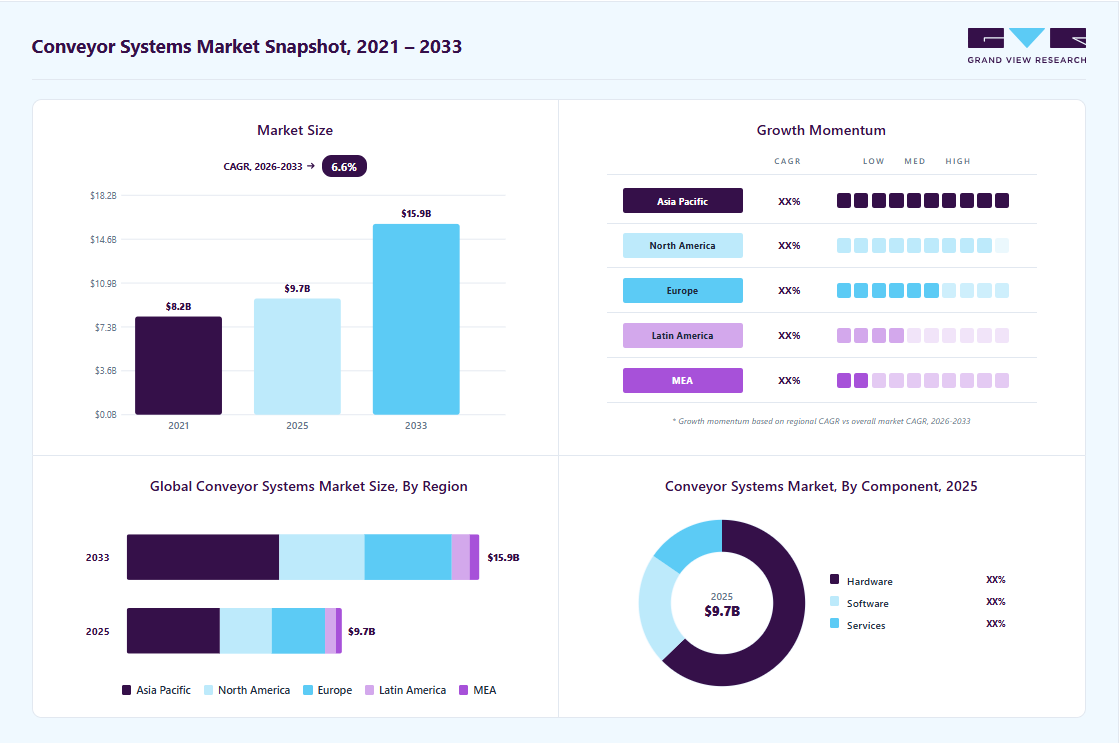
The global conveyor systems market size was valued at USD 9.7 billion in 2025 and is projected to grow from USD 10.2 billion in 2026 to USD 15.9 billion by 2033, at a CAGR of 6.6% from 2026 to 2033. The Asia Pacific held the largest share of 40.0% of the global market in 2025. The increasing automation across manufacturing and industrial processes is driving market growth.
Key Market Trends & Insights
- By component: The hardware segment accounted for the largest revenue share of 62.8% in 2025.
- By type of conveyor: The belt conveyor segment held the largest share in 2025.
- By load type: The unit load segment held the largest share in 2025.
- By operation mode: The fully automated segment dominated the market in 2025.
- By end use: The manufacturing segment dominated the market in 2025.
Regional Highlights
- Largest regional market: Asia Pacific (40.0% revenue share, 2025)
- Fastest-growing regional market: Asia Pacific (highest CAGR, 2026-2033)
- By country: China held a dominant position in 2025.
Market Size & Forecast
- Market size in 2025: USD 9.7 Billion
- Estimated market size in 2026: USD 10.2 Billion
- Projected market size by 2033: USD 15.9 Billion
- CAGR (2026-2033): 6.6%
The expansion of the e-commerce and logistics industry is driving the conveyor market growth. The growth of online retail has significantly increased the demand for advanced warehousing and distribution centers. Conveyor systems play a vital role in sorting, transporting, and packaging products within these facilities. They enable faster order processing and reduce turnaround time, both of which are essential for meeting customer expectations for quick deliveries. Additionally, conveyors help optimize space utilization in warehouses by enabling vertical and horizontal movement of goods. As e-commerce continues to grow globally, the need for efficient material-handling infrastructure is driving the adoption of conveyor systems.The rise of large-scale manufacturing and industrialization in emerging economies is also contributing significantly to the growth of the market. Countries undergoing rapid industrial development are investing heavily in infrastructure, manufacturing plants, and logistics facilities. Conveyor systems are essential components in these developments, enabling efficient movement of materials within factories and warehouses. They support high-volume production and help maintain a consistent workflow across different processes. As industries in emerging markets scale up operations, the demand for reliable and efficient material handling systems continues to grow. This trend is further supported by government initiatives to boost industrial output.
Technological advancements in conveyor system design and functionality are driving market growth. Modern conveyor systems are increasingly equipped with sensors, automation controls, and integration capabilities with advanced software systems. These features enable real-time monitoring, predictive maintenance, and improved operational control. Smart conveyor systems can adapt to changing production requirements and dynamically optimize material flow. They also support energy-efficient operations, which is becoming increasingly important in sustainability-focused industries. As technology continues to evolve, conveyor systems are becoming more intelligent, flexible, and efficient, further driving their adoption across various sectors.
The increasing trend toward mass production and high-volume manufacturing is also driving the demand for conveyor systems. Large-scale production facilities require efficient systems to handle massive quantities of raw materials and finished goods. Conveyor systems provide a reliable and scalable solution for managing high throughput without compromising efficiency. They enable manufacturers to maintain a consistent production flow even at high volumes, which is essential for meeting large-scale demand. Additionally, conveyors can be customized to meet specific production requirements, making them versatile across industries. As global demand for manufactured goods continues to rise, the need for high-capacity material-handling systems is growing.
Component Insights
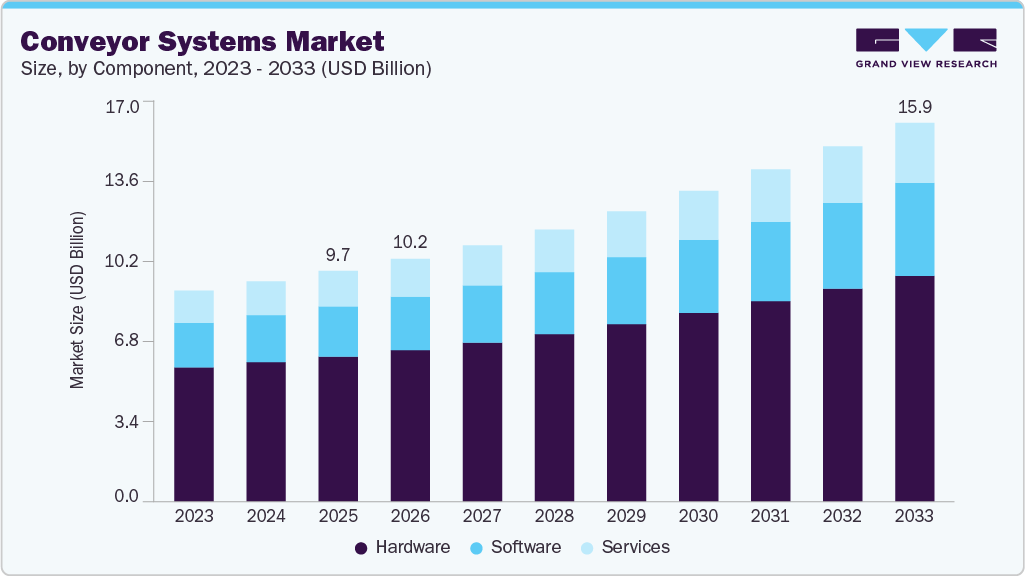
The hardware segment dominated the industry with a revenue share of 62.8% in 2025. The rising focus on automation in manufacturing and logistics is significantly driving the hardware segment of the conveyor system market. Automated systems rely heavily on physical components such as sensors, actuators, motors, and mechanical assemblies to function effectively. Conveyor hardware must be designed to integrate seamlessly with automated control systems and robotics. This requires precision engineering and high-quality materials to ensure smooth and accurate operation. Additionally, automated environments demand hardware that can operate continuously with minimal human intervention. As automation adoption increases, the demand for advanced and reliable conveyor hardware components continues to grow.
The software segment is projected to be the fastest-growing segment from 2026 to 2033. The increasing adoption of warehouse automation and smart logistics solutions is a key driver of the software segment. Modern warehouses rely heavily on automated sorting, picking, and packaging systems that require seamless coordination. Conveyor software integrates with warehouse management systems and robotics to ensure synchronized operations. It helps optimize material flow by dynamically adjusting conveyor routes based on order priorities and inventory levels. This improves order fulfillment speed and accuracy, which is critical in industries such as e-commerce and retail. As logistics operations become more complex and automated, the role of software in managing conveyor systems continues to expand.
Type of Conveyor Insights
The belt conveyor segment dominated the market in 2025. The increasing focus on automation and integration with advanced technologies is driving the belt conveyor segment growth. Modern belt conveyors are being equipped with sensors, automated controls, and monitoring systems that enhance their functionality. These features allow for real-time tracking of material flow, predictive maintenance, and system optimization. Integration with broader automation systems enables seamless coordination with other equipment, such as robotic arms and sorting machines. This transforms traditional belt conveyors into intelligent material handling solutions. As industries continue to adopt automation and smart technologies, the demand for advanced belt conveyor systems is growing.
The overhead conveyor segment is projected to be the fastest-growing segment from 2026 to 2033. The increasing focus on worker safety and ergonomic improvements is a key driver for the overhead conveyor segment. By moving materials above ground level, these systems reduce clutter on the factory floor and minimize the risk of accidents caused by manual handling or equipment congestion. Workers are less exposed to heavy lifting, which reduces physical strain and the likelihood of injury. This contributes to a safer and more organized working environment, which is becoming a priority for many industrial organizations. Overhead conveyors also help maintain clear pathways for movement, improving overall workplace efficiency. As safety regulations become more stringent, industries are increasingly adopting such systems to enhance workplace conditions.
Load Type Insights
The unit load segment dominated the market in 2025. The unit load segment within the conveyor system market is primarily driven by the rapid expansion of e-commerce and warehouse automation, where handling discrete items such as packages, cartons, and pallets efficiently is critical. Unit load conveyors are specifically designed to transport individual items in an organized and controlled manner, making them essential for modern distribution centers. As online retail continues to grow, warehouses must process a high volume of orders quickly and accurately. Unit load systems enable automated sorting, routing, and delivery of items across different stages of fulfillment. This significantly reduces manual handling and improves order processing efficiency. As demand for fast, reliable logistics operations increases, the adoption of unit load conveyor systems continues to grow.
The bulk load segment is projected to grow at a significant CAGR from 2026 to 2033. The expansion of mining and mineral extraction activities globally is a significant driver of the bulk load conveyor segment. Mining operations require the transportation of massive quantities of extracted materials from excavation sites to processing plants and storage facilities. Conveyor systems provide a reliable and efficient solution for handling these materials over long distances and challenging terrains. They can operate in harsh environments, including extreme temperatures, dust, and heavy loads. This makes them more suitable than alternative transport methods in mining applications. As demand for minerals and natural resources continues to grow, the adoption of bulk conveyor systems is increasing.
Operation Mode Insights
The fully automated segment dominated the market in 2025. The increasing adoption of Industry 4.0 and smart manufacturing practices is a key driver for this segment. Fully automated conveyor systems are integrated with advanced technologies such as IoT, artificial intelligence, and machine learning to create intelligent material handling networks. These systems can monitor their own performance, adapt to changing production requirements, and optimize operations in real time. This level of intelligence enhances efficiency and reduces operational uncertainties. It also enables predictive maintenance, which helps avoid unexpected downtime. As industries move toward digital transformation, fully automated conveyor systems are playing a central role in enabling smart factories.
The semi-automatic segment is projected to grow significantly from 2026 to 2033. The increasing demand for operational flexibility and adaptability is a key driver for the semi-automatic segment. Many industries deal with varying product types, batch sizes, and production requirements that cannot be fully standardized. Semi-automatic conveyor systems allow operators to adjust processes in real time to specific needs, providing greater flexibility than fully automated systems. Human involvement enables quick decision-making in situations where automation may not be sufficiently responsive. This is particularly useful in industries such as packaging, assembly, and small-batch manufacturing. As production environments become more dynamic, the need for flexible material handling solutions continues to grow.
End Use Insights
The manufacturing segment dominated the market in 2025. The advancement of smart manufacturing and digital technologies is driving the demand for conveyor systems in this segment. Manufacturers are increasingly integrating IoT devices, sensors, and data analytics into their operations to create intelligent production environments. Conveyor systems equipped with these technologies can provide real-time data on performance, material flow, and system health. This enables predictive maintenance, reduces downtime, and improves decision-making. It also enables dynamic adjustments to production processes based on real-time conditions. As Industry 4.0 continues to evolve, conveyor systems are becoming a critical component of digitally connected manufacturing ecosystems.
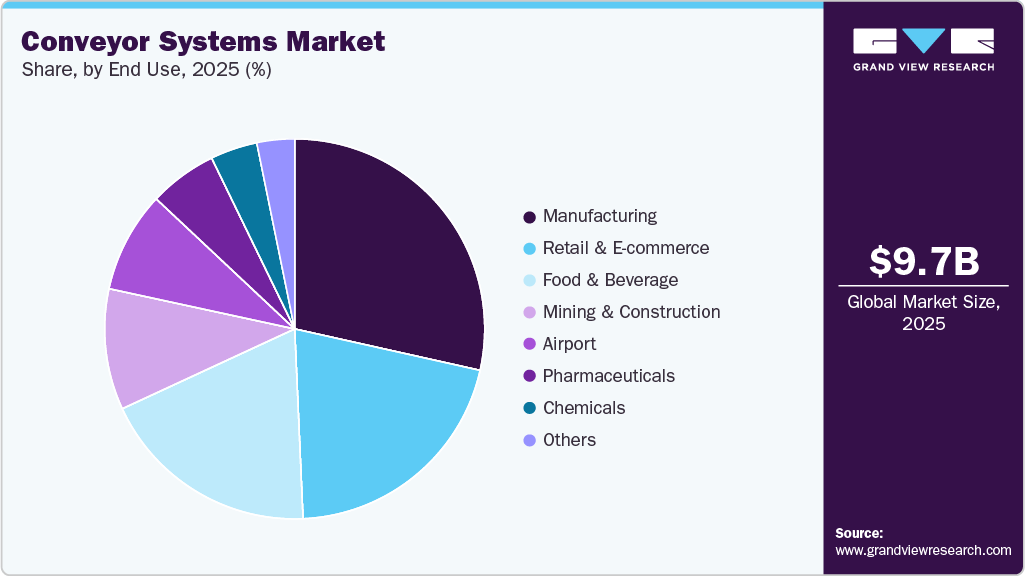
The retail and e-commerce segment is projected to grow significantly from 2026 to 2033. The retail and e-commerce segment within the conveyor system market is primarily driven by the explosive growth in online shopping and the resulting need for high-speed order fulfillment. As consumers increasingly shift toward digital purchasing channels, retailers are required to process a massive volume of orders within very short timeframes. Conveyor systems enable the rapid movement of packages across different stages such as picking, sorting, packing, and shipping. This significantly reduces order processing time and improves delivery speed, both of which are critical competitive factors in e-commerce. The ability to handle peak demand periods, such as seasonal sales and promotional events, further increases the reliance on conveyor system. As online retail continues to expand, the demand for efficient material handling infrastructure is rising sharply.
Regional Insights
Asia Pacific conveyor systems market dominated with the largest revenue share of 40.0% in 2025. The growing adoption of automation and digital technologies in industrial operations is contributing to market growth. Industries across the Asia Pacific are increasingly integrating automation, IoT, and data analytics into their operations to improve efficiency and competitiveness. Conveyor systems equipped with advanced sensors and control systems enable real-time monitoring and optimization of material flow. This enhances productivity and reduces downtime through predictive maintenance capabilities. It also enables better coordination across different stages of production and logistics. As digital transformation accelerates, conveyor systems are becoming more advanced and widely adopted.

China conveyor systems industry is projected to grow during the forecast period. The rapid expansion of e-commerce and the country's advanced logistics infrastructure is driving market growth. China has one of the largest and fastest-growing online retail markets, which requires highly efficient distribution and fulfillment systems. Conveyor systems play a critical role in sorting, transporting, and managing large volumes of packages in warehouses and distribution centers. They enable faster order processing and improve accuracy, both of which are essential for meeting customer expectations for quick deliveries. Additionally, the scale of operations in Chinese logistics hubs requires high-capacity, automated material-handling solutions. As e-commerce continues to expand, the demand for conveyor systems in logistics applications is increasing significantly.
North America Conveyor Systems Market Trends
The conveyor systems industry in North Americais projected to grow during the forecast period. The expansion of industries such as food and beverage, pharmaceuticals, and automotive manufacturing is contributing to market growth. These industries require efficient and reliable material handling systems to maintain high production standards and meet regulatory requirements. Conveyor systems are widely used to transport materials through different stages of production while maintaining quality and consistency. In sectors such as food and pharmaceuticals, conveyors also support hygienic, contamination-free operations. This makes them indispensable for maintaining compliance and product integrity. As these industries continue to grow and modernize, demand for conveyor systems continues to increase.
The U.S. conveyor systems industry is projected to grow during the forecast period. The presence of large-scale manufacturing and industrial sectors such as automotive, aerospace, food processing, and pharmaceuticals is driving market growth. These industries require efficient and reliable material handling systems to support high production volumes and maintain quality standards. Conveyor systems enable smooth and continuous flow of materials, reducing bottlenecks and improving production efficiency. They also support specialized requirements, such as hygienic handling in food and pharmaceutical applications. This versatility makes them indispensable across multiple industries. As these sectors continue to expand and modernize, the demand for conveyor systems in the U.S. remains strong.
Europe Conveyor Systems Market Trends
The conveyor systems industry in Europe is expected to grow during the forecast period. The increasing adoption of smart technologies and digital transformation initiatives is driving innovation in the European conveyor systems market. Industries are integrating IoT, data analytics, and automation into their operations to improve efficiency and competitiveness. Conveyor systems equipped with smart sensors and control systems enable real-time monitoring and predictive maintenance. This reduces downtime and enhances operational reliability. It also allows companies to make data-driven decisions to optimize performance. As digital transformation accelerates across Europe, conveyor systems are evolving into intelligent, highly efficient material-handling solutions.
The UK conveyor systems industry is growing as the increasing focus on sustainability and energy efficiency is driving innovation in the conveyor systems. Companies are under pressure to reduce their environmental impact and improve resource efficiency. Conveyor systems are being designed with energy-efficient components and optimized performance to reduce power consumption. They also help minimize waste and improve operational efficiency, contributing to sustainable practices. Additionally, conveyors reduce reliance on fuel-based internal transportation methods, lowering emissions. As sustainability becomes a key business priority, the demand for energy-efficient conveyor systems is growing in the U.K.
Key Conveyor Systems Companies Insights
Key players operating in the market are undertaking various initiatives to strengthen their presence and increase the reach of their products and services. Strategies such as expansion activities and partnerships are key in propelling the market growth.
-
Dematic is a global provider of intralogistics solutions specializing in warehouse automation, material handling, and supply chain optimization technologies. Dematic offers a comprehensive portfolio of advanced conveying technologies that efficiently move goods within warehouses and distribution facilities. Its conveyor systems include belt, roller, and sortation conveyors, as well as accumulation systems, enabling seamless material flow across various stages of order fulfillment and inventory handling. These systems are engineered to handle a wide range of products, from small parcels to heavy pallets, and are designed for high-speed, continuous operation in demanding logistics environments. Dematic’s conveyor solutions are highly customizable, allowing them to be configured according to facility layouts, product characteristics, and throughput requirements.
-
Interroll is a Switzerland-based global provider of key products and solutions for internal logistics, specializing in material-handling components and systems for warehouses, distribution centers, airports, and manufacturing facilities. Interroll offers a comprehensive portfolio of components and modular platforms that enable efficient and continuous material flow. Its solutions include roller conveyors, belt conveyors, drum motors, sortation systems, and dynamic storage modules designed to transport a wide range of goods, from lightweight parcels to heavy pallets. Interroll’s conveyor technologies are known for their high energy efficiency, quiet operation, and low maintenance requirements, making them suitable for high-throughput and 24/7 operational environments. The company’s modular conveyor platform concept enables flexible system design, allowing businesses to configure and expand their conveyor networks as operational needs evolve.
Key Conveyor Systems Companies:
The following key companies have been profiled for this study on the conveyor systems market
- American Conveyor Systems
- ATS Automation Tooling Systems Inc.
- Bosch Rexroth
- Daifuku Co., Ltd.
- Dematic
- Dorner Mfg. Corp.
- Dürr Group
- Dynamic Conveyor
- Fives Group
- Interroll
- Multi-Conveyor, LLC
- Panther Technologies
- Schaeffler Technologies AG & Co. KG
- SHG Conveyor Control GmbH
- VIBRA MASCHINENFABRIK SCHULTHEIS GmbH & Co.
Recent Developments
-
In March 2026, Bosch Rexroth has introduced a next-generation conveyor system capable of handling payloads of up to 3,000 kg. Expanding on its well-established range of twin-strand conveyors widely used across multiple industrial sectors, the company has launched the TS 7plus transfer system, recognized as the first fully electric and freely configurable conveyance solution for transporting workpieces of this weight class. The system incorporates a conveyor section with either solid or hollow rollers approximately 50% larger than those used in the earlier TS 7 model, enhancing load-handling capability and durability. By reducing the number of moving components per meter, the design improves overall system reliability and operational availability. Additionally, a newly engineered bearing block allows for quicker installation through two mounting tabs integrated into the profile, while also simplifying maintenance and component replacement.
-
In November 2025, Flexco acquired SHG Conveyor Control GmbH, the developer of Rip Prevent+, an advanced AI-driven conveyor monitoring solution designed to improve operational efficiency. Rip Prevent+ provides real-time detection and prevention of belt rips along with actionable performance insights, all without requiring embedded sensors, lasers, cameras, or structural changes to the conveyor system. This acquisition strengthens Flexco’s digital ecosystem by integrating Rip Prevent+ with its existing solutions. Together, these innovations reflect a broader shift toward smarter, connected, and data-driven conveyor belt management. By combining SHG’s capabilities with the Elevate platform, Flexco continues to advance its commitment to delivering greater value and productivity for its customers worldwide.
Conveyor Systems Market Report Scope
Report Attribute
Details
Market size in 2025
USD 9.7 billion
Estimated Market size in 2026
USD 10.2 billion
Projected Market size by 2033
USD 15.9 billion
Growth rate
CAGR of 6.6% from 2026 to 2033
Actual data
2021 - 2024
Forecast period
2026 - 2033
Quantitative units
Revenue in USD million/billion and CAGR from 2026 to 2033
Report coverage
Revenue forecast, company share, competitive landscape, growth factors, and trends
Segments covered
Component, type of conveyor, load type, operation mode, end use, region
Regional scope
North America, Europe, Asia Pacific, Latin America, MEA
Country scope
U.S.; Canada; Mexico; UK; Germany; France; China; India; Japan; Australia; South Korea; Brazil; UAE; Saudi Arabia; South Africa
Key companies profiled
American Conveyor Systems; ATS Automation Tooling Systems Inc.; Bosch Rexroth; Daifuku Co., Ltd.; Dematic; Dorner Mfg. Corp.; Dürr Group; Dynamic Conveyor; Fives Group; Interroll; Multi-Conveyor, LLC; Panther Technologies; Schaeffler Technologies AG & Co. KG; SHG Conveyor Control GmbH; VIBRA MASCHINENFABRIK SCHULTHEIS GmbH & Co.
Customization scope
Free report customization (equivalent to 8 analysts working days) with purchase. Addition or alteration to country, regional & segment scope.
Pricing and purchase options
Avail customized purchase options to meet your exact research needs. Explore purchase options
Global Conveyor Systems Market Report Segmentation
This report forecasts revenue growth at global, regional, and country levels and provides an analysis of the latest industry trends in each of the sub-segments from 2021 to 2033. For this study, Grand View Research has segmented the global conveyor systems market report based on component, type of conveyor, load type, operation mode, end use, and region.
-
Component Outlook (Revenue, USD Million, 2021 - 2033)
-
Hardware
-
Software
-
Services
-
-
Type of Conveyor Outlook (Revenue, USD Million, 2021 - 2033)
-
Belt Conveyor
-
Roller Conveyor
-
Chain Conveyor
-
Overhead Conveyor
-
Screw Conveyor
-
Others
-
-
Load Type Outlook (Revenue, USD Million, 2021 - 2033)
-
Unit Load
-
Bulk Load
-
-
Operation Mode Outlook (Revenue, USD Million, 2021 - 2033)
-
Manual
-
Semi-Automatic
-
Fully Automated
-
-
End Use Outlook (Revenue, USD Million, 2021 - 2033)
-
Manufacturing
-
Food & Beverage
-
Retail & E-commerce
-
Airport
-
Mining & Construction
-
Pharmaceuticals
-
Chemicals
-
Others
-
-
Regional Outlook (Revenue, USD Million, 2021 - 2303)
-
North America
-
U.S.
-
Canada
-
Mexico
-
-
Europe
-
Germany
-
UK
-
France
-
-
Asia Pacific
-
China
-
India
-
Japan
-
South Korea
-
Australia
-
-
Latin America
-
Brazil
-
-
Middle East & Africa
-
UAE
-
Saudi Arabia
-
South Africa
-
-
Frequently Asked Questions About This Report
The belt conveyor segment held the largest revenue share in 2025.
The global conveyor systems market was valued at USD 9.7 billion in 2025 and is expected to reach USD 10.2 billion in 2026.
Key factors that are driving the market growth include the increasing automation across manufacturing and industrial processes and growth of airport baggage handling and parcel sorting systems.
The unit load segment held the largest conveyor systems market share in 2025.
The fully automated segment dominated the market in 2025.
The manufacturing segment led the market in 2025.
Some key players operating in the conveyor systems market include American Conveyor Systems, ATS Automation Tooling Systems Inc., Bosch Rexroth, Daifuku Co., Ltd., Dematic, Dorner Mfg. Corp., Dürr Group, Dynamic Conveyor, Fives Group, Interroll, Multi-Conveyor, LLC, Panther Technologies, Schaeffler Technologies AG & Co. KG, SHG Conveyor Control GmbH, VIBRA MASCHINENFABRIK SCHULTHEIS GmbH & Co.
Asia Pacific dominated the conveyor systems market with the largest revenue share of 40.0% in 2025.
Asia Pacific is the fastest growing regional market.
The hardware segment accounted for the largest revenue share of 62.8% in 2025.
About the Author(s)
IT Services & Applications Research Team
Technology · IT Services & ApplicationsThis report was authored by the it services & applications research team at Grand View Research - comprising two research analysts, one senior research analyst, and one industry expert - with specialized expertise in the it services & applications segment of the technology industry. All findings are based on proprietary technology databases, executive interviews, and regulatory analysis, subject to internal peer review prior to publication.
Last Updated:
Speak to Analyst


Need a Tailored Report?
Customize this report to your needs — add regions, segments, or data points, with 20% free customization.
Or view our licence options:


ISO 9001:2015 & 27001:2022 Certified
We are GDPR and CCPA compliant! Your transaction & personal information is safe and secure. For more details, please read our privacy policy.












