
- Home
- »
- Advanced Interior Materials
- »
-
Copper Foil Market Size, Share & Trends Report, 2026-2033GVR Report cover

Copper Foil Market (2026 - 2033)
Size, Share & Trends Analysis Report By Product (Electrodeposited, Rolled), By Application (Circuit Boards, Batteries, Solar & Alternative Energy, Medical), By Region, And Segment Forecasts
Market Size, 2025
$11.9BMarket Estimate, 2026
$13.1BMarket Forecast, 2033
$37.5BCAGR, 2026–2033
16.2%Copper Foil Market Summary
The global copper foil market size was valued at USD 11.9 billion in 2025 and is projected to grow from USD 13.1 billion in 2026 to USD 37.5 billion by 2033, at a CAGR of 16.2% from 2026 to 2033. Asia Pacific dominated the copper foil market with the largest revenue share of 77.0% in 2025. The market is expected to be driven by the expansion of electric vehicles, digitalization, and clean energy. Copper plays a vital role in infrastructure development.
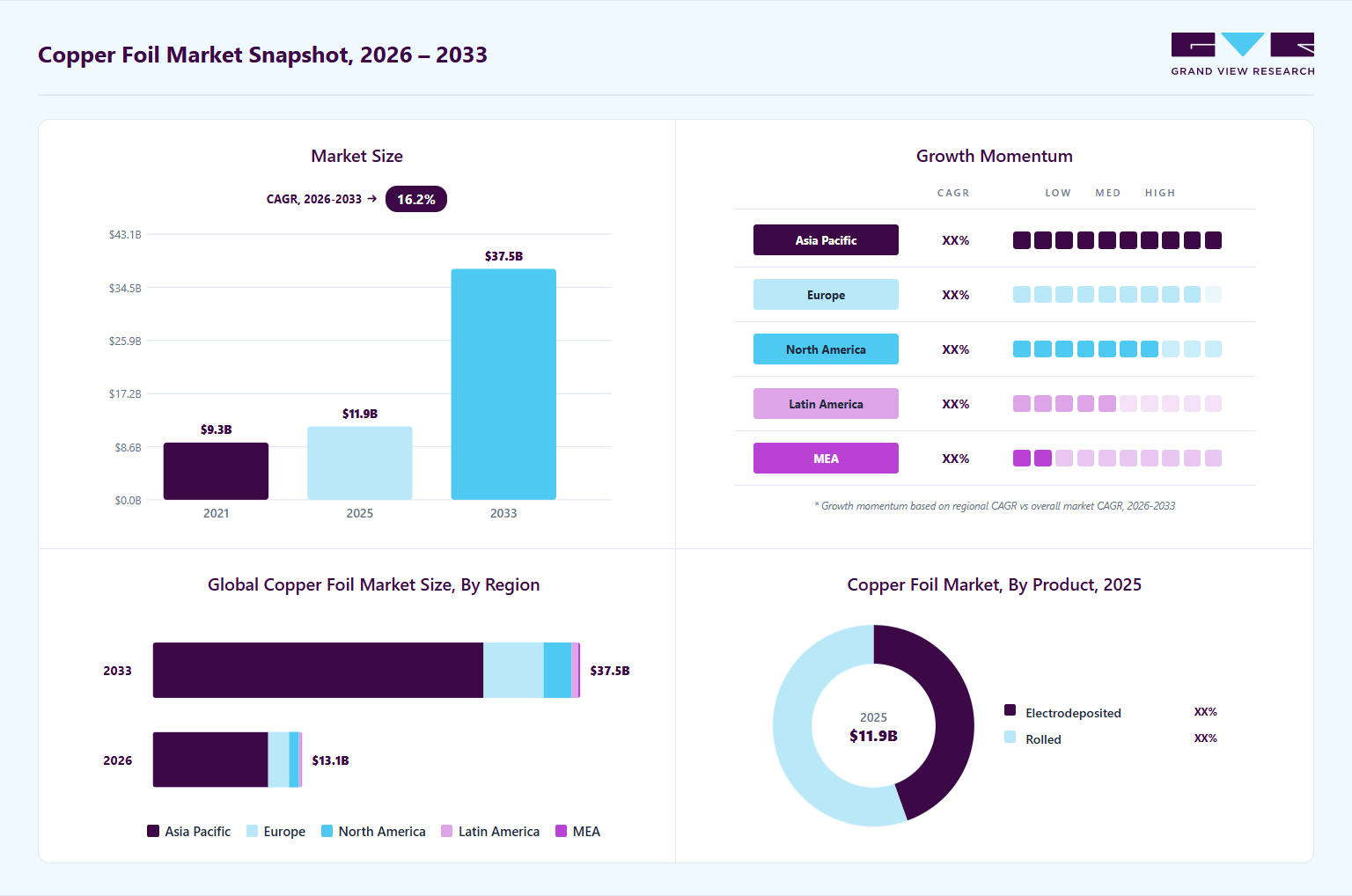 Source: Grand View Research, IR Documents, Primary Interviews, Paid DatabasesTo learn more about this report,
 Download Free Sample Report
 Key Market Trends & Insights
- By product: Rolled copper foil segment held the largest market share of 55.4% in 2025.
- By application: Circuit boards segment held the largest market share of 62.3% in 2025.
Regional Highlights
- Largest regional market: Asia Pacific (77.0% revenue share, 2025)
- By country: China held the largest market share in 2025
Market Size & Forecast
- Market size in 2025: USD 11.9 Billion
- Estimated market size in 2026: USD 13.1 Billion
- Projected market size by 2033: USD 37.5 Billion
- CAGR (2026-2033): 16.2%
Three ways to get this report
Buy it, customize it, or ask a question.Ask an Analyst
A direct answer, usually in 1 working day
- AccessReport author, directly
- Reply timeWithin 1 working day
- No sales callDirect answer only
- FormatEmail reply
- CostFree, no cost
Get the Full Report
What the study covers
- FormatsPDF · Excel · Dashboard
- Timeline2026–2033 annual, 2025 base
- Coverage20+ countries, 5 regions
- Companies10+ key players profiled
Customize the Report
20% free customization
- IncludeCountries, segments, points
- TailorTo your product definition
- ExtendDeeper competitor detail
- OrA fully bespoke study
- Turnaround5–10 working days
Presently, industry output and electricity generation are responsible for 40% of the world’s greenhouse gas emissions. Decarbonization involves the use of renewable resources for electrification. Copper is the key element used extensively for transmission infrastructure, and foil is essential for the manufacturing of components, including batteries used in renewable energy systems, such as solar and wind power storage.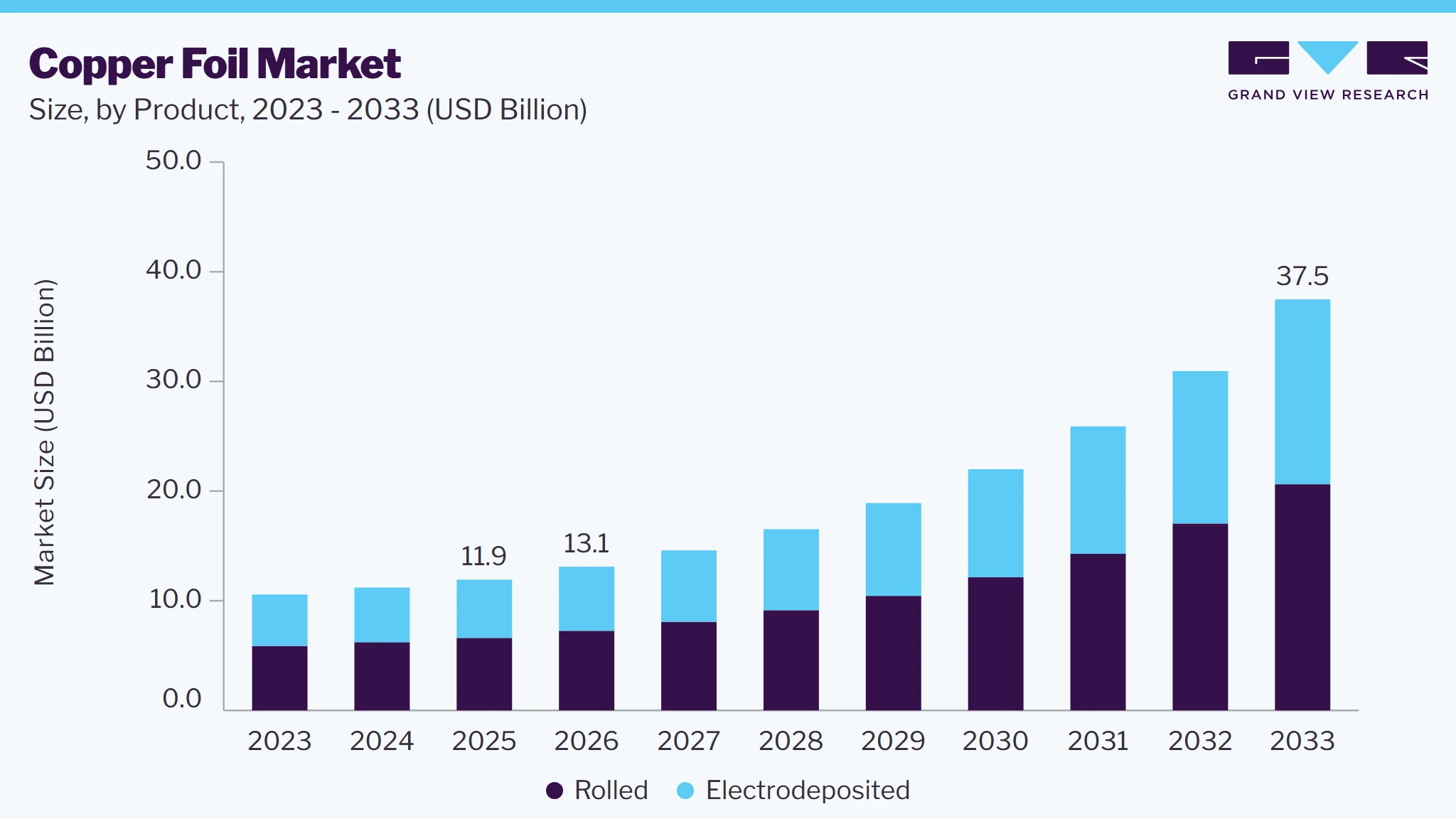 To learn more about this report, Download Free Sample Report
 Growing need for sustainable and eco-friendly energy production is boosting demand for solar energy worldwide. This is expected to have a positive impact on the copper foil industry. According to the Solar Energy Industries Association, more than 162.8 gigawatts (GW) of solar power is installed in the U.S., capable of powering 29.6 million homes. Over the last decade, the solar market in the country has grown at an average rate of 24% each year.This has encouraged manufacturers to ramp up their production and incorporate different technologies in their manufacturing processes. For instance, in December 2024, the Australian startup named Sun Drive Solar achieved copper plate production rates exceeding 99% through its cell metallization technology, which helped the company to lower production costs, improve efficiency and boost solar energy adoption.
Considering the potential of the market, key foil producers have been investing in the U.S. copper foil market. For instance, in February 2024, Addionics, a provider of next-generation battery technologies, announced its plan to invest USD 400 million in building 3D copper foil manufacturing facilities across the U.S. to support domestic EV battery production. As a result of rising demand for renewable energy, the usage of copper foil has increased in various applications, and key industry players are adopting strategic initiatives to stay ahead in a copper foil industry.
Market Dynamics
The copper foil market is experiencing strong growth, primarily driven by rising demand from EV batteries, energy storage systems, and advanced electronics applications. Increasing investments in battery manufacturing and government support for electrification and clean energy initiatives are accelerating the consumption of high-performance copper foil. The market faces challenges such as fluctuations in copper prices, energy costs, and supply chain constraints that can impact production economics. Technological advancements focused on ultra-thin, high-conductivity, and high-strength copper foils are creating new growth opportunities for manufacturers. As demand for lithium-ion batteries, printed circuit boards, and next-generation electronic devices continues to expand, the copper foil market is expected to maintain a positive growth trajectory over the coming years.
The growing adoption of electric vehicles worldwide is significantly increasing demand for copper foil, a critical component used as the anode current collector in lithium-ion batteries. As governments implement stricter emission regulations and promote vehicle electrification, automakers are expanding EV production and investing in battery manufacturing capacity. This is driving higher consumption of high-performance and ultra-thin copper foils that help improve battery energy density and vehicle range. The continued expansion of the EV value chain is expected to remain a key growth driver for the copper foil market.
According to projections cited by the International Energy Agency, global sales of electric vehicles and plug-in hybrids are expected to reach approximately 23 million units in 2026, accounting for nearly 30% of total global car sales. The agency also noted that EV sales surpassed 20 million units in 2025, reflecting continued strong growth in battery demand. This rapid expansion of EV production is directly increasing the consumption of battery-grade copper foil worldwide.
Raw material price volatility remains a significant challenge for the copper foil market, as copper is the primary input used in foil production. Sudden fluctuations in copper prices can increase manufacturing costs, reduce profit margins, and create difficulties in long-term procurement and pricing strategies. Market participants are particularly exposed to disruptions caused by mining supply constraints, geopolitical uncertainties, and changing global demand patterns. These factors can affect production planning and increase cost pressures across the copper foil value chain. In its 2025 Critical Minerals Outlook, the International Energy Agency warned that current and announced copper mining projects are insufficient to meet future demand, with the market potentially facing a 30% supply deficit by 2035. Concerns over tightening supply have contributed to continued volatility in copper prices, creating cost uncertainties for copper foil manufacturers.
The increasing trend toward thinner, lighter, and more compact electronic devices is creating significant growth opportunities for the copper foil market. Flexible Printed Circuits, widely used in smartphones, wearable devices, tablets, foldable displays, and other advanced electronics, require high-performance copper foils with excellent flexibility, conductivity, and durability. As manufacturers continue to innovate in flexible and miniaturized electronics, demand for ultra-thin and high-quality copper foil is expected to rise. This trend is opening new revenue opportunities for copper foil producers specializing in advanced electronic-grade materials. According to the Japan Electronics and Information Technology Industries Association, global demand for advanced electronic components continues to grow with the expansion of smartphones, wearable devices, and next-generation consumer electronics, supporting increased adoption of flexible printed circuits and the associated demand for high-performance copper foil.
Market Concentration & Characteristics
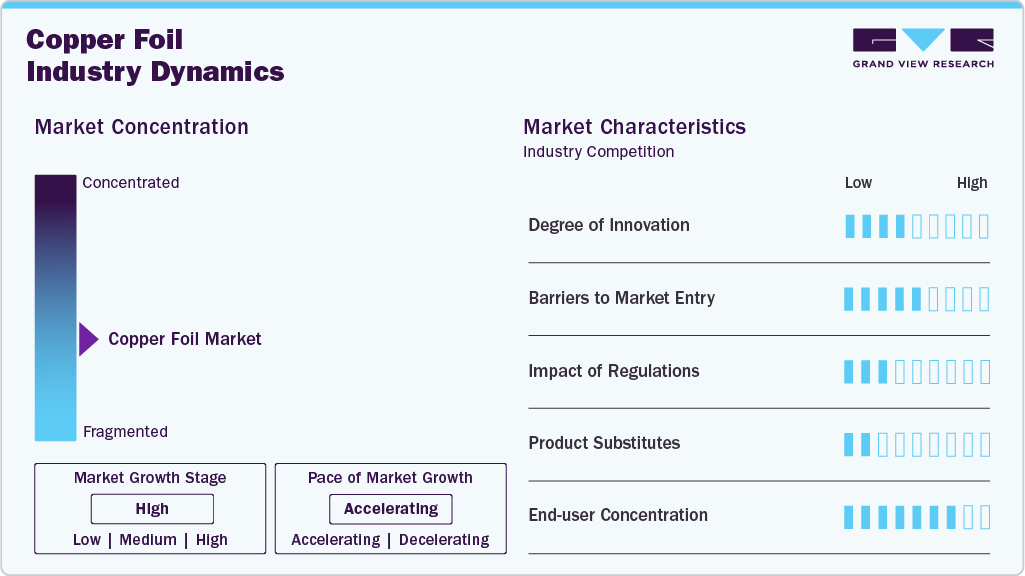
The market growth stage is high, and the pace of market growth is accelerating. The demand for copper foil is rising due to the growing adoption of clean, renewable energy in power generation and the electrification of applications. The industry experiences a moderate level of merger and acquisition activities by key industry companies owing to market concentration. Partnerships and collaborations among emerging players to enhance their positioning are witnessing a consistent rise. Emerging players have a shared commitment to work towards common objectives, using each other's expertise and strengths for mutual benefit. This is due to several factors, including a desire to maintain market share and a need for a highly competitive, and growing market.
For instance, in September 2023, SK Nexilis Co. entered into a contract worth approximately USD 1.5 billion (WON 2 trillion) with Envision Automotive Energy Supply Corp., a leading Chinese secondary battery manufacturer. Under the terms of the contract, SK Nexilis agreed to provide copper foil, a critical material used in the production of electric vehicle battery cells.
 To learn more about this report, Download Free Sample Report
 The copper foil industry is moderately impacted by regulations & standards pertaining to copper foil production. For instance, the Occupational Safety and Health Administration (OSHA) provides standards for processing various materials, including copper, zinc, aluminum, and others. Unlike aluminum foils, copper is used extensively for electrical and electronic applications. There are no plausible substitutes for copper foils across different end-use applications, and owing to this, the threat of substitutes is low. End-user concentration is high in industry owing to its limited applications, such as electrical appliances, circuit boards, medical, batteries, and solar and alternative energy.
Analyst Perspective
The copper foil market is benefiting from the rapid growth of electric vehicles, energy storage systems, and advanced electronics, all of which rely heavily on high-performance copper foil. Demand is increasingly shifting toward thinner and higher-conductivity foils as manufacturers seek to improve battery efficiency and electronic device performance. While strong investments in EV battery production and renewable energy infrastructure are creating significant opportunities, fluctuations in copper prices remain a key challenge for market participants. Over the long term, companies that can secure raw material supply, expand production capacity, and develop advanced foil technologies are expected to strengthen their competitive position in the market.
Product Insights
Based on product, the rolled copper foil segment led the market with the largest revenue share of 55.4% in 2025. It is anticipated to grow at a lucrative pace owing to high demand from applications such as lithium-ion batteries, IoT-enabled services, and solar photovoltaic panels. Further, increasing emphasis on technology upgrades is expected to be a key driver during the forecast period. Copper foil is extensively used in the printed circuit board industry owing to its granular structure and smooth surface that is optimal for flexible and dynamic circuitry applications. In addition, it is a preferred choice in the production of high-frequency printed circuit boards due to its smooth surface. This has encouraged the manufacturers to boost their rolled copper foil offerings. For instance, in 2024, Hindalco Industries announced its new copper foil manufacturing facility in India to support the EV battery sector and reduce import dependence. Hindalco is also partnering with global tech firms to localize production.
The electrodeposited segment is expected to register the fastest CAGR during the forecast period. The key drivers for this are attributed to advancements in 5G and IoT technologies, and strategic partnerships. Electrodeposited copper foils are obtained when high-grade copper is dissolved in acid to produce an electrolyte, which is pumped into partially immersed rotating drums that are charged electrically. A thin film of copper is electrodeposited on these drums. These are used in circuit boards for conduction as they easily bond with an insulating layer, can be printed with a protective coating, and form a circuit pattern after etching. Companies are sourcing funding and technological proficiency for manufacturing electrodeposited copper foils. For instance, in January 2024, Taiwan's LCY Group successfully secured a financing agreement totaling USD 9.5 million with Nippon Denkai. This investment will support DENKAI America Inc., their subsidiary specializing in electrolytic copper foil production. This collaboration signifies a strategic partnership between the two companies.
Application Insights
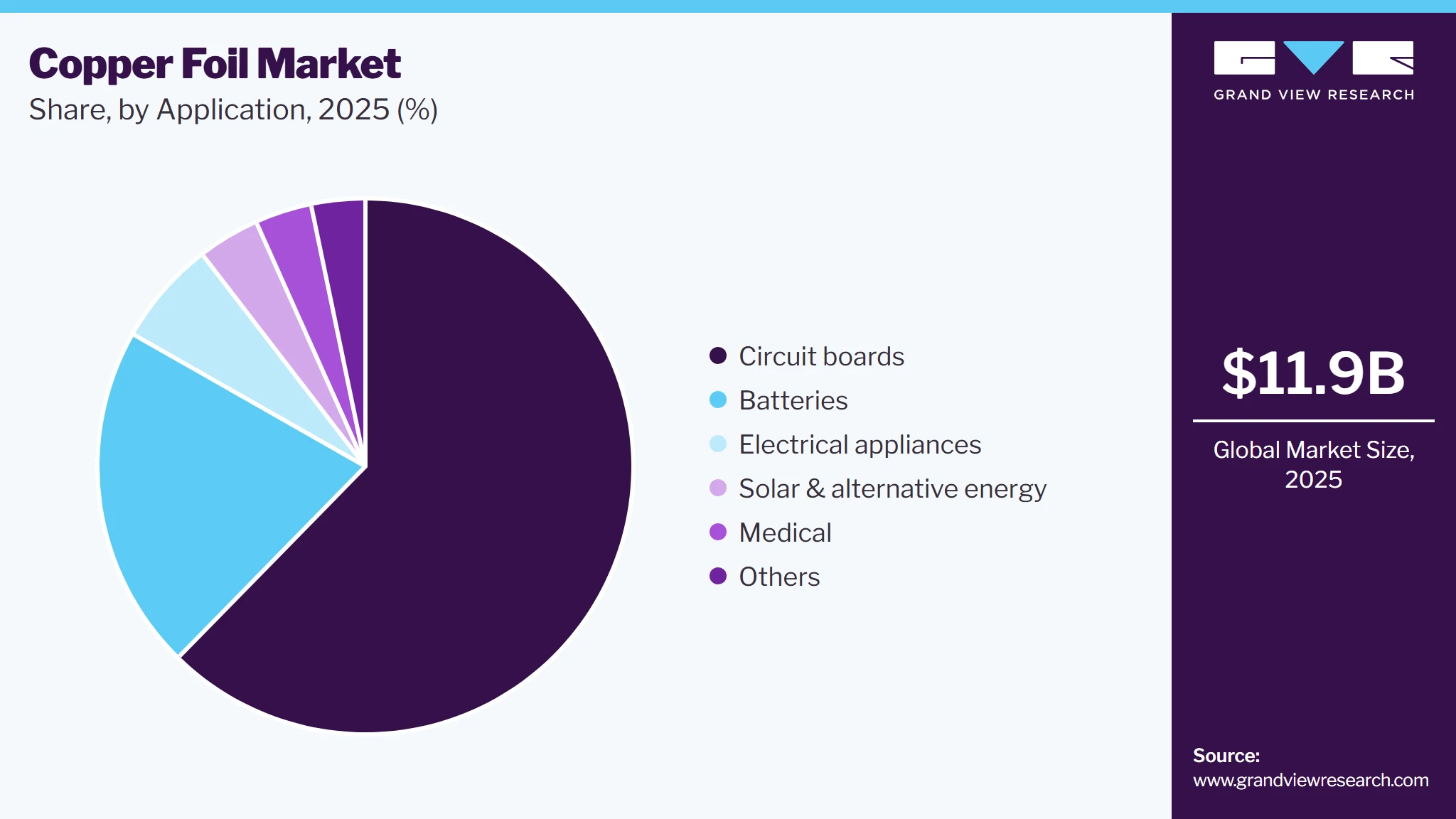
Based on application, circuit boards led the market with the largest revenue share of 62.3% in 2025. The advent of automation, 5G, and electronic gadget upgrades has been increasingly resulting in higher PCB production, and this trend is expected to continue over the forecast period. It is used as an anode in lithium-ion batteries, a source of power in electric vehicles. It is used as a current collector due to its excellent electrical conductivity and workability. A lithium-ion battery structure consists of anode, cathode, separator, and electrolyte. Electrodes are fabricated by applying coating slurry onto metallic foils.
 To learn more about this report, Download Free Sample Report
 Its application in batteries helps reduce the amount of wrinkling, folding, fracturing, and deformation at high pressure during cell manufacturing. Additionally, ultra-thin copper foil is beneficial due to the requirement for lightweight and compact battery designs.
The growth in the electric vehicle industry has resulted in a flurry of activity amongst copper foil producers, who have been increasing their production capacities and setting up new plants. For instance, in September 2024, Lotte Energy Materials Corporation (LEMC) has signed an exclusive supply agreement with StarPlus Energy LLC’s to provide copper foil for inaugural EV battery manufacturing facility, currently under construction in Indiana, USA.
Batteries segment is expected to register the fastest CAGR during the forecast period. The key factors attributed to growth are surging EV demand, advancements in battery technology spurred by global efforts to reduce carbon emissions and transition to clean energy transportation, and continuous advancements in battery technology that enhance energy density, charging speed, and lifecycle performance.
Regional Insights
Asia Pacific dominated the copper foil market with the largest revenue share of 77.0% in 2025. In recent years, the increasing urbanization, along with the shift towards renewable energy, has led to a significant rise in copper demand. The U.S. has intensified its efforts to develop critical minerals. In light of these supportive policies, 25 U.S. copper mining projects are currently receiving attention. Some of the projects that are being constructed include the Black Butte Project in Montana, the Florence Project in Arizona, and the Idaho Cobalt Operation in Idaho.
U.S. Copper Foil Market Trends
The U.S. copper foil market was identified as the largest market in North America in 2024. According to the U.S. Energy Information Administration (EIA), the percentage of U.S. solar electricity capacity additions grew from 45% in 2022 to 56% in 2023 and reached 62% in 2024. Implementation of the U.S. Inflation Reduction Act (IRA), solar panel manufacturing has been given a boost in the country. Through 2023, solar panel manufacturers, such as Trina Solar, Canadian Solar, and Longi, announced the construction of a total of 5 GW of solar module manufacturing facilities, which would add 15 GW to the solar capacity.
Asia Pacific Copper Foil Market Trends
The Asia Pacific copper foil market held the largest share of 77.0% in 2024. It is witnessing rapid development in the manufacturing sector, which is attributable to rising demand from various applications under study, cheap labor, government initiatives, and FDI inflow. Investments concerning battery production and energy projects are key growth drivers for the market, which are expected to boost copper foil consumption in the region over coming years. For instance, in March 2025, Hindalco planned to invest in India’s metal business and establish a copper foil manufacturing facility for EVs.
 To learn more about this report, Download Free Sample Report
 The copper foil market in China held the largest share in the Asia Pacific region in 2025, an IEA report stated that China contributed to the growth of electric vehicle (EV) sales by more than 4 million units in fiscal year 2024, representing 80% of global EV sales. This surge in sales has significantly impacted the copper foil market in 2024. Growth in EV production in China is anticipated to increase the consumption of copper foil over the forecast period.
Europe Copper Foil Market Trends
The Europe copper foil market was identified as a lucrative region in 2024. This is attributed to factors like sustainability initiatives, and technological advancements. For instance, in December 2024, Researchers at the Fraunhofer Institute for Solar Energy Systems (Fraunhofer ISE) in Germany are developing advanced copper metallization technologies as a sustainable alternative to silver in perovskite-silicon tandem solar cells.
Germany has one of the largest manufacturing sectors and ranks third globally in terms of goods and services exports. Improving industrial outlook, presence of renowned automotive players restructuring the market, and significant demand for electronic products are expected to fuel demand for copper foil. Moreover, increasing emphasis on solar energy is anticipated to boost consumption as Germany is among leading photovoltaic installers in global solar energy market.
Increasing demand for copper foil in Brazil is mainly due to growth of renewable energy industry. In 2023, according to the National Electric Energy Agency (Aneel), approximately 93% of country's electricity was generated from clean energy source., Solar energy sector has been main source of renewable power growth, contributing to over a 75.0% increase in electricity output in 2023 compared to same period in 2022. Total photovoltaic solar capacity in Brazil was 30.0 GW during same period, with an addition of 4.4 GW since January 2023.
Taiwan is an important hub for producing printed circuit boards in Asia Pacific. As such of several semiconductor and printed circuit board manufacturers have announced production expansion plans in Taiwan. In March 2023, JX Nippon Mining & Metals Group announced plans to expand its semiconductor production capacity in the country. This is expected to directly and positively impact demand for copper foils used in electronics and printed circuit boards in Taiwan in the coming future.
Key Copper Foil Company Insights
Some of the key players operating in the market include Furukawa Electric Co., Ltd. and Nippon Denkai, Ltd.
-
Furukawa Electric Co., Ltd is a manufacturer of electrical & electronics equipment. Key end-use industries of the company are telecommunications, electronics, construction, and automobiles. The company offers its products in Japan, China, North America, and the rest of the Asia Pacific. It focuses on maintaining its leadership position in the copper foil industry through continuous investment in R&D.
-
Nippon Denkai, Ltd. develops, manufactures, and sells electrodeposited copper foils. It offers high-strength foils, ultrathin copper foils with microcircuit substrates, carriers, and general-purpose foils. The company also offers materials for use in circuit boards mounted on electronic devices, including 5G communication devices such as mobile phones.
Lingbao and Circuit Foils are some of the emerging market participants.
-
Lingbao offers high-precision and alloy-rolled copper foils. It invested in advanced manufacturing technologies and process optimization to enhance productivity and reduce production costs. With leading production equipment and technology, it can produce different types of foils with a thickness of 4-100 μm and a maximum width of 660mm.
-
Circuit Foils is a European manufacturer of copper foil. Although the company was acquired by The Doosan Group in 2014, Circuit Foils continues to operate independently. It sells copper foil products for use in Internet of Things (IoT) applications, high-speed digitals, 5G devices, smart cards, smartphones, autonomous vehicles, and IC substrates. It also promotes innovations through its R&D centers. It has recently been certified with ISO 9001:2015 standards.
Key Copper Foil Companies:
The following key companies have been profiled for this study on the copper foil market.
-
Chang Chun Group
-
Circuit Foils
-
Doosan Corporation Electro-Materials
-
Furukawa Electric Co., Ltd.
-
Lingbao
-
Lotte Energy Materials
-
LS Mtron Ltd.
-
Nippon Denkai, Ltd.
-
SKC
-
UACJ Foil Corporation
Competitive Benchmarking
Category
Operating Strategies
Competitive Edge
Weakness
Established Players (Furukawa Electric, LOTTE Energy Materials, SKC, LS Mtron, UACJ Foil, Doosan Electro-Materials, Chang Chun Group)
- Expand production capacity for battery-grade and ultra-thin copper foils.
- Invest in R&D focused on high-performance foils for EV batteries and advanced electronics.
- Establish long-term supply agreements with battery manufacturers and PCB producers.
- Strong brand recognition and established customer relationships.
- Advanced manufacturing capabilities and proprietary technologies.
- Large-scale production capacity and global distribution networks.
- High exposure to copper price volatility and energy costs.
- Significant capital expenditure requirements for capacity expansion.
- Complex global operations can reduce operational flexibility.
Emerging Players (Nippon Denkai, Circuit Foil, Londian Wason, Circuit Foils)
- Focus on niche applications such as specialty copper foils, flexible electronics, and high-performance PCBs.
- Strengthen regional presence through targeted customer partnerships.
- Invest selectively in technology upgrades and product differentiation.
- Greater operational flexibility and faster response to market changes.
- Ability to serve specialized customer requirements.
- Strong focus on niche technologies and customized products.
- Smaller production capacities and limited economies of scale.
- Lower bargaining power with raw material suppliers.
- Limited geographic reach and customer diversification.
Recent Developments
-
In February 2024, Volta Energy Solution expanded its product offering by starting to manufacture a new battery copper foil plant in Quebec, Canada, to fill North America's battery copper foil vacuum supply chain. The plant is expected to have an annual production capacity of 25,000 tons, with operations in 2025.
-
In March 2025, Scientists have developed ultralight, ultrathin copper current collectors that could transform lithium battery technology. Compared to conventional copper foils, these advanced collectors are much lighter, significantly boosting energy density at the cell level.
Copper Foil Market Report Scope
Report Attribute
Details
Market Definition
The market size represents the revenue generated from the sale of thin copper sheets manufactured through electrodeposition or rolling processes and utilized across applications, including circuit boards, batteries, solar & alternative energy systems, electrical appliances, medical devices, and other industrial applications.
Market size in 2025
USD 11.9 billion
Estimated Market size in 2026
USD 13.1 billion
Projected Market size by 2033
USD 37.5 billion
Growth rate
CAGR of 16.2% from 2026 to 2033
Base year for estimation
2025
Historical data
2021 - 2024
Forecast period
2026 - 2033
Quantitative units
Revenue in USD Million, Volume in Kilotons, and CAGR from 2026 to 2033
Report coverage
Revenue forecast, volume forecast, company ranking, competitive landscape, growth factors, and trends
Segments covered
Product, application, region
Regional scope
North America; Europe; Asia Pacific; Latin America; MEA
Country scope
U.S., Canada, Mexico, Germany, UK, France, Russia, China, Japan, India, South Korea, Taiwan, Brazil.
Key companies profiled
Chang Chun Group; Circuit Foils; Doosan Corporation Electro-Materials; Furukawa Electric Co., Ltd.; Londian Wason (Shenzhen) Holdings Group Co., Ltd.; LOTTE ENERGY MATERIALS Corporation; Nippon Denkai Ltd.; SKC; LS Mtron; UACJ Foil Corporation
Customization scope
Free report customization (equivalent up to 8 analysts' working days) with purchase. Addition or alteration to country, regional & segment scope.
Pricing and purchase options
Avail customized purchase options to meet your exact research needs. Explore purchase options
Global Copper Foil Market Report Segmentation
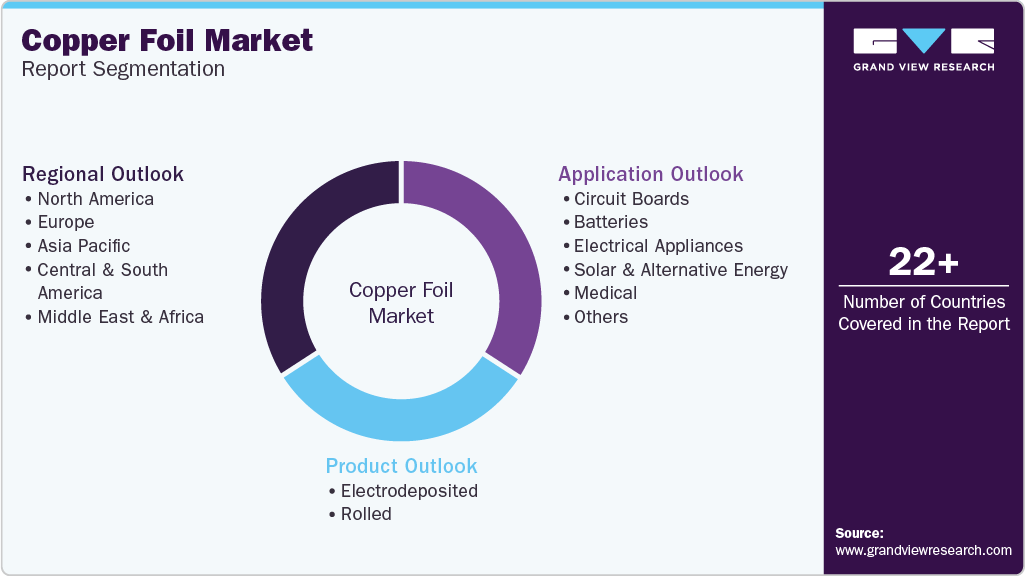
This report forecasts revenue growth at global, regional, and country levels and provides an analysis of the latest industry trends in each of the sub-segments from 2021 to 2033. For this study, Grand View Research has segmented the global copper foil market report based on product, application, and region.
 To learn more about this report, Download Free Sample Report
 -
Product Outlook (Revenue, USD Billion, 2021 - 2033)
-
Electrodeposited
-
Rolled
-
-
Application Outlook (Revenue, USD Billion, 2021 - 2033)
-
Circuit Boards
-
Batteries
-
Electrical Appliances
-
Solar & Alternative Energy
-
Medical
-
Other
-
-
Regional Outlook (Revenue, USD Billion, 2021 - 2033)
-
North America
-
U.S.
-
Canada
-
Mexico
-
-
Europe
-
Germany
-
UK
-
France
-
Russia
-
-
Asia Pacific
-
China
-
Japan
-
India
-
South Korea
-
Taiwan
-
-
Central & South America
-
Brazil
-
-
Middle East and Africa (MEA)
-
Research Methodology
The copper foil market figures in this report are based on a proven research process that combines executive interviews with secondary research from proprietary databases, company filings, and recognized regulatory and institutional sources. Market size is built through value-chain sizing - reconciling supply-side and demand-side estimates - and triangulated with bottom-up and top-down approaches. Every estimate passes multiple levels of expert validation before publication, with each copper foil segment quantified using the revenue-capture definitions in the table below.
Segment Definition
Segment - Product
Revenue capture definition
Electrodeposited
Revenue is generated from the sale of electrodeposited copper foils primarily used in lithium-ion batteries, printed circuit boards, and high-volume electronic applications requiring high conductivity and uniform thickness.
Rolled
Market revenue is derived from rolled copper foils utilized in flexible printed circuits, advanced electronics, medical devices, and specialty applications requiring superior flexibility, durability, and mechanical performance.
Segment - Application
Revenue capture definition
Circuit boards
Revenue is generated from the use of copper foils in printed circuit boards across consumer electronics, telecommunications equipment, automotive electronics, industrial automation systems, and data communication devices.
Batteries
Market value is derived from copper foils used as anode current collectors in lithium-ion batteries for electric vehicles, energy storage systems, consumer electronics, and portable electronic devices.
Solar & alternative energy
Revenue is associated with copper foils utilized in solar photovoltaic systems, fuel cells, energy storage solutions, and other renewable energy technologies requiring efficient electrical conductivity and energy transfer.
Electrical appliances
Revenue is generated from copper foils used in household appliances, power equipment, electrical components, motors, transformers, and electronic devices for conductivity and electromagnetic shielding purposes.
Medical
Market revenue is derived from copper foils incorporated into medical devices, diagnostic equipment, imaging systems, wearable health technologies, and other healthcare electronics requiring reliable electrical performance.
Others
Revenue is generated from copper foils used in industrial equipment, aerospace systems, heat exchangers, inductors, transformers, and various specialty applications beyond the primary end-use categories.
Estimation Model
Layer Name
Key Question
Description
Electronics & Energy Demand Base Layer
What forms the demand base?
Identify demand for copper-intensive applications across electronics, electric vehicles, energy storage systems, renewable energy infrastructure, medical devices, and electrical equipment. Assess production volumes of printed circuit boards (PCBs), batteries, solar installations, consumer electronics, and industrial electrical systems. This layer establishes the addressable market opportunity by evaluating industries that rely on high-conductivity copper foil components.
Copper Foil Application & Material Requirement Layer
Where is copper foil consumed?
Estimate copper foil consumption across circuit boards, batteries, solar & alternative energy systems, electrical appliances, medical devices, and other industrial applications. Analyze copper foil intensity per unit of production, technological requirements, miniaturization trends, battery manufacturing growth, and renewable energy deployment. Application-specific material requirements determine overall copper foil demand.
Product Adoption & Manufacturing Layer
How extensively are different copper foil types utilized?
Analyze the adoption of electrodeposited and rolled copper foils across end-use applications. Evaluate factors such as conductivity requirements, flexibility, thickness specifications, durability, battery technology advancements, PCB manufacturing trends, and investments in electronics and energy storage production facilities. Product utilization varies depending on application performance requirements and technological developments.
Revenue Layer
How is market revenue generated?
Market revenue is generated through the sale of electrodeposited and rolled copper foils utilized across circuit boards, batteries, solar & alternative energy systems, electrical appliances, medical devices, and other applications. Revenue is influenced by copper foil pricing, raw material costs, product specifications, consumption volumes, technological advancements, and regional demand patterns. Growth in EV batteries, electronics manufacturing, and renewable energy installations drives overall market value.
Delivered Customizations
This report has been delivered with the following In-depth customizations
Client Request
Customization Delivered
Value Adds
Technology Benchmarking
Conducted a detailed comparison of electrodeposited and rolled copper foil technologies, including manufacturing process, thickness range, conductivity, flexibility, tensile strength, surface treatment, and suitability for batteries, PCBs, flexible circuits, and solar applications. The study also assessed emerging trends such as ultra-thin copper foils, high-strength battery foils, low-profile foils, and advanced surface-treated foils.
Helps clients understand which copper foil technology is best suited for specific applications and supports product development, supplier selection, and technology investment decisions.
Competitive Benchmarking
Evaluated key copper foil manufacturers based on production capacity, product portfolio, geographic presence, battery-grade foil capabilities, PCB-grade foil offerings, customer base, expansion plans, partnerships, and R&D focus. The analysis also compares established and emerging players to identify their strategic positioning and competitive gaps.
Enables clients to benchmark competitors, identify market leaders, understand differentiation strategies, and evaluate potential partners, suppliers, or acquisition targets.
Growth Opportunity Assessment
Assessed high-growth opportunities across EV batteries, energy storage systems, flexible printed circuits, 5G electronics, renewable energy systems, medical electronics, and advanced electrical appliances. The study evaluates demand drivers, application attractiveness, regional growth potential, investment activity, and product requirements across each opportunity area.
Helps clients prioritize the most attractive growth segments, plan market entry or expansion strategies, and align production capacity with future demand trends.
Frequently Asked Questions About This Report
The copper foil market is primarily driven by rising demand for electric vehicle batteries, expanding electronics and PCB production, and increasing investments in renewable energy and energy storage systems.
The Asia Pacific region dominated the copper foil market with a revenue share of 77.0% in 2025.
China dominated the Asia Pacific market with a revenue share of 65.1% in 2025.
Asia Pacific is anticipated to register the fastest CAGR of 16.3% over the forecast period.
The key players operating in the copper foil market are Chang Chun Group; Circuit Foils; Doosan Corporation Electro-Materials; Furukawa Electric Co., Ltd.; Londian Wason (Shenzhen) Holdings Group Co., Ltd.; LOTTE ENERGY MATERIALS Corporation; Nippon Denkai Ltd.; SKC; LS Mtron; UACJ Foil Corporation; and others.
The copper foil market size was estimated at USD 11.9 billion in 2025 and is expected to reach USD 13.1 billion in 2026.
The copper foil market is expected to grow at a CAGR of 16.2% from 2026 to 2033 to reach USD 37.5 billion by 2033.
Based on product, the rolled copper foil segment accounted for largest revenue share of 55.4% in 2025.
Based on application, the circuit boards segment accounted for the largest revenue share of 62.3% in 2025.
About the Author(s)
Advanced Interior Materials Research Team
Advanced Materials · Advanced Interior MaterialsThis report was authored by the advanced interior materials research team at Grand View Research - comprising two research analysts, one senior research analyst, and one industry expert - with specialized expertise in the advanced interior materials segment of the advanced materials industry. All findings are based on proprietary advanced materials databases, executive interviews, and regulatory analysis, subject to internal peer review prior to publication.
Last Updated:
Speak to Analyst

Customize this report to your needs - add regions, segments, or data points, with 20% free customization.
Or view our licence options:


ISO 9001:2015 & 27001:2022 Certified
We are GDPR and CCPA compliant! Your transaction & personal information is safe and secure. For more details, please read our privacy policy.


