
- Home
- »
- Organic Chemicals
- »
-
Coupling Agents Market Size & Share Report, 2026-2033GVR Report cover

Coupling Agents Market (2026 - 2033)
Size, Share & Trends Analysis Report By Functional Group (Silane, Titanate), By Application (Rubber And Plastics, Adhesives And Sealants), By End Use (Automotive And Transportation, Building And Construction) By Region, And Segment Forecasts
Market Size, 2025
$1.7BMarket Estimate, 2026
$1.8BMarket Forecast, 2033
$2.5BCAGR, 2026–2033
4.9%Coupling Agents Market Summary
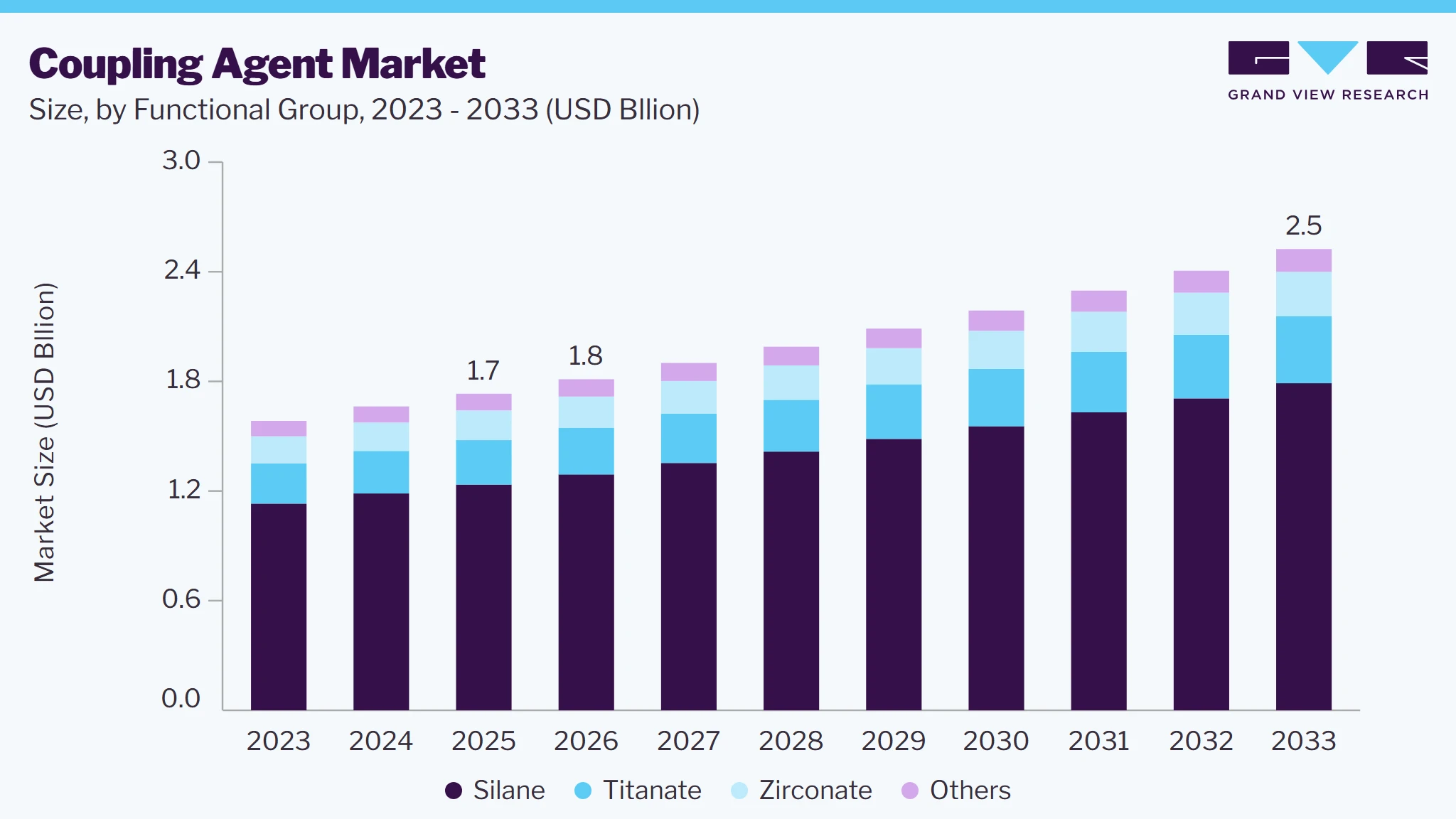
The global coupling agents market size was valued at USD 1.7 billion in 2025 and is projected to grow from USD 1.8 billion in 2026 to USD 2.5 billion by 2033, at a CAGR of 4.9% from 2026 to 2033. Asia Pacific dominated the market, accounting for a revenue share of 39.8% in 2025. Growth is supported by increasing demand for lightweight and high-performance materials, greater use of filled and reinforced polymers, and the expanding adoption of advanced composite systems across automotive, construction, packaging, electrical and electronics, and industrial applications.
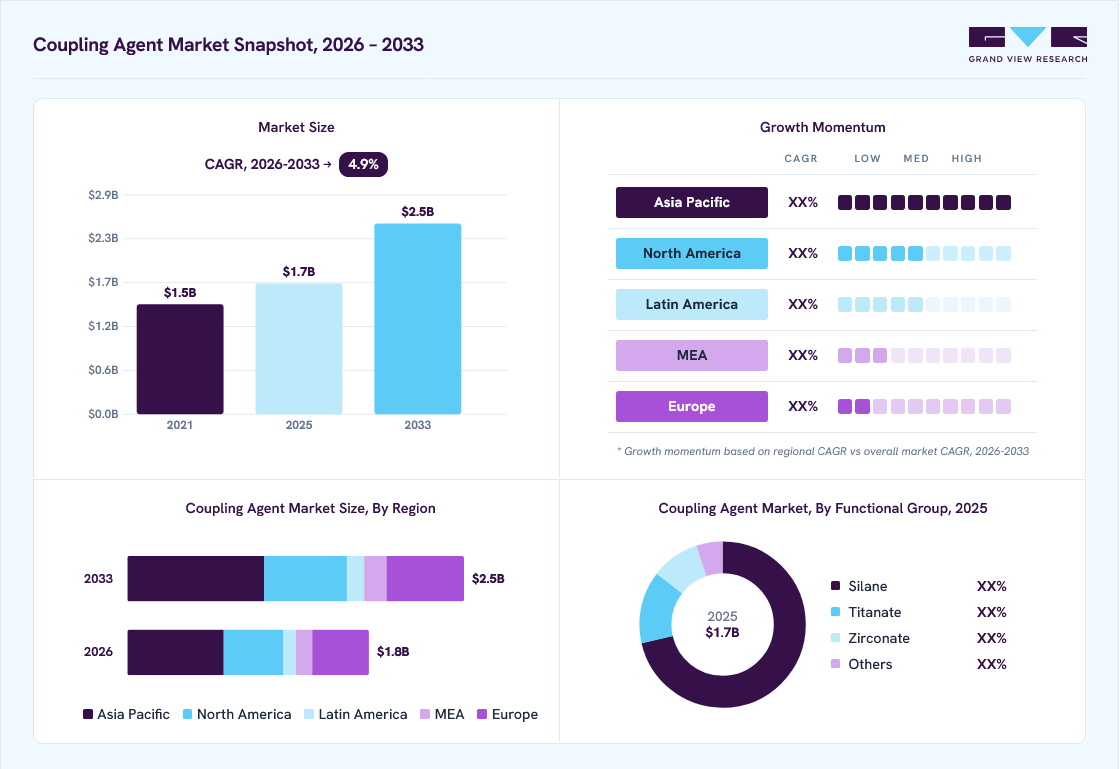 Source: Grand View Research, IR Documents, Primary Interviews, Paid DatabasesTo learn more about this report,
 Download Free Sample Report
 Key Market Trends & Insights
- By functional group: Silane segment held the largest revenue share of 71.3% in 2025.
- By application: Rubber and plastics segment dominated the market with a revenue share of 43.9% in 2025.
- By end use: Building and construction segment is expected to grow the fastest CAGR of 5.2% from 2026 to 2033.
Regional Highlights
- Largest Region: Asia Pacific (39.8%, revenue share, 2025)
- Fastest-growing region: Asia Pacific (fastest CAGR, 2026-2033)
Market Size & Forecast
- Market size in 2025: USD 1.7 Billion
- Estimated market size in 2026: USD 1.8 Billion
- Projected market size by 2033: USD 2.5 Billion
- CAGR (2026-2033): 4.9%
Three ways to get this report
Buy it, customize it, or ask a question.Ask an Analyst
Analyst response in 1 business day
- AccessReport author, directly
- Reply timeWithin 1 working day
- No sales callDirect answer only
- FormatEmail reply
- CostFree, no cost
Get the Full Report
What the study covers
- FormatsPDF · Excel · Dashboard
- Timeline2026–2033 annual, 2025 base
- Coverage20+ countries, 5 regions
- Companies10+ key players profiled
Customize the Report
20% free customization
- IncludeCountries, segments, points
- TailorTo your product definition
- ExtendDeeper competitor detail
- OrA fully bespoke study
- Turnaround5–10 working days
 To learn more about this report, Download Free Sample Report
The coupling agents market is supported by the growing use of additives that improve the compatibility and interfacial bonding between otherwise dissimilar materials. Coupling agents are widely used to enhance the interaction between polymers and reinforcing materials such as glass fibers, mineral fillers, wood fibers, and other inorganic substrates. Their ability to improve dispersion, adhesion, mechanical strength, durability, and processing performance makes them important in applications including plastics and composites, automotive components, construction materials, packaging, electrical and electronics, and adhesives. Increasing demand for lightweight materials, higher-performance polymer composites, and improved filler utilization is supporting market expansion.Market Dynamics
The market is influenced by developments in polymer modification, composite manufacturing, and the increasing incorporation of fillers and reinforcing materials into thermoplastic and thermoset systems. Manufacturers are focusing on coupling agents that improve filler-matrix interaction while maintaining processing efficiency and final-product performance. Demand is also being shaped by the shift toward lightweight and durable materials in transportation, infrastructure, and industrial applications. Advances in formulation technologies are enabling the tailoring of coupling agents to specific polymer systems, reinforcement types, and processing conditions.
The expanding applications of reinforced and filled polymers are a major driver of demand for coupling agents. Manufacturers increasingly incorporate glass fibers, mineral fillers, wood-based reinforcements, and other materials into polymer matrices to improve stiffness, dimensional stability, strength, thermal resistance, and cost efficiency. However, differences in surface chemistry between polymers and reinforcing materials can limit interfacial bonding and reduce composite performance.
Coupling agents address this compatibility challenge by promoting stronger interaction between the polymer matrix and the reinforcing phase. Their use can improve filler dispersion, interfacial adhesion, and mechanical properties, allowing manufacturers to increase reinforcement loading while maintaining desirable processing and performance characteristics. Growing production of engineered plastics and composite components is therefore creating broader application opportunities for coupling agents.
The performance of coupling agents depends strongly on the chemistry of the polymer, filler, or reinforcement, processing conditions, and desired end-use properties. A coupling agent that performs effectively in one material system may provide limited benefits in another, requiring manufacturers to conduct formulation development and performance testing before commercial adoption. This increases development time and can complicate production processes.
Inconsistent interaction between the coupling agent and different material components can also affect dispersion, viscosity, processing behavior, and finished-product properties. Manufacturers may therefore need application-specific formulations rather than standardized products, increasing technical requirements for product selection and limiting straightforward substitution between coupling-agent chemistries.
The development of bio-based, lower-emission coupling agents presents an opportunity for market participants, as material manufacturers seek alternatives with improved environmental profiles. Demand for more sustainable polymer formulations is encouraging research into coupling agents derived partly from renewable feedstocks and chemistries designed to reduce reliance on conventional petroleum-derived inputs.
This opportunity extends to composite applications incorporating natural fibers, recycled polymers, and other sustainable materials. Coupling agents that enhance the compatibility of natural or recycled components with polymer matrices can help overcome limitations such as poor interfacial adhesion and variable material properties. Application development focused on these material systems can therefore create new applications while supporting the broader adoption of sustainable composites.
Market Concentration & Characteristics
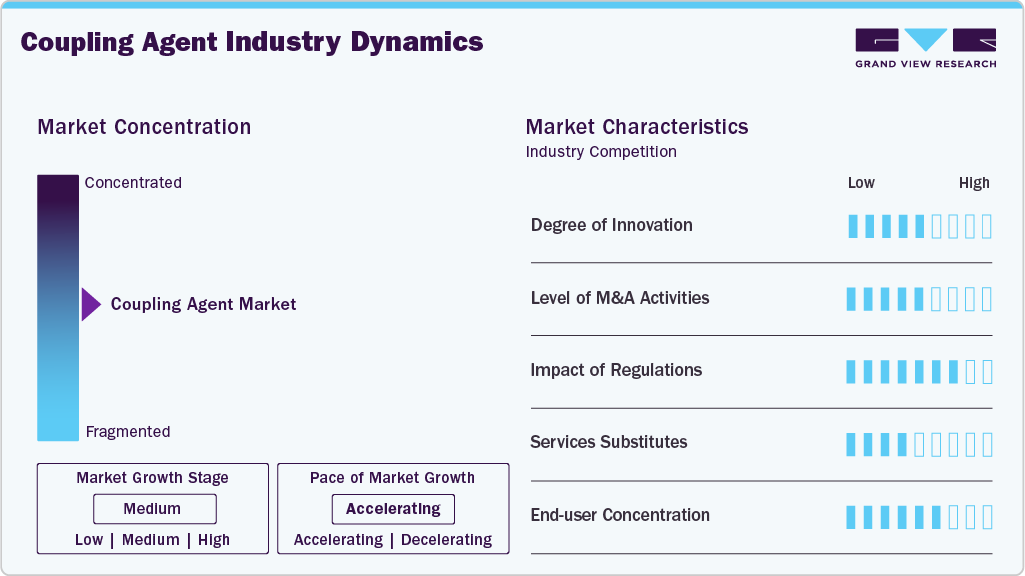
The coupling agents market comprises specialty chemical manufacturers, polymer additive producers, and companies with broader portfolios of adhesion promoters, compatibilizers, and performance additives. Competitive differentiation is based on chemical functionality, compatibility with specific polymer and reinforcement systems, product consistency, technical support, application expertise, and the ability to develop customized formulations.
Companies are investing in new coupling-agent chemistries, application-specific solutions, and technical development for advanced polymer and composite systems. Partnerships with polymer producers, compounders, composite manufacturers, and research organizations can support formulation optimization and accelerate commercial adoption. Companies with broad additive portfolios and strong application-development capabilities can also serve multiple polymer systems and end-use industries, reducing dependence on a single application segment.
 To learn more about this report, Download Free Sample Report
 Leading companies in the coupling agent industry are strengthening their market positions by expanding product portfolios, developing application-specific formulations, and improving technical support capabilities. Investments in new coupling chemistries and compatibility solutions are enabling manufacturers to address the performance requirements of different polymer, filler, and reinforcement systems. Companies are also collaborating with polymer producers, compounders, and composite manufacturers to optimize formulations and accelerate the adoption of coupling agents across automotive, construction, packaging, electrical, and industrial applications.
Analyst Perspective
The coupling agents market is driven by the growing demand for improved compatibility and performance in polymer-based materials. Manufacturers are increasingly seeking additives that enhance bonding between polymers and fillers or reinforcing materials, helping improve mechanical strength, dispersion, durability, and processing efficiency. The wider use of filled plastics, fiber-reinforced composites, and engineered polymer systems across automotive, construction, electrical, and industrial applications is supporting demand for coupling agents.
Functional Group Insights
The silane segment dominated the coupling agents market, accounting for 71.3% of total revenue in 2025. Its leading position is associated with broad utilization in polymer composites, filled plastics, rubber compounds, adhesives, and coatings, where silane chemistry facilitates bonding between organic matrices and inorganic materials.
The titanate segment is expected to expand at a CAGR of 5.3% during the forecast period supported by its ability to improve filler dispersion and enhance compatibility between polymers and inorganic materials. Its use in specialized formulations is contributing to sustained demand across plastics, composites, and industrial applications.
Application Insights
The rubber and plastics segment dominated the market, accounting for 43.9% of total revenue in 2025. Demand is supported by the widespread incorporation of fillers and reinforcing materials into polymer and rubber formulations, where coupling agents help improve interfacial bonding, dispersion, and finished-material properties.
The adhesive and sealants segment is expected to register the fastest growth, expanding at a CAGR of 5.2% during the forecast period, increasing requirements for stronger adhesion between organic resins and inorganic substrates are supporting the integration of coupling agents into advanced adhesive and sealant formulations.
End Use Insights
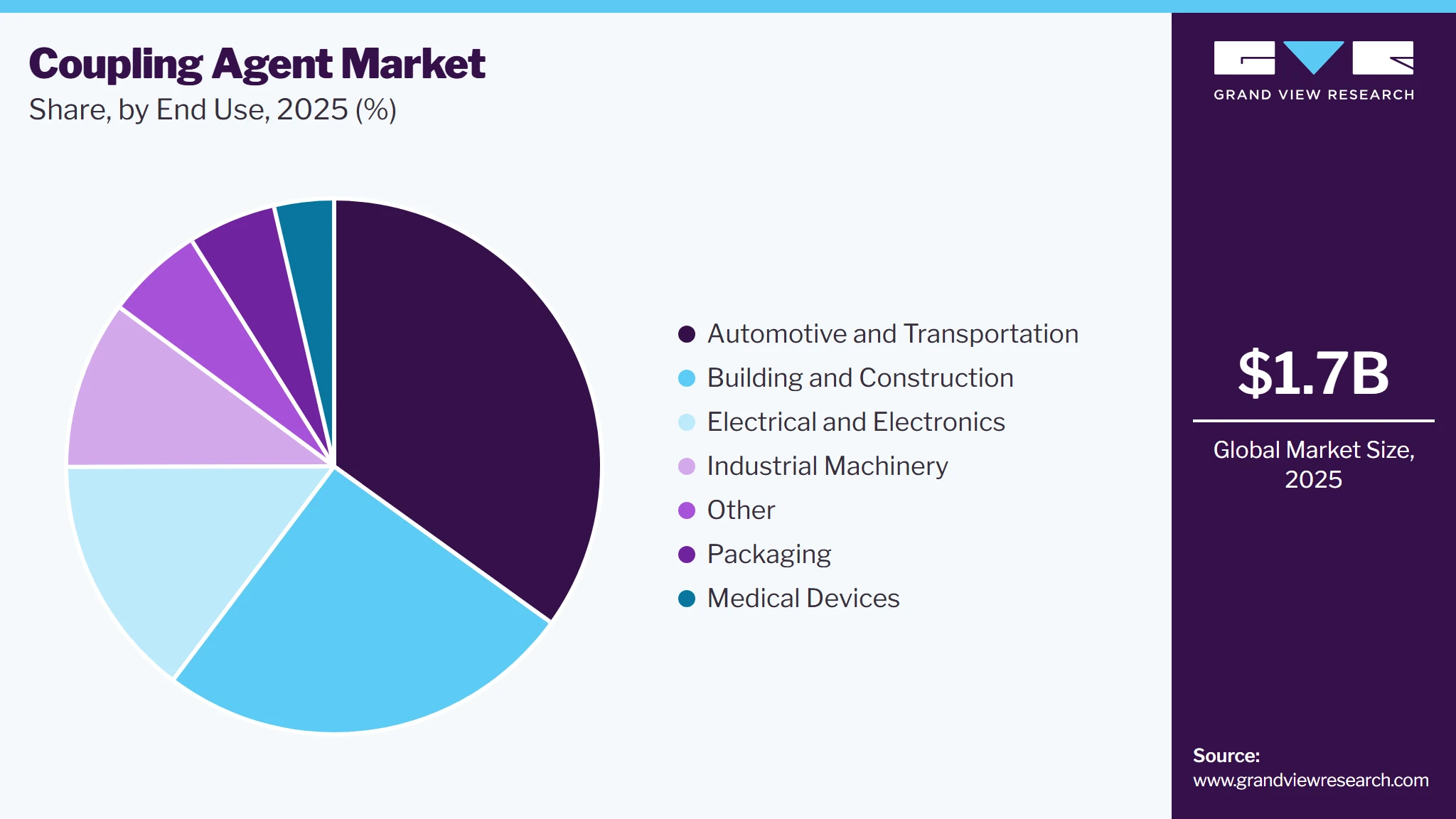
The automotive and transportation segment dominated the application segment with a revenue share of 34.9% in 2025. The segment benefits from increasing use of reinforced plastics, lightweight composites, adhesives, and other engineered materials in vehicle components, where enhanced material compatibility and mechanical performance are required.
 To learn more about this report, Download Free Sample Report
 The building and construction segment is expected to grow at a CAGR of 5.2% during the forecast period, driven by the use of coupling agents in construction polymers, composite materials, coatings, sealants, and other formulated products. The rising use of durable, performance-oriented polymer materials is driving demand across the sector.
Regional Insights
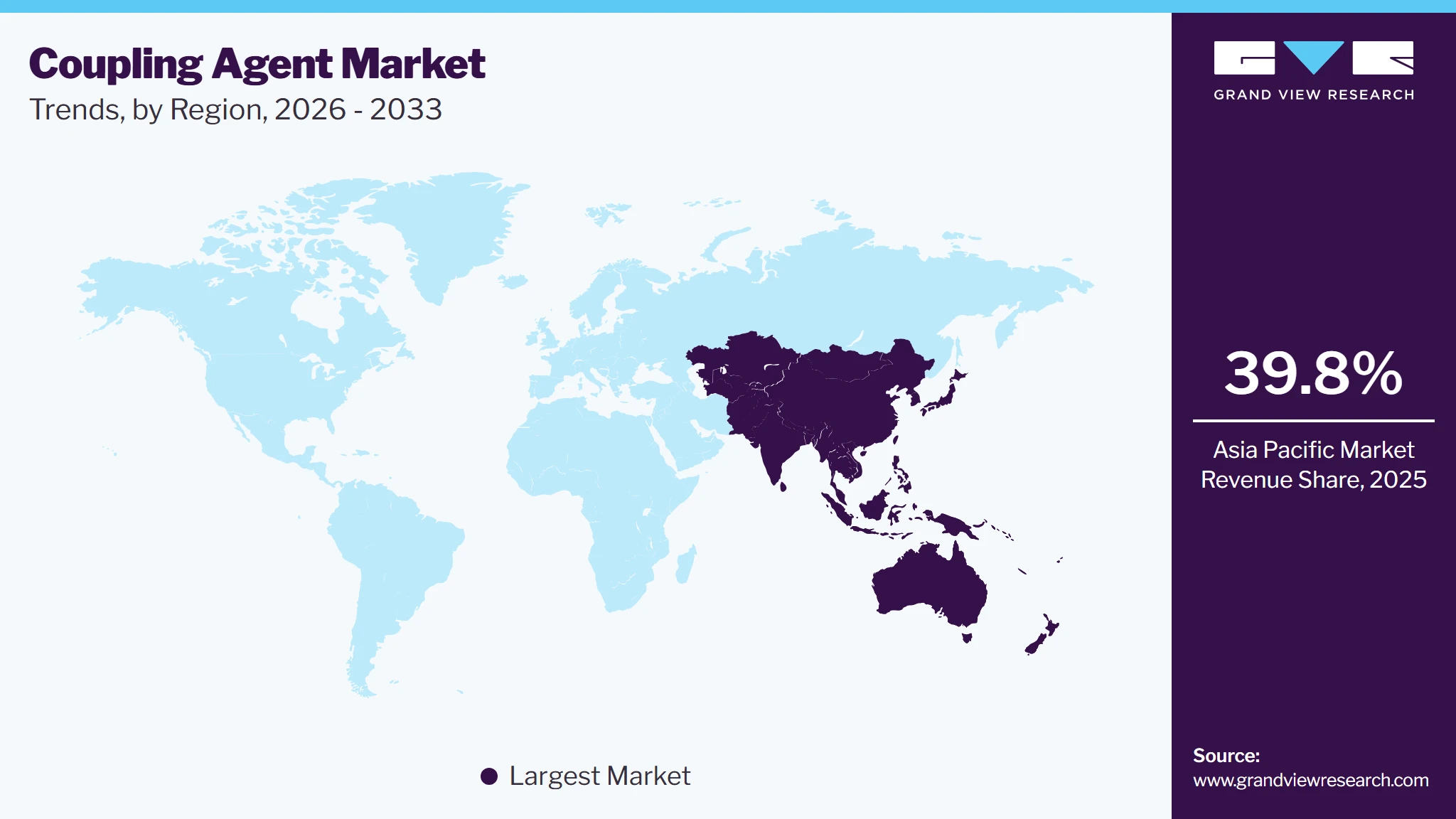
Asia Pacific dominated the global coupling agents market with a share of 39.8% in 2025. The region benefits from its large plastics, rubber, automotive, electronics, and construction manufacturing base, particularly across China, Japan, South Korea, and India. Expanding production of filled polymers and composite materials, together with increasing investment in specialty chemical manufacturing, is supporting regional demand for coupling agents.
 To learn more about this report, Download Free Sample Report
 The China coupling agents market is supported by its extensive plastics, rubber, automotive, electronics, and construction industries. Strong domestic production of polymer compounds and composite materials is generating demand for silane, titanate, and zirconate chemistries used to improve filler compatibility and material performance. The country's large manufacturing base and expanding specialty chemical capacity are also supporting local production and consumption.
Europe Coupling Agents Market Trends
The coupling agents market in Europe has gained ground from established automotive, plastics, rubber, construction, adhesives, and specialty chemical industries. Demand is being driven by the use of lightweight composites, reinforced polymers, high-performance adhesives, and filled plastic systems across industrial applications. The region's focus on material efficiency, circularity, recycled polymers, and lower-impact formulations is also encouraging the development of coupling agents that improve the compatibility and performance of recycled and bio-based materials.
The Germany coupling agents market is supported by its established automotive, industrial machinery, plastics, rubber, and chemical manufacturing sectors. Demand is linked to the use of engineered polymers and reinforced composites in lightweight vehicle components, industrial parts, construction materials, and technical applications. The country's emphasis on material efficiency, advanced manufacturing, and sustainable polymer solutions is encouraging development of higher-performance coupling-agent formulations.
North America Coupling Agents Market Trends
The coupling agents market in North America has huge significance due to its established automotive, construction, plastics, packaging, and industrial manufacturing sectors. Increasing adoption of reinforced polymers, specialty composites, and high-performance adhesives is supporting product demand. The region is also witnessing greater interest in recycled and bio-based materials, creating opportunities for coupling agents that improve compatibility and performance in formulations containing recycled polymers and natural reinforcements.
U.S. Coupling Agents Market Trends
The coupling agents market in the U.S. is a major contributor to the North American demand, underpinned by extensive production of plastics, rubber products, automotive components, construction materials, adhesives, and advanced composites. Manufacturers are increasingly using coupling agents to enhance the performance of filled and reinforced polymer systems while reducing material weight and improving durability. Continued development of high-performance composites and specialty polymer formulations is creating additional application opportunities.
Latin America Coupling Agents Market Trends
The coupling agents market in Latin America is supported by expanding plastics processing, automotive production, construction activity, packaging manufacturing, and agricultural equipment applications. Brazil represents a key regional consumer due to its sizeable industrial and polymer-processing base. Increasing use of filled plastics, rubber compounds, and composite materials is creating demand for coupling agents that improve filler dispersion, adhesion, and finished-product performance.
Middle East & Africa Coupling Agents Market Trends
The coupling agents market in the Middle East & Africa is benefiting from investments in petrochemicals, plastics conversion, construction, packaging, and industrial manufacturing. The region's established polymer production base provides opportunities for downstream applications of coupling agents in filled plastics, composites, coatings, and adhesives. Infrastructure development and efforts to expand non-oil manufacturing activities are also supporting the adoption of higher-value polymer and composite materials.
Key Coupling Agent Company Insights
Companies operating in the coupling agents market are strengthening their competitive positions through product portfolio expansion, new coupling-agent chemistries, application-specific formulations, technical support, and manufacturing capacity development. Leading participants are focusing on improving adhesion, filler dispersion, polymer compatibility, and processing performance across plastics, rubber, composites, adhesives, coatings, and other applications. Companies are also investing in research and development, sustainable material solutions, and partnerships with polymer producers and compounders to expand the adoption of coupling agents across diverse end-use industries.
-
Dow is a major participant in the coupling agents market, leveraging its broad specialty materials portfolio, polymer expertise, and global manufacturing and distribution network. The company develops silane-based solutions and related technologies that improve adhesion and compatibility between polymers and inorganic materials, supporting applications across adhesives, sealants, coatings, plastics, and composite systems.
-
Evonik operates in the market through its expertise in specialty chemicals and silane technologies. The company focuses on developing functional silanes that enhance adhesion, surface modification, filler interaction, and material compatibility, serving applications in tires, rubber, plastics, composites, adhesives, coatings, and other industrial formulations.
Key Coupling Agent Companies
The following key companies have been profiled for the study on the coupling agents market.
-
Dow
-
Evonik
-
Shin-Etsu Chemical Co., Ltd.
-
Wacker Chemie AG
-
Momentive
-
Arkema
-
Huntsman
-
BASF SE
-
Gelest Inc
-
Hubei Jianghan New Materials Co., Ltd.
-
KCC SILICONE CORPORATION
Competitive Benchmarking
Operating Strategies
Competitive Edge
Weaknesses
Mature Players: Dow, Evonik, Shin-Etsu Chemical Co., Ltd., Wacker Chemie AG, Momentive, Arkema, Huntsman, BASF SE, Gelest Inc.
- Expand coupling-agent portfolios across silane, titanate, zirconate, and other functional chemistries to serve diverse polymer and composite applications.
- Develop application-specific solutions for improving adhesion, filler dispersion, compatibility, and mechanical performance in polymer systems.
- Strengthen technical collaboration with polymer producers, compounders, composite manufacturers, and formulators to optimize material performance.
- Invest in research and development to improve coupling efficiency, processing stability, durability, and compatibility with advanced polymer formulations.
- Expand production and distribution capabilities across major plastics, composites, construction, automotive, and industrial markets.
- Broad product portfolios and established expertise in specialty chemicals and polymer additives.
- Strong research and development capabilities supporting customized coupling-agent formulations.
- Established relationships with global polymer, plastics, composites, and industrial manufacturers.
- Extensive manufacturing and distribution networks provide access to major end-use markets.
- Ability to integrate coupling agents with complementary additives, surface-treatment technologies, and polymer solutions.
- Strong technical-service capabilities support formulation development and customer-specific applications.
- Large-scale operations can result in higher organizational and development complexity when addressing specialized customer requirements.
- Dependence on specialty chemical raw materials can expose manufacturers to fluctuations in input costs and supply conditions.
- Advanced coupling-agent formulations may require extensive application testing before qualification by polymer and composite manufacturers.
- Broad product portfolios can increase the complexity of managing application-specific formulations and technical requirements.
- Regulatory and sustainability requirements may require continued investment in product reformulation and manufacturing processes.
Emerging Players: Hubei Jianghan New Materials Co., Ltd., KCC SILICONE CORPORATION
- Expand production of silane coupling agents and related functional additives for polymer, rubber, composite, adhesive, and coating applications.
- Strengthen regional manufacturing and distribution capabilities to serve growing demand from plastics, rubber, construction, and industrial customers.
- Develop customized silane solutions based on polymer compatibility, filler characteristics, and processing requirements.
- Increase participation in international markets through distributor networks, direct sales, and technical cooperation with downstream manufacturers.
- Improve production efficiency and product consistency through process optimization and expanded manufacturing capabilities.
- Specialized expertise in silane chemistry and related functional materials.
- Competitive manufacturing capabilities can support cost-sensitive applications and high-volume requirements.
- Greater flexibility in developing products for specific regional and customer requirements.
- Expanding product portfolios provide opportunities across rubber, plastics, composites, adhesives, and coatings.
- Regional production capabilities can provide closer access to Asian polymer and chemical manufacturing markets.
- Smaller global footprint compared with the largest multinational specialty chemical companies.
- Lower brand recognition in some international end-use markets can affect access to large multinational customers.
- Geographic concentration may increase exposure to regional demand and supply-chain conditions.
- More limited product breadth across complementary specialty additives compared with diversified chemical companies.
- Expansion into highly regulated international markets can require additional certification, technical validation, and regulatory investment.
- Dependence on continued capacity expansion and international distribution development may constrain rapid penetration of new markets.
Recent Developments
-
In September 2024, BRB International introduced BRB Silanil 581, an aqueous amino-functional silane designed to improve adhesion and coupling between organic resins and inorganic substrates. The product is suited to waterborne adhesives and coatings and is also recommended for filler treatment, insulation, glass-fiber binders, and water-based primers. The launch strengthens BRB’s coupling-agent portfolio for applications requiring improved interfacial bonding and compatibility between organic and inorganic materials.
Coupling Agents Market Report Scope
Report Attribute
Details
Market Definition
The coupling agents market comprises the production and sale of chemical additives used to improve the interfacial bonding, compatibility, and dispersion between polymers and reinforcing materials such as glass fibers, mineral fillers, wood fibers, pigments, and other inorganic substrates. These agents, including silane, titanate, zirconate, and other functional chemistries, are incorporated into plastics, rubber, adhesives, sealants, paints, coatings, and composite formulations to enhance mechanical strength, adhesion, durability, processing performance, and material stability.
Market size value in 2025
USD 1.7 billion
Estimated market size in 2026
USD 1.8 billion
Projected market size by 2033
USD 2.5 billion
Growth rate
CAGR of 4.9% from 2026 to 2033
Base year for estimation
2025
Historical data
2021 - 2024
Forecast period
2026 - 2033
Quantitative units
Volume in Kilotons, Revenue in USD billion, and CAGR from 2026 to 2033
Report coverage
Revenue forecast, company ranking, competitive landscape, growth factors, and trends
Segments covered
Functional group, application, end use, region
Regional Scope
North America; Europe; Asia Pacific; Latin America; Middle East & Africa
Country scope
U.S.; Canada; Mexico; Germany; UK; France; Italy; Spain; China; India; Japan; South Korea; Brazil; Argentina; Saudi Arabia; South Africa
Key companies profiled
Dow; Evonik; Shin-Etsu Chemical Co., Ltd.; Wacker Chemie AG; Momentive; Arkema; Huntsman; BASF SE; Gelest Inc.; Hubei Jianghan New Materials Co., Ltd.; KCC SILICONE CORPORATION
Customization scope
Free report customization (equivalent up to 8 analysts’ working days) with purchase. Addition or alteration to country, regional & segment scope.
Pricing and purchase options
Avail customized purchase options to meet your exact research needs. Explore purchase options
Global Coupling Agents Market Report Segmentation
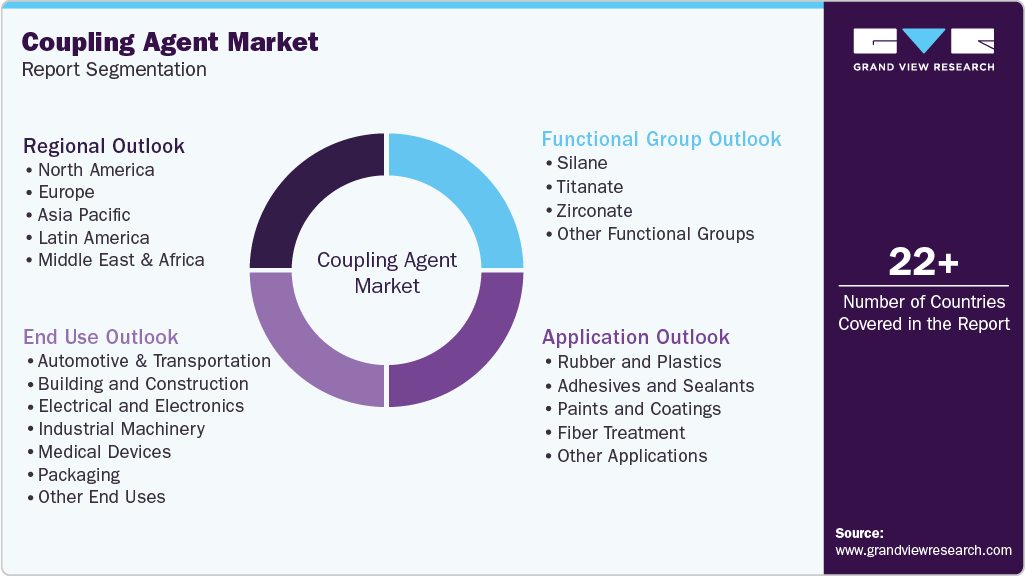
This report forecasts revenue growth at the global, regional, and country levels and provides an analysis of the latest industry trends in each of the sub-segments from 2021 to 2033. For this study, Grand View Research has segmented the global coupling agents market report based on functional group, application, end use, and region:
 To learn more about this report, Download Free Sample Report
 -
Functional Group Outlook (Volume, Kilotons; Revenue, USD billion, 2021 - 2033)
-
Silane
-
Titanate
-
Zirconate
-
Other Functional Groups
-
-
Application Outlook (Volume, Kilotons; Revenue, USD billion, 2021 - 2033)
-
Rubber and Plastics
-
Adhesives and Sealants
-
Paints and Coatings
-
Fiber Treatment
-
Other Applications
-
-
End Use Outlook (Volume, Kilotons; Revenue, USD billion, 2021 - 2033)
-
Automotive and Transportation
-
Building and Construction
-
Electrical and Electronics
-
Industrial Machinery
-
Medical Devices
-
Packaging
-
Other End Uses
-
-
Regional Outlook (Volume, Kilotons; Revenue, USD billion, 2021 - 2033)
-
North America
-
U.S.
-
Canada
-
Mexico
-
-
Europe
-
Germany
-
UK
-
France
-
Italy
-
Spain
-
-
Asia Pacific
-
China
-
India
-
Japan
-
South Korea
-
-
Latin America
-
Brazil
-
Argentina
-
-
Middle East & Africa
-
Saudi Arabia
-
South Africa
-
-
Research Methodology
The coupling agents marketfigures in this report are based on a proven research process that combines executive interviews with secondary research from proprietary databases, company filings, and recognized regulatory and institutional sources. Market size is built through value-chain sizing-reconciling supply-side and demand-side estimates-and triangulated with bottom-up and top-down approaches. Every estimate passes multiple levels of expert validation before publication, with eachcoupling agents’ segment quantified using the revenue-capture definitions in the table below.
Segment Definition
Segment - Functional Group
Revenue capture definition
Silane
Covers sales of silane-based coupling agents that promote adhesion between organic polymer matrices and inorganic fillers, fibers, pigments, or mineral substrates.
Titanate
Revenue attributed to titanate coupling agents used to modify filler surfaces, improve dispersion, and enhance compatibility between inorganic materials and polymer systems.
Zirconate
Includes zirconate-based products formulated to strengthen polymer-filler interactions and improve the processing and performance of filled plastics and composite materials.
Other Functional Groups
Encompasses coupling agents based on other chemical functionalities developed for specialized compatibility, adhesion, surface-treatment, or composite-material requirements.
Segment - Application
Revenue capture definition
Rubber and Plastics
Represents coupling-agent sales supporting the incorporation of fillers and reinforcing materials into rubber and plastic formulations, with emphasis on dispersion, adhesion, and finished-material properties.
Adhesives and Sealants
Covers products incorporated into adhesive and sealant systems to establish stronger bonds between dissimilar materials and improve formulation stability and durability.
Paints and Coatings
Includes coupling agents used in coatings to promote interaction between resins and pigments, fillers, substrates, or other inorganic components.
Fiber Treatment
Captures revenue from coupling agents applied to reinforcing fibers before or during composite production to improve their interaction with the surrounding polymer matrix.
Other Applications
Covers specialized uses such as construction composites, ceramics, inks, electronic materials, and other formulations requiring enhanced interfacial compatibility.
Segment - End Use
Revenue capture definition
Automotive and Transportation
Sales associated with coupling agents incorporated into lightweight plastics, reinforced composites, rubber components, coatings, and adhesives used across transportation applications.
Building and Construction
Revenue from coupling-agent use in construction plastics, composite materials, sealants, coatings, and other building products where stronger material interfaces are required.
Electrical and Electronics
Encompasses demand from manufacturers of electronic encapsulants, insulating materials, polymer compounds, and composite components requiring improved adhesion and material compatibility.
Industrial Machinery
Includes coupling-agent consumption in machinery components, engineered plastics, industrial rubber products, protective coatings, and composite parts.
Medical Devices
Covers applications in specialized polymers, composites, coatings, and adhesive systems used to manufacture medical and healthcare equipment and components.
Packaging
Represents coupling-agent demand from films, multilayer packaging, filled plastics, and other packaging structures where improved bonding between polymer layers or dissimilar materials is required.
Other End-User Industries
Captures consumption across sectors such as renewable energy, marine, consumer products, agriculture, and other industrial applications not covered by the primary end-use categories.
Estimation Model
Layer Name
Key Question
Description
Raw Material & Application Layer
What materials and manufacturing capabilities support supply?
Examines the raw materials, chemical intermediates, and production processes used to manufacture coupling agents, including silane, titanate, zirconate, and other functional chemistries. The assessment covers feedstock availability, synthesis routes, reaction processes, production capacity, plant utilization, quality control, purification, and manufacturing economics. It also considers technology capabilities, raw material costs, production scalability, and supply-chain factors that influence product availability and consistency.
Functional Group Adoption Layer
Which coupling-agent chemistries are selected for different material systems?
Evaluates the adoption of silane, titanate, zirconate, and other functional groups according to polymer type, filler or reinforcement material, processing requirements, and desired performance characteristics. The analysis considers compatibility, interfacial bonding, dispersion, surface treatment requirements, processing conditions, and application-specific formulation needs that determine the selection of each coupling-agent chemistry.
Consumption Intensity Layer
How extensively are coupling agents incorporated into end-use formulations?
Measures coupling-agent consumption across plastics, rubber, adhesives and sealants, paints and coatings, fiber treatment, and other applications. Estimation considers polymer and composite production volumes, filler and reinforcement loading, coupling-agent dosage, formulation requirements, application penetration, and replacement cycles. Differences in material composition, manufacturing processes, and performance specifications are incorporated to assess consumption intensity across regions and industries.
Revenue Layer
How does coupling-agent consumption translate into market revenue?
Assesses revenue generated through the manufacture and sale of coupling agents across functional groups, applications, and end-use industries. Revenue realization varies according to chemical composition, product grade, purity, performance characteristics, customization, application requirements, and order volumes. Pricing is also influenced by raw material costs, production technology, manufacturing scale, technical support requirements, supply conditions, and regional demand.
Delivered Customizations
This report has been delivered with the following In-depth customizations:
Client Request
Customization Delivered
Value Adds
Cross-segmentation
The assessment provides detailed cross-segmentation of the coupling agents market across functional group, application, and end-use industry. The analysis covers silane, titanate, zirconate, and other functional groups; rubber and plastics, adhesives and sealants, paints and coatings, fiber treatment, and other applications; and automotive and transportation, building and construction, electrical and electronics, industrial machinery, medical devices, packaging, and other end-use industries.
Enables identification of high-value combinations across chemistry-application-end-use categories. Supports product development, formulation planning, application targeting, capacity allocation, and market expansion by highlighting differences in compatibility requirements, performance characteristics, consumption intensity, and demand patterns.
Opportunity Assessment
Detailed evaluation of growth opportunities arising from the increasing use of coupling agents in reinforced plastics, composites, adhesives, coatings, rubber, and other polymer-based systems. The assessment covers demand for lightweight materials, growth in filled and fiber-reinforced polymers, adoption of recycled and bio-based materials, development of advanced composite formulations, and opportunities for application-specific coupling-agent chemistries.
Helps identify opportunities across the coupling-agent value chain, from chemical synthesis and product development to formulation support and downstream applications. Supports decisions related to new product development, technology investment, application expansion, regional market entry, and technical collaborations with polymer and composite manufacturers.
Competitive Benchmarking
Comparative assessment of leading coupling-agent manufacturers based on product portfolio, functional-group expertise, manufacturing capabilities, application coverage, technical support, geographic presence, production capacity, research and development activities, customer base, and strategic initiatives.
Supports evaluation of competitive positioning by identifying differences in chemistry capabilities, application expertise, manufacturing scale, product breadth, technical service, and market reach. The analysis assists decisions concerning portfolio expansion, product differentiation, technology development, partnerships, and penetration of targeted end-use industries.
About the Author(s)
Organic Chemicals Research Team
Bulk Chemicals · Organic ChemicalsThis report was authored by the organic chemicals research team at Grand View Research - comprising two research analysts, one senior research analyst, and one industry expert - with specialized expertise in the organic chemicals segment of the bulk chemicals industry. All findings are based on proprietary bulk chemicals databases, executive interviews, and regulatory analysis, subject to internal peer review prior to publication.
Last Updated:
Speak to Analyst

Customize this report to your needs - add regions, segments, or data points, with 20% free customization.
Or view our licence options:


ISO 9001:2015 & 27001:2022 Certified
We are GDPR and CCPA compliant! Your transaction & personal information is safe and secure. For more details, please read our privacy policy.


