
- Home
- »
- HVAC & Construction
- »
-
Crane Market Size, Share & Growth, Industry Report, 2033GVR Report cover

Crane Market (2026 - 2033) Size, Share & Trends Analysis Report By Product (Mobile Crane, Fixed Crane), By Application (Construction, Mining, Industrial, Oil & Gas, Others), By Region (North America, Europe, Asia Pacific, Latin America, MEA), And Segment Forecasts
Market Size, 2025
$38.5BMarket Estimate, 2026
$40.2BMarket Forecast, 2033
$59.2BCAGR, 2026–2033
5.7%Crane Market Summary
The global crane market size was valued at USD 38.5 billion in 2025 and is projected to grow from USD 40.2 billion in 2026 to USD 59.2 billion by 2033, at a CAGR of 5.7% from 2026 to 2033. The North America crane market held the largest share of 38.0% of the global market in 2025. The rapid infrastructure developments are driving the market growth.
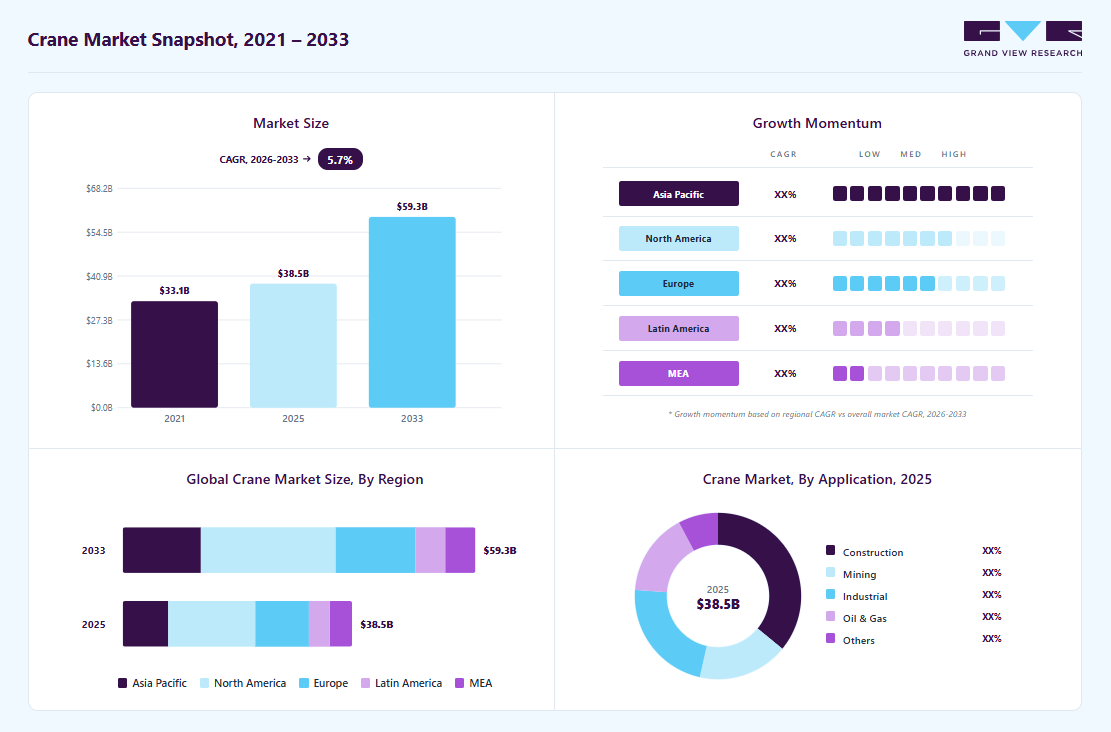 Source: Grand View Research, IR Documents, Primary Interviews, Paid DatabasesTo learn more about this report,
 Download Free Sample Report
 Key Market Trends & Insights
- By product, the mobile crane segment accounted for the largest market revenue share in 2025.
- By application, the construction segment led the market with the largest revenue share of 35.9% in 2025.
Regional Highlights
- Largest regional market: North America (38.0% revenue share, 2025)
- Fastest-growing regional market: Asia Pacific (highest CAGR, 2026-2033)
- The crane industry in the U.S. held the largest revenue share in 2025.
Market Size & Forecast
- Market size in 2025: USD 38.5 Billion
- Estimated market size in 2026: USD 40.2 Billion
- Projected market size by 2033: USD 59.2 Billion
- CAGR (2026-2033): 5.7%
Three ways to get this report
Buy it, customize it, or ask a question.Ask an Analyst
Analyst response in 1 business day
- AccessReport author, directly
- Reply timeWithin 1 working day
- No sales callDirect answer only
- FormatEmail reply
- CostFree, no cost
Get the Full Report
What the study covers
- FormatsPDF · Excel · Dashboard
- Timeline2026–2033 annual, 2025 base
- Coverage20+ countries, 5 regions
- Companies10+ key players profiled
Customize the Report
20% free customization
- IncludeCountries, segments, points
- TailorTo your product definition
- ExtendDeeper competitor detail
- OrA fully bespoke study
- Turnaround5–10 working days
Large-scale investments in infrastructure, such as highways, metro rail, airports, ports, and smart cities, are driving the demand for cranes. Emerging economies across Asia-Pacific, the Middle East, and Africa are significantly increasing public spending to support urbanization and economic growth. Cranes are essential for lifting heavy materials, structural components, and machinery in these projects, making them indispensable across all phases of construction. In addition, government-backed infrastructure stimulus programs are further accelerating equipment demand.The rapid expansion of renewable energy, particularly wind power, is driving demand for specialized cranes market such as truck loader crane market and truck mounter crane industry. Between 2015 and 2024, global renewable electricity capacity increased by approximately 2,600 GW, representing around 140% growth, underscoring the scale of project deployment worldwide. Wind turbine installation requires high-capacity, heavy-lift cranes to handle large, complex components such as towers, nacelles, and blades. This demand is further intensified by the growth of offshore wind projects, which require technologically advanced and highly specialized crane systems capable of operating in challenging marine environments. As countries continue to advance their decarbonization agendas and invest in clean energy infrastructure, this segment is expected to drive market growth.
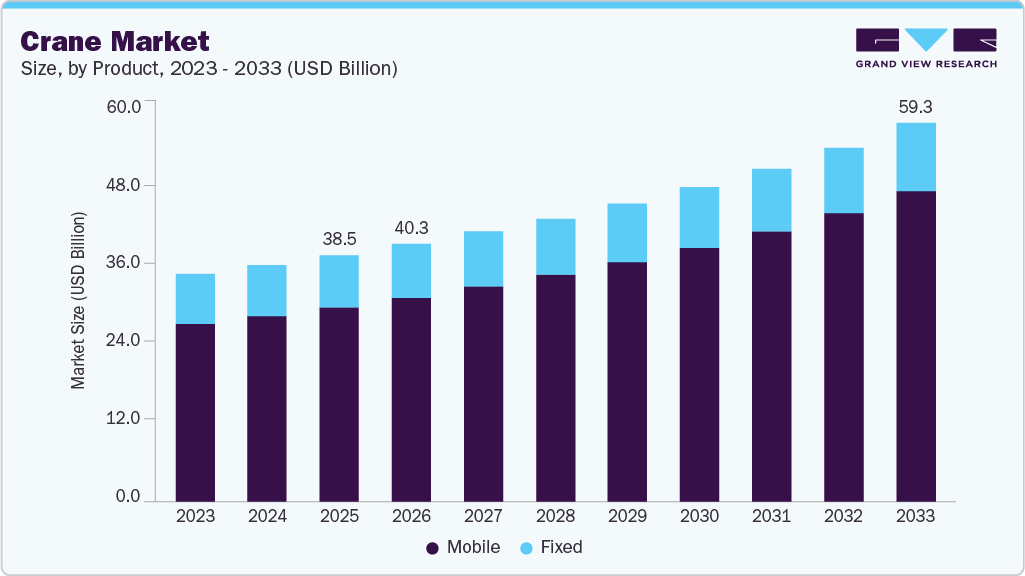 To learn more about this report, Download Free Sample Report
 Technological advancements and automation are transforming the crane industry by significantly enhancing operational efficiency, safety, and reliability. The integration of digital technologies such as the Internet of Things (IoT), telematics, artificial intelligence (AI)-based monitoring, and remote operation systems enables real-time data tracking and analytics, allowing operators to monitor crane performance and usage more effectively. These innovations support predictive maintenance, helping identify potential equipment failures in advance and thereby reducing unplanned downtime and maintenance costs. In addition, modern cranes are increasingly equipped with advanced safety features, such as load-monitoring systems and collision-avoidance technologies, thereby improving on-site safety standards. Automated and semi-automated cranes are also gaining widespread adoption, particularly in ports, warehouses, and industrial facilities, where precision, speed, and productivity are critical.
The regulatory landscape plays a crucial role in shaping the crane industry, particularly in terms of safety, emissions, and operational standards. Governments and regulatory bodies have implemented stringent safety norms to protect workers and minimize on-site accidents, leading to increased adoption of advanced safety technologies in cranes. Environmental regulations are also becoming more stringent, pushing manufacturers to develop low-emission, fuel-efficient, and electric crane models. Compliance with international standards and certifications is essential for manufacturers operating across multiple regions, which, in turn, drives technological upgrades and product innovation.
Despite strong growth prospects, the crane industry faces several restraints. High initial capital costs associated with crane procurement and maintenance can limit adoption, particularly among small and medium-sized contractors. The availability of skilled operators remains a challenge, as advanced cranes require specialized training and expertise. In addition, fluctuations in raw material prices and supply chain disruptions can impact manufacturing costs and delivery timelines. Economic uncertainties and cyclical downturns in construction and industrial activity may also affect demand. These factors collectively pose restrains market growth.
Product Insights
The mobile crane segment accounted for the largest market revenue share in 2025 and is projected to grow at the fastest CAGR during the forecast period. The market growth is driven by their flexibility, mobility, and suitability for a wide range of construction and infrastructure applications. These cranes are widely used in road construction, bridge development, urban infrastructure, and energy projects due to their ability to move easily between sites without requiring extensive setup. Rapid urbanization and the need for faster project execution have increased the preference for mobile cranes, as they can be deployed quickly and operate efficiently in congested or space-constrained environments. In addition, rising investments in renewable energy projects, particularly onshore wind installations, are boosting demand for high-capacity mobile cranes capable of lifting heavy turbine components.
The fixed crane segment is expected to grow at a significant CAGR of 3.7% during the forecast period. Fixed cranes, including tower cranes, gantry cranes, and stiff-leg cranes, are experiencing strong demand driven by large-scale construction and industrial activities. The increasing development of high-rise residential and commercial buildings in urban areas is fueling the adoption of tower cranes, which are essential for vertical construction. In parallel, the expansion of manufacturing facilities, warehouses, and logistics hubs is driving demand for overhead global market and gantry cranes market. These cranes are used in material handling and assembly operations. The growth of global trade and port infrastructure is further supporting demand for fixed cranes such as ship-to-shore and container-handling cranes. Moreover, the rising trend toward automation in industrial and port operations is accelerating the adoption of fixed cranes integrated with advanced control systems, improving efficiency, safety, and throughput.
Application Insights
The construction segment led the market with the largest revenue share of 35.9% in 2025 and is projected to grow at the fastest CAGR during the forecast period. The increasing scale, complexity, and speed requirements of modern infrastructure and real estate projects are driving the adoption of cranes in construction applications. Rapid urbanization has led to a surge in high-rise residential and commercial developments, where cranes, especially tower and mobile variants, are essential for lifting heavy materials such as steel structures, concrete components, and prefabricated modules. Large-scale infrastructure projects, including highways, metro systems, airports, and bridges, require the use of high-capacity lifting equipment to ensure efficient execution. In addition, the growing trend of modular and prefabricated construction is accelerating crane adoption, as these methods require precise placement of large, pre-assembled units.
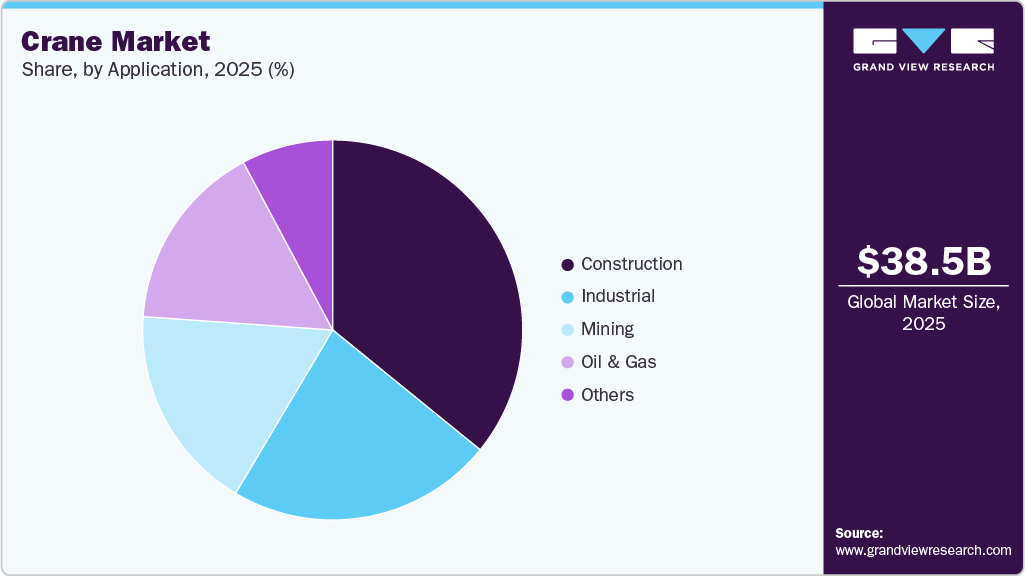 To learn more about this report, Download Free Sample Report
 The industrial segment is expected to grow at a significant CAGR during the forecast period. The need for efficient material handling, operational productivity, and workplace safety is driving the growth of cranes in industrial applications. Industries such as manufacturing, steel, automotive, energy, and shipbuilding rely on cranes to lift, transport, and position heavy machinery, raw materials, and finished goods. Overhead and gantry cranes are particularly critical in production facilities, where they streamline assembly processes and reduce manual labor. The expansion of logistics and warehousing, fueled by e-commerce growth, is further increasing demand for cranes in distribution centers. Moreover, the rise of automation and smart manufacturing is encouraging the deployment of technologically advanced cranes equipped with IoT-enabled monitoring, remote operation, and precision control systems. These capabilities enhance operational efficiency, minimize downtime, and ensure safe handling of heavy loads, making cranes indispensable across modern industrial environments.
Regional Insights
North America dominated the global crane market with the largest revenue share of 38.0% in 2025. The North America market is characterized by steady growth, driven by infrastructure modernization, energy-sector investments, and industrial expansion. Government initiatives focused on upgrading transportation networks, including highways, bridges, and rail systems, are supporting demand for mobile and tower cranes.
 To learn more about this report, Download Free Sample Report
 U.S. Crane Market Trends
The crane market in the U.S. accounted for the largest market revenue share in the North America in 2025, supported by significant federal infrastructure funding and private-sector investments in construction and logistics. The growth of commercial real estate, data centers, and warehouse infrastructure, driven by e-commerce expansion, is fueling the adoption of cranes across applications.
Europe Crane Industry Analysis
The crane market in Europe was identified as a lucrative region in 2025, driven by infrastructure renovation, sustainability initiatives, and strong regulatory frameworks. The region is seeing increased demand for energy-efficient, low-emission cranes due to stringent environmental regulations. Investments in offshore wind energy, particularly in Northern Europe, are significantly boosting demand for high-capacity and specialized crane systems.
The UK crane market is expected to grow rapidly during the forecast period, supported by infrastructure development, urban housing projects, and renewable energy investments. Government-led initiatives to expand transportation infrastructure and achieve net-zero emissions targets are driving the adoption of advanced crane technologies.
The crane market in Germany held a substantial market share in Europe in 2025. The market growth is characterized by strong industrial activity, advanced manufacturing, and a focus on engineering excellence. The country’s well-established automotive, machinery, and industrial sectors drive consistent demand for overhead and gantry cranes.
Asia Pacific Crane Industry Outlook
The crane market in the Asia Pacific is anticipated to grow at the fastest CAGR of 7.1% during the forecast period. The growth in the region is driven by rapid urbanization, industrialization, and large-scale infrastructure development. Countries across the region are investing heavily in transportation networks, smart cities, and energy projects, significantly boosting demand for cranes. The presence of major crane manufacturers and cost-competitive production capabilities further supports market expansion.
The China crane market held a substantial market share in the Asia Pacific in 2025. The growth of the market in the country is supported by extensive infrastructure development, urban expansion, and industrial growth. Government-backed investments in high-speed rail, highways, ports, and renewable energy projects continue to drive strong demand for cranes across segments.
Key Crane Company Insights
Some of the key companies in the crane industry include Kobelco Construction Machinery Co., Ltd., Konecranes, Liebherr, PALFINGER AG, SANY Group, Tadano America Corp, and others. Organizations are focusing on increasing customer base to gain a competitive edge in the industry. Therefore, key players are taking several strategic initiatives, such as mergers and acquisitions, and partnerships with other major companies.
-
XCMG Group is a construction machinery manufacturer with a comprehensive portfolio spanning 17 product categories, over 100 series, and 1,000+ specifications across cranes, excavators, loaders, road machinery, mining equipment, heavy trucks, sanitation gear, and components. It produces a comprehensive crane portfolio, including truck cranes, all-terrain cranes, crawler cranes, and rough terrain cranes, across 15 manufacturing bases and KD factories worldwide, leveraging advanced automation, 5G-connected smart factories, and technologies such as curved booms and plasma robotic welding for superior lifting capacity, safety, and efficiency in diverse environments from urban sites to extreme terrains.
-
SANY Group is a heavy equipment manufacturer and construction machinery firm. The group operates 47 lighthouse factories and 57 industrial parks globally, including in the U.S., Germany, India, Brazil, and Indonesia, employing ~90,000 people and spanning excavators, concrete pumps, cranes, loaders, road machinery, mining equipment, port machines, wind turbines, and emerging sectors such as hydrogen energy and photovoltaics. The company's crane portfolio spans truck cranes, all-terrain cranes, rough-terrain cranes, crawler cranes, tower cranes, and port cranes.
Key Crane Companies:
The following key companies have been profiled for this study on the crane market.
- Kobelco Construction Machinery Co., Ltd.
- Konecranes
- Liebherr
- PALFINGER AG
- SANY Group
- Tadano America Corp
- The Manitowoc Company, Inc.
- XCMG Group
- Zenhua Heavy Industries Co., Ltd (ZPMC)
- Zoomlion Heavy Industry Science&Technology Co., Ltd.
Recent Developments
-
In April 2026, Raimondi Cranes, under the Raimondi Group, launched its first telecrawler crane line, the TTC 70, engineered by its Terex Rough Terrain Cranes division at the Crespellano facility near Bologna, Italy, marking a strategic re-entry into the crawler segment after 14 years. This 70-tonne capacity telescopic boom crawler crane combines mobile crane efficiency with enhanced stability on uneven terrain (up to 4° slopes without outriggers), low ground pressure for soft sites, and 36.8m boom reach, targeting infrastructure, energy, and construction in the U.S., Canada, and Europe.
-
In March 2026, Chengli Special Truck Co., Ltd., a Chinese heavy equipment manufacturer, launched a 250-ton intelligent unmanned crawler crane, featuring 5G remote control, AI autonomous operation, and advanced automation for high-risk or remote applications such as wind turbine installation, bridge construction, and nuclear projects. The crane delivers 30% higher efficiency and 15% energy savings over manned models, with real-time monitoring, obstacle avoidance, precise positioning, and unmanned self-assembly/disassembly via a 5G+AI platform supporting 10 km remote range.
Crane Market Report Scope
Report Attribute
Details
Market size in 2025
USD 38.55 billion
Estimated market size in 2026
USD 40.26 billion
Projected market size by 2033
USD 59.28 billion
Growth rate
CAGR of 5.7% from 2026 to 2033
Base year for estimation
2025
Historical data
2021 - 2024
Forecast period
2026 - 2033
Quantitative units
Revenue in USD million/billion, and CAGR from 2026 to 2033
Report industry
Revenue forecast, company ranking, competitive landscape, growth factors, and trends
Segments covered
Product, application, region
Regional scope
North America; Europe; Asia Pacific; Latin America; MEA
Country scope
U.S.; Canada; Mexico; Germany; UK; France; Spain; Italy; China; Japan; India; South Korea; Australia; Brazil; Argentina; KSA; UAE; South Africa
Key companies profiled
Kobelco Construction Machinery Co., Ltd.; Konecranes; Liebherr; PALFINGER AG; SANY Group; Tadano America Corp; The Manitowoc Company, Inc.; XCMG Group; Zenhua Heavy Industries Co., Ltd (ZPMC); Zoomlion Heavy Industry Science&Technology Co., Ltd.
Customization scope
Free report customization (equivalent up to 8 analysts working days) with purchase. Addition or alteration to country, regional & segment scope.
Pricing and purchase options
Avail customized purchase options to meet your exact research needs. Explore purchase options
Global Crane Market Report Segmentation
This market report offers forecasts in terms of revenue growth at global, regional, and country levels and provides an analysis of the latest industry trends in each of the sub-segments from 2021 to 2033. For this study, Grand View Research has segmented the global crane market report based on product, application, and region.
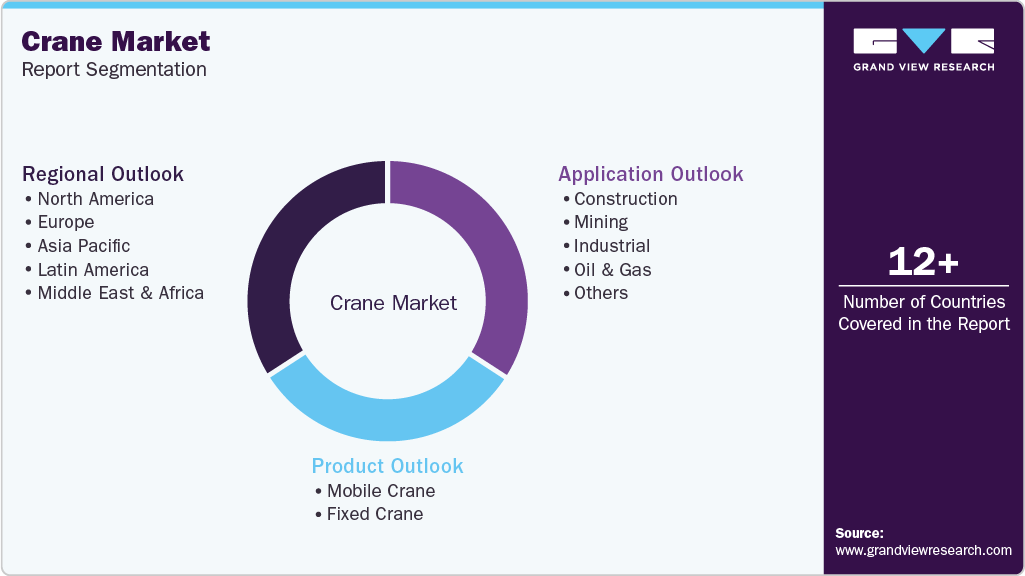 To learn more about this report, Download Free Sample Report
 -
Product Outlook (Revenue, USD Billion, 2021 - 2033)
-
Mobile Crane
-
Type
-
All Terrain Crane
-
Crawler Crane
-
Rough Terrain Crane
-
Truck Loader Crane
-
-
Load Capacity
-
Below 20 Ton
-
20 To 50 Ton
-
50 To 200 Ton
-
Above 200 Ton
-
-
-
Fixed Crane
-
Type
-
Monorail Crane
-
Stiff Leg Crane
-
Tower Crane
-
Gantry Crane
-
-
Load Capacity
-
Below 25 Ton
-
26-50 Ton
-
51-80 Ton
-
Above 80 Ton
-
-
-
-
Application Outlook (Revenue, USD Billion, 2021 - 2033)
-
Construction
-
Mining
-
Industrial
-
Oil & Gas
-
Others
-
-
Regional Outlook (Revenue, USD Billion, 2021 - 2033)
-
North America
-
U.S.
-
Canada
-
Mexico
-
-
Europe
-
Germany
-
UK
-
France
-
Italy
-
Spain
-
-
Asia Pacific
-
China
-
Japan
-
India
-
South Korea
-
Australia
-
-
Latin America
-
Brazil
-
Argentina
-
-
Middle East and Africa (MEA)
-
KSA
-
UAE
-
South Africa
-
-
Frequently Asked Questions About This Report
North America dominated with a 38.0% revenue share in 2025.
Asia Pacific is the fastest-growing region over the forecast period.
The rapid infrastructure developments is driving growth of the crane market. Large-scale investments in infrastructure, such as highways, metro rail, airports, ports, and smart cities, are driving the demand for cranes.
The global crane market size was estimated at USD 38.5 billion in 2025 and is expected to reach USD 40.2 billion in 2026.
The global crane market is expected to grow at a compound annual growth rate of 5.7% from 2026 to 2033 to reach USD 59.2 billion by 2033.
North America dominated the market with a market share of over 38.0% in 2025. The crane market in North America is characterized by steady growth, driven by infrastructure modernization, energy-sector investments, and industrial expansion.
Some key players operating in the crane market include Kobelco Construction Machinery Co., Ltd.; Konecranes; Liebherr; PALFINGER AG; SANY Group; Tadano America Corp; The Manitowoc Company, Inc.; XCMG Group; Zenhua Heavy Industries Co., Ltd (ZPMC); Zoomlion Heavy Industry Science&Technology Co., Ltd.
About the Author(s)
HVAC & Construction Research Team
Technology · HVAC & ConstructionThis report was authored by the hvac & construction research team at Grand View Research - comprising two research analysts, one senior research analyst, and one industry expert - with specialized expertise in the hvac & construction segment of the technology industry. All findings are based on proprietary technology databases, executive interviews, and regulatory analysis, subject to internal peer review prior to publication.
Last Updated:
Speak to Analyst

Customize this report to your needs - add regions, segments, or data points, with 20% free customization.
Or view our licence options:


ISO 9001:2015 & 27001:2022 Certified
We are GDPR and CCPA compliant! Your transaction & personal information is safe and secure. For more details, please read our privacy policy.


