
- Home
- »
- Advanced Interior Materials
- »
-
Cryogenic Freezers Market Size & Share Report, 2026-2033GVR Report cover
![Cryogenic Freezers Market Size, Share & Trends Report]()
Cryogenic Freezers Market (2026 - 2033) Size, Share & Trends Analysis Report By Technology (Liquid Nitrogen-based Cooling, Liquid Helium-based Cooling, Liquid CO2-based Cooling), By End-use (Healthcare & Hospitals), By Storage Capacity, By Freezer Type, By Region, And Segment Forecasts
Market Size, 2025
$1.2BMarket Estimate, 2026
$1.3BMarket Forecast, 2033
$2.2BCAGR, 2026–2033
8.3%Cryogenic Freezers Market Summary
The global cryogenic freezers market size was valued at USD 1.2 billion in 2025 and is projected to grow from USD 1.3 billion in 2026 to USD 2.2 billion by 2033, at a CAGR of 8.3% from 2026 to 2033.Asia Pacific dominated the global cryogenic freezers market with the largest revenue share of 37.2% in 2025.The growing demand for ultra-low-temperature storage in healthcare, pharmaceuticals, and biotechnology is a major driver of the cryogenic freezer industry.

Key Market Trends & Insights
- By technology: Liquid nitrogen-based cooling segment dominated the market, with a revenue share of 68.2% in 2025.
- By storage capacity: 100-400 liters storage capacity segment held the largest market share of 34.8% in 2025.
- By freezer type: Tunnel freezers segment led the market with the largest revenue share of 30.2% in 2025.
- By end-use: Healthcare & hospitals segment led the market with the largest revenue share of 34.9% in 2025.
Regional Highlights
- Largest regional market: Asia Pacific (37.2% revenue share, 2025)
- The cryogenic freezers market in China dominated the Asia Pacific region.
Market Size & Forecast
- Market size in 2025: USD 1.2 Billion
- Estimated market size in 2026: USD 1.3 Billion
- Projected market size by 2033: USD 2.2 Billion
- CAGR (2026-2033): 8.3%
The increasing use of biologics, vaccines, cell therapies, and regenerative medicine requires precise temperature control to maintain product stability and effectiveness. The expansion of biobanking activities and rising clinical research investments are also driving the adoption of advanced cryogenic storage solutions.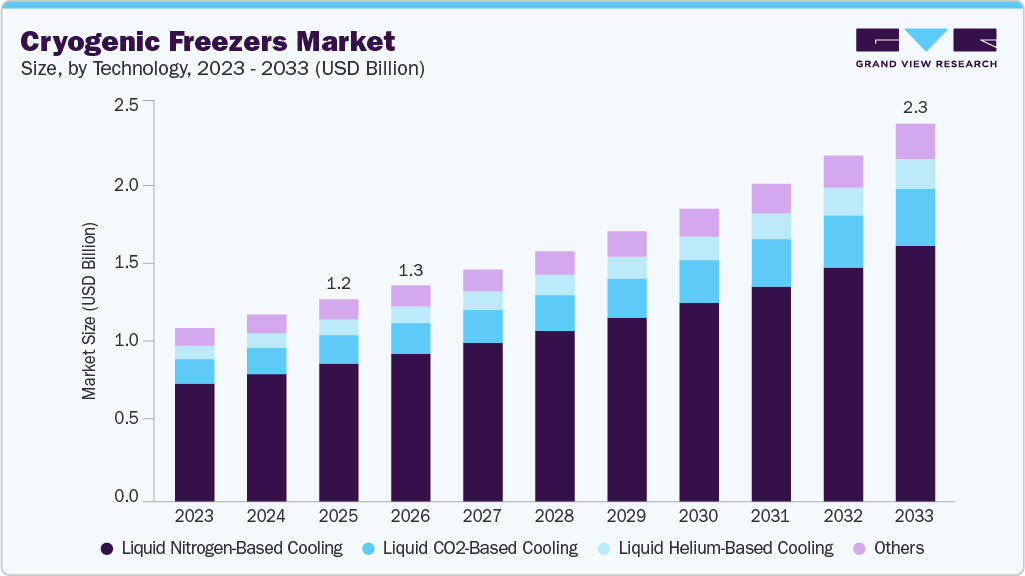
Another key growth factor is the increasing focus on energy efficiency and sustainable building practices across industries. ERVs help reduce heating and cooling loads by recovering energy from exhaust air, lowering overall energy consumption and operating costs. Governments and organizations are promoting eco-friendly construction through incentives and regulations, supporting market expansion. Technological advancements, including smart controls and compact system designs, are further improving performance and encouraging adoption across residential, commercial, and industrial sectors.
Market Dynamics
The growth of the cryogenic freezer industry is primarily driven by the flourishing demand for ultra-low-temperature storage across the healthcare, biotechnology, and pharmaceutical industries. Increasing production of biologics, vaccines, cell and gene therapies, and advanced research materials requires highly stable freezing environments to preserve product integrity and efficacy. In addition, the expansion of biobanking facilities, growing investments in life sciences infrastructure, and rising demand for cold chain logistics are accelerating market adoption. Furthermore, increasing consumption of frozen and processed foods is supporting the use of cryogenic freezing technologies across food processing and industrial applications.
High initial investment and operational challenges remain key restraints for the growth of the cryogenic freezer market. The requirement for advanced cooling technologies, specialized infrastructure, continuous power supply, and skilled handling of cryogenic liquids significantly increases installation, maintenance, and overall ownership costs. In addition, stringent regulatory and safety compliance requirements related to temperature monitoring and storage standards add to operational complexity. Dependence on cryogenic gas supply and fluctuations in supply chains may further impact operational continuity and limit adoption, particularly among small organizations and in cost-sensitive developing regions.
Market Concentration & Characteristics
The cryogenic freezers industry has a relatively concentrated structure, with a limited number of established global manufacturers holding a strong share due to their advanced technology capabilities and extensive distribution networks. High capital investment, strict regulatory standards, and technical expertise requirements create significant barriers for new entrants, supporting dominance by key players. Leading companies focus on innovation, reliability, and integrated solutions, strengthening customer retention across healthcare, pharmaceutical, and industrial sectors.
The cryogenic freezers industry demonstrates a high degree of innovation, driven by demand for ultra-low temperature performance, energy efficiency, and improved system reliability. Manufacturers are investing in advanced insulation materials, automated monitoring systems, and smart temperature control technologies to enhance operational precision. The integration of digital monitoring and remote diagnostics is becoming increasingly common to ensure sample safety and reduce maintenance risks. Continuous R&D efforts also focus on reducing cryogen consumption and improving sustainability.
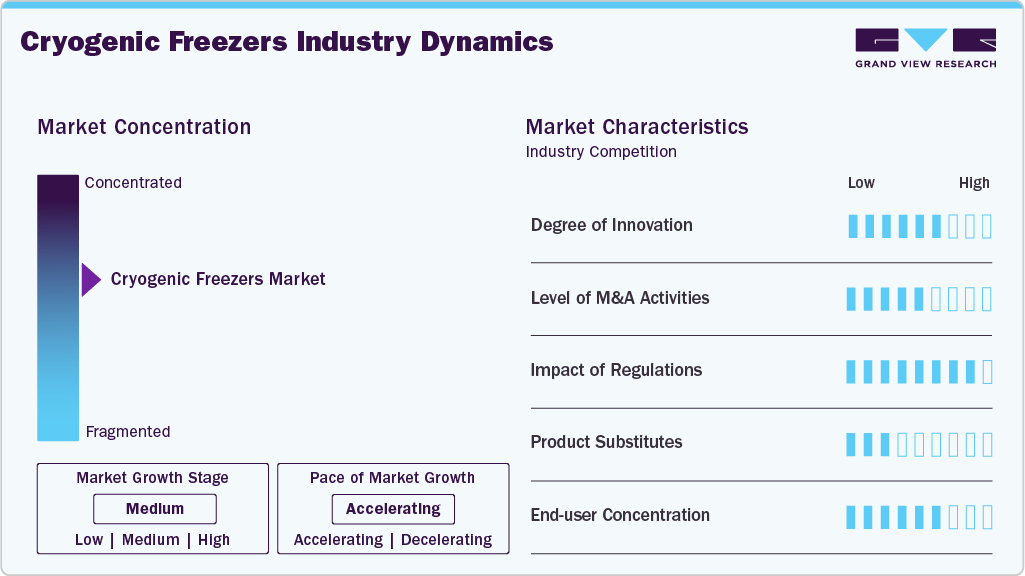
Regulatory frameworks have a significant impact on the industry, particularly in healthcare, pharmaceuticals, and biotechnology applications, where strict standards govern storage conditions and product safety. Compliance with international quality guidelines and cold chain requirements influences product design and manufacturing processes. Certifications related to safety, environmental standards, and operational performance are critical for market entry and customer trust. These regulatory pressures encourage companies to maintain high-quality assurance and traceability systems.
End-user concentration is relatively high in sectors such as pharmaceutical manufacturing, research laboratories, and food processing industries that require specialized freezing solutions. Large institutional buyers and industrial operators often prefer long-term partnerships with established suppliers offering technical support and customization. Demand patterns are shaped by global expansion in biologics, vaccine production, and frozen food consumption. This concentration creates stable demand but also increases expectations for reliability, scalability, and compliance from manufacturers.
Technology Insights
The liquid nitrogen-based cooling segment led the market with the largest revenue share of 68.2% in 2025, due to its ability to achieve extremely low temperatures rapidly while ensuring uniform and efficient freezing. Its widespread use in healthcare, biotechnology, and food processing applications supported strong adoption across multiple industries. The technology offers reliable performance for preserving sensitive biological samples and maintaining product quality in industrial freezing processes. Established infrastructure, ease of availability, and proven operational efficiency further strengthened its leading market position.
The liquid CO₂-based cooling segment is expected to grow at the fastest CAGR of 9.2% from 2026 to 2033, owing to its cost-effectiveness and controlled freezing capabilities. Increasing adoption in food processing and industrial applications that require precise temperature management has driven demand. Compared to some alternatives, CO₂ systems can offer improved operational flexibility and lower operating costs in certain use cases. Growing focus on energy efficiency and sustainable cooling solutions is also encouraging manufacturers to invest in CO₂-based cryogenic technologies.
Storage Capacity Insights
The 100-400 liters storage capacity segment led the market with the largest revenue share of 34.8% in 2025, due to its wide applicability across hospitals, laboratories, and pharmaceutical facilities. This capacity range offers a balance between storage volume and space efficiency, making it suitable for routine clinical and research use. Many healthcare institutions prefer mid-sized units as they provide flexibility without requiring extensive infrastructure. Strong demand from diagnostic labs and biobanking activities further supported the segment’s leading position.
The 400-700 liters segment is expected to grow at a fastest CAGR of 8.9% from 2026 to 2033 in terms of revenue, driven by increasing demand for higher storage volumes in pharmaceutical manufacturing and large-scale research programs. Expansion of vaccine production, biologics development, and long-term sample storage requirements is encouraging the adoption of larger systems. These freezers allow improved scalability while maintaining precise temperature control. Growing investments in advanced laboratories and centralized storage facilities are also accelerating growth within this capacity range.
Freezer Type Insights
The tunnel freezers segment led the market with the largest revenue share of 30.2% in 2025, due to their high throughput capability and suitability for continuous large-scale processing operations. These systems are widely used in the food and industrial sectors where rapid freezing and consistent product quality are essential. Their ability to handle large volumes efficiently makes them ideal for mass production environments. Established adoption in frozen food manufacturing and reliable operational performance supported their leading market share.
The spiral Freezers segment is expected to grow at the fastest CAGR of 9.3% from 2026 to 2033, owing to their space-efficient design and enhanced production flexibility. Industries are increasingly adopting spiral systems to maximize freezing capacity within limited floor space while maintaining high output levels. Improved airflow control and uniform freezing performance contribute to better product quality and energy efficiency. Rising automation trends and demand for compact processing solutions are further accelerating growth in this segment.
End-use Insights
The healthcare & hospitals segment led the market with the largest revenue share of 34.9% in 2025, driven by the growing need for reliable ultra-low-temperature storage for blood products, biological samples, vaccines, and clinical materials. Increased patient testing, expanded diagnostic services, and rising adoption of advanced medical procedures supported consistent demand. Hospitals require dependable freezing solutions to maintain sample integrity and comply with strict storage standards. Continuous investments in healthcare infrastructure and laboratory modernization further strengthened this segment’s leading position.
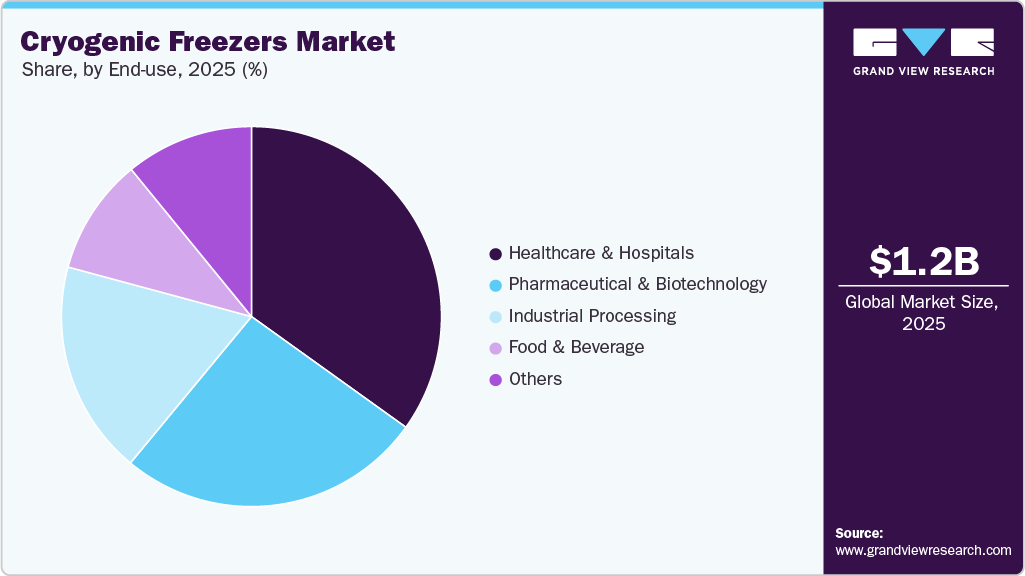
The pharmaceutical & biotechnology segment is expected to grow at the fastest CAGR of 9.0% from 2026 to 2033, driven by rapid expansion in biologics development, cell and gene therapies, and vaccine production. Research organizations require precise cryogenic storage to preserve sensitive compounds throughout development and manufacturing stages. Growing clinical trial activities and biobanking initiatives are also contributing to increased adoption of advanced freezing systems.
Regional Insights
The cryogenic freezers market in North America showed strong growth at CAGR of 7.9% over the forecast period, driven by advanced healthcare systems, extensive research activities, and a well-established pharmaceutical and biotechnology sector. High adoption of innovative cryogenic technologies and increasing focus on precision medicine supported market expansion. The presence of major industry players and strong R&D investments accelerated technological advancements. Growing demand for biobanking and clinical research storage solutions further strengthened regional growth.
U.S. Cryogenic Freezers Market Trends
The cryogenic freezers market in the U.S. accounted for the largest market revenue share in North America in 2025, due to its advanced healthcare infrastructure, strong pharmaceutical and biotechnology industry, and extensive research activities. High investments in biologics development, clinical trials, and biobanking helped drive the widespread adoption of ultra-low-temperature storage solutions. The presence of leading manufacturers and continuous technological innovation further strengthened market leadership. In addition, strict regulatory standards for sample preservation encouraged healthcare and research institutions to adopt advanced cryogenic systems.
The Canada cryogenic freezers market showed steady growth driven by expanding life sciences research, increasing healthcare investments, and rising demand for reliable cold storage solutions. Growth in pharmaceutical development and academic research programs supported the adoption of cryogenic freezers across laboratories and medical facilities. Government funding for biotechnology innovation and the modernization of healthcare infrastructure further contributed to market expansion. Increasing focus on improving cold chain logistics and research capabilities is expected to support continued growth.
Europe Cryogenic Freezers Market Trends
The cryogenic freezer market in Europe continued to grow steadily, driven by stringent regulatory standards for sample preservation and increasing demand for sustainable, energy-efficient freezing technologies. Expansion in pharmaceutical manufacturing and biologics research across Germany, the UK, and France supported adoption. The region’s focus on food safety and quality standards also increased demand for cryogenic freezing in food processing industries. Government support for scientific research and healthcare modernization contributed to consistent market expansion.
The Germany cryogenic freezers market held a significant share in Europe in 2025, due to its strong pharmaceutical manufacturing base, advanced research infrastructure, and high adoption of precision cooling technologies. The country’s well-established biotechnology sector and increasing investment in life sciences innovation supported consistent demand. Industrial food processing and strict quality standards also contributed to the wider adoption of cryogenic freezing systems.
The cryogenic freezers market in France showed notable growth driven by expanding biotechnology research, rising pharmaceutical production, and increased focus on healthcare modernization. Growing investments in clinical trials and biologics development have created demand for reliable ultra-low-temperature storage solutions. The country’s emphasis on improving cold chain logistics and laboratory infrastructure supported market expansion.
Asia Pacific Cryogenic Freezers Market Trends
Asia Pacific dominated the global cryogenic freezers market with the largest revenue share of 37.2% in 2025 and is anticipated to grow at the fastest CAGR during the forecast period, due to rapid expansion in healthcare infrastructure, pharmaceutical manufacturing, and food processing industries across countries such as China, India, Japan, and South Korea. Increasing investments in biotechnology research and vaccine production supported strong demand for advanced freezing solutions. Growing urbanization and rising consumption of frozen food products further contributed to market growth.
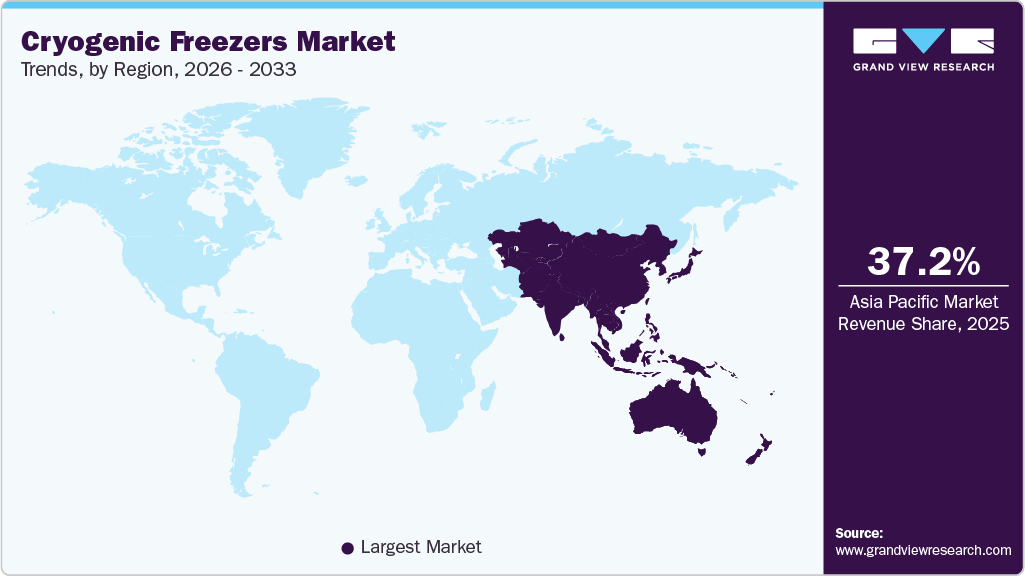
The cryogenic freezers market in China dominated the Asia Pacific region, supported by its large-scale pharmaceutical manufacturing capacity, expanding biotechnology sector, and rapid development of healthcare infrastructure. Strong government support for life sciences research and vaccine production increased demand for advanced ultra-low temperature storage solutions. Growth in frozen food processing and industrial applications further strengthened the adoption of cryogenic freezing technologies. In addition, the presence of domestic manufacturers and cost-competitive production capabilities reinforced China’s leading position.
The India cryogenic freezers market showed strong growth driven by rising investments in pharmaceutical manufacturing, biotechnology research, and healthcare infrastructure development. Increasing clinical research activities and the expansion of vaccine production facilities created demand for reliable cryogenic storage systems. Growth in organized food processing and cold chain logistics also supported market expansion across industrial sectors. Furthermore, government initiatives promoting domestic manufacturing and life sciences innovation encouraged wider adoption of advanced freezing technologies.
Middle East & Africa Cryogenic Freezers Market Trends
The cryogenic freezers market in the Middle East and Africa region is experiencing emerging growth, supported by expanding healthcare facilities and increasing investments in biotechnology and medical research. The growing demand for advanced food preservation technologies and the improvement in industrial processing capabilities contributed to market expansion. Government initiatives to strengthen healthcare systems and pharmaceutical production are driving the adoption of cryogenic storage solutions. Infrastructure development and rising awareness of cold chain management are further supporting long-term growth prospects.
The Saudi Arabia cryogenic freezer market in the Middle East & Africa showed notable growth, driven by increasing investments in healthcare infrastructure, biotechnology research, and pharmaceutical manufacturing. Government initiatives focused on economic diversification and development of local life sciences capabilities supported demand for advanced cold storage solutions. Expansion of food processing industries and improvements in cold chain logistics further encouraged adoption of cryogenic freezing technologies.
Latin America Cryogenic Freezers Market Trends
The cryogenic freezer market in Latin America experienced gradual growth, driven by improving healthcare infrastructure and rising investments in pharmaceutical manufacturing. Rising awareness about advanced storage solutions and expanding cold chain capabilities supported market adoption. Growth in food processing and export-oriented industries also encouraged the use of cryogenic freezing technologies. However, economic fluctuations and cost constraints may influence the pace of adoption in certain countries.
The Brazil cryogenic freezers market showed steady growth in the Latin America region, supported by expanding pharmaceutical production, increasing clinical research activities, and improvements in healthcare infrastructure. Rising demand for reliable ultra-low-temperature storage in laboratories and for vaccine distribution strengthened adoption across medical sectors. Growth in food processing and frozen food exports also contributed to increased use of cryogenic freezing systems.
Key Cryogenic Freezers Company Insights
Some of the key players operating in the market include Thermo Fisher Scientific Inc., Linde PLC, and Air Products and Chemicals, Inc.
-
Thermo Fisher Scientific Inc. develops advanced ultra-low temperature and cryogenic storage solutions used across pharmaceutical manufacturing, biotechnology research, healthcare laboratories, and life sciences applications. The company integrates precision temperature management, digital monitoring, and sample security features to support sensitive biological materials and long-term storage requirements. Its product portfolio supports biobanking, clinical research, vaccine storage, and cell therapy workflows requiring stable cryogenic conditions. Key company verticals include life sciences solutions, analytical instruments, laboratory equipment, diagnostics, bioproduction, and cryogenic freezer technologies. Continuous product innovation and focus on automation and energy efficiency strengthen its position in high-performance cold storage systems.
-
Linde PLC specializes in industrial gases and cryogenic engineering solutions, providing liquid nitrogen, CO₂, and related cooling technologies used for rapid freezing and controlled temperature applications. The company delivers integrated cryogenic systems for sectors such as food processing, pharmaceuticals, healthcare, and advanced manufacturing. Its expertise in gas-supply infrastructure enables scalable cryogenic freezing operations with greater efficiency and reliability. Key verticals include industrial gases, healthcare gas solutions, food freezing systems, cryogenic engineering, and cryogenic freezer technologies. Strong engineering capabilities and customized solutions allow Linde to address complex cooling requirements across diverse industries.
Key Cryogenic Freezers Companies:
The following key companies have been profiled for this study on the cryogenic freezers market.
- Planer
- LNEYA
- Air Products and Chemicals, Inc.
- NuAire
- STERICOX
- Azenta US Inc.
- CRYOMETRIX
- Thermo Fisher Scientific Inc.
- MATHESON TRI-GAS, INC
- Qingdao Antech Scientific Co., Ltd
- Salus d.o.o.
- RS Cryo Equipment INC.
- CRYOTHERM
- PHC Corporation
- Linde PLC
Competitive Benchmarking
Operating Strategies
Competitive Edge
Weaknesses
Mature Players: Thermo Fisher Scientific Inc., Air Products and Chemicals, Inc., Linde PLC.
- Mature players focus on expanding ultra-low-temperature storage portfolios, integrating smart monitoring and automated temperature control technologies, and strengthening global distribution and service networks.
- These companies also emphasize strategic acquisitions, investment in sustainable cryogenic technologies, and partnerships with pharmaceutical, biotechnology, and healthcare organizations to strengthen market presence.
- Established companies benefit from strong global brand recognition, advanced technological expertise, diversified product portfolios, and extensive after-sales support capabilities.
- Their large-scale manufacturing capacity, strong R&D investments, and compliance with stringent healthcare and laboratory standards support long-term contracts and adoption across pharmaceutical, biotech, and research facilities worldwide.
- Mature companies often face high operational and manufacturing costs due to advanced technology integration and extensive global infrastructure.
- Complex organizational structures and premium pricing strategies may reduce flexibility and competitiveness in highly price-sensitive and emerging regional markets.
Emerging Players: Planer, LNEYA, NuAire, STERICOX, CRYOMETRIX, Qingdao Antech Scientific Co., Ltd.
- Emerging players focus on offering cost-effective and customized cryogenic freezer solutions tailored to laboratories, research institutes, and small healthcare facilities.
- These companies emphasize regional expansion, flexible manufacturing capabilities, faster product customization, and strengthening local distribution partnerships to increase market penetration.
- Emerging companies benefit from greater operational flexibility, faster product development cycles, and the ability to provide customized ultra-low-temperature storage solutions for specialized applications.
- Their competitive pricing, shorter delivery timelines, and focus on localized technical support and aftermarket services help strengthen customer relationships in regional and mid-sized healthcare and research markets.
- Emerging players often face challenges related to limited global brand recognition, smaller distribution networks, and lower financial capacity for large-scale expansion and R&D investments.
- Dependence on third-party component suppliers, limited compliance certifications, and difficulty competing with established players in large pharmaceutical and biotechnology contracts may restrict long-term growth opportunities.
Recent Developments:
-
In September 2025, Air Products showcased its Freshline freezing solutions at the International Baking Industry Exposition, highlighting advanced cryogenic systems for bakery and food applications. The technology uses liquid nitrogen and CO₂ to rapidly and efficiently freeze products while maintaining product quality. Modular configurations allow flexible integration into different production lines. Remote monitoring capabilities support improved process control and operational efficiency.
-
In March 2024,DSI Dantech introduced the Freshline cryogenic tunnel freezer developed with Air Products to enhance freezing efficiency in food processing applications. The system focuses on improved performance, consistent product quality, and reliable cryogenic operation. It supports rapid freezing with an optimized design for modern production environments. This launch highlights ongoing advancements in smart and efficient cryogenic freezing technologies.
Cryogenic Freezers Market Report Scope
Report Attribute
Details
Market size in 2025
USD 1.2 Billion
Estimated market size in 2026
USD 1.3 Billion
Projected market size by 2033
USD 2.2 Billion
Growth rate
CAGR of 8.3% from 2026 to 2033
Base year for estimation
2025
Historical data
2021 - 2024
Forecast period
2026 - 2033
Quantitative units
Revenue in USD million/billion, and CAGR from 2026 to 2033
Report coverage
Revenue forecast, company ranking, competitive landscape, growth factors, and trends
Segments covered
Technology, storage capacity, freezer type, end-use, region
Regional scope
North America; Europe; Asia Pacific; Latin America; Middle East & Africa
Country scope
U.S.; Canada; Mexico; UK; Germany; France; Spain; Italy; China; Japan; India; Australia; South Korea; Brazil; Argentina; Saudi Arabia; South Africa; UAE
Key companies profiled
Planer; LNEYA; Air Products and Chemicals, Inc.; NuAire; STERICOX; Azenta US Inc.; CRYOMETRIX; Thermo Fisher Scientific Inc.; MATHESON TRI-GAS, INC; Qingdao Antech Scientific Co., Ltd; Salus d.o.o.; RS Cryo Equipment INC.; CRYOTHERM; PHC Corporation; Linde PLC
Customization scope
Free report customization (equivalent up to 8 analysts working days) with purchase. Addition or alteration to country, regional & segment scope.
Pricing and purchase options
Avail customized purchase options to meet your exact research needs. Explore purchase options
Global Cryogenic Freezers Market Report Segmentation
This report forecasts revenue growth at global, regional, and country levels and provides an analysis of the latest industry trends in each of the sub-segments from 2021 to 2033. For this study, Grand View Research has segmented the global cryogenic freezers market report based on technology, storage capacity, freezer type, end-use and region.
-
Technology Outlook (Revenue, USD Million, 2021 - 2033)
-
Liquid Nitrogen-based Cooling
-
Liquid Helium-based Cooling
-
Liquid CO2-based Cooling
-
Others
-
-
Storage Capacity Outlook (Revenue, USD Million, 2021 - 2033)
-
Up to 100 Liters
-
100-400 Liters
-
400-700 Liters
-
Above 700 Liters
-
-
Freezer Type Outlook (Revenue, USD Million, 2021 - 2033)
-
Tunnel Freezers
-
Spiral Freezers
-
Immersion Freezers
-
Cabinet / Chest Cryogenic Freezers
-
Others
-
-
End-use Outlook (Revenue, USD Million, 2021 - 2033)
-
Healthcare & Hospitals
-
Pharmaceutical & Biotechnology
-
Industrial Processing
-
Food & Beverage
-
Others
-
-
Regional Outlook (Revenue, USD Million, 2021 - 2033)
-
North America
-
U.S.
-
Canada
-
Mexico
-
-
Europe
-
Germany
-
France
-
Italy
-
Spain
-
UK
-
-
Asia Pacific
-
China
-
India
-
Japan
-
South Korea
-
-
Latin America
-
Brazil
-
Argentina
-
-
Middle East and Africa
-
Saudi Arabia
-
UAE
-
South Africa
-
Australia
-
-
Delivered Customizations
This report has been delivered with the following In-depth customizations
Client Request
Customization Delivered
Value Adds
Regional Segmentation
Detailed analysis of the cryogenic freezer market across North America, Europe, Asia Pacific, Latin America, and Middle East & Africa, including country-level evaluation for the U.S., Germany, China, India, Brazil, and Saudi Arabia. The study assessed the impact of expanding healthcare & hospital infrastructure, pharmaceutical & biotechnology production, industrial processing activities, and food & beverage cold storage requirements on the demand for cryogenic freezers across regional markets.
Supports regional expansion strategies, investment prioritization, and identification of high-growth markets driven by rising biologics production, vaccine storage needs, laboratory research activities, and expansion of cold chain logistics infrastructure.
Opportunity Assessment
Identification of growth opportunities associated with the expansion of pharmaceutical & biotechnology industries, increasing investments in healthcare and laboratory infrastructure, rising demand for biologics and vaccine storage, and growing adoption of cold chain logistics solutions.
Supports investment planning, product innovation, and market expansion strategies through rising demand for reliable, energy-efficient, and high-performance cryogenic freezer systems across healthcare, pharmaceutical, biotechnology, industrial, and food processing applications.
Competitive Benchmarking
Detailed benchmarking of key cryogenic freezer manufacturers based on product portfolio, temperature range offerings, storage capacity, cooling technology, manufacturing footprint, distribution network, after-sales service, and positioning across healthcare, pharmaceutical & biotechnology, industrial processing, and food & beverage applications.
Offers deeper insights into technological capabilities, product innovation, and competitive dynamics within the cryogenic freezer market.
Frequently Asked Questions About This Report
Liquid nitrogen-based cooling segment dominated the market, with a revenue share of 68.2% in 2025
The global cryogenic freezers market size was estimated at USD 1.2 billion in 2025 and is expected to be USD 1.3 billion in 2026.
The global cryogenic freezers market, in terms of revenue, is expected to grow at a compound annual growth rate of 8.3% from 2026 to 2033 to reach USD 2.2 billion by 2033.
Asia Pacific dominated the cryogenic freezers market in 2025 and accounted for 37.2% share, due to rapid expansion in healthcare infrastructure, pharmaceutical manufacturing, and food processing industries across countries such as China, India, Japan, and South Korea. Increasing investments in biotechnology research and vaccine production supported strong demand for advanced freezing solutions.
Some of the key players operating in the global cryogenic freezers market include Planer; LNEYA; Air Products and Chemicals, Inc.; NuAire; STERICOX; Azenta US Inc.; CRYOMETRIX; Thermo Fisher Scientific Inc.; MATHESON TRI-GAS, INC; Qingdao Antech Scientific Co., Ltd; Salus d.o.o.; RS Cryo Equipment INC.; CRYOTHERM; PHC Corporation; Linde PLC.
The global cryogenic freezers market is driven by increasing demand for ultra-low temperature storage in healthcare, pharmaceutical, and biotechnology sectors, particularly for vaccines, biologics, and research samples. Growth in frozen food processing and industrial applications requiring rapid freezing also supports market expansion.
The 100-400 liters storage capacity segment led the market with the largest revenue share of 34.8% in 2025, due to its wide applicability across hospitals, laboratories, and pharmaceutical facilities.
The tunnel freezers segment led the market with the largest revenue share of 30.2% in 2025, due to their high throughput capability and suitability for continuous large-scale processing operations.
The healthcare & hospitals segment led the market with the largest revenue share of 34.9% in 2025, driven by the growing need for reliable ultra-low-temperature storage for blood products, biological samples, vaccines, and clinical materials.
About the Author(s)
Advanced Interior Materials Research Team
Advanced Materials · Advanced Interior MaterialsThis report was authored by the advanced interior materials research team at Grand View Research - comprising two research analysts, one senior research analyst, and one industry expert - with specialized expertise in the advanced interior materials segment of the advanced materials industry. All findings are based on proprietary advanced materials databases, executive interviews, and regulatory analysis, subject to internal peer review prior to publication.
Last Updated:
Speak to Analyst


Customize this report to your needs — add regions, segments, or data points, with 20% free customization.
Or view our licence options:


ISO 9001:2015 & 27001:2022 Certified
We are GDPR and CCPA compliant! Your transaction & personal information is safe and secure. For more details, please read our privacy policy.


