
- Home
- »
- Homecare & Decor
- »
-
Cups And Mugs Market Size & Share Report, 2026-2033GVR Report cover

Cups And Mugs Market (2026 - 2033)
Size, Share & Trends Analysis Report By Product (Cups, Mugs), By Material (Ceramic, Glass, Silicone), By Capacity (Up to 250 ml, 251-350 ml, 351-500 ml, 501 ml and Above), By Price Tier, By Distribution Channel, By Region, Segment Forecasts
Market Size, 2025
$2.7BMarket Estimate, 2026
$2.8BMarket Forecast, 2033
$4.0BCAGR, 2026–2033
5.4%Cups And Mugs Market Summary
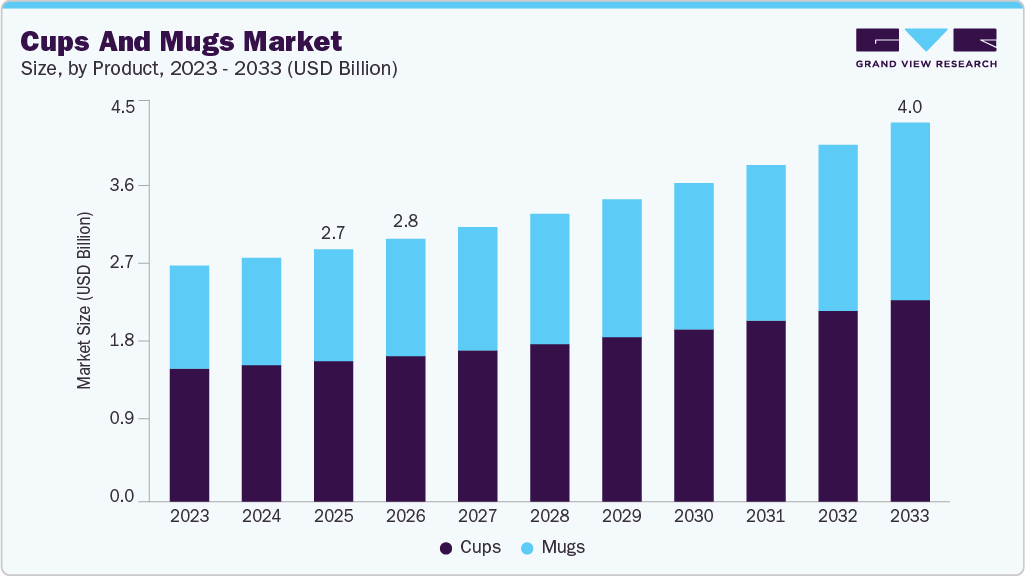
The global cups and mugs market size was valued at USD 2.7 billion in 2025 and is projected to grow from USD 2.8 billion in 2026 to USD 4.0 billion by 2033, at a CAGR of 5.4% from 2026 to 2033. The market in North America dominated with a revenue share of 34.2% in 2025. The cups and mugs market is driven by changing consumption habits that place greater emphasis on design, convenience, and everyday functionality as part of modern lifestyles.
 Source: Grand View Research, IR Documents, Primary Interviews, Paid DatabasesTo learn more about this report,
 Download Free Sample Report
 Key Market Trends & Insights
- By material: Ceramic cups and mugs segment held the largest market share of 39.5% in 2025.
- By capacity: 251-350 ml cups and mugs segment held the largest market share of 31.4% in 2025.
- By price tier: Economy/mass segment held the largest market share of 46.8% in 2025.
- By product: Cups segment held the largest market share of 55.7% in 2025.
- By distribution channel: Supermarkets & hypermarkets segment held the largest market share of 37.4% in 2025.
Regional Highlights
- Largest regional market: North America (34.2% revenue share, 2025)
- Fastest-growing regional market: Asia Pacific (highest CAGR, 2026-2033)
- By country: The U.S. held the largest market share in 2025
Market Size & Forecast
- Market size in 2025: USD 2.7 Billion
- Estimated market size in 2026: USD 2.8 Billion
- Projected market size by 2033: USD 4.0 Billion
- CAGR (2026-2033): 5.4%
Three ways to get this report
Buy it, customize it, or ask a question.Ask an Analyst
Analyst response in 1 business day
- AccessReport author, directly
- Reply timeWithin 1 working day
- No sales callDirect answer only
- FormatEmail reply
- CostFree, no cost
Get the Full Report
What the study covers
- FormatsPDF · Excel · Dashboard
- Timeline2026–2033 annual, 2025 base
- Coverage20+ countries, 5 regions
- Companies10+ key players profiled
Customize the Report
20% free customization
- IncludeCountries, segments, points
- TailorTo your product definition
- ExtendDeeper competitor detail
- OrA fully bespoke study
- Turnaround5–10 working days
Consumers are no longer viewing cups and mugs as basic drinkware, but as personal lifestyle products that reflect taste, routine, and on-the-go behavior across home, office, and travel settings. Rising coffee and tea consumption, remote work culture, and café-style experiences at home are encouraging buyers to invest in mugs that combine aesthetic appeal with practical features such as insulation, spill resistance, and ergonomic design. This shift is creating space for higher-value products, including premium ceramic mugs, travel mugs, and technologically enabled formats.
 To learn more about this report, Download Free Sample Report
 Innovation and design differentiation are playing a central role in shaping demand, particularly within the smart mug market. Consumers are increasingly drawn to mugs that enhance the drinking experience through temperature retention, precise heat control, and digital integration. The growing visibility of the temperature control smart mug market reflects demand from professionals and frequent beverage consumers who want drinks maintained at an ideal temperature over extended periods. Manufacturers are responding with sleek, minimalist designs, LED indicators, app connectivity, and rechargeable bases, positioning smart mugs as both functional tools and premium lifestyle accessories rather than novelty products.
For instance, in March 2025, Kickstarter unveiled a new Smart Pixel Display Mug, a tech-infused coffee mug that blends digital art with everyday use by integrating a customizable pixel screen into the ceramic body. Backers can send animated pixel designs, monitor drink temperature in real time, and use AI tools via a companion app to create or share messages and artwork directly on the mug. Beyond artistic expression, the mug also supports features such as hydration reminders, weather updates, interactive games, and social interaction between connected mugs, turning an ordinary drinkware item into a creative and engaging daily device.
Consumer awareness around quality, durability, and sustainability is also influencing purchasing behavior in the cups and mugs market. Buyers are showing greater willingness to pay for products made with durable materials such as stainless steel, double-walled ceramics, and BPA-free components, especially for daily-use items. Sustainability considerations, such as reusable drinkware to reduce single-use cup consumption, responsibly sourced materials, and long product lifecycles, are further strengthening demand for premium and smart mug formats. These factors are particularly relevant in the temperature control smart mug market, where long-term usability and build quality are critical decision drivers.
In Addition, the growing emphasis on on-the-go consumption and extended beverage use throughout the day has contributed to the rising demand for cups and mugs. Longer commutes, flexible work hours, and hybrid work models are increasing the amount of time consumers spend away from traditional kitchen setups, creating demand for mugs that maintain beverage temperature, prevent spills, and remain comfortable to use over long periods. This shift is accelerating interest in insulated travel mugs and products within the smart mug market, where precise heat retention reduces the need for reheating or beverage replacement. Within the temperature control smart mug market, this behavior is particularly relevant for frequent coffee and tea drinkers who value consistency and efficiency, reinforcing demand for performance-oriented drinkware as a practical daily necessity rather than a discretionary purchase.
Brand Market Share Analysis
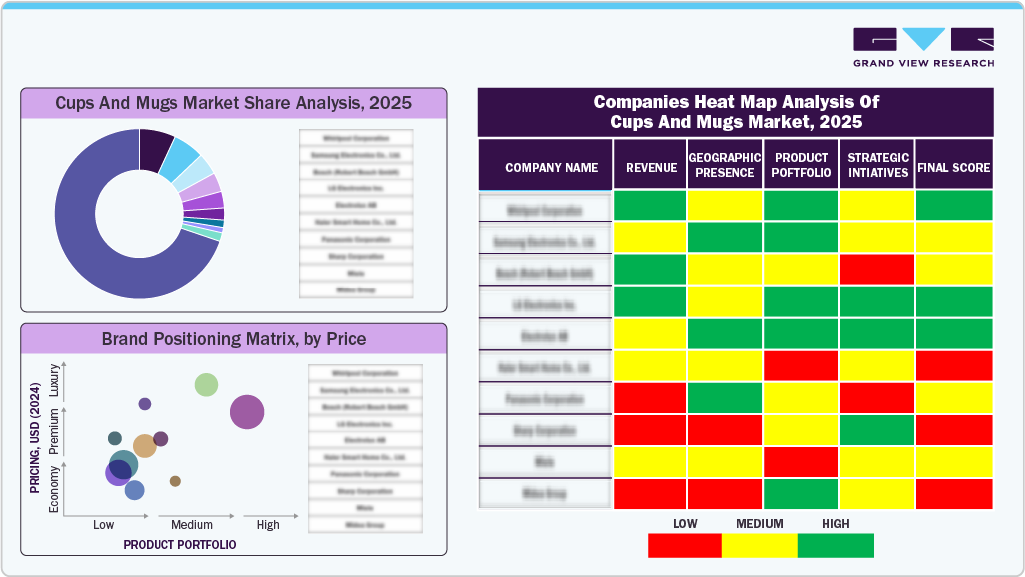
Established manufacturers and emerging brands in the cups and mugs market operate in a highly competitive landscape shaped by design differentiation, functional innovation, and pricing segmentation across mass, premium, and smart drinkware categories. Companies are increasingly competing on material quality, insulation performance, ergonomics, and visual appeal, offering a wide spectrum of products ranging from everyday ceramic mugs to insulated travel mugs and technology-enabled formats. Within the smart mug market and the temperature control smart mug market, competition is centered on heat precision, battery efficiency, charging convenience, and app integration, prompting frequent product upgrades and feature-led launches to maintain relevance.
 To learn more about this report, Download Free Sample Report
 Consumer Insights for Cabinet
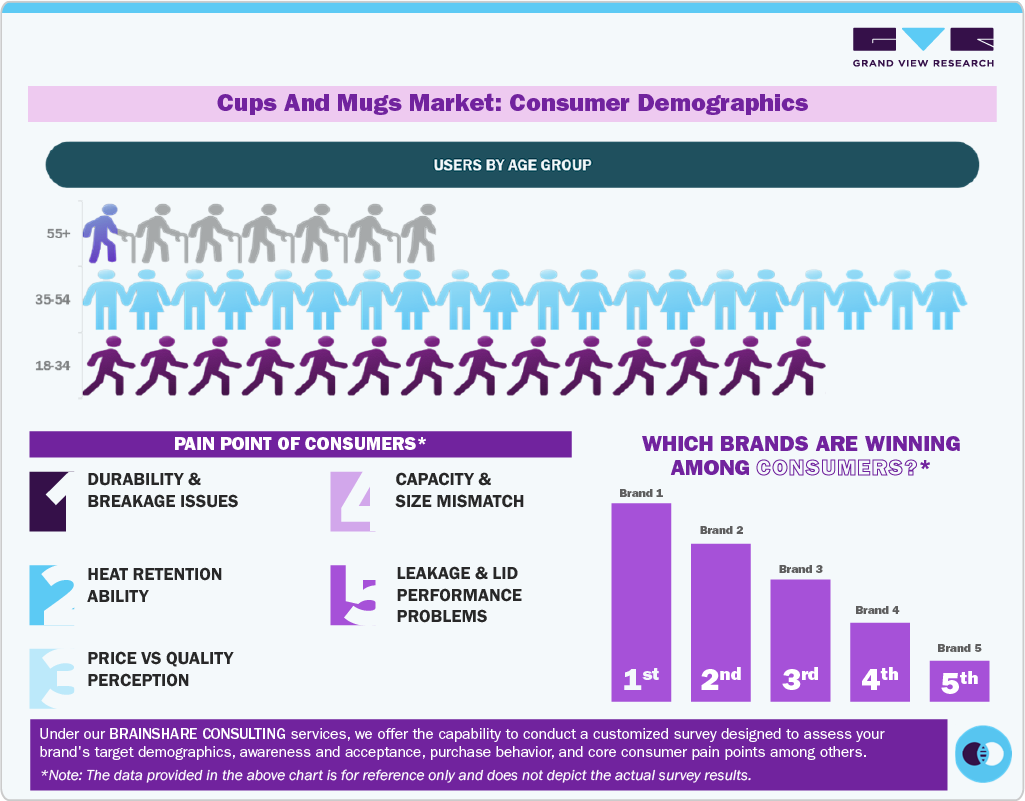
Consumer behavior in the cups and mugs market is strongly influenced by the sustained and frequent consumption of coffee across demographic groups, which drives repeat usage rather than occasional purchase. According to 2025 coffee consumption data, daily coffee drinking rates are highest among working-age adults, with 78% of people aged 35-44, 81% of those aged 45-54, and 79% of 55-64-year-olds reporting daily coffee consumption, while even younger adults (25-34 years) show a 75% daily rate. This broad engagement across key age segments translates into stronger demand for mugs and cups that can withstand repeated use throughout the day, whether for morning routines, office beverages, or social coffee sessions. The fact that a large share of adults drink multiple cups daily reinforces the role of cups and mugs as essential lifestyle goods rather than one-off household items.
 To learn more about this report, Download Free Sample Report
 At the same time, consumers are showing greater interest in product features that enhance the daily coffee experience, including durability, ergonomics, and tailored design. As specialty and at-home coffee routines continue to evolve, mugs are increasingly selected for their ability to match not just beverage type or temperature needs but also personal identity and habitual patterns. The high daily consumption rates among adults in prime working ages, such as those from 35 to 64, underscore why demand is skewing toward reusable, well-made mugs that elevate everyday routines and support repeat purchasing over simplistic or disposable alternatives.
Product Insights
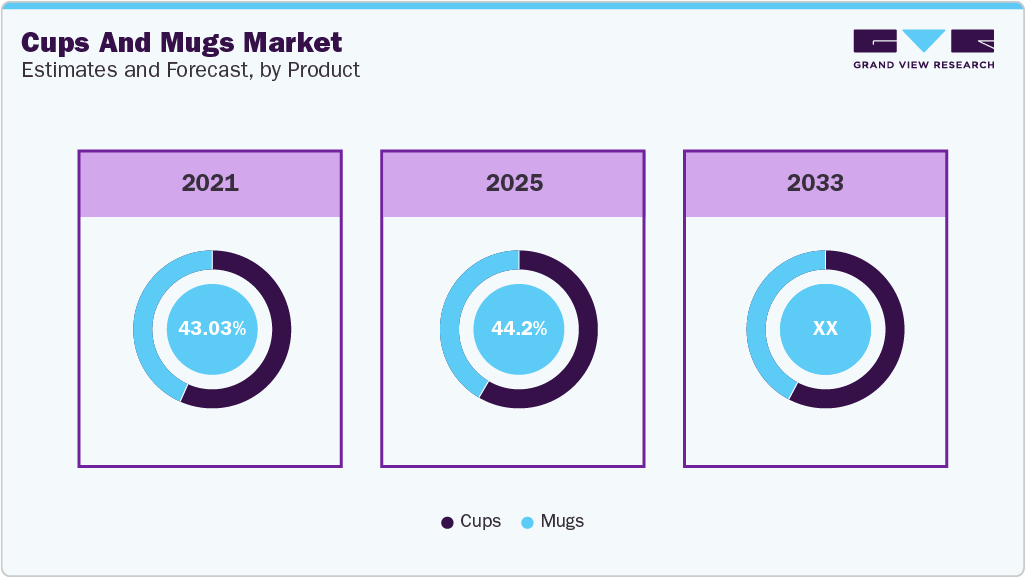
Cups accounted for a share of 55.71% of the global revenue in 2025, driven by style refresh and set-based purchasing behavior. Consumers frequently replace or add cups to maintain uniform sets, match updated tableware, or align with evolving kitchen aesthetics. Factors such as material feel, rim thickness, balance, and visual consistency within a set play a central role in selection. As dining and beverage consumption become more integrated into lifestyle presentation, cups continue to see consistent uptake as practical, repeat-purchase items rather than long-cycle durable goods.
 To learn more about this report, Download Free Sample Report
 Mugs are projected to grow at a CAGR of 6.1% from 2026 to 2033, driven by format innovation and lifestyle alignment, including insulated mugs, travel mugs, and products within the smart mug and temperature control smart mug market, which address common pain points such as frequent reheating and temperature loss. Consumers are increasingly upgrading mugs as part of small, everyday lifestyle improvements rather than full kitchen replacements, supporting steady replacement cycles.
Material Insights
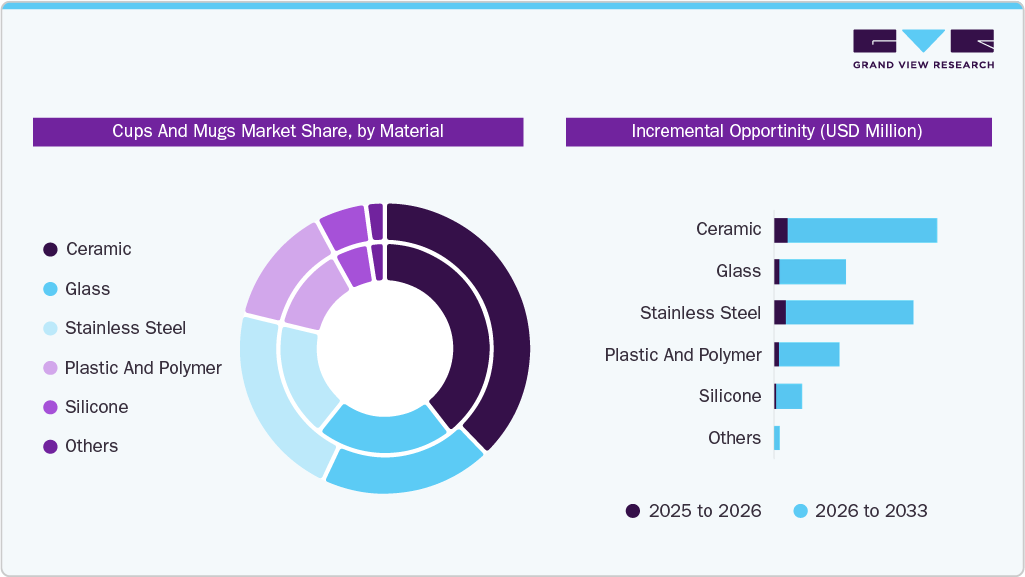
Ceramic cups and mugs accounted for a share of around 39.51% of the global revenue in 2025. The segment benefits from ceramics’ design flexibility, which allows manufacturers to offer a broad range of shapes, glazes, colors, and surface finishes, catering to both minimalist and decorative preferences. From classic white café mugs to artisanal, textured, and hand-glazed designs, ceramic formats adapt easily to changing interior and lifestyle trends. In addition, their compatibility with microwaves and dishwashers, combined with durability for regular use, continues to support strong adoption across both mass-market and premium product lines.
 To learn more about this report, Download Free Sample Report
 Stainless steel cups and mugs are projected to grow at a CAGR of 7.9% from 2026 to 2033. Stainless steel cups and mugs are preferred for temperature retention and portability, making them suitable for commuting, travel, and extended work hours. Insulated variants, including vacuum-sealed and double-wall designs, are seeing strong uptake among coffee and tea drinkers who value consistent beverage temperature without frequent reheating. Aesthetic improvements, such as matte finishes, brushed textures, and minimalist forms, are further expanding adoption in modern homes.
Capacity Insights
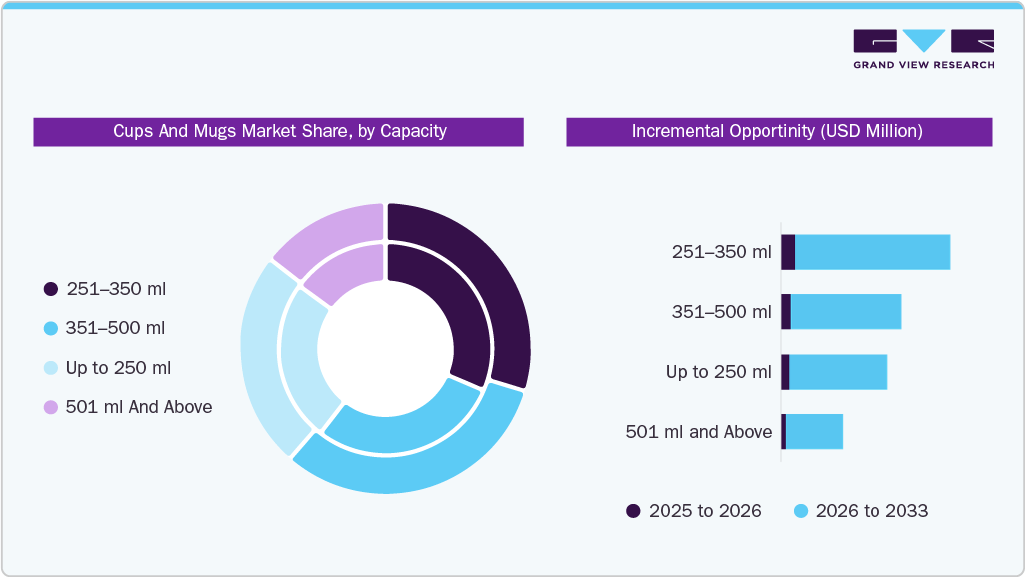
251-350 ml cups and mugs accounted for a share of around 31.41% of the global revenue in 2025, supported by their compatibility with coffee machines, beverage dispensers, and standard cup holders, which reinforces adoption across both residential and commercial settings. Consumers also favor this capacity during replacement and set-based purchases, as it fits seamlessly into existing kitchen storage and tableware collections.
 To learn more about this report, Download Free Sample Report
 351-500 ml cups and mugs are projected to grow at a CAGR of 6.5% from 2026 to 2033, driven by rising preference for larger beverage portions across workplaces, cafés, and home-office environments. This capacity range is increasingly favored by consumers who consume coffee, tea, or specialty beverages over longer periods, reducing the need for frequent refills during work or leisure. Demand is particularly strong in office pantries, hospitality settings, healthcare facilities, and retail cafés, where larger cup sizes align with convenience, productivity, and standardized serving practices.
Price Tier Insights
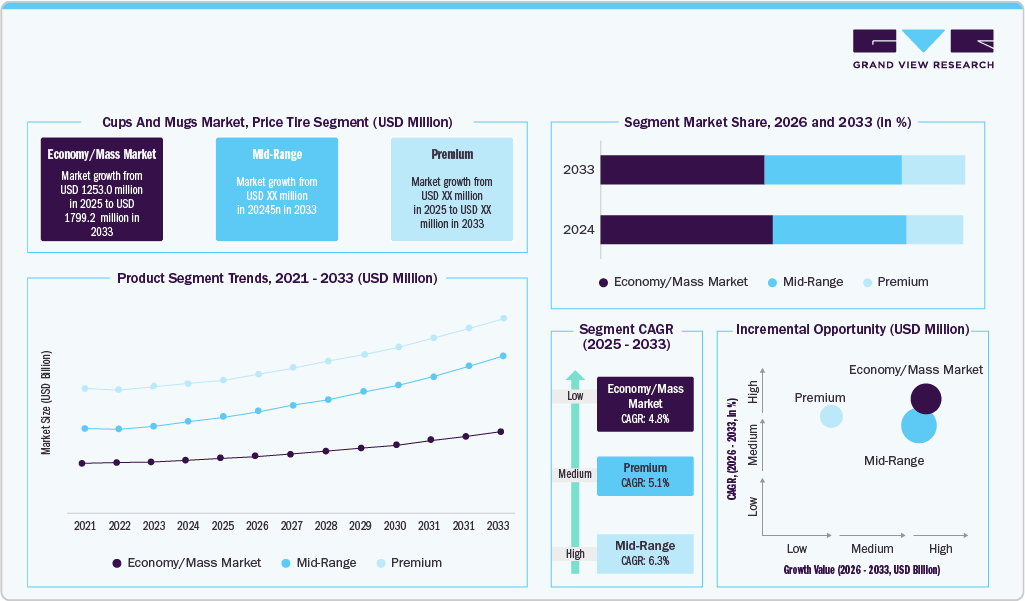
Economy/mass market cups and mugs accounted for a share of around 46.75% of the global revenue in 2025, driven by routine replacement demand across households, offices, institutional buyers, and foodservice operators, where affordability, availability, and functional reliability outweigh design differentiation. Mass-market cups and mugs are typically purchased in sets or bulk quantities, making them a preferred option for shared-use environments and large families. Standardized sizing, simple forms, and durable materials reduce switching costs and enable quick replacement without compatibility concerns. Widespread distribution through supermarkets, discount retailers, cash-and-carry stores, and online marketplaces further reinforces volume-led sales.
 To learn more about this report, Download Free Sample Report
 Mid-range cups and mugs are projected to grow at a CAGR of 6.3% from 2026 to 2033, driven by higher adoption across new residential developments, office infrastructure, and hospitality projects where drinkware is procured in coordinated sets. This price category is commonly selected for standard fit-outs and refurbishments, as it supports uniform appearance, adequate durability, and controlled replacement costs. Products in this range are widely used in shared-use environments, including rental housing, corporate pantries, cafés, and serviced apartments, where frequent handling and cleaning require dependable material performance.
Distribution Channel Insights
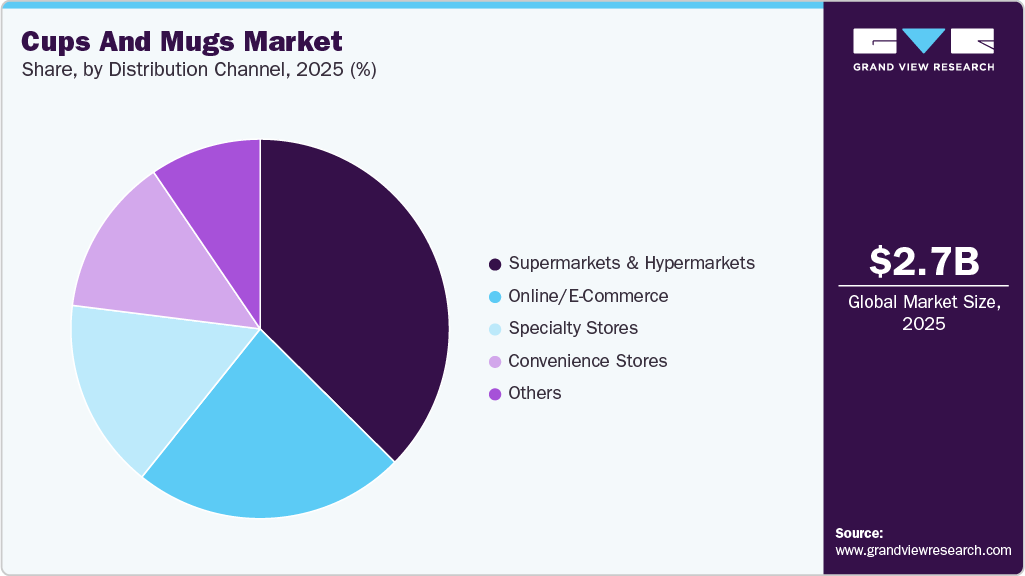
Sale of cups and mugs through supermarkets & hypermarkets accounted for a share of around 37.40% of the global revenue in 2025, reflecting the channel’s role as the primary point of purchase for everyday drinkware. These outlets support high-volume sales by offering broad assortments, consistent availability, and competitive pricing, which align with frequent replacement needs across households, workplaces, and foodservice users. Purchases through this channel are commonly set-based or bulk-oriented, supporting use in shared environments where uniformity and ease of replacement are important.
 To learn more about this report, Download Free Sample Report
 Sale of cups and mugs through online/e-commerce channel are projected to grow at a CAGR of 6.3% from 2026 to 2033, driven by increasing consumer preference for convenience, wider product choice, and price transparency. Online platforms allow buyers to compare designs, capacities, materials, and prices easily, supporting more informed purchasing decisions for both everyday use and gifting. Detailed product visuals, customer reviews, and doorstep delivery have further reduced reliance on physical stores, while brand-owned websites and marketplaces are expanding exclusive launches and customization options.
Regional Insights
 To learn more about this report, Download Free Sample Report
 North America Cups and Mugs Market Trends
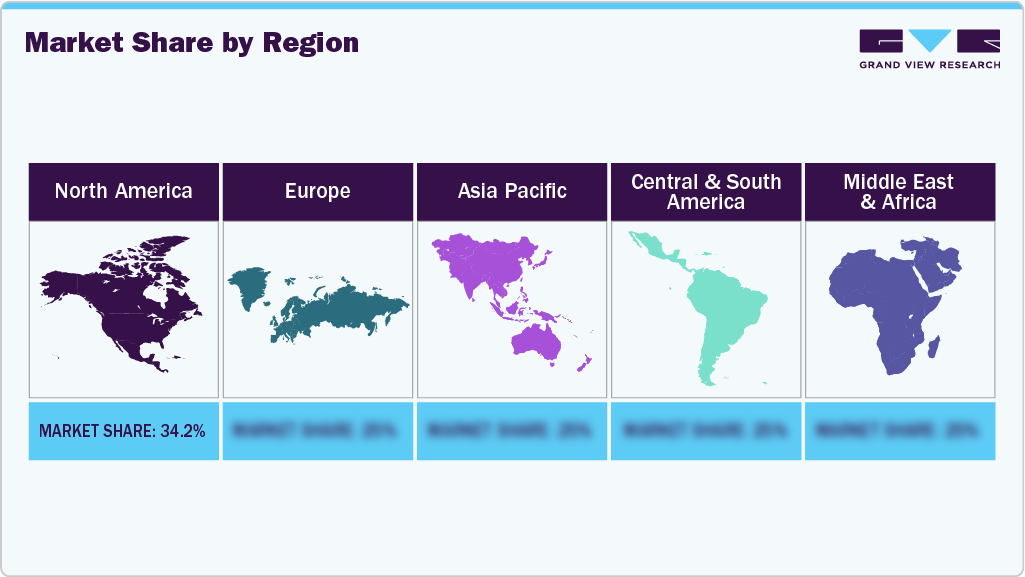
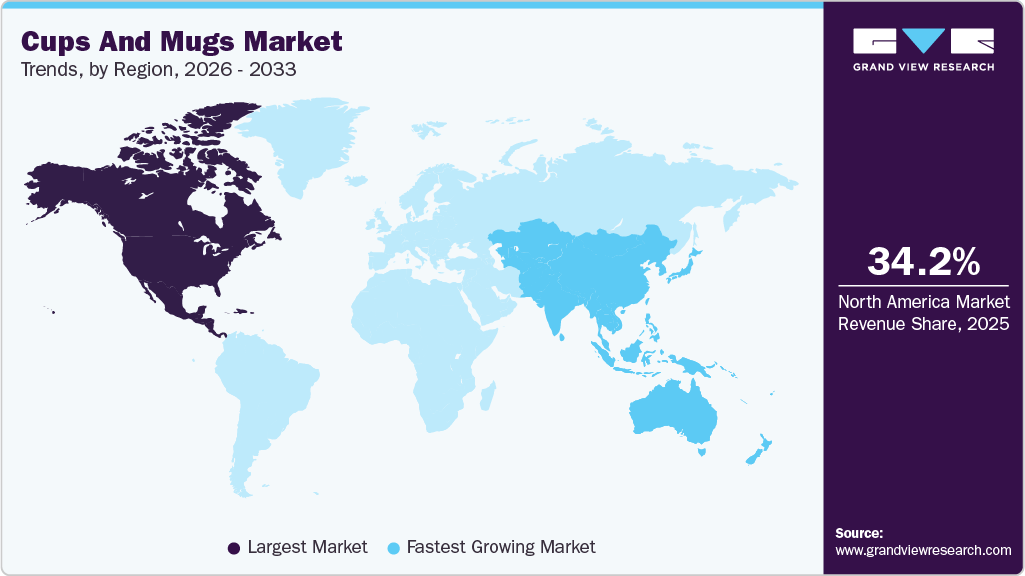
The cups and market in North America accounted for a share of 34.20% of the global revenue in 2025, driven by the region’s strong integration of drinkware into daily routines across home, work, and foodservice environments. The U.S. and Canada exhibit high penetration of single-serve beverage preparation, including drip coffee, pod machines, and specialty brewers, which sustains consistent demand for compatible cup and mug formats. Institutional usage across offices, universities, healthcare facilities, and quick-service restaurants further supports steady volume consumption.
 To learn more about this report, Download Free Sample Report
 The cups and mugs market in the U.S. is projected to grow at a significant CAGR from 2026 to 2033, supported by high-frequency beverage consumption and routine replacement behavior across households and workplaces. In the U.S., cups and mugs are regularly refreshed to match changing kitchen aesthetics, seasonal trends, and evolving lifestyle preferences, rather than being treated as long-term purchases.
Europe Cups and Mugs Market Trends
The cups and mugs market in Europe accounted for a share of 27.30% of the global revenue in 2025, reflecting the region’s structurally high consumption of hot beverages and long-established café and home-dining traditions. Demand is spread evenly across households, hospitality venues, offices, and institutional settings, creating a stable, multi-channel consumption base rather than reliance on a single end use sector. Replacement demand remains consistent due to frequent daily use, breakage, and the tendency to refresh drinkware sets as part of broader tableware updates.
The cups and mugs market UK is projected to grow at a significant CAGR 2026 to 2033, supported by strong at-home beverage consumption and evolving daily routines. Increased time spent working and dining at home has elevated the role of cups and mugs as high-use household essentials, leading to more frequent replacement and refresh cycles. British consumers regularly update drinkware to match changing kitchen styles, seasonal trends, and coordinated tableware sets, rather than treating cups and mugs as long-term purchases.
Asia Pacific Cups and Mugs Market Trends
The cups and mugs market in Asia Pacific is projected to grow at a CAGR of 6.2% from 2026 to 2033, supported by structural shifts in beverage consumption patterns across the region. Rising adoption of home coffee machines, instant beverage formats, specialty teas, and functional drinks is increasing the frequency of cup and mug usage across daily routines. This has led to higher replacement cycles, particularly in households where multiple beverage types are consumed throughout the day. Growth is also being reinforced by the rapid expansion of cafés, quick-service restaurants, co-working spaces, and corporate offices, especially in urban Asia. These environments require standardized, durable drinkware for high-turnover use, supporting bulk procurement of cups and mugs.
The cups and mugs market China accounted for the largest share of the Asia Pacific revenue in 2025, due to the country’s large-scale, routine use of drinkware across daily life and institutional settings. High population density, shared living arrangements, and extensive use of communal dining and break areas result in elevated consumption volumes and frequent replacement of cups and mugs. In many environments, drinkware is treated as a consumable item rather than a long-term household product, sustaining consistent demand throughout the year.
Central & South America Cups and Mugs Market Trends
The cups and mugs market Central & South America is projected to grow at a CAGR of 5.5% from 2026 to 2033, shaped by the region’s strong social dining culture and shared household usage patterns. In many markets across Brazil, Mexico, Colombia, and Argentina, cups and mugs are used intensively in multi-person households and extended family settings, leading to higher wear, breakage, and replacement frequency. Informal dining at home, frequent hosting, and everyday shared beverage consumption increase unit turnover compared with regions dominated by single-occupancy households.
Middle East & Africa Cups and Mugs Market Trends
The cups and mugs market Middle East & Africa is projected to grow at a CAGR of 2.7% from 2026 to 2033, supported by strong cultural reliance on hot beverage consumption and hospitality-led usage patterns across the region. Tea and coffee play a central role in daily routines and social interactions in countries across the Gulf, North Africa, and Sub-Saharan Africa, resulting in high-frequency use of cups and mugs within households and guest-facing environments. Regular hosting, communal gatherings, and extended family living arrangements contribute to higher ownership levels and recurring replacement demand.
Key Cups and Mugs Company Insights
The following are the leading companies in the cups and mugs market. These companies collectively hold the largest market share and dictate industry trends.
Key Cups and Mugs Companies:
The following key companies have been profiled for this study on the cups and mugs market.
- Stanley
- YETI Holdings, Inc.
- Hydro Flask
- Klean Kanteen
- S’well
- Villeroy & Boch AG
- Steelite International
- Starbucks Corporation
- Cello World Ltd.
- Thermos L.L.C
Recent Developments
-
In January 2026, Starbucks introduced a limited-edition lineup of winter-themed drinkware to kick off 2026, with designs inspired by seasonal moments like Lunar New Year and Valentine’s Day alongside everyday coffee rituals. Launching in participating Starbucks locations from January 6, the collection includes a range of tumblers, cold cups, and mugs, from hand-drawn, community-focused “Coffee for All” pieces to festive Lunar New Year and Valentine’s Day drinkware, all offered for a short time while supplies last.
-
In August 2025, Yeti restocked its popular ceramic-lined Rambler travel mugs, bringing back a product that previously sold out quickly and gained strong demand among fans. The mugs feature a ceramic interior designed to preserve drink taste while maintaining Yeti’s signature stainless-steel durability and insulation, and are available in multiple sizes at regular retail pricing.
Cups and Mugs Market Report Scope
Report Attribute
Details
Market size in 2025
USD 2.7 billion
Estimated market size in 2026
USD 2.8 billion
Projected market size by 2033
USD 4.0 billion
Growth rate
CAGR of 5.4% from 2026 to 2033
Actuals
2021 - 2025
Forecast period
2026 - 2033
Quantitative units
Revenue in USD million/billion, and CAGR from 2026 to 2033
Report coverage
Revenue forecast, company ranking, competitive landscape, growth factors, and trends
Segments covered
Product, material, capacity, price tier, distribution channel, and region
Regional scope
North America; Europe; Asia Pacific; Latin America; Middle East & Africa
Country scope
U.S.; Canada; Mexico; Germany; UK; France; Italy; Spain: China; Japan; India; South Korea; Australia & New Zealand; Brazil; South Africa
Key companies profiled
Stanley; YETI Holdings, Inc.; Hydro Flask; Klean Kanteen; S’well; Villeroy & Boch AG; Steelite International; Starbucks Corporation; Cello World Ltd.; Thermos L.L.C
Customization scope
Free report customization (equivalent up to 8 analysts’ working days) with purchase. Addition or alteration to country, regional & segment scope
Pricing and purchase options
Avail customized purchase options to meet your exact research needs. Explore purchase options
Global Cups And Mugs Market Report Segmentation
This report forecasts revenue growth at global, regional & country levels and provides an analysis of the latest trends and opportunities in each of the sub-segment from 2021 to 2033. For this study, Grand View Research has segmented the cups and mugs market on the basis of product, material, capacity, price tier, distribution channel, and region:
-
Product Outlook (Revenue, USD Million, 2021 - 2033)
-
Cups
-
Mugs
-
-
Material Outlook (Revenue, USD Million, 2021 - 2033)
-
Ceramic
-
Glass
-
Stainless Steel
-
Plastic and Polymer
-
Silicone
-
Others
-
-
Capacity Outlook (Revenue, USD Million, 2021 - 2033)
-
Up to 250 ml
-
251-350 ml
-
351-500 ml
-
501 ml and Above
-
-
Price Tier Outlook (Revenue, USD Million, 2021 - 2033)
-
Economy/Mass Market
-
Mid-Range
-
Premium
-
-
Distribution Channel Outlook (Revenue, USD Million, 2021 - 2033)
-
Supermarkets & Hypermarkets
-
Convenience Stores
-
Specialty Stores
-
Online/E-Commerce
-
Others
-
-
Regional Outlook (Revenue, USD Million, 2021 - 2033)
-
North America
-
U.S.
-
Canada
-
Mexico
-
-
Europe
-
Germany
-
UK
-
France
-
Italy
-
Spain
-
-
Asia Pacific
-
China
-
Japan
-
India
-
South Korea
-
Australia & New Zealand
-
-
Central & South America
-
Brazil
-
-
Middle East & Africa
-
South Africa
-
-
Frequently Asked Questions About This Report
The global cups and mugs market size was estimated at USD 2.7 billion in 2025 and is expected to reach USD 2.8 billion in 2026.
The global cups and mugs market is expected to grow at a compound annual growth rate of 5.4% from 2026 to 2033 to reach USD 4.0 billion by 2033.
Some key players in the global cups and mugs market include Stanley; YETI Holdings, Inc.; Hydro Flask; Klean Kanteen; S’well; Villeroy & Boch AG; Steelite International; Starbucks Corporation; Cello World Ltd.; Thermos L.L.C
Key factors driving the cups and mugs market include rising consumption of hot and cold beverages, increasing demand for reusable drinkware as a sustainable alternative to single-use cups, and frequent product launches featuring new designs, materials, and licensed themes that encourage repeat purchases across consumer segments.
The Ceramic cups and mugs segment led with a 39.5% revenue share in 2025.
251-350 ml cups and mugs held the largest revenue share 31.4% in 2025.
Economy/mass held the largest share (over 46.8%) in 2025.
North America dominated with a 34.2% revenue share in 2025.
Cups accounted for a share of 55.71% of the global revenue in 2025.
About the Author(s)
Homecare & Decor Research Team
Consumer Goods · Homecare & DecorThis report was authored by the homecare & decor research team at Grand View Research - comprising two research analysts, one senior research analyst, and one industry expert - with specialized expertise in the homecare & decor segment of the consumer goods industry. All findings are based on proprietary consumer goods databases, executive interviews, and regulatory analysis, subject to internal peer review prior to publication.
Last Updated:
Speak to Analyst

Customize this report to your needs - add regions, segments, or data points, with 20% free customization.
Or view our licence options:


ISO 9001:2015 & 27001:2022 Certified
We are GDPR and CCPA compliant! Your transaction & personal information is safe and secure. For more details, please read our privacy policy.


