
- Home
- »
- Homecare & Decor
- »
-
Cut Flowers Market Size, Share & Growth Report, 2026-2033GVR Report cover

Cut Flowers Market (2026 - 2033)
Size, Share & Trends Analysis Report By Flower Type (Rose, Chrysanthemum, Carnation, Gerbera, Lilium), By Application (Commercial, Residential/Household), By Distribution Channel, By Region, And Segment Forecasts
Market Size, 2025
$40.8BMarket Estimate, 2026
$42.7BMarket Forecast, 2033
$60.9BCAGR, 2026–2033
5.2%Cut Flowers Market Summary
The global cut flowers market size was valued at USD 40.8 billion in 2025 and is projected to grow from USD 42.7 billion in 2026 to USD 60.9 billion by 2033, at a CAGR of 5.2% from 2026 to 2033. Europe dominated the global market with the largest revenue share of 33.6% in 2025. The market is being propelled by the increasing use of flowers for everyday wellness, self-purchase, and home styling.
 Source: Grand View Research, IR Documents, Primary Interviews, Paid DatabasesTo learn more about this report,
 Download Free Sample Report
 Key Market Trends & Insights
- By distribution channel: Retail florists & flower shops accounted for the largest share of 42.0% of the global revenue in 2025.
- By flower type: Cut roses accounted for the largest share of 33.9% of the global revenue in 2025.
- By application: Commercial segment accounted for 77.1% of global revenue in 2025.
Regional Highlights
- Largest regional market: Europe (33.6% revenue share, 2025)
- Fastest-growing regional market: Asia Pacific (highest CAGR, 2026-2033)
- By country: Germany held the largest market share in 2025
Market Size & Forecast
- Market size in 2025: USD 40.8 Billion
- Estimated market size in 2026: USD 42.7 Billion
- Projected market size by 2033: USD 60.9 Billion
- CAGR (2026-2033): 5.2%
Three ways to get this report
Buy it, customize it, or ask a question.Ask an Analyst
Analyst response in 1 business day
- AccessReport author, directly
- Reply timeWithin 1 working day
- No sales callDirect answer only
- FormatEmail reply
- CostFree, no cost
Get the Full Report
What the study covers
- FormatsPDF · Excel · Dashboard
- Timeline2026–2033 annual, 2025 base
- Coverage20+ countries, 5 regions
- Companies10+ key players profiled
Customize the Report
20% free customization
- IncludeCountries, segments, points
- TailorTo your product definition
- ExtendDeeper competitor detail
- OrA fully bespoke study
- Turnaround5–10 working days
Consumers are buying fresh flowers more frequently to enhance their living spaces and improve their emotional well-being, rather than reserving purchases for special occasions. This behavioral shift is also supporting higher purchase frequency through digital retail channels. To learn more about this report, Download Free Sample Report
 Another major driver is the rapid digitalization of flower retail, supported by same-day delivery, live commerce, and direct-to-consumer sales models. Online platforms are making premium bouquets and customized floral arrangements more accessible while enabling florists to reach a wider customer base beyond traditional stores. According to the 2025 China Flower Association report, online channels accounted for approximately 54.5% of the country's flower retail sales in 2024, surpassing physical flower shops and becoming the industry's primary growth engine for the third consecutive year.
The market is also benefiting from growing consumer demand for sustainably sourced and traceable flowers, encouraging growers and retailers to invest in local sourcing, eco-friendly production, and responsible supply chains. Sustainability has become an important purchase consideration, particularly among younger consumers purchasing flowers for weddings and everyday use. According to a 2025 Associated Press report, Gen Z and Millennials are increasingly choosing locally grown, seasonal flowers over imported blooms to reduce environmental impact, reinforcing sustainability as a key growth driver for the global market.
Market Dynamics
The growing popularity of flowers as gifts and decorative items is a major driver of the market. Consumers increasingly purchase fresh flowers for birthdays, anniversaries, weddings, festivals, corporate gifting, and other special occasions due to their emotional and aesthetic appeal. The rising trend in personalized gifting and premium floral arrangements has further strengthened market demand in both developed and emerging economies.
The expansion of hospitality, tourism, and event management industries is also contributing significantly to market growth. Hotels, restaurants, convention centers, luxury retail outlets, and corporate offices regularly utilize cut flowers to enhance ambiance and customer experiences. In addition, rising urbanization and increasing consumer spending on home décor products have encouraged greater adoption of floral arrangements in residential settings. The growing influence of social media and lifestyle trends promoting visually appealing spaces is further stimulating demand for high-quality cut flowers globally.
The highly perishable nature of cut flowers remains one of the primary restraints affecting market growth. Cut flowers require strict temperature control, specialized packaging, and efficient transportation throughout the supply chain to maintain freshness and quality. Any disruptions in harvesting, storage, transportation, or distribution can result in significant product losses and reduced profitability for growers and distributors.
In addition, the market is highly susceptible to fluctuations in weather conditions, pest infestations, plant diseases, and climate-related challenges that can impact flower yields and quality. Rising transportation costs, labor shortages, and increasing energy expenses associated with greenhouse cultivation and cold storage infrastructure further create operational challenges for industry participants. These factors can lead to supply instability and price volatility, particularly in regions heavily dependent on flower imports and exports.
The rapid growth of e-commerce platforms and digital flower delivery services is creating significant market opportunities. Consumers increasingly prefer the convenience of online ordering, same-day delivery services, subscription-based floral offerings, and customized bouquet options. Digital platforms are enabling growers, wholesalers, and retailers to expand their customer reach while offering personalized purchasing experiences that enhance consumer engagement.
Growing interest in sustainable and environmentally responsible floriculture is also creating new avenues for growth for market participants. Consumers are increasingly seeking locally sourced flowers, eco-friendly packaging, and flowers produced using sustainable cultivation practices with reduced chemical inputs. In response, producers are investing in water-efficient irrigation systems, renewable energy-powered greenhouses, and certified sustainable farming methods. In addition, rising demand for premium exotic flowers, specialty floral arrangements, and year-round flower availability through advanced greenhouse technologies is expected to support long-term market expansion.
Analyst Perspective
The cut flowers industry is benefiting from rising consumer spending on gifting, celebrations, home décor, and premium floral arrangements, supported by the expansion of e-commerce and same-day delivery services. Demand is increasingly shifting toward high-quality, sustainably sourced, and customized floral products, creating opportunities for growers and distributors to differentiate through freshness, variety, and supply chain efficiency. The market remains highly dependent on logistics, cold-chain infrastructure, and seasonal production cycles, making operational excellence a critical competitive factor. Going forward, companies that integrate digital ordering platforms, sustainable cultivation practices, and efficient global distribution networks are expected to capture the strongest long-term growth opportunities.
Consumer Insights
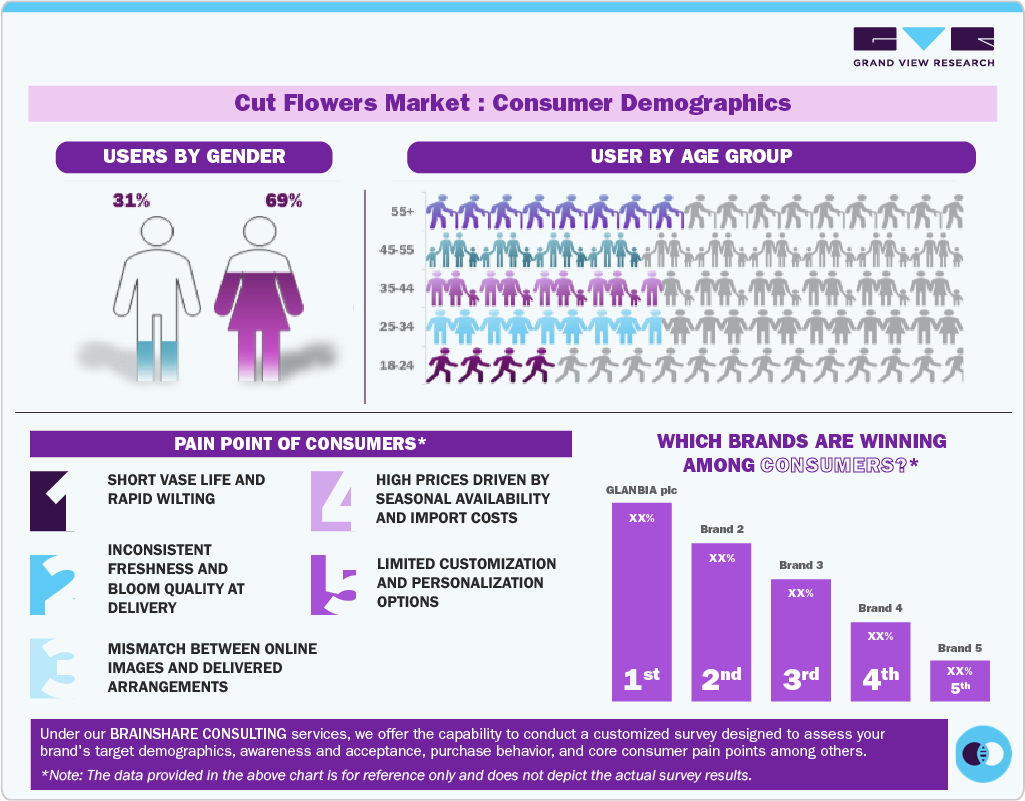
Consumers are increasingly purchasing cut flowers as everyday lifestyle products rather than exclusively for traditional gifting occasions. Fresh flowers are being used to enhance home décor, improve mood, celebrate personal milestones, and create meaningful everyday experiences, while social media and floral design inspiration continue to influence bouquet styles and purchasing preferences. Consumers also place greater emphasis on freshness, flower quality, convenience, and reliable delivery, leading to growing demand for florist-designed arrangements, subscription services, and online ordering platforms. Women remain the dominant purchasers of cut flowers, accounting for most purchases, reflecting their stronger engagement in both self-purchasing and gifting.
 To learn more about this report, Download Free Sample Report
 Consumer purchasing patterns also vary significantly across age groups. Baby Boomers represent the most valuable consumer segment due to their higher purchase frequency, stronger appreciation for flowers, and greater spending on birthdays, anniversaries, sympathy occasions, and personal enjoyment. Meanwhile, Millennials and Generation Z are helping reshape the market by purchasing flowers more spontaneously, favoring seasonal blooms, locally sourced products, sustainable packaging, and personalized floral arrangements discovered through digital platforms and social media. Across generations, emotional value, aesthetic appeal, and the desire to strengthen personal connections continue to influence purchasing decisions, reinforcing flowers as products that combine sentiment, wellness, and lifestyle expression.
Flower Type Insights
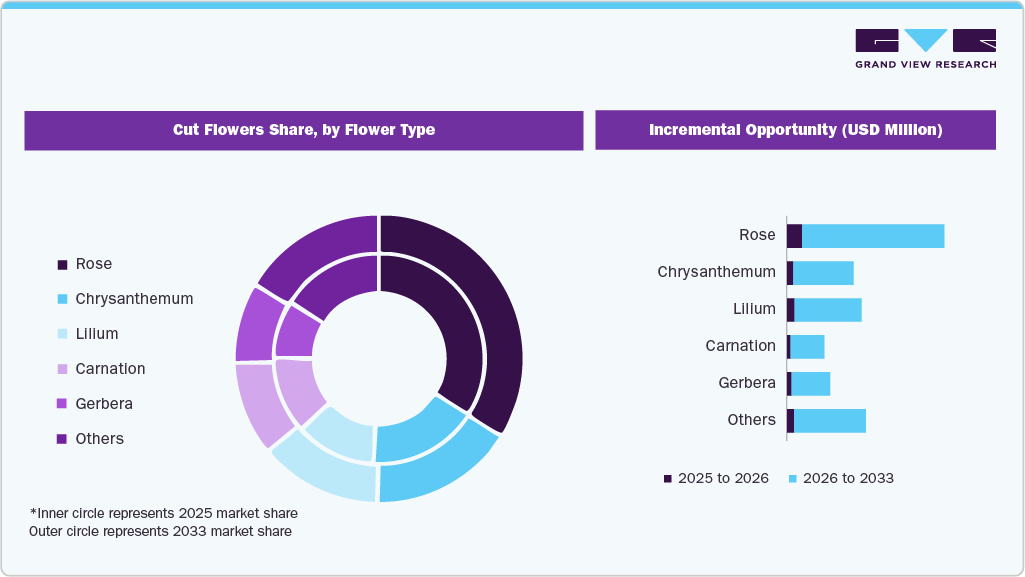
The cut roses market accounted for 33.9% of global revenue in 2025. Roses represent the most commercially significant category in the market owing to their broad consumer appeal, premium positioning, and consistent year-round demand. The flower's association with expressions of affection, celebration, appreciation, and remembrance has enabled it to maintain a strong presence across both developed and emerging markets. The demand for cut roses is supported by their extensive use in weddings, festivals, corporate events, luxury hospitality settings, and seasonal gifting occasions such as Valentine's Day, Mother's Day, and anniversaries.
 To learn more about this report, Download Free Sample Report
 The cut lilium market is projected to grow at a CAGR of 6.5% from 2026 to 2033, valued for its large blooms, distinctive fragrance, elegant appearance, and strong decorative appeal. The flower is widely utilized in luxury bouquets, wedding arrangements, event decorations, hospitality settings, religious ceremonies, and corporate floral displays. Due to its premium positioning and high aesthetic value, Lilium commands higher average selling prices than many conventional cut flower varieties, making it an important revenue contributor within the floriculture industry.
Application Insights
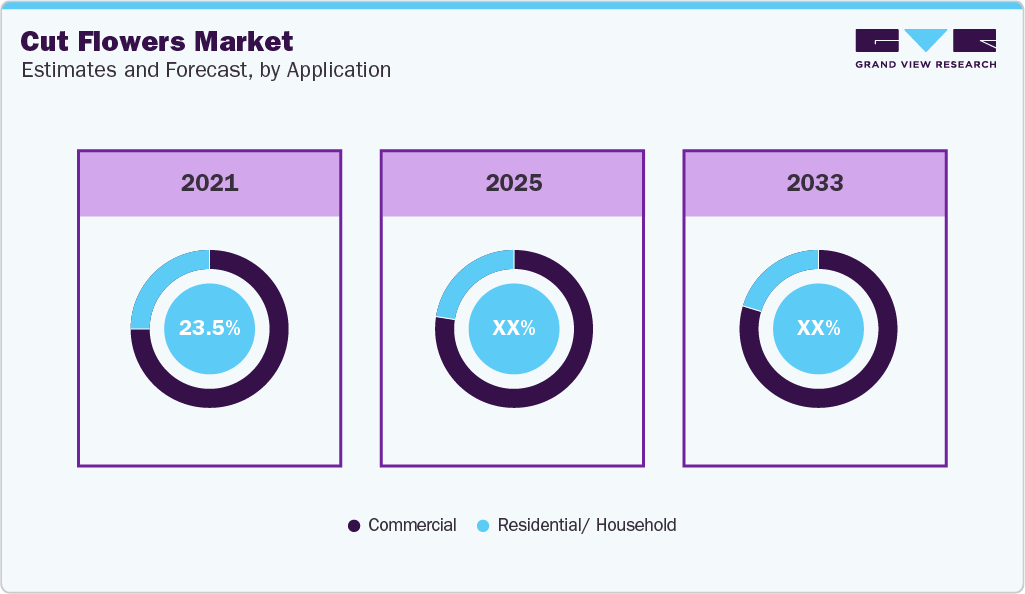
The commercial segment accounted for 77.1% of global revenue in 2025, driven by recurring demand for fresh floral arrangements in hospitality and event settings. Hotels, restaurants, and resorts use flowers to enhance customer experience and strengthen brand image, while weddings and corporate events generate substantial seasonal demand for premium varieties such as roses, lilies, orchids, gerberas, and carnations.
 To learn more about this report, Download Free Sample Report
 The residential/household segment is projected to grow at a CAGR of 4.6% from 2026 to 2033. The segment continues to benefit from rising consumer interest in home decor, wellness-oriented lifestyles, and personalized gifting. The growing popularity of online flower delivery platforms has further improved access to fresh flowers, enabling consumers to conveniently purchase them for everyday use and special occasions alike. In addition, social media trends and increasing consumer spending on experiential and aesthetic products are encouraging more frequent flower purchases, supporting sustained demand from residential/household customers across global markets.
Distribution Channel Insights
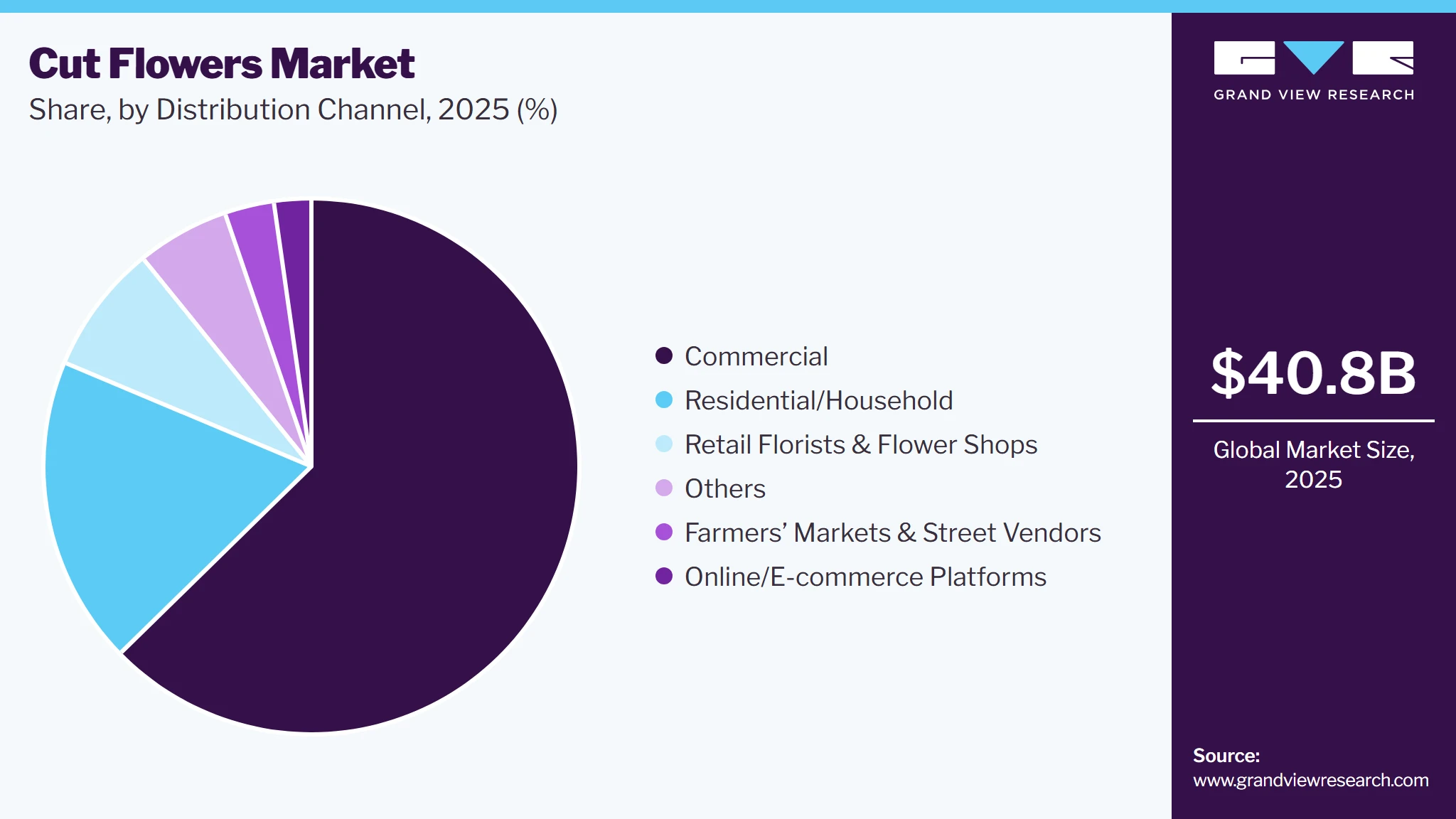
Sales of cut flowers through retail florists & flower shops accounted for a share of 42.0% of the global revenue in 2025. This channel plays a crucial role in the last-mile delivery of flowers to households, particularly in urban areas where consumers prefer professionally arranged bouquets. Retail florists also act as intermediaries between wholesalers and end consumers, ensuring quick turnover of fresh flowers and maintaining quality standards. Despite growing competition from supermarkets and e-commerce platforms, flower shops continue to remain relevant due to their specialized service, emotional value, and customization capabilities.
 To learn more about this report, Download Free Sample Report
 Sales of cut flowers through online/e-commerce platforms are projected to grow at a CAGR of 7.6% from 2026 to 2033. The online/e-commerce segment is experiencing rapid expansion as consumers increasingly purchase flowers for gifting and personal use through digital channels offering same-day delivery, subscription services, and customizable bouquets. AI-powered recommendations, real-time order tracking, seamless mobile purchasing, and partnerships with local florists are further enhancing customer convenience and driving higher online flower sales across both established and emerging markets.
Regional Insights
The cut flowers market in North America accounted for 28.3% of the global market in 2025. Consumers are demonstrating greater interest in year-round floral subscriptions, personalized bouquet services, and sustainably sourced blooms. Demand is particularly strong for premium roses, lilies, tulips, ranunculus, and specialty seasonal flowers, while younger consumers are driving purchases through digital platforms and direct-to-consumer floral brands. Environmental awareness is also influencing purchasing decisions, encouraging retailers to promote locally grown and traceable flower varieties.
U.S. Cut Flowers Market Trends
The cut flowers market in the U.S. accounted for the largest revenue share of around 76.9% in 2025. The market is characterized by strong consumer demand for event-driven and premium floral products, with purchasing patterns heavily influenced by major floral holidays such as Valentine’s Day, Mother’s Day, Easter, and Thanksgiving. The country remains highly dependent on imports from Colombia and Ecuador; however, consumer interest in domestically grown flowers is rising, particularly through the "Slow Flowers" movement that promotes seasonal and locally sourced blooms. Demand is increasing for specialty cut flowers such as dahlias, ranunculus, lisianthus, zinnias, peonies, and heirloom garden roses, especially among wedding planners, boutique florists, and upscale consumers seeking distinctive floral aesthetics.
Europe Cut Flowers Market Trends
The cut flowers market in Europe led the global market, with the largest revenue share of 33.6% in 2025. The market is undergoing a transformation driven by sustainability, traceability, and premium floral experiences. Consumers are increasingly seeking flowers certified under environmental and ethical sourcing standards, encouraging retailers and growers to adopt transparent supply chains. Subscription-based flower delivery services are gaining popularity across urban centers, allowing consumers to receive curated seasonal bouquets regularly rather than purchasing flowers only for special occasions. Demand is also shifting toward distinctive varieties such as garden roses, ranunculus, anemones, and specialty tulips that offer unique aesthetics and longer vase life. In March 2025, Hilverda Florist announced the commercial market launch of Dianthus Picture Perfect, a new Dianthus variety developed for both florists and retail consumers. The variety offers a distinctive color combination, extended vase life, abundant flowering, and improved shelf performance, addressing growing demand for premium and visually differentiated flowers.
 To learn more about this report, Download Free Sample Report
 Germany cut flowers market accounted for the largest revenue share of around 21.9% in 2025, driven by high per-capita flower consumption, a well-established florist and supermarket distribution network, and strong demand for premium bouquets for everyday purchases and seasonal occasions. The country's advanced cold-chain infrastructure and its role as a major European import and re-export hub through the Dutch flower trade ensure year-round availability of fresh flowers. Growing consumer preference for sustainably certified and locally sourced blooms is further supporting sales across both retail and online channels.
The cut flowers market in France is projected to grow at a CAGR of 4.1% from 2026 to 2033, driven by a growing preference for locally cultivated flowers, artisanal floral design, and premium botanical products that reflect the country’s strong appreciation for aesthetics and craftsmanship. The purchasing decisions are heavily influenced by durability and sustainability certifications. French consumers place greater emphasis on floral originality, seasonality, and design appeal. Demand is supported by gifting occasions, weddings, hospitality establishments, and everyday floral purchases, with consumers increasingly selecting flowers as part of their lifestyle and decorative expression.
Asia Pacific Cut Flowers Market Trends
The cut flowers market in the Asia Pacific is projected to grow at a CAGR of 6.5% from 2026 to 2033. The market is experiencing robust growth, driven by rising consumer spending on gifting and lifestyle products. Driven by a strong cultural affinity for floral usage across celebrations and ceremonial occasions, demand across the Asia Pacific is heavily influenced by weddings, festivals, corporate gifting, and the rising positioning of flowers as premium lifestyle products. Countries such as China, India, Japan, South Korea, Thailand, and Australia are witnessing increased consumption of fresh flowers for weddings, festivals, hospitality venues, and luxury retail environments. Consumers are increasingly seeking visually distinctive flowers, exotic varieties, and premium floral arrangements that reflect personal expression and social status.
China cut flowers market led the Asia Pacific market, accounting for 34.9% of the regional revenue in 2025. The market is witnessing strong demand for compact floral arrangements designed for apartment living, while premium gifting remains concentrated on occasions such as the Qixi Festival, Lunar New Year, and Valentine’s Day. Consumers are also showing increasing preference for aesthetically curated bouquets inspired by social media trends, driving demand for imported flowers and visually distinctive varieties that offer exclusivity and design appeal.
The cut flowers market in India is projected to grow at a CAGR of 7.8% from 2026 to 2033. The market is expanding steadily, supported by the rapid growth of the wedding industry, increasing corporate event spending, and rising demand for premium floral décor in urban centers. Flower consumption in India remains heavily influenced by social functions, religious ceremonies, and large-scale celebrations. Demand for cut flowers is particularly strong during weddings, festivals, temple offerings, and hospitality events, creating significant opportunities for both traditional and premium flower categories.
Central & South America Cut Flowers Market Trends
The cut flowers market in CSA is projected to grow at a CAGR of 5.3% from 2026 to 2033, supported by its established position as a leading global production and export base and rising urban consumption across major metropolitan areas. Market dynamics are heavily influenced by large-scale floriculture cultivation in high-altitude and climate-stable growing zones, enabling consistent year-round production and strong competitiveness in international trade. Demand is shaped by a combination of cultural traditions, ceremonial use, and event-driven purchasing patterns, with flowers playing a central role in social gatherings, religious observances, weddings, and commemorative occasions.
Middle East & Africa Cut Flowers Market Trends
The cut flowers market in MEA is projected to grow at a CAGR of 5.6% from 2026 to 2033. The market is evolving into a high-value, import-dependent floral consumption region, with strong demand concentrated in luxury hospitality, religious gatherings, ceremonial events, and premium gifting. The production strength and export infrastructure dominate the market structure. This region relies heavily on imported flowers for high-quality, exotic varieties, particularly for use in upscale hotels, event venues, and corporate functions. Floral demand is strongly influenced by social celebrations, weddings, and religious festivities, where large-scale decorative installations and premium floral arrangements play a central role.
Key Cut Flowers Company Insights
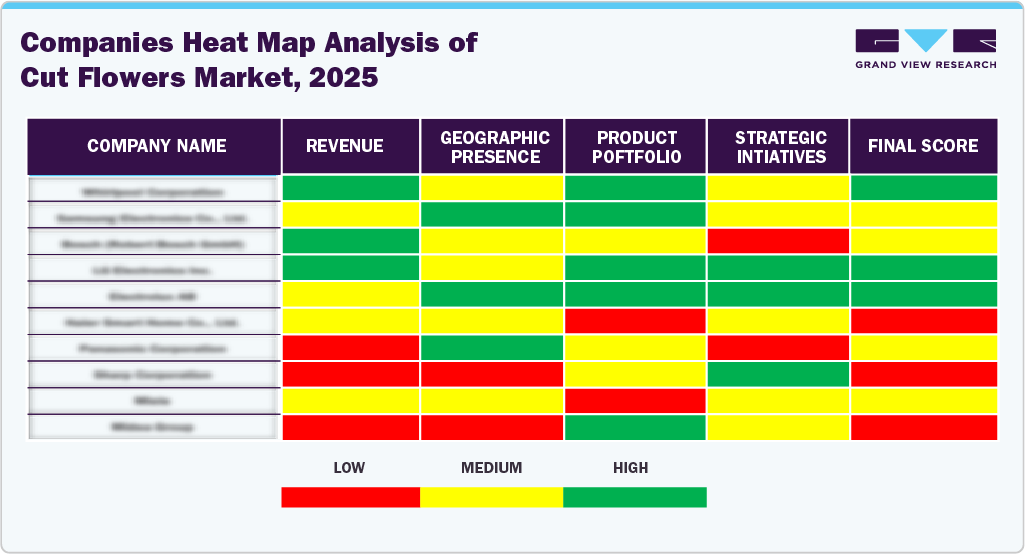
The global market is highly competitive, with international growers, exporters, breeders, and floral distributors competing on flower quality, varietal innovation, supply chain efficiency, and year-round product availability. Leading companies are strengthening their market position by investing in greenhouse cultivation, post-harvest preservation technologies, cold-chain logistics, and sustainable production practices to extend vase life and reduce spoilage during transportation. Product differentiation is increasingly centered on premium rose varieties, seasonal and exotic blooms, certified sustainable flowers, and customized floral assortments tailored for retail, e-commerce, supermarkets, and event floristry. Companies are also expanding their global sourcing networks and direct-to-retail partnerships to ensure a consistent supply while responding to rising demand for ethically sourced and environmentally responsible flowers.
-
Dutch Flower Group (DFG) is one of the world's leading floriculture companies, specializing in the sourcing, distribution, and marketing of fresh cut flowers and bouquets. Through its global grower network, advanced cold-chain logistics, and direct partnerships with supermarkets, wholesalers, florists, and e-commerce retailers, the company ensures year-round supply while emphasizing sustainable sourcing and efficient floral distribution.
-
Selecta Cut Flowers SAU is one of the leading players in the global market, specializing in the breeding, production, and international distribution of premium ornamental flowers and plant varieties. The company focuses on developing high-quality flower cultivars with enhanced color, bloom uniformity, disease resistance, and longer vase life. Through advanced breeding programs, sustainable cultivation practices, and a strong international production network, Selecta continues to strengthen its presence across wholesale, retail, and professional floristry markets.
 To learn more about this report, Download Free Sample Report
Key Cut Flowers Companies
The following key companies have been profiled for this study on the cut flowers market
-
Dutch Flower Group B.V. (DFG)
-
Rosebud Ltd.
-
Dümmen Orange Group B.V.
-
Multiflora Corp
-
Syngenta Flowers (Syngenta AG)
-
Selecta One Group
-
Afriflora Sher Ethiopia PLC
-
Washington Bulb Company, Inc.
-
Marginpar B.V.
-
The Queen’s Flowers Corp.
Competitive Benchmarking
Category
Operating Strategies
Competitive Edge
Weakness
Established Players (Dümmen Orange Holding BV; Selecta Cut Flowers SAU; Esmeralda Farms LLC; Sher Holland BV; Marginpar BV)
Expand global cultivation, breeding, and distribution networks through investments in greenhouse technologies, logistics infrastructure, and international wholesale partnerships.
Focus on developing premium flower varieties, year-round production capabilities, sustainability certifications, and direct relationships with retailers, supermarkets, florists, and event management companies.
Strong global supply chains, extensive breeding expertise, and diversified product portfolios across multiple flower species and geographic markets.
Established relationships with large-scale buyers, advanced cultivation technologies, and the ability to maintain consistent product quality and supply throughout the year.
High exposure to fluctuations in transportation costs, labor expenses, and climate-related production risks.
Significant capital requirements for greenhouse operations, cold-chain logistics, and compliance with international phytosanitary and sustainability standards.
Emerging & Regional Players (The Queen’s Flowers Corp; Multiflora Corp; Rosebud Ltd; Karen Roses Ltd; Washington Bulb Co Inc)
Focus on specialty flowers, premium roses, seasonal offerings, and customized floral solutions targeting regional wholesalers, florists, and event organizers.
Leverage sustainable farming practices, niche product positioning, and flexible production strategies to address changing consumer preferences and local market demand.
Greater agility in responding to floral design trends, seasonal demand patterns, and customer-specific requirements.
Strong regional expertise, specialized flower varieties, and the ability to provide differentiated products for weddings, celebrations, and premium gifting applications.
Limited geographic reach, smaller production capacities, and lower bargaining power within global distribution networks.
Greater vulnerability to weather conditions, supply chain disruptions, and pricing pressures from large multinational flower producers and exporters.
Recent Developments
-
In June 2026, Selecta One presented new ornamental plant varieties at FlowerTrials 2026, including the ‘Red around the clock’ Dianthus variety and the GRANDE series of large-flowered carnations. The introduction targets professional cut flower growers and export markets, reinforcing its focus on high-performing, market-ready floriculture solutions.
-
In May 2026, Syngenta Group announced the divestment of its Flowers business to a strategic joint venture with Dümmen Orange, marking a major consolidation move in the global cut-flower breeding and propagation sector. The transaction combines Syngenta’s flower portfolio with Dümmen Orange’s strong cut-flower genetics platform to form a larger, integrated ornamental business focused on R&D, production, and commercial scale across international floriculture markets.
-
In March 2026, Dümmen Orange expanded its presence in Latin America by opening The Orange Garden in Bogotá, Colombia, a centralized hub for cut flower genetics and innovation. The expansion brings together the company’s full cut flower portfolio, including roses, carnations, chrysanthemums, gerberas, callas, and Limonium, while enhancing technical support and strengthening access for growers in one of the world’s leading floriculture regions.
-
In December 2025, Dutch Flower Group (DFG) announced an agreement to acquire Adomex, subject to regulatory approval. The acquisition is expected to strengthen DFG’s position in foliage and filler flowers while enhancing its supply capabilities for wholesalers, exporters, bouquet makers, and florists across international markets.
Cut Flowers Market Report Scope
Report Attribute
Details
Market size in 2025
USD 40.8 billion
Estimated market size in 2026
USD 42.7 billion
Projected market size by 2033
USD 60.9 billion
Growth rate
CAGR of 5.2% from 2026 to 2033
Actuals
2021 - 2025
Forecast period
2026 - 2033
Quantitative units
Revenue in USD billion and CAGR from 2026 to 2033
Report coverage
Revenue forecast, company ranking, competitive landscape, growth factors, and trends
Segments covered
Flower type, application, distribution channel, region
Regional scope
North America; Europe; Asia Pacific; CSA; MEA
Country scope
U.S.; Canada; Mexico; Germany; UK; France; Italy; Spain; China; Japan; India; South Korea; Australia & New Zealand; Brazil; South Africa
Key companies profiled
Dutch Flower Group B.V. (DFG); Rosebud Ltd.; Dümmen Orange Group B.V.; Multiflora Corp; Syngenta Flowers (Syngenta AG); Selecta One Group; Afriflora Sher Ethiopia PLC; Washington Bulb Company, Inc.; Marginpar B.V.; The Queen’s Flowers Corp
Customization scope
Free report customization (equivalent up to 8 analysts’ working days) with purchase. Addition or alteration to country, regional & segment scope.
Pricing and purchase options
Avail customized purchase options to meet your exact research needs. Explore purchase options
Global Cut Flowers Market Report Segmentation
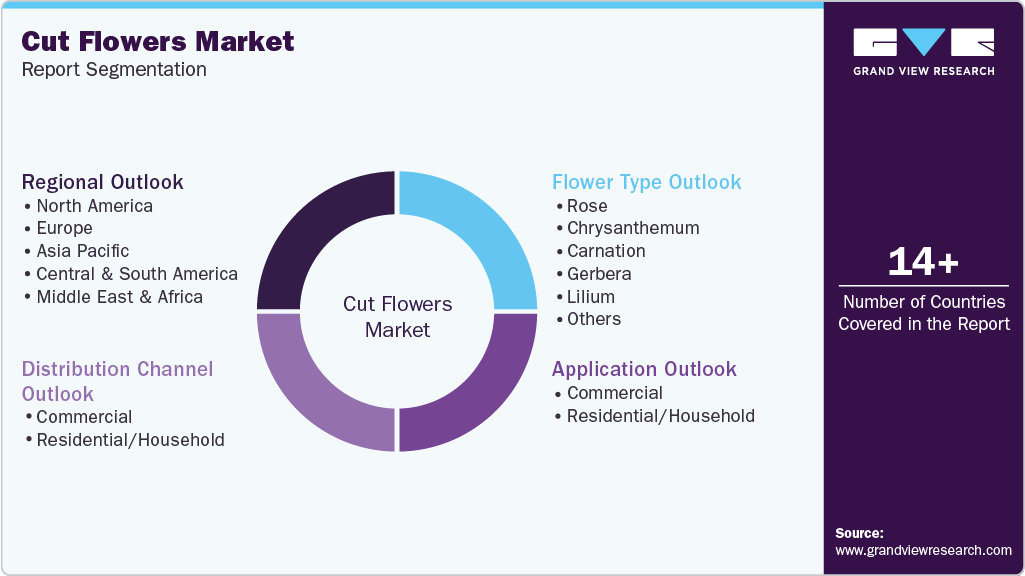
This report forecasts revenue growth at the global, regional & country levels and provides an analysis of the latest trends and opportunities in each sub-segment from 2026 to 2033. For this study, Grand View Research has segmented the global cut flowers market report based on flower type, application, distribution channel, and region:
 To learn more about this report, Download Free Sample Report
 -
Flower Type Outlook (Revenue, USD Billion, 2021 - 2033)
-
Rose
-
Chrysanthemum
-
Carnation
-
Gerbera
-
Lilium
-
Others
-
-
Application Outlook (Revenue, USD Billion, 2021 - 2033)
-
Commercial
-
Residential/Household
-
-
Distribution Channel Outlook (Revenue, USD Billion, 2021 - 2033)
-
Retail Florists & Flower Shops
-
Farmers’ Markets & Street Vendors
-
Online/E-commerce Platforms
-
Others
-
-
Regional Outlook (Revenue, USD Billion, 2021 - 2033)
-
North America
-
U.S.
-
Canada
-
Mexico
-
-
Europe
-
Germany
-
UK
-
France
-
Italy
-
Spain
-
-
Asia Pacific
-
China
-
Japan
-
India
-
South Korea
-
Australia & New Zealand
-
-
Central & South America
-
Brazil
-
-
Middle East & Africa
-
South Africa
-
-
Research Methodology
The cut flower market figures in this report are based on a proven research process that combines executive interviews with secondary research from proprietary databases, company filings, and recognized regulatory and institutional sources. Market size is built through value-chain sizing, reconciling supply-side and demand-side estimates, and triangulated with bottom-up and top-down approaches. Every estimate passes multiple levels of expert validation before publication, with each cut flower segment quantified using the revenue-capture definitions in the table below.
Segment Definition
Segment - Flower Type
Revenue capture definition
Rose
The scope covers cut roses traded in domestic and international markets, including standard, spray, and premium varieties. It includes flowers supplied for bouquets, floral arrangements, gifting, events, retail sales, and decorative applications. Revenue generated from fresh-cut roses across both commercial and household consumption channels is included in this segment.
Chrysanthemum
This segment covers fresh-cut chrysanthemum flowers marketed in various colors, shapes, and stem lengths. The study includes their use in floral decorations, bouquets, ceremonies, retail floristry, and event arrangements. Commercial cultivation, distribution, and sales of cut chrysanthemums through organized and unorganized channels are included in the market scope.
Carnation
The carnation segment encompasses fresh-cut standard and spray carnations supplied for floral design, gifting, celebrations, and decorative purposes. The scope includes cultivation output entering commercial supply chains, wholesale flower markets, florists, supermarkets, and online platforms. Revenue from both domestic consumption and export-oriented carnation sales is covered.
Gerbera
This segment includes fresh-cut gerbera flowers used in bouquets, floral arrangements, event decorations, and retail flower sales. The scope covers different gerbera varieties, stem grades, and color categories distributed through commercial channels. Market estimates account for revenues generated from professional florists, retailers, and direct consumer purchases.
Lilium
The lilium segment covers fresh-cut lily flowers sold for ornamental and decorative applications across residential and commercial settings. The study includes Asiatic, Oriental, and hybrid lily varieties supplied through wholesale, retail, and online distribution networks. Revenue associated with fresh-cut lilium sales for events, gifting, and floral design is included.
Others
This category includes all other cut-flower varieties, such as orchids, tulips, hydrangeas, sunflowers, alstroemerias, and mixed specialty flowers. The scope covers commercial production, distribution, and retail sales of these flowers across various end-use applications. Revenue generated from fresh-cut flowers not classified under the major product categories is considered.
Estimation Model
Layer
Key Question
Description
Floral Demand Layer
Who needs cut flowers?
Begin with the global population participating in gifting, celebrations, weddings, religious ceremonies, corporate events, hospitality decoration, and home décor activities. Apply flower consumption and floral gifting rates to identify the potential customer base requiring cut flowers.
Market Accessibility Layer
Who can be reached through floral distribution channels?
Filter the eligible consumer and commercial buyer base using florist penetration, supermarket availability, e-commerce accessibility, cold-chain infrastructure, urbanization levels, and disposable income. This defines the addressable market with access to fresh cut flowers through organized distribution networks.
Purchase & Usage Layer
Who actively purchases cut flowers?
Apply purchase frequency and adoption rates across individual consumers, event organizers, wedding planners, hotels, restaurants, corporate offices, and religious institutions. Demand is influenced by gifting traditions, seasonal celebrations, cultural festivals, weddings, and growing home decoration trends.
Monetisation Layer
How much revenue is generated?
Multiply active buyers by annual spending on roses, chrysanthemums, carnations, gerberas, lilies, and other cut flowers. Include recurring purchases from commercial establishments and event-based consumption to estimate total market revenue.
Customization Table
This report has been delivered with the following In-depth customizations
CLIENT REQUEST
CUSTOMIZATION DELIVERED
VALUE ADDS
Cross-Segmentation Analysis of Flower Types Across Applications and Distribution Channels
Detailed evaluation of Roses, Chrysanthemums, Carnations, Gerberas, Lilies, and Other Cut Flowers across commercial and home-use applications. Analysis includes demand patterns across supermarkets & hypermarkets, specialty stores, online platforms, and other sales channels. Benchmarking covers flower-type preferences, seasonal demand fluctuations, price realization, and category mix across key countries and regions.
Identified the fastest-growing flower categories and the most profitable application-channel combinations. Supports product portfolio optimization, inventory planning, and targeted sales strategies by highlighting demand hotspots across flower varieties and retail formats.
Commercial End-Use Demand & Floral Industry Consumption Analysis
Comprehensive assessment of cut flower demand from commercial buyers, including florists, event planners, wedding organizers, hospitality establishments, corporate offices, religious institutions, and retail floral chains. Analysis evaluates purchasing volumes, procurement practices, seasonal consumption patterns, and spending trends by flower type and region.
Helps stakeholders identify high-value commercial customer segments and optimize sales strategies. Supports B2B expansion initiatives, contract supply opportunities, and demand forecasting based on key end-use industries and event-driven consumption trends.
Distribution Channel Performance & E-commerce Growth Assessment
In-depth analysis of sales performance across Supermarkets & Hypermarkets, Specialty Stores, Online Channels, and Other Distribution Networks. The study evaluates channel-wise revenue contribution, consumer purchasing behavior, fulfillment models, subscription flower services, and the growing role of digital floral platforms. Regional benchmarking of channel penetration and growth trends is also included.
Enables companies to identify the most effective routes to market and allocate resources toward high-growth sales channels. Supports omnichannel strategies, digital transformation initiatives, and investments in direct-to-consumer floral delivery models.
Frequently Asked Questions About This Report
The global cut flowers market was valued at USD 40.8 billion in 2025 and is estimated at USD 42.7 billion in 2026.
The global cut flowers market is expected to grow at a CAGR of 5.2% from 2026 to 2033, reaching USD 60.9 billion by 2033.
Europe dominated the market with a 33.6% revenue share in 2025.
Asia Pacific is the fastest-growing regional market, projected to expand at a 6.2% CAGR during the forecast period.
Rose segment led the market with the largest revenue share of 33.9% in 2025.
Retail florists & flower shops accounted for the largest share of 42.0% of the global revenue in 2025.
Commercial segment led the market with the largest revenue share of 77.1% in 2025.
Key players in the cut flowers market include Dutch Flower Group B.V. (DFG), Rosebud Ltd., Dümmen Orange Group B.V., Multiflora Corp, Syngenta Flowers (Syngenta AG), Selecta One Group, Afriflora Sher Ethiopia PLC, Washington Bulb Company, Inc., Marginpar B.V., and The Queen’s Flowers Corp.
Key factors include increasing demand for floral decorations at weddings and events, rising gifting culture, growing urbanization and disposable incomes, expanding online flower delivery platforms, increasing use of flowers in hospitality and corporate settings, and growing consumer preference for premium floral arrangements.
About the Author(s)
Homecare & Decor Research Team
Consumer Goods · Homecare & DecorThis report was authored by the homecare & decor research team at Grand View Research - comprising two research analysts, one senior research analyst, and one industry expert - with specialized expertise in the homecare & decor segment of the consumer goods industry. All findings are based on proprietary consumer goods databases, executive interviews, and regulatory analysis, subject to internal peer review prior to publication.
Last Updated:
Speak to Analyst

Customize this report to your needs - add regions, segments, or data points, with 20% free customization.
Or view our licence options:


ISO 9001:2015 & 27001:2022 Certified
We are GDPR and CCPA compliant! Your transaction & personal information is safe and secure. For more details, please read our privacy policy.


