
- Home
- »
- Alcohol & Tobacco
- »
-
Dark Spirits Market Size, Share & Trends Report, 2026-2033GVR Report cover
![Dark Spirits Market (2026 - 2033)Report]()
Dark Spirits Market (2026 - 2033)
Size, Share & Trend Analysis Report By Type (Whiskey, Rum, Brandy), By Distribution Channel (Offline Trading, Online Trading), By Region (North America, Europe, Asia Pacific, Central & South America, MEA), And Segment Forecasts
Market Size, 2025
$70.2BMarket Estimate, 2026
$76.0BMarket Forecast, 2033
$130.2BCAGR, 2026–2033
8.0%Dark Spirits Market Summary
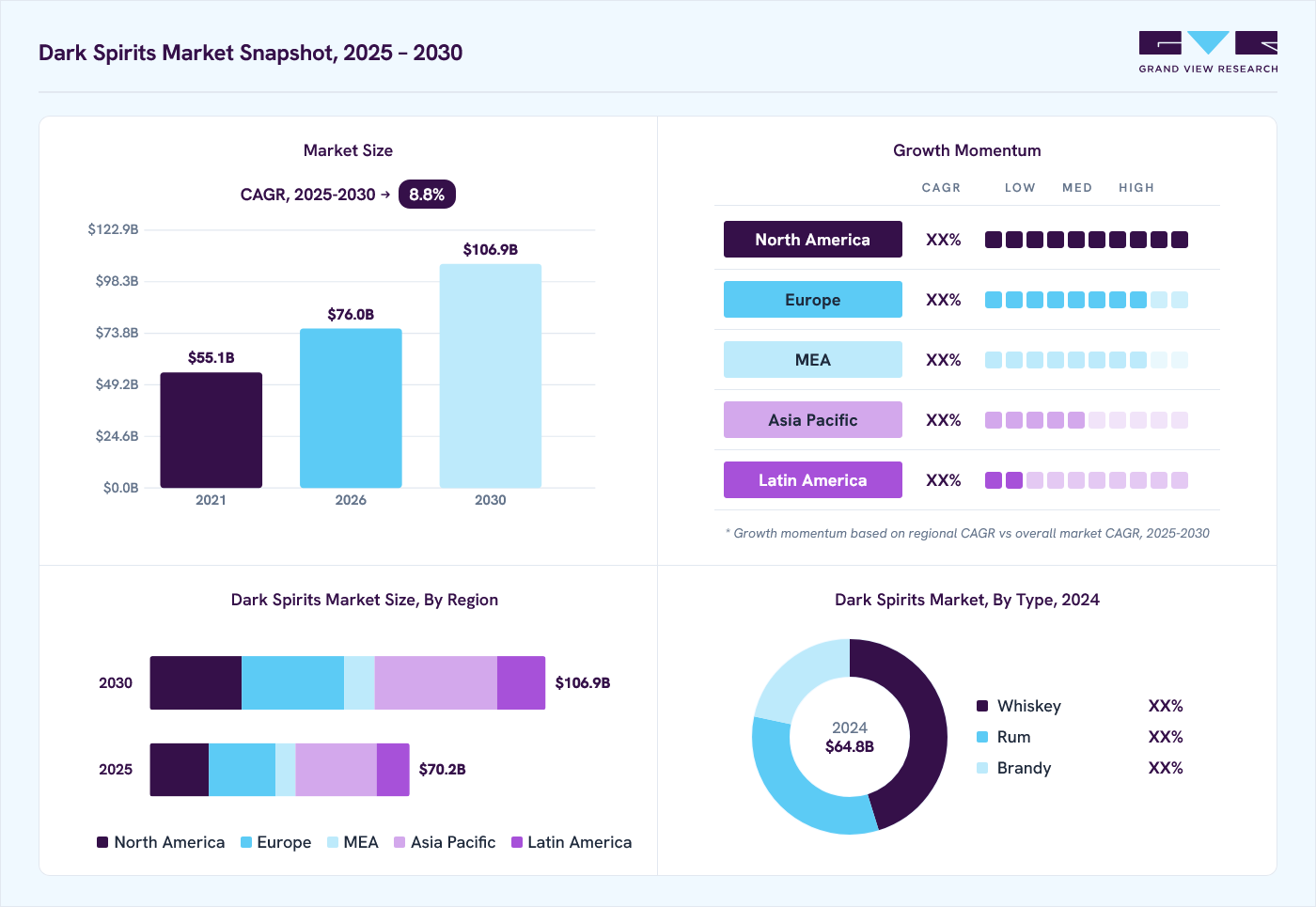
The global dark spirits market size was valued at USD 70.2 billion in 2025 and is projected to grow from USD 76.0 billion in 2026 to USD 130.2 billion by 2033, at a CAGR of 8.0% from 2026 to 2033. Asia Pacific dominated the market, accounting for a revenue share of 31.2% in 2025. The market has witnessed steady growth driven by evolving consumer preferences and increased demand for premium alcoholic beverages.
Key Market Trends & Insights
- By type: Whiskey segment dominated the market, with a revenue share of 48.0% in 2025.
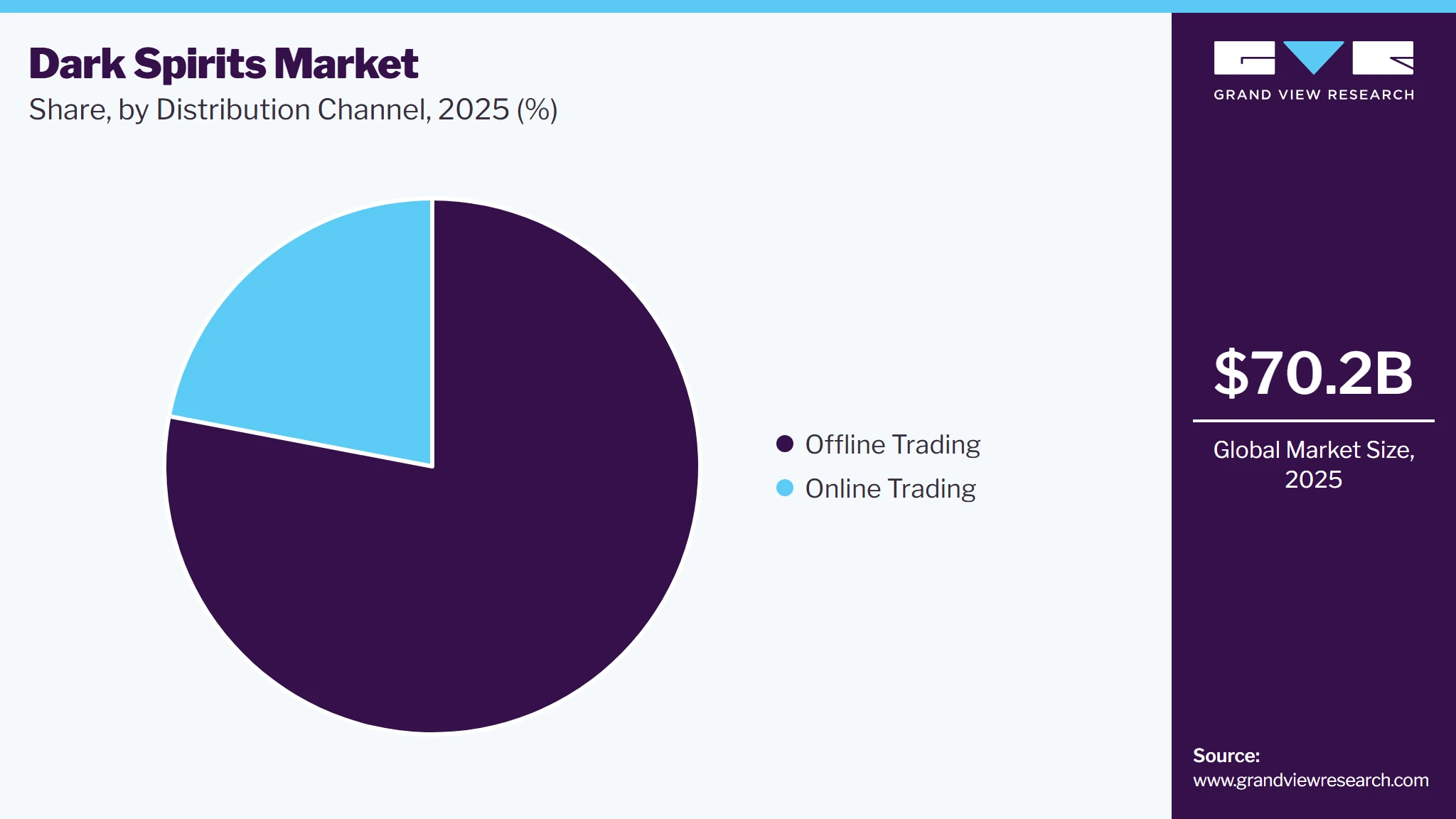
- By distribution channel: Offline trading segment held the largest market share of 78.0% in 2025.
Regional Highlights
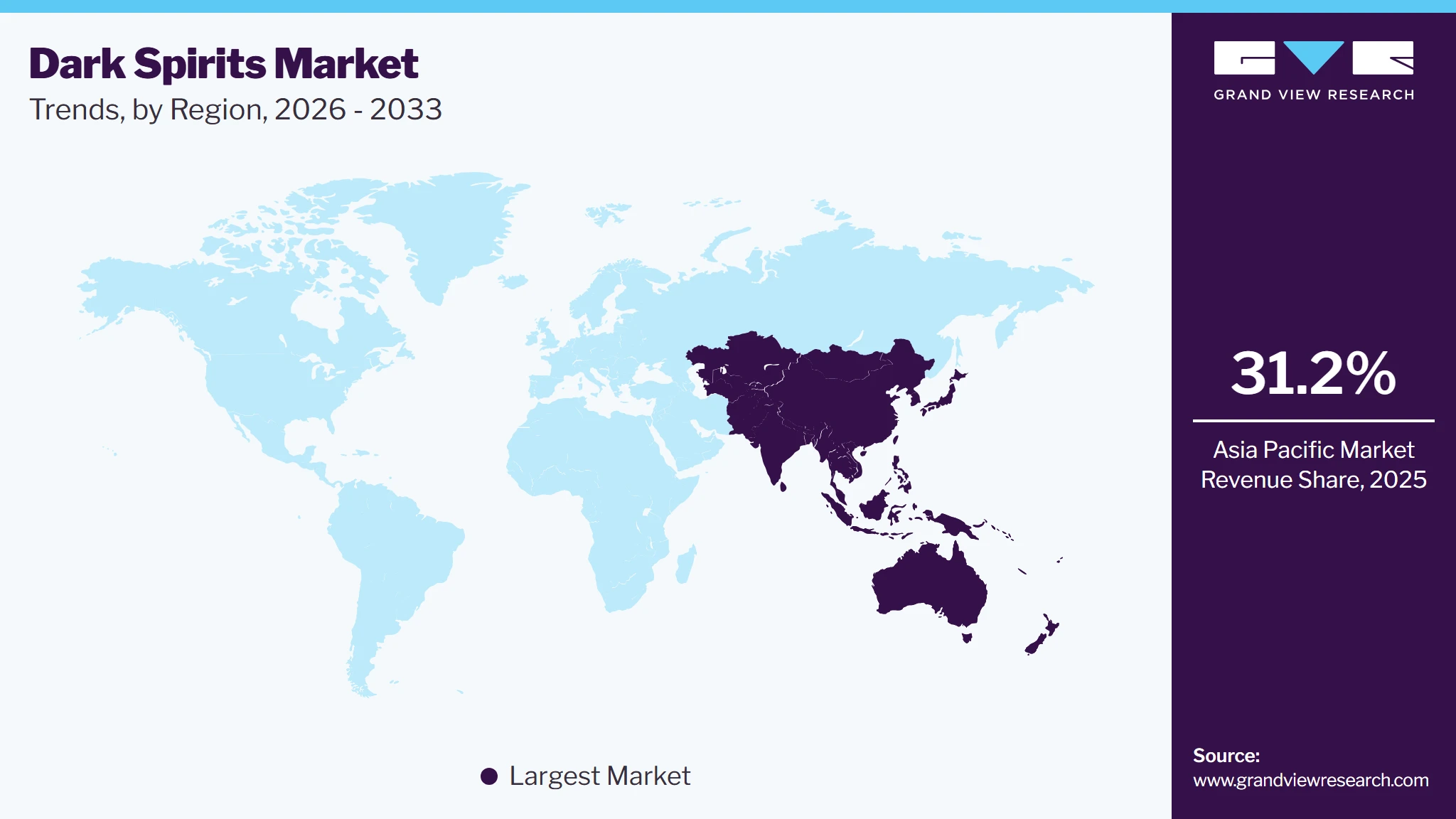
- Largest regional market: Asia Pacific (31.2% revenue share, 2025)
- By country: China held the largest market share in 2025.
Market Size & Forecast
- Market size in 2025: USD 70.2 Billion
- Estimated market size in 2026: USD 76.0 Billion
- Projected market size by 2033: USD 130.2 Billion
- CAGR (2026-2033): 8.0%
One of the key market trends is the growing preference for aged dark spirits, such as whiskey, rum, and brandy, as consumers increasingly seek out high-quality, sophisticated drinks. The rising popularity of craft spirits and small-batch distilleries has further fueled this demand, with connoisseurs and younger demographics willing to pay premium prices for unique, artisanal dark spirits.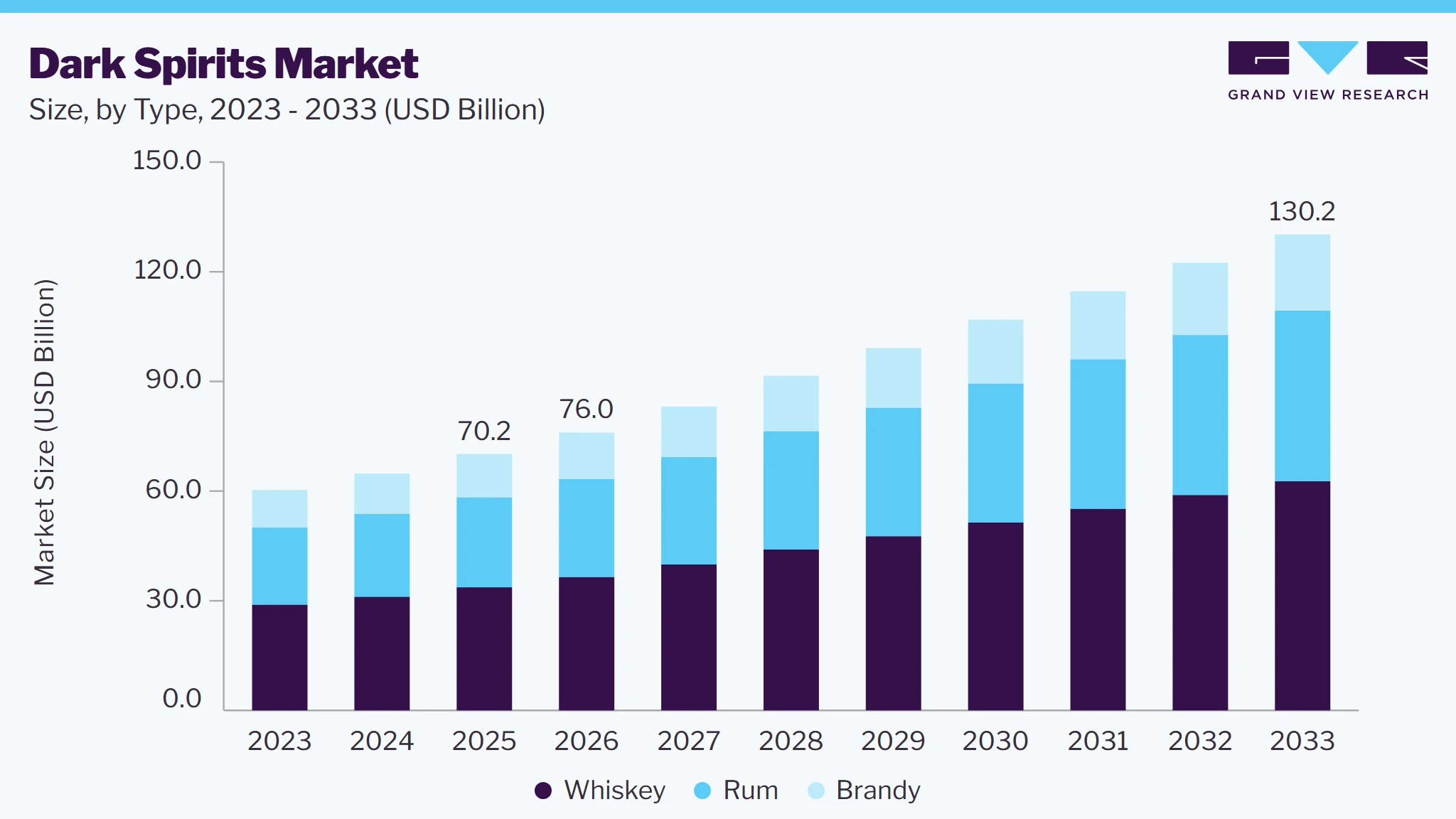
The growing acceptance of new exotic flavors of artisanal spirits is one of the major factors driving market growth. The increasing demand for premium spirit products in countries such as the U.S. and the UK is expected to boost market growth. The rising demand to procure high-quality spirits at an affordable cost is an upcoming market opportunity. However, the increasing trend to consume low-alcoholic beverages is hindering market growth. At present, key players are focusing on launching e-commerce platforms to gain traction with the spirits consumers. Hence, the spirits market is expected to showcase significant growth during the forecast period.
Mass-manufactured dark spirits are extremely prevalent in emerging countries such as India. However, the premium segment has observed an increase in demand in the past few years. Furthermore, aspiring customers are developing a taste for premium products that provide a unique and genuine experience. In addition, growing disposable income, urbanization, and increasing middle-class population positively impact the market for premium products. With the rising number of pubs, bars, and breweries offering alcoholic beverages, superior spirits are pouring into the market development in advanced and emerging economies. High taxation puts negative pressure on the customers and deeply impacts their buying decisions. With large taxation on whiskey, the market struggles across different regions.
Growing investment from U.S.-based key players to procure high-quality rum products is estimated to boost the market growth. The major market players are procuring value-added spirits with bizarre tastes. Rapidly growing demand for innovative spirit-based beverages from European consumers is driving industry growth. Adequate intake of dark spirits can relieve pain, swelling bone mineral density, stop the common cold, and keep the body warm.
Market Dynamics
The dark spirits market is benefiting from growing consumer interest in premium and aged alcoholic beverages that offer rich flavors and authentic craftsmanship. Rising cocktail consumption, expanding nightlife culture, and increasing spending on luxury beverages are supporting market growth across both developed and emerging economies. Producers are introducing innovative cask finishes, limited-edition products, and craft offerings to attract a broader consumer base. Additionally, the expansion of online alcohol retail platforms and demand for premium drinking experiences are creating new opportunities for market development.
The growth of e-commerce and direct-to-consumer (DTC) alcohol sales channels is a key driver of the dark spirits market, as it provides consumers with convenient access to a wider range of products, including premium and craft spirits. Online platforms enable brands to reach customers directly, offer personalized recommendations, and strengthen brand engagement. The increasing adoption of digital shopping, supported by home delivery services and secure payment systems, has further boosted online alcohol purchases. This expanded accessibility is helping dark spirit producers increase sales, penetrate new markets, and attract younger, digitally savvy consumers.
Stringent government regulations on alcohol production and sales act as a significant restraint on the dark spirits market by increasing compliance costs and operational complexities for manufacturers. Regulations related to licensing, taxation, advertising restrictions, labeling requirements, and distribution controls can limit market expansion and product availability. In many countries, high excise duties on alcoholic beverages raise retail prices, which may reduce consumer demand, particularly in price-sensitive markets. Additionally, varying regulatory frameworks across regions create challenges for international trade and market entry, restricting the growth potential of dark spirit brands.
The dark spirits market is experiencing strong opportunities due to rising premiumization, with consumers increasingly shifting toward aged whiskey, craft rum, and small-batch bourbon. Expansion of e-commerce and direct-to-consumer (DTC) channels is opening new growth avenues by enabling brands to reach consumers directly and offer exclusive products. Emerging markets, especially in Asia-Pacific and Central & South America, are also driving demand due to increasing disposable incomes and urbanization. Additionally, product innovation such as flavored dark spirits and sustainable packaging is helping brands attract younger and premium-focused consumers.
Analyst Perspective
The dark spirits category is undergoing a structural shift from heritage-led consumption toward occasion-based, premium-driven demand, where brand equity and experience matter more than pure volume growth. Consumption is increasingly shaped by urban lifestyle patterns, delayed home consumption, and the rise of “drink less, drink better” behavior, particularly in younger legal-age cohorts across both developed and emerging markets.
Type Insights
Based on type, whiskey segment led the market with the largest revenue share of 48.0% in 2025. The high disposable income of developing economies such as China and India, plus the growing whiskey consumption in Japan, is projected to continue its significant growth in the market during the forthcoming years. The delicious taste and lower fat content will enhance whiskey sales throughout the forecast period.
The brandy market is projected to grow at a CAGR of 9.3% from 2025 to 2030. This robust expansion can be attributed to a combination of factors, including increasing consumer demand for premium and craft spirits, particularly in regions such as Europe, North America, and Asia Pacific. Consumers are showing a greater preference for high-quality, aged brandy products as they become more knowledgeable about the nuances of flavor, aging processes, and the overall craftsmanship involved in production.
Distribution Channel Insights
Based on distribution channel, the offline trading segment led the market with the largest revenue share of 78.0% in 2025. The offline trading includes suppliers such as liquor shops, restaurants, bars, pubs, supermarkets, and specialty stores. Dark spirits are largely served in most restaurants, bars, and pubs. In addition, these are mixed with interesting, flavored juices and sparkling water to offer pleasing customer experiences. Domestic suppliers provide a variety of spirits at a lower cost, boosting segment growth. The increased inclination toward Western culture and rising adoption of drinking practices will propel market growth.
The online trading market is projected to grow at a CAGR of 10.1% from 2025 to 2030. This growth can be credited to the distributors' better focus on implementing modern trade technology for doorstep delivery. Moreover, brands and retailers are conducting online promotional campaigns via various social media platforms to increase customer brand awareness. Increasing demand for the super-premium spirit product over an e-commerce portal, coupled with the supportive government measures to fulfill the demand for alcoholic beverages by means of an online platform, are the factors fueling market growth.
Regional Insights
The North America dark spirits market accounted for 22.7% of the global revenue in 2024. This market is driven by increasing consumer interest in premium and craft spirits, particularly whiskey and bourbon, which have seen significant demand across the U.S. and Canada. Cocktail culture has gained momentum, with whiskey-based drinks enjoying widespread popularity. Millennials and younger consumers gravitate towards craft and small-batch distilleries, driving innovation and market growth.
U.S. Dark Spirits Market Trends
The dark spirits market in the U.S. held the largest share in the North America region in 2025. In the U.S., whiskey remains the dominant dark spirit, with bourbon and rye whiskey leading the market. The rise in home consumption and the cocktail culture has driven demand for premium whiskey brands. The craft distilling movement has also gained traction, with consumers increasingly seeking unique, local products. This growth is supported by favorable trade agreements and expanding distribution channels, particularly online platforms, making dark spirits more accessible across the country.
Europe Dark Spirits Market Trends
The Europe dark spirits market is projected to grow at a CAGR of 8.9% from 2025 to 2030. The European market is characterized by strong demand for whiskey, rum, and brandy, with established markets such as the UK, Germany, and France leading consumption. The region's rich heritage in whiskey production, particularly in Scotland and Ireland, continues to dominate. Craft and premium brands are in high demand, while sustainable production and organic sourcing trends are gaining traction among environmentally conscious consumers. Europe also remains a key exporter of dark spirits globally, particularly Scotch whiskey.
The UK dark spirits market accounted for a share of 25.68% of Europe's revenue in 2024. The UK market for dark spirits is dominated by Scotch whisky, which continues to enjoy strong domestic and international demand. The rise of premium, single-malt variants, and innovative craft distilleries has driven growth in the category. Consumer interest in whisky-based cocktails and home bartending has also surged, increasing consumption. In addition, a growing interest in rum, especially premium and spiced varieties, is adding diversity to the dark spirits landscape in the UK.
The dark spirits market in Germany is projected to grow at a CAGR of 9.0% from 2025 to 2030. Germany’s market is led by a growing preference for whiskey, particularly Scotch and bourbon, as well as rum and brandy. The market is experiencing a shift toward premium and craft options as German consumers become more interested in the craftsmanship and aging process behind dark spirits. E-commerce platforms have also enhanced accessibility, making it easier for consumers to explore a wide range of products. The country’s sophisticated palate for spirits and a growing cocktail culture continue to support market growth.
Asia Pacific Dark Spirits Market Trends
Asia Pacific dominated the dark spirits market with the largest revenue share of 31.2% in 2025. The Asia Pacific market is witnessing rapid growth, fueled by rising disposable incomes, urbanization, and the growing popularity of Western-style alcoholic beverages. Whiskey is the leading category, especially in countries like Japan and India, where local production contributes to strong demand. The region’s affluent middle class is driving the market for premium dark spirits, particularly in metropolitan areas. Increasing e-commerce penetration and expanded distribution networks also facilitate market growth.
China dark spirits market accounted for a share of 41.30% of the Asia Pacific market in 2024. China’s market is expanding, with whiskey and brandy leading the category due to rising demand among affluent consumers. Premiumization is a key trend, as Chinese consumers increasingly favor high-end international brands and locally-produced craft spirits. The growing cocktail culture in urban areas contributes to the rise in consumption, and the expansion of e-commerce platforms has made it easier for consumers to access a wide range of dark spirits. The market is expected to continue growing as disposable incomes rise.
The Japan dark spirits market is projected to grow at a CAGR of 8.5% from 2025 to 2030. Japan’s market is driven by its renowned whiskey industry, with Japanese whiskey gaining international acclaim for its high quality and craftsmanship. Domestic demand for whiskey remains strong, supported by a culture of whiskey bars and home consumption. The export market for Japanese whiskey is also booming, further enhancing the country’s position in the global dark spirits industry. Premiumization and the rising cocktail culture among younger consumers fuel continued growth in the sector.
Central & South America Dark Spirits Market Trends
The dark spirits market in Central and South America is projected to grow at a CAGR of 8.1% from 2025 to 2030.The market in Central & South America is heavily dominated by rum, particularly in Caribbean nations and countries like Brazil. Local production of rum plays a key role in both domestic consumption and exports. Whiskey is also gaining popularity, especially in urban centers where consumers explore premium and international brands. The rise of cocktail culture and increased disposable income in key markets like Brazil, Colombia, and Mexico drive demand for dark spirits across the region.
Middle East & Africa Dark Spirits Market Trends
The dark spirits market in the Middle East & Africa is projected to grow at a CAGR of 8.9% from 2025 to 2030.The market in the Middle East & Africa is relatively niche due to cultural and religious factors that limit alcohol consumption in several countries. However, in regions with a more liberal approach, such as the UAE and South Africa, the market is growing, driven by expatriates and affluent consumers who favor premium whiskey and rum. The hospitality sector, particularly in tourist-heavy areas, is crucial in driving dark spirits sales. Expanding distribution networks and rising disposable incomes in parts of Africa also support market growth.
Key Dark Spirits Company Insights
The major focus of the companies is to launch rum-based products to meet the increasing demand for alcoholic beverages. The main key players are adopting digital online platforms to fulfill the demand for alcoholic spirits. However, implementing sustainability has its unique challenges and limitations. Multiple companies are targeting the expansion and launch of premium brand products in the market.
Key Dark Spirits Companies:
The following key companies have been profiled for this study on the dark spirits market.
-
Diageo
-
Anheuser-Busch InBev
-
Suntory Holdings
-
Pernod Ricard
-
Asahi Group Holdings
-
Kirin Holdings
-
Bacardi Limited
-
LT Group, INC
-
The Brown-Forman Corporation
-
Rémy Cointreau
Competitive Benchmarking
Category
Operating Strategies
Competitive Edge
Weakness
Established Players(Diageo, Pernod Ricard, Bacardi Limited, Brown-Forman Corporation)
- Strong global distribution across retail, bars, HoReCa, and duty-free channels with premium branding and continuous portfolio expansion in whisky, rum, and brandy.
- Strong brand equity, extensive global reach, premium product portfolio, and strong control over on-trade and off-trade channels.
- High dependence on traditional markets and exposure to strict alcohol regulations and high taxation.
Emerging Players (LT Group, Inc)
- Focus on craft, small-batch, flavored, and premium artisanal spirits with increasing use of e-commerce and direct-to-consumer (DTC) channels.
- High innovation, strong appeal to younger consumers, and ability to quickly adapt to premiumization trends.
- Limited global distribution, lower brand awareness, and high competition from established multinational companies.
Recent Developments
-
In June 2024, Casa Lumbre, a Mexican-based global spirits company, unveiled a second wave of their highly sought-after Contraluz 11:11 Mezcal Reposado expression. The limited-edition product, made from 100% Maguey Espadín, has been matured for 11 months and 11 days in American Oak bourbon barrels and Sakura casks.
-
In May 2024, Pernod Ricard and ecoSPIRITS entered a new stage in their relationship with a five-year global licensing agreement to enable the distribution of Pernod Ricard's spirits brands in ecoSPIRITS' circular packaging technology to on-trade venues worldwide.
Dark Spirits Market Report Scope
Report Attribute
Details
Market size in 2025
USD 70.2 billion
Estimated market size in 2026
USD 76.0 billion
Projected market size by 2033
USD 130.2 billion
Growth rate
CAGR of 8.0% from 2026 to 2033
Base year for estimation
2025
Historical data
2021 - 2024
Forecast period
2026 - 2033
Quantitative units
Revenue in USD million/billion and CAGR from 2026 to 2033
Report coverage
Revenue forecast, company ranking, competitive landscape, growth factors, and trends
Segments covered
Type, distribution channel, region
Regional scope
North America; Europe; Asia Pacific; Central & South America; MEA
Country scope
U.S.; Canada; Mexico; UK; Germany; France; Russia; Italy; China; India; Japan; Brazil; Argentina; Saudi Arabia; South Africa
Key companies profiled
Diageo; Anheuser-Busch InBev; Suntory Holdings; Pernod Ricard; Asahi Group Holdings; Kirin Holdings; Bacardi Limited; LT Group, INC; The Brown-Forman Corporation; Rémy Cointreau
Customization scope
Free report customization (equivalent up to 8 analysts' working days) with purchase. Addition or alteration to country, regional & segment scope.
Pricing and purchase options
Avail customized purchase options to meet your exact research needs. Explore purchase options
Global Dark Spirits Market Report Segmentation
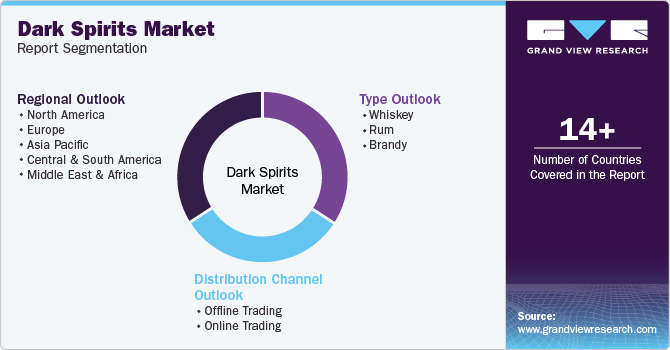
This report forecasts revenue growth at the global, regional, and country levels and provides an analysis of the latest industry trends and opportunities in each of the sub-segments from 2021 to 2033. For this study, Grand View Research has segmented the global dark spirits market report based on type, distribution channel, and region:
-
Type Outlook (Revenue, USD Billion, 2021 - 2033)
-
Whiskey
-
Rum
-
Brandy
-
-
Distribution Channel Outlook (Revenue, USD Billion, 2021 - 2033)
-
Offline Trading
-
Online Trading
-
-
Regional Outlook (Revenue, USD Billion, 2021 - 2033)
-
North America
-
U.S.
-
Canada
-
Mexico
-
-
Europe
-
Germany
-
UK
-
Spain
-
Italy
-
France
-
Russia
-
-
Asia Pacific
-
China
-
India
-
Japan
-
-
Central & South America
-
Brazil
-
Argentina
-
-
Middle East & Africa
-
South Africa
-
Saudi Arabia
-
-
Research Methodology
The dark spirits market figures in this report are based on a proven research process that combines executive interviews with secondary research from proprietary databases, company filings, and recognized regulatory and institutional sources. Market size is built through value-chain sizing - reconciling supply-side and demand-side estimates - and triangulated with bottom-up and top-down approaches. Every estimate passes multiple levels of expert validation before publication, with each dark spirits segment quantified using the revenue-capture definitions in the table below.
Segment Definition
Segment - Distribution Channel
Revenue capture definition
Offline Trading
Revenue is generated through traditional retail outlets such as supermarkets, hypermarkets, grocery stores, and convenience stores, where products are sold directly to consumers. This channel depends on strong shelf presence, promotional activities, and brand visibility at the point of sale.
Online Trading
Revenue is generated through e-commerce grocery platforms and quick-commerce apps that deliver frozen pizzas directly to consumers’ homes. This channel is driven by increasing digital adoption, convenience-based purchasing behavior, and expanding cold-chain delivery infrastructure.
Estimation Model
Layer Name
Key Question
Description
Consumption Universe Layer
Who consumes dark spirits globally?
Total population of legal-age alcohol consumers who drink premium and standard dark spirits is driven by rising disposable incomes, urban lifestyles, and growing social drinking culture across developed and emerging markets.
Access & Availability Layer
Who can access dark spirits through distribution channels?
Portion of consumers with access via liquor retail stores, duty-free outlets, bars, restaurants, and expanding e-commerce/DTC alcohol platforms supported by regulated distribution networks and evolving alcohol shipping laws.
Purchase & Usage Layer
Who are active dark spirits consumers?
Share of accessible consumers who actively purchase and consume dark spirits influenced by premiumization trends, brand preference, frequency of social occasions, and substitution with beer, wine, or other alcoholic beverages.
Revenue Conversion Layer
How much revenue is generated?
Final revenue driven by per-capita consumption, premium product mix (aged whisky, craft rum), pricing tiers, on-trade vs off-trade sales split, and growing contribution from e-commerce and premium bar/HoReCa channels.
Delivered Customizations
This report has been delivered with the following In-depth customizations
Client Request
Customization Delivered
Value Adds
Dark Spirits Regional Growth & Emerging Market Expansion
Assessed geographic expansion patterns with emphasis on high-growth emerging markets in Asia-Pacific, Latin America, and Africa, where rising income levels and urbanization are accelerating adoption of branded dark spirits. Evaluated localization strategies such as region-specific blends, price architecture adjustments, and domestic brand acquisitions by global players to penetrate fragmented markets.
Helps identify high-growth geographic white spaces, optimize market entry strategies, and tailor product-market fit approaches for emerging economies with strong long-term upside potential.
Dark Spirits Distribution Channel Dynamics
Analyzed multi-channel evolution across on-trade (bars, restaurants, hotels), off-trade retail, and digital alcohol e-commerce ecosystems. Assessed how premium discovery is increasingly driven by hospitality channels while conversion and volume scaling are shifting toward retail chains and e-commerce platforms. Evaluated the growing role of experiential marketing, direct-to-consumer engagement, and retail in shaping brand visibility and trial.
Enables optimization of channel mix strategy, improves allocation of trade investments, and supports expansion planning by identifying high-yield consumption touchpoints and evolving purchase pathways.
Dark Spirits Competitive Landscape & Strategic Positioning
Analyzed competitive dynamics across global incumbents, regional challengers, and craft entrants, focusing on portfolio breadth, brand equity strength, and pricing hierarchy strategies. Evaluated increasing consolidation through M&A activity and the strategic shift toward premium brand acquisitions to strengthen high-margin portfolios.
Enables benchmarking of competitive intensity, supports M&A and partnership screening, and helps refine positioning strategies to sustain differentiation in a consolidating global spirits industry.
Frequently Asked Questions About This Report
Offline trading segment held the largest market share of 78.0% in 2025., and the online trading channel is the fastest-growing.
Key players include Diageo, Anheuser-Busch InBev, Suntory Holdings, Pernod Ricard, Asahi Group Holdings, Kirin Holdings, Bacardi Limited, LT Group, INC, The Brown-Forman Corporation, and Rémy Cointreau.
The global dark spirits market size was valued at USD 70.2 billion in 2025 and is estimated at USD 76.0 billion for 2026.
The global dark spirits market is expected to grow at a CAGR of 8.0% from 2026 to 2033, reaching USD 130.2 billion.
Key factors include rising consumer interest in premium and craft alcoholic beverages, growing demand for aged and flavored spirits, and increasing popularity of cocktail culture across bars, restaurants, and home consumption.
Asia Pacific dominated with a 31.2% revenue share in 2025.
The whiskey market segment led with a 48.0% revenue share in 2025.
About the Author(s)
Alcohol & Tobacco Research Team
Consumer Goods · Alcohol & TobaccoThis report was authored by the alcohol & tobacco research team at Grand View Research - comprising two research analysts, one senior research analyst, and one industry expert - with specialized expertise in the alcohol & tobacco segment of the consumer goods industry. All findings are based on proprietary consumer goods databases, executive interviews, and regulatory analysis, subject to internal peer review prior to publication.
Last Updated:
Speak to Analyst


Customize this report to your needs — add regions, segments, or data points, with 20% free customization.
Or view our licence options:


ISO 9001:2015 & 27001:2022 Certified
We are GDPR and CCPA compliant! Your transaction & personal information is safe and secure. For more details, please read our privacy policy.


