
- Home
- »
- Next Generation Technologies
- »
-
Data Center Interconnect Market Size Report, 2026-2033GVR Report cover

Data Center Interconnect Market (2026 - 2033)
Size, Share, & Trends Analysis Report By Type (Hardware, Software, Services), By Application (Workload And Data Mobility, Shared Data & Resources, Workload and Data Mobility), By End Use, By Region, And Segment Forecasts
Market Size, 2025
$11.1BMarket Estimate, 2026
$12.5BMarket Forecast, 2033
$30.9BCAGR, 2026–2033
13.8%Data Center Interconnect Market Summary
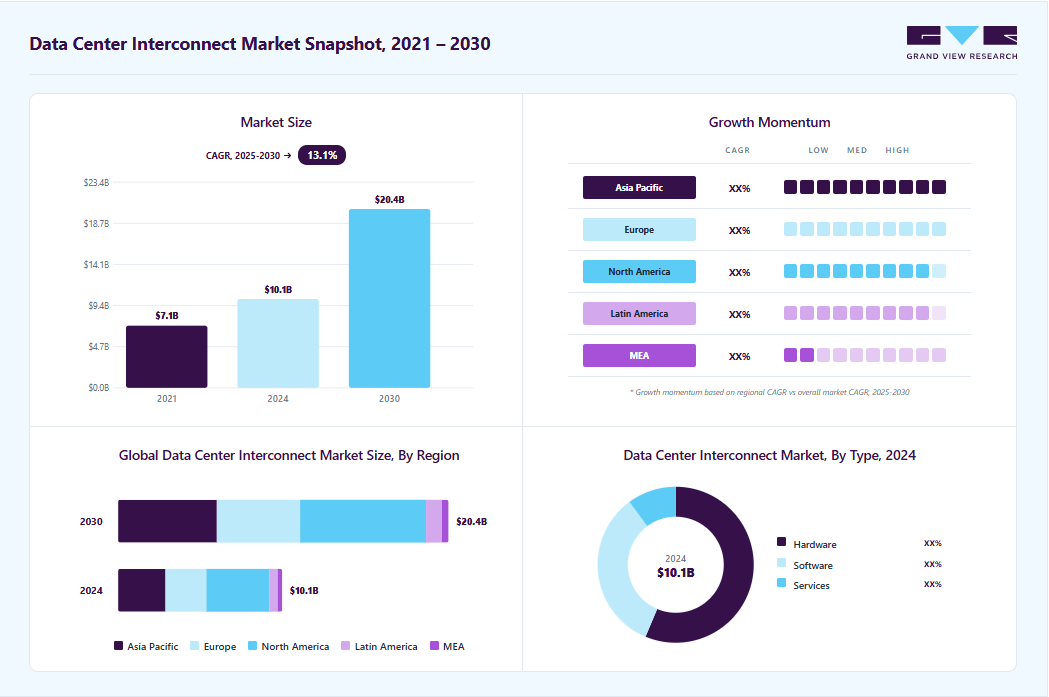
The global data center interconnect market size was valued at USD 11.1 billion in 2025 and is projected to grow from USD 12.5 billion in 2026 to USD 30.9 billion in 2033, at a CAGR of 13.8% from 2026 to 2033. The market in North America dominated with a revenue share of 38.0% in 2025. The data center interconnect (DCI) market plays a pivotal role in the infrastructure of modern data centers, enabling high-speed, high-capacity connectivity between geographically distributed facilities.
 Source: Grand View Research, IR Documents, Primary Interviews, Paid DatabasesTo learn more about this report,
 Download Free Sample Report
 Key Market Trends & Insights
- By type: Hardware segment dominated the market, with a revenue share of 56.3% in 2025
- By application: Disaster Recovery and Business Continuity segment held the largest market share of 53.1% in 2025
- By end use: Communications Service Providers (CSPs) segment held the largest market share of 32.6% in 2025
Regional Highlights
- Largest regional market: North America (38.0% revenue share, 2025)
- Fastest-growing regional market: Asia Pacific (highest CAGR, 2026-2033)
- By country: The U.S. held the largest market share in 2025.
Market Size & Forecast
- Market size in 2025: USD 11.1 Billion
- Estimated market size in 2026: USD 12.5 Billion
- Projected market size by 2033: USD 30.9 Billion
- CAGR (2026-2033): 13.8%
Three ways to get this report
Buy it, customize it, or ask a question.Ask an Analyst
A direct answer, usually in 1 working day
- AccessReport author, directly
- Reply timeWithin 1 working day
- No sales callDirect answer only
- FormatEmail reply
- CostFree, no cost
Get the Full Report
What the study covers
- FormatsPDF · Excel · Dashboard
- Timeline2026–2033 annual, 2025 base
- Coverage20+ countries, 5 regions
- Companies10+ key players profiled
Customize the Report
20% free customization
- IncludeCountries, segments, points
- TailorTo your product definition
- ExtendDeeper competitor detail
- OrA fully bespoke study
- Turnaround5–10 working days
DCI technology is essential for data-intensive applications such as cloud services, big data analytics, disaster recovery, and enterprise data mobility. Leading DCI solutions in this market range from optical transport systems to software-defined networking (SDN), supporting flexible and scalable data transfer between data centers. As enterprises, content providers, and telecommunications operators increasingly rely on multi-cloud and hybrid environments, demand for DCI solutions has surged. The market has witnessed rapid innovation, with key players offering advanced DCI services to meet the growing need for reliable, low-latency, and secure data connections. With the explosion of data, the rise of edge computing, and the need for efficient interconnectivity, DCI is becoming an integral part of digital transformation initiatives worldwide.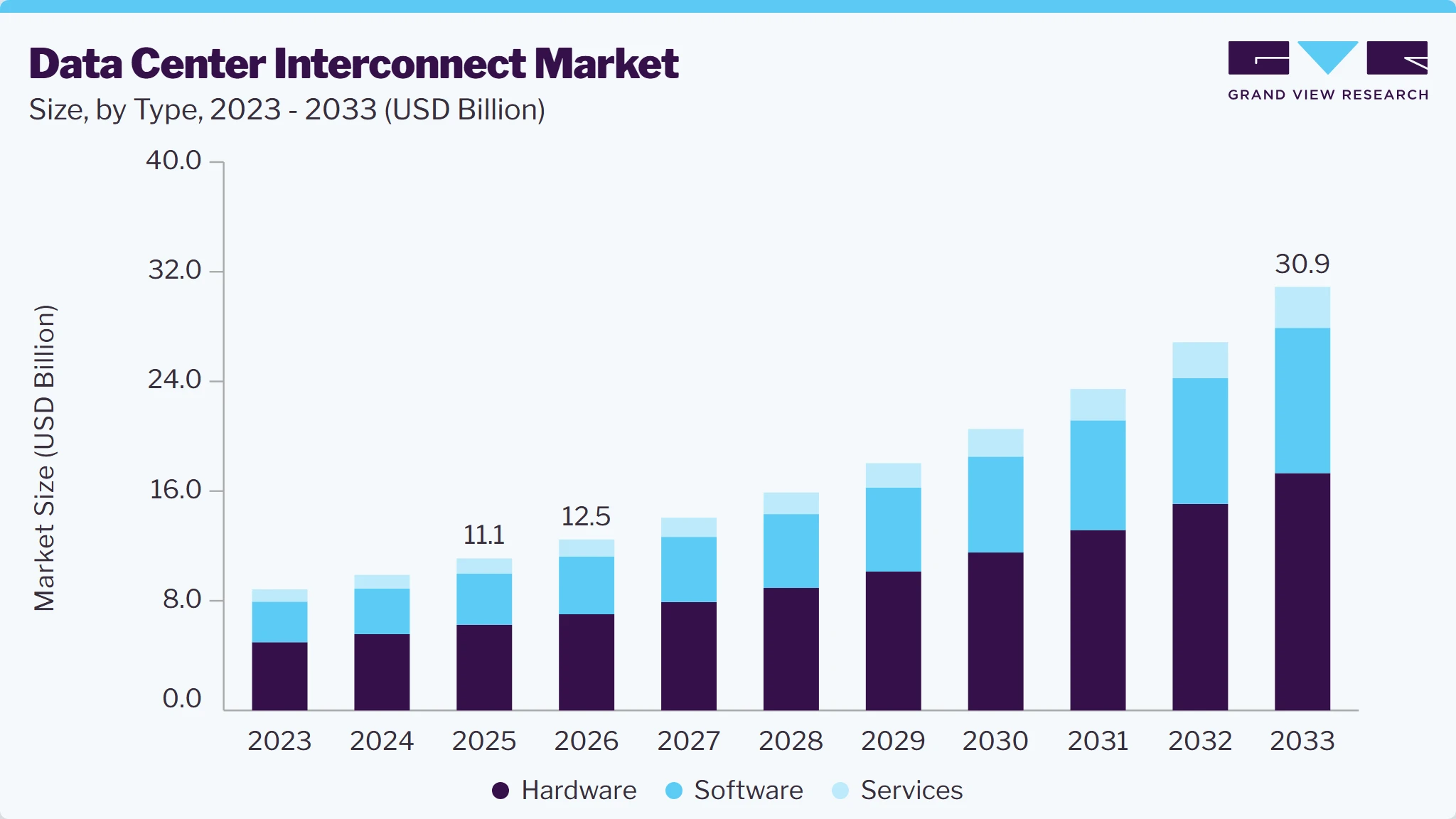 To learn more about this report, Download Free Sample Report
 The rise in data consumption due to IoT, 5G, and streaming services has significantly increased data traffic, necessitating more robust interconnectivity. Furthermore, enterprises’ disaster recovery and business continuity needs are propelling DCI demand, with data replication across sites essential for risk management and data redundancy. Advancements in SDN and network function virtualization (NFV) also make DCI solutions more scalable and efficient, enhancing their appeal across industries. Lastly, hyperscale data centers-such as those of tech giants-are expanding their networks, thus requiring DCI solutions to support high-speed, large-scale data flow.
Edge computing and 5G deployment will further boost the market, as data processing decentralizes, requiring faster and more reliable data transfers across broader networks. Innovations in SDN, artificial intelligence, and machine learning are likely to transform DCI infrastructure, offering self-healing networks that optimize bandwidth and latency. Moreover, cybersecurity will play an increasingly important role, with companies investing in DCI solutions that ensure data protection and compliance with global regulations. Expanding applications in industries like finance, healthcare, and retail will also contribute to market growth, as these sectors increasingly rely on data replication and disaster recovery capabilities. As hyperscale data centers proliferate and network demands grow, the DCI market is poised for strong, sustained expansion.
Market Dynamics
Data Center Interconnect (DCI) solutions are witnessing strong adoption as organizations increasingly require high-speed, secure, and low-latency connectivity between geographically distributed data centers. DCI serves as a critical infrastructure layer enabling data replication, workload mobility, disaster recovery, cloud connectivity, and real-time synchronization across enterprise, colocation, hyperscale, and edge data center environments. The rapid growth of cloud computing, artificial intelligence (AI), machine learning workloads, and hyperscale data center deployments is significantly increasing inter-data-center traffic volumes. Additionally, the widespread adoption of hybrid and multi-cloud architectures is driving demand for scalable optical networking and software-defined interconnect solutions that ensure seamless data exchange across diverse environments. The expansion of 400G/800G optical technologies, growing investments in fiber infrastructure, deployment of edge computing networks, and rising focus on business continuity and disaster recovery are further accelerating market growth. As enterprises and cloud service providers continue to modernize digital infrastructure and support data-intensive applications, demand for advanced Data Center Interconnect solutions is expected to increase steadily across global markets.
The increasing adoption of multi-cloud and hybrid cloud environments is a major driver for the data center interconnect market. Enterprises are deploying workloads across multiple data centers and cloud platforms to enhance scalability, resilience, and operational flexibility, creating a growing need for high-speed and secure inter-data-center connectivity. Additionally, the rapid expansion of artificial intelligence (AI), machine learning, and high-performance computing (HPC) workloads is significantly increasing data traffic between hyperscale facilities. Organizations require low-latency, high-bandwidth DCI solutions to support real-time data exchange, AI model training, and large-scale data replication. As digital transformation initiatives accelerate globally, demand for advanced DCI infrastructure continues to rise.
High deployment costs and increasing network complexity remain significant restraints for the data center interconnect market. Implementing DCI solutions often requires substantial investments in optical transport equipment, high-capacity fiber networks, routers, switches, and network management platforms. Furthermore, organizations must address challenges related to network scalability, latency optimization, interoperability across multi-vendor environments, and secure data transmission. Managing growing traffic volumes while maintaining performance, reliability, and compliance can increase operational complexity and total cost of ownership, particularly for small and mid-sized enterprises, potentially limiting adoption.
The rapid expansion of edge computing infrastructure and AI-focused data center ecosystems presents a significant opportunity for the data center interconnect market. Organizations are increasingly deploying edge data centers to support latency-sensitive applications such as autonomous systems, industrial IoT, video analytics, content delivery, and 5G services. These distributed facilities require robust interconnection with regional and hyperscale data centers, driving demand for scalable DCI solutions. Additionally, growing investments in AI training clusters, GPU-powered data centers, and next-generation optical networking technologies such as 400G, 800G, and coherent optics are creating substantial growth opportunities for DCI vendors. As enterprises and cloud providers continue to build highly interconnected digital infrastructure, demand for advanced DCI solutions is expected to grow significantly worldwide.
Analyst Perspective
The data center interconnect market sits at the intersection of several transformative technology trends, including the rapid expansion of cloud computing, accelerating adoption of artificial intelligence (AI) and machine learning workloads, increasing deployment of hyperscale and edge data centers, growing reliance on hybrid and multi-cloud architectures, and rising demand for high-speed digital infrastructure. As organizations seek to move, replicate, and process massive volumes of data across geographically distributed facilities, DCI solutions have evolved from traditional connectivity platforms into strategic enablers of cloud scalability, business continuity, AI infrastructure, and real-time data exchange. The central competitive moat, however, will belong to vendors that successfully integrate high-capacity coherent optics, software-defined networking (SDN), network automation, AI-driven traffic optimization, and ultra-low-latency connectivity into a unified interconnection platform. Furthermore, increasing adoption across hyperscale cloud providers, telecommunications operators, colocation facilities, enterprises, government organizations, and research institutions will continue to expand opportunities for innovation and differentiation within the global Data Center Interconnect ecosystem.
Type Insights
Based on type, the hardware segment led the market with the largest revenue share of 56.3% and is expected to grow at the significant CAGR over the forecast period. The adoption of 5G networks and edge computing is accelerating demand for Data Center Interconnect (DCI) hardware that can handle large volumes of decentralized data efficiently. 5G enables ultra-fast data speeds and low-latency connections, essential for real-time applications in industries like healthcare, automotive, and IoT. Edge computing, by processing data closer to its source, reduces latency and bandwidth issues. However, it requires robust DCI hardware to seamlessly connect distributed edge locations with central data centers. This hardware-such as high-speed routers, optical transceivers, and switches-ensures the rapid, reliable data exchanges needed for 5G and edge applications, making it a foundational element in modern network infrastructure. Together, 5G and edge computing drive DCI hardware’s market growth.
The software segment is expected to grow steadily over the forecast period. The demand for network automation is growing as organizations aim to streamline data center operations and minimize human error. DCI software enables centralized control, automating routine tasks and simplifying management across interconnected data centers. This automation enhances efficiency, reduces operational costs, and ensures consistency in complex environments, making it essential for companies handling high data volumes and aiming for optimized, resilient network infrastructure.
Application Insights
Based on application, disaster recovery and business continuity segment led the market with the largest revenue share of 53.1% in 2025. As businesses increasingly adopt cloud and hybrid infrastructures, ensuring reliable disaster recovery across multiple data centers has become crucial. Data Center Interconnect (DCI) solutions facilitate seamless connectivity between on-premises systems and cloud environments, allowing for efficient data redundancy and real-time backup. This integration ensures continuous data availability and minimizes data loss in the event of an outage, supporting business continuity. DCI’s robust interconnectivity across distributed infrastructures enables organizations to enhance backup capabilities and improve disaster recovery processes.
The shared data & resources segment is expected to grow at steadily over the forecast period. The rise of multi-cloud strategies among businesses is driving demand for data center interconnect (DCI) solutions, which enable seamless connectivity between various cloud providers and on-premises data centers. This connectivity allows organizations to efficiently share resources across diverse environments, enhancing operational flexibility and scalability. By utilizing DCI, companies can avoid vendor lock-in, ensuring they can select the best services from multiple cloud providers while optimizing their IT infrastructure and resources.
End Use Insights
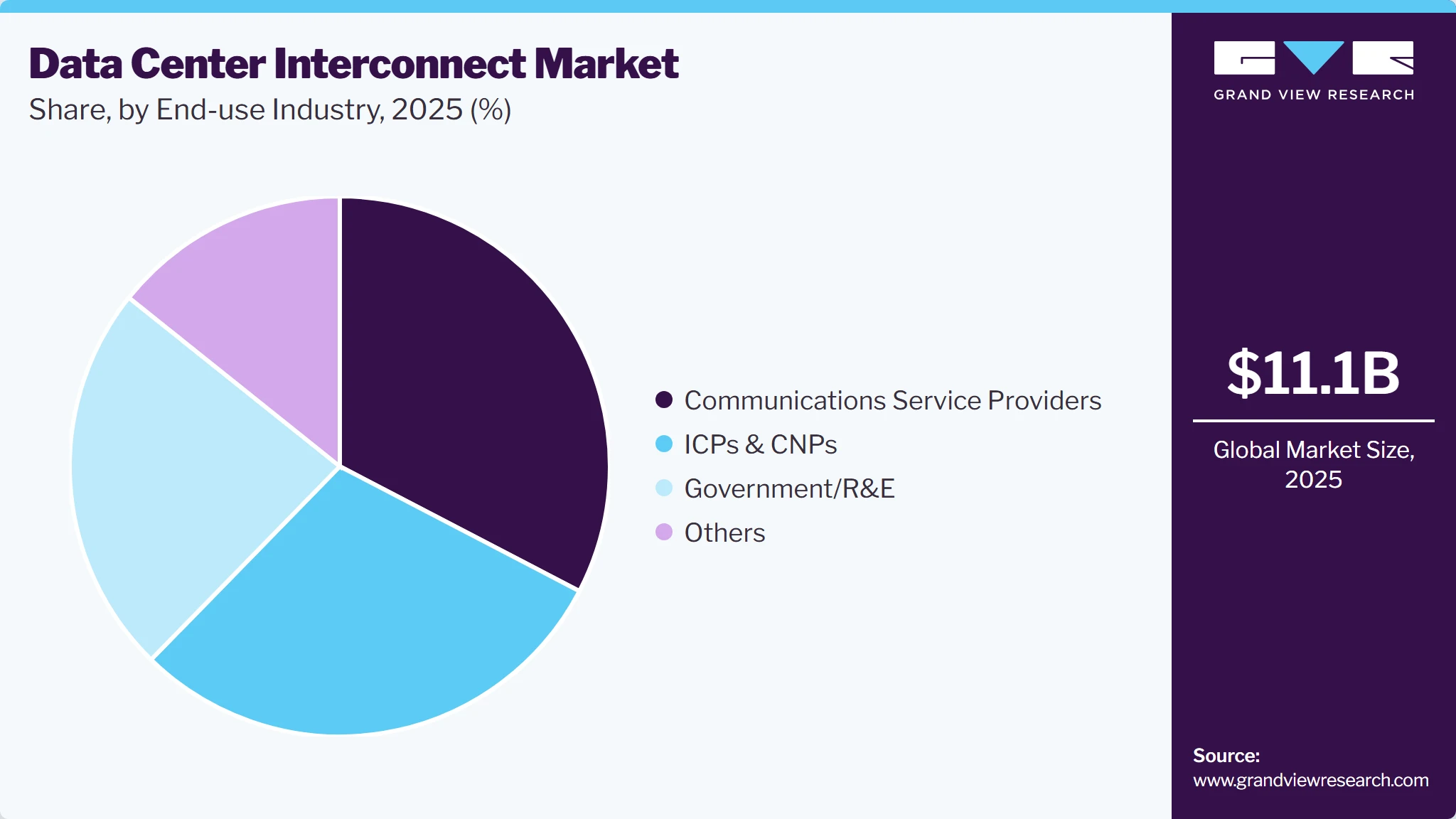
Based on end use, communications service providers (CSPs) segment led the market with the largest revenue share of 32.6% in 2025. The expansion of 5G networks is significantly driving demand for advanced data center interconnect (DCI) solutions. As 5G technology enables faster data transmission and supports a massive influx of Internet of Things (IoT) devices and smart technologies, the resulting surge in data traffic presents challenges for communication service providers (CSPs). To effectively manage and distribute this data across their networks, CSPs require robust interconnectivity solutions that ensure low latency and high reliability. DCI solutions facilitate seamless connectivity between centralized data centers and edge computing resources, enabling CSPs to optimize their infrastructure and enhance overall network performance. This capability is crucial for delivering the speed and responsiveness that 5G applications demand, thereby cementing DCI's role in 5G network infrastructure.
 To learn more about this report, Download Free Sample Report
 The Internet Content Providers and Carrier-Neutral Providers (ICPs/CNPs) is expected to grow steadily over the forecast period.The growing adoption of multi-cloud strategies among ICPs and CNPs is driving demand for data center interconnect (DCI) solutions. These solutions enable seamless connectivity across multiple cloud environments, allowing providers to leverage the best services from different vendors. This capability facilitates efficient resource sharing, enhances operational flexibility, and helps ICPs and CNPs optimize their infrastructures, ultimately improving service delivery and meeting diverse customer needs.
Regional Insights
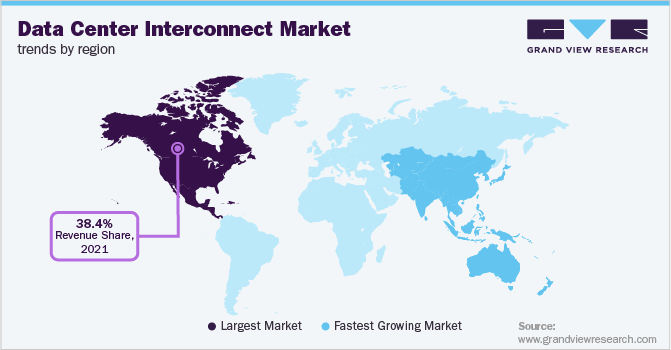
North America dominated the data center interconnect market with the largest revenue share of 38.0% in 2025. North America hosts the world's largest concentration of hyperscale data centers operated by companies such as Amazon Web Services, Microsoft, Google Cloud, and Meta Platforms. Continuous expansion of AI and cloud infrastructure is increasing the need for high-capacity interconnect networks between data centers, driving DCI investments. All these entities are aggressively adopting the latest technologies to improve corporate productivity and work efficiency. A well-developed ICT infrastructure and the presence of large data center clusters in the U.S., such as New York, Los Angeles, Chicago, and Washington DC, also bode well for the growth of the regional market.
 To learn more about this report, Download Free Sample Report
 U.S. Data Center Interconnect Market Trends
The data center interconnect market in the U.S. held the largest share in the North America region in 2025. The U.S. is experiencing a significant increase in data consumption driven by the rise of digital services, streaming platforms, and social media. This growing demand creates a pressing need for robust data center interconnect (DCI) solutions that can efficiently manage high data traffic. Effective DCI solutions ensure seamless connectivity across data centers, enabling businesses to handle the vast amounts of data generated while maintaining optimal performance and user experience.
Asia Pacific Data Center Interconnect Trends
The DCI market in Asia Pacific is growing significantly at a CAGR of 13.7% from 2025 to 2030. The Asia Pacific region is experiencing significant digital transformation as organizations increasingly adopt cloud computing, big data analytics, and IoT technologies. This shift drives the demand for efficient data center interconnect (DCI) solutions, which are essential for enabling seamless data transfer and connectivity across distributed systems. By ensuring reliable and high-speed connections, DCI solutions support organizations in leveraging their digital capabilities, enhancing operational efficiency, and improving overall business performance.
The Japan data center interconnect market is expected to grow rapidly in the coming years. Japan's advanced digital economy and high internet penetration create a strong demand for reliable data connectivity. Businesses need robust data center interconnect (DCI) solutions to effectively manage the increasing data traffic from online services, cloud applications, and IoT devices, ensuring seamless and efficient communication across their networks.
DCI market in China held a substantial market share in 2024. In China, the vast scale of operations across numerous enterprises creates a strong emphasis on network resilience. Businesses prioritize building robust data infrastructures to mitigate risks associated with downtime and data loss. Data Center Interconnect (DCI) solutions play a crucial role by providing essential redundancy and disaster recovery capabilities, ensuring that data remains accessible and secure even during disruptions. This focus on resilience is vital for maintaining operational continuity and protecting critical information.
Europe Data Center Interconnect Trends
The data center interconnect market in Europe was identified as a lucrative region in 2024. The European Union's stringent data protection regulations, such as the General Data Protection Regulation (GDPR), significantly influence data handling practices in the region. These regulations necessitate secure and compliant methods for managing sensitive data. As a result, there is a growing demand for data center interconnect (DCI) solutions that ensure data residency and sovereignty, allowing organizations to meet regulatory requirements while maintaining the integrity and security of their data across different jurisdictions.
Data center interconnect market in the UK is expected to grow rapidly in the coming years as the country is undergoing significant digital transformation across key sectors like finance, healthcare, and retail. The UK is experiencing significant data consumption driven by the growth of digital services, e-commerce, and online streaming. This increasing demand for data requires robust data center interconnect (DCI) solutions to facilitate efficient data transfer and connectivity between data centers, ensuring seamless operations and enhanced user experiences.
The Germany data center interconnect market is expected to hold a significant market share in the coming years. The rollout of 5G network in Germany has significantly increased the demand for advanced data center interconnect (DCI) solutions. These solutions are essential for managing the immense data traffic generated by connected devices, ensuring efficient data flow and enabling low-latency communication necessary for applications that depend on real-time data processing.
Key Data Center Interconnect Company Insights
Some of the key companies in the data center interconnect market include Cisco Systems, Inc., Juniper Networks, Inc., Broadcom Inc., Ciena Corporation, Nokia Corporation and others. Organizations are focusing on increasing customer base to gain a competitive edge in the industry. Therefore, key players are taking several strategic initiatives, such as mergers and acquisitions, and partnerships with other major companies.
-
Cisco Systems, Inc. plays a significant role in the data center interconnect (DCI) market by providing advanced networking solutions that enhance connectivity and data transfer between data centers. Cisco's DCI offerings include high-capacity routers and software-defined networking technologies, enabling efficient management of increased data traffic. Their solutions support cloud environments and hybrid infrastructures, addressing the growing demand for reliable and scalable interconnectivity.
-
Ciena Corporation is a prominent player in the data center interconnect (DCI) market, specializing in high-capacity optical networking solutions. Their products facilitate seamless data transmission between data centers, addressing the growing demand for bandwidth and connectivity. Ciena's DCI solutions are designed to optimize network performance and enhance operational efficiency, making them essential for organizations transitioning to cloud and hybrid environments.
Key Data Center Interconnect Companies:
The following key companies have been profiled for this study on the data center interconnect market.
- Cisco Systems, Inc.
- Juniper Networks, Inc.
- Broadcom Inc.
- Arista Networks, Inc.
- Nokia Corporation
- Huawei Technologies Co., Ltd.
- Mellanox Technologies (now part of NVIDIA)
- Ciena Corporation
- Extreme Networks, Inc.
- Fujitsu Limited
- IBM Corporation
- Infinera Corporation
- Adtran
- ZTE Corporation.
Market Participant Categorization
Category
Operating Strategies
Competitive Edge
Weakness
Established Players (Cisco Systems, Ciena, Nokia, Juniper Networks, Arista Networks, Huawei Technologies)
- Established players focus on delivering comprehensive DCI portfolios that include optical transport systems, packet-optical platforms, routers, switches, network automation software, and managed services. Their strategies emphasize investments in 400G/800G coherent optics, software-defined networking (SDN), AI-driven network management, and cloud-scale interconnection solutions.
- These companies benefit from strong global brand recognition, extensive customer bases, broad product portfolios, advanced R&D capabilities, and well-established channel ecosystems. Their ability to provide end-to-end networking infrastructure, optical transport solutions, software platforms, and support services enables them to address complex, mission-critical DCI deployments across multiple industries and regions.
- High operational and R&D costs, longer product development cycles, and dependence on large-scale infrastructure investments can impact agility. They also face pricing pressure from emerging vendors, technology disruptions from open networking architectures, and increasing competition in AI-driven optical networking solutions.
Emerging Players (Infinera, DriveNets, Ribbon Communications, Celestica)
- Emerging players focus on specialized DCI technologies such as open optical networking, disaggregated networking architectures, network virtualization, cloud-native software, and high-capacity coherent optical solutions. Many emphasize cost-efficient deployments, flexible architectures, rapid innovation, and customized solutions for hyperscale cloud providers, internet content providers, and carrier-neutral operators.
- These companies offer greater flexibility, faster innovation cycles, lower deployment costs, and specialization in next-generation networking technologies. Their focus on open standards, software-centric architectures, and scalable optical transport platforms enables them to address evolving requirements associated with AI workloads, cloud connectivity, and edge data center deployments.
- Limited global presence, smaller customer bases, lower financial resources, and reduced economies of scale may constrain their ability to compete for large multinational projects. Dependence on strategic partnerships, narrower product portfolios, and lower brand visibility can also impact market penetration compared with established networking and telecommunications vendors.
Recent Developments
-
In March 2024, Infinera Corporation announced its new ICE-D intra-data center optics, offering high-speed connectivity of up to 1.6 Tb/s. This technology, utilizing indium phosphide photonic integrated circuits, reduces power consumption per bit by up to 75%. It aims to support the growing bandwidth demand driven by AI applications, projecting nearly tenfold market growth by 2027. Infinera's solutions focus on cost-efficiency and scalability for data center operators.
-
In February 2024, Huawei Technologies Co., Ltd. introduced the OptiXtrans DC908 Pro, a next-generation Data Center Interconnect (DCI) platform at MWC Barcelona 2024. It boasts significant advancements, including single-wavelength transmission at 1.2 Tbit/s over 240 km, enhanced reliability at 99.999%, and improved intelligence for simplified deployment. This platform addresses increasing data demands in the AI era, making it a critical solution for efficient and secure data transmission between data centers.
Data Center Interconnect Market Report Scope
Report Attribute
Details
Market size in 2025
USD 11.1 Billion
Estimated market size in 2026
USD 12.5 Billion
Projected market size by 2033
USD 40.9 Billion
Growth rate
CAGR of 13.8% from 2026 to 2033
Base year for estimation
2025
Historical data
2021 - 2024
Forecast period
2026 - 2033
Quantitative units
Revenue in USD billion and CAGR from 2026 to 2033
Report coverage
Revenue forecast, company ranking, competitive landscape, growth factors, and trends
Segments covered
Type; application; end use; region
Regional scope
North America; Europe; Asia Pacific; Latin America; MEA
Country scope
U.S.; Canada; Mexico; Germany; UK; France; China; Japan; India; South Korea; Australia; Brazil; Saudi Arabia; South Africa; UAE
Key companies profiled
Cisco Systems, Inc.; Juniper Networks, Inc.; Broadcom Inc.; Arista Networks, Inc.; Nokia Corporation; Huawei Technologies Co., Ltd.; Mellanox Technologies (now part of NVIDIA); Ciena Corporation; Extreme Networks, Inc.; Fujitsu Limited; IBM Corporation; Infinera Corporation; Adtran; ZTE Corporation
Customization scope
Free report customization (equivalent up to 8 analysts' working days) with purchase. Addition or alteration to country, regional & segment scope.
Pricing and purchase options
Avail customized purchase options to meet your exact research needs. Explore purchase options
Global Data Center Interconnect Market Report Segmentation
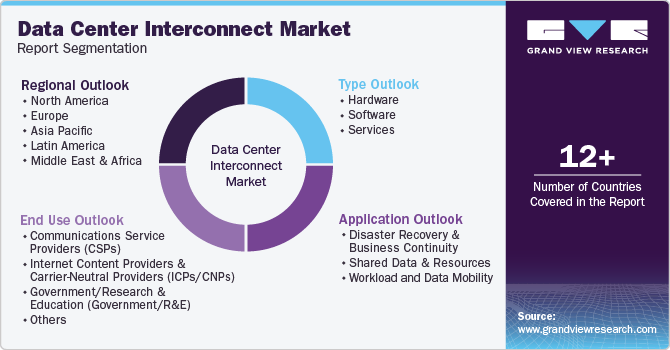
This report forecasts revenue growth at the global, regional, and country levels and provides an analysis of the latest industry trends from 2021 to 2033 in each of the sub-segments. For this study, Grand View Research has segmented the global data center interconnect market report based on type, application, end use, and region:
 To learn more about this report, Download Free Sample Report
 -
Type Outlook (Revenue, USD Billion, 2021 - 2033)
-
Hardware
-
Software
-
Services
-
Professional Services
-
Managed Services
-
-
-
Application Outlook (Revenue, USD Billion, 2021 - 2033)
-
Disaster Recovery and Business Continuity
-
Shared Data & Resources
-
Workload and Data Mobility
-
-
End Use Outlook (Revenue, USD Billion, 2021 - 2033)
-
Communications Service Providers (CSPs)
-
Internet Content Providers and Carrier-Neutral Providers (ICPs/CNPs)
-
Government/Research and Education (Government/R&E)
-
Others
-
-
Regional Outlook (Revenue, USD Billion, 2021 - 2033)
-
North America
-
U.S.
-
Canada
-
Mexico
-
-
Europe
-
UK
-
Germany
-
France
-
-
Asia Pacific
-
China
-
India
-
Japan
-
Australia
-
South Korea
-
-
Latin America
-
Brazil
-
-
Middle East & Africa (MEA)
-
UAE
-
Saudi Arabia
-
South Africa
-
-
Research Methodology
The data center interconnect market figures in this report are based on a proven research process that combines executive interviews with secondary research from proprietary databases, company filings, and recognized regulatory and institutional sources. Market size is built through value-chain sizing - reconciling supply-side and demand-side estimates - and triangulated with bottom-up and top-down approaches. Every estimate passes multiple levels of expert validation before publication, with each data center interconnect segment quantified using the revenue-capture definitions in the table below.
Segment Definition
Segment - Type
Revenue capture definition
Hardware
Hardware refers to the physical networking and transmission equipment used to establish and manage connectivity between geographically distributed data centers. This includes optical transport systems, routers, switches, transceivers, multiplexers, fiber-optic infrastructure, and network interface devices that facilitate high-speed, low-latency data transfer.
Software
Software includes the network management, orchestration, automation, monitoring, and security solutions used to configure, control, optimize, and manage DCI environments. These solutions enable traffic engineering, performance monitoring, software-defined networking (SDN), network analytics, and automated provisioning across interconnected data centers.
Services
Services encompass consulting, design, deployment, integration, maintenance, support, and managed services associated with DCI infrastructure.
Segment - Application
Revenue capture definition
Disaster Recovery and Business Continuity
This application involves replicating and synchronizing critical data and workloads between multiple data centers to ensure uninterrupted operations during system failures, cyberattacks, natural disasters, or other disruptions. DCI enables rapid failover and business continuity capabilities.
Shared Data & Resources
Shared Data & Resources refers to the use of DCI solutions to facilitate seamless access to applications, storage resources, databases, and computing infrastructure across multiple data center locations. This enables efficient resource utilization and centralized data management.
Workload and Data Mobility
Workload and Data Mobility involves transferring applications, virtual machines, containers, and datasets between data centers to optimize performance, scalability, resource allocation, and cloud integration. DCI provides the high-speed connectivity required for real-time workload migration and data movement.
Segment - End Use
Revenue capture definition
Communications Service Providers (CSPs)
Communications Service Providers include telecommunications operators, fixed-line providers, mobile network operators, and broadband service providers that utilize DCI solutions to interconnect core networks, regional data centers, cloud infrastructure, and edge facilities while supporting high-volume traffic transmission.
Internet Content Providers and
Carrier-Neutral Providers (ICPs/CNPs)
This segment includes hyperscale cloud providers, content delivery networks (CDNs), streaming platforms, internet service platforms, and carrier-neutral colocation providers. These organizations deploy DCI solutions to support cloud services, content distribution, large-scale data transfers, and interconnection ecosystems.
Government/Research
and Education (Government/R&E)
This segment comprises government agencies, defense organizations, public institutions, research laboratories, universities, and academic networks that use DCI infrastructure to facilitate secure data sharing, scientific collaboration, high-performance computing (HPC), and mission-critical operations across distributed facilities.
Others
The Others segment includes enterprises operating across industries such as banking, financial services, healthcare, manufacturing, retail, energy, and transportation that leverage DCI solutions to connect multiple data centers, support hybrid cloud strategies, ensure business continuity, and optimize digital operations.
Estimation Model
Layer
Question
Analysis
Data Center Infrastructure Demand Layer
Who requires Data Center Interconnect solutions?
Identify end users operating multiple data centers, including hyperscale cloud providers, colocation operators, telecommunications companies, enterprises, government agencies, research institutions, and content providers. Assess the number of distributed data centers requiring high-speed connectivity for data replication, cloud access, workload sharing, and business continuity to establish the total addressable market for DCI solutions.
Network Modernization & Cloud Adoption Layer
Which applications can deploy DCI solutions?
Evaluate adoption of hybrid cloud, multi-cloud, disaster recovery, workload mobility, edge computing, AI infrastructure, content delivery, and high-performance computing environments. Analyze networking requirements across industries to determine deployment opportunities for DCI hardware, software, and services.
Interconnection Investment Expansion Layer
Who actively invests in DCI infrastructure?
Analyze investments by hyperscalers, cloud service providers, telecommunications operators, carrier-neutral colocation providers, internet content providers, enterprises, and government organizations. Assess growth in data center construction, fiber network expansion, AI data center deployments, and digital transformation initiatives to identify active adopters of DCI solutions.
Monetization Layer
How much revenue is generated?
Quantify revenue generated from DCI hardware, software and services. Evaluate revenues from disaster recovery, workload mobility, cloud connectivity, and inter-data-center networking deployments across global markets.
Delivered Customizations
This report has been delivered with the following In-depth customizations
Client Request
Customization Delivered
Value Adds
Regional Data Center Infrastructure & Connectivity Assessment
Analyzed regional data center capacity, hyperscale expansion plans, cloud adoption trends, fiber network infrastructure, edge data center deployments, AI infrastructure investments, and interconnection ecosystems across Europe.
Helps investors, network equipment vendors, cloud providers, and infrastructure operators identify attractive growth markets, optimize expansion strategies, strengthen connectivity planning, and capitalize on emerging digital infrastructure opportunities.
Competitive Benchmarking & Technology Innovation Assessment
Assessed product portfolios, optical networking capabilities, coherent transmission technologies, software-defined networking (SDN) platforms, network automation solutions, AI-driven traffic management capabilities, and go-to-market strategies of leading and emerging DCI vendors globally.
Helps stakeholders benchmark competitors, identify technology differentiation opportunities, evaluate partnership or acquisition prospects, and develop effective competitive positioning strategies in the rapidly evolving DCI market.
Data Center Interconnect Application & End-User Adoption Assessment
Analyzed adoption patterns across disaster recovery and business continuity, workload mobility, shared data resources, cloud connectivity, and data replication applications among CSPs, ICPs/CNPs, government agencies, research institutions, and enterprises.
Provides insights into key revenue-generating applications, identifies high-growth customer segments, supports go-to-market planning, and enables targeted investment decisions across diverse end-user industries.
Frequently Asked Questions About This Report
The hardware segment led with a 56.3% revenue share in 2025, while software segment is the fastest-growing segment.
The disaster recovery and business continuity segment led with a 53.1% revenue share in 2025, while shared data & resources segment is the fastest-growing segment.
The communications service providers (CSPs) segment held the largest share (over 32.6%) in 2025, while internet content providers and carrier-neutral providers (ICPs/CNPs) segment is the fastest-growing segment.
Some key players operating in the data center interconnect market include Cisco Systems, Inc.; Juniper Networks, Inc.; Broadcom Inc.; Arista Networks, Inc.; Nokia Corporation; Huawei Technologies Co., Ltd.; Mellanox Technologies (now part of NVIDIA); Ciena Corporation; Extreme Networks, Inc.; Fujitsu Limited; IBM Corporation; Infinera Corporation; Adtran; ZTE Corporation.
With the explosion of data, the rise of edge computing, and the need for efficient interconnectivity, DCI is becoming an integral part of digital transformation initiatives worldwide. The market has witnessed rapid innovation, with key players offering advanced DCI services to meet the growing need for reliable, low-latency, and secure data connections.
The global data center interconnect market size was estimated at USD 11.1 billion in 2025 and is expected to reach USD 12.5 billion in 2026.
The global data center interconnect market is expected to grow at a compound annual growth rate of 13.8% from 2026 to 2033 to reach USD 30.9 billion by 2033.
North America dominated with 38.0% revenue share in 2025.
Asia Pacific is the fastest-growing region over the forecast period.
About the Author(s)
Next Generation Technologies Research Team
Technology · Next Generation TechnologiesThis report was authored by the next generation technologies research team at Grand View Research - comprising two research analysts, one senior research analyst, and one industry expert - with specialized expertise in the next generation technologies segment of the technology industry. All findings are based on proprietary technology databases, executive interviews, and regulatory analysis, subject to internal peer review prior to publication.
Last Updated:
Speak to Analyst

Customize this report to your needs - add regions, segments, or data points, with 20% free customization.
Or view our licence options:


ISO 9001:2015 & 27001:2022 Certified
We are GDPR and CCPA compliant! Your transaction & personal information is safe and secure. For more details, please read our privacy policy.


