
- Home
- »
- Next Generation Technologies
- »
-
Data Loss Prevention Market Size, Share Report, 2026-2033GVR Report cover
![Data Loss Prevention Market (2026 - 2033)Report]()
Data Loss Prevention Market (2026 - 2033)
Size, Share & Trends Analysis Report By Software (Network DLP, Endpoint DLP), By Services, By Deployment, By Enterprise Size, By Application, By End Use, By Region, And Segment Forecasts
Market Size, 2025
$3.4BMarket Estimate, 2026
$4.1BMarket Forecast, 2033
$13.8BCAGR, 2026–2033
19.0%Data Loss Prevention Market Summary
The global data loss prevention market was valued at USD 3.4 billion in 2025 and is projected to grow from USD 4.1 billion in 2026 to USD 13.8 billion in 2033, at a CAGR of 19.0% from 2026 to 2033. North America dominated the global market, accounting for the largest revenue share of 30.0% in 2025.Data loss prevention (DLP) refers to the processes and technologies organizations use to prevent the loss, theft, and unauthorized disclosure of sensitive data.
Key Market Trends & Insights
- By software: The data center and storage-based DLP segment accounted for the largest market share of around 42.0% in 2025.
- By services: The consulting services segment accounted for the largest market share of over 38.5% in 2025.
- By deployment: The cloud-based segment accounted for the largest market share of around 60.2% in 2025.
- By end use: The BFSI segment accounted for the largest market share of around 19.5% in 2025.
Regional Highlights
- Largest regional market: North America (around 30.0% revenue share, 2025)
- Fastest-growing regional market: Asia Pacific (highest CAGR, 2026-2033)
Market Size & Forecast
- Market size in 2025 : USD 3.4 Billion
- Estimated market size in 2026: USD 4.1 Billion
- Projected market size by 2033: USD 13.8 Billion
- CAGR (2023-2033): 19.0%
Cyberattacks and high-profile data breaches have become increasingly frequent, affecting numerous businesses. Organizations are experiencing the adverse impacts of these incidents, including financial losses, reputational damage, and potential legal consequences. The surge in data security enables organizations to identify and mitigate data loss risks. Organizations can limit the possibility of data breaches, unauthorized access, or accidental data leaks by implementing robust safety policies, reducing the potential for data loss incidents.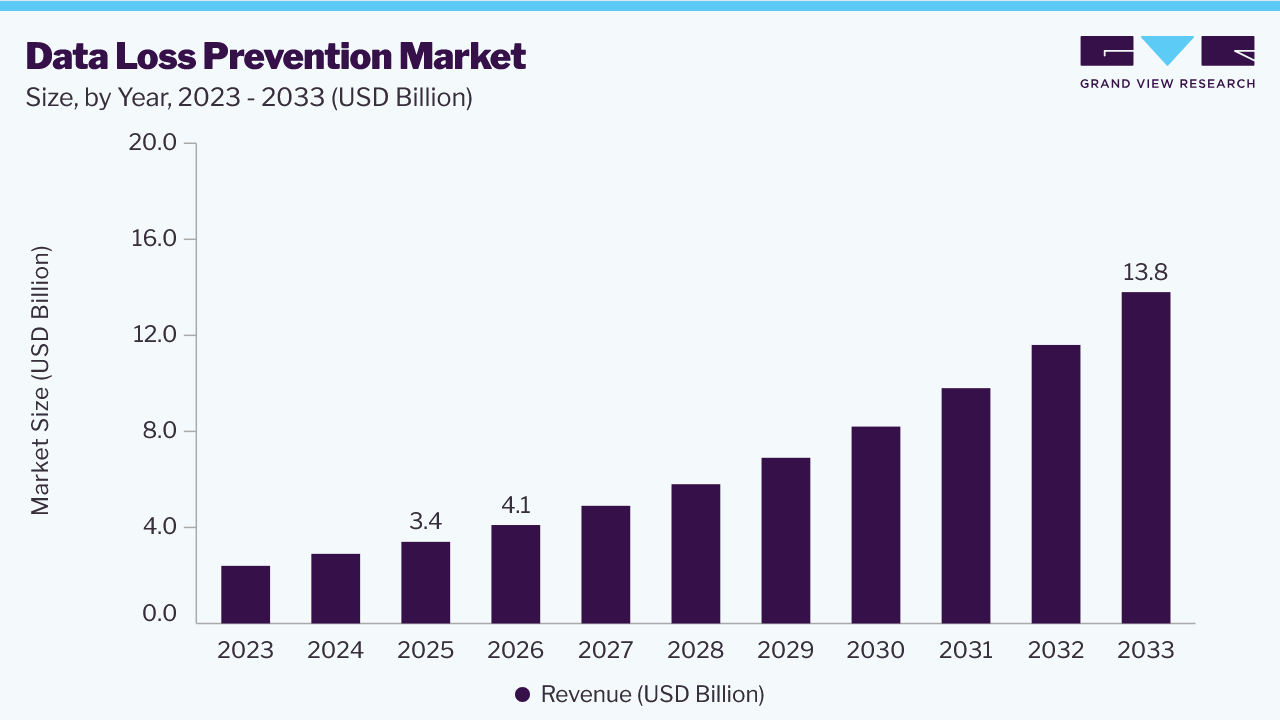
Organizations are opting for data loss prevention by installing data classification, which enables organizations to apply targeted protection measures to different data categories based on its sensitivity. Large and mid size enterprises are implementing appropriate security controls with a well-defined classification framework, such as access controls, encryption, or data loss prevention policies tailored to each data classification level.
It ensures that the most sensitive data receives the highest level of protection, reducing the risk of unauthorized access or data leakage. With the proliferation of digital data and the adoption of emerging technologies, such as Artificial Intelligence (AI), robotics, the Internet of Things (IoT), big data, and cloud computing, the volume and complexity of data continue to increase. This complexity creates opportunities for DLP solutions that can effectively discover, classify, and monitor sensitive data across diverse data sources and platforms. Implementing and sustaining effective DLP solutions is an expensive endeavor that requires software licenses, hardware infrastructure, ongoing maintenance, and specialized personnel.
To provide broad coverage, DLP systems are designed to support and integrate with a variety of data sources, cloud platforms, and endpoints. The challenge of managing fragmented data environments and delivering consistent protection across these different platforms could hinder the expansion of DLP initiatives. For instance, the GDPR, introduced by the European Union (EU), is one of the most important data protection legislations globally. It strives to protect EU individuals' data and puts stringent standards on organizations regarding data protection, privacy rights, data breach reporting, and consent. The GDPR has driven organizations to deploy robust DLP solutions to maintain compliance and secure personal data.
Market Dynamics
The growing use of cloud computing by businesses is a key driver for the rising demand for data loss prevention (DLP) solutions. As more organizations are moving essential workloads, applications, and sensitive data to public, private, and hybrid cloud environments to improve flexibility, scalability, and cost savings. Cloud platforms such as Microsoft 365, Amazon Web Services (AWS), Google Cloud, and Box allow businesses to store, access, and share data easily across teams spread out geographically, supporting remote and hybrid work models. However, the increasing amount of sensitive information in cloud environments also raises the risk of data leaks, unauthorized access, accidental exposure, and failure to meet regulations.
As businesses continue to grow their cloud usage, keeping track of and controlling data across various cloud applications and storage systems has become more difficult. This has led to faster adoption of DLP solutions, which offer real-time monitoring, data classification, policy enforcement, encryption, and threat detection to protect sensitive information. According to the European Commission, the share of businesses using paid cloud computing services increased from 45.32% in 2023 to 52.74% in 2025. In 2025, email, office software, and file storage were the most popular paid cloud services, with 85.15%, 71.69%, and 71.53% of businesses using them, respectively.
The difficulty of setting up and managing data loss prevention (DLP) policies is a major barrier to market growth. As more organizations use cloud services, remote work, and bring-your-own-device practices, sensitive data spreads across various environments. This makes it harder to create effective protection policies. DLP solutions need organizations to write detailed rules that can find and protect confidential information without interfering with normal business operations. However, poorly set policies can lead to many false alerts, increase the workload for administrators, and hurt employee productivity. In addition, many organizations do not have the specialized cybersecurity staff required to monitor, improve, and manage complex DLP systems. As a result, worries about setup complexity, operational costs, and user acceptance keep many companies, especially small and medium-sized ones, from widely adopting DLP solutions.
Analyst’s Perspective
The Data Loss Prevention (DLP) market is growing steadily owing to the increase in digital data, more companies adopting cloud services, and a rise in cybersecurity threats. Organizations are focusing on DLP solutions to protect sensitive information, meet regulations, and avoid data breaches in complex IT environments that include on-premises systems, cloud platforms, and remote endpoints. However, the market faces challenges such as complex deployment, high implementation costs, and the difficulty of managing false positives and enforcing policies on scale. In addition, stringent data protection laws including GDPR, CCPA, and other regional privacy rules are pushing organizations to improve their data governance and monitoring capabilities. In this context, vendors that offer unified, cloud-native, and AI-powered DLP solutions with easy policy management, high accuracy, and smooth integration across enterprise systems are likely to find better long-term success and a competitive edge.
Software Insights
The data center and storage-based DLP segment accounted for the largest market share, around 42.0%, in 2025. The segment growth can be attributed to the increasing data breach concerns. Data center and storage system data flows are monitored by DLP solutions to detect potential data loss incidents. The need for effective data protection systems has increased due to the rapid growth of data within organizations. Large volumes of sensitive and important data are kept in storage facilities such as data centers. DLP solutions offer organizations the controls and monitoring tools required to protect data from loss or unauthorized access. Data center or storage system disruptions can drastically impact business operations. DLP systems in data centers are essential for mitigating the effects of data loss incidents and enabling rapid recovery, especially when used with reliable data backup and recovery processes.
The endpoint DLP segment is expected to grow at a CAGR of over 21.0% during the forecast period. Endpoint DLP solutions help organizations prevent data breaches by tracking and controlling data transfers and endpoint access. Data categorization, encoding, enforcement of policies, and user engagement surveillance caters to endpoint solutions. Endpoint DLP enables organizations to protect sensitive data while also ensuring regulatory compliance. It helps prevent data leakage across various sources, such as email, portable devices, cloud storage, and internet connections. Endpoint DLP provides organizations with an in-depth, adaptive approach to data security, legal compliance, and risk mitigation. It helps maintain data quality, security, and accessibility, thereby protecting sensitive information and limiting the consequences of data breaches.
Services Insights
The consulting services segment accounted for the largest market share of over 38.5% in 2025. The segment growth is attributed to the growing complexity of data environments and the need to safeguard sensitive data. DLP consulting services offer expertise in developing effective data loss risk mitigation techniques and solutions. Technology is evolving rapidly, and new threats and vulnerabilities emerge continuously. DLP consulting services aim to keep pace with technological advancements and emerging threats, providing organizations with the most up-to-date expertise and solutions. DLP consulting services help organizations enhance data loss prevention capabilities by leveraging advanced tools such as machine learning, robotics, artificial intelligence, and behavioral analytics.
The managed security services segment is expected to grow at a CAGR of around 22.0% over the forecast period. DLP-managed security services help organizations develop and enhance data protection policies and procedures. They assist in the development of data classification plans, the creation of policy enforcement mechanisms, and ensuring the compliance of policies with industry rules. Managed security service providers partner with organizations to optimize DLP policies, keeping them up to date with evolving business needs and security requirements. DLP-managed security services provide incident response capabilities in case of a data breach or security issue. They have procedures and practices to investigate problems, limit damage, and reduce potential risks.
Deployment Insights
The cloud-based segment accounted for the largest market share, around 60.2%, in 2025. The surge in cloud-based services is attributed to their easy implementation and accessibility from any location with an internet connection. This enables organizations to protect data regardless of where its users or devices are located. It even facilitates the same security to remote employees as on-site staff. Moreover, cloud provider regularly updates and maintain cloud-based DLP solutions, ensuring organizations have access to the latest threat intelligence, security features, and regulatory compliance capabilities.
The on-premises segment is expected to grow at a CAGR of around 17.5% over the forecast period. On-premises data loss prevention provides organizations with greater control over sensitive data. It enables users to maintain information within personal infrastructure, facilitating direct monitoring and management. This level of control is essential for organizations dealing with highly sensitive or regulated data, as it reduces reliance on third-party entities. On-premises DLP solutions offer more customization and integration options with updated security and infrastructure systems. Moreover, on-premises DLP offers faster response times and lower latency than cloud-based solutions. For instance, in February 2026, Versa Networks introduced AI-Enhanced DLP features using on-premises Docker-containerized ML models for SASE gateways, providing discovery-first policy creation without ever removing the data from the organization's infrastructure.
Enterprise Size Insights
The large enterprise segment held around 58.5% market share in 2025 and is expected to dominate the market by 2033. Large organizations deal with complicated data ecosystems, including structured and unstructured data distributed across multiple systems and platforms. DLP assists in setting up data governance frameworks by detecting, categorizing, and managing sensitive material. It enables organizations to create and enforce data retention policies, reduce data-related risks, and ensure data handling compliance. Large enterprises employ DLP solutions to enforce data protection policies and monitor data transfers to third parties. DLP solutions aims to reduce the chances of third-party data breaches, mismanagement, or noncompliance with security regulations.
The SMEs segment is expected to grow at a CAGR of over 20.5% over the forecast period. SMEs often need more funds and resources than large enterprises. DLP solutions for SMEs offer cost-effective data protection measures that are scalable and tailored to the specific requirements of smaller businesses. DLP solutions assist SMEs in developing robust data protection practices, safeguarding customer data, and showcasing an ongoing commitment towards data security and privacy. These solutions enable SMEs to prioritize data protection efforts, concentrate on essential data assets, and install security policies corresponding to its risk profile and financial limits.
Application Insights
The encryption segment held around 21.6% market share in 2025 and is expected to dominate the market by 2033. As data loss is increasing, setting up policies and guidelines to detect and govern sensitive data movements within the organization is essential. Organizations provide an extra layer of security by combining encryption with DLP. The encryption segment is evolving as it protects data by turning it into an unreadable ciphertext format via cryptographic methods. Individuals with encryption keys can decrypt and access the data.
The policy, standards, and procedures segment is expected to grow at a CAGR of over 22.5% over the forecast period. The invention of advanced technologies protecting data from being exploited by unauthorized parties has raised awareness within organizations to strictly abide by the policy, procedures, and standards. Regulatory bodies such as HIPAA, GDPR, PCI DSS (Payment Card Industry Data Security Standard), and data loss prevention software facilitate organizations to classify data as confidential, standardized, or business-critical. DLP tools enhance regulatory requirements, making compliance audits more flexible at the time of occurrence.
End-use Insights
The BFSI segment held over 19.5% market share in 2025 and is expected to dominate the market by 2033. BFSI firms deal with massive amounts of data, such as client account details, credit card information, and financial information. DLP contributes to data governance by identifying, categorizing, and managing sensitive data. Data breaches, cyberattacks, and network intrusions pose ongoing challenges for the BFSI sector. DLP solutions facilitate real-time monitoring, analysis, and alerting, allowing for the early discovery of security incidents or policy violations. BFSI organizations rely significantly on intellectual property, such as patents, financial information, or patented technologies. DLP safeguards intellectual property from unauthorized disclosure or theft. It contributes to the confidentiality of key business information and prevents it from being exposed to rival parties.
The manufacturing segment is expected to grow at a CAGR of around 23.0% over the forecast period. Manufacturing organizations handle massive amounts of client data, including payment information, personally identifiable information (PII), and purchase history. Data loss prevention protects data against unauthorized access, breaches, or leaks by implementing security controls, monitoring data flows, and preventing data loss. Moreover, manufacturing firms work closely with many export & import vendors, suppliers, and partners, transferring sensitive data throughout the supply chain. DLP solutions assist in the monitoring and privacy of data transfers, minimizing the danger of data breaches while ensuring confidentiality.
Regional Insights
The North American regional market dominated the market with a share of around 30.0% in 2025. The increased awareness of data security risks has prompted organizations in North America to prioritize the protection of sensitive data. Cybersecurity disasters, security incidents, and increased data value have prompted security measures among organizations. DLP solutions are essential to a comprehensive data security strategy, helping organizations prevent data loss, maintain customer trust, and safeguard the brand image. North American businesses are progressively adopting cloud computing and leveraging cloud services for data storage, collaboration, and business operations. This shift has prompted the use of cloud-based DLP solutions to secure sensitive data in cloud environments.

Asia Pacific Data Loss Prevention Market Trends
The Asia Pacific is anticipated to rise as the fastest-developing regional market at a CAGR of over 22.0%. The Asia Pacific region has witnessed increased cybersecurity risks such as data breaches, ransomware attacks, and insider threats. Organizations have become increasingly aware of the possible threats and are proactively protecting sensitive data. Many Asia Pacific countries are undergoing significant digital transformation, with organizations embracing mobile technologies, cloud computing, and remote work approaches. These improvements have resulted in a growth in data storage, transfer, and partnership, prompting the implementation of DLP solutions to protect data across multiple settings and devices.
Key Data Loss Prevention Company Insights
The key players in the market are investing resources in research and development activities to support growth and enhance their internal business operations. The report will include company analysis based on their financial performance, product benchmarking, key business strategies, and recent strategic alliances. Companies can be seen engaging in mergers & acquisitions, and partnerships to further upgrade their products and gain a competitive advantage in the market. They are effectively working on new product development and enhancement of existing products to acquire new customers and capture more market shares
-
In April 2025, Netskope announced the launch of Netskope One DLP On Demand, the latest addition to its unified Netskope One Data Security platform. This new solution broadens data protection capabilities by allowing better integration with technology partners, offering support for on-premises deployment, and improving the overall data security framework. With this launch, Netskope has enhanced its Data Security Posture Management (DSPM) offering by adding the advanced and patented features of Netskope One DLP.
-
In August 2025, MIND, a provider of data loss prevention (DLP) solutions, announced the general availability of its autonomous AI-native DLP platform designed to help organizations securely adopt generative AI while strengthening data protection. The platform automates the entire data security lifecycle, offering continuous discovery and inventory of sensitive data across enterprise environments. Leveraging AI-powered classification capabilities, it improves detection accuracy and reduces false positives compared to traditional DLP solutions.
Key Data Loss Prevention Companies
The following key companies have been profiled for this study on the data loss prevention market.
-
BlackBerry
-
Broadcom, Inc.
-
CheckPoint
-
Cisco Systems, Inc.
-
Citrix Systems
-
CrowdStrike
-
Digital Guardian Inc.
-
IBM
-
Mcafee LLC
-
Microsoft
-
proofprint
-
SAP SE
-
Sophos Ltd.
-
Trend Micro
-
VMware, Inc.
Data Loss Prevention Market Report Scope
Report Attribute
Details
Market size in 2025
USD 3.4 billion
Estimated market size in 2026
USD 4.1 billion
Projected market size by 2033
USD 13.8 billion
Growth rate
CAGR of 19.0% from 2026 to 2033
Base year for estimation
2025
Historical data
2021 - 2024
Forecast period
2026 - 2033
Quantitative units
Revenue in USD billion, and CAGR from 2026 to 2033
Report coverage
Revenue forecast, company ranking, competitive landscape, growth factors, and trends
Segments covered
Software, services, deployment, enterprise size, application, end use, and region
Regional Scope
North America; Europe; Asia Pacific; Latin America; Middle East & Africa
Country scope
U.S.; Canada; UK; Germany; France; Italy; Spain; China; India; Japan; Australia; South Korea; Brazil; Mexico; Argentina; UAE; Saudi Arabia; South Africa
Key companies profiled
BlackBerry; Broadcom, Inc.; CheckPoint; Cisco Systems, Inc.;Citrix Systems; CrowdStrike; Digital Guardian Inc.; IBM; Mcafee LLC; Microsoft; proofprint; SAP SE; Sophos Ltd.; Trend Micro; VMware, Inc.
Customization scope
Free report customization (equivalent up to 8 analysts working days) with purchase. Addition or alteration to country, regional & segment scope.
Pricing and purchase options
Avail of customized purchase options to meet your exact research needs. Explore purchase options
Global Data Loss Prevention Market Report Segmentation
This report forecasts revenue growth and provides an analysis of the latest trends in each of the sub-segments from 2021 to 2033. For this study, Grand View Research has segmented the data loss prevention market report based on software, services, deployment, enterprise size, application, end use, and region:
-
Software Outlook (Revenue, USD Billion, 2021 - 2033)
-
Network DLP
-
Endpoint DLP
-
Data Center/Storage based DLP
-
-
Services Outlook (Revenue, USD Billion, 2021 - 2033)
-
Managed Security Services
-
Consulting Services
-
Others
-
-
Deployment Outlook (Revenue, USD Billion, 2021 - 2033)
-
On-premises
-
Cloud-based
-
-
Enterprise Size Outlook (Revenue, USD Billion, 2021 - 2033)
-
Small And Medium Enterprise (SMEs)
-
Large Enterprise
-
-
Application Outlook (Revenue, USD Billion, 2021 - 2033)
-
Encryption
-
Centralized Management
-
Policy, Standards and Procedures
-
Web, and Email Protection
-
Cloud Storage
-
Incident Response and Workflow Management
-
-
End-use Outlook (Revenue, USD Billion, 2021 - 2033)
-
BFSI
-
IT and Telecommunication
-
Retail and Logistics
-
Healthcare
-
Manufacturing
-
Government
-
Others
-
-
Regional Outlook (Revenue, USD Billion, 2021 - 2033)
-
North America
-
U.S.
-
Canada
-
-
Europe
-
UK
-
Germany
-
France
-
Italy
-
Spain
-
-
Asia Pacific
-
China
-
India
-
Japan
-
Australia
-
South Korea
-
-
Latin America
-
Brazil
-
Mexico
-
Argentina
-
-
Middle East & Africa
-
UAE
-
Saudi Arabia
-
South Africa
-
-
Frequently Asked Questions About This Report
The global data loss prevention market size was valued at USD 3.4 billion in 2025 and is projected to grow from USD 4.1 billion in 2026.
The global data loss prevention market is expected to grow at a CAGR of 19.0% from 2026 to 2033, reaching USD 13.8 billion by 2033.
Some key players operating in the data loss prevention market include BlackBerry; Broadcom, Inc.; CheckPoint; Cisco Systems, Inc.; Citrix Systems; CrowdStrike; Digital Guardian Inc.; IBM; Mcafee LLC; Microsoft; proofprint; SAP SE; Sophos Ltd.; Trend Micro; and VMware, Inc.
Key factors that are driving the data loss prevention market growth include Cyberattacks and high-profile data breaches have increased frequently, affecting numerous businesses. Organizations are witnessing the adverse impacts of these incidents, such as monetary losses, reputational harm, and potential legal consequences. The surge in data security facilitates organizations in identifying and mitigating data loss hazards.
North America dominated with a revenue share of 30.0% in 2025.
About the Author(s)
Next Generation Technologies Research Team
Technology · Next Generation TechnologiesThis report was authored by the next generation technologies research team at Grand View Research - comprising two research analysts, one senior research analyst, and one industry expert - with specialized expertise in the next generation technologies segment of the technology industry. All findings are based on proprietary technology databases, executive interviews, and regulatory analysis, subject to internal peer review prior to publication.
Last Updated:
Speak to Analyst


Customize this report to your needs — add regions, segments, or data points, with 20% free customization.
Or view our licence options:


ISO 9001:2015 & 27001:2022 Certified
We are GDPR and CCPA compliant! Your transaction & personal information is safe and secure. For more details, please read our privacy policy.


