
- Home
- »
- Organic Chemicals
- »
-
Dead Burned Magnesia Market Size Report, 2026-2033GVR Report cover

Dead Burned Magnesia Market (2026 - 2033)
Size, Share & Trends Analysis Report By Source (Magnesite Ore, Seawater, Brine & Bittern, Dolomite), By Grade (Industrial, High Purity/Specialty), By End-use, By Region, And Segment Forecasts
Market Size, 2025
$3.8BMarket Estimate, 2026
$3.9BMarket Forecast, 2033
$5.4BCAGR, 2026–2033
5.1%Dead Burned Magnesia Market Summary
The global dead burned magnesia market size was valued at USD 3.8 billion in 2025 and is projected to grow from USD 3.9 billion in 2026 to USD 5.4 billion in 2033, at a CAGR of 5.1% from 2026 to 2033. North America dominated the market, accounting for the largest revenue share of 49.2% in 2025. The market is expanding as demand for durable, heat-resistant refractory materials rises across industries requiring reliable high-temperature operations and longer equipment service life.
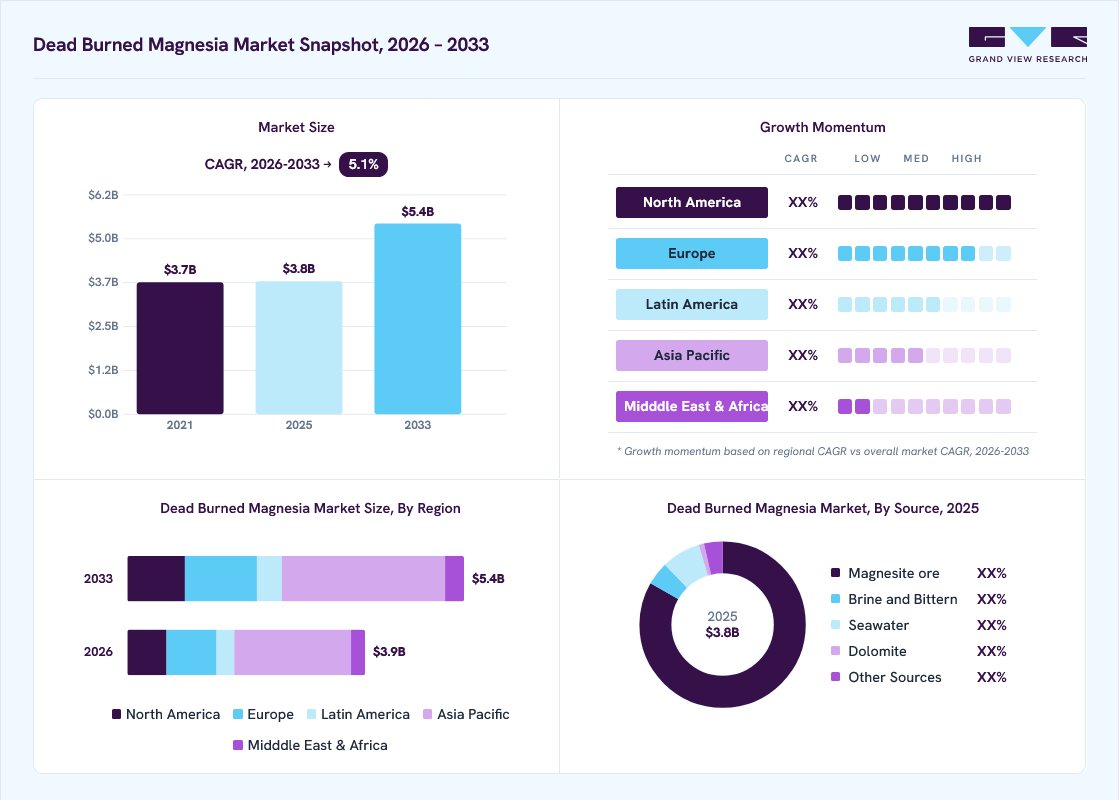 Source: Grand View Research, IR Documents, Primary Interviews, Paid DatabasesTo learn more about this report,
 Download Free Sample Report
Key Market Trends & Insights
- By source: Magnesite ore segment dominated the market in 2025, accounting for 83.2% of total revenue.
- By grade: High-purity/specialty-grade magnesia (>95% MgO) led the market at 56.4% in 2025.
- By end use: Iron and steel segment dominated the market in 2025, accounting for 69.2% of total revenue.
Regional Highlights
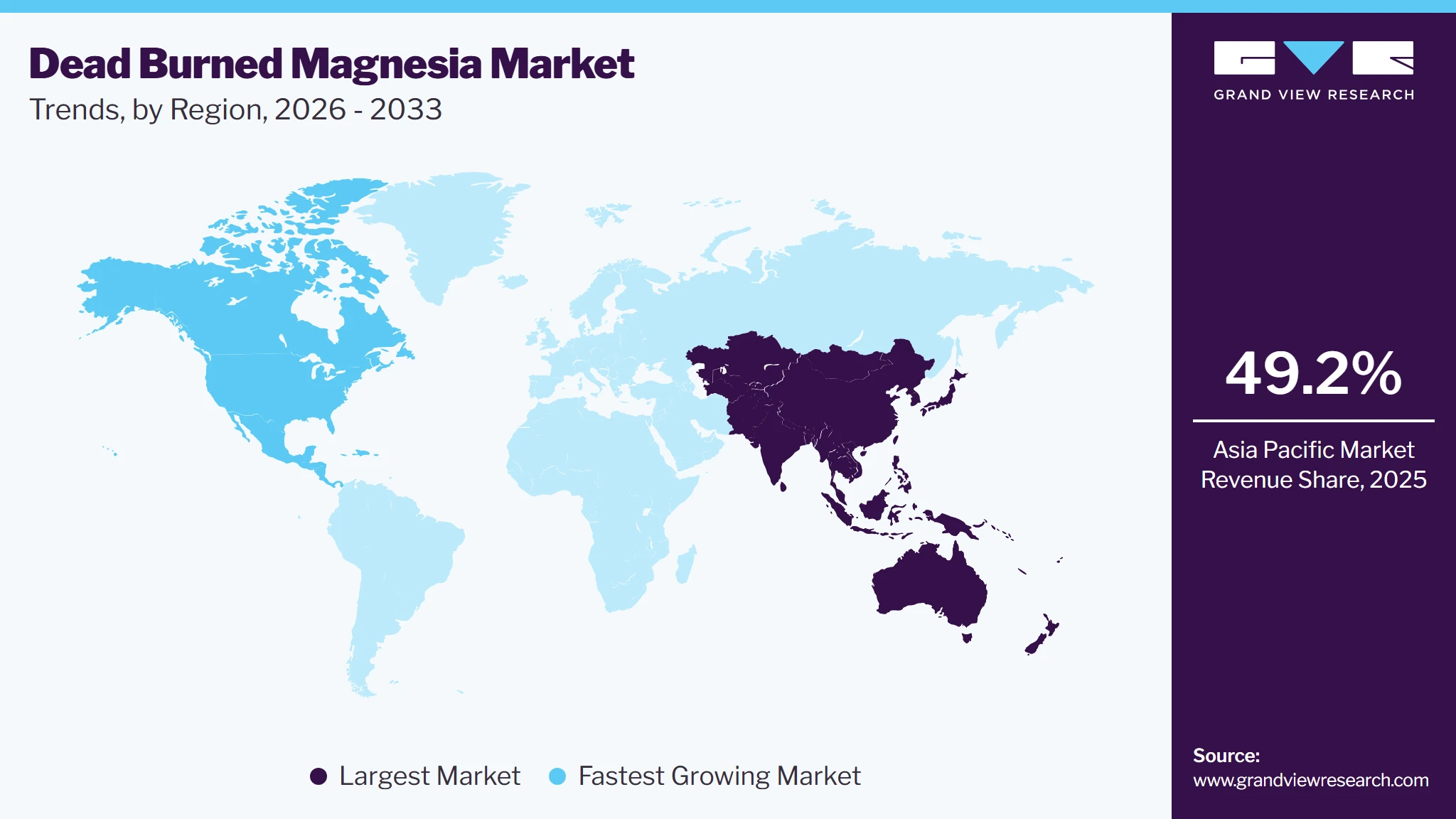
- Largest region: Asia Pacific (49.2% revenue share, 2025)
- Fastest-growing region: North America (highest CAGR, 2026-2033)
Market Size & Forecast
- Market size in 2025: USD 3.8 Billion
- Estimated market size in 2026: USD 3.9 Billion
- Projected market size by 2033: USD 5.4 Billion
- CAGR (2026-2033): 5.1%
Three ways to get this report
Buy it, customize it, or ask a question.Ask an Analyst
Analyst response in 1 business day
- AccessReport author, directly
- Reply timeWithin 1 working day
- No sales callDirect answer only
- FormatEmail reply
- CostFree, no cost
Get the Full Report
What the study covers
- FormatsPDF · Excel · Dashboard
- Timeline2026–2033 annual, 2025 base
- Coverage20+ countries, 5 regions
- Companies10+ key players profiled
Customize the Report
20% free customization
- IncludeCountries, segments, points
- TailorTo your product definition
- ExtendDeeper competitor detail
- OrA fully bespoke study
- Turnaround5–10 working days
Dead burned magnesia (DBM) is a high-temperature processed form of magnesium oxide valued for its high refractoriness, chemical stability, and resistance to thermal and mechanical stress. These properties make it an essential raw material in refractory products used to protect industrial furnaces, kilns, converters, and other high-temperature equipment. Its principal applications include refractory bricks and monolithic materials used in iron and steel production, cement manufacturing, non-ferrous metal processing, glass production, and foundry operations. Market demand is closely linked to refractory consumption, industrial operating activity, equipment maintenance, and the performance requirements of high-temperature processes.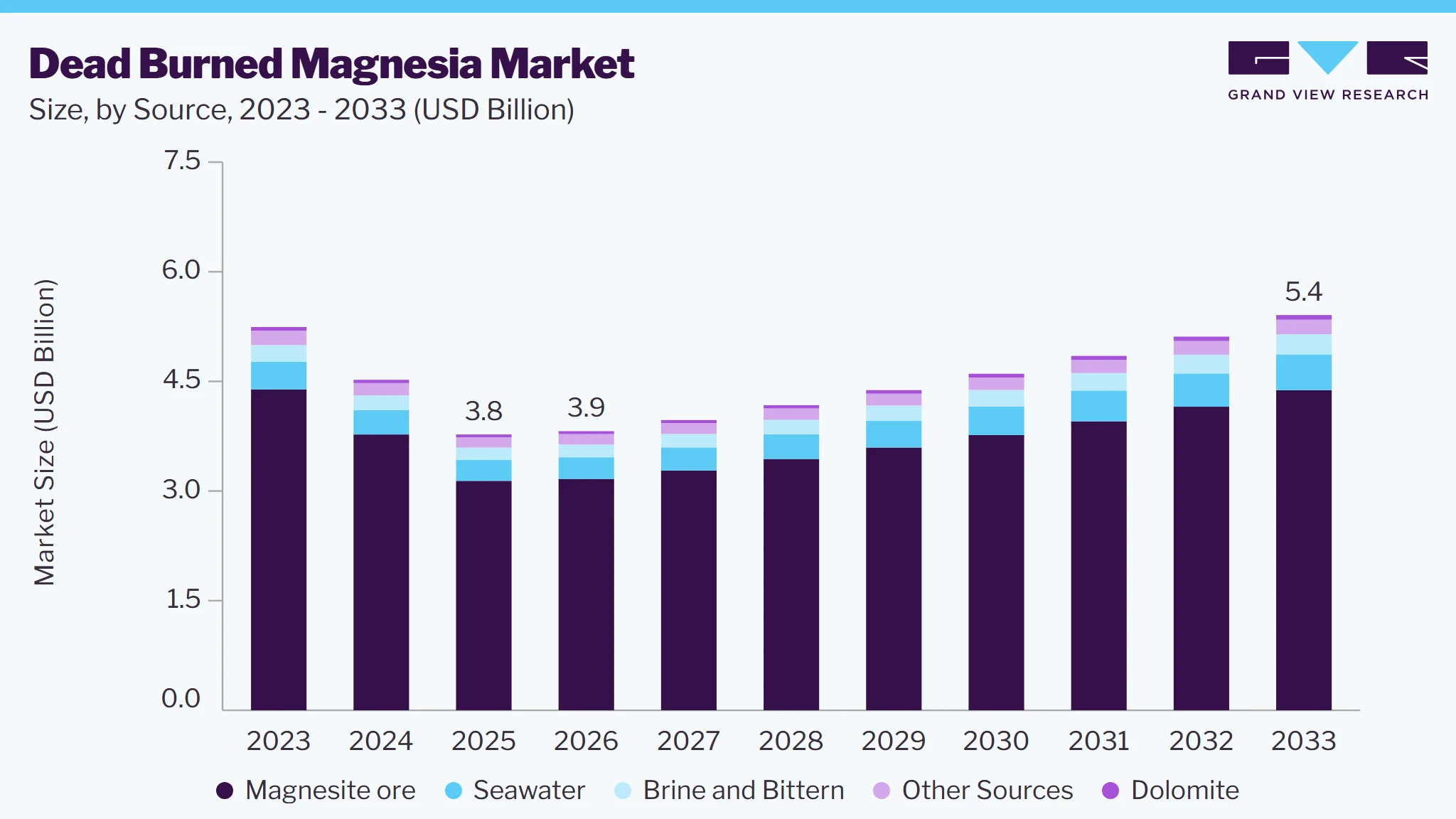 To learn more about this report, Download Free Sample Report
Market development is shaped by the availability and quality of magnesia-bearing raw materials, MgO content, production efficiency, and energy-intensive dead-burning processes. Manufacturers must balance product consistency, thermal performance, and service life with raw material and processing costs. Demand for higher-performance refractory materials also supports the importance of DBM grades suited to demanding operating conditions. Overall, the market reflects the essential role of DBM in industrial heat management, with its commercial outlook influenced by refractory requirements, production economics, and the need for reliable performance in severe operating environments.
Market Dynamics
The market benefits from its essential role in producing refractory linings that withstand extreme temperatures and chemically aggressive industrial environments. Steelmaking, cement production, and non-ferrous metal processing require refractory materials capable of protecting furnaces and extending campaign life. Demand is influenced by refractory replacement cycles, furnace maintenance, and the need to reduce unplanned shutdowns.
Industrial furnace operators require refractory linings that retain structural integrity under prolonged exposure to high temperatures, corrosive slags, and repeated heating and cooling. Dead-burned magnesia offers high magnesium oxide content, low reactivity, and resistance to chemical attack, making it suitable for basic refractory formulations used in steelmaking and other metallurgical processes. These properties support its use in refractory bricks and related products designed for demanding furnace conditions.
The need to extend refractory service life also influences purchasing decisions. Premature lining failure can interrupt production, increase maintenance expenditure, and require costly furnace shutdowns. Refractory producers therefore select raw materials according to their chemical composition, density, and performance under operating conditions. DBM provides an established material option for formulations intended to withstand these stresses. As industrial facilities seek dependable refractory performance and more predictable maintenance schedules, demand for suitable DBM grades remains closely connected to refractory manufacturing and replacement requirements.
Dead-burned magnesia production requires intense heating to achieve the dense structure and low reactivity associated with refractory-grade material. This process consumes substantial energy, making fuel and electricity expenses important components of manufacturing costs. Changes in energy prices can increase the cost of calcination and reduce producers’ margins, particularly when customers resist corresponding price increases. Production economics are also influenced by raw material quality, furnace efficiency, and the need to maintain consistent product specifications. Manufacturers operating older or less efficient kilns may face higher unit costs than producers with optimized equipment. When energy and processing expenses rise faster than selling prices, suppliers may find it harder to remain competitive while preserving profitability. These cost pressures can restrict production flexibility and discourage capacity expansion where expected returns do not justify the required investment.
Opportunities - Customized DBM grades can help manufacturers serve demanding refractory applications
Manufacturers can pursue growth by developing dead burned magnesia grades tailored to the chemical and physical requirements of specific refractory formulations. Steelmaking vessels, cement kilns, and nonferrous metal furnaces operate under different combinations of temperature, slag chemistry, and mechanical stress. Consistent control of magnesium oxide content, impurity levels, density, and particle size can help refractory producers formulate products suited to these operating conditions. Suppliers that provide reliable specifications and technical support can strengthen relationships with refractory manufacturers and compete for higher-value orders. Investment in process control, product testing, and application-specific grade development can also reduce batch variability and improve customer confidence. By aligning product characteristics with clearly defined customer requirements, DBM manufacturers can expand their range of value-added offerings, differentiate their products beyond price, and build longer-term supply relationships with specialized refractory producers.
Market Concentration & Characteristics
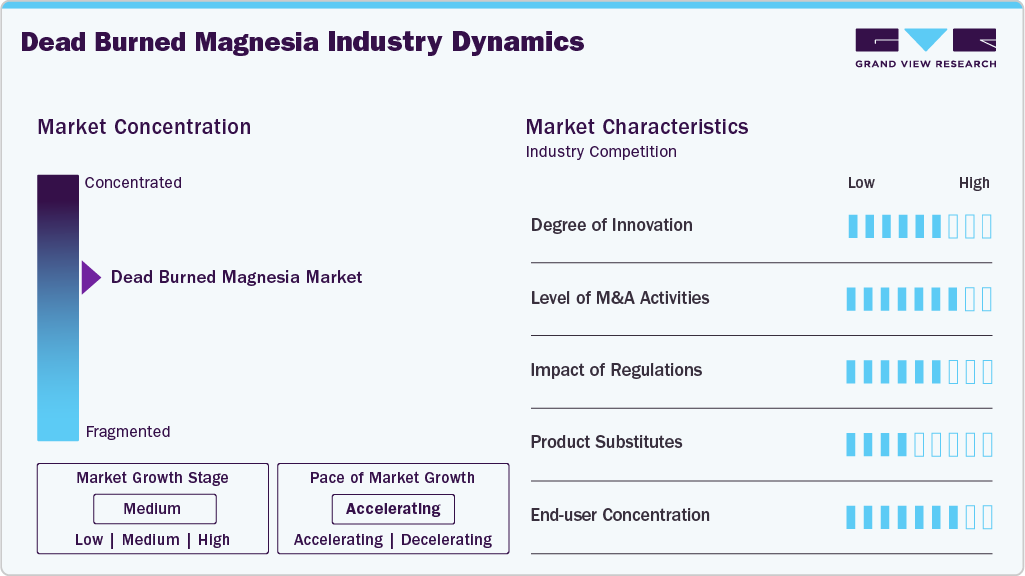
The dead burned magnesia industry is characterized by specialized production processes, quality-sensitive purchasing, and close links between raw material suppliers and refractory manufacturers. Producers must maintain consistent chemical composition, impurity control, and firing conditions because variations can affect the performance of finished refractory products. These technical requirements influence supplier selection, as customers often prioritize dependable specifications and consistent product quality to ensure compatibility with their manufacturing processes.
 To learn more about this report, Download Free Sample Report
Market concentration is influenced by access to suitable magnesia feedstocks, energy-intensive processing capabilities, and the investment required to operate high-temperature kilns efficiently. These requirements can create barriers for new entrants, while established producers may benefit from operational experience and established customer relationships. However, product specifications and application requirements vary among buyers, leaving room for suppliers that can provide customized grades and dependable delivery. Competition therefore involves not only pricing but also product consistency, technical support, production efficiency, and supply reliability.
Analyst Perspective
The market remains closely linked to refractory demand from steelmaking and other high-temperature industries. Product quality, MgO content, and impurity control influence purchasing decisions and supplier selection. Energy-intensive manufacturing makes production costs and kiln efficiency important factors affecting profitability. Manufacturers can strengthen their position by supplying consistent, customized grades and maintaining reliable delivery. The market’s long-term outlook depends on refractory consumption, industrial maintenance requirements, and producers’ ability to control costs while meeting demanding product specifications.
Source Insights
The magnesite ore segment dominated the market in 2025, accounting for 83.2% of total revenue. Its leading position reflects its established role as a feedstock for commercial magnesia production and the availability of established mining and processing infrastructure. Magnesite can be processed through high-temperature firing to produce dense, low-reactivity material suitable for refractory applications. Consistent access to suitable ore and established production methods contribute to its widespread adoption among DBM manufacturers.
The seawater segment is projected to grow at a CAGR of 7.5% from 2026 to 2033. Seawater provides an alternative source of magnesium, offering manufacturers an opportunity to diversify their raw material supply beyond mined deposits. Magnesium can be recovered through chemical extraction and processed into magnesia before dead burning. The segment's expansion will depend on extraction efficiency, energy consumption, processing costs, and the ability to produce material that meets the purity and performance requirements of refractory applications.
Grade Insights
High purity and specialty grade magnesia containing more than 95% MgO accounted for 56.4% of market revenue in 2025 and is projected to grow at a CAGR of 6.0% through 2033. Its leading share reflects demand for material with high magnesium oxide content and controlled impurities for specialized refractory formulations.
Industrial applications such as steelmaking and non-ferrous metal processing require refractory materials that meet strict chemical and thermal specifications. High-purity DBM helps manufacturers formulate products for these demanding conditions, supporting continued demand for premium grades where material consistency and performance are essential.
End Use Insights
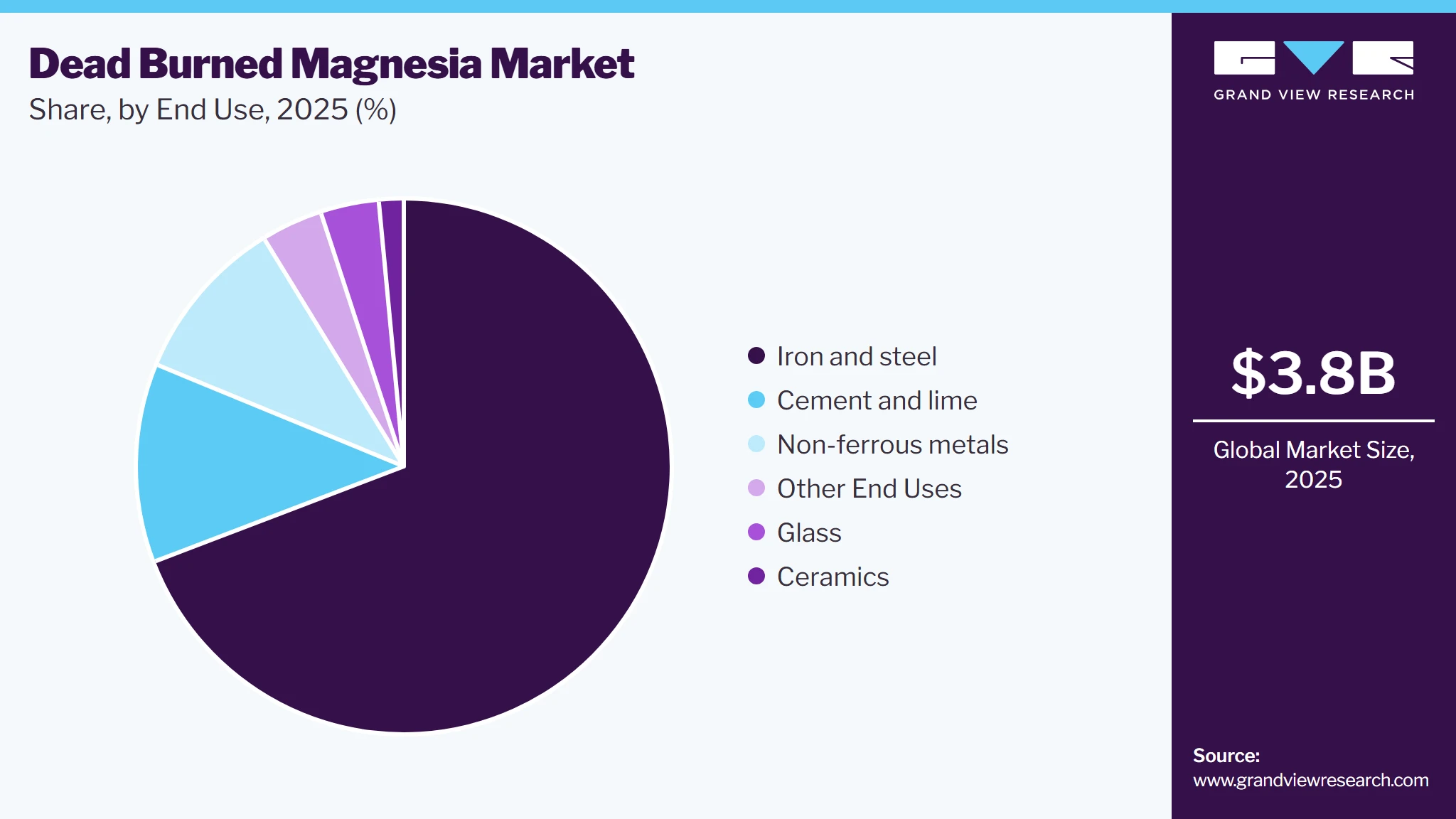
The iron and steel segment dominated the market in 2025, accounting for 69.2% of total revenue. Steelmaking operations expose furnace linings to molten metal, corrosive slags, and substantial thermal stress. Basic refractory products containing DBM are used in equipment such as converters, electric arc furnaces, and ladles to withstand these conditions. Refractory wear and scheduled relining create recurring material requirements, linking DBM consumption to steel production processes, equipment operating conditions, and maintenance frequency.
 To learn more about this report, Download Free Sample Report
The ceramics segment is projected to record the fastest growth, with a CAGR of 6.8% from 2026 to 2033. Potential demand is associated with specialized ceramic materials and kiln-related applications where magnesium-based compounds provide useful thermal or chemical properties. DBM's contribution depends on the specific formulation and operating requirements, as it is not a standard ingredient across all ceramic products. Growth will therefore be influenced by adoption in relevant specialty applications and the ability of manufacturers to meet their material specifications.
Regional Insights
Asia Pacific accounted for 49.2% of global dead burned magnesia market revenue in 2025. The region’s leadership is supported by its concentration of steel production, refractory manufacturing, and magnesia processing, particularly in China. Demand also comes from cement kilns, non-ferrous metal processing, and other applications requiring basic refractory materials. The presence of integrated industrial supply networks and established refractory producers supports DBM procurement across major manufacturing economies, while differences in industrial development and raw material access shape demand across the region.
 To learn more about this report, Download Free Sample Report
China Dead Burned Magnesia Market Trends
The dead burned magnesia market in China is shaped by its domestic magnesite resource base and extensive magnesia processing industry. Access to magnesite supports the production of refractory raw materials for steelmaking and other high-temperature applications. Market conditions are influenced by mining regulations, environmental requirements, energy use during calcination, and changes in steel-sector activity. Producers also face pressure to maintain consistent MgO content and impurity levels to meet refractory manufacturers’ specifications. These factors influence sourcing strategies, operating costs, and competition among domestic suppliers.
North America Dead Burned Magnesia Market Trends
The dead burned magnesia market in North America is projected to register a CAGR of 5.6% from 2026 to 2033. Demand is linked to refractory replacement cycles across steel plants, cement kilns, and other high-temperature industrial facilities. Purchasing decisions are influenced by product consistency, supply reliability, and the ability to limit unplanned furnace downtime. The region’s market also reflects the role of established refractory suppliers and cross-border material sourcing. Growth will depend on industrial operating rates, maintenance schedules, and the economics of refractory upgrades.
The U.S. dead burned magnesia market is influenced by the operating requirements of electric arc furnace steelmaking, foundries, and industrial mineral processing. Refractory materials must withstand intense heat, mechanical wear, and chemical exposure during repeated production cycles. Steel mill maintenance schedules and refractory service life therefore affect the timing and volume of DBM purchases. Buyers also consider imported material costs, freight expenses, and supplier qualification requirements. Demand patterns are shaped by domestic steel output, the condition of existing industrial equipment, and specifications set by refractory manufacturers.
Europe Dead Burned Magnesia Market Trends
The dead burned magnesia market in Europe reflects the requirements of mature steel, cement, glass, and metal-processing industries, alongside increasingly stringent environmental and energy-efficiency expectations. Refractory buyers may assess material performance in relation to furnace efficiency, service life, and the volume of waste generated during relining. High energy costs can influence the economics of magnesia processing and refractory production, while industrial decarbonization initiatives may change furnace technologies and operating practices. Demand consequently varies by industry, with purchasing decisions shaped by plant modernization, maintenance needs, and compliance requirements.
Germany dead burned magnesia market demand is associated with its steelmaking operations, foundries, engineering industries, and specialized high-temperature manufacturing processes. Refractory requirements vary across furnaces, casting systems, and thermal equipment, making material specifications and operational performance important purchasing considerations. Industrial cost pressures can lead manufacturers to scrutinize refractory consumption, maintenance intervals, and equipment efficiency. Changes in steel production methods and investment in industrial modernization may also influence the types of refractory formulations required. Market demand is therefore tied to manufacturing activity and the technical needs of individual applications.
Latin America Dead Burned Magnesia Market Trends
The dead burned magnesia market in Latin America is influenced by steel production, cement manufacturing, mining, and metal-processing activity. Demand differs across countries according to the scale of local industrial operations and the availability of refractory manufacturing services. Cement producers require kiln linings that tolerate prolonged heat exposure, while metallurgical operations use refractory materials suited to their specific furnace conditions. For buyers reliant on imported DBM or finished refractory products, currency movements, shipping costs, and delivery lead times can affect procurement. Regional consumption is closely linked to industrial investment and operating conditions in key end-use sectors.
Middle East & Africa Dead Burned Magnesia Market Trends
The dead burned magnesia market in MEA is shaped by cement capacity, infrastructure development, metal processing, and the establishment or expansion of industrial facilities. Cement kilns are an important source of refractory demand, particularly where construction activity supports sustained production. Metallurgical applications create additional requirements where steelmaking and related industries are established. In countries with limited local magnesia processing, buyers may depend on overseas suppliers and must account for freight, inventory planning, and delivery schedules. Demand prospects vary with project completion, cement utilization, and investment in industrial production.
Key Dead Burned Magnesia Company Insights
The two key manufacturers in the market are Martin Marietta Magnesia Specialties, LLC and Premier Magnesia, LLC, both recognized for magnesia production.
-
Martin Marietta Magnesia Specialties, LLC is an American manufacturer of high-purity magnesium oxide and magnesium hydroxide products for industrial, environmental, chemical, and specialty applications. Its magnesia portfolio includes dead burned grades marketed under the MagChem® brand. These materials are used in refractory bricks, monolithic refractories, and other applications requiring resistance to high temperatures and corrosive conditions.
-
Premier Magnesia, LLC is a United States-based magnesia manufacturer with operations focused on natural magnesite and magnesium-based products. Its portfolio includes DB 90 BMF, a dead-burned magnesium oxide product designed for applications requiring low reactivity. The product is used in refractory applications, magnesium phosphate cement, and drilling mud and cement additives, reflecting the company’s focus on industrial magnesia applications.
Key Dead Burned Magnesia Companies
The following key companies have been profiled for the study on the dead burned magnesia market.
-
Martin Marietta Magnesia Specialties, LLC
-
Premier Magnesia, LLC
-
Grecian Magnesite S.A.
-
Terna Mag
-
Nedmag B.V.
-
China Mineral (Yingkou) Magnesia Co., Ltd.
-
YIMAG Group Corporation
-
Dashiqiao Yutong Refractories Co., Ltd.
-
Henan Qingjiang Industrial Co., Ltd.
-
Magnesitas Navarras, S.A.
Competitive Benchmarking
Operating Strategies
Competitive Edge
Weaknesses
Mature Players: Martin Marietta Magnesia Specialties, Grecian Magnesite, Terna Mag, Nedmag
- Develop DBM grades with controlled MgO content, impurity levels, density, and particle size to meet refractory specifications.
- Optimize high-temperature kiln operations and raw material processing to maintain product consistency and manage production costs.
- Strengthen technical support and customer relationships to adapt DBM grades to changing refractory formulations and industrial operating conditions.
- Established magnesia processing expertise and specialized product portfolios support applications in steelmaking and other high-temperature industries.
- Multiple purity grades and specialized products help address differing refractory performance requirements and customer specifications.
- Production experience and established customer relationships support consistent supply and qualification for demanding industrial applications.
- Energy-intensive calcination and kiln operations expose manufacturers to fuel, electricity, maintenance, and operating cost fluctuations.
- Dependence on consistent feedstock quality and strict process control can increase production complexity and limit flexibility across specialized grades.
- Competition from regional producers may put pressure on pricing, particularly in standard DBM grades where customers have more sourcing options.
Emerging Players: China Mineral (Yingkou) Magnesia, YIMAG Group, Dashiqiao Yutong Refractories, Henan Qingjiang Industrial, TANMAG
- Offer DBM across different MgO concentrations to serve refractory manufacturers with varied chemical and performance requirements.
- Focus on regional industrial demand and product specifications while developing production consistency across grades and particle sizes.
- Build customer relationships with refractory manufacturers and industrial buyers seeking suitable grades and dependable regional supply.
- A range of MgO grades gives customers options for balancing purity requirements and material costs.
- Regional manufacturing presence can support access to local refractory producers and industrial customers, particularly in established magnesia-producing areas.
- Specialized DBM offerings allow certain producers to target defined customer requirements without relying exclusively on premium high-purity grades.
- Publicly available information on production capacity, international reach, and DBM-specific market share is limited for several companies.
- Competing for specialized refractory contracts may require stronger technical support, consistent quality documentation, and dependable supply across different customer markets.
- Limited public evidence of global service networks and product-development capabilities makes their international competitive position difficult to compare with established producers.
Recent Developments
-
In July 2025, Martin Marietta completed its acquisition of Premier Magnesia, strengthening its position in natural and synthetic magnesia-based products in the United States. The transaction expanded its Magnesia Specialties business and consolidated ownership of a producer offering dead-burned magnesium oxide for industrial and refractory applications.
-
In June 2025, Grecian Magnesite announced the commissioning of a new rotary kiln at its Akdeniz Mineral Kaynaklari facility in Türkiye, with a capacity of 140 tonnes per day, increasing output of high-purity caustic-calcined and dead-burned magnesia.
Dead Burned Magnesia Market Report Scope
Report Attribute
Details
Market Definition
The market comprises the production and sale of magnesium oxide processed at high temperatures to achieve high density, low reactivity, and thermal stability. It primarily serves refractory manufacturing for steelmaking, cement, non-ferrous metals, and other high-temperature industrial applications.
Market size in 2025
USD 3.8 billion
Estimated market size in 2026
USD 3.9 billion
Projected market size by 2033
USD 5.4 billion
Growth rate
CAGR of 5.1% from 2026 to 2033
Historical data
2021 - 2025
Forecast period
2026 - 2033
Quantitative units
Volume in kilotons, revenue in USD billion, and CAGR from 2026 to 2033
Report coverage
Volume and revenue forecast, company ranking, competitive landscape, growth factors, and trends
Segments covered
Product, application, end use, region
Regional scope
North America; Europe; Asia Pacific; MEA; Latin America
Country scope
U.S., Canada, Mexico, Germany, UK, France, Italy, Spain, China, India, Japan, South Korea, Brazil, Argentina, Saudi Arabia, South Africa
Key companies profiled
Martin Marietta Magnesia Specialties, LLC; Premier Magnesia, LLC; Grecian Magnesite S.A.; Terna Mag; Nedmag B.V.; China Mineral (Yingkou) Magnesia Co., Ltd.; YIMAG Group Corporation; Dashiqiao Yutong Refractories Co., Ltd.; Henan Qingjiang Industrial Co., Ltd.; Magnesitas Navarras, S.A.
Customization scope
Free report customization (equivalent up to 8 analysts’ working days) with purchase. Addition or alteration to country, regional & segment scope.
Pricing and purchase options
Avail customized purchase options to meet your exact research needs. Explore purchase options
Global Dead Burned Magnesia Market Report Segmentation
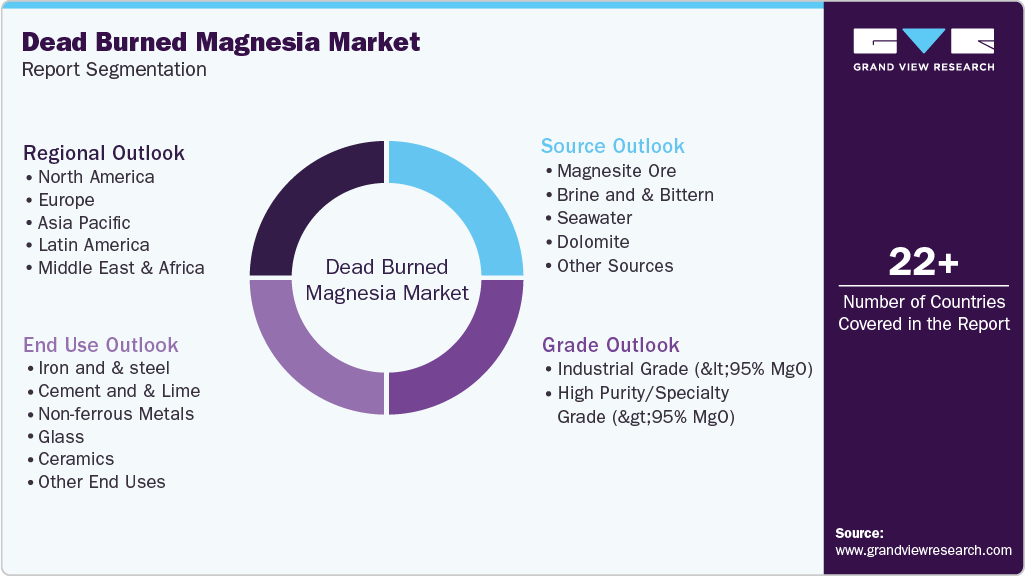
This report forecasts revenue growth at global, regional, and country levels and provides an analysis of the latest industry trends in each of the sub-segments from 2021 to 2033. For this study, Grand View Research has segmented the global dead burned magnesia market report based on source, grade, end use, and region:
 To learn more about this report, Download Free Sample Report
-
Source Outlook (Volume, Kilotons; Revenue, USD Billion, 2021 - 2033)
-
Magnesite Ore
-
Brine & Bittern
-
Seawater
-
Dolomite
-
Other Sources
-
-
Grade Outlook (Volume, Kilotons; Revenue, USD Billion, 2021 - 2033)
-
Industrial Grade (<95% MgO)
-
High Purity/Specialty Grade (>95% MgO)
-
-
End Use Outlook (Volume, Kilotons; Revenue, USD Billion, 2021 - 2033)
-
Iron & steel
-
Cement & Lime
-
Non-ferrous Metals
-
Glass
-
Ceramics
-
Other End Uses
-
-
Regional Outlook (Volume, Kilotons; Revenue, USD Billion, 2021 - 2033)
-
North America
-
U.S.
-
Canada
-
Mexico
-
-
Europe
-
Germany
-
UK
-
Italy
-
Spain
-
France
-
-
Asia Pacific
-
China
-
India
-
Japan
-
South Korea
-
-
Latin America
-
Brazil
-
Argentina
-
-
Middle East & Africa
-
Saudi Arabia
-
South Africa
-
-
Research Methodology
The dead burned magnesia market figures in this report are based on a proven research process that combines executive interviews with secondary research from proprietary databases, company filings, and recognized regulatory and institutional sources. Market size is built through value-chain sizing-reconciling supply-side and demand-side estimates-and triangulated with bottom-up and top-down approaches. Every estimate passes multiple levels of expert validation before publication, with each dead burned magnesia segment quantified using the revenue-capture definitions in the table below.
Segment Definition
Segment
Revenue capture definition
Magnesite Ore
Revenue is captured through the production and sale of dead burned magnesia manufactured by firing magnesite ore at high temperatures. Income is generated from bulk purchases by refractory manufacturers supplying steelmaking, cement, and other industrial applications requiring high-temperature resistance.
Seawater
Revenue is generated through the sale of dead burned magnesia produced from magnesium recovered from seawater. Manufacturers capture value by supplying processed material to refractory producers requiring consistent chemical composition, controlled impurities, and reliable performance in demanding industrial environments.
Segment - Grade
Revenue capture definition
High-Purity / Specialty Grade (Above 95% MgO)
Revenue is generated through sales of high-purity dead burned magnesia with elevated magnesium oxide content and controlled impurities. Manufacturers capture value by supplying premium grades for specialized refractory formulations requiring consistent chemistry, thermal stability, and reliable performance under demanding operating conditions.
Standard / Industrial Grade (Up to 95% MgO)
Revenue is captured through bulk sales of standard and industrial-grade dead burned magnesia used in conventional refractory products and other high-temperature applications. Income is driven by recurring purchases from refractory manufacturers seeking suitable material specifications, dependable availability, and cost-effective performance.
Segment - End Use
Revenue capture definition
Iron and Steel
Revenue is generated through the supply of dead burned magnesia for refractory bricks, furnace linings, converters, and other steelmaking equipment. Manufacturers capture value through recurring orders linked to refractory production, maintenance schedules, and replacement requirements in high-temperature steelmaking operations.
Cement and Lime
Revenue is captured through sales of dead burned magnesia used in refractory linings for rotary kilns and other high-temperature processing equipment. Demand is driven by refractory installation, maintenance, and replacement requirements across cement and lime manufacturing facilities.
Non-Ferrous Metals
Revenue is generated through sales of dead burned magnesia for refractory applications in non-ferrous metal smelting and processing. Manufacturers serve industrial customers requiring materials that withstand high temperatures and demanding operating conditions, supporting purchases for refractory production and furnace maintenance.
Ceramics
Revenue is captured through the supply of dead burned magnesia for relevant specialty ceramic and refractory applications requiring thermal stability and controlled material properties. Sales depend on specific formulation requirements and the use of magnesia-based materials in high-temperature processing.
Others
Revenue is generated through sales to foundries, ferroalloy producers, and other industrial users requiring refractory materials for high-temperature operations. Manufacturers capture value through bulk orders and repeat purchases associated with refractory production, furnace maintenance, and equipment relining.
Estimation Model
Layer Name
Key Question
Content
Industrial Demand Base Layer
What forms the demand base?
Identify global production activity across steelmaking, cement and lime, non-ferrous metals, foundries, ferroalloys, and relevant specialty ceramic applications. Assess industrial output, furnace installations, and refractory consumption to establish the addressable demand base for dead burned magnesia.
Refractory Application Layer
Where is dead burned magnesia consumed?
Estimate DBM utilization across refractory bricks, monolithic refractories, furnace linings, converters, rotary kilns, and other high-temperature equipment. Evaluate application penetration by industry, considering refractory material requirements, equipment operating conditions, maintenance cycles, and replacement demand.
Material Consumption Intensity Layer
How much DBM is required?
Assess DBM consumption per unit of refractory production and relevant industrial output. Consider refractory formulation, MgO content, impurity levels, operating temperatures, service life, and application-specific specifications. Incorporate differences between high-purity specialty grades and standard industrial grades to estimate material requirements.
Revenue Estimation Layer
How is market revenue generated?
Calculate market revenue from DBM sales volumes multiplied by average selling prices across source types, grades, end-use industries, and regions. Account for product purity, processing costs, customer specifications, contract structures, and regional price differences to estimate total market revenue and validate results against manufacturer disclosures and industry trade data.
Delivered Customizations
This report has been delivered with the following In-depth customizations
Client Request
Customization Delivered
Value Adds
Cross-Segmentation Analysis
Cross-segment analysis of dead burned magnesia by source (magnesite ore and seawater), grade (high-purity/specialty and standard/industrial), end use (iron and steel, cement and lime, non-ferrous metals, ceramics, and others), and region. Evaluates how material source and grade requirements vary across industrial applications and geographic markets.
Identifies high-value segment combinations, highlights differences in application-specific material requirements, and supports targeted market positioning based on grade preferences, end-use demand, and regional customer needs.
Competitive Benchmarking
Comparative assessment of key DBM manufacturers, including Martin Marietta Magnesia Specialties, Grecian Magnesite, Terna Mag, Nedmag, and selected regional producers. Reviews product portfolios, MgO purity ranges, specialty-grade offerings, application focus, geographic presence, and recent strategic developments.
Helps evaluate competitor positioning, identify product differentiation opportunities, understand strengths across customer segments, and support strategic decisions regarding market entry, product development, and customer targeting.
Opportunity Assessment
Assessment of potential growth opportunities arising from refractory replacement needs, demand for high-purity DBM grades, specialized high-temperature applications, and evolving material requirements across steelmaking, cement, non-ferrous metals, and selected specialty ceramic applications.
Helps identify attractive application segments, evaluate demand for premium-grade products, prioritize promising regional markets, and align product strategies with customer performance requirements and long-term industrial demand trends.
About the Author(s)
Organic Chemicals Research Team
Bulk Chemicals · Organic ChemicalsThis report was authored by the organic chemicals research team at Grand View Research - comprising two research analysts, one senior research analyst, and one industry expert - with specialized expertise in the organic chemicals segment of the bulk chemicals industry. All findings are based on proprietary bulk chemicals databases, executive interviews, and regulatory analysis, subject to internal peer review prior to publication.
Last Updated:
Speak to Analyst

Customize this report to your needs - add regions, segments, or data points, with 20% free customization.
Or view our licence options:


ISO 9001:2015 & 27001:2022 Certified
We are GDPR and CCPA compliant! Your transaction & personal information is safe and secure. For more details, please read our privacy policy.


