
- Home
- »
- IT Services & Applications
- »
-
Deck Planning Software Market Size Report, 2026-2033GVR Report cover

Deck Planning Software Market (2026 - 2033)
Size, Share & Trends Analysis Report By Deployment (Cloud-based & On-premise), By Application (Residential, Commercial), By End Use (Architects & Builders, Remodelers, Interior Designers), By Region, And Segment Forecasts
Market Size, 2025
$272.7MMarket Estimate, 2026
$301.1MMarket Forecast, 2033
$624.8MCAGR, 2026–2033
11.0%Deck Planning Software Market Summary
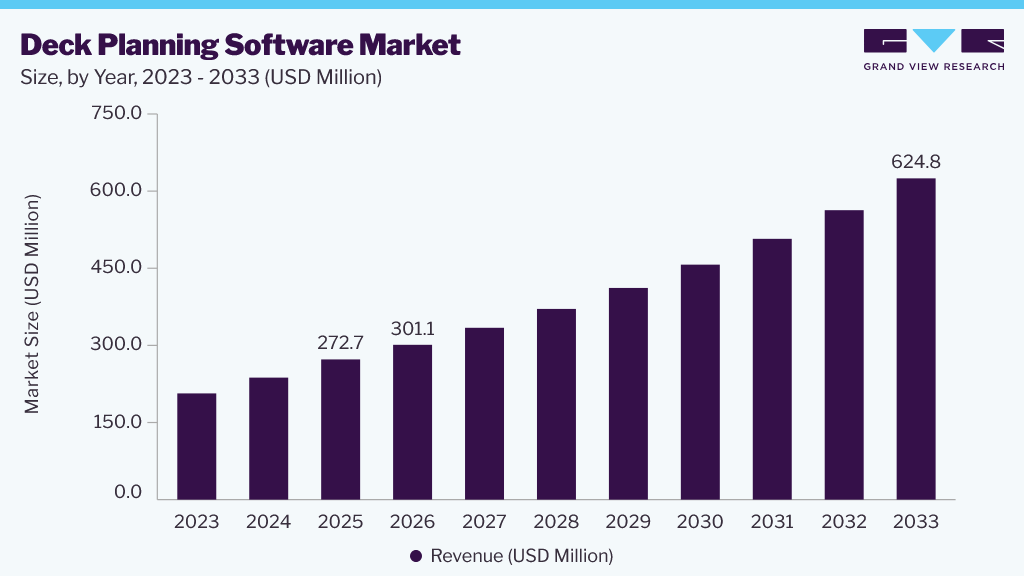
The global deck planning software market size was valued at USD 272.7 million in 2025 and is projected to grow from USD 301.1 million in 2026 to USD 624.8 million in 2033, at a CAGR of 11.0% from 2026 to 2033. North America dominated the market, accounting for a revenue share of 40.0% in 2025. This growth in the deck planning software market is driven by the increasing demand for construction planning, estimating, and design software within the construction industry. Real estate companies are increasingly adopting various types of construction software, including 3D modeling, deck planning, and computer-aided design tools, to streamline their business processes and enhance efficiency. 3D deck planning software offers multiple material options, user-friendly tools, and integrated structural choices that work together more effectively than standalone deck planning software.
 Source: Grand View Research, IR Documents, Primary Interviews, Paid DatabasesTo learn more about this report,
 Download Free Sample Report
 Key Market Trends & Insights
- By deployment: The cloud-based deck planning software held the largest market share of around 52.0% in 2025.
- By application: The residential segment accounted for the largest market share in 2025.
- By end use: The architect & builders segment accounted for the largest market share in 2025.
Regional Highlights
- Largest regional market: North America (40.0% revenue share, 2025)
- Fastest-growing regional market: Asia Pacific (highest CAGR, 2026-2033)
Market Size & Forecast
- Market size in 2025: USD 272.7 Million
- Estimated market size in 2026: USD 301.1 Million
- Projected market size by 2033: USD 624.8 Million
- CAGR (2026-2033): 11.0%
Three ways to get this report
Buy it, customize it, or ask a question.Ask an Analyst
A direct answer, usually in 1 working day
- AccessReport author, directly
- Reply timeWithin 1 working day
- No sales callDirect answer only
- FormatEmail reply
- CostFree, no cost
Get the Full Report
What the study covers
- FormatsPDF · Excel · Dashboard
- Timeline2026–2033 annual, 2025 base
- Coverage20+ countries, 5 regions
- Companies10+ key players profiled
Customize the Report
20% free customization
- IncludeCountries, segments, points
- TailorTo your product definition
- ExtendDeeper competitor detail
- OrA fully bespoke study
- Turnaround5–10 working days
The increasing complexity of deck design has prompted market players to develop more user-friendly deck-planning software, driving growth in the deck-planning software market. For example, Simpson Strong-Tie has launched the Deck Planner Software. This web-based tool allows homeowners, contractors, and DIY enthusiasts to create complete deck layouts using a simple drag-and-drop interface. This platform enables users to design decks, automatically generate material lists, produce permit-ready drawings, and visualize deck structures in both 2D and 3D, all without needing advanced CAD skills. By improving usability and reducing design complexity, this update highlights the industry’s growing focus on making deck-planning software more accessible and better integrated with construction workflows.The deck planning software allows users to select every component of their new deck while comparing various colors and materials within the application. It automatically generates a materials list, provides a pricing estimate, and creates a printable design that users can share with potential contractors if they are satisfied with their design. This software uses Augmented Reality (AR) and Virtual Reality (VR) technologies and is compatible with most web browsers, guiding users through the deck-planning process.
In July 2025, Trex launched an upgraded version of the ‘Trex Deck Railing Designer.’ This 3D web-based deck-planning and visualization tool enables users to design railing and deck combinations in real time using interactive 3D configuration technology. The platform offers immersive deck layout visualizations, instant material estimates, and cross-device compatibility, allowing homeowners and contractors to experience a highly visual, near-AR design environment to plan outdoor deck structures more efficiently. As a result, the incorporation of AR and VR applications in deck planning software is anticipated to drive market growth.
The use of deck planning software is increasing due to the need for a more streamlined process for creating deck structures and generating detailed floor plans, material selections, and deck specifications. This method provides greater cost and time efficiency compared to traditional drafting and estimating processes. The growing adoption of deck planning software is also fueled by the rise in residential landscaping projects and the expansion of backyards and gardens. Additionally, the growing trend among homeowners to design elaborate decks with features such as water fountains, fire pits, pergolas, walls, and outdoor kitchens is expected further to boost demand for deck-planning software in the coming years.
Analyst Perspective
The deck planning software market is witnessing steady growth owing to increasing demand for easy-to-use digital tools that help homeowners and contractors design outdoor deck spaces with greater accuracy and convenience. The market is witnessing growing adoption of 3D visualization, cloud-based design platforms, artificial intelligence, and augmented reality features as companies focus on improving user experience and making deck planning more interactive and realistic. These tools allow users to customize layouts, compare materials, estimate costs, and view real-time design changes, thereby improving decision-making and reducing planning errors. Although challenges such as limited digital awareness among some users, reliance on accurate input data, and varying levels of technology adoption across regions persist, advancements in AI design automation, AR-based visualization, and browser-based planning tools are continually creating new opportunities. Companies that focus on simple interfaces, immersive visualization, and intelligent design recommendations are expected to benefit from the market’s long term growth by improving customer engagement and making deck planning more efficient and accessible.
Deployment Insights
Cloud-based deck planning software held the largest market share, over 50.0%, in 2025. Cloud-based deck planning software can transform traditional deck-planning practices by modernizing processes and workflows. Deck planning software providers offer automatic updates, remote access, scalability, mobility, cost-saving, and on-demand support. This reduces the need to purchase, manage, and maintain software and hardware at users’ locations, as the SaaS provider supplies a package of data storage, software, and support on a per-term, per-usage basis. Cloud-based deck planning solutions generally run on the cloud provider’s servers and can be accessed by users with internet connectivity.
The on-premises segment is expected to register a significant CAGR over the forecast period. On-premises software solutions provide greater flexibility for customization, greater control over integrations with other systems and sensitive data, and help users ensure compliance with industry regulations. On-premises deployments are also more reliable and stable, reducing concerns about external factors such as internet connectivity and server downtime. These factors combined are driving the demand for on-premise deck planning software.
Application Insights
The residential segment accounted for the largest market share in 2025. Deck planning software is becoming increasingly popular among contractors, interior designers, and residential project developers. There is a growing demand for customized detailing in residential properties, including apartments, duplexes, bungalows, and independent houses. Thus, drafting a detailed plan is increasingly crucial to the project's overall success. It involves detailed floor planning, color and material selection, and theme finalization while meeting the homeowner's specifications. Deck planning software offers advanced features such as 2D and 3D representations of layouts, sizes, shapes, and fine details that are essential for finalizing deck plans.
The commercial segment is expected to register a significant CAGR from 2026 to 2033. Deck planning software provides a vital tool for commercial project developers to plan, create, and analyze detailed layouts and specifications for deck construction projects. With 2D and 3D representations, customizable templates, and a variety of deck-planning tools, deck-planning software enables developers to create a more structured and realistic project outline. This software also helps to ensure compliance with regulatory standards and enhances the safety and security features of deck railings, claddings, fasteners, and other accessories. With application deck planning software, commercial deck construction projects can be initiated, planned, and executed more easily, efficiently, and accurately.
End use Insights
By end use, the architect & builders segment accounted for the largest market share in 2025. Architects play a crucial role in planning and constructing decking and in ensuring compliance with regulatory and sustainability requirements. However, with ever-changing customer demands and the complexity of modern construction projects, architects and architectural firms need to leverage advanced deck-planning software to plan, visualize, and draft project specifications. This software helps architects increase project efficiency, minimize the risk of errors, and streamline collaboration among various parties involved in the deck project. By using deck planning software, architects can easily plan and monitor the initial design with real-time project updates, compare deck materials against the design plan, and incorporate client requirements at any time during the deck development phase.
The remodelers segment is expected to grow significantly over the forecast period. Deck planning software is becoming increasingly popular among remodelers as it enables them to create more efficient and effective designs for their clients' outdoor spaces. With deck planning software, remodelers can easily utilize existing space, choose the right materials, and incorporate specific homeowner preferences into the deck blueprint. This software also allows you to draw and import deck layouts from a library of pre-existing deck plans, customize the deck's size and shape, and recreate the outdoor space.
Regional Insights
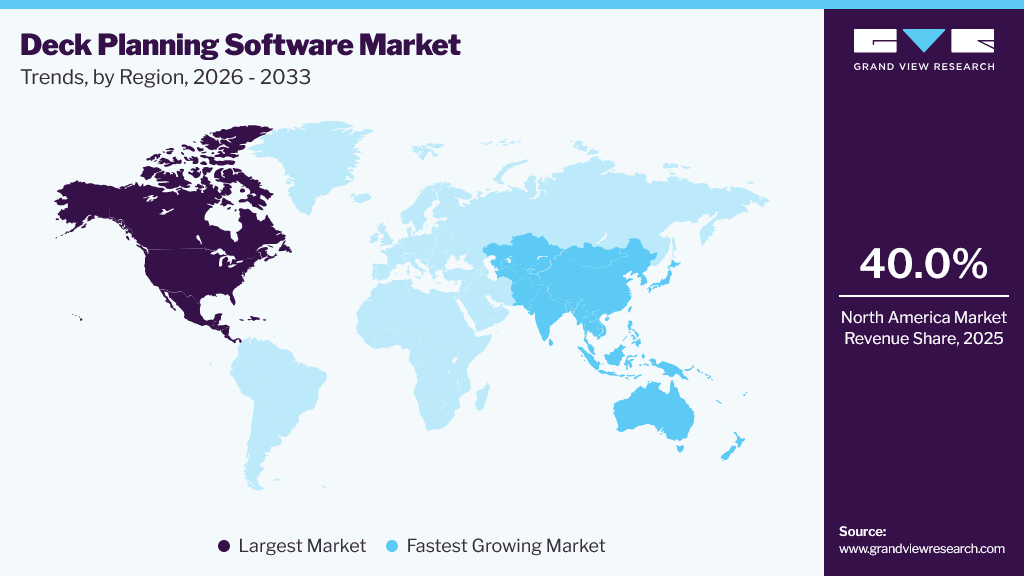
North America deck planning software market held the largest market share, at around 40.0% by revenue, in 2025. The North American deck planning software market is experiencing rapid growth due to the increasing number of residential and commercial projects in the region. With rising trends in outdoor gatherings, barbecues, pool parties, and events, there's a growing demand for decks on properties. This demand is driving the growth of the North American deck planning software market. Additionally, the region's investments in the renovation and redevelopment of construction projects and the adoption of cloud-based technologies are expected to be key drivers of the market's growth over the coming years. Fiberon is a U.S.-based company that has introduced the Discovery Deck Designer tool, enabling users to create customized deck layouts with 3D visualization features using the company’s product range. The platform allows homeowners and contractors to select decking boards, railing systems, and colors, and automatically generates material estimates and design previews. This supports easier planning and improves decision-making in residential deck construction projects by offering a more visual, simplified design experience.
 To learn more about this report, Download Free Sample Report
 U.S. Deck Planning Software Market Trends
The deck planning software market in the U.S. is expected to grow at a significant CAGR from 2026 to 2033. Increased spending on residential and non-residential activities in the country is a key driver of growth in the U.S. deck planning software market. According to the U.S. Census Bureau, U.S. total construction spending in April 2026 increased by 0.4% compared to March 2026, reaching a seasonally adjusted annual rate of USD 2.172 trillion, driven by growth in both private and public construction activity. Private construction also rose by 0.4%, while residential construction increased by 0.8%, reflecting steady demand for housing and infrastructure projects. Moreover, other factors such as the increasing adoption of advanced technology, automation in the construction and architecture industries, and the growing demand for software for planning and visualizing deck projects are expected to drive growth in the U.S. deck planning software market over the forecast period.
Asia Pacific Deck Planning Software Market Trends
The deck planning software market in Asia Pacific is projected to grow at the fastest CAGR from 2026 to 2033. The demand for deck planning software in the Asia Pacific region is rising due to growth in the construction industry, especially in the residential sector. With the increasing development of new residential and commercial projects, there is a greater need for outdoor living spaces such as decks, balconies, and rooftops.
Aspects such as railings, walls, staircases, and flooring require detailed specifications that match the client's requirements. Deck planning software enables developers and architects to provide clients with a comprehensive list of decking product vendors, material quality, cost, and designs. This results in a more precise and transparent deck-building process, making deck-planning software an essential tool in the Asia Pacific region.
China deck planning software market is expected to grow at a significant CAGR from 2026 to 2033. China boasts one of the largest construction industries in the world, driven by a large population base and a thriving hospitality industry, as well as corporate offices and banking and financial sectors. This has led to a constant need for new construction projects, thereby promoting the adoption of advanced software for construction, design, cost estimation, and deck planning, among other applications. Deck planning software assists construction firms, architects, and individuals in designing 2D and 3D layouts, optimizing space utilization, and setting up walls, railings, and staircases. These benefits are expected to drive the growth of the deck planning software market in China during the forecast period.
A growing number of government initiatives are driving growth in the India deck planning software market, with a focus on smart cities and smart infrastructure development, which have accelerated construction activities across the country. In addition, rising investment in the real estate sector in recent years has further contributed to market expansion. These developments have created favorable conditions for the adoption of advanced planning and design technologies within the construction industry. Moreover, the growing consumer preference for home renovation and remodeling projects, owing to their cost-effectiveness and shorter completion timelines than new construction, is further driving demand for deck planning software. As a result, architecture, engineering, and construction firms are increasingly adopting sophisticated, user-friendly deck-planning solutions to enhance design accuracy, improve project visualization, and streamline deck development.
The Japan deck planning software market is currently facing several challenges, including labor shortages, strict regulations, and an increasing demand for complex infrastructure projects. To overcome these obstacles, contractors are turning to advanced technology, software, and devices to minimize costs, reduce errors, and ensure timely project completion. Deck planning software has become an essential tool for contractors aiming to succeed in their deck projects. Additionally, due to Japan's vulnerability to natural disasters such as earthquakes and floods, the government is implementing initiatives to develop earthquake-resistant residential projects. This focus is expected further to drive the adoption of deck planning software in Japan.
Europe Deck Planning Software Market Trends
The deck-planning software market in Europe is expected to grow at a significant CAGR from 2026 to 2033. The fast-paced development of luxurious properties, including hotels, residential buildings, villas, and penthouses, is driving the adoption of deck planning software in Europe. This software not only helps define the layout, color, and material specifications but also allows project developers to create and present blueprints in different formats, such as 2D and 3D. Additionally, the growing number of regulatory requirements related to safety, security, and sustainability in residential projects is fueling the adoption of deck planning software in the construction industry.
The UK deck planning software market is expected to grow significantly at the fastest CAGR from 2026 to 2033. The construction and architecture industries in the U.K. are seeing increased use of technology and software, further fueled by growing customer demand for highly detailed, specific deck models. Additionally, the need to ensure deck safety and sustainability in line with regulatory compliance is prompting commercial developers and architects to incorporate deck planning software to design, remodel, and introduce modern, sophisticated decks. These factors are likely to propel the adoption of deck planning software in the U.K.
The deck planning software market in Germany is growing due to the increasing demand for visually appealing outdoor spaces in residential houses, luxury hotels, and sea-facing villas. As the architecture and construction industry continues to evolve, there is a growing adoption of construction software for design, estimating, resource planning, and client relationships. Deck planning software, with its diverse range of modern, traditional, and theme-based deck design galleries, is becoming increasingly popular in the country.
Considering the significance of psychology, tradition, imagination, and trends, it can be difficult for architects and construction firms to incorporate all these elements without software. Deck planning software helps streamline this process, making it more cost-effective and flexible. Homeowners can modify and adjust their decking layouts and designs before installation, ensuring they achieve exactly what they desire.
Middle East & Africa Deck Planning Software Market Trends
The deck-planning software market in the Middle East and Africa is experiencing steady growth, driven by rapid urbanization and the increasing adoption of digital technologies across the construction sector. The rising demand for advanced software solutions for deck design, planning, and construction is driven by expanding infrastructure development and a growing emphasis on smart construction practices. Governments across the region are also undertaking significant initiatives to accelerate digitization within industries such as real estate, architecture, and construction.
Moreover, increasing public and private investments in commercial and residential developments, including residential towers, luxury villas, hotels, and waterfront apartments, are encouraging construction professionals to adopt sophisticated software solutions for home décor planning, outdoor space visualization, and deck design applications. These trends are expected to continue supporting the growth of the deck planning software market in the Middle East and Africa.
The Saudi Arabian deck planning software market is growing as the government has launched several initiatives to promote innovation, technology adoption, and development, including deck planning software, as part of its Vision 2030 initiative. This initiative aims to diversify the economy, reduce dependence on oil, and promote technological innovations. Additionally, the government has been investing in various projects, including residential, commercial, and public infrastructure.
Key Deck Planning Software Market Companies Insights
Some of the key players operating in the market include Autodesk Inc. and Trimble Inc., among others.
- Autodesk Inc. offers a comprehensive portfolio of industry-standard software, including AutoCAD, Civil 3D, AutoCAD LT, and BIM Collaborate Pro. These well-established applications have become the preferred choice for architects, engineers, and other professionals, creating a strong user network. Those familiar with Autodesk software are more likely to continue using it due to its established workflows and compatibility with existing projects, making it a safe and familiar option for companies.
- Trimble Inc. focuses on cloud platform services and connected software applications. Key components of its growth strategy include the company's Construction Scanning and Trimble CloudEngine solutions. In addition, Trimble is dedicated to the philosophy of application programming interfaces (APIs) and promoting an open vendor environment. As a result, its software and analytics solutions are widely adopted in the market.
Drafix Software, Inc. and Idea Spectrum, Inc. are among the emerging market participants in the deck-planning software market.
- Drafix Software, Inc. is a software development company specializing in drafting and design solutions for architects, engineers, and contractors. Its CAD Pro software is recognized for its user-friendly interface and drafting capabilities, enabling users to create precise blueprints and technical drawings for architectural plans, mechanical diagrams, electrical layouts, and landscaping projects. The software helps professionals efficiently visualize and execute design concepts.
- Idea Spectrum, Inc. offers landscape design solutions, including Realtime Landscaping Architect, Realtime Landscaping Pro, Realtime Landscaping Plus, and Realtime Landscaping Photo. These solutions provide advanced 3D landscape planning and visualization capabilities, allowing professional designers and homeowners to create realistic, interactive landscaping concepts with greater design accuracy and clearer project visualization.
Key Deck Planning Software Companies
The following key companies have been profiled for this study on the deck planning software market:
-
Autodesk Inc.
-
Cedreo SAS
-
Chief Architect, Inc.
-
Dassault Systèmes SE
-
Deckorators, Inc.
-
Delta Software International LLC
-
Drafix Software, Inc.
-
Idea Spectrum, Inc.
-
Advanced Environmental Recycling Technologies, Inc.
-
RoomSketcher AS
-
Simpson Strong-Tie Company, Inc.
-
SmartDraw Software, LLC
-
The AZEK Company Inc.
-
Trex Company, Inc.
-
Trimble Inc.
Recent Developments
-
In April 2026, Trimble signed an agreement to acquire Document Crunch, an AI-based construction document intelligence company, to integrate automated risk analysis and compliance management capabilities into its construction technology ecosystem. The acquisition strengthened Trimble’s AI-driven workflow and project planning capabilities across connected design and construction environments.
-
In March 2026, Autodesk announced the evolution of Autodesk Construction Cloud into Autodesk Forma, expanding its AI-powered platform for planning, design, and construction workflows. The update enhanced cloud-based collaboration, connected design capabilities, and advanced visualization and planning tools supporting design and layout planning applications.
Deck Planning Software Market Report Scope
Report Attribute
Details
Market size in 2025
USD 272.7 million
Estimated market size in 2026
USD 301.1 million
Projected market size by 2033
USD 624.8 million
Growth rate
CAGR of 11.0% from 2026 to 2033
Base year for estimation
2025
Historical data
2021 - 2024
Forecast period
2026 - 2033
Quantitative units
Revenue in USD million/billion, and CAGR from 2026 to 2033
Report coverage
Revenue forecast, company ranking, competitive landscape, growth factors, and trends
Segments covered
Deployment, application, end-use, region
Regional scope
North America; Europe; Asia Pacific; Latin America; MEA
Country scope
U.S.; Canada; Mexico; U.K.; Germany; France; Italy; Spain; China; India; Japan; Australia; South Korea; Brazil; Argentina; UAE; KSA; South Africa
Key companies profiled
Autodesk Inc.; Cedreo SAS; Chief Architect, Inc.; Dassault Systèmes SE; Deckorators, Inc.; Delta Software International LLC; Drafix Software, Inc.; Idea Spectrum, Inc.; Advanced Environmental Recycling Technologies, Inc.; RoomSketcher AS; Simpson Strong-Tie Company, Inc.; SmartDraw Software, LLC; The AZEK Company Inc.; Trex Company, Inc.; Trimble Inc.
Customization scope
Free report customization (equivalent up to 8 analysts working days) with purchase. Addition or alteration to country, regional & segment scope.
Pricing and purchase options
Avail of customized purchase options to meet your exact research needs. Explore purchase options
Deck Planning Software Market Report Segmentation
This report forecasts revenue growth at the global, regional, and country levels and provides an analysis of the latest industry trends from 2021 to 2033 in each of the sub-segments. For this study, Grand View Research has segmented the global deck planning software market report based on deployment, application, end-use, and region:
- Deployment Outlook (Revenue; USD Million, 2021 - 2033)
- Cloud-based
- On-premise
- Application Outlook (Revenue; USD Million, 2021 - 2033)
- Residential
- Commercial
- End-use Outlook (Revenue; USD Million, 2021 - 2033)
- Architects & Builders
- Remodelers
- Interior Designers
- Others
- Regional Outlook (Revenue; USD Million, 2021 - 2033)
- North America
- U.S.
- Canada
- Mexico
- Europe
- UK
- Germany
- France
- Italy
- Spain
- Asia Pacific
- China
- India
- Japan
- South Korea
- Australia
- Latin America
- Brazil
- Argentina
- Middle East & Africa (MEA)
- UAE
- KSA
- South Africa
- North America
Frequently Asked Questions About This Report
The global deck planning software market size was valued at USD 272.7 million in 2025 and is estimated at USD 301.1 million for 2026.
The global deck planning software market is expected to grow at a CAGR of 11.0% from 2026 to 2033, reaching USD 624.8 million.
North America dominated with an approximately 40.0% revenue share in 2025.
The cloud-based deck planning software held the largest market share of around 52% in 2025.
Key players in the market include Autodesk Inc.; Cedreo SAS; Chief Architect, Inc.; Dassault Systèmes SE; Deckorators, Inc.; Delta Software International LLC; Drafix Software, Inc.; Idea Spectrum, Inc.; Advanced Environmental Recycling Technologies, Inc.; RoomSketcher AS; Simpson Strong-Tie Company, Inc.; SmartDraw Software, LLC; The AZEK Company Inc.; Trex Company, Inc.; Trimble Inc.
About the Author(s)
IT Services & Applications Research Team
Technology · IT Services & ApplicationsThis report was authored by the it services & applications research team at Grand View Research - comprising two research analysts, one senior research analyst, and one industry expert - with specialized expertise in the it services & applications segment of the technology industry. All findings are based on proprietary technology databases, executive interviews, and regulatory analysis, subject to internal peer review prior to publication.
Last Updated:
Speak to Analyst

Customize this report to your needs - add regions, segments, or data points, with 20% free customization.
Or view our licence options:


ISO 9001:2015 & 27001:2022 Certified
We are GDPR and CCPA compliant! Your transaction & personal information is safe and secure. For more details, please read our privacy policy.


