
- Home
- »
- Advanced Interior Materials
- »
-
Decorative Glass Market Size, Share & Trends Report, 2033GVR Report cover
![Decorative Glass Market (2026 - 2033)Report]()
Decorative Glass Market (2026 - 2033)
Size, Share & Trends Analysis Report By Application (Commercial Building, Residential Building, Furniture), By Glass Type (Etched Glass, Colored/Coated Glass, Patterned Glass, Digital Printed Glass), By Region, And Segment Forecasts
Market Size, 2025
$3.8BMarket Estimate, 2026
$4.0BMarket Forecast, 2033
$6.0BCAGR, 2026–2033
6.0%Decorative Glass Market Summary
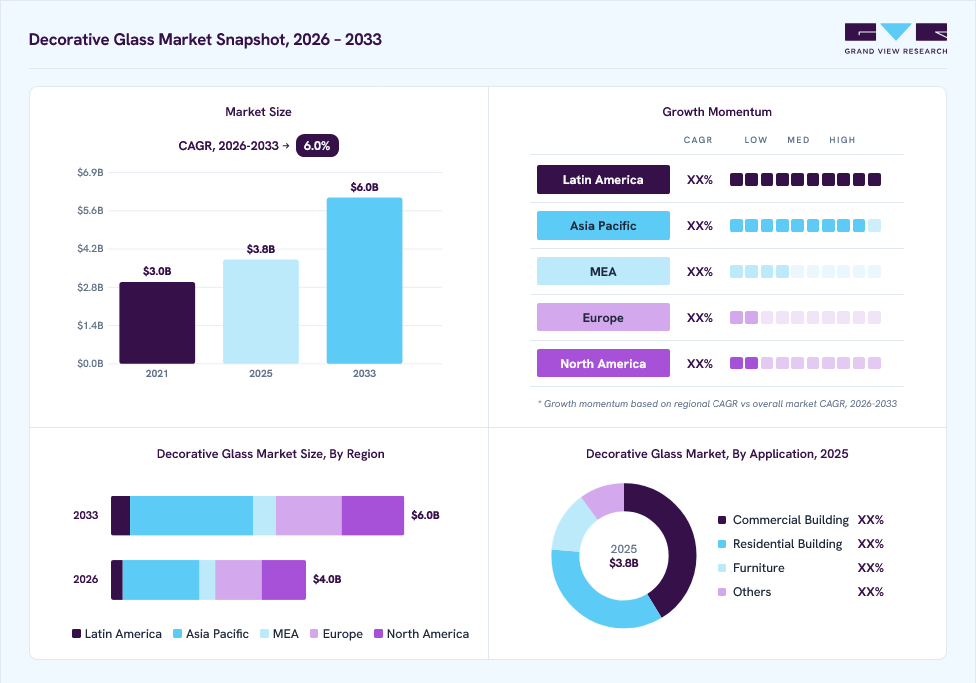
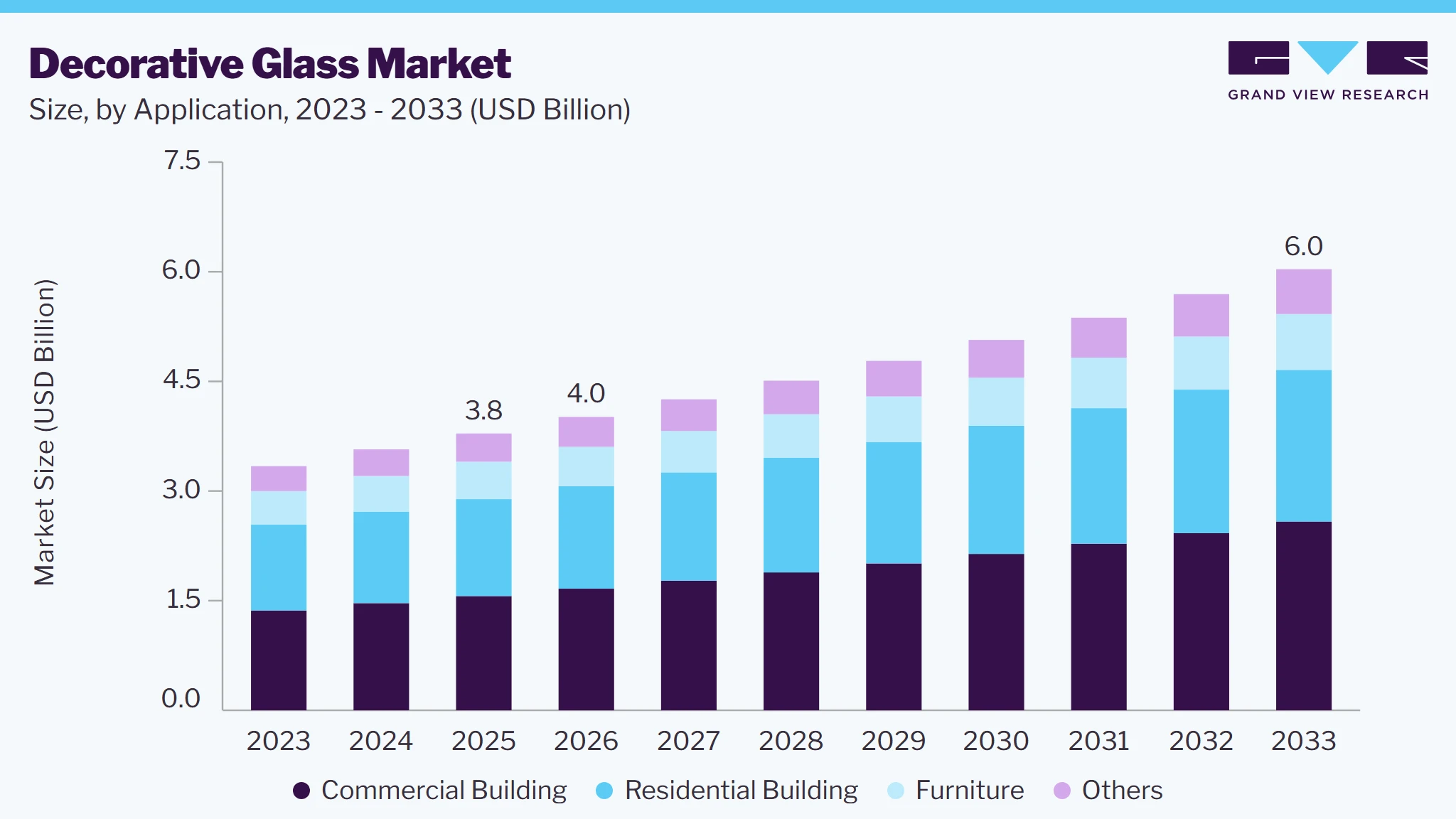
The global decorative glass market size was valued at USD 3.8 billion in 2025 and is projected to grow from USD 4.0 billion in 2026 to USD 6.0 billion by 2033, at a CAGR of 6.0% from 2026 to 2033. Asia Pacific dominated the market, accounting for the largest revenue share of 39.0% in 2025. Market growth is primarily driven by increasing demand for aesthetically enhanced and customized glass products across residential, commercial, hospitality, retail, and architectural applications.
Key Market Trends & Insights
- By application: Commercial building accounted for the largest market revenue share of 41.3% in 2025.
- By glass type: Digital printed glass segment is anticipated to register the fastest CAGR of 7.7% from 2026 to 2033.
Regional Highlights
- Largest regional market: Asia Pacific (39.0% revenue share, 2025)
- Fastest-growing regional market: Latin America (highest CAGR, 2026-2033)
Market Size & Forecast
- Market size in 2025: USD 3.8 Billion
- Estimated market size in 2026: USD 4.0 Billion
- Projected market size by 2033: USD 6.0 Billion
- CAGR (2026-2033): 6.0%
Three ways to get this report
Buy it, customize it, or ask a question.Get the Full Report
What the study covers
- FormatsPDF · Excel · Dashboard
- Timeline2026–2033 annual, 2025 base
- Coverage20+ countries, 5 regions
- Companies10+ key players profiled
Customize the Report
20% free customization
- IncludeCountries, segments, points
- TailorTo your product definition
- ExtendDeeper competitor detail
- OrA fully bespoke study
- Turnaround5–10 working days
Ask an Analyst
A direct answer, usually in 1 working day
- AccessReport author, directly
- Reply timeWithin 1 working day
- No sales callDirect answer only
- FormatEmail reply
- CostFree, no cost
Rising construction and renovation activity, together with greater emphasis on distinctive interior and exterior designs, is encouraging the use of patterned, textured, etched, colored, coated, laminated, and digitally printed glass.Growing emphasis on sustainable construction is supporting the adoption of durable and resource-efficient decorative glass solutions. Manufacturers are focusing on optimized material utilization, longer product life, recyclable glass content, and processing methods that can minimize production waste. Decorative glass can also replace selected conventional interior finishing materials such as laminates, ceramic surfaces, and other wall-covering products, providing opportunities to combine aesthetic value with durability. Increasing preference for long-lasting finishes and multifunctional architectural products is further supporting the development of more resource-efficient solutions.
Technology advancements are expanding the design capabilities and processing flexibility of decorative glass products. Developments in digital printing, ceramic printing, etching, frosting, back-painting, coating, lamination, and precision glass processing are enabling manufacturers to produce more complex patterns, graphics, textures, and color combinations. Improved printing resolution and surface-treatment techniques are also supporting greater consistency across customized orders. These developments are enabling decorative glass to meet increasingly specialized architectural and interior design requirements while expanding the range of designs available to architects and designers.
Market Dynamics
Growing preference for personalized and visually distinctive interiors is increasing demand for decorative glass across residential, commercial, hospitality, retail, and institutional spaces. Architects, interior designers, and developers are increasingly incorporating customized glass into partitions, doors, wall panels, façades, furniture, reception areas, kitchens, bathrooms, and feature installations. Products with specific colors, patterns, textures, opacity levels, and graphics allow projects to achieve differentiated visual concepts while maintaining the functional advantages of glass.
The growing use of design-led materials is also encouraging manufacturers to expand their customization capabilities. Digital printing, back-painting, etching, patterned surfaces, and decorative laminates enable glass to be tailored to project-specific themes, branding requirements, artwork, and architectural concepts. This trend is supporting higher-value applications and creating opportunities for suppliers capable of producing smaller batches and complex designs without compromising finish quality or consistency.
High production costs can constrain the adoption of decorative glass, particularly for customized products and projects with limited budgets. Compared with standard flat glass, decorative products may require additional processing such as etching, printing, painting, coating, laminating, tempering, cutting, and edge finishing. Material wastage associated with complex designs, customized dimensions, small production runs, and quality-control requirements can further increase manufacturing costs.
Customization can also involve longer production and approval cycles because designs may require digital preparation, sample development, color matching, prototyping, and project-specific quality checks. Transportation and handling costs can increase for large-format or specially processed glass due to its weight and susceptibility to breakage. These factors can limit adoption in price-sensitive applications and create challenges for manufacturers seeking to balance customization, production efficiency, and competitive pricing.
Increasing adoption of digital printing is creating new opportunities for decorative glass manufacturers by enabling the reproduction of complex graphics, artwork, photographs, patterns, logos, and architectural motifs. Unlike conventional decorative treatments, digital printing offers greater flexibility in reproducing designs and enables manufacturers to develop customized surfaces for individual projects. This capability is particularly relevant to commercial interiors, hospitality properties, retail environments, branded spaces, façades, partitions, and feature walls.
The technology also enables decorative glass to be integrated into broader architectural concepts where visual identity and customization are important. Improvements in printing resolution, color reproduction, ceramic inks, and production automation are expanding the range of achievable designs while improving repeatability. Increasing demand for customized architectural surfaces is therefore expected to create opportunities for digitally printed products and other high-value decorative glass formats.
Analyst Perspective
The decorative glass market is increasingly benefiting from the shift toward design-led, multifunctional glazing solutions across residential, commercial, hospitality, retail, and institutional applications. Growing demand for customized interiors, visually distinctive façades, privacy solutions, and premium architectural finishes is encouraging wider use of patterned, textured, etched, colored, laminated, and digitally printed glass. Advances in digital printing, surface treatment, lamination, and glass processing are enabling manufacturers to combine decorative appeal with safety, acoustic, solar-control, and energy-efficiency characteristics.
Application Insights
The commercial building segment accounted for the largest revenue share of 41.3% in 2025, supported by the use of decorative glass in offices, hotels, retail stores, restaurants, shopping centers, and other commercial properties. Products are incorporated into façades, storefronts, entrance doors, partitions, feature walls, reception areas, and interior installations to create distinctive architectural environments. Demand is also supported by commercial renovation and refurbishment projects, where decorative glass can modernize interiors without requiring extensive structural changes.
The residential building segment is expected to register a significant CAGR during the forecast period, supported by increasing consumer interest in customized interior design and premium finishing materials. Applications include kitchen backsplashes, shower enclosures, doors, wardrobes, partitions, furniture, wall panels, and other interior features. The availability of colored, patterned, frosted, etched, textured, and digitally printed options is providing homeowners with greater design flexibility and supporting wider use across new residential developments and renovation projects.
Glass Type Insights
The etched glass segment accounted for the largest revenue share of 21.7% in 2025, supported by its established use in applications requiring distinctive surface finishes, controlled transparency, and visual privacy. The product is used across partitions, doors, shower enclosures, office interiors, façades, hospitality spaces, and residential settings. Variations in etching depth, patterns, translucency, and surface treatment allow manufacturers to address both standardized and customized design requirements.
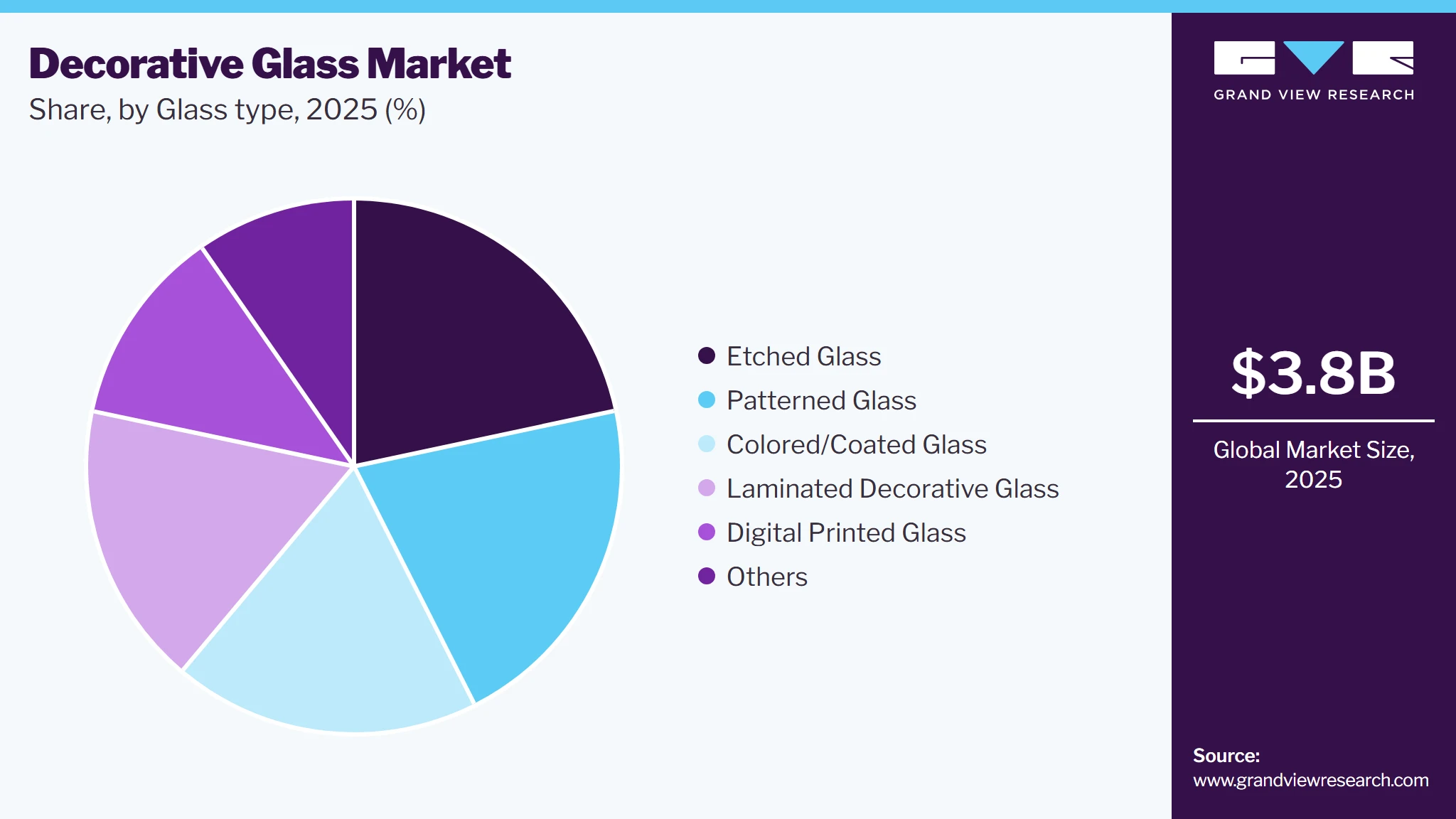
Digital printed glass is projected to register the highest CAGR of 7.7% during the forecast period, driven by increasing demand for customized graphics, artwork, patterns, branding elements, and architectural imagery. Digital printing provides flexibility in reproducing detailed designs while allowing customization of colors, layouts, and visual motifs. Growing application in commercial interiors, hospitality spaces, retail displays, façades, partitions, feature walls, and branded environments is expected to further expand its adoption.
Regional Insights
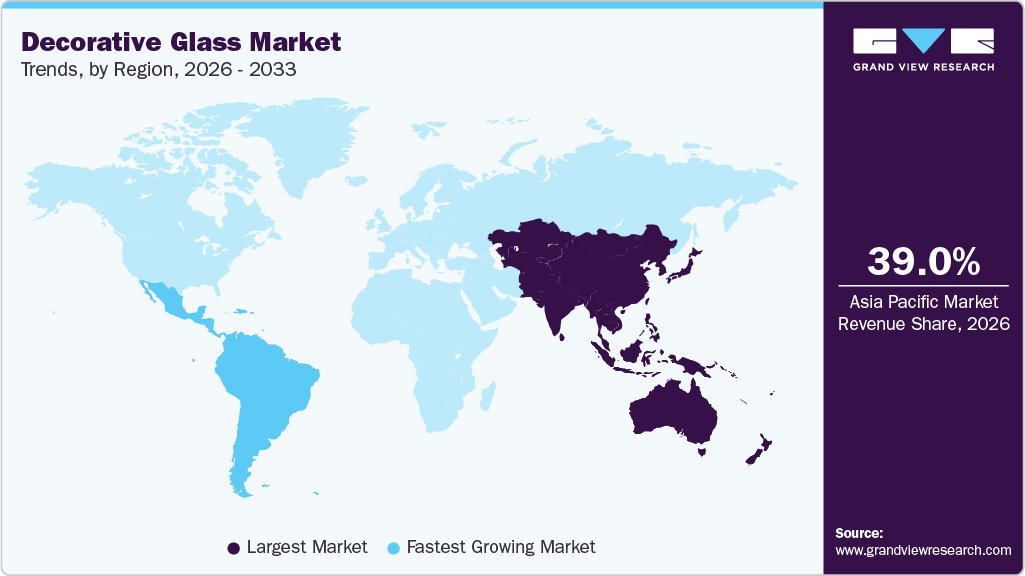
Asia Pacific dominated the decorative glass market with a revenue share of 39.0% in 2025, supported by large-scale residential and commercial construction, urbanization, and expanding investment in modern architectural projects. China, India, Japan, South Korea, and Southeast Asian economies provide substantial demand across façades, partitions, doors, interiors, furniture, and hospitality applications. Increasing development of high-rise buildings and premium commercial spaces is creating opportunities for value-added glass products. Growing architectural customization and improvements in local glass-processing capabilities are further supporting regional adoption.
China Decorative Glass Market Trends
China represents a significant market for decorative glass, supported by its extensive residential and commercial construction base and large manufacturing ecosystem. Development of high-rise buildings, commercial complexes, hospitality properties, retail spaces, and modern residential interiors is generating demand for patterned, textured, etched, colored, back-painted, laminated, and digitally printed glass. Increasing emphasis on customized architectural interiors is encouraging the incorporation of decorative products into partitions, doors, wall panels, façades, furniture, and other design elements.
North America Decorative Glass Market Trends
North America represents an established demand center for decorative glass, supported by commercial renovation, residential remodeling, hospitality development, and premium interior projects. Demand is increasingly associated with applications where visual appearance needs to be combined with privacy, daylight management, durability, or other functional characteristics. Architects and designers are incorporating decorative glass into partitions, doors, façades, feature walls, and interior installations. The region also benefits from established glass-processing infrastructure and the presence of manufacturers offering customized architectural products.
U.S. Decorative Glass Market Trends
The U.S. decorative glass market is supported by replacement, remodeling, commercial construction, hospitality projects, and specification-driven architectural developments. Demand is particularly relevant to customized interiors, retail environments, corporate spaces, hotels, and high-end residential projects where differentiated finishes are important. Manufacturers are expanding options for digitally printed, textured, etched, back-painted, and specialty glass to address project-specific requirements. The country's mature architectural design and glass-processing ecosystem provides opportunities for premium and customized products.
Europe Decorative Glass Market Trends
Europe has a well-established architectural and interior-design sector, with decorative glass used across residential, commercial, hospitality, retail, and institutional applications. Demand is supported by building renovation, adaptive reuse, premium interior design, and the use of visually distinctive façades and interior surfaces. Sustainability considerations also influencing material selection, increasing interest in durable products with long service lives and efficient material utilization. The region's established design culture and emphasis on customized architectural solutions continue to support the development of specialized decorative glass products.
Latin America Decorative Glass Market Trends
Latin America is expected to provide attractive growth opportunities as residential development, commercial construction, urban modernization, and renovation activity expand across major economies. Brazil and Mexico represent important demand centers, while other countries in the region are creating opportunities through hospitality, retail, office, and residential projects. Decorative glass is increasingly suitable for applications where customized finishes can enhance interior and exterior appearance.
Middle East & Africa Decorative Glass Market Trends
The Middle East & Africa region is supported by hospitality developments, premium residential projects, commercial construction, retail infrastructure, and large-scale architectural developments. Gulf countries, particularly Saudi Arabia and the UAE, provide opportunities for customized façades, feature walls, partitions, entrance systems, and high-end interiors associated with hospitality, retail, and mixed-use developments. Africa presents a broader demand base linked to residential and commercial construction and urban development.
Key Decorative Glass Company Insights
Some of the key players operating in the market include AGC Inc., Asahi India Glass Ltd., and others.
-
AGC Inc., established in 1907, is a Japan-based global manufacturer of glass and other materials, with a broad portfolio of architectural and interior glass products. The company offers decorative solutions including Lacobel and Matelac, featuring colored, lacquered, and acid-etched surfaces for interior applications. Its portfolio serves wall cladding, furniture, doors, partitions, and other design-oriented installations, with multiple colors and finishes available for architectural projects. AGC also combines decorative treatments with glass-processing capabilities to address projects requiring both visual differentiation and functional characteristics.
-
Asahi India Glass Ltd. (AIS), established in 1984, is an India-based integrated glass manufacturer serving the architectural, automotive, and consumer glass sectors. The company offers decorative products including AIS Décor, a lacquered and back-painted glass range designed for interior applications. Its products are used in walls, furniture, kitchens, bathrooms, doors, partitions, and other spaces requiring colored and visually enhanced surfaces. The company's integrated manufacturing and processing capabilities enable it to serve a broad range of residential and commercial design requirements.
-
Bendheim, established in 1927, is a U.S.-based architectural and specialty glass manufacturer focused on decorative and design-oriented products. Its portfolio includes textured, etched, digitally printed, ceramic-fritted, back-painted, laminated, mirrored, and specialty art glass. The company serves interior and exterior applications such as walls, façades, partitions, doors, and decorative surfaces. Its specialization in customized architectural glass enables it to address projects requiring distinctive designs, specialty finishes, and complex fabrication.
Key Decorative Glass Companies
The following key companies have been profiled for this study on the decorative glass market.
-
AGC Inc.
-
Asahi India Glass Ltd. (AIS)
-
Bendheim
-
GlasPro
-
Guardian Glass
-
NSG Group (Pilkington)
-
Pulp Studio
-
Saint-Gobain Glass
-
Şişecam
-
Vitro Architectural Glass
Competitive Benchmarking
Category
Operating Strategies
Competitive Edge
Weakness
Established Players (AGC Inc.; Asahi India Glass Ltd. (AIS); Guardian Glass; NSG Group (Pilkington); Saint-Gobain Glass; Şişecam; Vitro Architectural Glass)
- Use broad architectural-glass portfolios to address multiple design requirements across residential and non-residential projects.
- Work closely with architects, façade consultants, processors, and developers to secure product specifications at the project-design stage.
- Expand differentiated finishes and digital design capabilities to respond to increasing demand for customized architectural surfaces.
- Strong market recognition makes these companies frequently considered during large architectural and building-material specifications.
- Geographic reach enables them to participate in projects across multiple construction markets and reduce dependence on a single region.
- Established technical teams and processing infrastructure support consistent quality across large project requirements.
- Scale-oriented production models may be less flexible for highly individualized decorative orders.
- Broad architectural portfolios require substantial resources for product development, certification, and market support.
- Strong presence in conventional architectural glass can expose them to price competition where decorative products become standardized.
Emerging & Regional Players (Bendheim; GlasPro; Pulp Studio)
- Position around bespoke architectural requirements rather than competing primarily on high-volume glass production.
- Develop close project partnerships with architects, artists, interior designers, and specialty fabricators to translate designs into finished glass.
- Concentrate on premium projects requiring distinctive graphics, textures, colors, patterns, or complex fabrication.
- Greater flexibility in handling non-standard designs and relatively small project quantities.
- Specialized craftsmanship and fabrication expertise provide differentiation in high-value architectural applications.
- Project-driven development enables customized solutions that can command higher value than standardized decorative products.
- Limited scale may restrict participation in projects requiring very high and continuous volumes.
- Project-specific production can result in longer engineering and fabrication cycles than standardized products.
- Premium positioning can make products more sensitive to reductions in architectural design budgets or delays in discretionary projects.
Recent Development
-
In February 2026, AGC Interpane Architectural Glass introduced ipasolar, a range of colored magnetron coatings for photovoltaic cover glass used in building-integrated photovoltaics (BIPV). The coatings are available in multiple standard colors, including terracotta, green, blue, red, bronze, gold, and silver, with custom colors also possible. Depending on the color, the coated modules can retain 90–96% of the efficiency of an uncoated black module. The development expands the role of colored architectural glass by combining façade aesthetics with photovoltaic functionality.
-
In March 2026, Saint-Gobain Glass highlighted SGG Colormaxx Canvas, a customizable digitally printed glass solution for interior applications. The product uses UV printing technology to reproduce patterns, artwork, and visual motifs directly on glass, enabling designers to develop customized wall panels, partitions, and other interior surfaces. The development demonstrates the expanding role of digital printing in creating project-specific decorative finishes for residential, hospitality, and commercial spaces.
-
In May 2026, Skyline Glass announced its Color + Water collection, developed in collaboration with designer and artist Kelly Harris Smith and subsequently presented at NeoCon 2026. The collection translates original watercolor artwork into large-scale architectural glass through high-resolution printing and tempering at Skyline's Chicago studio. The development highlights the growing use of digitally reproduced artwork in architectural glass and its application as a large-scale decorative element in commercial and interior environments.
Decorative Glass Market Report Scope
Report Attribute
Details
Market Definition
The market size represents the revenue generated from the sale of decorative glass across various regions in a given year.
Market size in 2025
USD 3.8 billion
Estimated market size in 2026
USD 4.0 billion
Projected market size by 2033
USD 6.0 billion
Growth rate
CAGR of 6.0% from 2026 to 2033
Base year for estimation
2025
Historical data
2021 - 2024
Forecast period
2026 - 2033
Quantitative Units
Revenue in USD million/billion, and CAGR from 2026 to 2033
Report coverage
Revenue forecast, competitive landscape, growth factors, and trends
Segments covered
Application, glass type, region
Regional scope
North America; Europe; Asia Pacific; Latin America; Middle East & Africa
Country scope
U.S.; Canada; Mexico; Germany; UK; France; Italy; China; Japan; India; South Korea; Brazil; Argentina; South Africa; Saudi Arabia; UAE
Key companies profiled
AGC Inc.; Asahi India Glass Ltd. (AIS); Bendheim; GlasPro; Guardian Glass; NSG Group (Pilkington); Pulp Studio; Saint-Gobain Glass; Şişecam; Vitro Architectural Glass
Customization scope
Free report customization (equivalent up to 8 analysts working days) with purchase. Addition or alteration to country, regional & segment scope.
Pricing and purchase options
Avail customized purchase options to meet your exact research needs. Explore purchase options
Global Decorative Glass Market Report Segmentation
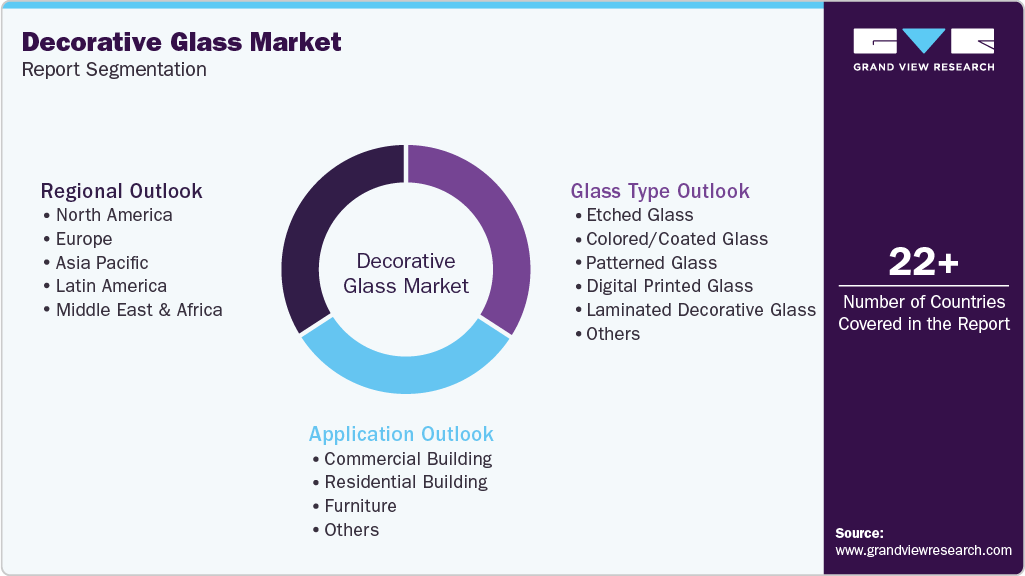
This report forecasts revenue growth at global, regional, and country levels and provides an analysis of the latest industry trends in each of the sub-segments from 2021 to 2033. For the purpose of this study, Grand View Research has segmented the global decorative glass market report on the basis of application, glass type, and region.
-
Application Outlook (Revenue, USD Million, 2021 - 2033)
-
Commercial Building
-
Residential Building
-
Furniture
-
Others
-
-
Glass Type Outlook (Revenue, USD Million, 2021 - 2033)
-
Etched Glass
-
Colored/Coated Glass
-
Patterned Glass
-
Digital Printed Glass
-
Laminated Decorative Glass
-
Others
-
-
Regional Outlook (Revenue, USD Million, 2021 - 2033)
-
North America
-
U.S.
-
Canada
-
Mexico
-
-
Europe
-
Germany
-
UK
-
France
-
Italy
-
-
Asia Pacific
-
China
-
Australia
-
India
-
South Korea
-
-
Latin America
-
Brazil
-
Argentina
-
-
Middle East & Africa
-
South Africa
-
Saudi Arabia
-
UAE
-
-
Research Methodology
The decorative glass market figures in this report are based on a proven research process that combines executive interviews with secondary research from proprietary databases, company filings, and recognized regulatory and institutional sources. Market size is built through value-chain sizing-reconciling supply-side and demand-side estimates-and triangulated with bottom-up and top-down approaches. Every estimate passes multiple levels of expert validation before publication, with each decorative glass segment quantified using the revenue-capture definitions in the table below.
Segment Definition
Application
Revenue Capture Definition
Commercial Building
Revenue is captured from the sale of decorative glass used in façades, partitions, entrance doors, curtain walls, feature walls, skylights, storefronts, office interiors, hospitality spaces, retail environments, and other commercial architectural applications where aesthetic enhancement, privacy, branding, or visual differentiation is required.
Residential Building
Revenue is derived from decorative glass used in interior doors, partitions, kitchens, bathrooms, shower enclosures, wardrobes, furniture, windows, balconies, wall panels, and other residential applications where customized colors, patterns, textures, or privacy features are desired.
Furniture
Revenue is generated from decorative glass incorporated into tables, cabinets, shelving, display units, countertops, wardrobes, kitchen furniture, and other furnishings. Products may include back-painted, colored, etched, patterned, textured, laminated, or digitally printed glass designed to provide an enhanced visual appearance.
Others
Includes revenue from decorative glass used in transportation interiors, public spaces, cultural and institutional buildings, signage, exhibitions, retail displays, specialty interiors, and other applications where glass is used primarily for decorative, privacy, branding, or design purposes.
Glass Type
Revenue Capture Definition
Etched Glass
Revenue is captured from the sale of glass featuring acid-etched, sandblasted, or mechanically treated surfaces that create translucent, matte, frosted, or patterned appearances. These products are used where visual privacy, light diffusion, and decorative surface effects are required.
Colored/Coated Glass
Revenue is derived from glass incorporating colored, lacquered, back-painted, or decorative surface coatings that provide specific colors, finishes, and visual effects. These products are used extensively for wall cladding, furniture, doors, partitions, kitchens, façades, and other interior and architectural applications.
Patterned Glass
Revenue is generated from glass manufactured with embossed, rolled, or patterned surfaces that create distinctive textures and varying levels of privacy and light transmission. Applications include doors, partitions, windows, façades, bathrooms, interior features, and other architectural spaces.
Digital Printed Glass
Revenue is captured from glass decorated using digital ceramic or other digital printing technologies to reproduce patterns, images, graphics, artwork, logos, and customized designs. These products are used in façades, partitions, wall panels, retail displays, hospitality interiors, and other applications requiring high levels of design customization.
Laminated Decorative Glass
Revenue is derived from laminated glass incorporating decorative interlayers, printed films, colored films, fabrics, mesh, artwork, or other design elements between glass layers. These products combine decorative characteristics with additional functional attributes such as safety, sound attenuation, UV protection, and design flexibility.
Others
Includes revenue from other decorative glass formats such as textured, frosted, mirrored, stained, cast, kiln-formed, and specialty art glass that provide distinctive visual, tactile, privacy, or light-transmission characteristics for architectural, interior, furniture, and specialty applications.
Estimation Model
Layer Name
Key Question
Description
Addressable Construction & Application Base
Where is decorative glass demand generated?
Assess the building and interior application base across residential, commercial, hospitality, retail, healthcare, education, and institutional sectors. Quantify relevant construction, renovation, and refurbishment activity and identify applications such as doors, partitions, façades, windows, furniture, shower enclosures, wall panels, and other areas suitable for decorative glass.
Application & Glass Utilization Layer
What proportion of applicable glass uses decorative solutions?
Determine decorative glass penetration across identified applications and end-use sectors. Evaluate adoption by product type, including patterned, textured, frosted, etched, colored, back painted, laminated, and digitally printed glass, while accounting for differences in architectural preferences, project specifications, building type, and regional adoption.
Volume & Consumption Layer
How much decorative glass is consumed annually?
Calculate annual decorative glass demand by applying adoption rates to the addressable glass area. Incorporate new construction, renovation, replacement, and refurbishment activity, along with average glass requirements per application, replacement cycles, and processing or installation losses. Demand is quantified primarily in square meters and can additionally be converted into tons.
Pricing & Revenue Layer
What is the monetary value of the installed glass demand?
Estimate market revenue by multiplying the calculated decorative glass volume by the applicable average selling price per square meter. Pricing should account for differences in glass type, thickness, processing, surface treatment, pattern, color, printing, lamination, customization, and application. Installation and ancillary services are excluded unless specifically included within the market definition.
Delivered Customizations
This report has been delivered with the following In-depth customizations
Client Request
Customization Delivered
Value Adds
Architectural Design & Customization Analysis
Assessment of decorative glass requirements across major architectural applications, including façades, partitions, doors, wall panels, ceilings, furniture, shower enclosures, and interior features. The analysis considers patterns, textures, colors, finishes, graphics, opacity, dimensions, bespoke designs, and customization technologies such as digital printing, etching, frosting, back-painting, and lamination.
Identifies emerging architectural design preferences, customization trends, premium design opportunities, and applications where bespoke decorative glass can provide greater aesthetic differentiation and value.
Decorative Glass Cost & Pricing Analysis
Assessment of product and processing costs across different decorative glass configurations, including patterned, textured, frosted, etched, colored, back-painted, laminated, mirrored, and digitally printed glass. The analysis considers glass thickness, dimensions, base-glass type, design complexity, processing requirements, customization, order volumes, fabrication, transportation, and installation costs.
Identify the major cost drivers and pricing premiums associated with decorative treatments and customized products, while enabling comparison between standardized and bespoke decorative glass solutions across key architectural applications.
Decorative Glass Product & Design Analysis
Comparative assessment of decorative glass products based on design format, surface treatment, transparency, translucency, opacity, texture, color, pattern, visual appearance, and application suitability. The analysis covers major product formats and evaluates their use across façades, partitions, doors, furniture, wall panels, bathrooms, kitchens, retail displays, and other architectural applications.
Enables comparison of competing decorative glass products and design offerings, identifies product differentiation and portfolio gaps, and highlights opportunities for innovative finishes, new designs, and higher-value decorative glass solutions.
About the Author(s)
Advanced Interior Materials Research Team
Advanced Materials · Advanced Interior MaterialsThis report was authored by the advanced interior materials research team at Grand View Research - comprising two research analysts, one senior research analyst, and one industry expert - with specialized expertise in the advanced interior materials segment of the advanced materials industry. All findings are based on proprietary advanced materials databases, executive interviews, and regulatory analysis, subject to internal peer review prior to publication.
Last Updated:
Speak to Analyst


Customize this report to your needs - add regions, segments, or data points, with 20% free customization.
Or view our licence options:


ISO 9001:2015 & 27001:2022 Certified
We are GDPR and CCPA compliant! Your transaction & personal information is safe and secure. For more details, please read our privacy policy.


