
- Home
- »
- Next Generation Technologies
- »
-
Deep Space Exploration Market Size & Share Report, 2033GVR Report cover

Deep Space Exploration Market (2026 - 2033)
Size, Share & Trends Analysis Report By Application (Transportation, Mars Exploration), By Mission Type (Manned, Unmanned), By Subsystem, By End Use, By Region, And Segment Forecasts
Market Size, 2025
$29.5BMarket Estimate, 2026
$30.8BMarket Forecast, 2033
$44.0BCAGR, 2026–2033
5.2%Deep Space Exploration Market Summary
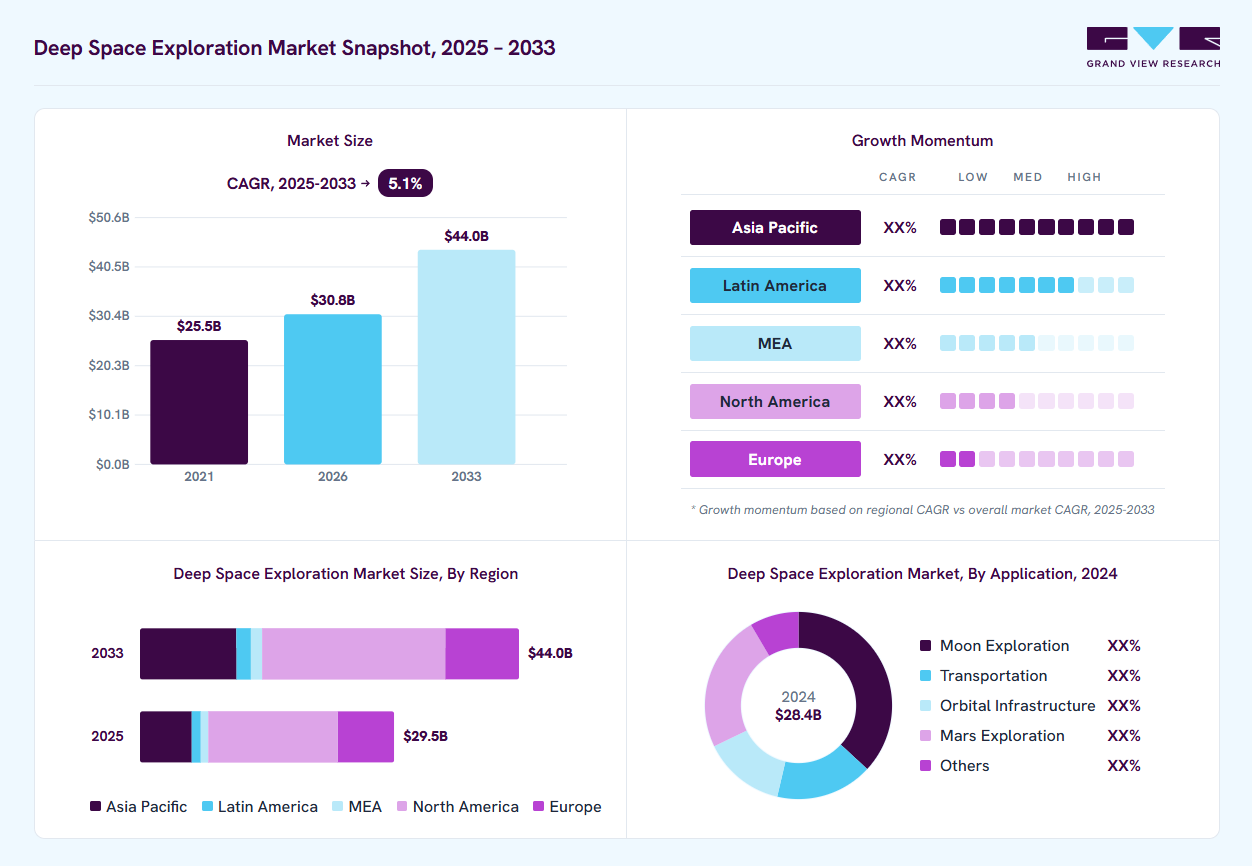
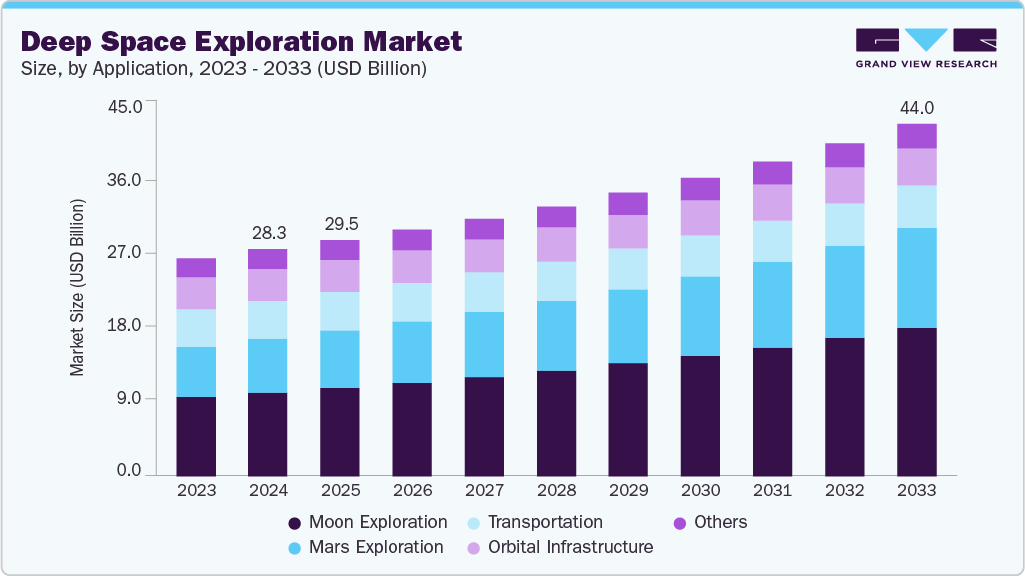
The global deep space exploration market size was valued at USD 29.5 billion in 2025 and is projected to grow from USD 30.8 billion in 2026 to USD 44.0 billion by 2033, at a CAGR of 5.2% from 2026 to 2033. North America dominated the market, accounting for a revenue share of 50.9% in 2025. The deep space exploration market is driven by increasing government investments in lunar and planetary exploration programs, growing participation by private space companies, and rising demand for advanced deep-space mission capabilities.
 Source: Grand View Research, IR Documents, Primary Interviews, Paid DatabasesTo learn more about this report,
 Download Free Sample Report
 Key Market Trends & Insights
- By application: Moon exploration segment dominated the market, with a share of 37.0% in 2025.
- By subsystem: Propulsion system segment accounted for the largest market share of 40.3% in 2025.
- By mission type: Unmanned mission segment dominated the market in 2025.
- By end use: Government space agencies segment accounted for the largest market share in 2025.
Regional Highlights
- Largest regional market: North America (50.9% revenue share in 2025)
- Fastest growing regional market: Asia Pacific (highest CAGR 8.2%, 2026-2033)
- By Country: The U.S. held the largest market share in 2025.
Market Size & Forecast
- Market size in 2025: USD 29.5 Billion
- Estimated market size in 2026: USD 30.8 Billion
- Projected market size by 2033: USD 44.0 Billion
- CAGR (2026-2033): 5.2%
Three ways to get this report
Buy it, customize it, or ask a question.Ask an Analyst
Analyst response in 1 business day
- AccessReport author, directly
- Reply timeWithin 1 working day
- No sales callDirect answer only
- FormatEmail reply
- CostFree, no cost
Get the Full Report
What the study covers
- FormatsPDF · Excel · Dashboard
- Timeline2026–2033 annual, 2025 base
- Coverage20+ countries, 5 regions
- Companies10+ key players profiled
Customize the Report
20% free customization
- IncludeCountries, segments, points
- TailorTo your product definition
- ExtendDeeper competitor detail
- OrA fully bespoke study
- Turnaround5–10 working days
The expanding deployment of lunar landers, deep-space probes, orbital spacecraft, and robotic exploration systems for missions to the Moon, Mars, asteroids, and other planetary targets is significantly accelerating market growth. The increasing adoption of advanced propulsion systems, autonomous navigation technologies, deep-space communication networks, artificial intelligence, and high-performance scientific payloads is enhancing mission efficiency, extending operational capabilities, and enabling more complex exploration missions, thereby creating growth opportunities in the market.
The increasing demand for scientific discovery, space resource utilization, and long-duration interplanetary missions primarily drives market growth. The growing involvement of private aerospace companies and international collaborations accelerates mission planning and execution. Government investments and long-term strategic initiatives foster innovation and funding for advanced exploration technologies. Rising interest in planetary defense, asteroid mining, and extraterrestrial habitation is further propelling the expansion of the deep space exploration industry.
 To learn more about this report, Download Free Sample Report
 The rising interest in interplanetary missions and space colonization is significantly fueling the growth of the deep space exploration industry. Government agencies like NASA, ESA, CNSA, and private companies such as SpaceX and Blue Origin are investing heavily in long-duration missions. These initiatives drive demand for advanced propulsion systems, space habitats, and autonomous navigation technologies. This surge in mission planning and execution is expanding the commercial viability of deep space ventures and accelerating innovation across the industry.
In addition, the increasing emphasis on international collaboration and public-private partnerships is becoming a major market growth driver. Collaborative R&D efforts enable shared access to critical technologies, reduce development costs, and boost the pace of mission deployment. This cooperative approach strengthens global capabilities and supports the sustainable expansion of the deep space economy.
Furthermore, advancements in AI, robotics, and autonomous systems are revolutionizing deep space exploration capabilities. These technologies are integrated into planetary rovers, space probes, and unmanned missions to enhance real-time decision-making, terrain mapping, and sample collection. Automation reduces reliance on human intervention, allowing extended missions in harsh and remote environments. AI and robotics continue to evolve, streamlining complex tasks and driving greater efficiency in mission planning and execution, accelerating market growth.
Moreover, growing investments in space infrastructure and on-orbit servicing technologies are enhancing the long-term potential of the deep space exploration industry. Innovations such as reusable launch vehicles, in-space manufacturing, and orbital refueling systems are laying the foundation for sustainable operations beyond Earth orbit. These advancements reduce mission costs and open new commercial opportunities, including asteroid mining, lunar tourism, and deep space logistics. As the infrastructure matures, it is expected to catalyze a new era of exploration and economic development in space, fueling market growth.
Market Dynamics
The deep space exploration market is experiencing strong growth, driven by increasing investments in lunar and planetary exploration programs, expanding participation of commercial space companies, and the growing focus on long-duration missions beyond Earth's orbit. Rising funding for Moon, Mars, asteroid, and deep-space exploration initiatives by government space agencies and private organizations is accelerating the development of spacecraft, lunar landers, deep-space probes, and supporting mission infrastructure. The growing adoption of advanced propulsion systems, autonomous spacecraft, high-gain communication systems, radiation-hardened electronics, and precision navigation technologies is enhancing mission reliability and operational efficiency. The integration of autonomous robotics, deep-space communication networks, in-space resource utilization technologies, and improved data transmission has enhanced mission safety, extended exploration capabilities, reduced mission risks, and enabled greater scientific discovery, creating significant long-term growth opportunities for the global deep space exploration market.
Increasing government investments in lunar exploration, Mars missions, asteroid studies, and deep-space scientific programs are creating sustained demand for advanced exploration technologies. National space agencies are allocating larger budgets to develop spacecraft, launch systems, scientific payloads, and deep-space communication infrastructure to strengthen scientific research, technological leadership, and strategic capabilities. These long-term programs provide stable funding for complex exploration missions and encourage continuous technological advancement.
Government agencies are also expanding partnerships with commercial aerospace companies to accelerate mission development, reduce program costs, and improve operational efficiency. Contract awards for lunar landers, robotic exploration vehicles, deep-space logistics, and communication systems are increasing private sector participation. This collaborative approach is supporting innovation, strengthening supply chains, and enabling more frequent exploration missions beyond Earth's orbit.
Deep-space exploration missions involve highly complex engineering, rigorous testing procedures, and strict reliability standards due to the extreme conditions encountered beyond Earth's orbit. Designing spacecraft capable of operating over long distances with limited opportunities for maintenance requires advanced materials, redundant systems, and extensive validation processes. These technical challenges increase project complexity and extend mission preparation periods.
Long mission durations also expose spacecraft to radiation, extreme temperatures, communication delays, and unpredictable operating conditions, making risk management critical. Mission failures can result in substantial financial losses and scientific setbacks because repairs are generally impossible after launch. Consequently, organizations must invest significant resources in system verification, quality assurance, and mission planning before deployment.
The increasing commercialization of space exploration is creating opportunities for companies developing lunar transportation, cargo delivery, surface mobility, communication networks, and in-space infrastructure. Government agencies are increasingly relying on commercial partners to deliver technologies and operational services that support sustained exploration activities. This shift is encouraging investment in scalable platforms capable of supporting multiple deep-space missions.
Future exploration strategies are expected to require permanent communication systems, navigation infrastructure, robotic construction equipment, and resource utilization technologies for long-duration missions. Companies capable of delivering reliable commercial services for lunar operations, orbital logistics, and deep-space support infrastructure are well-positioned to secure long-term contracts. These evolving business models are expanding private sector participation beyond traditional spacecraft manufacturing.
Market Concentration & Characteristics
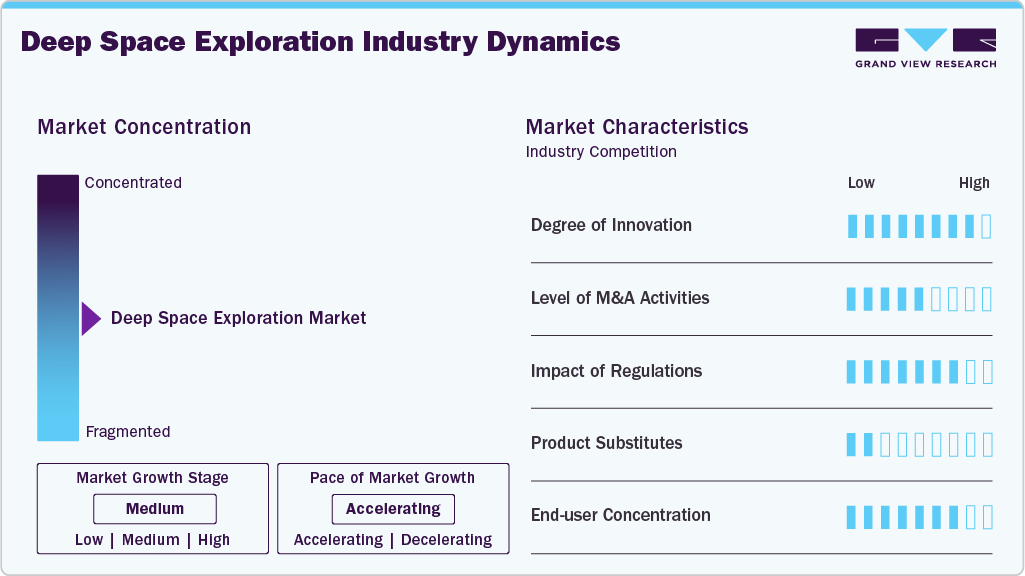
The deep space exploration market is moderately concentrated, with leading aerospace manufacturers, launch service providers, spacecraft developers, propulsion technology companies, and deep-space mission integrators competing across lunar exploration, Mars missions, asteroid exploration, planetary science, and space infrastructure programs. Rising investments in government-led exploration initiatives, expanding commercial participation in lunar missions, and increasing demand for advanced spacecraft and deep-space communication systems are driving market expansion. Companies are strengthening their competitive positions through strategic partnerships, government contracts, technology acquisitions, and continuous investments in reusable launch systems, autonomous spacecraft, advanced propulsion technologies, robotic exploration platforms, and high-performance scientific payloads.
 To learn more about this report, Download Free Sample Report
 The market is characterized by a very high degree of innovation, supported by rapid advancements in autonomous navigation, artificial intelligence, radiation-hardened electronics, deep-space communication networks, electric and nuclear propulsion technologies, robotic exploration systems, and precision scientific instruments. Merger and acquisition activity remains moderate as companies strengthen spacecraft manufacturing capabilities and expand end-to-end space exploration portfolios. Regulatory impact is significant due to launch licensing requirements, export control regulations, planetary protection protocols, spectrum allocation policies, and international space governance frameworks. The threat of substitutes remains low because no alternative technologies can replace dedicated deep-space spacecraft, specialized propulsion systems, and mission infrastructure required for exploration beyond Earth's orbit.
Analyst Perspective
The deep space exploration market is experiencing growth, driven by expanding government space budgets, growing private-sector participation, and ongoing advances in interplanetary mission technologies. Increasing deployment of reusable launch vehicles, robotic explorers, autonomous spacecraft, precision navigation systems, advanced propulsion technologies, and deep-space communication infrastructure is enhancing mission success rates, operational endurance, and scientific outcomes. Space agencies and commercial enterprises are emphasizing sustainable lunar operations, Mars exploration, and cislunar infrastructure to strengthen future exploration capabilities. Investments in next-generation exploration platforms continue to rise, and technology developers and mission service providers are well-positioned to secure long-term contracts and establish sustainable revenue streams across the global deep-space exploration ecosystem.
Mission Type Insights
Based on mission type, the unmanned mission segment accounted for the largest market share of 74.2% in 2025, driven by the increasing demand for cost-effective, risk-free, and technologically advanced exploration capabilities. As space agencies and private players focus on exploring distant celestial bodies like Mars, asteroids, and outer planets, unmanned missions offer a practical solution without endangering human life. Advances in autonomous navigation, AI-driven data analysis, and high-performance robotics are enabling longer, more complex missions with greater scientific yield. These advantages, lower mission costs and faster deployment timelines, propel unmanned missions' dominance in the deep space exploration industry.
The manned mission segment is expected to witness the highest CAGR from 2025 to 2033, driven by increasing investments in human-led missions to the Moon, Mars, and beyond. Governments and space agencies prioritize crewed exploration to establish long-term human presence, conduct complex scientific research, and demonstrate geopolitical leadership in space. Developing advanced life support systems, radiation shielding, and deep space habitats further supports this growth. International collaborations and rising private sector involvement in astronaut-led missions are accelerating the momentum of manned deep space programs.
End Use Insights
Based on end use, the government space agencies segment dominated the market with a revenue share of 60.8% in 2025, owing to increasing investments in deep space missions aimed at lunar exploration, Mars colonization, and asteroid mining. National agencies such as NASA, ESA, CNSA, and ISRO drive the demand for advanced propulsion systems, long-duration life support, and autonomous navigation technologies to support ambitious interplanetary missions. These agencies collaborate with international partners and private companies to expand scientific capabilities and geopolitical influence in space. The focus on strategic, long-term exploration goals and the development of next-generation spacecraft continues to position government space agencies as the primary market end-users.
The commercial segment is expected to witness a significant CAGR from 2025 to 2033. This growth is driven by increasing private sector investments in lunar missions, asteroid mining, and satellite deployment beyond Earth’s orbit. Emerging space companies are capitalizing on cost reductions in launch services, reusable rockets, and miniaturized spacecraft technologies to develop profitable deep space ventures. Strategic partnerships with national space agencies and advancements in in-space propulsion and autonomous navigation systems enable commercial players to pursue long-duration missions, fueling rapid market expansion.
Application Insights
Based on application, the moon exploration segment led the market with the largest revenue share of 37.0% in 2025 and is expected to grow at a considerable CAGR over the forecast period, driven by renewed global interest in lunar missions for scientific, commercial, and strategic purposes. Government-led programs such as NASA’s Artemis and increasing private sector investments accelerate mission planning and infrastructure development around the Moon. The segment's leadership is further supported by advancements in propulsion systems, autonomous navigation, and lunar surface robotics, all crucial for sustained lunar presence. The Moon's potential as a staging point for deeper space missions reinforces its strategic importance in the exploration ecosystem.
Mars exploration is expected to witness the highest CAGR of over 7% from 2025 to 2033. This growth is primarily driven by rising government investments and international collaborations focused on crew and robotic missions to Mars. Advancements in propulsion systems, autonomous navigation, and life-support technologies are further enhancing mission feasibility. The increasing role of private space companies and strategic partnerships with space agencies is accelerating innovation, making Mars exploration a central focus of the next-generation deep space exploration industry.
Subsystem Insights
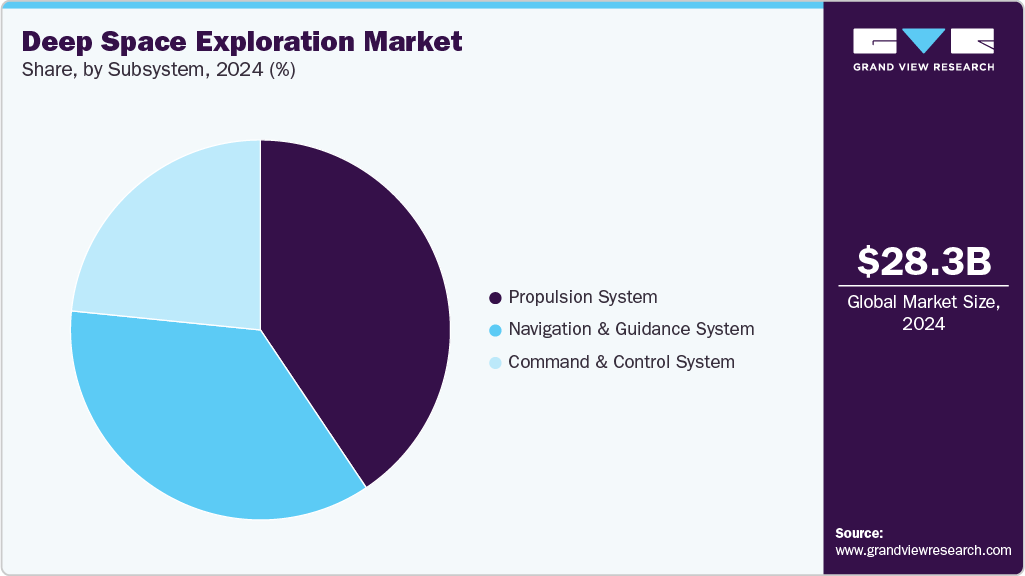
Based on subsystem, the propulsion system segment dominated the market with the largest revenue share of 40.3% in 2025, driven by the increasing number of deep space missions requiring advanced propulsion technologies for extended travel beyond low Earth orbit. Agencies and private companies invest in high-efficiency systems such as electric propulsion, nuclear thermal propulsion, and ion thrusters to reduce travel time and enhance mission capability. As deep space exploration targets more ambitious destinations like Mars and asteroids, the demand for reliable and scalable propulsion systems continues to surge. The growing emphasis on long-duration missions and interplanetary travel further propels the adoption of next-generation propulsion subsystems in the deep space exploration industry.
 To learn more about this report, Download Free Sample Report
 The command and control system segment is expected to witness the highest CAGR from 2025 to 2033. This growth is driven by the increasing complexity of interplanetary missions and the need for highly autonomous, real-time decision-making systems. Advancements in AI-powered navigation, fault detection, and spacecraft health monitoring enable deep space probes to operate with minimal ground intervention. The rising deployment of robotic missions to the Moon, Mars, and beyond fuels demand for robust and scalable command and control architectures, accelerating adoption across government and commercial space programs.
Regional Insights
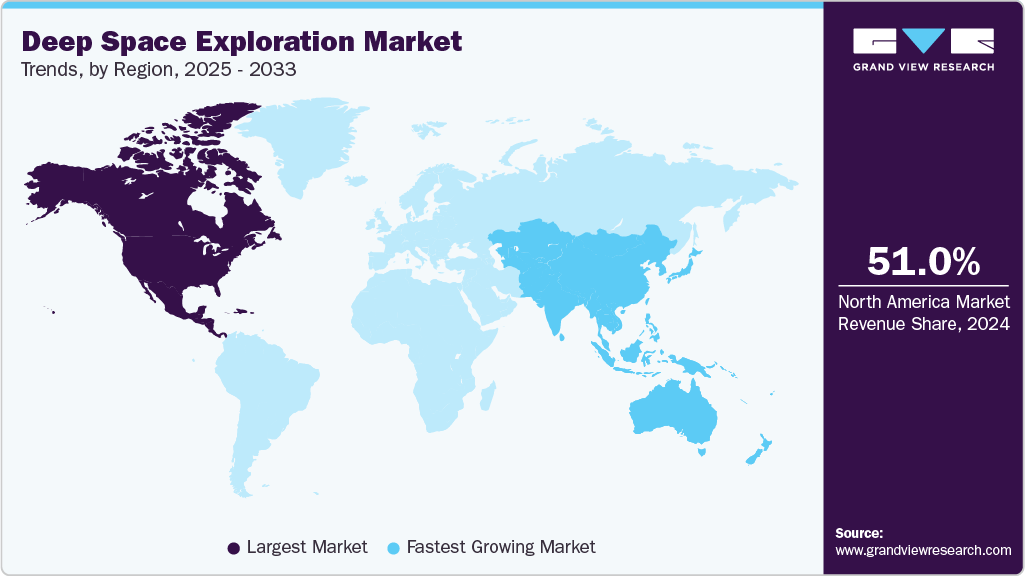
North America dominated deep space exploration market with the largest revenue share of 50.9% in 2025, driven by the strong presence of leading space agencies, robust government funding for space research, and early adoption of advanced aerospace technologies. The region benefits from a mature ecosystem of private space companies engaged in developing interplanetary missions and space infrastructure. Increasing investment in AI-powered autonomous systems, rapid advancements in launch vehicle technologies, and growing interest in lunar and Mars missions are accelerating the adoption of the deep space exploration industry across the region.
 To learn more about this report, Download Free Sample Report
 U.S. Deep Space Exploration Market Trends
The deep space exploration market in the U.S. held the largest share in the North America region in 2025, driven by the country’s strong presence of government space, a thriving private aerospace sector, and significant investment in next-generation space technologies. The increasing number of collaborative programs between NASA and private players accelerates mission timelines and fosters innovation. Integrating AI, robotics, and autonomous systems into mission planning and operations further boosts efficiency and expands the capabilities of unmanned missions, contributing to the country's rapid growth of the deep space exploration industry.
Europe Deep Space Exploration Market Trends
The deep space exploration market in Europe has a significant market share of over 22% in 2024. In Europe, the growth is driven by increased funding from the European Space Agency (ESA) and national governments for Moon and Mars missions, alongside strong participation in international collaborations like the Artemis program. Europe's focus on developing autonomous navigation systems, reusable launch vehicles, and in-space manufacturing further fuels innovation. The presence of advanced aerospace industries supports the development of next-generation deep space technologies, driving sustained market momentum.
The UK deep space exploration market is expected to grow significantly in the coming years. The country benefits from strong government backing through initiatives by the UK Space Agency aimed at participation in the Mars mission. Investment in advanced satellite and propulsion technologies and partnerships with ESA and private aerospace firms is boosting research and development. The presence of world-class universities and innovation hubs fosters talent and drives technological advancements. Increasing focus on commercial space ventures and orbital infrastructure creates new growth opportunities across the country's deep space exploration industry.
The deep space exploration market in Germany is driven by the country’s robust aerospace engineering capabilities, strong government backing through institutions like DLR (German Aerospace Center), and active participation in European Space Agency (ESA) missions. Germany’s commitment to scientific research, space innovation, and sustainability leads to increased investment in propulsion systems, orbital infrastructure, and unmanned exploration technologies. Collaboration between academia, private firms, and international partners fosters technological advancements and reinforces Germany’s strategic role in future Moon and Mars missions.
Asia Pacific Deep Space Exploration Market Trends
The deep space exploration market in Asia Pacific is expected to grow at the highest CAGR of over 8% from 2025 to 2033, driven by increasing investments from interplanetary missions and satellite programs. The region’s growing technological capabilities boost mission readiness, including robotics, AI, and launch vehicle development advancements. Supportive government policies, rising public-private partnerships, and expanding regional space agencies are accelerating innovation. Establishing dedicated spaceports and R&D facilities strengthens the infrastructure for long-term deep space initiatives across Asia Pacific.
Japan deep space exploration market is gaining traction, driven by the country's advanced aerospace capabilities, strong government support, and collaborative efforts with global space agencies. Japan's space agency, JAXA, plays a key role in lunar and asteroid missions, including partnerships in the Artemis program and the successful Hayabusa missions. The nation’s expertise in robotics and miniaturized satellite technology also enhances mission efficiency and scientific output. With a focus on innovation and international collaboration, Japan continues to expand its presence in the deep space exploration industry.
The deep space exploration market in China is rapidly expanding. The country’s strong commitment to space leadership, demonstrated through major initiatives like the Chang’e lunar missions and the Tianwen Mars program, drives significant investments in deep space technologies. Robust government support through policies and funding, along with advancements in propulsion systems, robotics, and AI, is accelerating mission readiness. China's growing commercial space sector and strategic collaborations with international partners are enhancing innovation and boosting the overall growth of the deep space exploration industry.
Key Deep Space Exploration Company Insights
Some key players operating in the market include SpaceX and Lockheed Martin Corporation.
-
SpaceX is a leading force in the market, known for its ambitious Starship program designed for interplanetary travel to the Moon, Mars, and beyond. With successful contracts under NASA's Artemis program and continuous advancements in reusable launch technology, SpaceX is revolutionizing the economics and scale of deep space missions. Its vertically integrated approach, rapid development cycles, and proven launch capabilities position it as a central player in the future of human and robotic exploration.
-
Lockheed Martin Corporation is an aerospace and defense contractor with a major footprint in the deep space exploration industry. It is critical in developing NASA’s Orion spacecraft, designed for crewed missions beyond low Earth orbit. Lockheed Martin is also a key contributor to the Lunar Gateway program and Mars Sample Return mission architecture. Decades of expertise and collaborations with multiple space agencies are central to shaping next-generation deep space missions.
ASTROBOTIC TECHNOLOGY and ROCKET LAB are some of the emerging market participants.
-
ASTROBOTIC TECHNOLOGY is an emerging deep space exploration player specializing in lunar logistics and lander systems. The company’s Peregrine and Griffin landers are developed to deliver payloads to the Moon under NASA's CLPS (Commercial Lunar Payload Services) initiative. Focused on low-cost, reliable access to the lunar surface, Astrobotic enables scientific and commercial missions, positioning itself as a vital player in the commercial lunar economy.
-
ROCKET LAB is an emerging commercial space company gaining momentum in deep space exploration through its Photon spacecraft platform. Originally focused on small satellite launches, the company has expanded into interplanetary missions, including a planned mission to Venus. With its flexible launch services and deep space-ready spacecraft, Rocket Lab is carving out a niche in affordable, agile deep space missions for governments and private customers.
Key Deep Space Exploration Companies
The following key companies have been profiled for this study on the deep space exploration market.
-
SpaceX
-
BLUE ORIGIN
-
NEC Space Technologies, Ltd.
-
Lockheed Martin Corporation.
-
Northrop Grumman.
-
Thales Alenia Space
-
AIRBUS
-
ROCKET LAB
-
Sierra Nevada Corporation
-
Boeing.
-
ASTROBOTIC TECHNOLOGY
-
Maxar Technologies
Competitive Benchmarking
Category
Operating Strategies
Competitive Edge
Weakness
Established Players (SpaceX, Lockheed Martin Corporation, Northrop Grumman)
Focus on expanding deep space mission capabilities through government contracts and international collaborations.
Invest heavily in advanced spacecraft, propulsion technologies, robotic systems, and deep-space communication.
Strong global presence, proven mission heritage, and advanced aerospace expertise support long-term market leadership.
Ability to deliver reliable, end-to-end deep space exploration solutions for highly complex interplanetary missions.
Dependence on lengthy government procurement cycles can delay project execution and revenue realization.
Large organizational structures may reduce operational flexibility compared with emerging commercial space competitors.
Emerging Players (Sierra Nevada Corporation, ASTROBOTIC TECHNOLOGY, Maxar Technologies)
Emerging players focus on developing innovative lunar technologies through strategic partnerships and technology demonstration missions.
Invest aggressively in autonomous spacecraft, advanced propulsion systems, and cost-efficient deep-space exploration platforms.
Agile development capabilities enable rapid innovation across lunar missions and deep space exploration technologies.
Specialized expertise in autonomous systems and commercial mission services strengthens competitive market positioning.
Limited financial resources may restrict participation in large-scale, long-duration exploration programs.
A smaller operational scale can constrain manufacturing capacity and global mission execution capabilities.
Recent Developments
-
In June 2025, ROCKET LAB successfully launched “Symphony in the Stars,” a small satellite mission to sun-synchronous orbit, demonstrating its expanding capabilities in orbital delivery. The company secured a NASA contract for its Photon spacecraft to support the Aspera ultraviolet astronomy mission in 2026. These developments highlight Rocket Lab’s growing role in the deep space exploration industry, offering reliable and cost-effective solutions for scientific payload deployment and interplanetary missions.
-
In May 2025, Northrop Grumman announced a USD 50 million investment in space startup Firefly Aerospace to accelerate the development of their jointly built medium lift launch vehicle, Eclipse. Designed for deep space missions, Eclipse combines technology from Northrop’s Antares and Firefly’s Alpha rockets. The vehicle will support a range of applications, including space station supply, scientific payload delivery, and national security missions. This strategic collaboration enhances market capabilities.
-
In May 2025, Lockheed Martin Corporation commenced integrating its Orion spacecraft for the Artemis II lunar mission, marking a major advancement in the deep space exploration industry. The Orion spacecraft is a critical component of NASA’s crewed mission architecture, designed to transport astronauts beyond low Earth orbit. This milestone highlights Lockheed Martin’s pivotal role in enabling sustainable human exploration of the Moon and future missions to Mars, reinforcing its leadership in next-generation deep space transportation systems.
Deep Space Exploration Market Report Scope
Report Attribute
Details
Market size in 2025
USD 29.5 billion
Estimated market size in 2026
USD 30.8 billion
Projected market size by 2033
USD 44.0 billion
Growth rate
CAGR of 5.2% from 2026 to 2033
Base year for estimation
2025
Historical data
2021 - 2024
Forecast period
2026 - 2033
Quantitative units
Revenue in USD million/billion, and CAGR from 2026 to 2033
Report coverage
Revenue forecast, company ranking, competitive landscape, growth factors, and trends
Segments covered
Application, subsystem, mission type, end use, region
Regional scope
North America; Europe; Asia Pacific; Latin America; MEA
Country scope
U.S.; Canada; Mexico; U.K.; Germany; France; Russia; China; Japan; India; South Korea; Australia; Brazil; Saudi Arabia; UAE; South Africa
Key companies profiled
SpaceX; BLUE ORIGIN; NEC Space Technologies, Ltd.; Lockheed Martin Corporation; Northrop Grumman; Thales Alenia Space; AIRBUS; ROCKET LAB; Sierra Nevada Corporation; Boeing; ASTROBOTIC TECHNOLOGY; Maxar Technologies
Customization scope
Free report customization (equivalent up to 8 analysts' working days) with purchase. Addition or alteration to country, regional & segment scope.
Pricing and purchase options
Avail customized purchase options to meet your exact research needs. Explore purchase options
Global Deep Space Exploration Market Report Segmentation
This report forecasts revenue growth at the global, regional, and country levels and provides an analysis of the latest technological trends in each of the sub-segments from 2021 to 2033. For this study, Grand View Research has segmented the deep space exploration market report based on application, subsystem, mission type, end use, and region:
-
Application Outlook (Revenue, USD Million, 2021 - 2033)
-
Moon Exploration
-
Transportation
-
Orbital Infrastructure
-
Mars Exploration
-
Others
-
-
Subsystem Outlook (Revenue, USD Million, 2021 - 2033)
-
Propulsion system
-
Command and control system
-
Navigation and guidance system
-
-
Mission Type Outlook (Revenue, USD Million, 2021 - 2033)
-
Manned Mission
-
Unmanned Mission
-
-
End Use Outlook (Revenue, USD Million, 2021 - 2033)
-
Government Space Agencies
-
Commercial
-
Military
-
Others
-
-
Regional Outlook (Revenue, USD Million, 2021- 2033)
-
North America
-
U.S.
-
Canada
-
Mexico
-
-
Europe
-
UK
-
Germany
-
France
-
Russia
-
-
Asia Pacific
-
China
-
Japan
-
India
-
South Korea
-
Australia
-
-
Latin America
-
Brazil
-
-
Middle East & Africa
-
Saudi Arabia
-
UAE
-
South Africa
-
-
Research Methodology
The deep space exploration market figures in this report are based on a proven research process that combines executive interviews with secondary research from proprietary databases, company filings, and recognized regulatory and institutional sources. Market size is built through value-chain sizing - reconciling supply-side and demand-side estimates - and triangulated with bottom-up and top-down approaches. Every estimate passes multiple levels of expert validation before publication, with each deep space exploration segment quantified using the revenue-capture definitions in the table below.
Segment Definition
Segment - Application
Revenue capture definition
Moon Exploration
Revenue is generated through deep-space exploration missions that support lunar surface exploration, robotic landers, sample-return missions, habitat development, resource prospecting, and scientific research. This segment is driven by increasing government-funded lunar programs, commercial lunar payload services, and growing investments in sustainable lunar infrastructure and in-situ resource utilization technologies.
Transportation
Revenue is captured through spacecraft, transfer vehicles, orbital logistics systems, cargo delivery platforms, and transportation technologies supporting missions beyond Earth orbit. This segment is propelled by rising demand for cislunar transportation, commercial payload delivery, reusable space vehicles, and logistics support for long-duration exploration missions.
Orbital Infrastructure
Revenue is generated from space stations, lunar orbit platforms, communication networks, navigation infrastructure, docking systems, and in-space servicing technologies that support deep-space operations. This segment is driven by increasing investments in cislunar infrastructure, deep-space communication capabilities, and long-term human exploration programs.
Mars Exploration
Revenue is captured through spacecraft, rovers, orbiters, landers, scientific payloads, and mission support systems designed for Mars exploration and research. This segment is supported by growing investments in robotic missions, future human exploration initiatives, advanced propulsion technologies, and scientific investigations of the Martian environment.
Others
Revenue is generated through asteroid exploration, outer planet missions, comet studies, space telescopes, planetary defense programs, and deep-space scientific research beyond the Moon and Mars. This segment is driven by increasing interest in planetary science, resource exploration, and long-term exploration of the solar system.
Segment - Subsystem
Revenue capture definition
Propulsion system
Revenue is generated through chemical, electric, ion, solar electric, and advanced propulsion technologies that enable spacecraft maneuvering, trajectory correction, and long-distance travel in deep space. This segment is driven by the need for higher mission efficiency, extended operational lifespans, and improved spacecraft performance during long-duration exploration missions.
Command and control system
Revenue is captured through onboard computing platforms, mission control software, telemetry systems, communication interfaces, and spacecraft monitoring technologies that manage mission operations. This segment is propelled by increasing adoption of autonomous mission management, artificial intelligence, and reliable deep-space communication systems.
Navigation and guidance system
Revenue is generated through navigation sensors, star trackers, inertial measurement units, guidance software, autonomous positioning technologies, and trajectory control systems. This segment is driven by growing demand for precise navigation, autonomous spacecraft operations, and accurate guidance during complex interplanetary missions.
Segment - Mission Type
Revenue capture definition
Manned Mission
Revenue is generated from crewed spacecraft, life support systems, crew transportation vehicles, lunar habitats, and mission infrastructure that support human exploration beyond Earth orbit. This segment is driven by expanding lunar exploration programs, planning for future Mars missions, and increasing investments in human spaceflight capabilities.
Unmanned Mission
Revenue is captured through robotic spacecraft, planetary probes, orbiters, landers, autonomous rovers, and scientific exploration platforms operating without human crews. This segment is propelled by lower mission costs, reduced operational risks, and growing demand for scientific discovery and planetary exploration.
Segment - End Use
Revenue capture definition
Government Space Agencies
Revenue is generated through exploration missions funded by national and international space agencies for scientific research, planetary exploration, and strategic space programs. This segment is driven by sustained government investments, long-term exploration roadmaps, and international space collaboration initiatives.
Commercial
Revenue is captured through private companies providing launch services, spacecraft manufacturing, lunar transportation, communication infrastructure, robotic systems, and mission support services for deep space exploration. This segment is propelled by increasing commercialization of space activities, public-private partnerships, and private investment in lunar and planetary missions.
Military
Revenue is generated through defense-supported deep-space research, space domain awareness, secure communication technologies, advanced navigation systems, and strategic space capabilities. This segment is driven by growing national security interests, space resilience initiatives, and investments in advanced technologies.
Others
Revenue is generated by academic institutions, research organizations, international collaborations, and non-profit space exploration programs that conduct scientific studies, technology validation, and educational missions. This segment is supported by growing collaborative research efforts and expanding international participation in deep-space exploration initiatives.
Estimation Model
Layer Name
Key Question
Description
Deep Space Mission Adoption Layer
Who are the potential adopters?
Identifies organizations adopting deep space exploration technologies, including government space agencies, commercial space companies, defense organizations, research institutions, universities, and international collaborations supporting lunar, Mars, planetary, and robotic exploration missions.
Space Exploration Technology Enablement Layer
Who can deploy deep space exploration solutions?
Deployment depends on advanced spacecraft, launch vehicles, propulsion technologies, deep-space communication systems, navigation infrastructure, scientific payloads, mission control capabilities, skilled aerospace professionals, and robust engineering expertise supporting reliable interplanetary exploration missions.
Mission Application Layer
Where are deep space exploration solutions actively utilized?
Deep space exploration solutions are utilized across lunar exploration, Mars missions, asteroid exploration, orbital infrastructure, robotic missions, planetary science, sample return programs, deep-space observatories, and long-duration scientific research initiatives beyond Earth orbit.
Revenue Generation Layer
How is revenue generated?
Revenue is generated through spacecraft manufacturing, launch services, propulsion systems, mission integration, communication infrastructure, engineering services, scientific payload development, government contracts, commercial lunar transportation, mission operations, and long-term exploration support services.
Delivered Customizations
This report has been delivered with the following In-depth customizations
Client Request
Customization Delivered
Value Adds
Lunar Exploration Program Assessment & Mission Capability Evaluation
Conducted detailed assessment of lunar exploration programs across crewed missions, robotic landers, lunar logistics, surface mobility, and resource utilization technologies, integrating propulsion, navigation, communication, and autonomous mission systems to evaluate mission readiness and operational capabilities.
Improves mission planning, strengthens operational readiness, supports technology investments, and enhances long-term exploration success.
Deep Space Infrastructure Deployment & Interplanetary Mission Strategy
Evaluated deployment of deep-space infrastructure across orbital platforms, communication networks, navigation systems, spacecraft operations, and mission support services, integrating autonomous technologies, advanced propulsion, and robotics to improve interplanetary mission execution and infrastructure reliability.
Enhances mission reliability, optimizes infrastructure planning, improves operational efficiency, and supports sustainable deep-space exploration.
AI-Enabled Autonomous Spacecraft & Scientific Mission Optimization
Assessed implementation of artificial intelligence-enabled spacecraft operations, autonomous navigation, robotic exploration systems, scientific payload management, and deep-space communication technologies to improve mission autonomy, scientific data collection, operational efficiency, and exploration performance.
Enables autonomous missions, improves scientific outcomes, enhances spacecraft efficiency, and strengthens exploration capabilities.
Frequently Asked Questions About This Report
The key players in the deep space exploration market are SpaceX, BLUE ORIGIN, NEC Space Technologies, Ltd. , Lockheed Martin Corporation., Northrop Grumman., Thales Alenia Space, AIRBUS, ROCKET LAB, Sierra Nevada Corporation, Boeing., ASTROBOTIC TECHNOLOGY, Maxar Technologies
Key drivers of deep space exploration market include by the increasing investments from government space agencies and private aerospace companies, rising interest in interplanetary missions, deep space communication technologies, growing demand for scientific research beyond Earth's orbit, and the development of reusable launch systems.
The global deep space exploration market size was valued at USD 29.5 billion in 2025 and is estimated at 30.8 billion for 2026.
The North America deep space exploration market accounted for the largest market share of 50.9% in 2025
The global deep space exploration market is expected to grow at a CAGR of 5.2% from 2026 to 2033, reaching USD 44.0 billion by 2033.
Asia Pacific is the fastest-growing region over the forecast period.
Moon exploration segment dominated the market, with a share of 37.0% in 2025.
The propulsion system segment dominated the market with a share of 40.3% in 2025, driven by the increasing number of deep space missions requiring advanced propulsion technologies for extended travel beyond low Earth orbit.
The government space agencies segment accounted for the largest share, with 60.8% of revenue in 2025.
About the Author(s)
Next Generation Technologies Research Team
Technology · Next Generation TechnologiesThis report was authored by the next generation technologies research team at Grand View Research - comprising two research analysts, one senior research analyst, and one industry expert - with specialized expertise in the next generation technologies segment of the technology industry. All findings are based on proprietary technology databases, executive interviews, and regulatory analysis, subject to internal peer review prior to publication.
Last Updated:
Speak to Analyst

Customize this report to your needs - add regions, segments, or data points, with 20% free customization.
Or view our licence options:


ISO 9001:2015 & 27001:2022 Certified
We are GDPR and CCPA compliant! Your transaction & personal information is safe and secure. For more details, please read our privacy policy.


