
- Home
- »
- Advanced Interior Materials
- »
-
Deep Well Pumps Market Size, Share & Trends Report, 2033GVR Report cover
![Deep Well Pumps Market (2026 - 2033)Report]()
Deep Well Pumps Market (2026 - 2033)
Size, Share & Trends Analysis Report By Type (Borewell Submersible Pumps, Lineshaft Vertical Turbine Pumps), By End-use (Agriculture & Irrigation, Residential, Municipal, Industrial), By Region, And Segment Forecasts
Market Size, 2025
$6.7BMarket Estimate, 2026
$7.0BMarket Forecast, 2033
$10.0BCAGR, 2026–2033
5.2%Deep Well Pumps Market Summary
The global deep well pumps market size was valued at USD 6.7 billion in 2025 and is projected to grow from USD 7.0 billion in 2026 to USD 10.0 billion by 2033, at a CAGR of 5.2% from 2026 to 2033. Asia Pacific dominated the market, accounting for the largest revenue share of 45.2% in 2025. The global deep well pumps industry growth is driven by increasing demand for reliable groundwater extraction across agriculture, municipal water supply, industrial facilities, and remote water infrastructure.

Key Market Trends & Insights
- By type: Borewell submersible pumps accounted for the largest revenue share at 83.9% in 2025.
- By end-use: Agriculture and irrigation segment dominated the market in 2025, holding 43.2% share.
Regional Highlights
- Largest regional market: Asia Pacific (45.2% revenue share, 2025)
- By country: China held the largest share of Asia Pacific in 2025.
Market Size & Forecast
- Market Size in 2025: USD 6.7 Billion
- Estimated market size in 2026: USD 7.0 Billion
- Projected Market Size by 2033: USD 10.0 Billion
- CAGR (2026-2033): 5.2%
Expansion of irrigated agriculture and the need for consistent water availability are encouraging the deployment of high-efficiency submersible pumping systems for deep aquifers. Municipal investments in water distribution networks, groundwater development, and rural water supply projects are further creating demand for durable pumps capable of operating at substantial depths.
Technological advancements in motor efficiency, variable-frequency drives, remote monitoring, and corrosion-resistant materials are improving pump performance, reducing energy consumption, and extending equipment service life, thereby supporting replacement and new-installation demand. In addition, increasing emphasis on water resource management and efficient groundwater utilization is encouraging end users to adopt advanced deep well pumping systems.
Market Dynamics
The global deep well pumps industry is being shaped by increasing requirements for reliable groundwater extraction across agricultural, municipal, industrial, commercial, and construction applications. Pump manufacturers are expanding their offerings with high-efficiency submersible systems, variable-speed pumping solutions, corrosion-resistant components, and digitally enabled monitoring technologies to address different well depths, flow requirements, and operating conditions. Product development is increasingly focused on improving hydraulic efficiency, reducing energy consumption, extending equipment service life, and enabling more reliable operation in demanding groundwater environments.
The deep well pumps industry is driven by increasing dependence on groundwater for agricultural irrigation, municipal water supply, and industrial operations. Expansion of irrigated farmland and the need for dependable water availability are increasing demand for high-head pumping systems capable of extracting water from deeper aquifers. Investments in rural water infrastructure, municipal distribution networks, industrial facilities, mining operations, and construction projects are further supporting equipment deployment. Growing emphasis on water-use efficiency is also encouraging users to replace conventional pumping equipment with energy-efficient deep well pumps that can deliver required water volumes while reducing operating costs.
High initial costs associated with deep well pump equipment, borewell installation, electrical infrastructure, and associated components can constrain adoption, particularly among small-scale agricultural users and cost-sensitive markets. Pump performance can also be affected by variations in groundwater depth, water quality, well conditions, and sediment levels, increasing maintenance requirements and influencing equipment selection. Difficult installation and retrieval procedures for deep submersible systems can further increase servicing costs, while inadequate technical expertise and limited access to specialized maintenance services in developing regions may restrict the effective utilization of advanced pumping systems.
The growing focus on efficient groundwater management presents significant opportunities for deep well pump manufacturers. Demand for high-efficiency motors, variable-frequency drives, solar-powered pumping systems, and smart monitoring solutions is creating opportunities to improve energy performance and operational control. Integration of sensors, remote monitoring, automated controls, and predictive maintenance capabilities can help users identify performance issues, optimize pumping schedules, and reduce equipment downtime. Expanding agricultural irrigation, rural water supply programs, industrial water infrastructure, and renewable-powered pumping projects across emerging economies further provide opportunities for manufacturers to develop application-specific and energy-efficient deep well pumping solutions.
Market Concentration & Characteristics
The deep well pump industry is characterized by a moderately fragmented competitive landscape, with global pump manufacturers competing alongside regional and specialized suppliers. Established companies maintain broad product portfolios and extensive distribution networks, while regional manufacturers strengthen their position through competitive pricing, localized manufacturing, and application-specific solutions. The presence of numerous suppliers across major producing and consuming regions limits market dominance by any single participant and creates a competitive environment based on product performance, reliability, cost, and service capabilities.
The industry demonstrates a high degree of product and application differentiation, as deep well pumps are designed to address varying requirements related to well depth, water discharge, pumping head, motor capacity, borewell diameter, and operating conditions. Agricultural irrigation represents an important demand area, while municipal water supply, industrial facilities, mining, construction, and commercial applications contribute to broader market adoption. Purchasing decisions are influenced by energy efficiency, equipment durability, installation requirements, maintenance needs, and the ability of pumping systems to deliver consistent performance under demanding groundwater conditions.
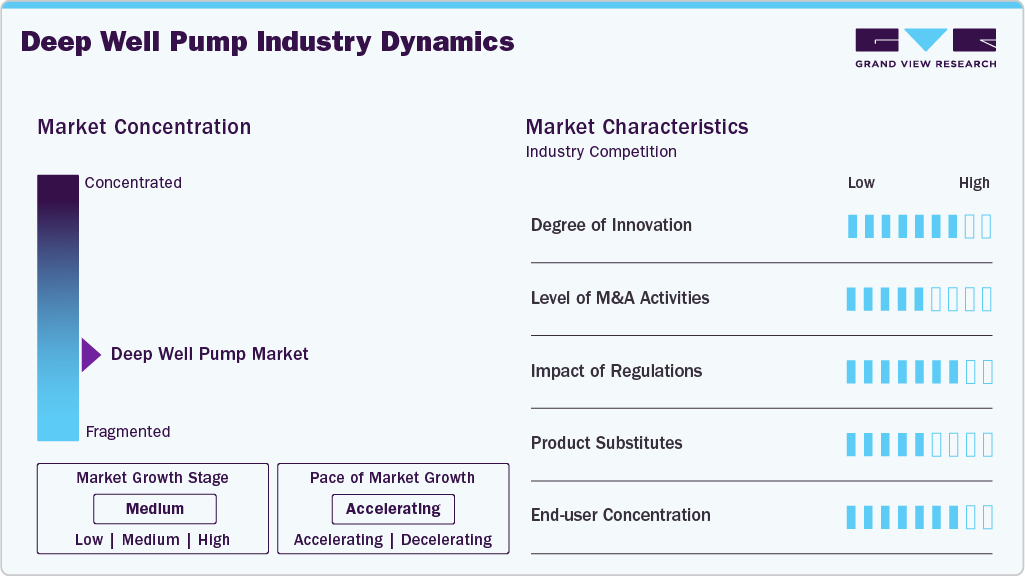
Competition is also shaped by technological advancement and lifecycle operating efficiency. Manufacturers are incorporating high-efficiency motors, variable-frequency drives, intelligent controls, remote monitoring, and improved materials to enhance pump performance and reduce energy and maintenance requirements. After-sales service, technical support, spare-parts availability, and distribution coverage remain important differentiating factors, particularly for applications where pump reliability directly affects water availability. This combination of technological differentiation, application diversity, regional competition, and service capabilities gives the deep well pump industry a diverse and competitive structure.
Analyst Perspective
The global deep well pumps industry is expected to witness steady growth, driven by rising groundwater demand, expanding irrigation activities, water scarcity, municipal water infrastructure development, and increasing industrial water requirements. Agriculture remains a major demand center, while municipal, mining, construction, and industrial applications provide additional opportunities. Demand is increasingly shifting toward energy-efficient, durable, solar-compatible, and digitally monitored pumping systems, particularly in emerging economies. Asia Pacific is expected to remain a key growth region due to its large agricultural base, groundwater dependence, and infrastructure investments. However, groundwater depletion and stricter water-management regulations may constrain long-term demand, encouraging the adoption of efficient and sustainable deep well pumping technologies.
Type Insights
Borewell submersible pumps accounted for the largest revenue share at 83.9%, driven by their extensive use for groundwater extraction in agricultural irrigation, municipal water supply, and rural water systems. Their compact installation, suitability for deep boreholes, and ability to operate with the motor submerged make them well suited to applications requiring reliable water lifting from considerable depths.
Lineshaft vertical turbine pumps are expected to grow significantly at a CAGR over the forecast period, supported by their suitability for high-capacity water extraction from deep wells, particularly in agricultural irrigation, municipal water supply, and industrial applications. Their above-ground motor configuration simplifies maintenance, while multi-stage designs provide flexibility across different head and flow requirements.
End-use Insights
The agriculture and irrigation segment accounted for the largest revenue share in 2025, supported by the widespread use of groundwater-based irrigation and increasing demand for reliable water extraction in farming. Deep well pumps are particularly important in regions where irrigation depends on borewells and other deep groundwater sources. Expanding irrigated agriculture, water scarcity, and investments in irrigation infrastructure are expected to sustain demand from this segment.
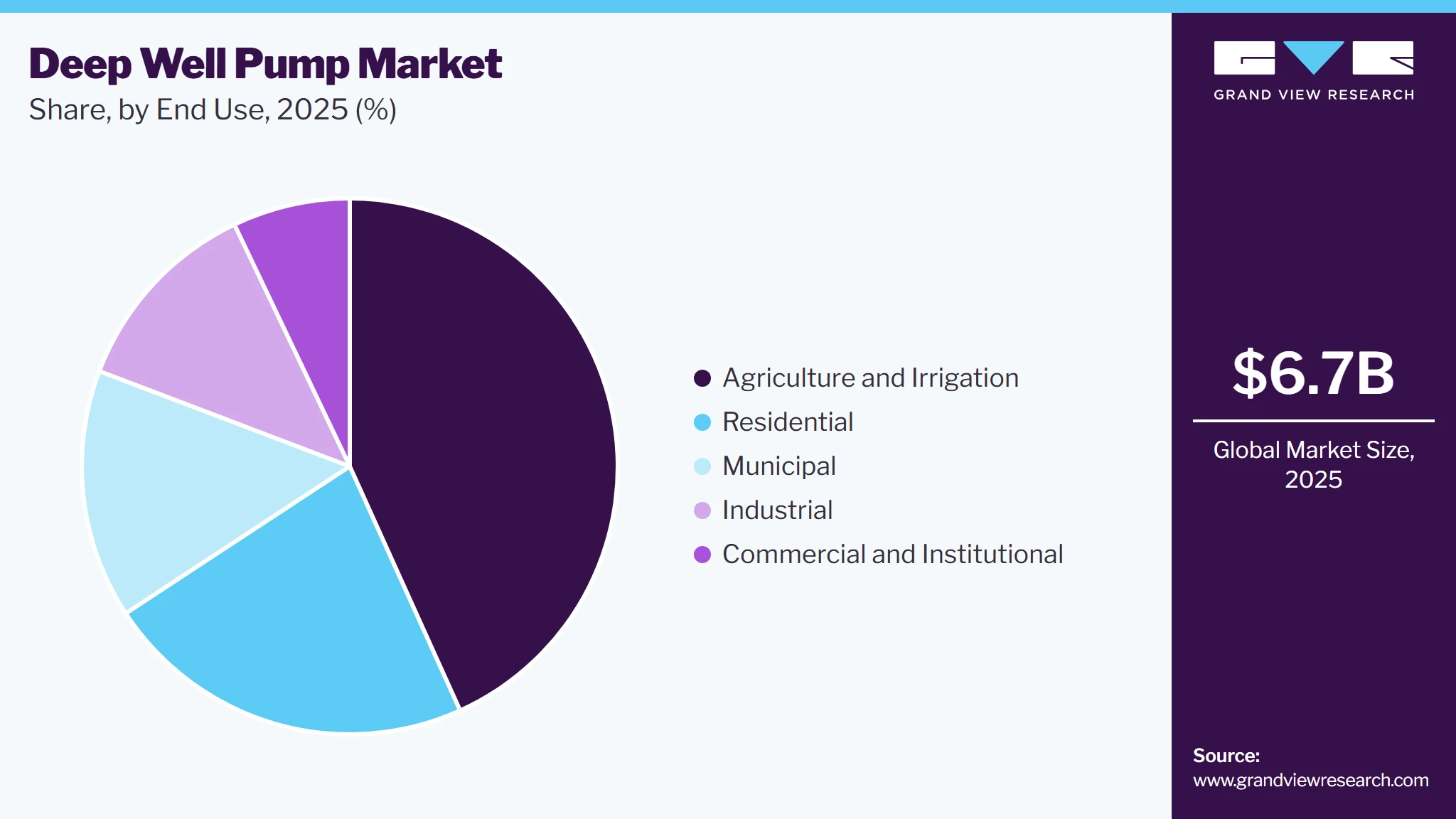
The municipal segment is projected to register a CAGR of 5.4% over the forecast period, driven by increasing investments in municipal water supply infrastructure, groundwater-based water systems, and urban water distribution networks. Rising urbanization and the need to improve reliable access to clean water are encouraging municipalities to expand and modernize pumping infrastructure, creating continued opportunities for deep well pump manufacturers.
Regional Insights
North America deep well pumps market represents a mature market, with demand concentrated across agricultural irrigation, municipal and rural water supply, industrial water management, mining, and groundwater extraction. Replacement of aging pumping infrastructure, modernization of irrigation systems, and increasing focus on energy-efficient water conveyance are shaping purchasing decisions. Manufacturers are increasingly offering high-efficiency submersible pumps, advanced motor systems, variable-speed configurations, and monitoring capabilities to improve hydraulic performance and reduce lifecycle operating costs.
U.S. Deep Well Pumps Market Trends
The U.S. deep well pumps industry is a prominent market, supported by extensive groundwater extraction across agricultural, municipal, and industrial applications. Agricultural irrigation remains an important demand area in groundwater-intensive regions, while municipal utilities and industrial facilities require dependable borehole pumping systems for continuous water supply. Replacement of aging installations, modernization of irrigation infrastructure, and adoption of energy-efficient pump-motor combinations are creating opportunities for advanced deep well pumping equipment.
Mexico deep well pumps industry has a strong application base for deep well pumps across agricultural irrigation, municipal water supply, industrial facilities, and rural water systems. Groundwater extraction is particularly important in areas with constrained or variable surface-water availability. Demand is being shaped by irrigation infrastructure development, replacement of older pumping equipment, and efforts to improve pumping efficiency and reliability. Suppliers offering durable submersible systems capable of operating across different well depths and water conditions are well positioned across the market.
Europe Deep Well Pumps Market Trends
Europe deep well pumps industry is technologically advanced, supported by groundwater abstraction, agricultural irrigation, municipal water supply, industrial water management, and rehabilitation of existing water infrastructure. Energy-efficiency requirements and lifecycle cost considerations are influencing equipment selection, encouraging the adoption of high-efficiency motors, variable-speed drives, and digitally monitored pumping systems. The replacement of older borehole installations remains an important source of demand as utilities, agricultural users, and industrial operators seek improved reliability and lower energy consumption.
Germany deep well pumps industry represents an established market, supported by municipal water infrastructure, groundwater abstraction, agricultural applications, and industrial water requirements. Demand is influenced by the modernization of existing borehole systems and the replacement of inefficient equipment with higher-performance pumping solutions. Industrial and utility customers increasingly prioritize operational reliability, energy efficiency, and equipment durability, supporting demand for technologically advanced submersible pumps and integrated pump-motor systems.
The UK deep well pumps industry is driven by groundwater management, agricultural irrigation, water utility infrastructure, and industrial water applications. Investment in water infrastructure rehabilitation is supporting the replacement of aging pumping equipment and modernization of borehole systems. Demand is also influenced by requirements for reliable water abstraction and efficient operation, encouraging the deployment of deep well pumps with improved hydraulic efficiency, variable-speed control, and remote monitoring capabilities.
Asia Pacific Deep Well Pumps Market Trends
Asia Pacific deep well pumps market dominated the global industry and held the largest revenue share of 45.2% in 2025. Asia Pacific represents a substantial market, underpinned by extensive agricultural irrigation, expanding municipal infrastructure, industrialization, and continued dependence on groundwater resources. Demand varies considerably across countries based on irrigation intensity, groundwater availability, industrial activity, and infrastructure development. Manufacturers are emphasizing energy-efficient pump designs, robust construction, corrosion-resistant materials, and advanced controls to address diverse well conditions and operating requirements.

China deep well pumps industry has a broad installed base of deep well and submersible pumps serving agricultural, municipal, industrial, and rural water applications. Agricultural irrigation remains an important demand segment, while municipal and industrial development continues to create requirements for reliable groundwater extraction systems. Replacement of conventional equipment and modernization of pumping infrastructure are supporting demand for efficient pump-motor assemblies and advanced control systems.
India deep well pumps industry is a significant market, with extensive utilization across agricultural irrigation, rural water supply, municipal systems, and industrial operations. Groundwater-based irrigation generates substantial demand for borewell and submersible pumping equipment across major agricultural regions. Energy efficiency, equipment durability, dependable operation under variable groundwater conditions, and reduced maintenance requirements are becoming increasingly important purchasing criteria.
Middle East & Africa Deep Well Pumps Market Trends
MEA deep well pumps industry demand is closely associated with groundwater extraction, agricultural irrigation, municipal water supply, mining, and industrial water management. Limited surface-water availability across several markets creates a strong requirement for dependable groundwater pumping infrastructure. Equipment operating in the region must often withstand high temperatures, mineral-rich water, and demanding duty cycles, increasing preference for robust pump construction, corrosion-resistant components, efficient motors, and reliable control systems.
Saudi Arabia deep well pumps industry represents an important market, particularly across agricultural irrigation, municipal water supply, industrial facilities, and groundwater extraction. Agricultural operations require reliable pumping equipment to deliver water from boreholes to irrigation networks, while industrial and municipal projects create demand for higher-capacity systems. Increasing emphasis on water-use efficiency is encouraging the replacement of conventional equipment with energy-efficient pumps and controlled pumping systems designed to optimize water delivery.
Latin America Deep Well Pumps Market Trends
Latin America deep well pumps industry presents sustained demand for deep well pumps across agricultural irrigation, municipal water supply, livestock operations, mining, and industrial applications. Groundwater serves as an important water source in several agricultural and remote regions, particularly where surface-water availability is seasonal or infrastructure is limited. Market opportunities are centered on irrigation expansion, rehabilitation of existing water systems, replacement of inefficient pumps, and deployment of equipment capable of maintaining reliable performance under variable groundwater conditions.
Brazil deep well pumps industry is a prominent market, supported by extensive agricultural production, irrigation requirements, municipal water systems, livestock operations, and industrial activity. Groundwater pumping is utilized across agricultural regions to supplement water availability and maintain irrigation during periods of seasonal variability. Modernization of irrigation infrastructure and increasing attention to energy-efficient water management are supporting demand for high-efficiency submersible pumps, durable pump-motor assemblies, and systems capable of delivering consistent flow and pressure across deep-well applications.
Key Deep Well Pumps Company Insights
Some of the key players operating in the market include Grundfos Group, Franklin Electric, Wilo, Ebara Corporation Holding A/S, and Zhejiang Doyin Technology.
-
Grundfos Group is a Denmark-based water technology company specializing in pumps, pumping systems, water treatment equipment, and digital water management solutions. Its portfolio serves residential, commercial, industrial, agricultural, and municipal applications, including groundwater extraction, irrigation, water distribution, and utility systems. The company offers borehole and submersible pumping solutions relevant to deep well applications, with an emphasis on energy efficiency, operational reliability, intelligent controls, and system performance. Its broad international presence and diversified water technology portfolio position it as an established participant in the global market.
-
Franklin Electric is a U.S.-based manufacturer focused on water and fluid management equipment, including pumps, submersible motors, drives, controls, and integrated pumping systems. The company serves residential, agricultural, commercial, industrial, and municipal water applications, with a strong presence in groundwater and well-water pumping. Its product portfolio includes submersible pumping systems designed for deep-well and borehole applications, supported by motor and control technologies that improve pumping efficiency and system reliability. The company's integrated approach to pumps, motors, and controls strengthens its position in the market.
Key Deep Well Pumps Companies:
The following key companies have been profiled for this study on the deep well pumps market.
-
Grundfos Group
-
Franklin Electric
-
Wilo
-
KSB Group
-
Ebara Corporation
-
Pedrollo
-
Xylem
-
PENTAIR
-
Shimge Pump
-
C.R.I. Pumps
-
Kirloskar Brothers
-
Zhejiang Doyin Technology
-
Jiadi Pump
-
Dayuan Pump
-
STAIRS Industrial
Company Categorization
Operating strategies
Competitive Edge
Weakness
Mature Players: Grundfos Group, Franklin Electric, Wilo, KSB Group, Ebara Corporation, Pedrollo, Xylem
- Maintain broad deep well pump portfolios covering borehole, submersible, high-capacity, and groundwater pumping applications.
- Invest in energy-efficient pump and motor technologies, variable-speed drives, digital monitoring, and system-level pumping solutions.
- Strong brand recognition, extensive global distribution, and established relationships with utilities, agricultural users, contractors, and industrial customers.
- Broad product portfolios and engineering capabilities enable customization across different well depths, flow requirements, and operating conditions.
- Large global operations and extensive product portfolios can result in higher manufacturing, logistics, and service costs.
- Exposure to diverse regulatory standards and energy-efficiency requirements across countries can increase product compliance and development complexity.
Emerging Players: PENTAIR, Shimge Pump, C.R.I. Pumps, Kirloskar Brothers, Zhejiang Doyin Technology, Jiadi Pump, Dayuan Pump, STAIRS Industrial
- Focus on deep well, borehole, and submersible pump systems for agricultural irrigation, residential water supply, municipal projects, and industrial applications.
- Expand through regional distributors, dealers, OEM relationships, and localized manufacturing to strengthen market access.
- Competitive pricing, localized product development, and strong understanding of regional groundwater and irrigation requirements.
- Flexible manufacturing enables faster adaptation to specific flow, head, bore diameter, and installation requirements.
- Comparatively smaller international presence and distribution networks than established multinational pump manufacturers.
- Limited resources for global R&D, digital technologies, and advanced system integration can constrain differentiation in premium applications.
Recent Developments:
-
In July 2026, Grundfos unveiled its next-generation SP47 submersible pump, including the SPE47 variant, for groundwater infrastructure applications. The new pump is designed to improve efficiency, reliability, and performance in demanding groundwater extraction systems, making it suitable for deep-well and borehole applications. The product is scheduled to become available across the Middle East and North Africa region from September 2026, strengthening Grundfos’ portfolio of specialized submersible pumping solutions for groundwater infrastructure.
-
In February 2025, Franklin Electric acquired Australia-based PumpEng Pty Ltd., a manufacturer of submersible pumps for mining and dewatering applications. The acquisition expands Franklin Electric’s submersible pumping portfolio and strengthens its presence in specialized water extraction applications. It also complements the company’s existing pumping operations in Australia and enhances its ability to serve demanding groundwater, dewatering, and mining requirements.
Deep Well Pumps Market Report Scope
Report Attribute
Details
Market size in 2025
USD 6.7 billion
Market size value in 2026
USD 7.0 billion
Revenue forecast in 2033
USD 10.0 billion
Growth rate
CAGR of 5.2% from 2026 to 2033
Historical data
2021 - 2024
Forecast period
2026 - 2033
Quantitative units
Revenue in USD billion, and CAGR from 2026 to 2033
Report coverage
Revenue forecast, company ranking, competitive landscape, growth factors, and trends
Segments covered
Type, end-use, region.
Regional scope
North America; Europe; Asia Pacific; Latin America; Middle East & Africa
Country scope
U.S.; Canada; Mexico; UK; Germany; France; Italy; Spain; China; Japan; India; Australia; South Korea; Brazil; Argentina; UAE; Saudi Arabia; South Africa
Key companies profiled
Grundfos Group; Franklin Electric; Wilo; KSB Group; Ebara Corporation; Pedrollo; Xylem; PENTAIR; Shimge Pump; C.R.I. Pumps; Kirloskar Brothers; Zhejiang Doyin Technology; Jiadi Pump; Dayuan Pump; STAIRS Industrial
Customization scope
Free report customization (equivalent up to 8 analysts working days) with purchase. Addition or alteration to country, regional & segment scope.
Pricing and purchase options
Avail customized purchase options to meet your exact research needs. Explore purchase options
Global Deep Well Pumps Market Report Segmentation
This report forecasts revenue growth at global, regional, and country levels and provides an analysis of the latest industry trends in each of the sub-segments from 2021 to 2033. For this study, Grand View Research has segmented the global deep well pumps market report based on type, end-use, and region.

-
Type Outlook (Revenue, USD Billion, 2021 - 2033)
-
Borewell Submersible Pumps
-
Lineshaft Vertical Turbine Pumps
-
Deep-Well Jet Pumps
-
Others
-
-
End-use Outlook (Revenue, USD Billion, 2021 - 2033)
-
Agriculture and Irrigation
-
Residential
-
Municipal
-
Industrial
-
Commercial and Institutional
-
-
Regional Outlook (Revenue, USD Billion, 2021 - 2033)
-
North America
-
U.S.
-
Canada
-
Mexico
-
-
Europe
-
Germany
-
Spain
-
France
-
Italy
-
UK
-
-
Asia Pacific
-
China
-
India
-
Japan
-
Australia
-
South Korea
-
-
Latin America
-
Brazil
-
Argentina
-
-
Middle East and Africa
-
Saudi Arabia
-
UAE
-
South Africa
-
-
Research Methodology
The deep well pumps market figures in this report are based on a proven research process that combines executive interviews with secondary research from proprietary databases, company filings, and recognized regulatory and institutional sources. Market size is built through value-chain sizing—reconciling supply-side and demand-side estimates—and triangulated with bottom-up and top-down approaches. Every estimate passes multiple levels of expert validation before publication, with each deep well pumps segment quantified using the revenue-capture definitions in the table below.
Segment Definition
Segment - Type
Revenue Capture Definition
Borewell Submersible Pumps
Revenue is generated from the sale of submersible pumps designed for installation inside borewells to lift groundwater for agricultural, residential, municipal, and industrial applications.
Lineshaft Vertical Turbine Pumps
Revenue generated from the sale of vertical turbine pump systems that use a lineshaft arrangement to transfer power from an above-ground motor to submerged pumping components for deep groundwater and high-capacity water lifting applications.
Deep-Well Jet Pumps
Revenue is generated from the sale of jet pump systems designed to extract water from deep wells by using pressure-driven suction and ejector mechanisms for residential, agricultural, and other groundwater applications.
Others
Revenue generated from the sale of deep-well pumping systems that do not fall within borewell submersible, lineshaft vertical turbine, or deep-well jet pump categories.
Segment-End Use
Revenue Capture Definition
Agriculture and Irrigation
Revenue generated from deep-well pump sales for agricultural water extraction and irrigation activities, including groundwater supply for crops, livestock, and farm operations.
Residential
Revenue generated from the sale of deep-well pumps for household groundwater extraction, domestic water supply, and related residential water-use requirements.
Municipal
Revenue generated from deep-well pump sales to municipalities and public water utilities for groundwater extraction, water distribution, and community water supply systems.
Industrial
Revenue generated from deep-well pump sales for industrial facilities requiring groundwater for processing, cooling, washing, utility operations, and other production-related applications.
Commercial and Institutional
Revenue is generated from the sale of deep-well pumps for commercial and institutional facilities such as offices, hotels, educational institutions, healthcare facilities, and other large buildings requiring groundwater supply.
Estimation Model
Layer No.
Layer Name
Key Question
Description
01
Groundwater Demand Layer
Where is the demand for deep well pumps generated?
Assess groundwater extraction requirements across agriculture and irrigation, residential, municipal, industrial, commercial, and institutional applications. Demand is evaluated based on well depth, groundwater availability, required water flow, pumping head, and application-specific water requirements.
02
Infrastructure & Equipment Demand Layer
Where is the demand for new deep well pumps created?
Evaluate investments in irrigation systems, groundwater wells, municipal water infrastructure, residential water supply, industrial facilities, and commercial developments. New well construction, irrigation expansion, water-supply projects, and replacement of aging pumping equipment are assessed to determine demand for new deep well pumps.
03
Pump Type Adoption Layer
Which deep well pump types are being purchased?
Analyze market demand across borewell submersible pumps, lineshaft vertical turbine pumps, deep-well jet pumps, and others. Adoption is assessed based on well depth, discharge capacity, pumping head, power availability, installation conditions, efficiency requirements, and application suitability.
04
Revenue Conversion Layer
How is market revenue estimated?
Convert estimated pump demand into annual revenue based on the sales value of new deep well pumps across the defined type and end-use segments and geographic markets. Revenue estimates incorporate equipment sold by manufacturers, OEMs, distributors, irrigation suppliers, and water infrastructure contractors.
Delivered Customizations
This report has been delivered with the following In-depth customizations
Client Request
Customization Delivered
Value Adds
Competitive Benchmarking
A comprehensive competitive benchmarking analysis was conducted across leading deep well pump manufacturers, evaluating product portfolios, pump types, pumping capacity, well-depth suitability, hydraulic performance, energy efficiency, application coverage, geographic presence, strategic initiatives, and market positioning.
Provides a structured assessment of competitive differentiation, product capabilities, type focus, application coverage, and strategic positioning to support competitor evaluation and business planning.
Regional Segmentation
A detailed regional assessment was conducted across North America, Europe, Asia Pacific, Latin America, and the Middle East & Africa, covering deep well pump demand across agriculture and irrigation, residential, municipal, industrial, and commercial and institutional applications. The assessment considered groundwater extraction requirements, irrigation development, water-supply infrastructure, industrial water demand, and equipment replacement activity.
Enables stakeholders to evaluate regional demand patterns, identify attractive geographic markets, assess application-specific opportunities, and support market expansion strategies.
Opportunity Assessment
An opportunity assessment was conducted across irrigation development, groundwater-based water supply, municipal pumping requirements, industrial water applications, residential groundwater extraction, and replacement of aging deep well pumps. Opportunities related to energy-efficient, high-capacity, and application-specific pumping systems were also evaluated.
Supports identification of addressable growth opportunities, product development priorities, investment areas, and strategies for strengthening competitive positioning within the global deep well pumps market.
Frequently Asked Questions About This Report
The market is driven by increasing demand for reliable groundwater extraction, expansion of irrigated agriculture, municipal water infrastructure development, rural water supply projects, and growing water requirements across industrial and remote applications.
Key trends include increasing adoption of high-efficiency submersible pumps, growing use of solar-powered pumping systems, modernization of irrigation infrastructure, investments in municipal water systems, and demand for durable pumps designed for deep groundwater extraction.
India is projected to register the fastest growth in the deep well pumps market, with a CAGR of 6.8% during the forecast period. Growth is driven by increasing demand for agricultural irrigation, rural water supply, groundwater extraction, and infrastructure development.
Key players include Grundfos Group, Franklin Electric, Wilo, KSB Group, Ebara Corporation, Pedrollo, Xylem, PENTAIR, Shimge Pump, C.R.I. Pumps, Kirloskar Brothers, Zhejiang Doyin Technology, Jiadi Pump, Dayuan Pump, and STAIRS Industrial.
The global deep well pumps market size was valued at USD 6.7 billion in 2025 and is estimated at USD 7.0 billion in 2026.
The market is expected to grow at a CAGR of 5.2% from 2026 to 2033, reaching approximately USD 10.0 billion by 2033.
Asia Pacific dominated the global deep well pumps market, accounting for the largest revenue share of 45.2% in 2025, supported by extensive agricultural activity, groundwater dependence, urbanization, and investments in water infrastructure.
The borewell submersible pumps segment is projected to register a CAGR of 5.4% during the forecast period, driven by increasing groundwater extraction, agricultural irrigation, rural water supply, and demand for efficient deep-borewell pumping systems.
The agriculture and irrigation segment dominated the market in 2025, accounting for 43.2% of global revenue, supported by extensive groundwater-based irrigation and investments in irrigation infrastructure.
About the Author(s)
Advanced Interior Materials Research Team
Advanced Materials · Advanced Interior MaterialsThis report was authored by the advanced interior materials research team at Grand View Research - comprising two research analysts, one senior research analyst, and one industry expert - with specialized expertise in the advanced interior materials segment of the advanced materials industry. All findings are based on proprietary advanced materials databases, executive interviews, and regulatory analysis, subject to internal peer review prior to publication.
Last Updated:
Speak to Analyst


Customize this report to your needs — add regions, segments, or data points, with 20% free customization.
Or view our licence options:


ISO 9001:2015 & 27001:2022 Certified
We are GDPR and CCPA compliant! Your transaction & personal information is safe and secure. For more details, please read our privacy policy.


