
- Home
- »
- Medical Devices
- »
-
Dental Anesthesia Injectable Market Size Report, 2026-2033GVR Report cover
![Dental Anesthesia Injectable Market (2026 - 2033)Report]()
Dental Anesthesia Injectable Market (2026 - 2033)
Size, Share & Trends Analysis Report By Product Formulation, By Age Group (Pediatric, Adult), By Application (Tooth Extraction, Implantology), By End Use, By Region, And Segment Forecasts
Market Size, 2025
$1.5BMarket Estimate, 2026
$1.6BMarket Forecast, 2033
$2.5BCAGR, 2026–2033
7.0%Dental Anesthesia Injectable Market Summary
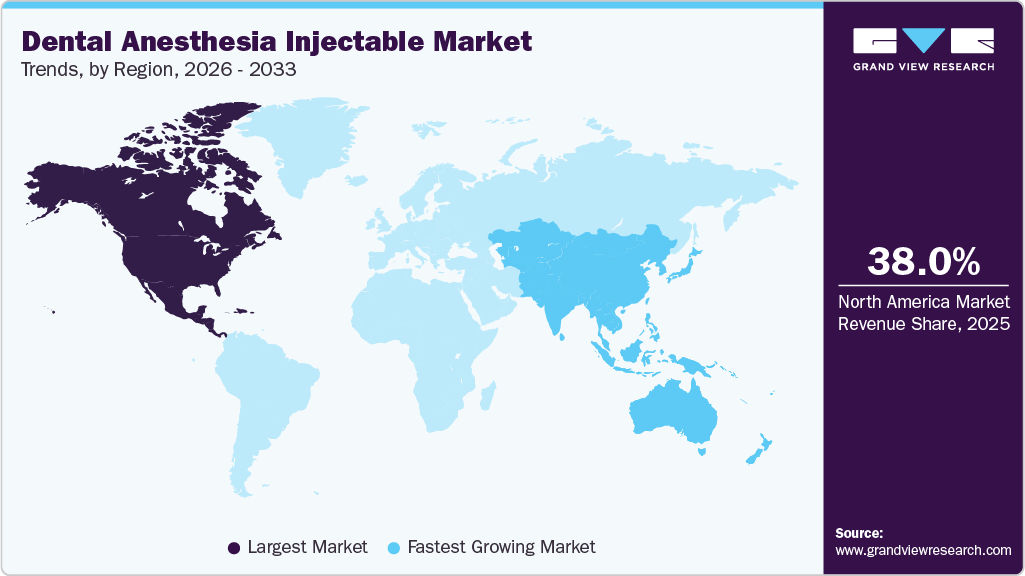
The global dental anesthesia injectable market size was valued at USD 1.5 billion in 2025 and is projected to grow from USD 1.6 billion in 2026 to USD 2.5 billion by 2033, at a CAGR of 7.0% from 2026 to 2033. North America held the largest share of 38.0% of the global market in 2025. The growing prevalence of dental disorders such as tooth decay, periodontal diseases, and oral infections, which require pain management during procedures is attributed to market growth.
Key Market Trends & Insights
- By product formulation: the lidocaine 2% with epinephrine segment led the market with the largest revenue share in 2025.
- By age group: the adult (18-64 years) segment led the market with the largest revenue share in 2025.
- By application: the restorative dentistry & minor procedures segment led the market with the largest revenue share in 2025.
- By end use: the private dental clinics segment led the market with the largest revenue share in 2025.
Regional Highlights
- Largest regional market: North America (38.0% market share, 2025)
- Fastest-growing regional market: Asia Pacific (2026-2033)
- By country: The U.S. represented the largest market in 2025.
Market Size & Forecast
- Market size in 2025: USD 1.5 Billion
- Estimated market size in 2026: USD 1.6 Billion
- Projected market size by 2033: USD 2.5 Billion
- CAGR (2026-2033): 7.0%
As populations age globally, the demand for dental treatments is also increasing, since older individuals are more prone to complex oral health issues that often involve surgical or restorative interventions requiring anesthesia.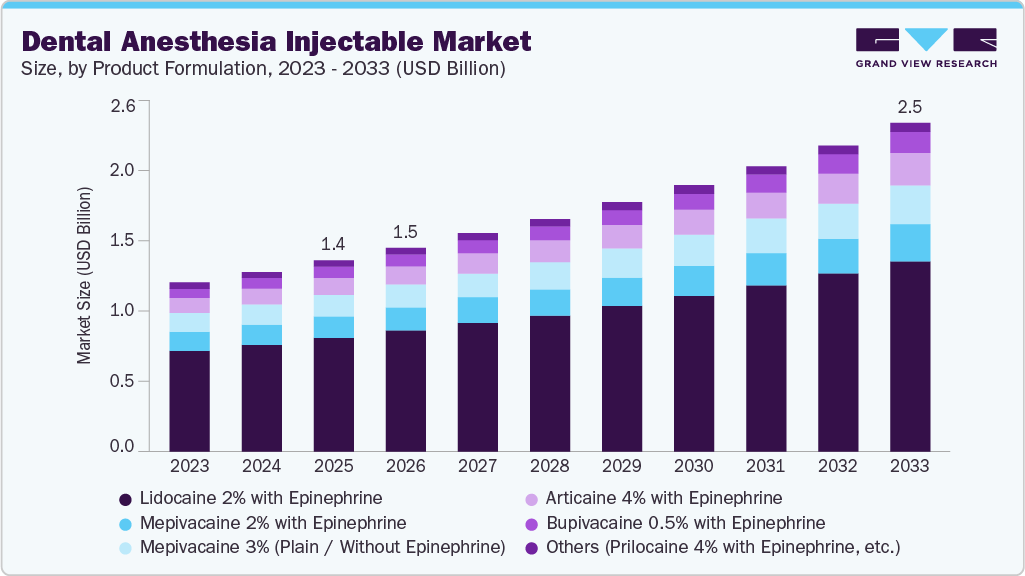
In addition, contributing to market expansion is the increasing awareness of oral hygiene and the importance of preventive and corrective dental care. Governments and healthcare organizations are actively promoting dental health through public campaigns, leading to higher patient footfall in dental clinics. For instance, September 2025, the Department of Community Medicine, FOMS, KBN University conducted a National Oral Health Month Awareness Program on 30 September 2025 at an Anganwadi Centre to promote oral and hand hygiene among children and caregivers. The initiative included interactive demonstrations, educational sessions, and health check-ups to prevent common diseases. Such initiatives are expected to drive early diagnosis and treatment adoption, thereby supporting sustained growth in the dental healthcare market.
Anesthesia in dentistry is used to numb a specific area of the mouth, allowing procedures to be performed without pain while the patient remains conscious. According to the American Academy of Pediatric Dentistry, it involves the temporary loss of sensation in a targeted region using topical or injectable agents without affecting awareness. These anesthetics work by blocking nerve signals from reaching the brain, preventing pain while still allowing sensations like pressure. They typically act within minutes and last for about 30 to 60 minutes. Achieving numbness in the lower jaw can be more challenging than in the upper jaw due to anatomical differences. Dentists commonly use local anesthesia for procedures such as fillings, extractions, root canals, gum treatments, and crowns. Common agents include Lidocaine, articaine, prilocaine, mepivacaine, and bupivacaine, available in forms such as gels, sprays, and injections, depending on the procedure.
The increasing prevalence of dental conditions such as tooth decay, periodontal diseases, and impacted wisdom teeth, which often require extraction as a primary treatment. For instance, in the UK, from 2021 to 2024, total tooth extractions increased sharply from 22,549 to 49,112, more than doubling as dental services resumed after the disruption. Tooth decay extractions rose from 14,645 to 30,587, while non-tooth decay extractions increased from 7,904 to 18,525, indicating a strong recovery in both essential and elective procedures. The sustained rise in both essential and elective tooth extraction procedures is expected to continue driving strong demand for dental anesthesia injectables, thereby supporting the steady growth of this market over the forecast period.
Number of tooth extraction episodes in the last 10 years by extraction category
Year
Tooth decay extractions
Non-tooth decay extractions
All tooth extractions
2015
42,209
20,987
63,196
2016
39,278
21,083
60,361
2017
39,346
21,955
61,301
2018
38,385
20,929
59,314
2019
37,404
21,607
59,011
2020
35,190
19,947
55,137
2021
14,645
7,904
22,549
2022
26,741
15,439
42,180
2023
31,165
16,416
47,581
2024
30,587
18,525
49,112
Source: Gov.UK
The rising global burden of oral diseases is a major factor driving the growth of the dental anesthesia injectable industry. Conditions such as dental caries (tooth decay), periodontal (gum) diseases, tooth loss, and oral infections are becoming common across both developed and developing regions. These issues are largely influenced by changing dietary habits, particularly higher consumption of sugar-rich foods and beverages, along with poor oral hygiene practices and limited access to preventive dental care in certain populations. For instance, in March 2025, according to the World Health Organization (WHO), oral diseases affect nearly 3.7 billion people worldwide, highlighting a vast target population in need of effective dental procedures. This substantial and growing patient population continues to drive the demand for effective dental procedures, thereby significantly supporting the expansion of the dental anesthesia injectable industry.
Pricing and Medical Tourism Dynamics in Dental Care
The dental anesthesia injectable industry is also experiencing rapid expansion due to the rise in cost-sensitive dental care and medical tourism, where affordability and procedural efficiency significantly influence treatment volumes. According to medical tourism packages, in January 2026, dental care in Mexico is approximately 50-80% more affordable than in the U.S., attracting over 1.35 million patients annually to key hubs such as Los Algodones, Tijuana, Cancun, and Puerto Vallarta. For instance, a single dental implant in Mexico costs between USD750 and USD1,100, compared to USD3,000 to USD5,000 in the U.S., while all-on-4 full-arch restorations range from USD8,100 to USD11,000, versus USD24,000 to USD35,000 domestically. Despite lower costs, leading clinics maintain high-quality standards by using globally recognized implant systems such as Nobel Biocare and Straumann, ensuring outcomes comparable to those of U.S.-based treatments.
Cost comparison of dental procedures: U.S., Canada, UK vs Mexico
Procedure
US
Canada
UK
Mexico (Border)
Mexico (Resort)
Savings
Single Dental Implant
USD3,000-USD5,000
USD2,500-USD4,500
USD2308.48-USD3462.72
USD750-USD1,100
USD900-USD1,200
70-80%
Porcelain Veneer (e.max)
USD1,000-USD2,500
USD1,100-USD1,800
USD692.54-USD1154.24
USD350-USD550
USD400-USD550
75-80%
Zirconia Crown
USD1,200-USD2,000
USD1,200-USD1,800
USD692.54-USD1038.82
USD230-USD450
USD400-USD600
70-80%
Implant Crown (Zirconia)
USD1,500-USD2,500
USD1,500-USD2,000
USD923.39-USD1385.09
USD450-USD600
USD500-USD700
70-80%
All-on-4 (Per Arch)
USD24,000-USD35,000
USD22,000-USD30,000
USD13850.88-USD20776.32
USD8,100-USD11,000
USD10,000-USD13,000
60-70%
Root Canal (Molar)
USD1,000-USD1,500
USD900-USD1,400
USD 461.70-USD807.97
USD200-USD350
USD250-USD450
70-80%
Teeth Whitening
USD500-USD800
USD400-USD600
USD346.27-USD577.12
USD150-USD200
USD200-USD300
60-70%
Source: Medical Tourism Packages
Average costs of common dental treatments in Mexico Vs the U.S.
Procedure
Avg. U.S. Cost (USD)
Mexico Cost (USD)
% Savings
USD Savings
Titanium Dental Implant
USD 3,000
USD 750
75.00%
USD 2,250
Porcelain Fused to Metal Crown
USD 900
USD 199
77.90%
USD 701
Zirconia Crown
USD 1,170
USD 450
61.50%
USD 720
Porcelain Veneer
USD 1,440
USD 350
75.70%
USD 1,090
All-on-4 Implants
USD 14,220
USD 8,900
37.40%
USD 5,320
Root Canal
USD 920
USD 199
78.40%
USD $721
Wisdom Teeth Extraction
USD 310
USD 180
41.90%
USD 130
Cleaning
USD 150
USD 50
66.70%
USD 100
Source: Denta Del Rio
Market Characteristics & Concentration
Innovation in the dental anesthesia injectable industry is moderate. While there have been advancements such as improved delivery systems (e.g., computer-controlled local anesthetic delivery) and formulations with reduced side effects, the core anesthetic agents (such as lidocaine and articaine) have remained largely unchanged for years. This limits the extent to which innovation can differentiate competitors. Companies invest in incremental improvements rather than breakthrough innovations, resulting in a relatively level playing field.
Mergers and acquisitions in the market occur but are not highly aggressive compared to other pharmaceutical sectors. Larger companies occasionally acquire smaller firms to expand product portfolios or geographic reach. However, the market has not experienced significant consolidation through frequent large-scale deals. This moderate level of M&A activity allows multiple players to coexist without major dominance shifts. Smaller companies can still operate independently, especially in regional markets.
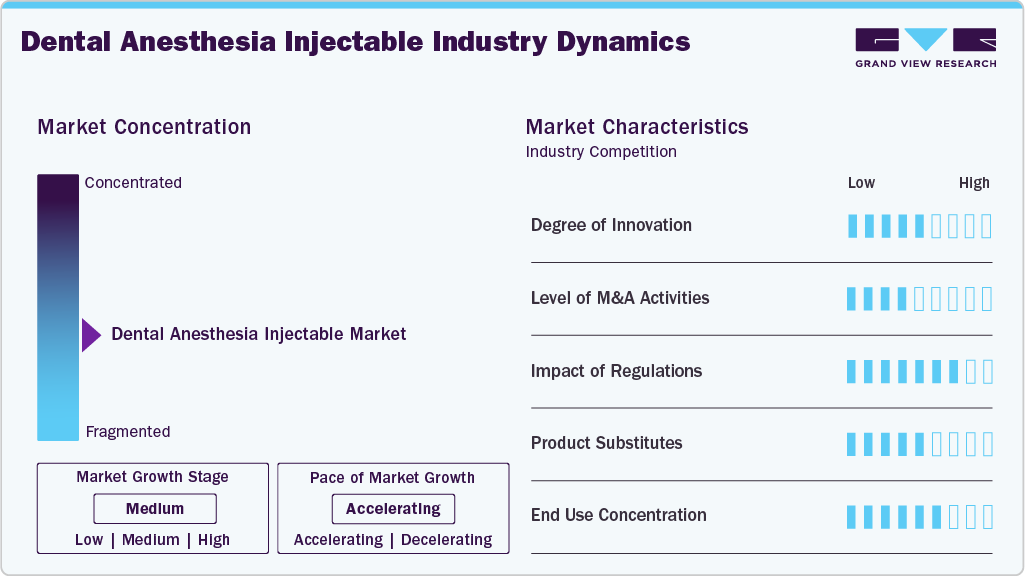
Regulation has a high impact on the market, significantly influencing market structure and competition. Dental anesthesia is governed by strict clinical, safety, and training guidelines issued by bodies such as the American Dental Association (ADA). According to ADA guidelines, dentists administering sedation or general anesthesia must comply with state laws, mandatory training requirements, and defined competency standards, which act as a major barrier to entry for new participants. In addition, regulations require continuous patient monitoring, detailed documentation, emergency preparedness, and availability of trained personnel and equipment during procedures. These requirements increase operational costs and limit participation to well-equipped providers. Recent updates to guidelines also emphasize standardization, safety protocols, and education requirements, further tightening regulatory oversight.
The availability of product substitutes in the market is relatively limited. While alternative pain management methods such as sedation techniques or non-pharmacological approaches (e.g., behavioral management or laser dentistry) exist, they do not fully replace the need for local anesthetics in most dental procedures. This low level of substitution means that core anesthetic products maintain steady demand. However, because many manufacturers produce similar formulations of widely used anesthetics, competition remains strong among existing players.
End use concentration in the dental anesthesia injectable industry is moderately high. The primary consumers, dental clinics, hospitals, and specialized dental care centers, are relatively well-defined and account for most of the demand. Large dental chains and hospital networks have strong purchasing power, often preferring established and trusted brands. This can benefit larger manufacturers with strong distribution networks and brand recognition. However, independent dental practices also represent a significant portion of the market and often purchase from a variety of suppliers.
Product Formulation Insights
The lidocaine 2% with epinephrine product formulation segment dominated the market in 2025 due to its balanced clinical performance and broad applicability in dental care. The 2% concentration delivers a strong and stable nerve blockade, making it suitable for restorative procedures, periodontal therapy, endodontics, extractions, and minor surgical interventions. Its pharmacological properties enable rapid penetration of nerve membranes, ensuring quick onset of anesthesia while maintaining a reversible loss of sensation that minimizes prolonged numbness and supports patient comfort. In November 2025, My DDS Supply reported that lidocaine HCl 2% with Epinephrine 1:100,000 is widely recognized as the gold standard in dental local anesthesia due to its rapid onset, reliable efficacy, and strong safety profile. Its proven performance across diverse dental procedures has made it a routine and trusted choice in clinical practice.
The articaine 4% with epinephrine segment in the market is expected to grow significantly during the forecast period. This growth is driven by its superior clinical performance and increasing preference among dental professionals. Articaine offers faster onset and better tissue penetration compared to traditional anesthetics, making it highly effective for complex procedures such as extractions and implant surgeries. Its ability to provide reliable anesthesia with reduced need for multiple injections improves patient comfort and procedural efficiency. In addition, the rising volume of dental procedures, driven by growing oral health awareness and cosmetic dentistry demand, is supporting adoption.
Age Group Insights
The adult (18-64 years) age group segment dominated the market in 2025. The increasing use of standardized weight-based dosing guidelines in adult dental procedures is supporting the growth of the market. Clear dosing limits for commonly used anesthetics such as lidocaine, mepivacaine, and articaine help dentists ensure safe and effective pain management during procedures. These formulations are administered to produce local anesthesia under defined dosing guidelines, weight-based dosing limits such as 4.4 mg/kg for lidocaine, 6.6 mg/kg for mepivacaine, and 7.0 mg/kg for articaine, along with corresponding maximum total dose limits per session depending on the formulation.
Dosage for Adult Population (18-64 Years)
-
For lidocaine 2% with epinephrine formulations, the maximum dose for adults is specified as 4.4 mg/kg body weight, with a maximum total dose not exceeding 300 mg per session.
-
For mepivacaine 3% (plain) formulations (Dentocain Simple), the maximum adult dose is specified as 6.6 mg/kg body weight, with a maximum total dose not exceeding 400 mg per session in a healthy patient.
-
For articaine 4% with epinephrine formulations (Turbocaina), the maximum adult dose is specified as 7.0 mg/kg body weight, with a maximum total dose not exceeding 500 mg per session.
The combination of high procedural demand in adult dentistry and well-defined, formulation-specific dosing protocols continues to reinforce the dominance of the 18-64 years age group in the market.
The geriatric (65+ years) age group segment is growing strongly in the market. Dental anesthetic products, including formulations such as lidocaine with epinephrine among others, are indicated for use in elderly patients as part of routine clinical practice. The indication for geriatric patients aligns with the general use of these formulations, which is the production of local anesthesia for dental procedures requiring an adequate and sustained anesthetic effect.
Application Insights
The restorative dentistry & minor procedures application segment dominated the market in 2025 due to high and increasing volume of routine dental treatments such as fillings, root canal therapies, crown placements, and tooth extractions. Rising awareness of oral health, coupled with greater access to dental care services, has led to more patients seeking timely treatment for dental issues. Moreover, the growing prevalence of dental caries and periodontal diseases is contributing to consistent demand for these procedures. Injectable anesthesia is essential in ensuring pain-free and comfortable patient experiences, which enhances patient compliance and repeat visits.
The implantology segment in the market is expected to grow significantly during the forecast period. Dental implants require precise and effective pain management, which increases the demand for long acting and reliable local anesthetic formulations. In addition, growing patient preference for advanced restorative and cosmetic dental treatments is supporting higher adoption of implant-based procedures. Technological advancements in implantology, along with improved surgical techniques, are also making procedures more predictable and widely accessible, further boosting procedure volumes.
End Use Insights
The private dental clinics end use segment dominated the market in 2025. Private clinics handle a high volume of routine and specialized dental procedures, including extractions, root canals, and cosmetic treatments, all of which require effective pain management through injectable anesthesia. Patients prefer private clinics because of shorter waiting times, better service quality, and personalized care compared to public healthcare facilities. In addition, rising disposable incomes and growing awareness of oral health are encouraging more people to seek timely dental treatment in private settings.
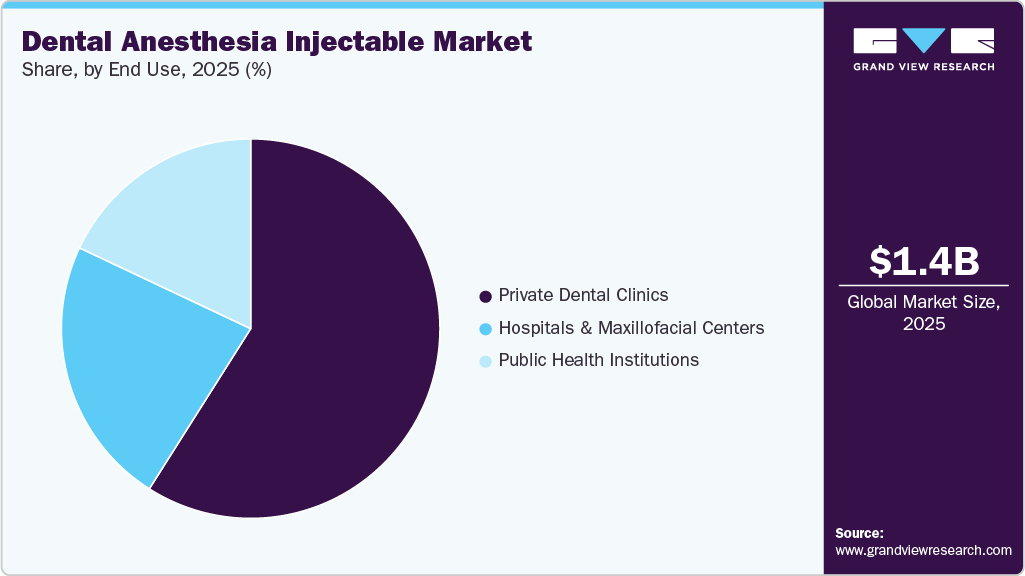
The hospitals & maxillofacial centers end use segment in the market is expected to grow strongly during the forecast period. Rising cases of complex dental and oral surgical procedures, such as jaw reconstruction, trauma management, and implant surgeries, are increasing the demand for advanced anesthesia in controlled clinical environments. Hospitals and maxillofacial centers are better equipped with skilled specialists, monitoring systems, and emergency care facilities, making them the preferred settings for high-risk or complicated procedures requiring injectable anesthesia.
Regional Insights
North America Dental Anesthesia Injectable Market Trends
The dental anesthesia injectable industry in North America held the largest global revenue share in 2025. Cavities remain one of the most common chronic conditions in pediatric (0-17 years) age group, with many cases progressing without timely intervention. Untreated tooth decay frequently leads to pain, infections, and complications such as abscess formation, which can affect eating, speaking, and overall development. For instance, in May 2024, according to the CDC in the U.S., approximately 50% of kids aged 6 to 9 years experiencing decay in primary or permanent teeth. Also, 10% of adolescents aged 12 to 19 years have at least one untreated cavity, which can lead to pain, infections, and serious health complications if not addressed. These conditions increase the need for clinical dental procedures that require effective pain management, thereby driving demand for injectable anesthesia in North America.
U.S. Dental Anesthesia Injectable Market Trends
The U.S. dental anesthesia injectable industry is witnessing significant growth driven by increasing consumer expenditure on oral health. As individuals allocate more financial resources toward preventive and restorative dental care, the demand for pain management solutions during procedures continues to rise. According to the American Dental Association, annual dental spending in the U.S. reached approximately USD 189 billion in 2024, reflecting strong consumer investment in oral care products and services. Dental spending grew by nearly USD 7 billion, marking a 4% increase from 2023, closely aligning with the broader trend in healthcare, where inflation-adjusted overall health spending rose by 4.6%. Dental expenditure accounted for around 3.6% of total national health spending, maintaining a stable share compared to the previous year. This sustained rise in consumer spending on oral healthcare is expected to continue supporting the expansion of the U.S. market.
Europe Dental Anesthesia Injectable Market Trends
The Europe dental anesthesia injectable industry is witnessing strong growth over the forecast period due to the rising demand for advanced and pain-free dental procedures, supported by well-established healthcare systems and increasing awareness of oral health. Countries such as UK, Germany, France, Italy, Spain, Denmark, Sweden, and Norway are experiencing steady growth driven by a higher prevalence of dental disorders. Also, the expansion of private dental clinics and increased focus on cosmetic dentistry further contribute to market growth.
The UK dental anesthesia injectable industry is primarily driven by the rising demand for pain management during increasing dental extraction procedures, especially among children and adolescents. Significant regional disparities in oral health have led to higher treatment volumes in certain areas, placing greater reliance on injectable anesthesia in both public and private dental settings. For instance, in 2024, government data shows significant regional disparities, with Yorkshire and the Humber reporting a decayed tooth extraction rate of 454 per 100,000 among individuals aged 0 to 19, which is nearly 6.5 times higher than the East Midlands at 70. Other regions such as the North East (418) and North West (337) also report elevated extraction rates. This sustained regional burden of severe dental decay is expected to continue driving the need for injectable anesthesia across clinical settings in the UK.
The Italy dental anesthesia injectable industry is driven by the development of advanced delivery systems that improve both clinical outcomes and patient experience. Innovations such as computer-controlled local anesthetic delivery systems enable precise, controlled administration of anesthesia, minimizing pain and anxiety associated with injections. These technologies enhance accuracy in dosage and targeting, reducing the risk of complications and improving procedural efficiency for dental professionals. Moreover, they support better patient compliance, particularly among individuals with dental phobia, thereby increasing the overall number of dental visits and treatments.
Asia Pacific Dental Anesthesia Injectable Market Trends
The Asia Pacific dental anesthesia injectable industry is anticipated to register the fastest growth over the forecast period. Rapid urbanization and rising disposable incomes are increasing access to advanced dental care, while growing awareness of oral hygiene is boosting the number of dental visits. Countries such as China and India are experiencing large patient volumes due to their huge populations and expanding middle-class base, whereas Japan and South Korea show strong demand for advanced and precision-based dental procedures due to aging populations.
The China dental anesthesia injectable industry is significantly driven by the expansion of dental healthcare services across multiple end use segments, including private dental clinics, hospitals and maxillofacial centers, and public health institutions. Private dental clinics are a major driver as rising disposable incomes, growing awareness of oral health, and demand for advanced cosmetic and pain-free dental procedures are encouraging more patients to seek treatment. Hospitals and maxillofacial centers are also contributing significantly, as they handle complex dental surgeries and trauma cases that require reliable and effective local anesthesia solutions.
Latin America Dental Anesthesia Injectable Market Trends
The Latin America dental anesthesia injectable industry is expected to grow strongly over the forecast period. In Brazil, expanded public healthcare programs are improving access to dental treatments through government hospitals and community clinics, leading to higher demand for injectable anesthesia in routine and advanced dental procedures. Similarly, Argentina is strengthening its public health system by increasing investment in preventive dental care and subsidized treatment programs, which is encouraging more patients to seek professional dental services.
MEA Dental Anesthesia Injectable Market Trends
The MEA dental anesthesia injectable industry is growing significantly due to the evolving regulatory changes and stricter safety standards. Governments and healthcare authorities across the region are focusing on improving the quality of dental care by enforcing updated clinical guidelines, sterilization protocols, and drug safety regulations. These measures are encouraging dental practitioners to adopt safer and more effective injectable anesthetic products that meet international compliance requirements. In addition, regulatory bodies are strengthening approval processes for dental anesthesia drugs, which is improving patient safety and boosting confidence among healthcare providers.
Key Dental Anesthesia Injectable Company Insights
Some of the key companies in the dental anesthesia injectable industry include Dentsply Sirona, Aspen Holdings, Septodont Holding, Fresenius Kabi USA, Centurion Healthcare, Pierrel, Huons, Zeyco, Acteon, and Primex Pharmaceuticals. Organizations are focusing on increasing customer base to gain a competitive edge in the industry. Therefore, key players are taking several strategic initiatives, such as mergers and acquisitions, and partnerships with other major companies.
Key Dental Anesthesia Injectable Companies:
The following key companies have been profiled for this study on the dental anesthesia injectable market.
- Dentsply Sirona
- Aspen Holdings
- Septodont Holding
- Fresenius Kabi USA
- Centurion Healthcare
- Pierrel
- Huons
- Zeyco
- NEW STETIC S.A.
- Acteon
- Primex Pharmaceuticals
Recent Developments
-
In August 2025, Avenacy launched Lidocaine Hydrochloride Injection, USP in the U.S. market, marking its first Lidocaine product and 25th product since its inception in October 2023. The FDA-approved generic is equivalent to Xylocaine and is used for local or regional anesthesia. It comes in 1% strength, packaged as 500 mg per 50 mL multi-dose vials.
-
In May 2025, Huons received U.S. FDA ANDA approvals for 2% (400 mg/20 mL) and 1% (200 mg/20 mL) multiple-dose lidocaine hydrochloride injection vials. These preservative-added formulations can be used multiple times after opening and are therapeutically equivalent to Xylocaine injection. The approvals strengthen Huons’ presence in the North American local anesthetics market.
-
In December 2024,Camber Pharmaceuticals launched Lidocaine HCl Injection, USP, in both single-dose and multi-dose vial formats. Available in 1% and 2% concentrations, the product comes in multiple vial and pack sizes to support varied clinical requirements. This expansion aims to enhance flexibility and accessibility in local anesthetic supply.
Dental Anesthesia Injectable Market Report Scope
Report Attribute
Details
Market size in 2025
USD 1.5 billion
Estimated market size in 2026
USD 1.6 billion
Projected market size by 2033
USD 2.5 billion
Growth rate
CAGR of 7.0% from 2026 to 2033
Base year for estimation
2025
Historical data
2021 - 2024
Forecast period
2026 - 2033
Market representation
Revenue in USD million and CAGR from 2026 to 2033
Segments covered
Product formulation, age group, application, end use, region
Regional scope
North America; Europe; Asia Pacific; Latin America; Middle East & Africa
Country scope
U.S.; Canada; Mexico; UK; Germany; France; Italy; Spain; Denmark; Sweden; Norway; Japan; China; India; Thailand; Australia; South Korea; Brazil; Argentina; South Africa; Saudi Arabia; UAE; Kuwait
Key companies profiled
Dentsply Sirona; Aspen Holdings; Septodont Holding; Fresenius Kabi USA; Centurion Healthcare; Pierrel; Huons; Zeyco; NEW STETIC S.A.; Acteon; Primex Pharmaceuticals
Customization scope
Free report customization (equivalent up to 8 analyst’s working days) with purchase. Addition or alteration to country, regional & segment scope
Pricing and purchase options
Avail customized purchase options to meet your exact research needs. Explore purchase options
Global Dental Anesthesia Injectable Market Report Segmentation
This report forecasts revenue growth at global, regional & country levels and provides an analysis of the latest industry trends in each of the sub-segments from 2021 to 2033. For this study, Grand View Research has segmented the global dental anesthesia injectable market report based on product formulation, age group, application, end use, and region:
-
Product Formulation Outlook (Revenue, USD Million, 2021 - 2033)
-
Lidocaine 2% with Epinephrine
-
Mepivacaine 2% with Epinephrine
-
Mepivacaine 3% (Plain / Without Epinephrine)
-
Articaine 4% with Epinephrine
-
Bupivacaine 0.5% with Epinephrine
-
Others (Prilocaine 4% with epinephrine, etc.)
-
-
Age Group Outlook (Revenue, USD Million, 2021 - 2033)
-
Pediatric (0-17 years)
-
Adult (18-64 years)
-
Geriatric (65+ years)
-
-
Application Outlook (Revenue, USD Million, 2021 - 2033)
-
Tooth Extraction
-
Endodontic Procedures (Root Canal)
-
Implantology
-
Periodontal Surgery
-
Restorative Dentistry & Minor Procedures
-
-
End Use Outlook (Revenue, USD Million, 2021 - 2033)
-
Private Dental Clinics
-
Hospitals & Maxillofacial Centers
-
Public Health Institutions
-
-
Regional Outlook (Revenue, USD Million, 2021 - 2033)
-
North America
-
U.S.
-
Canada
-
Mexico
-
-
Europe
-
UK
-
Germany
-
France
-
Italy
-
Spain
-
Denmark
-
Sweden
-
Norway
-
-
Asia Pacific
-
Japan
-
China
-
India
-
Thailand
-
Australia
-
South Korea
-
-
Latin America
-
Brazil
-
Argentina
-
-
Middle East & Africa
-
South Africa
-
Saudi Arabia
-
UAE
-
Kuwait
-
-
Frequently Asked Questions About This Report
North America dominated the global dental anesthesia injectable market with a revenue share of 38.0% in 2025, driven by high dental healthcare expenditure, strong awareness of oral health, and widespread adoption of advanced dental procedures.
The lidocaine 2% with epinephrine segment led the market in 2025 due to its rapid onset, reliable efficacy, strong safety profile, and broad applicability across dental procedures.
The adult (18-64 years) segment dominated the market in 2025 owing to the high volume of dental procedures and well-established dosing protocols for commonly used anesthetics.
The restorative dentistry & minor procedures segment held the largest market share in 2025 due to the increasing volume of fillings, root canal treatments, crown placements, and tooth extractions.
The private dental clinics segment accounted for the largest market share in 2025, supported by high procedure volumes, personalized care, and increasing patient preference for private dental services.
Key factors driving market growth include the increasing prevalence of dental disorders, rising oral healthcare awareness, growing demand for restorative and cosmetic dental procedures, expanding dental tourism, technological advancements in anesthesia delivery systems, and increasing investments in dental healthcare infrastructure worldwide.
The global dental anesthesia injectable market size was valued at USD 1.5 billion in 2025 and is estimated at USD 1.6 billion in 2026.
The global dental anesthesia injectable market is expected to grow at a CAGR of 7.0% from 2026 to 2033, reaching USD 2.5 billion by 2033.
Asia Pacific is expected to be the fastest-growing regional market during the forecast period, driven by rising disposable incomes, increasing awareness of oral health, and expanding access to dental care services.
Some of the key players operating in the market include Dentsply Sirona, Aspen Holdings, Septodont Holding, Fresenius Kabi USA, Centurion Healthcare, Pierrel, Huons, Zeyco, NEW STETIC S.A., Acteon, and Primex Pharmaceuticals.
About the Author(s)
Medical Devices Research Team
Healthcare · Medical DevicesThis report was authored by the medical devices research team at Grand View Research - comprising two research analysts, one senior research analyst, and one industry expert - with specialized expertise in the medical devices segment of the healthcare industry. All findings are based on proprietary healthcare databases, executive interviews, and regulatory analysis, subject to internal peer review prior to publication.
Last Updated:
Speak to Analyst


Customize this report to your needs — add regions, segments, or data points, with 20% free customization.
Or view our licence options:


ISO 9001:2015 & 27001:2022 Certified
We are GDPR and CCPA compliant! Your transaction & personal information is safe and secure. For more details, please read our privacy policy.


