
- Home
- »
- Medical Devices
- »
-
Dental Braces Market Size, Share & Trends Report, 2033GVR Report cover
![Dental Braces Market (2026 - 2033)Report]()
Dental Braces Market (2026 - 2033)
Size, Share & Trends Analysis Report By Component (Brackets, Archwires), By Material (Stainless Steel), By Placement (Labial/Buccal, Lingual), By Patient Group, By Application, By End-use, By Distribution Channel, By Region, And Segment Forecasts
Market Size, 2025
$3.5BMarket Estimate, 2026
$3.7BMarket Forecast, 2033
$5.3BCAGR, 2026–2033
5.4%Dental Braces Market Summary
The global dental braces market size was valued at USD 3.5 billion in 2025 and is projected to grow from USD 3.7 billion in 2026 to USD 5.3 billion by 2033, at a CAGR of 5.4% from 2026 to 2033. North America dominated the market, accounting for the largest revenue share of 35.6% in 2025. The growth of the dental braces industry is driven by the rising prevalence of malocclusion and orthodontic disorders, increasing demand for teeth alignment and improved dental aesthetics, growing adoption of ceramic and self-ligating braces, and expanding access to orthodontic treatment.

Key Market Trends & Insights
- By component: The brackets segment led the market with the largest revenue share of 40.5% in 2025.
- By material: The stainless steel segment led the market with the largest revenue share of 43.3% in 2025.
- By placement: The labial/buccal segment led the market with the largest revenue share of 91.8% in 2025.
- By patient group: The teenagers (12-17) segment led the market with the largest revenue share of 54.6% in 2025.
- By application: The teeth alignment segment led the market with the largest revenue share of 35.1% in 2025.
Regional Highlights
- Largest regional market: North America (35.6% revenue share, 2025)
- Fastest-growing regional market: Asia Pacific (highest CAGR, 2026-2033)
- By country: The U.S. held largest market share in 2025.
Market Size & Forecast
- Market size in 2025: USD 3.5 Billion
- Estimated market size in 2026: USD 3.7 Billion
- Projected market size by 2033: USD 5.3 Billion
- CAGR (2026-2033): 5.4%
The rising prevalence of malocclusion and dental misalignment is increasing the need for orthodontic treatment and supporting demand for dental braces. Conditions such as crowding, spacing, overbite, underbite, crossbite, and irregular tooth positioning can affect dental function, oral hygiene, and facial aesthetics. As more children, teenagers, and adults seek correction of these conditions, orthodontic treatment volumes are increasing across dental and orthodontic clinics. This is creating sustained demand for fixed orthodontic products, including Brackets, Archwires, Ligatures/Elastomeric Modules, and Tubes & Bands. Growing awareness of the functional and aesthetic benefits of properly aligned teeth is also encouraging patients to seek treatment earlier, supporting continued demand for dental braces across different patient groups and treatment applications.

For instance, according to a systematic review and meta-analysis published in July 2024, which analyzed studies of preschool children across different geographic regions, the prevalence of malocclusion in Africa was 32.50%. Africa also recorded an 18.60% prevalence of anterior open bite, indicating a notable burden of orthodontic conditions among young children. These findings highlight an underlying need for orthodontic assessment and future corrective treatment as children progress into later dentition stages.

In addition, social media is influencing demand for dental braces by raising awareness of smile aesthetics, teeth alignment, and orthodontic treatment options. Platforms such as Instagram, TikTok, YouTube, and Facebook allow patients to view treatment journeys, before-and-after results, and information about different orthodontic appliances. This exposure can increase interest in aesthetic options such as Polycrystalline Ceramic, Monocrystalline (Sapphire) Ceramic, Self-Ligating Brackets, and Lingual braces, particularly among younger and adult patients. A study published in August 2025 evaluated social media use and orthodontic treatment decisions among 206 participants. WhatsApp was used by 95.1% of participants and Instagram by 92.2%, with Instagram identified as the most influential platform in treatment decision-making. These findings indicate that social media can influence patient preferences and encourage consideration of orthodontic treatment.
Social media influence on orthodontic treatment decisions:
Parameter
Details
Total Participants (n)
206
Gender Distribution
Women: 148 (71.8%)
Men: 58 (28.2%)
Mean Age
37.3 ± 15.0 years
Most Used Social Media Platforms
WhatsApp (95.1%)
Instagram (92.2%)
YouTube (56.8%)
Facebook (30.1%)
Source: National Library of Medicine
Rising medical tourism and cost-sensitive orthodontic treatment
The growing cost difference between countries is supporting demand for dental braces by encouraging patients to seek orthodontic treatment in more affordable destinations. India is increasingly attractive for cost-sensitive patients because orthodontic procedures are generally less expensive than in the U.S., UK, and Canada. Lower treatment costs can improve access to Conventional Brackets, Ceramic Brackets, Self-Ligating Brackets, and other orthodontic systems, particularly for patients who pay out of pocket. The availability of qualified dental professionals, private clinics, and expanding dental infrastructure further supports this trend. As patients compare treatment costs internationally, medical tourism can create additional demand for dental braces and related orthodontic components in cost-competitive markets such as India.
Orthodontic treatment cost comparison across selected countries, 2025:
Treatment type
India
USA
UK
Canada
Metal braces
USD 523-756
USD 3,488-5,233
USD 2,907-4,651
USD 3,256-5,233
Ceramic braces
USD 814-1,047
USD 4,070-5,814
USD 3,488-5,581
USD 4,070-5,814
Invisalign / clear aligners
USD 1,744-4,070
USD 4,070-6,977
USD 3,488-5,814
USD 3,721-6,395
Source: ADVANCED DENTAL CARE CENTER, 2025
Market Dynamics
The dental braces market is experiencing steady growth due to the increasing prevalence of malocclusion, rising demand for teeth alignment and bite correction, and growing awareness of orthodontic treatment among teenagers and adults. Dental braces provide controlled tooth movement and are widely used to address crowding, spacing, overbite, underbite, crossbite, and other alignment abnormalities. The market is further supported by advancements in conventional brackets, self-ligating brackets, ceramic and sapphire brackets, archwires, and tubes & bands, offering improved treatment efficiency, aesthetics, and patient comfort. Increasing preference for less visible orthodontic options, including aesthetic and lingual braces, is also expanding treatment choices. In addition, the expansion of dental and orthodontic clinics, DSO-affiliated practices, hospital-based orthodontic services, and digital treatment planning is improving access to orthodontic care.
Advancements in bracket design and orthodontic materials are supporting the growth of the dental braces market by improving treatment efficiency, aesthetics, comfort, and clinical handling. Manufacturers are developing Conventional Brackets, Self-Ligating Brackets, ceramic brackets, and customized systems with improved designs and material properties. Stainless steel remains widely used because of its strength and durability, while polycrystalline and monocrystalline ceramic materials provide less visible alternatives. Nickel-titanium and cobalt-chromium materials are also used in orthodontic components such as archwires because of their mechanical properties. These developments allow orthodontists to select products according to treatment requirements, patient preferences, and clinical complexity, supporting demand across different applications and patient groups.
High out-of-pocket treatment costs remain a key restraint for the dental braces market, particularly in countries where orthodontic treatment is predominantly privately funded. For instance, in November 2024, a cross-sectional study of 5,000 patients actively seeking orthodontic treatment in India found that 58.34% considered orthodontic treatment expensive, while 77.3% felt they needed some assistance to manage treatment expenses. The findings indicate that treatment affordability can prevent or delay patients from initiating orthodontic care. Higher-priced options, including Polycrystalline Ceramic, Monocrystalline (Sapphire) Ceramic, Self-Ligating Brackets, and Lingual braces, can further increase treatment costs compared with conventional stainless-steel systems.
The expansion of private dental clinics and DSO-affiliated practices presents a significant opportunity for the dental braces market by creating larger and more organized procurement networks for orthodontic products. According to the American Dental Association's Health Policy Institute, 16.1% of U.S. dentists were affiliated with a DSO in 2024, while the proportion increased to 27% among dentists who had graduated within the previous 10 years, indicating growing consolidation among younger dental professionals. This expansion can support centralized purchasing of Brackets, Archwires, Ligatures / Elastomeric Modules, and Tubes & Bands, while enabling manufacturers to reach multiple clinics through a single organizational relationship.
Market Concentration & Characteristics
The dental braces market is characterized by a moderate to high degree of innovation, driven by improvements in bracket design, orthodontic materials, customization, and manufacturing technologies. Manufacturers are developing Self-Ligating Brackets, aesthetic ceramic brackets, customized brackets, and digitally designed orthodontic systems. Advances in 3D printing are also enabling patient-specific bracket production and more precise orthodontic components. Innovations in Nickel-Titanium and other archwire materials are supporting controlled tooth movement and treatment customization.
The industry is characterized by moderate strategic partnership activity, as companies expand their orthodontic portfolios and strengthen distribution capabilities rather than relying solely on acquisitions. For instance, in September 2025, Young Innovations announced a strategic distribution partnership with OrthoNu, under which Young Specialties became a nationwide distributor of OrthoNu’s professional-grade, at-home orthodontic solutions in the U.S. The partnership expanded Young Specialties’ existing orthodontic product portfolio and strengthened its ability to provide complementary solutions to orthodontic practices. Such partnerships can improve market access, broaden product offerings, strengthen distributor networks, and create cross-selling opportunities across orthodontic practices.
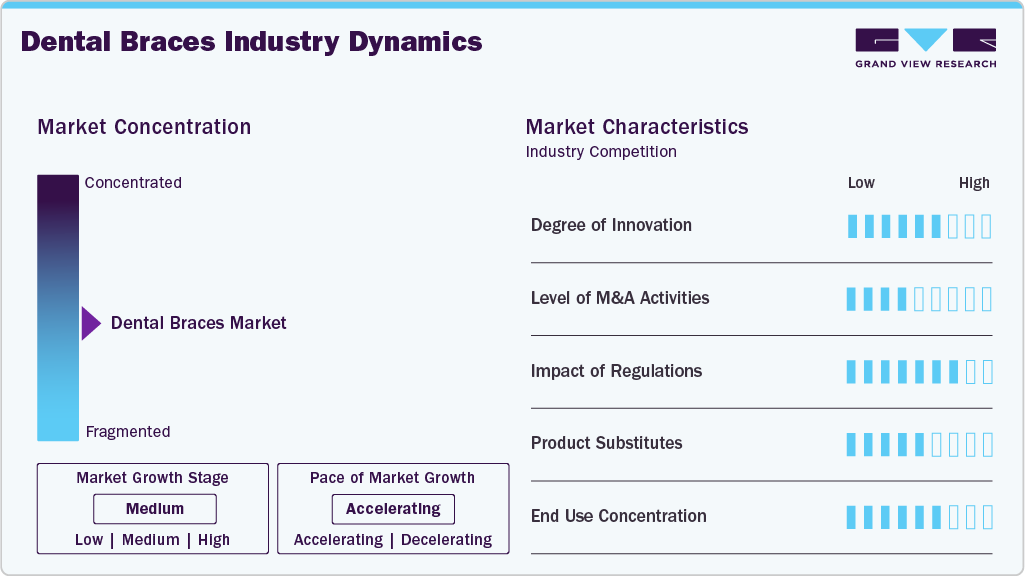
Dental braces are medical devices and must comply with applicable regulatory and quality requirements in major markets. Regulations influence the development, manufacturing, labeling, clinical evaluation, and commercialization of brackets, tubes & bands, and other orthodontic components. In the U.S., applicable orthodontic devices are regulated by the FDA, while manufacturers selling products in Europe must comply with the Medical Device Regulation (EU) 2017/745 (MDR) and applicable conformity-assessment requirements. Regulatory compliance increases product-development and quality-control requirements but supports product safety, performance, traceability, and market confidence.
The dental braces industry faces moderate substitution from clear aligners and other removable orthodontic appliances, particularly for mild-to-moderate malocclusion and patients prioritizing aesthetics. Clear aligners can provide an alternative to fixed Labial/Buccal and Lingual braces because they are removable and less visible. However, fixed braces remain important for complex tooth movements, significant crowding and spacing, bite correction, and cases requiring continuous orthodontic force.
Demand for dental braces is concentrated primarily among dental & orthodontic clinics, followed by hospitals and academic and research institutions. Within the clinic segment, private clinics and DSO-affiliated practices represent important purchasing channels because orthodontic treatment is frequently provided through specialist and organized dental-care networks. These end users purchase a broad range of products, including Brackets, Ligatures / Elastomeric Modules, and Tubes & Bands. Hospitals and academic institutions contribute additional demand through specialist orthodontic services, training, and clinical research.
Analyst Perspective
From an analyst’s perspective, the dental braces market is expected to witness steady growth, supported by rising orthodontic treatment adoption, increasing prevalence of malocclusion, growing demand for aesthetic dental treatment, and technological advancements in conventional and self-ligating braces. Demand for ceramic and customized orthodontic solutions is also creating opportunities for market expansion. Companies offering high-quality, comfortable, and cost-effective braces while expanding their product portfolios across brackets, archwires, ligatures, tubes, and bands are likely to strengthen their competitive position. Future market leadership is expected to depend on product innovation, material advancements, digital orthodontic integration, strong distribution networks, regulatory compliance, and expansion across emerging markets.
Component Insights
The brackets segment dominated the dental braces market with 40.5% revenue share in 2025. This dominance is supported by the central role of brackets in fixed orthodontic treatment, where they provide the attachment point for archwires and enable controlled tooth movement. Both Conventional Brackets and Self-Ligating Brackets are widely used across routine and complex orthodontic cases. Demand is also supported by the availability of stainless steel, ceramic, and sapphire options, allowing orthodontists to select products based on clinical requirements and patient aesthetic preferences. The broad applicability of brackets across Teeth Alignment, Crowding & Spacing, and Bite Correction further strengthens their market position.
The tubes & bands segment is expected to grow at a significant rate during the forecast period due to the increasing use of molar bands and buccal tubes as anchorage components in fixed orthodontic treatment. Molar bands provide stable support around posterior teeth, while buccal tubes guide and secure archwires during tooth movement. Their importance is particularly high in treatments involving Bite Correction and Arch Expansion, where stable posterior anchorage is required. Growing orthodontic treatment volumes and continued use of fixed braces across children, teenagers, and adults are expected to sustain demand for tubes and bands.
Material Insights
The stainless steel segment dominated the market, accounting for 43.3% share in 2025. The growth is attributed to the widespread preference for stainless steel due to its high strength, durability, corrosion resistance, and cost-effectiveness. Stainless steel is extensively used in brackets, archwires, tubes, and bands, making it suitable for a broad range of fixed orthodontic treatments. Its established clinical use, predictable mechanical performance, and relatively lower cost compared with aesthetic materials continue to support adoption across private dental clinics, DSO-affiliated practices, and hospitals.
The monocrystalline (sapphire) ceramic segment is expected to grow at the fastest rate during the forecast period due to the increasing demand for highly aesthetic orthodontic treatment and less visible fixed braces. Sapphire brackets are transparent and offer improved aesthetic integration with the natural appearance of teeth compared with conventional metal brackets. Rising demand for cosmetic orthodontic treatment among teenagers and adults, particularly patients concerned about the appearance of braces, is supporting adoption. The material also offers high hardness and good resistance to staining, making it attractive for longer orthodontic treatment periods.
Placement Insights
The labial/buccal segment led the market with 91.8% share in 2025. This dominance is largely due to the widespread clinical use, established treatment protocols, and relatively straightforward placement and adjustment of braces on the outer surfaces of teeth. Labial/buccal braces are available across conventional metal, ceramic, and self-ligating systems, allowing orthodontists to select products according to treatment requirements and patient preferences. Their broad applicability across Teeth Alignment, Crowding & Spacing, and Bite Correction also supports continued demand.
The lingual segment is expected to grow at the fastest rate during the forecast period due to the increasing demand for discreet orthodontic treatment and improved dental aesthetics. Lingual braces are placed on the inner surface of the teeth, making them substantially less visible than conventional labial systems. This positioning is particularly attractive to adult patients and image-conscious consumers seeking fixed orthodontic treatment without the visible appearance of traditional braces. Advances in customized lingual brackets, digital treatment planning, and improved appliance design are also enhancing treatment precision and patient comfort.
Patient Group Insights
The teenagers (12-17) segment dominated the dental braces market, accounting for 54.6% revenue share in 2025. The segment has gained ground on the back of a high clinical suitability of orthodontic treatment during adolescence, when permanent teeth have generally erupted, and jaw growth can still support effective correction. Increased awareness among parents regarding early correction of Crowding & Spacing, Bite Correction, and Teeth Alignment further supports treatment initiation during this age group. In addition, fixed braces remain widely used for adolescent patients because they provide predictable tooth movement and can address moderate-to-complex malocclusions.
The adults (18+) segment is expected to grow at the fastest rate during the forecast period due to increasing demand for dental aesthetics, greater awareness of orthodontic treatment, and the availability of less visible fixed-brace options. Adults are increasingly seeking correction of long-standing Crowding & Spacing, Teeth Alignment, and Bite Correction concerns that may have remained untreated during adolescence. In November 2024, a study in India involving 5,000 patients seeking orthodontic treatment found that 38.88% were above 28 years, while 21.04% were aged 18-24 years and 25.46% were aged 25-28 years. This indicates a substantial proportion of orthodontic care seekers are adults, supporting the growth potential of the Adults (18+) segment in the dental braces market.
Application Insights
The teeth alignment segment accounted for 35.1% of the market share in 2025. This dominance is led by the high prevalence of increased overjet, deep overbite, crowding, and other tooth-position abnormalities that require orthodontic correction. A systematic review published in July 2024, covering 47 studies of preschool children, found a global malocclusion prevalence of 54.8%, while increased overjet and deep overbite were the two most common reported traits, at 25.2% and 23.8%, respectively. These conditions create a broad treatment base for Brackets, Archwires, and Ligatures/Elastomeric Modules, supporting continued demand for teeth-alignment procedures.
The bite correction segment is expected to grow at the fastest rate during the forecast period due to the increasing need to correct malocclusions such as overbite, underbite, crossbite, and open bite. These conditions can affect chewing efficiency, speech, oral hygiene, and overall dental function, increasing the need for comprehensive orthodontic treatment. Growing recognition of the functional benefits of correcting bite abnormalities is encouraging patients to seek treatment beyond cosmetic alignment. Advances in Self-Ligating Brackets, Archwires, Tubes & Bands, and Lingual systems are also providing orthodontists with greater treatment flexibility for complex cases.
End-use Insights
The dental & orthodontic clinics segment dominated with 81.6% of the market share in 2025. The growth is mainly attributed to the fact that orthodontic treatment is primarily delivered through specialized dental and orthodontic practices, where patients receive bracket placement and regular follow-up care. The availability of conventional brackets, self-ligating brackets, ceramic brackets, and sapphire brackets further supports clinic-based adoption. In December 2025, a study involving 150 pre-orthodontic patients aged 15-35 years at a private dental institution in Tamil Nadu demonstrates continued patient flow through dental practices for orthodontic assessment and treatment planning.
The hospitals segment is expected to grow at a significant rate during the forecast period due to the expansion of hospital-based dental departments, investment in specialized dental infrastructure, and increasing availability of orthodontic services within multispecialty and teaching hospitals. For instance, in July 2026, Lone Star Family Health Center opened its sixth location in Magnolia, Texas, expanding access to primary medical and dental care in Montgomery County. The expansion followed the completion of a 24,000-square-foot facility addition at its Conroe campus in 2025. The organization provides dental services across its growing network, demonstrating continued expansion of integrated healthcare and dental infrastructure in the U.S. Such expansion can increase access to orthodontic services and support demand for dental braces and related components.
Distribution Channel Insights
The direct sales segment dominated the dental braces market in 2025, accounting for 52.9% of the revenue share. The dominance is driven by the direct relationships between orthodontic manufacturers and dental & orthodontic clinics, hospitals, and large DSO-affiliated practices, allowing suppliers to provide product demonstrations, technical support, clinical training, and customized purchasing arrangements. Direct sales are particularly relevant for professional orthodontic products such as brackets, archwires, tubes & bands, and ligatures /elastomeric modules, where product selection and clinical support can influence purchasing decisions.

The indirect sales segment is expected to grow at a significant rate during the forecast period. Growth is driven by the expansion of dental distributors, medical suppliers, and online / e-commerce platforms, which improve product availability and enable orthodontic practices to source multiple brands through established distribution networks. This channel is particularly important in emerging markets where manufacturers may rely on regional distributors to reach smaller clinics and independent orthodontists.
Regional Insights
The North America dental braces market spearheaded the global market, accounting for the largest revenue share of 35.6% in 2025. The region has reigned supreme against the backdrop of a well-established dental and orthodontic infrastructure across the U.S., Canada, and Mexico, including specialist orthodontic practices, private dental clinics, hospitals, and organized dental service networks. The U.S. represents the region’s most developed market, supported by a large dental workforce and high dental expenditure; U.S. national dental spending reached USD 189 billion in 2024, while the ADA reported continued movement toward larger dental practices and DSOs. Canada benefits from an established orthodontic specialist network, with the American Association of Orthodontists representing more than 19,000 orthodontists across the U.S., Canada, and other countries, indicating a substantial specialist base serving the region.

U.S. Dental Braces Market Trends
The dental braces market in the U.S. is benefiting from the large and diversified orthodontic practice network, including private orthodontic practices and DSO-affiliated dental organizations. The expansion of organized dental care is supporting standardized procurement of orthodontic components such as Brackets, Archwires, Ligatures / Elastomeric Modules, and Tubes & Bands. At the same time, patient demand is becoming more differentiated, with adults increasingly seeking aesthetic alternatives such as ceramic and lingual braces. The continued availability of conventional metal braces also supports the market because they provide a relatively cost-effective fixed treatment option. This creates opportunities across both value-oriented and premium orthodontic products.
Europe Dental Braces Market Trends
The dental braces market in Europe is witnessing strong growth due to rising demand for cosmetic orthodontic treatments and increasing focus on dental aesthetics across countries such as the UK, Germany, France, Italy, Spain, Denmark, Sweden, and Norway. A major growth driver is the rapid advancement in orthodontic technologies, including ceramic brackets, self-ligating systems, and digitally designed customized braces, which offer better comfort, faster treatment, and improved visual appeal.
The UK dental braces market is supported by strong demand for orthodontic treatment among younger patients and an established NHS orthodontic care infrastructure. In 2024, according to the British Orthodontic Society, around 200,000 young people undergo NHS-funded orthodontic treatment annually in the UK, indicating a substantial and recurring patient base for fixed orthodontic appliances. NHS-funded treatment is primarily focused on patients under 18 with a clear clinical need, supporting demand for Conventional Brackets, Self-Ligating Brackets, Archwires, and Ligatures / Elastomeric Modules.
Asia Pacific Dental Braces Market Trends
The dental braces market in the Asia Pacific has gained prominence with the expansion and modernization of dental care infrastructure, particularly across India and other high-growth urban markets. In India, the shift from fragmented, standalone practices toward organized dental clinic networks is increasing access to standardized orthodontic services. For instance, in April 2026, Eka Dental Care announced plans to expand to more than 25 self-owned clinics by FY2027, strengthening its presence across the Mumbai Metropolitan Region and entering Tier 1 cities such as Pune and Bengaluru. The company also reported a 25-30% increase in patient traffic during Q1 2026 and plans to increase patient volumes by 2-2.5 times over the following 12-18 months.
The China dental braces market is witnessing the growth of private dental clinics and orthodontic service networks, particularly in major urban centers. The increasing geographic reach of dental service providers is improving access to orthodontic treatment beyond established metropolitan markets. In addition, the development of direct sales and indirect distribution channels, including dental distributors and medical suppliers, is helping manufacturers penetrate lower-tier cities where orthodontic services are expanding. This broader distribution infrastructure is expected to support the adoption of both conventional and self-ligating braces across China.
Latin America Dental Braces Market Trends
The dental braces market in Latin America is well-positioned in the global landscape as Brazil’s large dental-care workforce, established private dental infrastructure, and growing demand for orthodontic treatment continue to gain traction. Brazil has one of the world’s largest populations of dental professionals, providing a broad base of dentists and orthodontic specialists capable of delivering fixed orthodontic treatment. The country’s established network of private dental clinics and specialist practices supports demand for Conventional Brackets, Self-Ligating Brackets, Archwires, and other orthodontic components. In addition, the availability of a large healthcare professional base enables manufacturers to expand through direct sales and dental distributors, while competitively priced stainless steel braces remain important for cost-sensitive patients.
MEA Dental Braces Market Trends
The dental braces market in the Middle East & Africa expects lucrative opportunities due to the growth of dental medical tourism, particularly in the UAE, Saudi Arabia, and other Gulf markets. Countries such as the UAE are strengthening their position as healthcare and medical tourism destinations by investing in advanced private healthcare facilities, internationally trained healthcare professionals, and specialized dental services. Medical tourists seeking orthodontic and aesthetic dental procedures can support demand for ceramic, sapphire, self-ligating, and lingual braces, particularly where treatment quality, specialist expertise, and shorter waiting times are important.

Key Dental Braces Company Insights
Some of the key companies in the dental braces market include Ormco Corporation (Envista), Solventum, American Orthodontics, Dentsply Sirona, Dentaurum GmbH & Co. KG, Forestadent, G&H Orthodontics, Tomy Inc. (Trilanz), GC Orthodontics (GC Corporation), Dental Morelli, Zhejiang PROTECT Medical Equipment Co., Ltd., Modern Orthodontics, Rocky Mountain Orthodontics (RMO), JJ Orthodontics, and OSSTEM ORTHODONTICS Inc. Organizations are focusing on increasing their customer base to gain a competitive edge in the industry. Therefore, key players are taking several strategic initiatives, such as product launches, and partnerships with other major companies.
Key Dental Braces Companies
The following key companies have been profiled for this study on the dental braces market.
-
Ormco Corporation (Envista)
-
Solventum
-
American Orthodontics
-
Dentsply Sirona
-
Dentaurum GmbH & Co. KG
-
Forestadent
-
G&H Orthodontics
-
Tomy Inc. (Trilanz)
-
GC Orthodontics (GC Corporation)
-
Dental Morelli
-
Zhejiang PROTECT Medical Equipment Co., Ltd.
-
Modern Orthodontics
-
Rocky Mountain Orthodontics (RMO)
-
JJ Orthodontics
-
OSSTEM ORTHODONTICS Inc.
-
LightForce
Competitive Benchmarking
Category
Operating Strategies
Competitive Edge
Weakness
Established Players (Ormco Corporation (Envista), Solventum, Dentsply Sirona)
- Focus on expanding portfolios across conventional, self-ligating, ceramic, labial/buccal, and lingual braces.
- Expand global presence through orthodontic clinics, dental service organizations, distributors, hospitals, and educational institutions.
- Strong brand recognition, extensive orthodontic product portfolios, established distribution networks, broad geographic presence, and strong R&D capabilities.
- Established relationships with orthodontists and dental clinics support product adoption and recurring demand.
- Higher R&D, manufacturing, regulatory, and distribution costs can contribute to premium pricing.
- Large organizations may also face longer product development cycles and increasing competition from lower-cost regional manufacturers.
Emerging Players (G&H Orthodontics, Tomy Inc. (Trilanz), GC Orthodontics (GC Corporation)
- Expand product availability through regional distributors and direct sales while developing cost-effective brackets, archwires, tubes, bands, and other orthodontic components.
- Focus on self-ligating and aesthetic brackets, improved materials, product customization, international certifications, and expansion across emerging markets.
- Competitive pricing, flexible product portfolios, regional market expertise, faster product development, and increasing distribution reach.
- Ability to serve cost-sensitive orthodontic clinics and expand access to fixed orthodontic treatment.
- Comparatively lower global brand recognition, smaller international sales and service networks, and limited penetration in some developed markets.
- Dependence on distributors and comparatively smaller R&D resources may constrain global expansion and product innovation.
Recent Developments
-
In May 2026, SMILE-FX Orthodontic Studio launched its AI Braces system, integrating artificial intelligence with high-resolution 3D CBCT imaging to develop predictive orthodontic treatment plans. The system used predictive modeling to create a digital twin of the patient’s dentition and simulate tooth movement throughout treatment.
"Traditional orthodontics has always involved some degree of trial and error," said Dr. Liang, DDS, MS, the board-certified orthodontist and founder of SMILE-FX. "With AI Braces by SMILE-FX, we are able to show patients a projected visualization of what their smile may look like at month 3, month 6, and at completion. The AI functions as a co-pilot, enhancing my clinical judgment rather than replacing it, and together we work toward that projection with a level of precision that was not possible before."
-
In April 2026, LightForce Orthodontics announced LightBracket Metal, a patient-specific 3D-printed metal bracket designed to expand access to individualized fixed orthodontic treatment. The launch introduced “generative braces,” in which each bracket was generated directly from the patient’s treatment plan and customized for the specific tooth.
“For decades, every patient got the same bracket. That ends now. We are accelerating toward a future where the very idea of a universal, one-size-fits-all bracket is unthinkable,” said James Lawton, president of LightForce Orthodontics.
-
In April 2026, Ormco Corporation expanded its Digital Bonding capabilities to support additional orthodontic bracket systems, including Damon Clear, Mini Diamond, Orthos, Titanium Orthos, and Mini-Twin. The company also showcased its enhanced EtchFree Bonding system at the AAO 2026 Annual Session, featuring a new twist-top unit-dose delivery system.
Dental Braces Market Report Scope
Report Attribute
Details
Market size in 2025
USD 3.5 billion
Estimated market size in 2026
USD 3.7 billion
Projected market size by 2033
USD 5.3 billion
Growth rate
CAGR of 5.4% from 2026 to 2033
Base year for estimation
2025
Actual estimates/Historical data
2021 - 2024
Forecast period
2026 - 2033
Quantitative units
Revenue in USD billion and CAGR from 2026 to 2033
Report coverage
Revenue forecast, company ranking, competitive landscape, growth factors, and trends
Segments covered
Component, material, placement, patient group, application, end-use, distribution channel, region
Regional scope
North America; Europe; Asia Pacific; Latin America; Middle East & Africa
Country scope
U.S.; Canada; Mexico; UK; Germany; France; Italy; Spain; Denmark; Sweden; Norway; Japan; China; India; Thailand; Australia; South Korea; Brazil; Argentina; South Africa; Saudi Arabia; UAE; Kuwait
Key companies profiled
Ormco Corporation (Envista); Solventum; American Orthodontics; Dentsply Sirona; Dentaurum GmbH & Co. KG; Forestadent; G&H Orthodontics; Tomy Inc. (Trilanz); GC Orthodontics (GC Corporation); Dental Morelli; Zhejiang PROTECT Medical Equipment Co., Ltd.; Modern Orthodontics; Rocky Mountain Orthodontics (RMO); JJ Orthodontics; OSSTEM ORTHODONTICS Inc.; LightForce
Customization scope
Free report customization (equivalent up to 8 analyst’s working days) with purchase. Addition or alteration to country, regional & segment scope
Pricing and purchase options
Avail customized purchase options to meet your exact research needs. Explore purchase options
Global Dental Braces Market Report Segmentation
This report forecasts revenue growth at global, regional & country levels and provides an analysis of the latest industry trends in each of the sub-segments from 2021 to 2033. For this study, Grand View Research has segmented the global dental braces market report based on component, material, placement, patient group, application, end-use, distribution channel, and region:
-
Component Outlook (Revenue, USD Billion, 2021 - 2033)
-
Brackets
-
Conventional Brackets
-
Self-Ligating Brackets
-
Passive Self-Ligating
-
Active Self-Ligating
-
-
Archwires
-
Ligatures / Elastomeric Modules
-
Tubes & Bands
-
Others
-
-
Material Outlook (Revenue, USD Billion, 2021 - 2033)
-
Stainless Steel
-
Polycrystalline Ceramic
-
Monocrystalline (Sapphire) Ceramic
-
Nickel-Titanium
-
Cobalt-Chromium
-
Others
-
-
Placement Outlook (Revenue, USD Billion, 2021 - 2033)
-
Labial/Buccal
-
Lingual
-
-
Patient Group Outlook (Revenue, USD Billion, 2021 - 2033)
-
Children (<12)
-
Teenagers (12-17)
-
Adults (18+)
-
-
Application Outlook (Revenue, USD Billion, 2021 - 2033)
-
Teeth Alignment
-
Crowding & Spacing
-
Bite Correction
-
Arch Expansion
-
Others
-
-
End-use Outlook (Revenue, USD Billion, 2021 - 2033)
-
Dental & Orthodontic Clinics
-
Private Clinics
-
DSO Affiliated
-
Hospitals
-
Academic & Research Institutions
-
-
Distribution Channel Outlook (Revenue, USD Billion, 2021 - 2033)
-
Direct Sales
-
Indirect Sales
-
Dental Distributors
-
Medical Suppliers
-
Online / E-commerce
-
-
Regional Outlook (Revenue, USD Billion, 2021 - 2033)
-
North America
-
U.S.
-
Canada
-
Mexico
-
-
Europe
-
UK
-
Germany
-
France
-
Italy
-
Spain
-
Denmark
-
Sweden
-
Norway
-
-
Asia Pacific
-
Japan
-
China
-
India
-
Thailand
-
Australia
-
South Korea
-
-
Latin America
-
Brazil
-
Argentina
-
-
Middle East & Africa
-
South Africa
-
Saudi Arabia
-
UAE
-
Kuwait
-
-
Research Methodology
The dental braces market figures in this report are based on a proven research process that combines executive interviews with secondary research from proprietary databases, company filings, and recognized regulatory and institutional sources. Market size is built through value-chain sizing-reconciling supply-side and demand-side estimates-and triangulated with bottom-up and top-down approaches. Every estimate passes multiple levels of expert validation before publication, with each dental braces segment quantified using the revenue-capture definitions in the table below.
Segment Definition
Segment - Placement
Revenue capture definition
Labial/Buccal
Revenue generated from dental braces designed to be placed on the outer (front) surfaces of the teeth, facing the lips and cheeks. This segment includes conventional, self-ligating, ceramic, and metal braces placed on the labial/buccal surfaces.
Lingual
Revenue generated from dental braces designed to be placed on the inner (tongue-facing) surfaces of the teeth. This segment includes customized and conventional lingual braces used for orthodontic treatment while keeping the appliance less visible from the front.
Estimation Model
Approach
Description
Bottom-Up Estimation
The market is estimated by analyzing the annual volume of dental braces procedures and orthodontic treatments performed across dental and orthodontic clinics, hospitals, and other orthodontic care settings at the country, regional, and global levels. The assessment considers the utilization of brackets, archwires, ligatures / elastomeric modules, tubes & bands, and other components, along with differences between conventional and self-ligating braces.
Top-Down Approach
The market estimation begins with an assessment of the broader orthodontic devices and dental equipment market, followed by evaluating the share attributable to dental braces through secondary research and industry validation. The analysis considers key market indicators such as the prevalence of malocclusion, orthodontic treatment volumes, adoption of fixed braces, demand for aesthetic and self-ligating braces, and the expansion of dental and orthodontic clinics.
Supply-Side Analysis
The analysis considers manufacturers' production capacity, annual shipments, product portfolio breadth, manufacturing facilities, average selling prices, regulatory approvals, and regional distribution networks. Product categories including conventional brackets, self-ligating brackets, archwires, ligatures / elastomeric modules, tubes & bands, and other components are evaluated.
Delivered Customizations
This report has been delivered with the following In-depth customizations
Client Request
Customization Delivered
Value Adds
Dental Braces Product Portfolio & Component Analysis
Conducted a comprehensive assessment of dental braces across Brackets, Archwires, Ligatures / Elastomeric Modules, Tubes & Bands, and Others. Within brackets, the analysis covered Conventional Brackets and Self-Ligating Brackets, including passive and active self-ligating designs. The study evaluated product offerings by material, including stainless steel, polycrystalline ceramic, monocrystalline (sapphire) ceramic, nickel-titanium, and cobalt-chromium, while assessing product positioning, innovation, and adoption across orthodontic treatment settings.
Helps manufacturers identify high-demand components and materials, assess portfolio gaps, prioritize product development, and align offerings with changing orthodontist preferences and treatment requirements.
Placement & Patient Group Demand Analysis
Analyzed dental braces adoption across Labial/Buccal and Lingual placement types and evaluated demand among Children (<12), Teenagers (12-17), and Adults (18+). The assessment considered differences in treatment preferences, aesthetic requirements, treatment complexity, and adoption patterns across patient groups. Particular attention was given to the growing demand for less visible orthodontic solutions among adult patients and the continued use of fixed braces among younger patients.
Enables companies to identify attractive placement and patient segments, develop targeted products, refine marketing strategies, and align product features with the clinical and aesthetic requirements of different patient groups.
Competitive Positioning & Manufacturer Benchmarking
Benchmarked major dental braces manufacturers based on component portfolio breadth, bracket technology, material offerings, product customization, geographic presence, distribution capabilities, pricing positioning, regulatory compliance, and innovation. The analysis also reviewed developments in self-ligating and aesthetic braces, portfolio expansion, partnerships, and regional market strategies.
Supports competitive benchmarking, identifies differentiation opportunities, highlights portfolio gaps, and helps manufacturers strengthen market positioning through product innovation, pricing strategies, distribution expansion, and targeted geographic growth.
Frequently Asked Questions About This Report
Key factors include the rising prevalence of malocclusion and orthodontic disorders, increasing demand for teeth alignment and improved dental aesthetics, growing adoption of ceramic and self-ligating braces, and expanding access to orthodontic treatment.
Asia Pacific is the fastest-growing region over the forecast period.
The brackets segment held the largest share of 40.5% in 2025, while tubes & bands segment is the fastest-growing component.
The stainless steel held the largest share of 43.3% in 2025, while monocrystalline (sapphire) ceramic is the fastest-growing material.
The global dental braces market is expected to grow at a CAGR of 5.4% from 2026 to 2033, reaching USD 5.3 billion by 2033.
The global dental braces market size was valued at USD 3.5 billion in 2025 and is projected to reach USD 3.7 billion for 2026.
North America dominated the market, accounting for the largest revenue share of 35.6% in 2025.
The labial/buccal held the largest share of 91.8% in 2025, while lingual is the fastest-growing placement .
Key players include Ormco Corporation (Envista), Solventum, American Orthodontics, Dentsply Sirona, Dentaurum GmbH & Co. KG, Forestadent, G&H Orthodontics, Tomy Inc. (Trilanz), GC Orthodontics (GC Corporation), Dental Morelli, Zhejiang PROTECT Medical Equipment Co., Ltd., Modern Orthodontics, Rocky Mountain Orthodontics (RMO), JJ Orthodontics, and OSSTEM ORTHODONTICS Inc.
About the Author(s)
Medical Devices Research Team
Healthcare · Medical DevicesThis report was authored by the medical devices research team at Grand View Research - comprising two research analysts, one senior research analyst, and one industry expert - with specialized expertise in the medical devices segment of the healthcare industry. All findings are based on proprietary healthcare databases, executive interviews, and regulatory analysis, subject to internal peer review prior to publication.
Last Updated:
Speak to Analyst


Customize this report to your needs — add regions, segments, or data points, with 20% free customization.
Or view our licence options:


ISO 9001:2015 & 27001:2022 Certified
We are GDPR and CCPA compliant! Your transaction & personal information is safe and secure. For more details, please read our privacy policy.


