
- Home
- »
- Clothing, Footwear & Accessories
- »
-
Department Stores Market Size & Share Report, 2028GVR Report cover

Department Stores Market (2022 - 2028) Size, Share & Trends Analysis Report, By Product Type (Apparel And Accessories, FMCG, Hardline And Softline), By Region, And Segment Forecasts
Department Stores Market Summary
The global department stores market size was estimated at USD 117.15 billion in 2021 and is projected to reach USD 166.08 billion by 2030, growing at a CAGR of 5.1% from 2022 to 2028. A departmental store offers to purchase all the necessary items under one roof and the customers are not required to go from one store to another for purchasing products.
Key Market Trends & Insights
- North America accounted for the highest market revenue share of over 45% in 2021.
- Asia Pacific is anticipated to register the highest CAGR of 5.8% from 2022 to 2028.
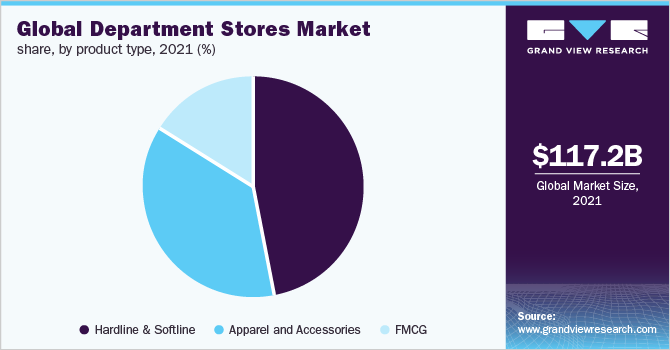
- By product type, the hardline and softline segment led the market, holding the largest revenue share of 47% in 2021.
- Based on product type, the apparel and accessories segment is expected to witness the highest CAGR of 5.8% from 2022 to 2028.
Market Size & Forecast
- 2021 Market Size: USD 117.15 Billion
- 2028 Projected Market Size: USD 166.08 Billion
- CAGR (2022-2028): 5.1%
- North America: Largest market in 2021
Three ways to get this report
Buy it, customize it, or ask a question.Ask an Analyst
Analyst response in 1 business day
- AccessReport author, directly
- Reply timeWithin 1 working day
- No sales callDirect answer only
- FormatEmail reply
- CostFree, no cost
Get the Full Report
What the study covers
- FormatsPDF · Excel · Dashboard
- Timeline2022–2028 annual, 2021 base
- Coverage20+ countries, 5 regions
- Companies10+ key players profiled
Customize the Report
20% free customization
- IncludeCountries, segments, points
- TailorTo your product definition
- ExtendDeeper competitor detail
- OrA fully bespoke study
- Turnaround5–10 working days
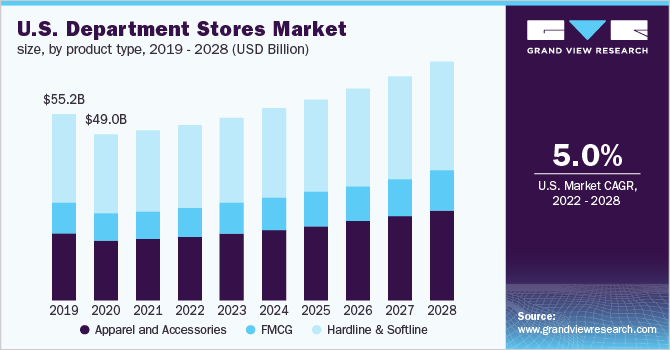
This factor provides great convenience to the customers and also saves their time and energy, thus driving the overall market growth. Moreover, a wide variety of products from different manufacturers or retailers are sold in separate department stores, thus further driving the market. The COVID-19 outbreak negatively impacted the market. During COVID-19, department stores around the world remain closed due to strict lockdown across the globe. Moreover, supply chains were disrupted, which affected the global retailers running the business.A departmental store is a part of a retail organization having several separate departments under one roof. Each department specializes in one particular kind of merchandise or business. These departments are centrally managed and operate under one united management and control. A departmental store is a part of retailing that does business in many segments of merchandise, which includes men’s wear, women’s wear, accessories, and household furnishing. They are gaining popularity because it includes a large variety of goods that are sold under one roof and provides convenience to customers.
 Source: Grand View Research, IR Documents, Primary Interviews, Paid DatabasesTo learn more about this report,
 Download Free Sample Report
 Department stores have numerous benefits such as it can provide various clothing stores, food courts, and much more in a single place by different vendors. These stores provide a variety of goods under one roof which saves the time and energy of the customers. Moreover, department stores occasionally offer their products at discounted rates which are further attracting consumers to visit the stores thereby attributing to the growth of the market. Department stores offer organized products so that customers can easily get their required ones. Additionally, it gives the customers a chance to look at similar products under the same roof.
The COVID-19 pandemic has negatively impacted the global department stores market. During the pandemic, retailers around the world reported a severe drop in their revenue due to the prolonged closure of physical stores. Also, supply chains were disturbed which affected the global retailers running the business. Except for groceries and pharmacies all other department stores had seen a fall in physical footfall during the pandemic which resulted in a huge loss to the retailers. Also, it was observed that retail industry sales plunged around 20% from February to April with a very large decline of 89% in clothing and accessories stores and 45% in department stores. The revenue generated from department stores declined as the retail sector was hit badly since the outbreak of the COVID-19 pandemic.
Product Type Insights
The hardline and softline segment dominated the market and contributed a revenue share of over 47% in 2021 and is projected to grow at a CAGR of 4.5% from 2022 to 2028. The rising trend among the new generation to have designer furniture and decorate their home are the major factor driving the hardline and softline segment growth. Moreover, the variety of products offered by department stores are providing convenience to the customers to directly choose from the stores. Hence, the organized products and growing demands for luxury home décor items are further driving the growth of the hardline and softline segment.
 To learn more about this report, Download Free Sample Report
 The apparel and accessories segment is expected to witness the highest CAGR of 5.8% from 2022 to 2028. The rising fashion trends among the young population, coupled with the evolving retail landscape across different brands, are the key factors driving the apparel and accessories segment growth. Additionally, various retailers offer great deals and affordable prices at the department stores occasionally during festive seasons which is another factor driving the growth of department stores' apparel and accessories segment. Additionally, the high spending on apparel and accessories by financially independent women across the globe is again increasing the market demand. Thus, the apparel and accessories segment is expected to grow at the fastest CAGR over the forecast period.
Regional Insights
North America accounted for the highest market revenue share of over 45% in 2021. In North America, rapid urbanization is surging the demand for environment-friendly department stores. Additionally, the presence of well-established key players namely Target Corporation, Macy's Inc, and Walmart Inc are contributing to the market growth of department stores in this region. The department stores are popular because they are very convenient as well as provide a selected range of products from different retailers to choose from. Thus, the region is expected to grow at a significant CAGR over the forecast period.
Asia Pacific is anticipated to register the highest CAGR of 5.8% from 2022 to 2028. The growing digitization and urbanization, increasing disposable incomes, and changes in lifestyle particularly among the middle-class population are acting as a booster for the Indian retail sector. Additionally, the retailers in department stores are adopting AI and biometrics to attract consumers and boost revenue. Moreover, the growth in education levels, middle-class income, the standard of living, and willingness to spare money by Indians are surging the demand for department stores in this region. Thus, the region is expected to grow at the fastest CAGR during the forecast period.
Key Companies & Market Share Insights
The market is characterized by the presence of established as well as new players. Major players operating in this market are offering various advantages such as expansion. In 2019, Lotte Department Store announced their new hypermarket opening at Incheon Terminal & Incheon Branch along with a new department store in Korea. It will offer a variety of luxury and fashionable products both from domestic and international brands, including the exclusive brand Lotte. Some of the prominent players in the global department stores market include:
-
Marks and Spencer Group Plc
-
Macy's Inc
-
Sears Holdings Corp
-
Target Corporation
-
Nordstrom, Inc.
-
Walmart Inc
-
Isetan Mitsukoshi Holdings Ltd.
-
Kohl's Corporation
-
Chongqing Department Store Co. Ltd
-
Lotte Department Store
Department Stores Market Report Scope
Report Attribute
Details
Market size value in 2022
USD 121.78 billion
Revenue forecast in 2028
USD 166.08 billion
Growth Rate
CAGR of 5.1% from 2022 to 2028
Base year for estimation
2021
Historical data
2017 - 2020
Forecast period
2022 - 2028
Quantitative units
Revenue in USD billion and CAGR from 2022 to 2028
Report coverage
Revenue forecast, company ranking, competitive landscape, growth factors, and trends
Segments covered
Product type, region
Regional scope
North America; Europe; Asia Pacific; Central & South America; Middle East & Africa
Country scope
U.S.; Canada; U.K.; Germany; France; China; India; Japan; Brazil; Argentina; GCC; South Africa
Key companies profiled
Marks and Spencer Group Plc; Macy's Inc.; Sears Holdings Corp; Target Corporation; Nordstrom, Inc.; Walmart Inc.; Isetan Mitsukoshi Holdings Ltd.; Kohl's Corporation; Chongqing Department Store Co. Ltd.; Lotte Department Store
Customization scope
Free report customization (equivalent up to 8 analysts’ working days) with purchase. Addition or alteration to country, regional & segment scope.
Pricing and purchase options
Avail customized purchase options to meet your exact research needs. Explore purchase options
Segments Covered in the Report
This report forecasts revenue growth at global, regional, and country levels and provides an analysis of the latest industry trends in each of the sub-segments from 2017 to 2028. For this study, Grand View Research has segmented the global department stores market report based on type and region:
-
Product Type Outlook (Revenue, USD Billion, 2017 - 2028)
-
Apparel and Accessories
-
FMCG
-
Hardline and Softline
-
-
Regional Outlook (Revenue, USD Billion, 2017 - 2028)
-
North America
-
U.S.
-
Canada
-
-
Europe
-
U.K.
-
Germany
-
France
-
-
Asia Pacific
-
China
-
India
-
Japan
-
-
Central & South America
-
Brazil
-
Argentina
-
-
Middle East & Africa
-
GCC
-
South Africa
-
-
Frequently Asked Questions About This Report
The global department stores market size was estimated at USD 117.15 billion in 2021 and is expected to reach USD 121.78 billion in 2022.
The global department stores market is expected to grow at a compound annual growth rate of 5.1% from 2022 to 2028 to reach USD 166.08 billion by 2028.
North America dominated the department stores market with a share of 47% in 2021. This is attributable to higher demand for environment friendly department stores and presence of well-established key players.
Some key players operating in the department stores market include Marks and Spencer Group Plc, Macy's Inc.; Sears Holdings Corp; Target Corporation; Nordstrom, Inc.; Walmart Inc.; Isetan Mitsukoshi Holdings Ltd.; Kohl's Corporation; Chongqing Department Store Co. Ltd.; and Lotte Department Store.
Key factors that are driving the department stores market growth include growing digitization and urbanization, increasing disposable incomes, and changes in lifestyle.
About the Author(s)
Clothing, Footwear & Accessories Research Team
Consumer Goods · Clothing, Footwear & AccessoriesThis report was authored by the clothing, footwear & accessories research team at Grand View Research - comprising two research analysts, one senior research analyst, and one industry expert - with specialized expertise in the clothing, footwear & accessories segment of the consumer goods industry. All findings are based on proprietary consumer goods databases, executive interviews, and regulatory analysis, subject to internal peer review prior to publication.
Last Updated:
Speak to Analyst

Customize this report to your needs - add regions, segments, or data points, with 20% free customization.
Or view our licence options:


ISO 9001:2015 & 27001:2022 Certified
We are GDPR and CCPA compliant! Your transaction & personal information is safe and secure. For more details, please read our privacy policy.


