
- Home
- »
- Agrochemicals & Fertilizers
- »
-
Digestate-based Fertilizer Market Size Report, 2026-2033GVR Report cover
![Digestate-based Fertilizer Market (2025 - 2033)Report]()
Digestate-based Fertilizer Market (2025 - 2033)
Size, Share & Trends Analysis By Form (Solid, Liquid), By Feedstock (Agricultural, Organic Municipal Waste), By Product (Direct Digestate-based Fertilizers, Processed Digestate-based Fertilizers), By Crop Type, By Region And Segment Forecasts
Market Size, 2025
$372.5MMarket Estimate, 2026
$390.5MMarket Forecast, 2033
$570.4MCAGR, 2026–2033
5.6%Digestate-based Fertilizer Market Summary
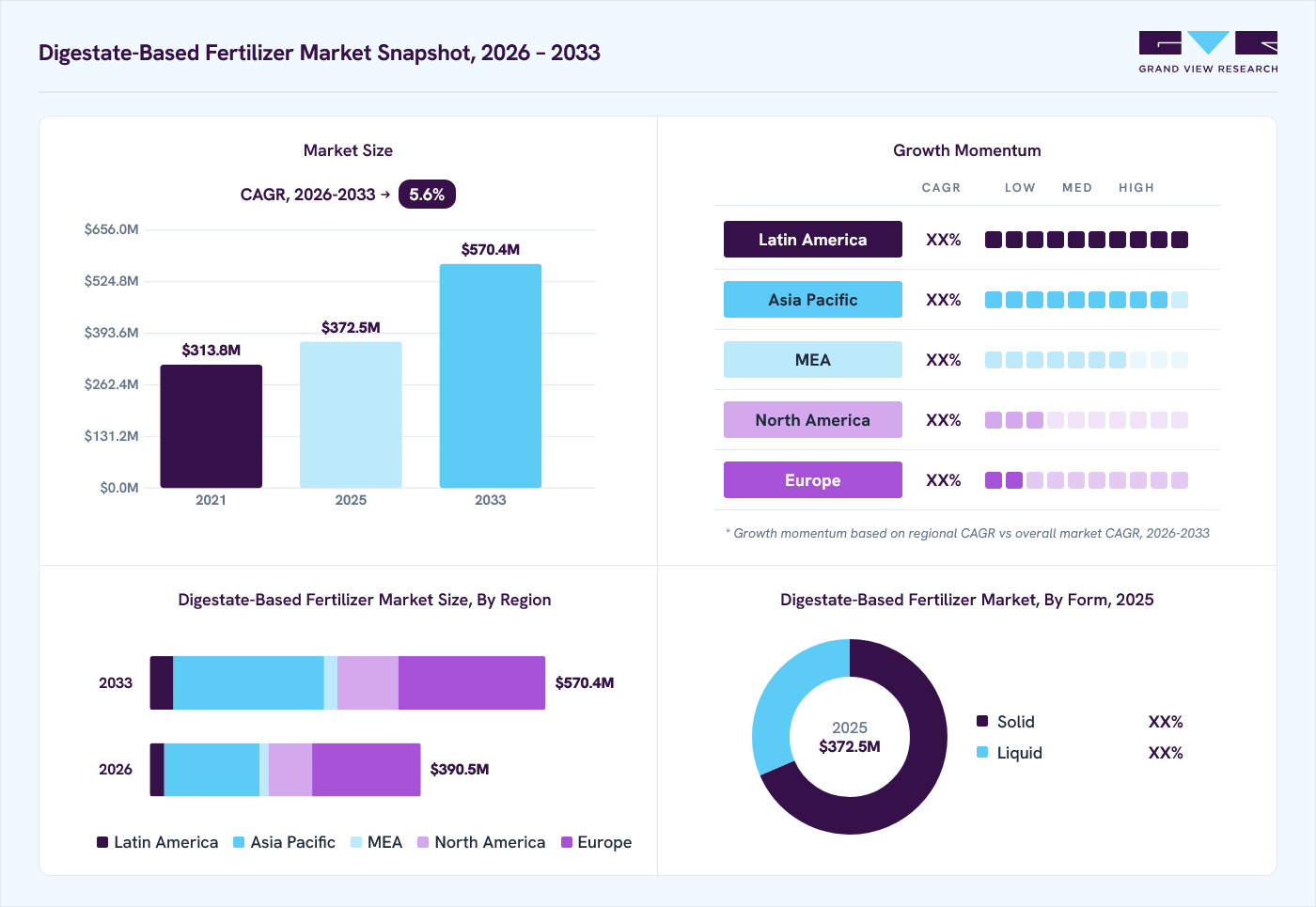
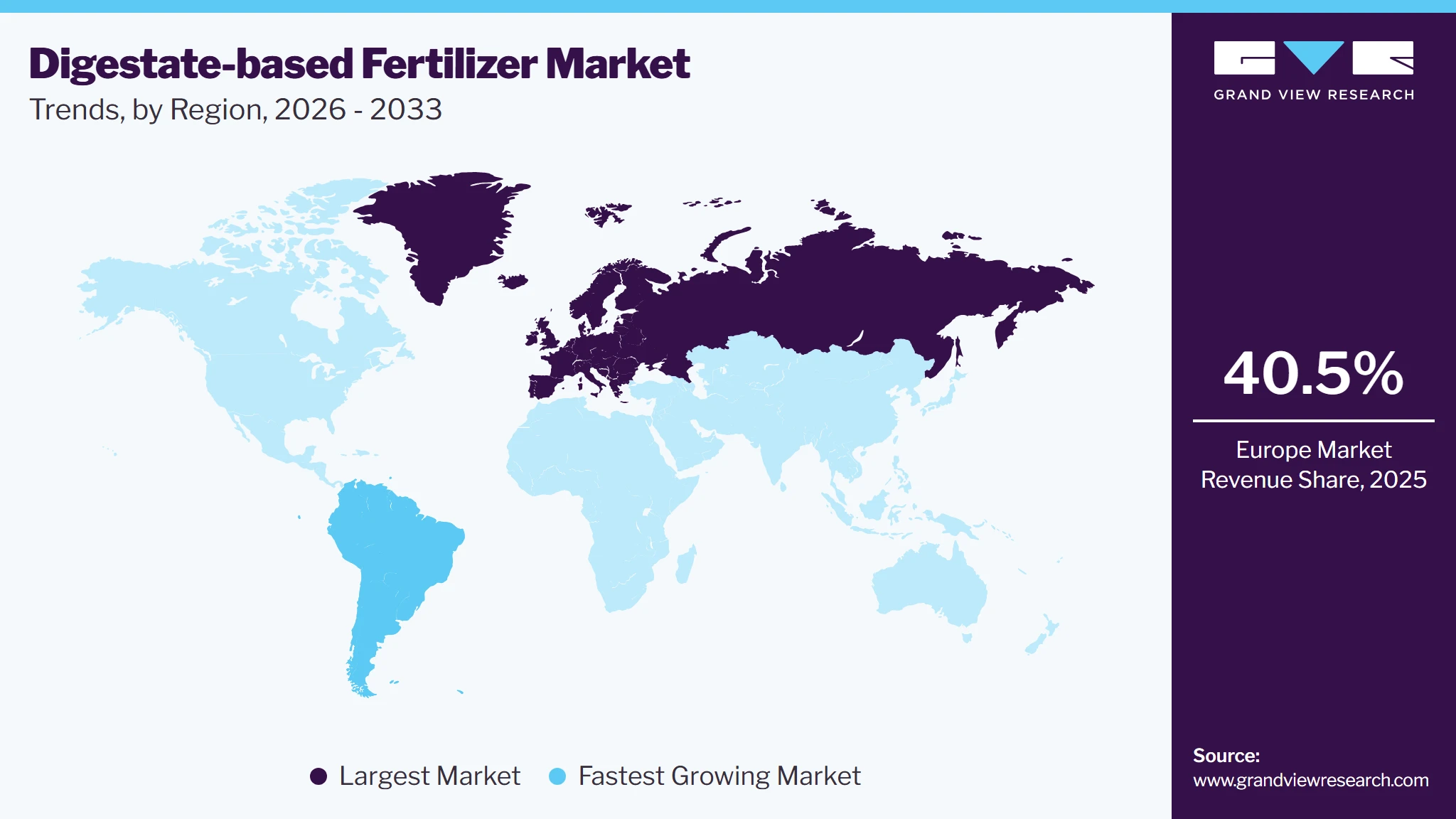
The global digestate-based fertilizer market size was valued at 372.5 million in 2025 and is projected to grow from USD 390.5 million in 2026 to USD 570.4 million by 2033, at a CAGR of 5.6% from 2026 to 2033. Europe dominated the market, accounting for a revenue share of 40.5% in 2025. Market growth is supported by increasing demand for sustainable nutrient sources, organic waste recycling, soil health improvement, and alternatives to synthetic fertilizers across crop cultivation, horticulture, pasture management, and other agricultural applications.
Key Market Trends & Insights
- By form: The solid segment held the largest revenue share of 68.5% in 2025.
- By product: The nutrient-recovered digestate-based fertilizers segment dominated the market with a revenue share of 39.8% in 2025.
- By feedstock: The organic municipal waste is expected to grow the fastest at a CAGR of 6.4% from 2026 to 2033.
- By crop type: The fruits & vegetables segment is anticipated to be the fastest-growing at a CAGR of 6.2% during the forecast period.
Regional Highlights
- Largest region: Europe (40.5%, revenue share, 2025)
- Fastest-growing region: Latin America (fastest CAGR, 2026-2033)
- By country: Germany held the largest market share in 2025
Market Size & Forecast
- Market size in 2025: USD 372.5 Million
- Estimated market size in 2026: USD 390.5 Million
- Projected market size by 2033: USD 570.4 Million
- CAGR (2026-2033): 5.6%
Three ways to get this report
Buy it, customize it, or ask a question.Get the Full Report
What the study covers
- FormatsPDF · Excel · Dashboard
- Timeline2026–2033 annual, 2025 base
- Coverage20+ countries, 5 regions
- Companies10+ key players profiled
Customize the Report
20% free customization
- IncludeCountries, segments, points
- TailorTo your product definition
- ExtendDeeper competitor detail
- OrA fully bespoke study
- Turnaround5–10 working days
Ask Prism AI
A cited answer in seconds
- Corpus30K studies, 1.2M points
- ScopeAll markets, not just this
- CitationTraced to report & table
- HonestySays "not covered" if so
- SpeedSeconds, not days
Rising adoption of circular agriculture and organic nutrient recycling is driving the use of digestate-based fertilizer as an alternative to conventional fertilizers. Digestate is produced through anaerobic digestion of organic materials such as animal manure, food waste, agricultural residues, and municipal organic waste. The resulting material contains nutrients such as nitrogen, phosphorus, and potassium, along with organic matter that can support soil fertility. Growing interest in sustainable farming practices, increasing emphasis on resource recovery, rising organic waste volumes, and efforts to reduce dependence on synthetic fertilizers are supporting market growth.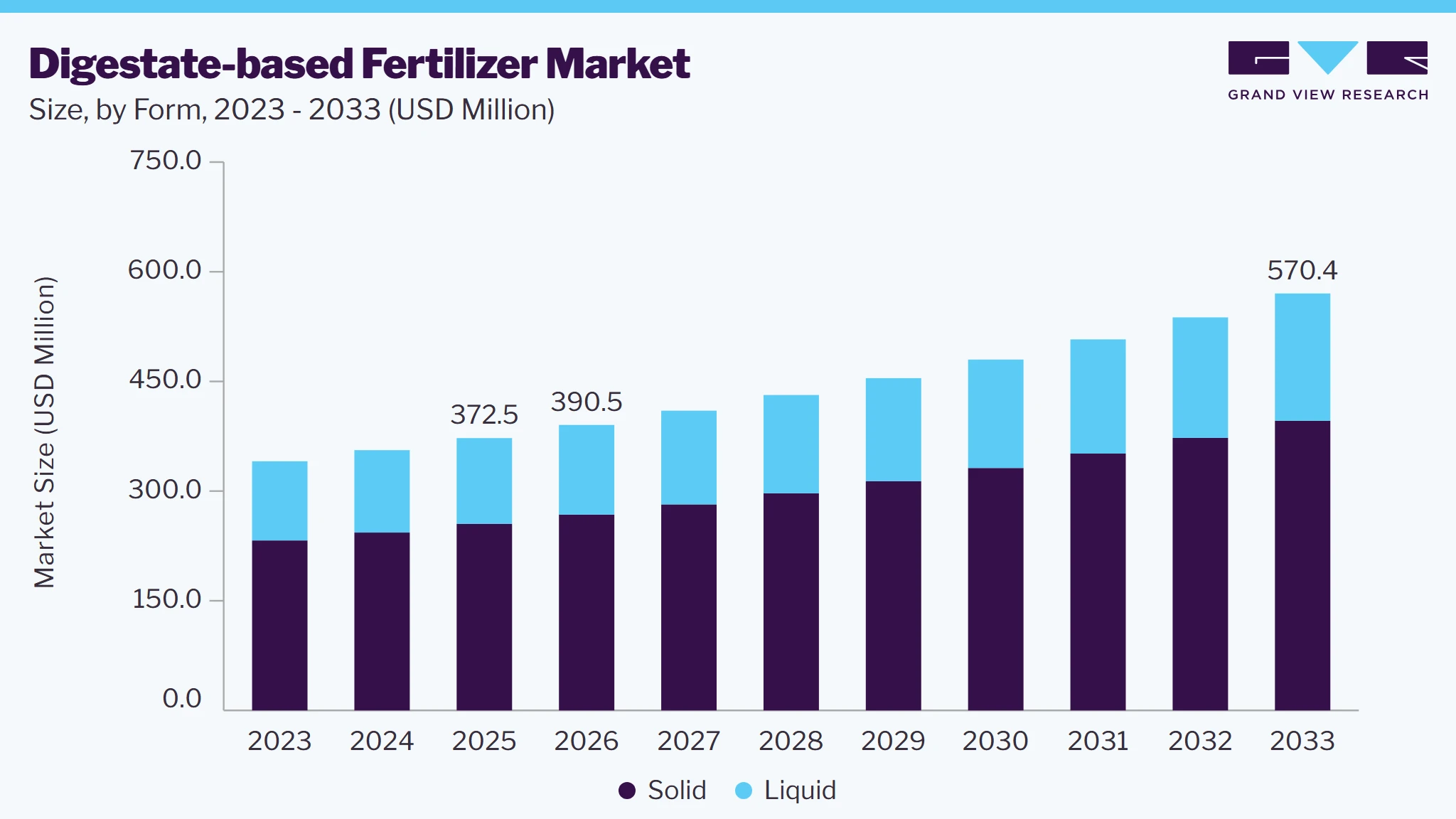
Market Dynamics
The market is supported by the expansion of anaerobic digestion and biogas production infrastructure across agricultural, municipal, and industrial applications. As anaerobic digestion facilities expand, the availability of digestate as a co-product is increasing, creating opportunities for its use in crop production and soil management. Digestate can be processed into liquid or solid fertilizer products and applied according to crop and soil requirements. Growing investment in biogas and biomethane facilities, improvements in digestate processing technologies, and increasing integration of waste treatment with agricultural operations are strengthening market development across major regions.
The transition toward circular agricultural systems is a major market driver. Farmers and agricultural producers are increasingly seeking methods to recover nutrients from organic waste and return them to agricultural soils rather than relying entirely on externally sourced mineral fertilizers. Digestate provides a pathway for recycling nutrients generated from livestock manure, food residues, crop waste, and other biodegradable materials.
The increasing focus on resource efficiency is strengthening this trend. Agricultural and waste-management operators are adopting closed-loop systems in which organic residues are converted into biogas while the remaining digestate is utilized as a nutrient source. This approach improves resource utilization, reduces waste disposal requirements, and supports more sustainable nutrient management practices.
Variations in digestate composition can constrain market development, particularly where standardized fertilizer performance is required. The nutrient content and physical characteristics of digestate can vary depending on the feedstock used, anaerobic digestion conditions, processing methods, and storage practices. Such variability can make consistent product formulation and application more challenging compared with standardized synthetic fertilizers.
Concerns regarding contaminants can also influence adoption. Digestate derived from mixed or poorly controlled waste streams may require treatment and testing to manage pathogens, heavy metals, plastics, or other unwanted materials. Requirements for nutrient analysis, quality control, transportation, storage, and regulatory compliance can increase processing costs and create additional barriers for smaller producers.
The increasing diversion of food waste and other biodegradable waste streams toward anaerobic digestion presents significant opportunities for digestate-based fertilizer producers. Growing volumes of food-processing residues, municipal organic waste, livestock manure, and agricultural biomass provide an expanding feedstock base for digestion facilities. Converting these materials into biogas and nutrient-rich digestate creates additional value from waste that would otherwise require disposal.
Opportunities are also emerging through the development of specialized digestate products. Producers can separate, concentrate, dry, pelletize, or otherwise process digestate to improve handling, storage, transport, and application characteristics. Development of higher-value formulations tailored to specific crops and soil conditions, combined with improved nutrient-recovery technologies, can expand the commercial applications of digestate-based fertilizers.
Market Concentration & Characteristics
The digestate-based fertilizer industry comprises biogas operators, anaerobic digestion companies, agricultural waste processors, fertilizer manufacturers, and integrated waste-to-energy businesses. Competitive positioning depends on access to organic feedstocks, anaerobic digestion capacity, digestate processing capabilities, product quality, nutrient consistency, regulatory compliance, distribution networks, and proximity to agricultural markets.
Companies are focusing on improving digestate treatment and nutrient recovery, expanding anaerobic digestion capacity, developing value-added fertilizer formulations, and establishing partnerships with farmers and agricultural distributors. Vertical integration across waste collection, anaerobic digestion, biogas production, digestate processing, and fertilizer distribution can provide companies with greater control over feedstock availability, production economics, and product supply.
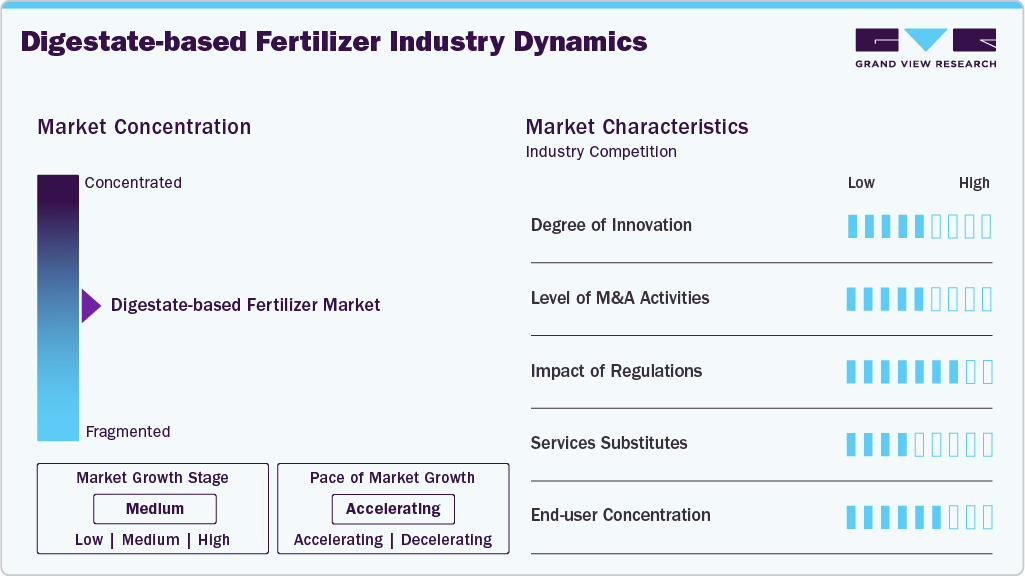
Leading companies in the digestate-based fertilizer industry are strengthening their positions by improving digestate processing capabilities, product standardization, distribution networks, and agricultural market penetration. Investments in separation, nutrient recovery, drying, and formulation technologies are enabling producers to develop more consistent and application-specific fertilizer products. Companies are also building relationships with farmers, agricultural cooperatives, waste-management operators, and fertilizer distributors to expand product utilization and establish reliable routes to market.
Analyst Perspective
The market is supported by the increasing focus on soil fertility and nutrient management in modern agriculture. Farmers are seeking fertilizer solutions that can supply essential nutrients while improving soil quality and supporting long-term crop productivity. Digestate contains nitrogen, phosphorus, potassium, and organic matter, making it suitable for use as a nutrient source and soil amendment. Growing interest in improving soil health, reducing nutrient losses, and adopting more efficient fertilization practices is expected to encourage the use of digestate-based fertilizer across agricultural applications.
Form Insights
The solid segment dominated the market, accounting for 68.5% of total revenue in 2025. Its leading position is supported by easier storage, transportation, and handling compared with high-moisture liquid products. Dried, composted, pelletized, and granulated digestate fertilizers can also be integrated into conventional fertilizer application systems, improving their suitability for commercial farming operations.
The liquid segment is expected to expand at a CAGR of 5.1% during the forecast period. Growth is being driven by the increasing adoption of fertigation and liquid nutrient application methods, which deliver fertilizers directly through irrigation systems. The growing use of controlled nutrient application in intensive farming is also supporting demand for easily dispersible digestate-derived formulations.
Product Insights
The nutrient-recovered digestate-based fertilizers segment dominated the market, accounting for 39.8% of total revenue in 2025. Demand is supported by growing emphasis on recovering nitrogen, phosphorus, potassium, and other valuable nutrients from digestate. Such recovery processes can improve nutrient concentration and consistency, enabling producers to develop higher-value fertilizer products for targeted agricultural applications.
The processed digestate-based fertilizers segment is expected to register the fastest growth, expanding at a CAGR of 5.7% during the forecast period. Expansion is linked to the need for improved product quality, reduced moisture, enhanced shelf life, and better handling characteristics. Processing technologies such as drying, separation, composting, pelletization, and granulation are helping convert raw digestate into commercially convenient fertilizer formats.
Feedstock Insights
Agriculture dominated the application segment, accounting for 45.1% of revenue in 2025. Its strong position is attributed to the widespread availability of livestock manure, crop residues, and other farm-generated organic materials suitable for anaerobic digestion. Established agricultural waste streams provide a consistent source of nutrients while supporting on-farm resource recycling and reducing waste management requirements.
Organic municipal waste is expected to grow at a CAGR of 6.4% during the forecast period. Increasing implementation of source-separated organic waste collection and municipal anaerobic digestion programs is creating greater availability of feedstock for digestate production. Rising efforts to divert food and green waste from landfills are also encouraging municipalities to recover nutrients and produce agricultural inputs.
Crop Type Insights
Cereals & grains dominated the market with a revenue share of 31.6% in 2025. High adoption is associated with the extensive cultivation of crops such as wheat, maize, rice, barley, and oats. Digestate-based fertilizers can supply essential nutrients and organic matter, making them suitable for nutrient-demanding field crops and supporting efforts to improve soil fertility.
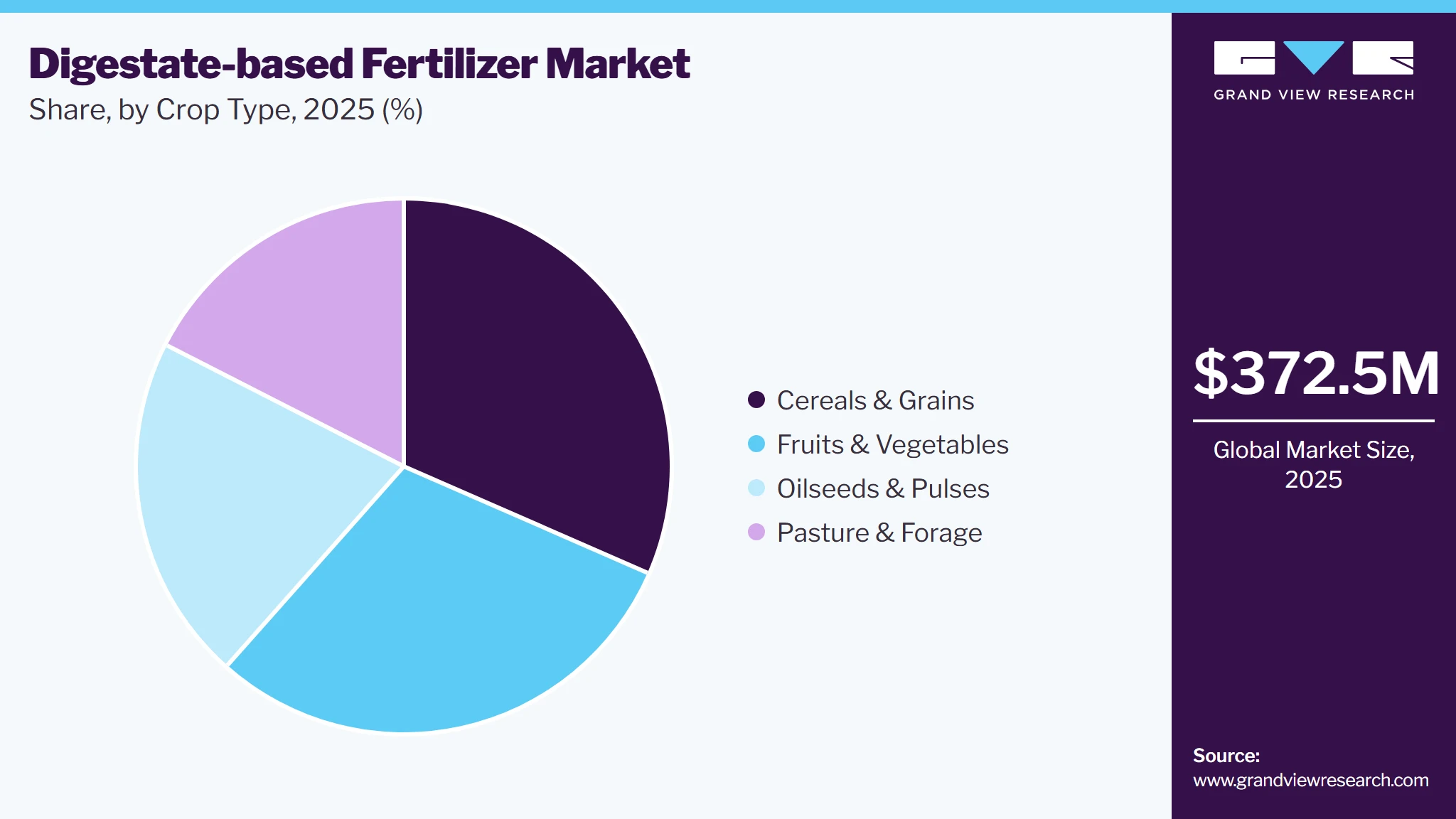
The fruits & vegetables segment is expected to grow fastest at a CAGR of 6.2% during the forecast period. Rising demand for nutrient-efficient crop production, protected cultivation, and high-value horticultural output is creating opportunities for digestate-derived fertilizers. Their use in fertigation, soil amendment, and targeted nutrient management can support productivity while aligning with growing consumer and producer interest in sustainable farming practices.
Region Insights
Europe Digestate-based Fertilizer Market Trends
Europe dominated the global market, accounting for 40.5% of revenue in 2025. The region’s leadership is supported by a mature anaerobic digestion industry, a strong organic waste management infrastructure, and an increasing emphasis on nutrient recycling. Established biogas facilities in countries such as Germany, France, Italy, and the UK generate substantial volumes of digestate, creating a strong supply base for fertilizer production and agricultural applications.
Germany Digestate-based Fertilizer Market Trends
The digestate-based fertilizer market in Germany represents a major European market due to its extensive network of agricultural and biogas plants. The country’s large livestock sector provides substantial manure feedstock for anaerobic digestion, while established biogas infrastructure supports continuous digestate generation. Growing interest in nutrient recovery, farm-level resource efficiency, and the utilization of digestate as an alternative nutrient source is encouraging investments in separation, treatment, and application technologies.
Asia Pacific Digestate-based Fertilizer Market Trends
The digestate-based fertilizer market in the Asia Pacific is gaining momentum as expanding livestock production, food processing, and urbanization increase the availability of biodegradable feedstocks. Countries across the region are investing in biogas and waste-to-energy facilities to address organic waste disposal while generating renewable energy. The resulting digestate offers an opportunity to return nutrients to agricultural soils, particularly in markets seeking to reduce dependence on imported fertilizer.
China digestate-based fertilizer market is supported by large agricultural production volumes, substantial livestock manure generation, and increasing deployment of agricultural waste treatment systems. Government initiatives promoting rural environmental management and resource utilization are encouraging the conversion of manure and crop residues into biogas and fertilizer inputs. The development of centralized and decentralized anaerobic digestion facilities is creating opportunities for commercial processing of digestate and agricultural distribution.
North America Digestate-based Fertilizer Market Trends
The digestate-based fertilizer market in North America is seeing growing adoption of these fertilizers as anaerobic digestion expands across livestock farms, food processing facilities, and organic waste management operations. The region benefits from established agricultural markets and growing investment in renewable natural gas projects. Integration of digestate management with biogas facilities is improving resource utilization, while nutrient recovery technologies are creating higher-value fertilizer products from digestion residues.
U.S. Digestate-based Fertilizer Market Trends
The U.S. digestate-based fertilizer market is benefiting from the expansion of anaerobic digestion projects associated with dairy farms, livestock operations, food waste, and municipal organic waste. Rising investment in renewable natural gas infrastructure is increasing the number of digestion facilities and, consequently, the availability of digestate. Producers are exploring separation, nutrient concentration, and other treatment methods to improve product consistency and create commercially attractive fertilizer formulations.
Latin America Digestate-based Fertilizer Market Trends
The digestate-based fertilizer market in Latin America is expected to grow the fastest, at a CAGR of 7.2%, during the forecast period. Growth is supported by the region’s strong agricultural base and abundant availability of livestock manure, sugarcane residues, food-processing waste, and other organic materials. The expansion of decentralized biogas systems and the increasing interest in agricultural waste valorization are creating opportunities to convert locally available feedstocks into nutrient-rich fertilizer products.
Middle East Digestate-based Fertilizer Market Trends
The digestate-based fertilizer market in the Middle East is being driven by the need to improve water and resource efficiency in agriculture while addressing increasing volumes of organic waste. Anaerobic digestion offers an avenue for treating food waste, livestock residues, and other biodegradable materials while generating nutrient-rich digestate. Controlled agricultural production, greenhouse cultivation, and the development of circular waste-management projects are creating opportunities for treated digestate to supplement conventional soil nutrients.
Key Digestate-based Fertilizer Company Insights
Companies operating in the market are strengthening their competitive positions through digestate processing, product portfolio development, nutrient recovery, technology upgrades, and distribution expansion. Leading participants are focusing on improving nutrient consistency, reducing moisture content, enhancing product handling, and developing fertilizer formats suitable for different agricultural applications. Companies are also investing in processing and separation technologies to convert digestate into higher-value fertilizer products while expanding access to farmers, agricultural distributors, and commercial farming operations.
-
Yara is a major player in the market, leveraging its established fertilizer portfolio, agronomic expertise, and global distribution network to drive adoption of nutrient-rich organic fertilizers. The company focuses on nutrient management, sustainable agricultural solutions, and improving fertilizer efficiency, supporting the integration of recovered nutrients into crop production systems.
-
HoSt Bio-Energy operates in the market through its expertise in anaerobic digestion, biogas systems, and digestate processing technologies. The company focuses on recovering and upgrading nutrients from digestate, improving treatment efficiency, and enabling the production of fertilizer products suitable for agricultural use.
Key Digestate-based Fertilizer Companies
The following key companies have been profiled for the study on the digestate-based fertilizer market.
-
Yara
-
HoSt Bio-Energy
-
ReFood
-
Future Biogas
-
Condorchem Enviro Solutions
-
NDDB Mrida
-
Hydrotech Engineering
-
Doranova Oy
-
Dhakshhin Agropolis Ltd.
-
Bharat Bio Gas
Competitive Benchmarking
Operating Strategies
Competitive Edge
Weaknesses
Mature Players: Yara, HoSt Bio-Energy, ReFood, Future Biogas, Condorchem Enviro Solutions, NDDB Mrida
- Expand digestate processing and fertilizer production capabilities to increase the utilization of nutrient-rich residues generated from anaerobic digestion.
- Develop technologies for separation, drying, concentration, and nutrient recovery to improve the quality and usability of digestate-based fertilizer.
- Establish partnerships with farmers, agricultural cooperatives, fertilizer distributors, and waste-management operators to strengthen market reach.
- Develop application-specific fertilizer products suited to different crops, soil conditions, and nutrient requirements.
- Invest in process optimization and automation to improve operational efficiency, product consistency, and resource recovery.
- Strengthen quality-control, nutrient-analysis, and regulatory compliance capabilities to support wider agricultural adoption.
- Established expertise in fertilizer production, anaerobic digestion, environmental engineering, or agricultural nutrient management.
- Strong technical capabilities for processing organic residues and recovering valuable nutrients.
- Established customer relationships across agricultural, waste-management, and environmental markets.
- Broad operational infrastructure supports reliable processing and distribution capabilities.
- Ability to develop integrated solutions covering waste treatment, digestion, digestate management, and fertilizer utilization.
- Strong sustainability positioning supports demand for resource-efficient agricultural inputs.
- High capital requirements associated with anaerobic digestion, digestate treatment, and nutrient-recovery infrastructure.
- Digestate quality can vary with feedstock characteristics and digestion conditions, creating challenges in meeting consistent fertilizer specifications.
- Transportation and storage costs can be high because untreated digestate has high moisture content and relatively low nutrient concentration by volume.
- Regulatory requirements governing digestate classification, treatment, and agricultural application can increase operating complexity.
- Market development depends on farmer acceptance and awareness of digestate-based fertilizer benefits.
- Processing and nutrient-recovery technologies can increase the cost of producing commercially standardized fertilizer products.
Emerging Players: Hydrotech Engineering, Doranova Oy, Dhakshhin Agropolis Ltd., Bharat Bio Gas
- Develop localized solutions for converting organic residues and digestate into marketable fertilizer products.
- Focus on granulation, composting, drying, and other processing techniques that improve product handling and storage.
- Target agricultural regions where livestock manure, food waste, and other organic residues are readily available.
- Build relationships with local farmers and agricultural organizations to increase field-level adoption.
- Introduce customized fertilizer formulations based on regional soil and crop requirements.
- Improve processing efficiency through modular equipment and scalable treatment systems suited to smaller and decentralized operations.
- Greater flexibility in serving regional agricultural markets and adapting products to local requirements.
- Lower geographic concentration can enable closer proximity to organic waste sources and end-use farms.
- Specialized processing capabilities can support the development of granulated and value-added digestate products.
- Ability to respond quickly to emerging demand for organic and recycled nutrient products.
- Local partnerships can facilitate access to feedstock, agricultural customers, and distribution channels.
- Smaller operating structures can support faster experimentation with new digestate-processing approaches and product formats.
- Smaller production capacity and financial resources compared with established fertilizer and environmental technology companies.
- Limited geographic coverage can restrict access to international agricultural markets.
- Dependence on local waste collection, processing infrastructure, and feedstock availability can create supply limitations.
- Lower brand recognition may make it more difficult to build confidence among large agricultural customers.
- Limited economies of scale can result in higher per-unit processing and distribution costs.
- Investment requirements for advanced nutrient recovery, quality testing, and certification may constrain rapid expansion.
Recent Developments
- In February 2026, Bharat Petroleum Corporation Limited inaugurated a compressed biogas plant at Brahmapuram, Kochi, designed to process 150 tonnes of biodegradable municipal waste per day. The facility is expected to produce 28 tonnes of organic manure daily alongside compressed biogas, creating an additional output stream for agricultural applications. The project demonstrates the integration of waste management, renewable energy generation, and organic fertilizer production, supporting the growth of digestate-based fertilizer in India.
Digestate-based Fertilizer Market Report Scope
Report Attribute
Details
Market Definition
The market comprises fertilizers produced from nutrient-rich digestate generated by the anaerobic digestion of organic waste and biomass for agricultural use.
Market value in 2025
USD 372.5 million
Estimated market size in 2026
USD 390.5 million
Projected market size by 2033
USD 570.4 million
Growth rate
CAGR of 5.6% from 2026 to 2033
Historical data
2021 - 2025
Forecast period
2026 - 2033
Quantitative units
Volume in kilotons, revenue in USD million, and CAGR from 2026 to 2033
Report coverage
Revenue forecast, company ranking, competitive landscape, growth factors, and trends
Segments covered
Form, product, feedstock, crop type, region
Regional scope
North America; Europe; Asia Pacific; Latin America; MEA
Country scope
U.S.; Canada; Mexico; Germany; UK; France; Italy; Spain; China; India; Japan; South Korea; Brazil; Argentina; Saudi Arabia; South Africa
Key companies profiled
Yara; HoSt Bio-Energy; ReFood; Future Biogas; Condorchem Enviro Solutions; NDDB Mrida; Hydrotech Engineering; Doranova Oy; Dhakshhin Agropolis Ltd.; Bharat Bio Gas
Customization scope
Free report customization (equivalent up to 8 analysts’ working days) with purchase. Addition or alteration to country, regional & segment scope.
Pricing and purchase options
Avail customized purchase options to meet your exact research needs. Explore purchase options
Global Digestate-based Fertilizer Market Report Segmentation
This report forecasts revenue growth at regional levels and provides an analysis of the latest industry trends in each of the sub-segments from 2021 to 2033. For this study, Grand View Research has segmented the global digestate-based fertilizer market report based on form, product, feedstock, crop type, and region:
-
Form Outlook (Volume, Kilotons; Revenue, USD Million, 2021 - 2033)
-
Solid
-
Liquid
-
-
Product Outlook (Volume, Kilotons; Revenue, USD Million, 2021 - 2033)
-
Direct Digestate-based Fertilizers
-
Whole Digestate
-
Liquid Digestate
-
Solid Digestate
-
-
Processed Digestate-based Fertilizers
-
Dried Digestate
-
Pelletized / Granulated Digestate
-
Composted Digestate
-
-
Nutrient-Recovered Digestate-based Fertilizers
-
Nitrogen-Recovered Fertilizers
-
Ammonium Sulfate
-
Other Nitrogen-Recovered Products
-
-
Phosphorus-Recovered Fertilizers
-
Struvite
-
Other Phosphorus-Recovered Products
-
-
N/P/NK-Recovered Fertilizers
-
-
Other Products
-
-
Feedstock Outlook (Volume, Kilotons; Revenue, USD Million, 2021 - 2033)
-
Agricultural
-
Manure
-
Crop Residues / Crops
-
-
Industrial / Food Waste
-
Organic Municipal Waste
-
Sewage Sludge
-
Other Feedstocks
-
-
Crop Type Outlook (Volume, Kilotons; Revenue, USD Million, 2021 - 2033)
-
Cereals & Grains
-
Oilseeds & Pulses
-
Fruits & Vegetables
-
Pasture & Forage
-
-
Region Outlook (Volume, Kilotons; Revenue, USD Million, 2021 - 2033)
-
North America
-
U.S.
-
Canada
-
Mexico
-
-
Europe
-
Germany
-
UK
-
France
-
Italy
-
Spain
-
-
Asia Pacific
-
China
-
India
-
Japan
-
South Korea
-
-
Latin America
-
Brazil
-
Argentina
-
-
Middle East & Africa
-
Saudi Arabia
-
South Africa
-
-
Research Methodology
The digestate-based fertilizer market figures in this report are based on a proven research process that combines executive interviews with secondary research from proprietary databases, company filings, and recognized regulatory and institutional sources. Market size is built through value-chain sizing - reconciling supply-side and demand-side estimates - and triangulated with bottom-up and top-down approaches. Every estimate passes multiple levels of expert validation before publication, with each digestate-based fertilizer segment quantified using the revenue-capture definitions in the table below.
Segment Definition
Form
Revenue capture definition
Solid
Revenue generated from digestate-based fertilizer products supplied in solid forms, including dried, composted, pelletized, or granulated formulations.
Liquid
Covers sales of digestate-derived fertilizers marketed as liquid products, including nutrient-rich liquid fractions and concentrated formulations intended for agricultural application.
Product
Revenue capture definition
Direct Digestate-based Fertilizers
Includes revenue from digestate applied or marketed as fertilizer with minimal processing beyond basic separation, stabilization, or quality treatment.
Processed Digestate-based Fertilizers
Accounts for sales of digestate that undergoes treatments such as drying, composting, concentration, granulation, or pelletization before being commercialized as a fertilizer product.
Nutrient-Recovered Digestate-based Fertilizers
Encompasses products derived through the extraction, concentration, or recovery of specific nutrients from digestate, including nitrogen-, phosphorus-, and potassium-rich fertilizer products.
Feedstock
Revenue capture definition
Agricultural
Revenue associated with digestate-based fertilizers produced from agricultural feedstocks, including livestock manure, crop residues, and other farm-generated organic materials.
Industrial / Food Waste
Covers fertilizer products originating from organic residues generated by food processing, food manufacturing, commercial facilities, and other industrial operations.
Organic Municipal Waste
Represents sales of fertilizers obtained from the anaerobic digestion of separately collected municipal organic waste, including household food and green waste.
Sewage Sludge
Captures revenue from fertilizer products produced using digestate derived from the anaerobic treatment of sewage sludge and related wastewater-processing residues.
Others
Includes digestate-based fertilizer revenue linked to feedstocks not classified under the major categories, such as certain agricultural-industrial residues, energy crops, and other biodegradable organic materials.
Crop Type
Revenue capture definition
Cereals & Grains
Measures revenue from digestate-based fertilizer supplied for cereal and grain cultivation, including crops such as wheat, rice, maize, barley, and oats.
Oilseeds & Pulses
Encompasses fertilizer sales directed toward oilseed and pulse production, covering crops such as soybean, rapeseed, sunflower, chickpea, lentil, and related varieties.
Fruits & Vegetables
Includes products purchased for fruit and vegetable cultivation across open-field, protected, greenhouse, and intensive farming systems.
Pasture & Forage
Represents demand generated by fertilizer applications on grazing land and forage-producing areas used for livestock feed, including grasses, hay, and fodder crops.
Estimation Model
Layer No.
Layer Name
Key Question
Description
01
Raw Material & Production Layer
What forms is the supply base?
Examines the availability and processing of organic materials used in anaerobic digestion, including agricultural residues, livestock manure, food waste, municipal organic waste, and other biodegradable feedstocks. The assessment covers feedstock collection, preparation, anaerobic digestion, nutrient retention, digestate separation, treatment, drying, granulation, storage, and production capacity. It also considers feedstock quality, digestion efficiency, nutrient recovery, processing costs, facility integration, contamination control, and technological capabilities that influence fertilizer quality and supply.
02
Form Adoption Layer
Where is digestate-based fertilizer utilized?
Evaluates the use of digestate-derived fertilizers across agricultural applications, including cereals and grains, oilseeds and pulses, fruits and vegetables, pasture and forage, and other crop systems. The analysis considers adoption according to fertilizer form, nutrient composition, crop requirements, soil conditions, application methods, and farmer preferences. Regulatory standards, product certification, awareness of soil-health benefits, and compatibility with existing fertilizer practices also influence market penetration.
03
Consumption Intensity Layer
How much digestate-based fertilizer is consumed?
Assesses fertilizer consumption across major crop categories and agricultural production systems. Estimation considers cultivated area, crop production volumes, application rates, frequency of fertilizer use, nutrient requirements, substitution of conventional fertilizers, adoption rates, and the availability of locally produced digestate. Regional differences in farming practices, soil conditions, organic waste availability, and agricultural intensity are incorporated to determine consumption patterns.
04
Revenue Layer
How is market revenue generated?
Market revenue is generated through the collection, processing, upgrading, and sale of digestate-derived fertilizer products in solid and liquid forms. Revenue realization varies according to product quality, nutrient concentration, processing level, fertilizer formulation, packaging, transportation requirements, and end-use application. Market pricing is also influenced by organic waste processing costs, nutrient-recovery efficiency, conventional fertilizer prices, regulatory requirements, regional demand, and the scale of production facilities.
Delivered Customizations
This report has been delivered with the following In-depth customizations
Client Request
Customization Delivered
Value Adds
Cross-segmentation
The assessment provides detailed cross-segmentation of the digestate-based fertilizer industry across form, product type, feedstock, and crop type. The analysis covers solid and liquid forms; direct, processed, and nutrient-recovered digestate-based fertilizers; agricultural, industrial/food waste, organic municipal waste, sewage sludge, and other feedstocks; and cereals & grains, oilseeds & pulses, fruits & vegetables, and pasture & forage.
Enables identification of high-potential combinations across feedstock-product-crop categories. Supports product development, feedstock allocation, processing decisions, distribution planning, and market targeting by identifying differences in nutrient requirements, processing needs, application suitability, and demand potential.
Opportunity Assessment
Detailed evaluation of growth opportunities arising from the increasing utilization of organic waste for nutrient recovery and agricultural applications. The assessment covers expansion of anaerobic digestion infrastructure, rising demand for organic fertilizers, nutrient-recovery technologies, development of value-added digestate products, improved processing and granulation techniques, and opportunities across major agricultural markets.
Helps identify attractive opportunities across the digestate-based fertilizer value chain, from organic waste sourcing and digestion to fertilizer processing and agricultural distribution. Supports decisions related to capacity development, technology adoption, product formulation, regional expansion, and partnerships with agricultural and waste-management stakeholders.
Competitive Benchmarking
Comparative assessment of leading digestate-based fertilizer producers, anaerobic digestion operators, fertilizer companies, and environmental technology providers based on processing capabilities, product portfolio, feedstock access, production capacity, technology, geographic presence, fertilizer quality, nutrient-recovery capabilities, distribution networks, and strategic initiatives.
Supports evaluation of competitive positioning by identifying differences in processing efficiency, product quality, technology capabilities, feedstock access, agricultural reach, and commercialization strength. The analysis assists decisions concerning technology investments, product portfolio expansion, strategic partnerships, geographic penetration, and differentiation strategies.
About the Author(s)
Agrochemicals & Fertilizers Research Team
Bulk Chemicals · Agrochemicals & FertilizersThis report was authored by the agrochemicals & fertilizers research team at Grand View Research - comprising two research analysts, one senior research analyst, and one industry expert - with specialized expertise in the agrochemicals & fertilizers segment of the bulk chemicals industry. All findings are based on proprietary bulk chemicals databases, executive interviews, and regulatory analysis, subject to internal peer review prior to publication.
Last Updated:
Speak to Analyst


Customize this report to your needs - add regions, segments, or data points, with 20% free customization.
Or view our licence options:


ISO 9001:2015 & 27001:2022 Certified
We are GDPR and CCPA compliant! Your transaction & personal information is safe and secure. For more details, please read our privacy policy.


