
- Home
- »
- Next Generation Technologies
- »
-
Digital Audio Workstation Market Size Report, 2026-2033GVR Report cover

Digital Audio Workstation Market (2026 - 2033)
Size, Share & Trends Analysis Report By Component (Software, Services), By Operating System (MAC, Windows, Android), By End Use (Electronic Musicians, Music Studios), By Region, And Segment Forecasts
Market Size, 2025
$4.4BMarket Estimate, 2026
$4.7BMarket Forecast, 2033
$8.9BCAGR, 2026–2033
9.4%Digital Audio Workstation Market Summary
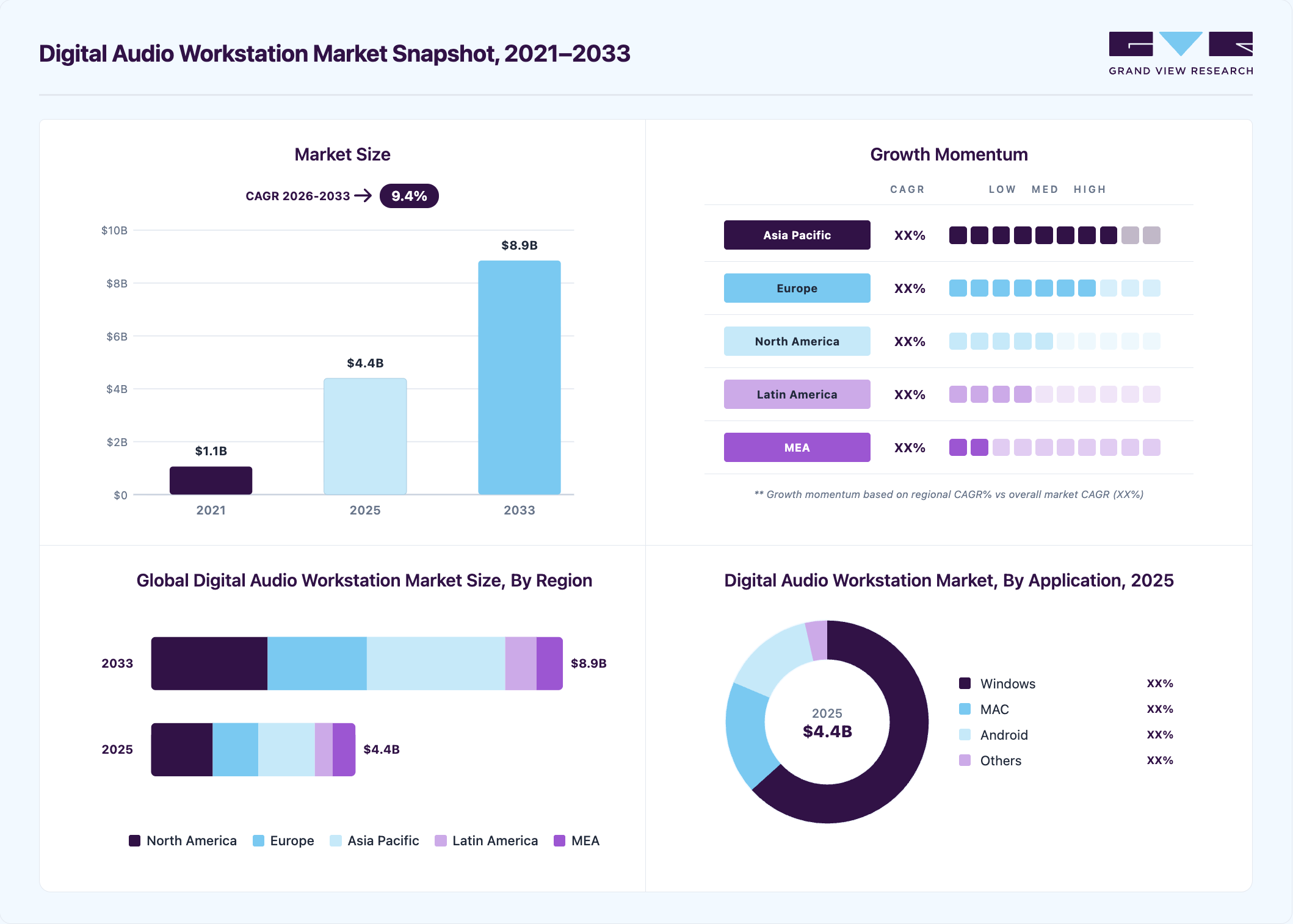
The global digital audio workstation market size was valued at USD 4.4 billion in 2025 and is projected to grow from USD 4.7 billion in 2026 to USD 8.9 billion by 2033, at a CAGR of 9.4% from 2026 to 2033. The market in North America dominated with a revenue share of 30.2% in 2025. The market is expanding as more individuals and professionals seek advanced audio production tools.
 Source: Grand View Research, IR Documents, Primary Interviews, Paid DatabasesTo learn more about this report,
 Download Free Sample Report
 Key Market Trends & Insights
- By component: Software segment held the largest market share of 57.9% in 2025.
- By operating system: Windows segment held the largest market share in 2025.
- By end use: Professional audio engineers and mixers segment held the largest market share in 2025.
Regional Highlights
- Largest regional market: North America (30.2% revenue share, 2025)
- Fastest-growing regional market: Asia Pacific (highest CAGR, 2026-2033)
- By country: U.S. held the largest market share in 2025
Market Size & Forecast
- Market size in 2025: USD 4.4 Billion
- Estimated market size in 2026: USD 4.7 Billion
- Projected market size by 2033: USD 8.9 Billion
- CAGR (2026-2033): 9.4%
Three ways to get this report
Buy it, customize it, or ask a question.Ask an Analyst
Analyst response in 1 business day
- AccessReport author, directly
- Reply timeWithin 1 working day
- No sales callDirect answer only
- FormatEmail reply
- CostFree, no cost
Get the Full Report
What the study covers
- FormatsPDF · Excel · Dashboard
- Timeline2026–2033 annual, 2025 base
- Coverage20+ countries, 5 regions
- Companies10+ key players profiled
Customize the Report
20% free customization
- IncludeCountries, segments, points
- TailorTo your product definition
- ExtendDeeper competitor detail
- OrA fully bespoke study
- Turnaround5–10 working days
Growth is driven by the increasing popularity of music creation, podcasting, and content production. The rise of independent artists and home studio setups is fueling this demand. AI and automation are accelerating growth in the Digital Audio Workstation (DAW) market by simplifying complex music production tasks. Features such as stem separation, chord generation, and intelligent arrangement tools reduce the need for manual input and technical expertise. This allows both beginners and professionals to experiment more freely and produce high-quality results faster. DAWs with built-in AI capabilities are attracting users across genres, from electronic music to film scoring. Automation also enhances workflow efficiency by handling repetitive editing, mixing, and mastering functions. As AI models improve, their integration into DAWs is expected to drive continued user adoption and expand creative possibilities. For instance, in March 2025, Ableton, a German music software company, released Live 12.2, introducing features such as Bounce to New Track, enhanced Auto Filter, and MPE-enabled devices such as Expressive Chords and Meld. The update also brought advanced creative tools and improvements to hardware integration for Push, enhancing sequencing, tuning, and real-time performance control.Mobile and remote collaboration is becoming a key trend in the Digital Audio Workstation (DAW) market as users increasingly seek the ability to create and edit music from any location. To support this, DAWs are adding cloud-based sharing, real-time syncing, and mobile compatibility. These features enable musicians, producers, and teams to collaborate without being in the same studio. Mobile DAWs also attract creators on the go, who use tablets or smartphones, driving adoption among independent artists and content creators worldwide. For instance, in October 2024, PreSonus Audio Electronics, Inc., a U.S. professional audio equipment and software company, launched Studio One Pro 7, which includes AI-powered stem separation, Splice integration, and advanced tools such as a dynamic launcher and CV control. These additions enhance creative flexibility, streamline workflows, and show the growing demand for intelligent, integrated DAW solutions.
 To learn more about this report, Download Free Sample Report
 Hybrid hardware-software ecosystems are becoming increasingly important in the digital audio workstation market. Users are looking for seamless integration between software and physical controllers. This integration helps improve overall performance during music production. It enables smoother, more efficient workflows. Enhanced connectivity between devices supports greater creative flexibility. Musicians and producers can work more intuitively with connected tools. The combination of hardware and software creates a more immersive production environment. This trend meets the demand for faster, hands-on control. As a result, it is driving innovation and adoption in the market.
Component Insights
In terms of component, the software segment dominated the market with a 57.9% share in 2025. The growth is driven by the rising demand for intuitive, feature-rich platforms that support a broad spectrum of audio production use cases, including music composition, podcasting, live streaming, and advanced sound design. Modern DAWs are increasingly incorporating AI-powered tools such as automated mixing and mastering, smart audio editing, generative music assistance, and voice enhancement, significantly improving workflow efficiency and creative output. The emergence of cloud-native and browser-based DAWs is reshaping the industry by enabling seamless remote access, real-time collaboration, and project synchronization across devices, fostering global creative collaboration. Additionally, integration with edge computing and low-latency streaming technologies is enhancing real-time audio processing capabilities.
The service segment is expected to witness robust growth over the forecast period, driven by the increasing reliance on value-added and on-demand audio production services. This segment is evolving rapidly as the adoption of cloud-based, subscription-driven service models rises, enabling users to access projects, plugins, and collaborative tools from anywhere while supporting real-time, multi-user editing and production workflows. A key trend shaping this segment is the integration of AI-as-a-Service (AIaaS) capabilities, including automated mixing, intelligent mastering, noise reduction, and voice processing, which reduce production time and enhance output quality. Furthermore, remote collaboration services powered by low-latency streaming and WebRTC technologies are enabling geographically dispersed artists, producers, and sound engineers to work together seamlessly.
Operating System Insights
The Windows segment led the digital audio workstation market in 2025. As the most widely used OS for personal computers, Windows supports a vast array of DAW software, making it a preferred choice for many audio professionals and musicians. The growing demand for high-quality, cost-effective audio production tools has significantly driven the adoption of Windows-based DAWs. These platforms provide powerful capabilities for recording, editing, mixing, and mastering audio, while remaining accessible to home studios and independent creators. The surge in DIY music production, content creation, and podcasting has further accelerated the use of budget-friendly, Windows-compatible DAWs. Furthermore, advancements such as low-latency audio drivers (ASIO), GPU-accelerated processing, edge computing, and support for high-resolution audio formats are strengthening the performance capabilities of Windows-based DAWs.
The MAC segment is estimated to grow significantly over the forecast period. The growth is attributed to the increasing demand for applications used among end use sector. Due to its superior build quality and stability, Mac offers an excellent solution for a wide range of users. Its design and structural advantages provide enhanced solutions for various consumers, which is anticipated to boost the growth of the Mac segment. While Apple's Mac operating system has steadily increased its market share, it still holds a smaller position in the overall desktop OS market. The latest version, macOS Ventura, represents the nineteenth iteration of the macOS line. Moreover, the growing adoption of Mac services for recording and editing digital audio files is anticipated to drive increased demand for the operating system throughout the forecast period.
End Use Insights
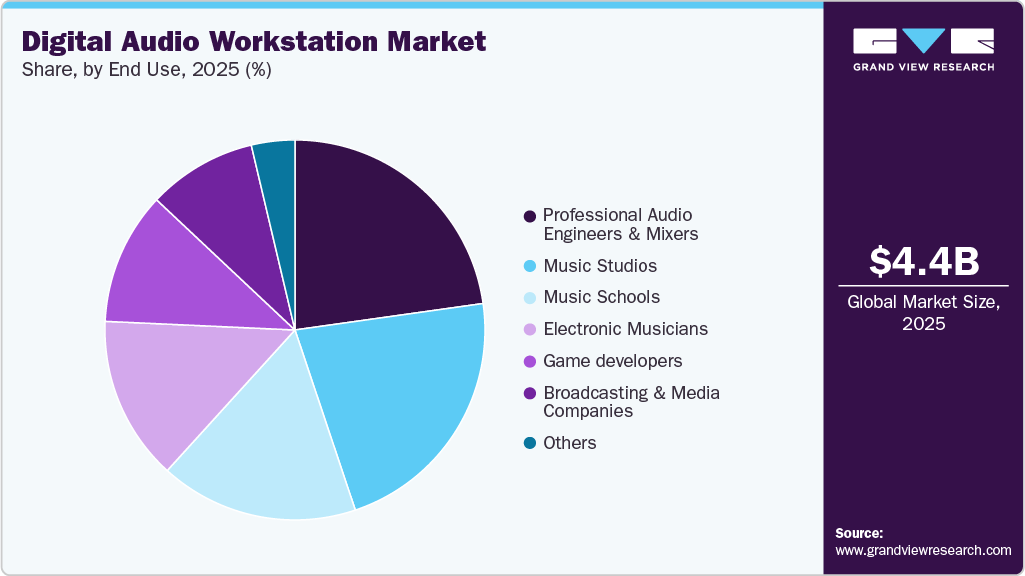
The professional audio engineers and mixers segment generated the largest market revenue in 2025. The role of professional audio engineers and mixers is experiencing significant growth in the digital audio workstation industry due to several key factors. As the demand for high-quality audio content escalates across various media platforms, including music, film, and gaming, there is a growing need for skilled professionals who can deliver polished and sophisticated sound productions. Advances in DAW technology, such as enhanced features for mixing, mastering, and audio manipulation, are empowering these professionals to achieve superior sound quality and greater creative control. Moreover, the expansion of remote collaboration tools within DAWs allows audio engineers and mixers to work seamlessly with clients and collaborators from around the world, further increasing their opportunities and demand. The rise in content creation, coupled with the continual evolution of audio technology, is driving the need for expertise in managing and refining complex audio projects, making professional audio engineers and mixers integral to the industry's growth.
 To learn more about this report, Download Free Sample Report
 The music studios segment is estimated to grow significantly over the forecast period. prominently driven by the increasing demand for high-quality audio production and the accessibility of advanced recording technologies. As the music sector evolves, there is a surge in independent artists and producers seeking professional-grade tools to create, mix, and master their music. The affordability of DAWs and related equipment has enabled a broader range of creators to establish music studios, allowing them to produce high-quality audio without the need for expensive commercial facilities. Moreover, the growing popularity of streaming platforms has intensified the competition among artists, driving the need for polished and professionally produced tracks. Music studios equipped with state-of-the-art DAWs provide the necessary infrastructure for artists to meet these demands, enabling them to produce music that stands out in a crowded market.
Regional Insights
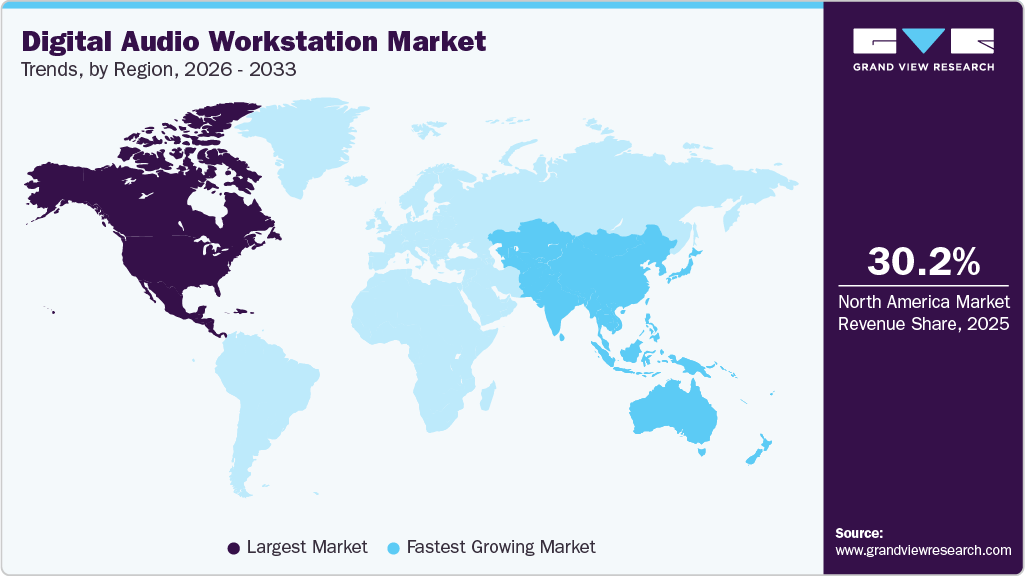
The digital audio workstation industry in North America dominated the global landscape, accounting for 30.2% share in 2025. The North American market is growing steadily with increased adoption by musicians and producers. Advanced technology infrastructure supports the use of cloud-based and AI-driven DAWs. High investment in music production studios fuels market expansion. Consumers demand more intuitive and integrated DAW solutions. The region hosts many leading DAW developers driving innovation. This fosters competitive growth and diverse product offerings.
 To learn more about this report, Download Free Sample Report
 U.S. Digital Audio Workstation Market Trends
The U.S. digital audio workstation industry is experiencing steady expansion, driven by strong adoption among both independent artists and established professional studios. The country’s well-developed music, film, and digital ecosystem continues to fuel demand for advanced audio production tools. Additionally, the rise of creator economy platforms, podcasting, and streaming services is accelerating demand for high-quality audio production.
Europe Digital Audio Workstation Market Trends
The digital audio workstation industry in Europe benefits from a vibrant music scene and increasing digital production. Mobile and remote collaboration tools are becoming widely adopted. Government initiatives support creative industries and technology innovation. Users prefer hybrid setups combining hardware and software. Cross-border collaborations encourage market expansion.
Asia Pacific Digital Audio Workstation Market Trends
The digital audio workstation industry in the Asia Pacific is growing quickly due to rising digital content creation and streaming. Mobile device usage fuels demand for portable DAW applications. Countries such as China, India, and Japan invest in music technology infrastructure. Interest in music education and production is increasing. Local developers are also contributing to market growth. This region shows significant potential for future expansion.
Key Digital Audio Workstation Company Insights
Some of the key companies in the Digital Audio Workstation industry include Apple INC., Adobe, Avid Technology Inc., MA Lighting, Steinberg Media Technologies GmbH, and others. Organizations are focusing on increasing their customer base to gain a competitive edge in the industry. Therefore, key players are taking several strategic initiatives, such as mergers and acquisitions, and partnerships with other major companies.
-
Apple Inc. continues to enhance its DAW offerings with seamless integration across its ecosystem. Logic Pro software receives regular updates, improving workflow and creative tools. The company focuses on user-friendly interfaces and powerful performance. Apple also supports mobile music production through GarageBand on iOS devices. These efforts strengthen its position in the DAW market.
-
Adobe is expanding its footprint in music production with AI-powered features and cloud-based collaboration tools. Its Creative Cloud suite integrates audio editing seamlessly with other creative applications. Adobe invests in simplifying workflows for both beginners and professionals. The company enhances real-time collaboration capabilities in its software. These developments boost Adobe’s role in the DAW space.
Key Digital Audio Workstation Companies:
The following key companies have been profiled for this study on the digital audio workstation market.
- Apple Inc.
- Adobe
- Avid Technology Inc.
- MA Lighting
- Steinberg Media Technologies GmbH
- Native Instruments GmbH
- Renoise
- Harrison Consoles
- MAGIX Software GmbH
Recent Developments
-
In January 2026, Apple Inc. introduced Apple Creator Studio at NAMM 2026, a subscription-based creative suite that integrates professional tools such as Logic Pro, Final Cut Pro, Motion, Compressor, MainStage, and Pixelmator Pro into a unified ecosystem. The platform features AI-powered capabilities, including intelligent editing, automated music composition, and smart workflow optimization, along with seamless cross-device compatibility across Mac, iPad, and iPhone.
-
In November 2025, Steinberg Media Technologies GmbH launched Cubase 15, introducing a new Melodic Pattern Sequencer, updated Expression Maps, six additional Modulators, AI-powered stem separation, and new plugins including Omnivocal, UltraShaper, and PitchShifter. The update also enhances instruments, effects, workflow, and DAWproject compatibility across Pro, Artist, and Elements editions.
-
In June 2025, Avid Technology Inc. released Pro Tools 2025.6, featuring MIDI enhancements, AI-powered Speech-to-Text, expanded Melodyne ARA integration, ADR workflow improvements, and a new Splice integration for direct access to royalty-free samples. The update also streamlines composition and post-production workflows, offering faster editing, partner integrations, and enhanced creative tools for all Pro Tools users.
-
In May 2024, Apple Inc. launched Logic Pro for iPad 2 and Logic Pro for Mac 11, introducing advanced tools for songwriting, beat-making, production, and mixing. Enhanced with artificial intelligence, both versions include studio assistant features that support the creative process while ensuring artists maintain full control over their work.
Digital Audio Workstation Market Report Scope
Report Attribute
Details
Market size in 2025
USD 4.4 billion
Estimated market size in 2026
USD 4.7 billion
Projected market size by 2033
USD 8.9 billion
Growth rate
CAGR of 9.4% from 2026 to 2033
Base year for estimation
2025
Historical data
2021 - 2024
Forecast period
2026 - 2033
Quantitative units
Revenue in USD million/billion and CAGR from 2026 to 2033
Report coverage
Revenue forecast, company ranking, competitive sector, growth factors, and trends
Segment scope
Component, operating system, end use, region
Region scope
North America; Europe; Asia Pacific; Latin America; Middle East & Africa
Country scope
U.S.; Canada; Mexico; Germany; UK; France; China; Japan; India; Australia; South Korea; Brazil; KSA; UAE; South Africa
Key companies profiled
Apple INC.; Adobe; Avid Technology Inc.; MA Lighting; Steinberg Media Technologies GmbH; Native Instruments GmbH; Renoise; Harrison Consoles; MAGIX Software GmbH
Customization scope
Free report customization (equivalent up to 8 analysts’ working days) with purchase. Addition or alteration to country, regional & segment scope
Pricing and purchase options
Avail customized purchase options to meet your exact research needs. Explore purchase options
Global Digital Audio Workstation Market Report Segmentation
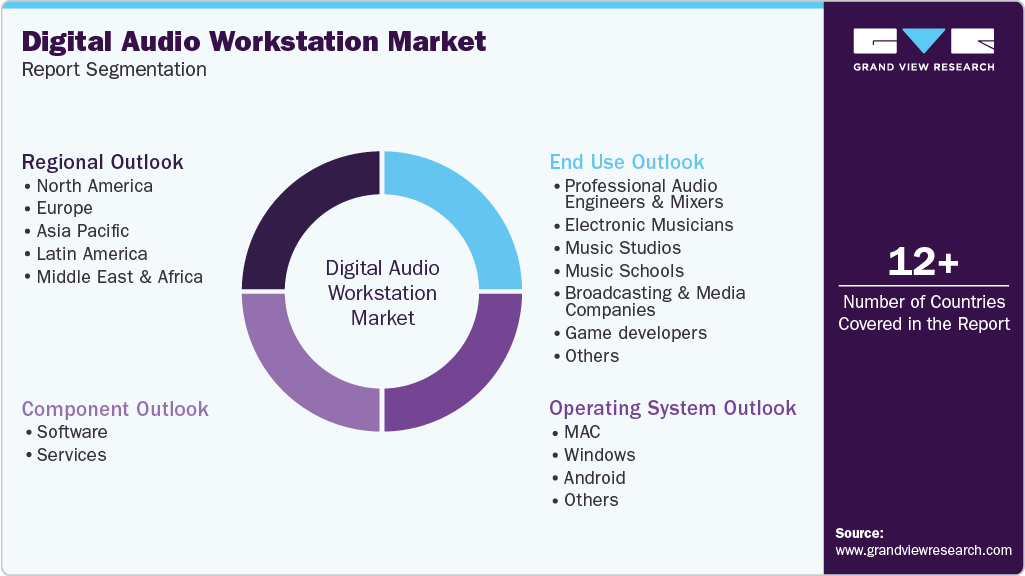
This report forecasts revenue growth at global, regional, and country levels and provides an analysis of the latest industry trends and opportunities in each of the sub-segments from 2021 to 2033. For this study, Grand View Research has segmented the global digital audio workstation market report in terms of component, operating system, end use, and region.
 To learn more about this report, Download Free Sample Report
 -
Component Outlook (Revenue, USD Million, 2021 - 2033)
-
Software
-
Services
-
-
Operating System Outlook (Revenue, USD Million, 2021 - 2033)
-
MAC
-
Windows
-
Android
-
Others
-
-
End Use Outlook (Revenue, USD Million, 2021 - 2033)
-
Professional Audio Engineers and Mixers
-
Electronic Musicians
-
Music Studios
-
Music Schools
-
Broadcasting and Media Companies
-
Game developers
-
Others
-
-
Regional Outlook (Revenue, USD Million, 2021 - 2033)
-
North America
-
U.S.
-
Canada
-
Mexico
-
-
Europe
-
UK
-
Germany
-
France
-
-
Asia Pacific
-
China
-
Japan
-
India
-
Australia
-
South Korea
-
-
Latin America
-
Brazil
-
-
Middle East & Africa (MEA)
-
KSA
-
UAE
-
South Africa
-
-
Frequently Asked Questions About This Report
Key factors that are driving the market growth include the surge in demand for high-definition audio and video content, increasing digitalization of musical instruments and advancements in audio technology, and the rising adoption of cloud-based DAWs.
The software segment led with a 57.9% revenue share in 2025, while the service segment is the fastest-growing.
The windows segment held the largest revenue share in 2025, while the MAC segment is the fastest-growing.
The professional audio engineers and mixers segment held the largest revenue share in 2025, while the music studios segment is the fastest-growing.
The global digital audio workstation market size was valued at USD 4.4 billion in 2025 and is estimated at USD 4.7 billion for 2026.
The global digital audio workstation market is expected to grow at a CAGR of 9.4% from 2026 to 2033, reaching USD 8.9 billion by 2033.
North America dominated with a 30.2% revenue share in 2025.
Asia Pacific is the fastest-growing region over the forecast period.
Key players include Apple INC.; Adobe; Avid Technology Inc.; MA Lighting; Steinberg Media Technologies GmbH; Native Instruments GmbH; Renoise; Harrison Consoles; MAGIX Software GmbH
About the Author(s)
Next Generation Technologies Research Team
Technology · Next Generation TechnologiesThis report was authored by the next generation technologies research team at Grand View Research - comprising two research analysts, one senior research analyst, and one industry expert - with specialized expertise in the next generation technologies segment of the technology industry. All findings are based on proprietary technology databases, executive interviews, and regulatory analysis, subject to internal peer review prior to publication.
Last Updated:
Speak to Analyst

Customize this report to your needs - add regions, segments, or data points, with 20% free customization.
Or view our licence options:


ISO 9001:2015 & 27001:2022 Certified
We are GDPR and CCPA compliant! Your transaction & personal information is safe and secure. For more details, please read our privacy policy.


