
- Home
- »
- Electronic & Electrical
- »
-
Digital Pen Market Size, Share & Growth Report, 2026-2033GVR Report cover
![Digital Pen Market (2026 - 2033)Report]()
Digital Pen Market (2026 - 2033)
Size, Share & Trends Analysis Report By Product (Scanning Pen, Handwriting Pen), By Usage (PC, Tablet), By End Use (Healthcare, Education), By Region (North America, Europe, Asia Pacific), And Segment Forecasts
Market Size, 2025
$3.3BMarket Estimate, 2026
$3.7BMarket Forecast, 2033
$9.5BCAGR, 2026–2033
14.2%Digital Pen Market Summary
The global digital pen market size was valued at USD 3.3 billion in 2025 and is projected to grow from USD 3.7 billion in 2026 to USD 9.5 billion by 2033, growing at a CAGR of 14.2% from 2026 to 2033, driven by the rising use in education, creative work, and professional settings, which is facilitated by precise input and seamless software integration. The North America market held the largest share of 37.2% of the global market in 2025. A key ongoing trend in the digital pen industry is the integration of AI-enabled features that enhance precision, productivity, and workflow automation.
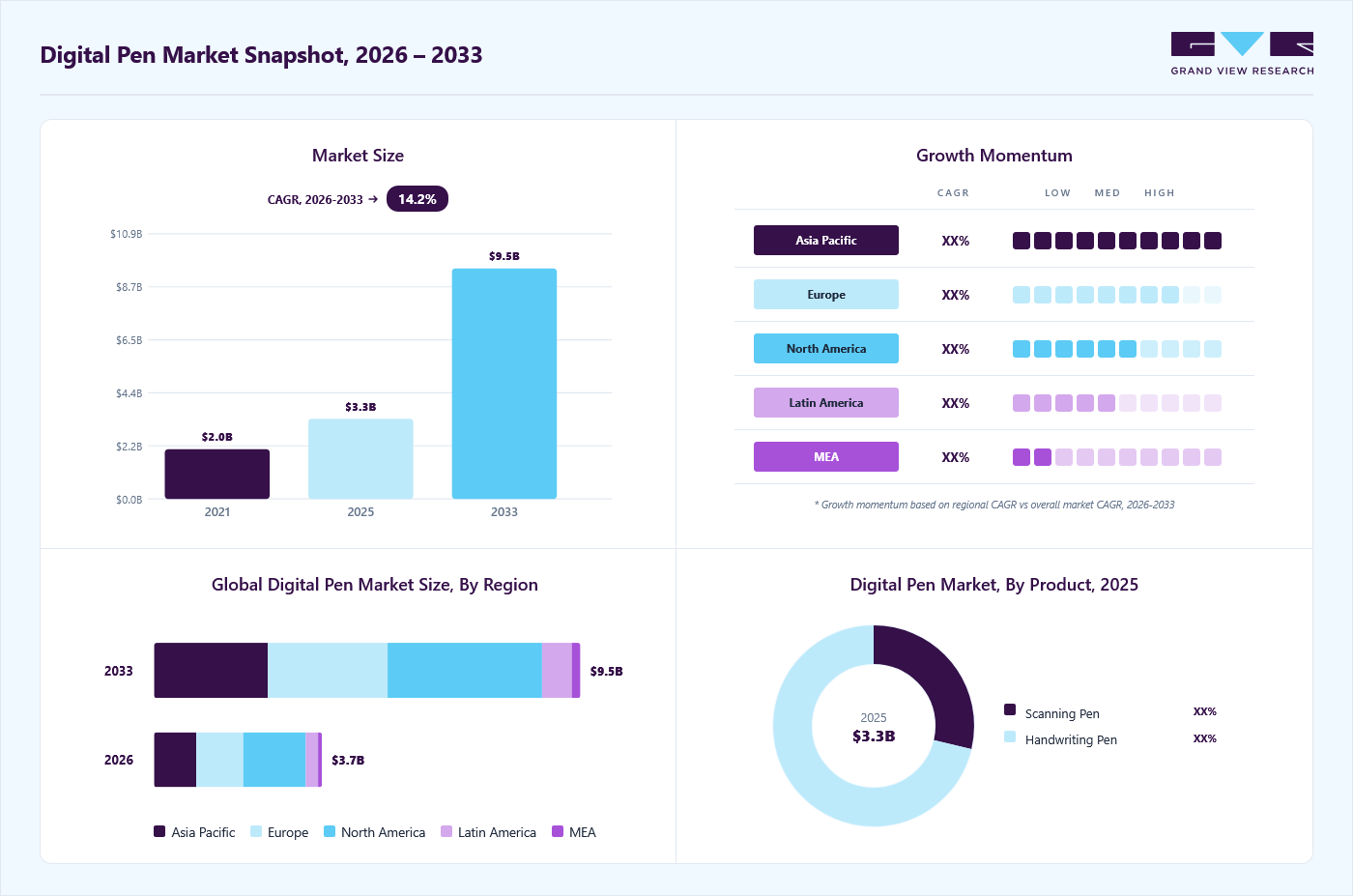
Key Market Trends & Insights
- By product: Handwriting pen led the market with the largest revenue share of 72.7% in 2025
- By usage: Digital pen for tablets led the market with the largest revenue share of 59.8 % in 2025.
- By end use: Healthcare segment led the market with the largest revenue share of 22.8% in 2025.
Regional Highlights
- Largest regional market: North America (37.2% revenue share, 2025)
- Fastest-growing regional market: Asia Pacific (highest CAGR, 2026-2033)
- By country: The U.S. held the largest market share in 2025.
Market Size & Forecast
- Market size in 2025: USD 3.3 Billion
- Estimated market size in 2026: USD 3.7 Billion
- Projected market size by 2033: USD 9.5 Billion
- CAGR (2026-2033): 14.2%
Three ways to get this report
Buy it, customize it, or ask a question.Get the Full Report
What the study covers
- FormatsPDF · Excel · Dashboard
- Timeline2026–2033 annual, 2025 base
- Coverage20+ countries, 5 regions
- Companies10+ key players profiled
Customize the Report
20% free customization
- IncludeCountries, segments, points
- TailorTo your product definition
- ExtendDeeper competitor detail
- OrA fully bespoke study
- Turnaround5–10 working days
Ask an Analyst
A direct answer, usually in 1 working day
- AccessReport author, directly
- Reply timeWithin 1 working day
- No sales callDirect answer only
- FormatEmail reply
- CostFree, no cost
Modern styluses increasingly incorporate intelligent handwriting recognition, gesture-based commands, and context-aware functionality, allowing users to convert handwritten notes into editable text, execute commands, and interact seamlessly with multiple applications.The growth of the digital pen industry is being driven by increasing adoption of stylus-compatible devices in education and corporate environments. In schools and universities, especially in North America and Asia Pacific, tablets and 2-in-1 devices are replacing traditional notebooks for note-taking and interactive learning, creating steady demand for digital pens. On the corporate side, hybrid work setups and digital collaboration tools are encouraging professionals to adopt stylus-enabled devices for document annotation, presentations, and remote teamwork, providing a tangible boost to sales.
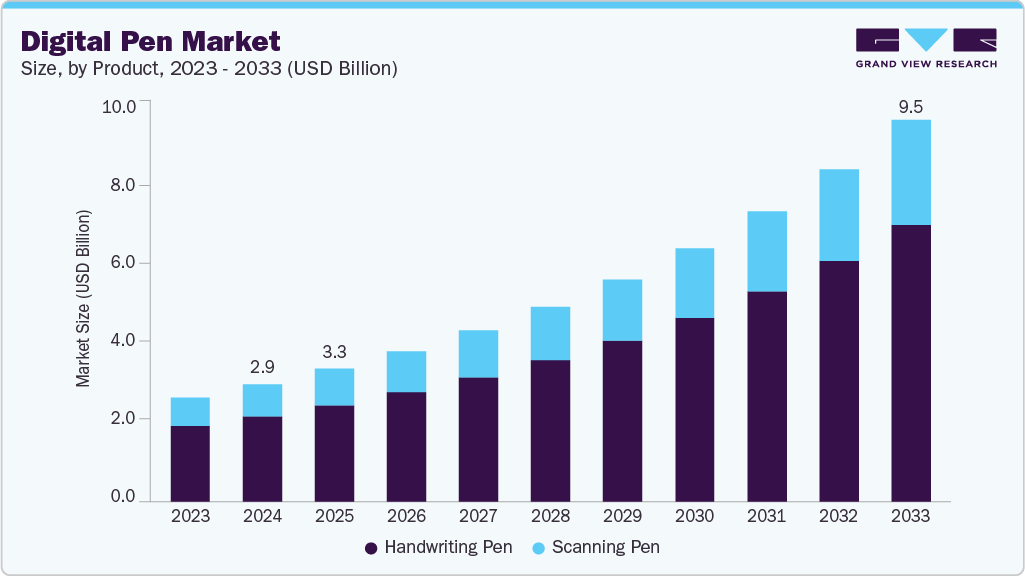
According to a January 2023 article by Digital Stationary Consortium, 38% of digital pen users report using their pen on a daily basis, primarily for tasks like note‑taking, list‑making, and light editing.
Another key factor is the rapid expansion of creative and design industries that require precise input devices. Freelance designers, architects, and digital artists are increasingly relying on high-performance pens with low latency, pressure sensitivity, and tilt recognition for professional work. The rise of content creation for social media, digital illustration, and online design platforms has pushed demand for ecosystem-specific pens such as the Apple Pencil, Samsung S Pen, and Wacom styluses, creating a specialized segment within the market that drives both revenue and innovation.
In addition, regional affordability and online distribution channels are accelerating penetration in emerging markets. Brands such as Adonit, Lenovo, and XP-Pen offer cost-effective styluses that work across multiple devices, making them accessible to students and casual users in countries like India, China, and Southeast Asia. The proliferation of e-commerce platforms, combined with increasing awareness of digital learning and creative applications, has made digital pens more visible and affordable at the ground level, fueling adoption beyond premium device owners.
Market Dynamics
The global digital pen market is being driven by the increasing adoption of tablets, e-paper devices, and digital note-taking platforms across education, enterprise, and creative applications. Demand is shifting beyond niche design use cases toward everyday productivity and learning workflows, as users seek a paper-like writing experience combined with the convenience of digital storage, sharing, and collaboration. However, market growth remains closely tied to proprietary device ecosystems, making compatibility and interoperability key factors influencing adoption and competitive positioning.
The primary demand driver for digital pens is the growing adoption of tablets, e-paper notebooks, and hybrid work tools that replicate the handwriting experience while enabling digital storage, editing, and sharing. Students, educators, designers, healthcare professionals, and corporate users increasingly prefer handwritten note-taking for comprehension and workflow efficiency, creating sustained demand for digital pens that integrate seamlessly with devices such as tablets, interactive displays, and smart notebooks. The replacement cycle of companion devices further supports recurring demand for upgraded stylus technologies featuring improved latency, pressure sensitivity, and palm-rejection capabilities.
Market growth remains constrained by the fact that many digital pens are designed to function only within specific hardware ecosystems. Compatibility limitations across operating systems, screen technologies, and device brands reduce interchangeability and increase total ownership costs for users. As a result, consumers often purchase digital pens only when bundled with or required by a compatible tablet or notebook, making standalone pen adoption heavily dependent on broader device sales rather than independent demand.
An important growth opportunity for the digital pen market is the increasing adoption of handwritten data digitization across enterprises. Industries such as healthcare, banking, insurance, logistics, and field services still rely heavily on handwritten forms, signatures, inspections, and customer records. Digital pens enable these handwritten inputs to be captured, stored, and integrated directly into digital workflows, reducing manual data entry, improving accuracy, and accelerating document processing. As organizations continue their digital transformation efforts, demand for solutions that seamlessly convert handwritten information into searchable and shareable digital data is expected to increase.
Analyst Perspective
The digital pen market is primarily ecosystem-driven, with revenue tied to shipments of stylus-enabled devices rather than standalone demand. Value is concentrated in OEM-integrated ecosystems where pens are bundled or optimized for specific devices, while usage is expanding from creative professionals into education and enterprise productivity. However, fragmented standards and limited interoperability constrain aftermarket adoption. As a result, competitive advantage is increasingly shifting toward ecosystem owners that control hardware-software integration and associated accessory monetization.
Consumer Insights
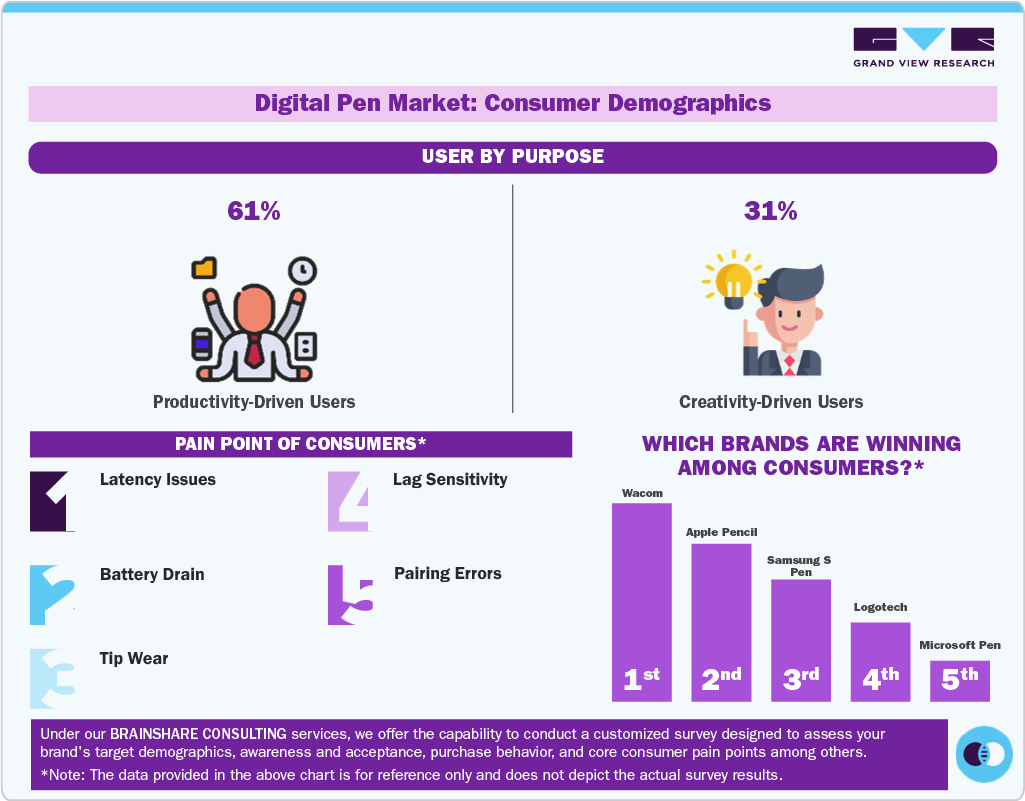
The global digital pen industry is primarily driven by productivity-focused users, who account for approximately 61% of the market. This group, including students, professionals, and remote workers, relies on digital pens for note-taking, document annotation, and efficient workflow management. Creativity-driven users, representing 39%, such as designers, architects, and digital artists, prioritize precision, pressure sensitivity, and software compatibility to support tasks like sketching, illustration, and digital design.
Consumers encounter recurring challenges that influence adoption and satisfaction. Common pain points include latency issues, battery drain, tip wear, lag sensitivity, and pairing errors, which can affect accuracy, responsiveness, and overall usability. Addressing these technical limitations is critical for brands seeking to maintain user trust and encourage continued engagement with stylus devices.
Leading companies have emerged by effectively tackling these challenges and offering high-quality, reliable solutions. Brands such as Wacom, Apple Pencil, Samsung S Pen, Logitech, and Microsoft Pen dominate the market, leveraging precise input, long battery life, and seamless integration with devices and software. Their focus on performance and compatibility appeals to both productivity-focused and creative users, reinforcing their competitive position globally.
Product Insights
Based on product, handwriting pen led the market with the largest revenue share of 72.7% in 2025 and scanning pen is anticipated to grow at the fastest CAGR over the forecast period, driven by user preference for natural writing experience, low-latency performance, and precision for note-taking, sketching, and annotations. High adoption in education, professional, and creative sectors is supported by ecosystem integration with devices like Apple iPads, Microsoft Surface tablets, and Wacom devices, making them the default choice for productivity and design applications.
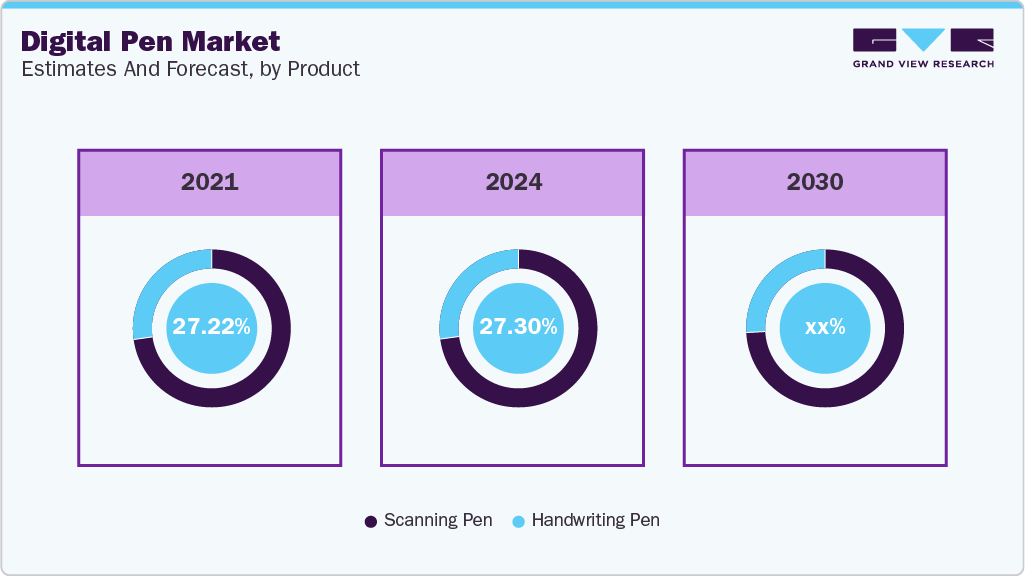
The scanning pen segment is anticipated to witness at the fastest CAGR of 14.3 % from 2026 to 2033, fueled by increasing demand for text digitization, translation, and real-time data capture in offices, educational institutions, and libraries. Rising adoption of digital learning and remote work tools encourages users to convert printed or handwritten material into editable formats, with brands like C-Pen and IRISPen benefiting from this trend, which drives strong projected CAGR during the forecast period.
Usage Insights
Based on usage, the digital pen for tablets led the market with the largest revenue share of 59.8 % in 2025. Tablet-compatible digital pens dominate the industry as tablets are widely used for productivity, creative work, and education, offering larger screens and better stylus integration than smartphones. Professionals, students, and artists prefer tablets with styluses for precise input, note-taking, sketching, and digital design. Products like Apple Pencil for iPad, Microsoft Surface Pen, and Wacom Bamboo are popular due to their low latency, pressure sensitivity, and ecosystem compatibility, driving the high revenue share in this segment.
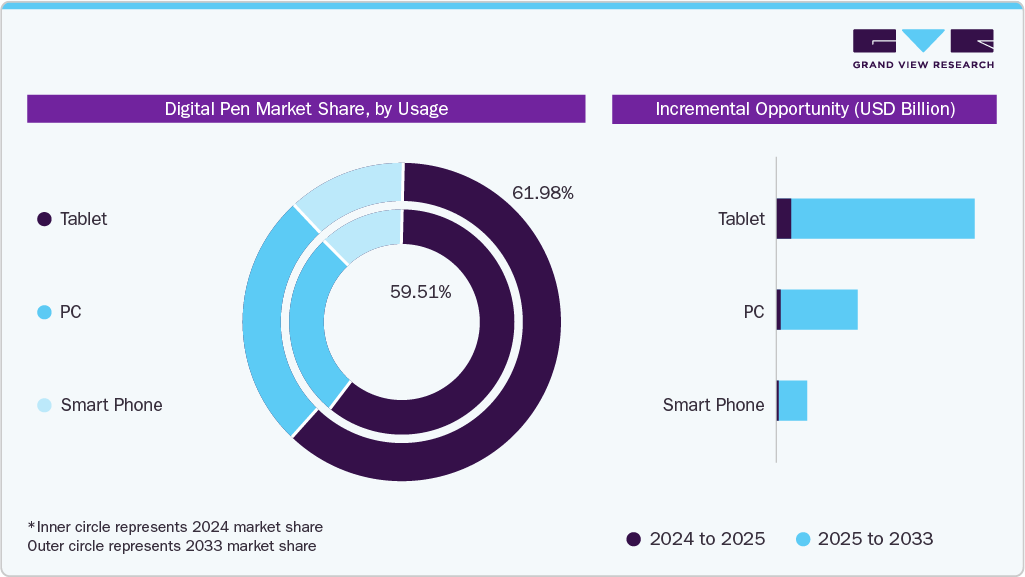
The smartphone segment is anticipated to grow at the fastest CAGR of 13.8 % from 2026 to 2033, as consumers increasingly use stylus-enabled devices for on-the-go note-taking, messaging, and creative tasks. Compact smartphones with integrated or compatible pens, such as Samsung Galaxy S series with S Pen and LG Stylo series, attract students, professionals, and creative users who value portability without sacrificing functionality. Rising smartphone adoption in emerging markets, coupled with increasing productivity and content-creation use cases, fuels the segment’s high projected CAGR during the forecast period.
End Use Insights
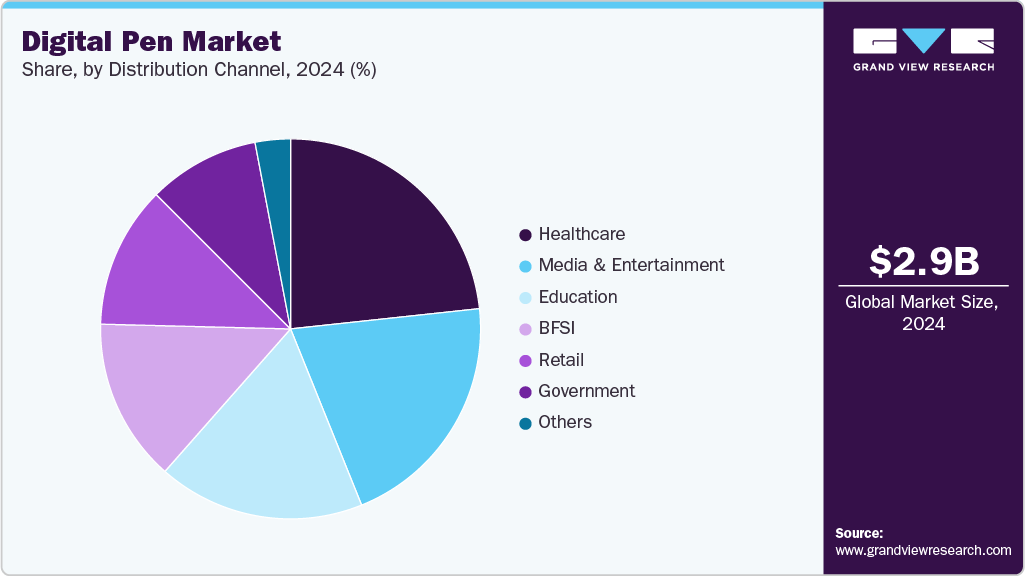
The healthcare segment led the market with the largest revenue share of 22.8% in 2025, as digital pens streamline record-keeping, prescription writing, and patient charting, reducing errors and improving workflow efficiency. Hospitals and clinics increasingly adopt stylus-enabled tablets and hybrid devices to digitize patient records and support telemedicine applications. Products like Wacom and Microsoft Surface pens are commonly integrated into EMR/EHR systems, enabling precise input and compliance with regulatory standards, which drives steady demand in this segment. According to an article published by PMC, a survey of 208 U.S. medical students reported that 59.7% preferred using a tablet over paper for note‑taking, citing benefits like ease of annotation and portability.
The education segment is anticipated to grow at the fastest CAGR of 5.9% from 2026 to 2033, as schools and universities shift toward digital learning, e-textbooks, and interactive classrooms. Stylus-compatible tablets and hybrid devices enhance note-taking, diagram drawing, and collaborative learning, particularly in K-12 and higher education. Observational studies in K-12 schools in South Korea and Singapore found that classroom adoption of tablets with pens increased student engagement scores by 15-20%, particularly for STEM and art subjects. Affordable digital pens from brands like Lenovo, Adonit, and XP-Pen, combined with government initiatives promoting e-learning in countries like India, China, and South Korea, are driving adoption and contributing to the segment’s steady CAGR during the forecast period.
Regional Insights
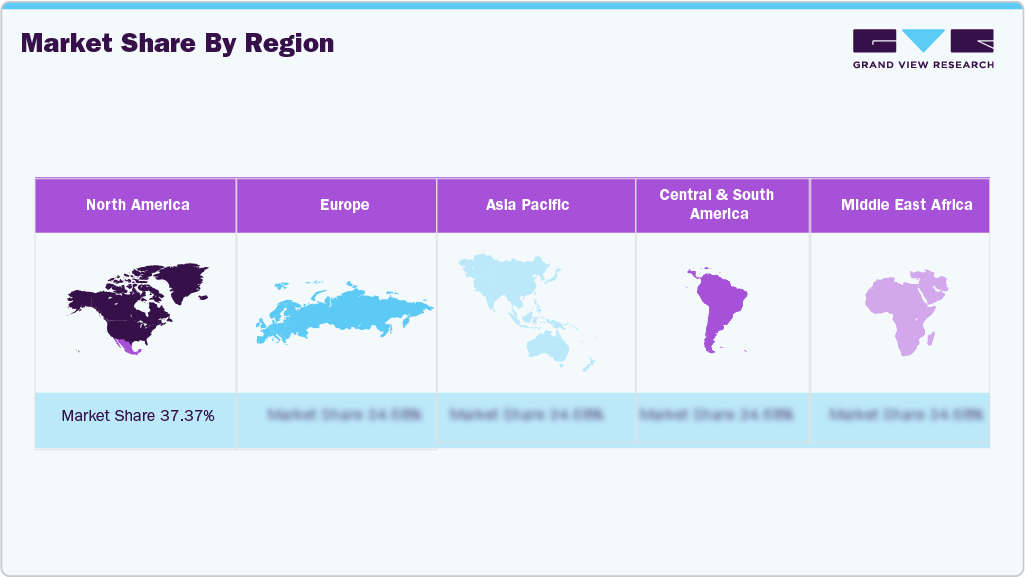
North America dominated the digital pen market with the largest revenue share of 37.2% in 2025, primarily due to the high adoption of tablets, 2-in-1 laptops, and stylus-compatible devices in the professional, educational, and creative sectors. Growth is driven by productivity-focused users in enterprises, universities, and design studios, who demand precise, low-latency styluses for note-taking, digital sketching, and workflow integration. The U.S. contributes explicitly significantly, with strong uptake of Apple Pencil, Microsoft Surface Pen, and Wacom products, supported by wide retail availability, software ecosystem integration, and early technology adoption, leading to sustained revenue dominance.
U.S. Digital Pen Market Trends
The digital pen market in U.S. held the largest share in the North America region in 2025, fueled by increasing demand for stylus-enabled devices in remote work, online education, and creative industries. Rising adoption of digital learning tools in schools and higher education, combined with corporate investments in collaborative devices like the Surface Pro series and iPad Pro, drives higher penetration.
Asia Pacific Digital Pen Market Trends
The digital pen market in Asia Pacific is anticipated to witness at the fastest CAGR of 15.0% from 2026 to 2033, driven by a large student population, expanding creative industries, and rising smartphone and tablet penetration. Countries such as China, India, Japan, and South Korea are seeing increasing adoption of affordable digital pens for education, graphic design, and office productivity. The proliferation of e-learning, government initiatives for digital classrooms, and the expansion of affordable regional brands like Lenovo, Xiaomi, and Adonit further accelerate market growth in this region.
Key Digital Pen Company Insights
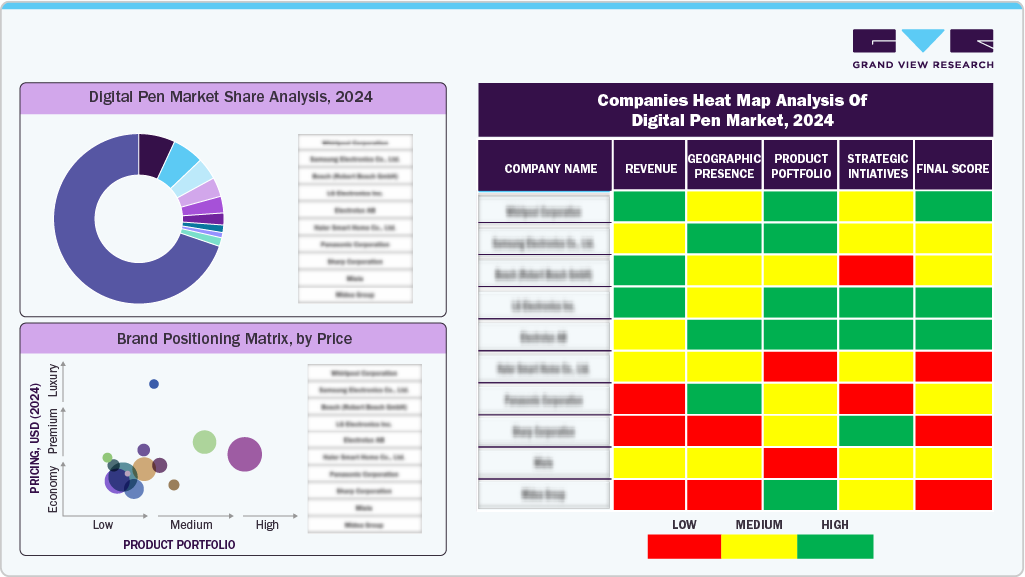
The global digital pen industry is led by established specialists, premium ecosystem brands, and emerging regional players that address productivity, education, and creative needs.
Wacom, Microsoft, Logitech, and HP dominate the mainstream and professional segments with reliable technology, broad device compatibility, and wide retail presence.
Premium brands such as Apple, Samsung, and Huawei focus on precision, low latency, and seamless software integration, appealing to digital artists and productivity-focused users.
Regional manufacturers such as Xiaomi, Lenovo, and Adonit are gaining traction in price-sensitive markets by providing affordable yet functional pens designed for mass-market tablets and hybrid devices. Their strong presence across online marketplaces and alignment with locally popular devices are strengthening their position, particularly in Asia Pacific. This multi-layered competitive structure, spanning entry-level universal styluses to premium ecosystem-bound pens, continues to define the global digital pen industry landscape.
Key Digital Pen Companies:
The following key companies have been profiled for this study on the digital pen market.
-
Wacom
-
Apple
-
Microsoft
-
Samsung
-
Logitech
-
Huawei
-
Xiaomi
-
HP
-
Lenovo
-
Adonit
-
Graco Inc.
Recent Developments
-
In July 2025, UltraProlink launched the JOT Pencil, a universal stylus designed for iPads, tablets, and smartphones, offering a 1.5 mm precision tip, palm-rejection support in iPad mode, a lightweight aluminum build, and easy mode switching for broader device compatibility.
-
In April 2025, Motorola launched the Edge 60 Stylus, a mid-range smartphone equipped with a built-in stylus—bringing productivity features typically reserved for ultra-premium devices to a more affordable price point.
Digital Pen Market Report Scope
Report Attribute
Details
Market size value in 2025
USD 3.3 billion
Estimated market size in 2026
USD 3.7 billion
Projected market size by 2033
USD 9.5 billion
Growth rate
CAGR of 14.2% from 2026 to 2033
Base year for estimation
2025
Historical data
2021 - 2024
Forecast period
2026 - 2033
Quantitative units
Revenue in USD million/billion and CAGR from 2026 to 2033
Report coverage
Revenue forecast, company ranking, competitive landscape, growth factors, and trends
Segments covered
Product, handwriting, usage, and end user
Regional scope
North America; Europe; Asia Pacific; Central & South America; Middle East & Africa
Country scope
U.S.; Canada; Mexico; Germany; UK; France; Italy; Spain; China; Japan; India; South Korea; Australia & New Zealand; Brazil; South Africa
Key companies profiled
Wacom; Apple; Microsoft; Samsung; Logitech; Huawei; Xiaomi; HP; Lenovo; Adonit; Graco Inc.
Customization scope
Free report customization (equivalent up to 8 analysts' working days) with purchase. Addition or alteration to country, regional & segment scope.
Pricing and purchase options
Avail customized purchase options to meet your exact research needs. Explore purchase options
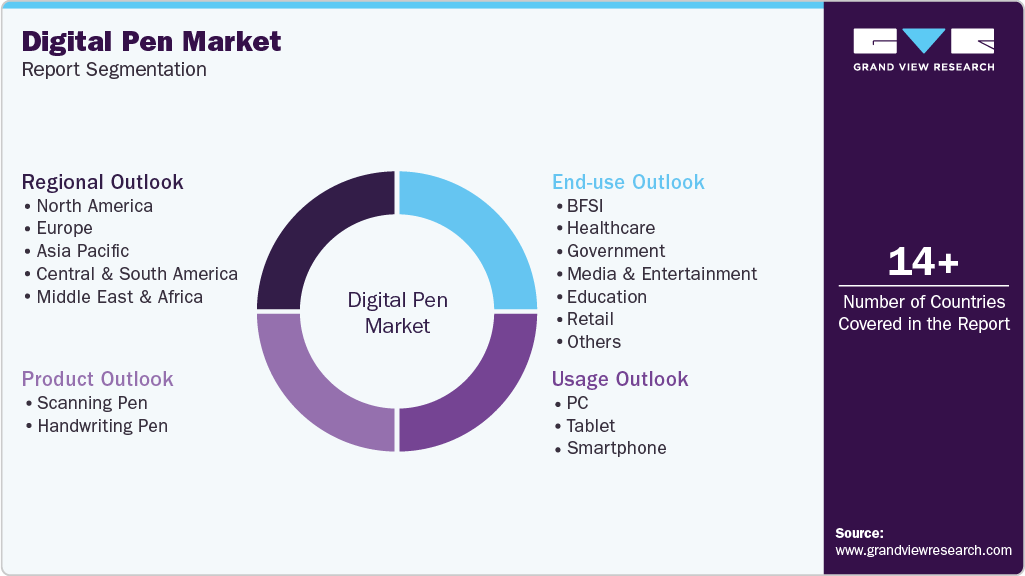
Global Digital Pen Market Report Segmentation
This report forecasts revenue growth at the global, regional, and country levels and provides an analysis of the latest industry trends and opportunities in each of the sub-segments from 2021 to 2033. For this study, Grand View Research has segmented the global digital pen market report based on the product, usage, end use, and region.
-
Product Outlook (Revenue, USD Million, 2021 - 2033)
-
Scanning Pen
-
Handwriting Pen
-
Hybrid
-
Stylus
-
-
-
Usage Outlook (Revenue, USD Million, 2021 - 2033)
-
PC
-
Tablet
-
Smartphone
-
-
End Use Outlook (Revenue, USD Million, 2021 - 2033)
-
BFSI
-
Healthcare
-
Government
-
Media & Entertainment
-
Education
-
Retail
-
Others
-
-
Regional Outlook (Revenue, USD Million, 2021 - 2033)
-
North America
-
U.S.
-
Canada
-
Mexico
-
-
Europe
-
UK
-
Germany
-
France
-
Italy
-
Spain
-
-
Asia Pacific
-
China
-
Japan
-
India
-
Australia
-
South Korea
-
-
Central & South America
-
Brazil
-
-
Middle East & Africa
-
South Africa
-
-
Research Methodology
Segment Definition
Segment - Product
Revenue capture definition
Scanning Pen
Revenue is generated through the sale of smart scanning pens that digitize physical text from printed paper and convert it into editable digital formats, typically bundled with supporting ecosystems such as smart notebooks, OCR-based mobile applications, cloud storage, and enterprise document digitization platforms. Additional recurring revenue is generated through software subscriptions for data storage, synchronization, translation, and enterprise workflow integration.
Handwriting Pen
Revenue is generated through the sale of digital pens designed for real-time handwriting and drawing input directly on electronic devices such as tablets, smartphones, laptops, and e-paper displays. These products are typically monetized as standalone hardware accessories or bundled with OEM ecosystems, with incremental revenue potential from compatible device ecosystems, productivity applications, note-taking software, and creative suite integrations.
Estimation Model
Layer Name
Key Question
Description
Population Layer
Who forms the base consumer pool?
Total consumers with potential demand for digital pens, including students, professionals, and creators, adjusted for tablet, laptop, and e-paper device penetration.
Access Layer
Who has access to digital pen ecosystem?
Consumers with access to stylus-enabled devices such as tablets, convertible laptops, interactive displays, and e-paper notebooks, across OEM ecosystems including Apple, Microsoft, Samsung, Wacom, Huawei, and others.
Behavioural Layer
Who actively uses digital pens?
Active users based on frequency of note-taking, annotation, sketching, and creative/design workflows, including students in digital learning environments, professionals in documentation-heavy roles, and creators using stylus-enabled applications.
Monetisation Layer
How much revenue is generated?
Revenue derived from active users multiplied by average annual spend on digital pens, bundled ecosystem replacement styluses, and associated accessories/software, including OEM device-linked purchases and standalone stylus sales.
Delivered Customizations
This report has been delivered with the following In-depth customizations
Client Request
Customization Delivered
Value Adds
Digital Writing Ecosystem Architecture Analysis (Device × Interaction Mode Mapping)
Mapped Scanning Pens, Handwriting Pens, Hybrid Devices, and Stylus solutions across PC, Tablet, and Smartphone usage environments to define where each input technology dominates in the digital workflow stack (capture, creation, annotation, and transfer).
Reveals how digital pen adoption is distributed across ecosystems (PC-centric documentation vs mobile-first note capture vs tablet-based creation), helping identify where product innovation should be concentrated and which device platforms are structurally winning.
Workflow Digitization & Use-Case Penetration Analysis (Input Technology × Functional Adoption)
Evaluated how different digital pen types support distinct workflows such as document digitization (scanning pens), freehand content creation (handwriting pens), real-time annotation (stylus), and hybrid capture-to-edit workflows across enterprise and consumer environments.
Identifies how value is created in workflows, not just where devices are used—pinpointing automation opportunities, productivity bottlenecks, and the most monetizable use-cases (e.g., education note capture vs BFSI documentation vs healthcare records).
Vertical-Specific Adoption & Monetization Strategy (End-User Industry × Pen Type Fitment)
Assessed adoption intensity and fitment of digital pen technologies across BFSI, Healthcare, Government, Media & Entertainment, Education, Retail, and Other sectors, linking each vertical to dominant pen formats and usage contexts.
Helps identify where revenue is structurally concentrated and why—highlighting high-velocity adoption sectors (e.g., education, healthcare documentation) versus premium/enterprise-driven pockets (e.g., BFSI compliance workflows), enabling targeted GTM and pricing strategy.
Frequently Asked Questions About This Report
The global digital pen market size was valued at USD 3.3 billion in 2025 and is estimated at USD 3.7 billion for 2026.
The global digital pen market is expected to grow at a CAGR of 14.2% from 2026 to 2033, reaching USD 9.5 billion by 2033.
Key factors that are driving the digital pen market growth include the growing need to digitize business in various sectors, including banking, healthcare, education, and retail, and the rising adoption of e-learning sites and apps among students of all ages.
The handwriting pen led with a 72.7% revenue share in 2025, while scanning pen is the fastest-growing segment.
Some key players operating in the digital pen market include Wacom; Apple; Microsoft; Samsung; Logitech; Huawei; Xiaomi; HP; Lenovo; Adonit; Graco Inc.
Digital pen for tablets held the largest revenue share of 59.8 % in 2025, while smartphone is the fastest-growing segment.
Healthcare held the largest share of 22.8% in 2025 and education is the fastest growing end user.
North America dominated with a 37.2% revenue share in 2025.
Asia Pacific is the fastest-growing region over the forecast period.
About the Author(s)
Electronic & Electrical Research Team
Consumer Goods · Electronic & ElectricalThis report was authored by the electronic & electrical research team at Grand View Research - comprising two research analysts, one senior research analyst, and one industry expert - with specialized expertise in the electronic & electrical segment of the consumer goods industry. All findings are based on proprietary consumer goods databases, executive interviews, and regulatory analysis, subject to internal peer review prior to publication.
Last Updated:
Speak to Analyst


Customize this report to your needs - add regions, segments, or data points, with 20% free customization.
Or view our licence options:


ISO 9001:2015 & 27001:2022 Certified
We are GDPR and CCPA compliant! Your transaction & personal information is safe and secure. For more details, please read our privacy policy.


