
- Home
- »
- Electronic Security
- »
-
Digital Provenance Market Size & Share Report, 2026-2033GVR Report cover

Digital Provenance Market (2026 - 2033) Size, Share & Trends Analysis Report By Component (Software, Services), By Deployment Mode (On-Premise, Cloud-Based, Hybrid), By Technology (AI & ML, Blockchain, Digital Forensics), By End Use, By Region, And Segment Forecasts
Market Size, 2025
$3.7BMarket Estimate, 2026
$4.2BMarket Forecast, 2033
$16.9BCAGR, 2026–2033
21.9%Digital Provenance Market Summary
The global digital provenance market size was valued at USD 3.7 billion in 2025 and is projected to grow from USD 4.2 billion in 2026 to USD 16.9 billion by 2033, growing at a CAGR of 21.9% from 2026 to 2033. North America dominated the digital provenance industry, accounting for the largest global revenue share of over 38.0% in 2025. The global market growth is driven by the rising adoption of AI-generated content detection technologies, the increasing need for digital content authentication, and the growing demand for blockchain-based provenance solutions.
 Source: Grand View Research, IR Documents, Primary Interviews, Paid DatabasesTo learn more about this report,
 Download Free Sample Report
 Key Market Trends & Insights
- The U.S. digital provenance industry led North America with the largest revenue share of over 77.0% in 2025.
- By component, the software segment held the dominant market position with the largest revenue share of over 73.0% in 2025.
- By deployment mode, the cloud-based segment is expected to grow at the fastest CAGR of over 24.0% from 2026 to 2033.
- By technology, the AI & ML segment accounted for the largest revenue share of over 34.0% in 2025.
- By end use, the media & entertainment segment dominated the market with a revenue share of over 27.0% in 2025.
Market Size & Forecast
- 2025 Market Size: USD 3.7 Billion
- 2033 Projected Market Size: USD 16.9 Billion
- CAGR (2026-2033): 21.9%
- North America: Largest market in 2025
Three ways to get this report
Buy it, customize it, or ask a question.Ask an Analyst
Analyst response in 1 business day
- AccessReport author, directly
- Reply timeWithin 1 working day
- No sales callDirect answer only
- FormatEmail reply
- CostFree, no cost
Get the Full Report
What the study covers
- FormatsPDF · Excel · Dashboard
- Timeline2026–2033 annual, 2025 base
- Coverage20+ countries, 5 regions
- Companies10+ key players profiled
Customize the Report
20% free customization
- IncludeCountries, segments, points
- TailorTo your product definition
- ExtendDeeper competitor detail
- OrA fully bespoke study
- Turnaround5–10 working days
The growth of the digital provenance market is driven by the increasing demand for content authenticity verification, the rising adoption of blockchain-enabled traceability solutions, and the growing need to combat deepfakes, misinformation, and digital fraud across enterprise and consumer ecosystems. Organizations are increasingly investing in digital provenance platforms to establish transparent content ownership, secure intellectual property rights, and maintain immutable audit trails for digital assets. The adoption of cloud-based provenance management solutions is accelerating as enterprises seek scalable authentication frameworks and seamless integration with existing digital workflows to improve trust, compliance, and cybersecurity resilience.The rapid expansion of digital content creation, the growing adoption of generative artificial intelligence technologies, and the increasing circulation of synthetic media are accelerating the demand for the digital provenance industry. The integration of blockchain, cryptographic watermarking, and metadata authentication technologies enables secure tracking of images, videos, documents, and digital communications across complex digital ecosystems. This growing reliance on trusted digital verification frameworks and secure content authentication is significantly strengthening demand for digital provenance solutions across global industries.
 To learn more about this report, Download Free Sample Report
 Additionally, the rising prevalence of misinformation, deepfakes, manipulated digital evidence, and online fraud is driving the adoption of digital provenance technologies. Organizations are leveraging provenance platforms to establish immutable audit trails, detect unauthorized alterations to content, and improve trust in digital communications. The integration of AI-powered forensic analysis, real-time verification systems, and automated authenticity checks enables enterprises to identify fraudulent media, protect brand reputation, and strengthen cybersecurity resilience. This growing focus on digital trust and content integrity is expanding the role of digital provenance solutions across media, financial services, legal, and public-sector environments.
Moreover, the growing complexity of digital intellectual property management and the increasing demand for transparent ownership verification are significantly driving the adoption of digital provenance platforms. Enterprises, artists, publishers, and content creators are increasingly implementing provenance technologies to protect copyrights, manage licensing rights, and ensure traceability of digital assets throughout their lifecycle. The incorporation of decentralized identity systems, tokenized ownership frameworks, and interoperable provenance standards is improving accountability and enabling secure collaboration across distributed digital ecosystems, thereby reinforcing the importance of digital provenance technologies in modern content economies.
Market Dynamics
The rapid growth of generative artificial intelligence platforms and synthetic media creation is significantly driving demand for digital provenance solutions across global industries. Organizations are increasingly implementing provenance technologies to verify content authenticity, track ownership history, and detect manipulated media in real time. The growing prevalence of deepfakes, AI-generated misinformation, and digital fraud is encouraging enterprises to adopt secure authentication frameworks, cryptographic watermarking systems, and metadata verification tools to strengthen digital trust and transparency.
The increasing adoption of Content Credentials standards, blockchain-enabled verification systems, and AI-powered forensic analysis platforms is accelerating market expansion. Media companies, social media platforms, governments, and enterprises are investing heavily in provenance infrastructure to improve accountability and ensure secure digital communication. The integration of cloud-based authentication systems and interoperable provenance frameworks is further supporting the scalable deployment of digital provenance technologies across enterprise and consumer digital ecosystems.
The lack of universal interoperability standards and fragmented implementation approaches is restraining the growth of the digital provenance industry. Organizations often face challenges integrating provenance technologies across multiple platforms, content formats, and enterprise systems due to inconsistent metadata structures and authentication protocols. Variations in regional regulatory frameworks and differing approaches to AI content disclosure are creating operational complexity for enterprises deploying provenance solutions.
The lack of globally unified governance frameworks for authenticating AI-generated content is slowing enterprise adoption in some sectors. Many organizations remain concerned about compatibility limitations, long-term data validation, and the technical complexity associated with implementing blockchain-enabled provenance infrastructure. Smaller enterprises also face budget and resource constraints related to deploying advanced cryptographic verification systems and maintaining secure provenance management environments across distributed digital networks.
The increasing digitalization of enterprise operations and the growing need for trusted information exchange are creating major growth opportunities for the digital provenance market. Organizations across healthcare, finance, legal services, e-commerce, and government sectors are increasingly adopting provenance technologies to strengthen cybersecurity, secure digital records, and improve compliance with emerging AI governance regulations. Rising demand for transparent data management and authenticated communication systems is accelerating enterprise investment in provenance infrastructure.
The expansion of decentralized identity technologies, blockchain ecosystems, and cloud-native verification platforms is opening new revenue opportunities for market participants. Enterprises are focusing on integrating provenance capabilities into digital asset management systems, secure collaboration platforms, and AI-governance frameworks to improve operational transparency and reduce fraud risks. The growing emphasis on responsible AI deployment and trusted digital ecosystems is expected to further accelerate the adoption of scalable digital provenance solutions.
Market Concentration & Characteristics
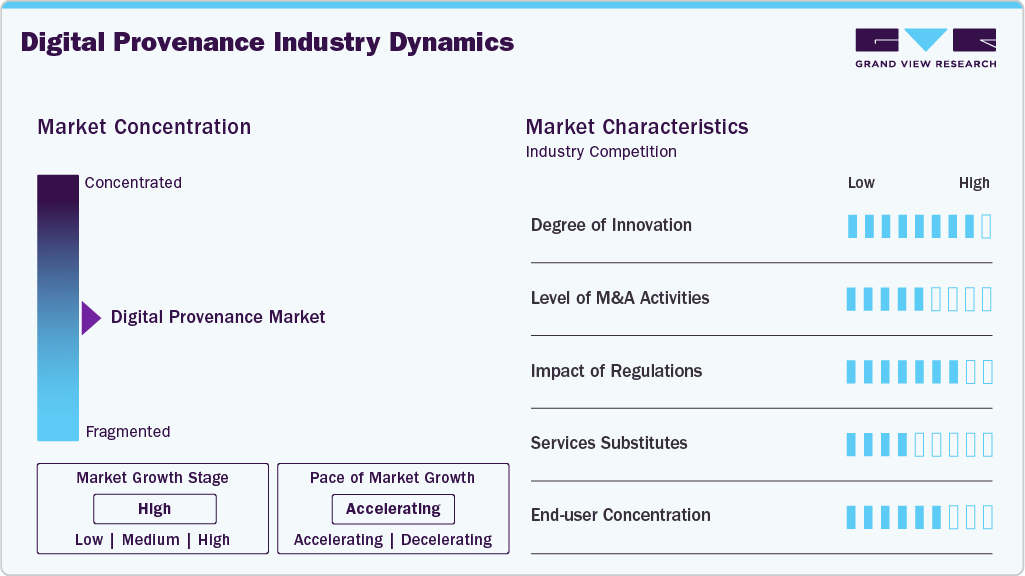
The digital provenance market is moderately concentrated, with a mix of large technology companies, cybersecurity providers, blockchain platform developers, and emerging AI authentication startups competing. The market is experiencing growth driven by the rapid expansion of generative AI technologies, rising concerns about deepfakes, and digital misinformation. Strategic collaborations, partnerships, and technology integration initiatives are becoming increasingly common as companies aim to strengthen AI-content verification capabilities, expand provenance interoperability standards, and enhance secure digital asset authentication platforms. Continuous investments in cryptographic watermarking, blockchain-enabled traceability, and AI-powered forensic analysis are emerging as core competitive strategies in the market.
 To learn more about this report, Download Free Sample Report
 The market is characterized by a very high degree of innovation, supported by rapid advancements in AI watermarking technologies, metadata authentication systems, decentralized identity frameworks, and content provenance standards such as C2PA. The industry is witnessing moderate merger and acquisition activities as technology providers seek to strengthen digital trust infrastructure and expand AI governance capabilities. Competition from conventional cybersecurity tools and standalone content verification solutions remains moderate. Growing investments in responsible AI deployment, enterprise digital governance, secure media authentication, and trusted online communication ecosystems are expected to accelerate the expansion of the digital provenance market.
Component Insights
The software segment dominated the digital provenance market, accounting for the largest revenue share of over 73.0% in 2025, propelled by the deployment of digital watermarking platforms, metadata authentication tools, and blockchain-enabled provenance management systems. Enterprises are increasingly adopting advanced provenance software to automate content traceability, detect manipulated media, and manage secure digital ownership records. The rapid integration of generative AI monitoring capabilities and cloud-native verification engines is reinforcing the software segment's dominance.
The services segment is expected to grow at a significant CAGR of over 19.0% from 2026 to 2033. The segment growth is driven by increasing demand for provenance consulting, deployment support, and managed authentication services. Enterprises are increasingly relying on third-party expertise to integrate provenance frameworks with existing cybersecurity, media management, and AI governance infrastructures. The rapid expansion of compliance-focused digital trust strategies and enterprise AI transparency initiatives is expected to accelerate global demand for digital provenance services.
Deployment Mode Insights
The cloud-based segment accounted for the largest share of the digital provenance industry in 2025, fueled by increasing enterprise preference for scalable verification infrastructure and centralized digital trust management platforms. Cloud-native provenance systems enable organizations to authenticate AI-generated media, monitor content integrity, and manage large volumes of digital assets. Growing investments in SaaS-based authentication frameworks, remote collaboration ecosystems, and real-time provenance analytics are strengthening the adoption of cloud-based deployment models.
 To learn more about this report, Download Free Sample Report
 The hybrid segment is expected to grow at a significant CAGR from 2026 to 2033, driven by rising enterprise demand for flexible, compliance-focused provenance architectures. Organizations are increasingly combining private infrastructure for sensitive data authentication with cloud-enabled verification capabilities for scalable content monitoring and interoperability. The growing adoption of multi-cloud environments, decentralized digital workflows, and secure enterprise collaboration platforms is accelerating the adoption of hybrid deployment strategies in the industry.
Technology Insights
The AI & ML segment accounted for the largest market share in 2025, driven by increasing deployment of AI-generated content authentication systems, rising demand for automated deepfake detection, and growing adoption of intelligent media verification platforms. Organizations are increasingly leveraging AI and ML technologies to identify manipulated content, validate digital ownership, and improve real-time authenticity. The integration of automated forensic analysis and AI-powered watermarking systems is sustaining the segment’s dominance.
The NLP analytics segment is expected to witness a significant CAGR from 2026 to 2033. This growth is driven by the increasing need to analyze AI-generated text, detect misinformation, and authenticate digital communication across enterprise and media ecosystems. Organizations are increasingly deploying NLP-based provenance solutions to verify the authenticity of textual content, identify manipulated language patterns, and improve trust in digital communications. The rising focus on automated text verification and multilingual content monitoring is expected to accelerate adoption in the market.
End Use Insights
The media & entertainment segment accounted for the largest share of the digital provenance market in 2025, driven by the rapid growth of AI-generated content, rising concerns about deepfakes and misinformation, and the growing demand for authenticated digital media ecosystems. Media companies are increasingly adopting digital provenance technologies to verify content authenticity, track ownership history, and strengthen copyright protection. The growing adoption of content credentials and AI watermarking systems is sustaining the segment's dominance.
The healthcare segment is expected to grow at a significant CAGR from 2026 to 2033. This growth is driven by the increasing need for secure patient data authentication, the rising adoption of digital health records, and growing concerns regarding healthcare data manipulation. Healthcare organizations are increasingly deploying digital provenance solutions to improve medical record traceability, secure digital communications, and maintain data integrity. The growing focus on regulatory compliance, trusted data exchange, and AI-enabled systems is expected to accelerate market adoption.
Regional Insights
The North America digital provenance market held the largest share of over 38.0% in 2025, driven by the rising adoption of AI-generated content authentication technologies, increasing cybersecurity concerns related to digital misinformation, and strong investments in secure digital infrastructure across enterprise and government sectors. The region is witnessing growing demand for blockchain-enabled provenance platforms, content verification systems, and tamper-detection technologies to combat deepfakes and digital fraud. The increasing integration of AI-powered forensic analytics, decentralized identity frameworks, and cloud-based verification solutions is accelerating the deployment of advanced digital provenance technologies.
 To learn more about this report, Download Free Sample Report
 U.S. Digital Provenance Market Trends
The U.S. dominated the market with a share of over 77.0% in 2025, fueled by the strong presence of leading AI companies, cybersecurity providers, and digital media platforms investing heavily in content authenticity and trust verification systems. The growing prevalence of synthetic media, manipulated online content, and AI-driven fraud is prompting enterprises to adopt comprehensive provenance frameworks that maintain immutable audit trails and enable real-time content validation. Continuous advancements in blockchain infrastructure, AI-based content-detection algorithms, and secure metadata-authentication technologies are driving sustained market growth in the country.
Europe Digital Provenance Market Trends
The Europe digital provenance industry is expected to grow at a CAGR of over 19.0% from 2026 to 2033. Market growth is driven by stringent data governance regulations, increased focus on responsible AI deployment, and rising investments in secure digital identity ecosystems. The region is experiencing strong demand for provenance technologies to improve transparency, protect digital intellectual property, and ensure compliance with evolving digital content regulations. The integration of interoperable authentication standards, privacy-centric verification platforms, and blockchain-enabled traceability systems is improving digital accountability across the market.
The UK digital provenance market is expected to grow significantly in the coming years, driven by increased investments in digital media security, the adoption of AI governance frameworks, and the growing demand for trusted online content verification solutions. The country is focusing on deploying AI-powered authenticity detection systems, secure digital watermarking technologies, and cloud-based provenance platforms to strengthen digital trust across enterprise and public communication networks. The growing emphasis on combating misinformation, protecting journalistic integrity, and improving cybersecurity resilience is boosting demand for advanced digital provenance solutions in the country.
The digital provenance market in Germany is expected to grow, driven by the country’s strong focus on industrial cybersecurity, the increasing adoption of secure digital documentation systems, and the growing emphasis on protecting intellectual property. The country is witnessing the growing adoption of blockchain-enabled traceability platforms, encrypted data authentication systems, and digital compliance tools to improve secure information exchange. Strong government support for digital transformation initiatives and enterprise-grade cybersecurity frameworks is encouraging the deployment of highly reliable digital provenance technologies across industrial and corporate environments.
Asia Pacific Digital Provenance Market Trends
The Asia Pacific digital provenance industry is expected to grow at the fastest CAGR of over 25.0% from 2026 to 2033, driven by rapid digitalization, increasing internet penetration, and growing concerns regarding online fraud, counterfeit digital assets, and manipulated media content. The region is experiencing strong demand for scalable provenance solutions to secure digital ecosystems, authenticate digital transactions, and strengthen trust in online platforms. The growing deployment of AI-based verification technologies, blockchain-powered audit systems, and cloud-native provenance infrastructure, along with government-led cybersecurity initiatives, is significantly enhancing demand for advanced digital provenance solutions across the region.
The Japan digital provenance market is gaining traction, driven by the increasing adoption of AI-driven content management systems, a strong focus on digital trust frameworks, and growing investments in secure information verification technologies. The country is focusing on integrating digital provenance solutions into enterprise cybersecurity strategies, intellectual property protection systems, and digital media authentication workflows. The growing emphasis on high-quality digital governance, secure data exchange, and advanced identity verification is encouraging investments in reliable and high-performance provenance platforms in Japan.
The digital provenance market in China is rapidly expanding, driven by strong government initiatives to modernize cybersecurity and the rapid growth of digital commerce platforms. The country is witnessing growing adoption of digital provenance solutions to monitor the authenticity of online content, strengthen digital transaction security, and improve traceability across digital ecosystems. The expansion of blockchain infrastructure, smart identity management systems, and AI-enabled verification platforms is accelerating the adoption of advanced provenance technologies across media, e-commerce, and enterprise sectors.
Key Digital Provenance Company Insights
Some of the key players operating in the market are Adobe Inc. and Microsoft Corporation, among others.
-
Adobe Inc. is a global player in the digital provenance market, driven by its strong focus on Content Credentials, AI-generated content transparency, and secure digital asset authentication technologies. The company plays a major role in advancing C2PA standards and provides integrated provenance capabilities across its creative software ecosystem to verify content origin, ownership, and editing history. Its continuous investments in cryptographic metadata, generative AI transparency tools, and creator-focused authenticity solutions are strengthening its leadership position in the market.
-
Microsoft Corporation is a major player in the digital provenance industry, offering advanced cloud-based security, identity verification, and AI governance solutions that support trusted digital ecosystems. The company is actively integrating provenance frameworks, secure authentication technologies, and responsible AI practices into its enterprise and cloud platforms to combat misinformation and digital manipulation. Its strong capabilities in cybersecurity, blockchain integration, and enterprise-scale digital trust infrastructure are enhancing its competitive position in the market.
Truepic and Digimarc Corporation are some of the emerging participants in the digital provenance market.
-
Truepic is an emerging player providing secure image authentication and digital verification solutions, specializing in cryptographic signing, metadata validation, and tamper-detection technologies. The company supports enterprises, insurers, and financial institutions in verifying the authenticity of digital images and media assets through secure provenance tracking systems. Its growing focus on AI-driven content verification and trusted visual media authentication is enhancing its competitive market position.
-
Digimarc Corporation is an emerging player offering digital watermarking and content identification technologies designed to improve traceability, authenticity, and secure information exchange across digital ecosystems. The company enables organizations to embed imperceptible identifiers into digital content for lifecycle tracking, ownership verification, and counterfeit prevention applications. Its increasing emphasis on automated content authentication, brand protection, and secure digital identity solutions is strengthening its presence in the digital provenance industry.
Key Digital Provenance Companies
The following key companies have been profiled for this study on the digital provenance market.
-
Adobe Inc.
-
Microsoft Corporation
-
Google LLC
-
Meta Platforms, Inc.
-
IBM Corporation
-
Truepic
-
Digimarc Corporation
-
Intel Corporation
-
Qualcomm Technologies, Inc.
-
Oracle Corporation
Competitive Benchmarking
Operating Strategies
Competitive Edge
Weaknesses
Mature Players: Adobe Inc.; Microsoft Corporation; IBM Corporation
- Focus on expanding interoperable provenance ecosystems through cloud, AI, and authentication technology partnerships.
- Invest heavily in AI transparency, blockchain verification, and scalable digital trust infrastructure development.
- Strong global enterprise presence and advanced cybersecurity expertise support digital provenance market leadership.
- Broad customer ecosystems and trusted authentication capabilities enable scalable enterprise provenance solution deployment.
- Dependence on complex legacy enterprise infrastructure may slow adoption of evolving provenance technologies.
- Large operational structures can reduce agility compared to emerging digital provenance technology competitors.
Emerging Players: Truepic; Digimarc Corporation
- Expanding AI-powered authentication platforms through strategic enterprise and cybersecurity technology.
- Invest in blockchain verification, watermarking technologies, and scalable cloud-based provenance.
- Strong specialization in digital authentication and tamper-detection technologies supports competitive market positioning.
- Agile innovation capabilities enable rapid deployment of advanced provenance verification and security solutions.
- Limited global presence and smaller enterprise networks may restrict large-scale market penetration capabilities.
- Dependence on external technology partnerships can create scalability and interoperability implementation challenges.
Recent Developments
-
In April 2026, Adobe Inc. expanded Content Credentials integration across Adobe Premiere Pro, Adobe Media Encoder, and Adobe Experience Manager to strengthen provenance tracking and AI-content transparency for enterprise media workflows. The company enhanced tamper-evident metadata capabilities and secure creator attribution features to support trusted digital asset authentication across large-scale content ecosystems. This development highlights the accelerating adoption of enterprise-grade provenance infrastructure and authenticated content management solutions in the digital provenance industry.
-
In April 2026, Google LLC expanded the deployment of its SynthID watermarking framework across AI-generated text, video, image, and audio content generated through Gemini and DeepMind platforms. The company strengthened provenance verification capabilities by embedding invisible identifiers into generative AI outputs to improve synthetic media detection and traceability. This expansion highlights the growing role of AI watermarking and automated authenticity verification technologies in the market.
-
In February 2026, Microsoft Corporation collaborated with Adobe and other C2PA ecosystem partners to support interoperable Content Credentials deployment across enterprise AI and cloud platforms. The company focused on expanding provenance-enabled AI governance frameworks and authenticated media verification capabilities for enterprise digital environments. This collaboration highlights the growing demand from enterprises for interoperable AI governance and trusted content-authentication infrastructure in the digital provenance market.
Digital Provenance Market Report Scope
Report Attribute
Details
Market size valued in 2025
USD 3.7 billion
Market size value in 2026
USD 4.2 billion
Revenue forecast in 2033
USD 16.9 billion
Growth rate
CAGR of 21.9% from 2026 to 2033
Base year for estimation
2025
Historical data
2021 - 2024
Forecast period
2026 - 2033
Quantitative units
Revenue in USD billion and CAGR from 2026 to 2033
Report Product
Revenue forecast, company ranking, competitive landscape, growth factors, and trends
Segments covered
Component, deployment mode, technology, end use, and region
Region scope
North America; Europe; Asia Pacific; Latin America; Middle East & Africa
Country scope
U.S.; Canada; Mexico; UK; Germany; France; China; Japan; India; South Korea; Australia; Brazil; Saudi Arabia; UAE; South Africa
Key companies profiled
Adobe Inc.; Microsoft Corporation; Google LLC; Meta Platforms, Inc.; IBM Corporation; Truepic; Digimarc Corporation; Intel Corporation; Qualcomm Technologies, Inc.; Oracle Corporation
Customization scope
Free report customization (equivalent to up to 8 analyst’s working days) with purchase. Addition or alteration to country, regional & segment scope.
Pricing and purchase options
Avail customized purchase options to meet you exact research needs. Explore purchase options
Global Digital Provenance Market Report Segmentation
This report forecasts revenue growth at the global, regional, and country levels and provides an analysis of the latest technological trends in each of the sub-segments from 2021 to 2033. For this study, Grand View Research has segmented the digital provenance market report based on component, deployment mode, technology, end use, and region:
-
Component Outlook (Revenue, USD Billion, 2021 - 2033)
-
Software
-
Services
-
-
Deployment Mode Outlook (Revenue, USD Billion, 2021 - 2033)
-
On-Premise
-
Cloud-Based
-
Hybrid
-
-
Technology Outlook (Revenue, USD Billion, 2021 - 2033)
-
AI & ML
-
Blockchain
-
Digital Forensics
-
NLP Analytics
-
Others
-
-
End Use Outlook (Revenue, USD Billion, 2021 - 2033)
-
BFSI
-
Media & Entertainment
-
Government & Defense
-
Healthcare
-
IT & Cybersecurity
-
Retail & E-commerce
-
Others
-
-
Regional Outlook (Revenue, USD Billion, 2021 - 2033)
-
North America
-
U.S.
-
Canada
-
Mexico
-
-
Europe
-
UK
-
Germany
-
France
-
-
Asia Pacific
-
China
-
Japan
-
India
-
South Korea
-
Australia
-
-
Latin America
-
Brazil
-
-
Middle East and Africa (MEA)
-
Saudi Arabia
-
UAE
-
South Africa
-
-
Delivered Customizations
This report has been delivered with the following In-depth customizations
Client Objective
Custom Research Modules Delivered
Strategic Value / Business Impact
Technology & Innovation Assessment
Emerging technology trend analysis
Innovation pipeline and patent review
Technology adoption readiness assessment
Ecosystem and partnership mapping
Identified future growth areas
Supported innovation roadmap planning
Evaluated commercialization potential
Strengthened strategic partnership decisions
Customer & End-User Insights Study
Consumer awareness and adoption analysis
Purchase decision journey mapping
Satisfaction and loyalty assessment
Usage pattern and pain-point evaluation
Revealed key adoption drivers and barriers
Supported customer-centric product development
Improved targeting and engagement strategy
Identified opportunities for retention and upselling
Frequently Asked Questions About This Report
The global digital provenance market size was estimated at USD 3.7 billion in 2025 and is expected to reach 4.2 billion in 2026.
The global digital provenance market is expected to grow at a compound annual growth rate of 21.9% from 2026 to 2033 to reach USD 16.9 billion by 2033.
The software segment accounted for the largest market share of over 73% in 2025, propelled by the deployment of digital watermarking platforms, metadata authentication tools, and blockchain-enabled provenance management systems. Enterprises are increasingly adopting advanced provenance software to automate content traceability, detect manipulated media, and manage secure digital ownership records. The rapid integration of generative AI monitoring capabilities and cloud-native verification engines is reinforcing the software segment's dominance in the digital provenance market.
Some key players operating in the industrial automation & control systems market include Adobe Inc., Microsoft Corporation, Google LLC, Meta Platforms, Inc., IBM Corporation, Truepic, Digimarc Corporation, Intel Corporation, Qualcomm Technologies, Inc., Oracle Corporation
The market growth is driven by the rising adoption of AI-generated content detection technologies, the increasing need for digital content authentication, and the growing demand for blockchain-based provenance solutions.
About the Author(s)
Electronic Security Research Team
Semiconductors & Electronics · Electronic SecurityThis report was authored by the electronic security research team at Grand View Research - comprising two research analysts, one senior research analyst, and one industry expert - with specialized expertise in the electronic security segment of the semiconductors & electronics industry. All findings are based on proprietary semiconductors & electronics databases, executive interviews, and regulatory analysis, subject to internal peer review prior to publication.
Last Updated:
Speak to Analyst

Customize this report to your needs - add regions, segments, or data points, with 20% free customization.
Or view our licence options:


ISO 9001:2015 & 27001:2022 Certified
We are GDPR and CCPA compliant! Your transaction & personal information is safe and secure. For more details, please read our privacy policy.


