
- Home
- »
- Semiconductors
- »
-
Digital Signal Processor Market Size Report, 2026-2033GVR Report cover

Digital Signal Processor Market (2026 - 2033)
Size, Share & Trends Analysis Report By Type (General-purpose DSPs, Application-specific DSPs), By Application (Communications, Radar & Sensing), By End-use, By Region, and Segment Forecasts
Market Size, 2025
$11.6BMarket Estimate, 2026
$12.3BMarket Forecast, 2033
$20.5BCAGR, 2026–2033
7.6%Digital Signal Processor Market Summary
The global digital signal processor market size was valued at USD 11.6 billion in 2025 and is projected to grow from USD 12.3 billion in 2026 to USD 20.5 billion by 2033, at a CAGR of 7.6% from 2026 to 2033. Asia Pacific dominated the market, accounting for a revenue share of 36.4% in 2025. The global market is growing as demand for efficient signal processing increases across telecommunications, automotive, and consumer electronics.
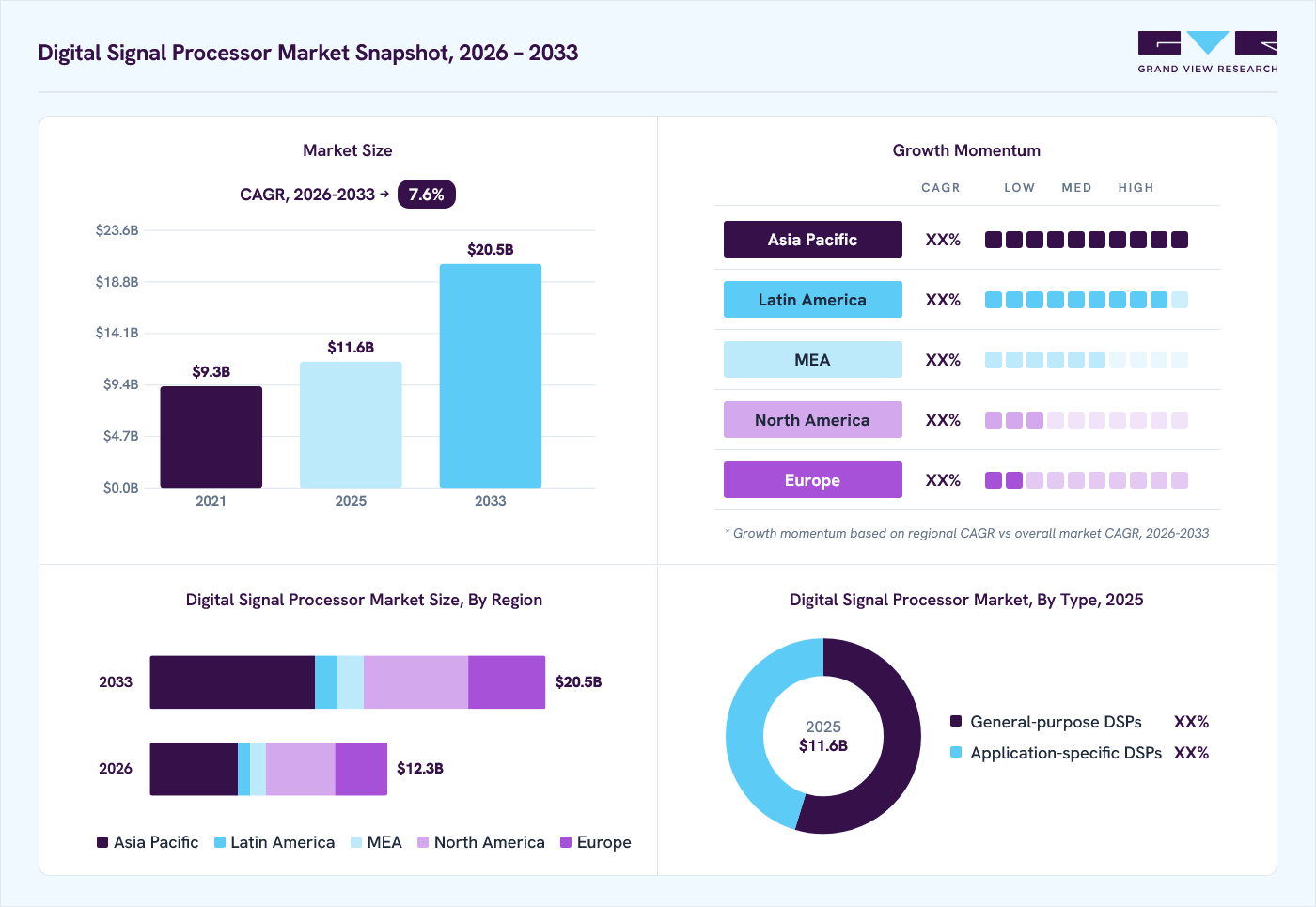 Source: Grand View Research, IR Documents, Primary Interviews, Paid DatabasesTo learn more about this report,
 Download Free Sample Report
Key Market Trends & Insights
- By type: General-purpose DSPs segment held the largest market share of around 54.7% in 2025.
- By application: Communications segment held the largest market revenue share in 2025.
- By end use: Telecommunications segment led the market with the largest revenue share in 2025.
Regional Highlights
- Largest regional market: Asia Pacific (36.4% revenue share, 2025)
- By country: China held the largest market share in 2025.
Market Size & Forecasts
- Market size in 2025: USD 11.6 Billion
- Estimated market size in 2026: USD 12.3 Billion
- Projected market size by 2033: USD 20.5 Billion
- CAGR (2026-2033): 7.6%
Prism AI by Grand View Research Free to tryAsk a question about the digital signal processor marketTry asking✓Every figure cited from GVR research Prefer the report? Download free sample →
The growing use of connected devices is increasing the need for faster data processing. This is encouraging the adoption of digital signal processors (DSPs) in communication systems, vehicle electronics, and industrial equipment. Continuous improvements in processing capabilities are expected to support further market growth. Growing demand for efficient, high-performance signal processing across consumer electronics, automotive, telecommunications, and industrial applications is driving the digital signal processor market. The increasing use of connected devices, advanced communication systems, and intelligent automotive technologies is creating demand for faster processing and improved energy efficiency. These requirements are encouraging the development of advanced DSP architectures capable of handling complex computational workloads while reducing power consumption. For instance, in January 2026, Cadence Design Systems, Inc., a U.S.-based semiconductor and electronic design automation (EDA) company launched the Tensilica HiFi iQ DSP IP, offering 2× greater computing performance and 8× higher AI performance than its predecessor. This launch aims to support next-generation voice AI and advanced audio applications by improving processing performance and energy efficiency across smartphones, automotive infotainment, and home entertainment systems.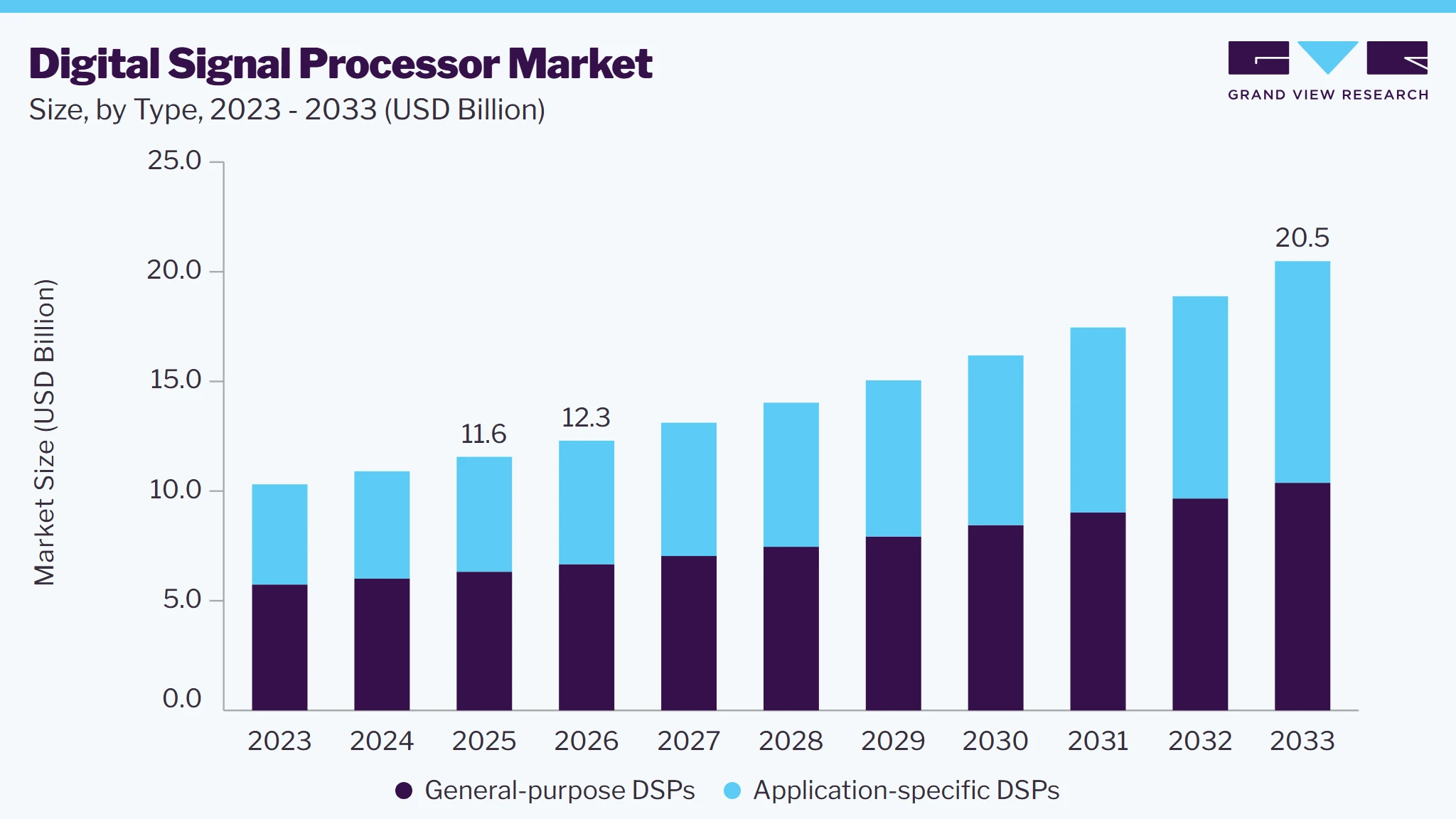 To learn more about this report, Download Free Sample Report
The increasing integration of DSPs into advanced driver-assistance systems (ADAS) and automotive sensing technologies is expanding their role in vehicle safety and real-time perception. DSPs process signals from radar, cameras, and other sensors to support functions such as object detection, occupant monitoring, collision avoidance, and adaptive cruise control. As automakers introduce more advanced safety features and intelligent in-cabin systems, demand is increasing for DSP architectures that deliver high processing performance with low power consumption and predictable response times. For instance, in January 2025, Texas Instruments Incorporated, a U.S.-based semiconductor company, introduced the AM275x-Q1 microcontrollers and AM62D-Q1 processors featuring an integrated C7x DSP core to support advanced automotive audio processing and in-cabin experiences. The devices support applications such as active noise cancellation, spatial audio, and intelligent audio processing.
The growing demand for advanced automotive electronics and intelligent vehicle systems is increasing the adoption of digital signal processors (DSPs) across the automotive industry. The expansion of advanced driver assistance systems (ADAS), adaptive cruise control (ACC), and connected vehicle technologies is raising signal processing requirements. DSPs support real-time signal processing, sensor data interpretation, noise reduction, and control functions, improving vehicle safety and system performance. Increasing integration of ACC features across passenger vehicles and pickup trucks is further creating demand for automotive ACC digital signal processors. These developments are supporting the growth of the vehicle ACC digital signal processor market and the broader digital signal controller and processor market.
The increasing use of electronic control units and intelligent vehicle technologies is creating new opportunities for digital signal processors. Modern vehicles rely on efficient processing systems to manage engine control, vehicle stability, braking, powertrain functions, and other electronic operations. The growing integration of advanced sensors, driver-assistance features, and real-time control capabilities is further increasing the need for reliable processing solutions. This development is supporting demand across the pickup ACC digital signal processor market, particularly as pickup trucks adopt more advanced electronic and safety features. In addition, the use of adaptive cruise control (ACC) and other vehicle control technologies requires accurate processing of sensor inputs and driving conditions. The convergence of signal processing and embedded control functions is also expanding opportunities in the digital signal controller & processor market. Ongoing advancements in vehicle electronics, automation, and intelligent safety systems are expected to support the adoption of DSP-based solutions throughout the forecast period.
Market Dynamics
The digital signal processor (DSP) market is growing as demand for high-speed, energy-efficient signal processing increases across telecommunications, automotive, consumer electronics, and industrial applications. The expansion of connected devices, advanced wireless networks, and AI-enabled systems is increasing the need for processors capable of handling complex computational workloads. Continuous advancements in semiconductor architectures and signal processing technologies are creating opportunities for market participants across the broader digital signal controller & processor market. However, high development costs, design complexity, and power efficiency requirements may influence market growth.
The increasing adoption of digital technologies across consumer electronics, telecommunications, automotive, and industrial sectors is driving demand for digital signal processors. These processors enable efficient processing of audio, video, communication, and sensor data in applications that require fast and accurate responses. The expansion of 5G networks, connected devices, and advanced driver-assistance systems is further increasing the need for high-performance signal processing capabilities. DSPs support functions such as noise cancellation, image enhancement, signal filtering, and real-time data processing. The growing use of these capabilities across a broad range of electronic systems is supporting market expansion.
Moreover, the integration of artificial intelligence into edge devices and embedded systems is increasing demand for DSP architectures that can manage computationally intensive workloads with lower power consumption. Manufacturers are developing processors with enhanced computing performance and energy efficiency to support applications such as voice recognition, machine vision, and intelligent audio processing. The need for reliable, real-time processing across increasingly sophisticated electronic devices is expected to continue driving market growth. In the automotive sector, increasing adoption of advanced driver-assistance systems (ADAS) and adaptive cruise control (ACC) is creating demand for specialized processors, supporting the automotive ACC digital signal processor market.
The development of digital signal processors involves substantial research and development expenditure, specialized semiconductor design expertise, and advanced manufacturing processes. Designing DSP architectures that deliver high processing performance while maintaining low power consumption and thermal efficiency can be technically challenging. These requirements may increase development timelines and raise costs for manufacturers, particularly those developing processors for specialized applications. The need to meet stringent performance and reliability requirements can further complicate product development.
Furthermore, integrating DSPs into existing electronic systems may require hardware modifications, software optimization, and compatibility testing. Differences in processor architectures, instruction sets, and development environments can increase integration complexity for equipment manufacturers. Smaller companies may face difficulties competing with established semiconductor providers that have greater research capabilities and broader product portfolios. These factors may constrain market entry and slow adoption in cost-sensitive applications.
The growing deployment of AI-enabled devices is creating opportunities for DSP manufacturers to develop processors optimized for on-device intelligence and real-time signal analysis. Applications such as voice assistants, smart cameras, wearable devices, industrial monitoring systems, and automotive electronics require efficient processing of large volumes of data. DSPs can support these applications by performing specialized computations locally, reducing processing delays and dependence on cloud-based systems. This creates opportunities for manufacturers to introduce architectures that combine signal processing capabilities with AI acceleration and improved energy efficiency.
The expansion of advanced automotive electronics and next-generation communication infrastructure is creating opportunities for DSP adoption. Automotive applications, including radar processing, in-cabin audio systems, and driver-assistance technologies, require reliable processing of complex signals. The growing integration of adaptive cruise control (ACC) across vehicle categories, including pickup trucks, is increasing demand for specialized processors used in vehicle sensing and control systems. Meanwhile, telecommunications infrastructure relies on advanced signal processing for functions such as filtering, modulation, and error correction. Increasing demand for application-specific DSP solutions with improved performance, scalability, and power efficiency is expected to support adoption across these industries.
Market Concentration & Characteristics
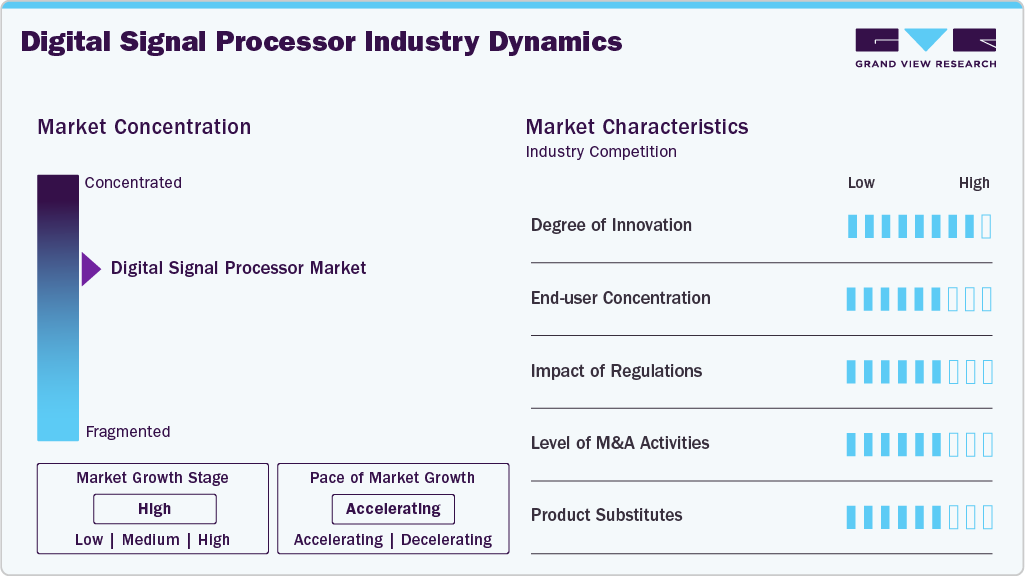
The global market is moderately concentrated, with established semiconductor manufacturers holding significant positions alongside specialized technology providers. Competition is influenced by processing performance, power efficiency, architectural flexibility, software support, and suitability for application-specific workloads. Major players leverage their semiconductor design expertise, intellectual property portfolios, established customer relationships, and broad product offerings to strengthen their market positions. Specialized providers also participate in the market by offering DSP intellectual property and customized processing solutions for embedded systems, audio applications, and AI-enabled devices.
 To learn more about this report, Download Free Sample Report
The market is characterized by the growing convergence of digital signal processing, embedded computing, and artificial intelligence. Manufacturers are developing advanced DSP architectures with improved processing capabilities and energy efficiency to address increasingly complex workloads across telecommunications, automotive, consumer electronics, and industrial applications. High research and development requirements, specialized design expertise, and stringent performance standards create barriers to entry for new participants. Meanwhile, technological innovation, strategic partnerships, and application-specific product development remain important competitive factors shaping the market.
Analyst Perspective
The global market is poised for steady growth, driven by increasing demand across telecommunications, automotive, consumer electronics, and industrial sectors. The expansion of 5G networks connected devices, and AI-enabled systems is expected to strengthen demand for efficient signal processing. Advancements in semiconductor technology and energy-efficient architectures will create further growth opportunities. However, high development costs and alternative processing technologies may pose challenges. The market outlook remains positive, supported by continued technological advancements and expanding application areas.
Type Insights
The general-purpose DSPs segment dominated the market in 2025, accounting for a 54.7% revenue share . Its dominance is attributed to its versatility across a wide range of applications and its ability to address diverse signal-processing requirements. These processors support applications across telecommunications, consumer electronics, automotive systems, and industrial equipment, where efficient and reliable data processing is essential. Their flexibility allows manufacturers to integrate them into different electronic systems based on specific performance and functional requirements. In addition, their suitability for applications such as audio processing, image enhancement, and communication signal processing supports adoption across end-use industries.
The application-specific DSPs segment is expected to register faster growth during the forecast period, driven by increasing demand for processors designed to meet specific application requirements. These processors offer optimized performance, power efficiency, and reliability across automotive, telecommunications, consumer electronics, and industrial applications. In the automotive sector, the growing integration of advanced driver-assistance systems (ADAS), including adaptive cruise control (ACC), is increasing the need for specialized signal processing capabilities. Rising adoption of AI-enabled devices and industrial automation is further expanding the demand for application-specific processing solutions. Their ability to handle complex workloads through optimized architectures is supporting adoption across diverse end-use industries. Ongoing advancements in semiconductor design are also expected to support segment growth.
Application Insights
The communications segment held the largest market share in 2025. Demand is driven by the growing need for efficient signal processing in wireless and wired communication systems. DSPs support functions such as signal modulation, filtering, noise reduction, and error correction, helping improve transmission quality and reliability. The expansion of 5G networks, high-speed data transmission, and connected devices is further increasing demand for high-performance processors. Continued advancements in communication technologies and network infrastructure are expected to sustain segment growth throughout the forecast period.
The radar and sensing segment is expected to witness steady growth during the forecast period, driven by the increasing adoption of advanced driver-assistance systems (ADAS), including adaptive cruise control (ACC), across automotive applications. Radar and sensing technologies enable object detection, distance measurement, and real-time environmental monitoring, supporting the development of intelligent vehicle safety systems. Growing adoption of industrial automation and safety monitoring solutions is further expanding the application scope of these technologies. Continued advancements in sensor accuracy, detection range, and signal processing capabilities are improving their performance across various applications. Rising demand for enhanced vehicle safety and intelligent sensing solutions is expected to support segment growth.
End Use Insights
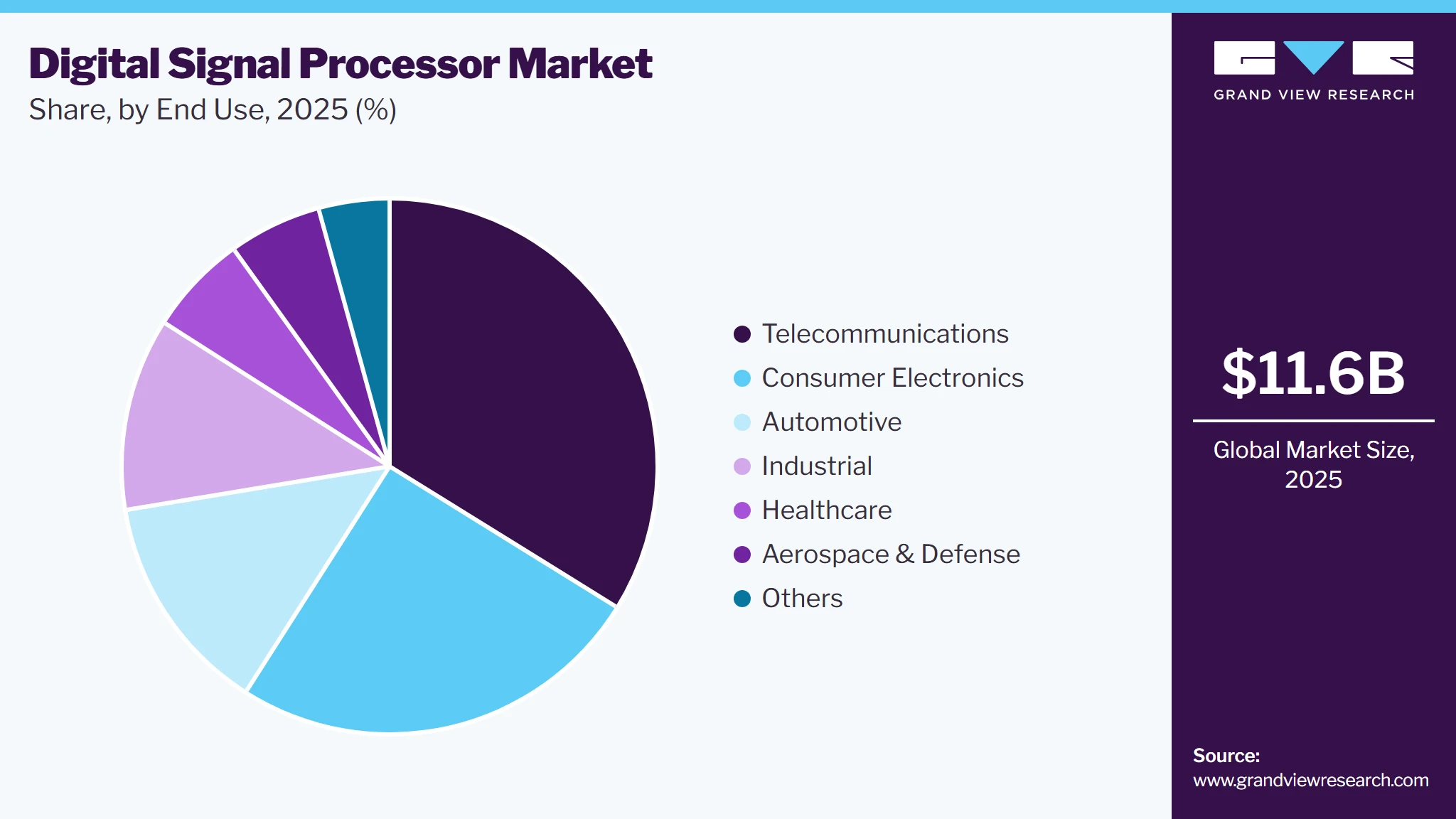
The telecommunications segment led the market in 2025. Demand is driven by the growing need for high-speed data transmission and efficient signal processing across communication networks. DSPs support essential functions such as signal filtering, modulation, noise reduction, and error correction. The expansion of 5G networks, wireless communication infrastructure, and high-speed broadband services is further strengthening segment demand. Increasing data traffic and the need for reliable connectivity are encouraging the adoption of advanced signal-processing technologies. Continued developments in communication infrastructure are expected to sustain demand for DSPs throughout the forecast period.
 To learn more about this report, Download Free Sample Report
The automotive segment is expected to witness steady growth during the forecast period, driven by the increasing adoption of advanced driver-assistance systems (ADAS), in-vehicle electronics, and connected vehicle technologies. DSPs play an important role in applications such as radar signal processing, audio enhancement, sensor data analysis, and vehicle safety systems. The growing integration of adaptive cruise control (ACC) and other driver-assistance features is increasing demand for specialized processors, supporting the vehicle ACC digital signal processor market. Furthermore, the rising use of electronic control systems and advanced infotainment features is expanding DSP applications across vehicle categories. The development of electric and autonomous vehicles is also increasing the need for efficient real-time processing capabilities. Overall, rising demand for intelligent, connected, and safety-focused vehicles is expected to support segment growth.
Regional Insights
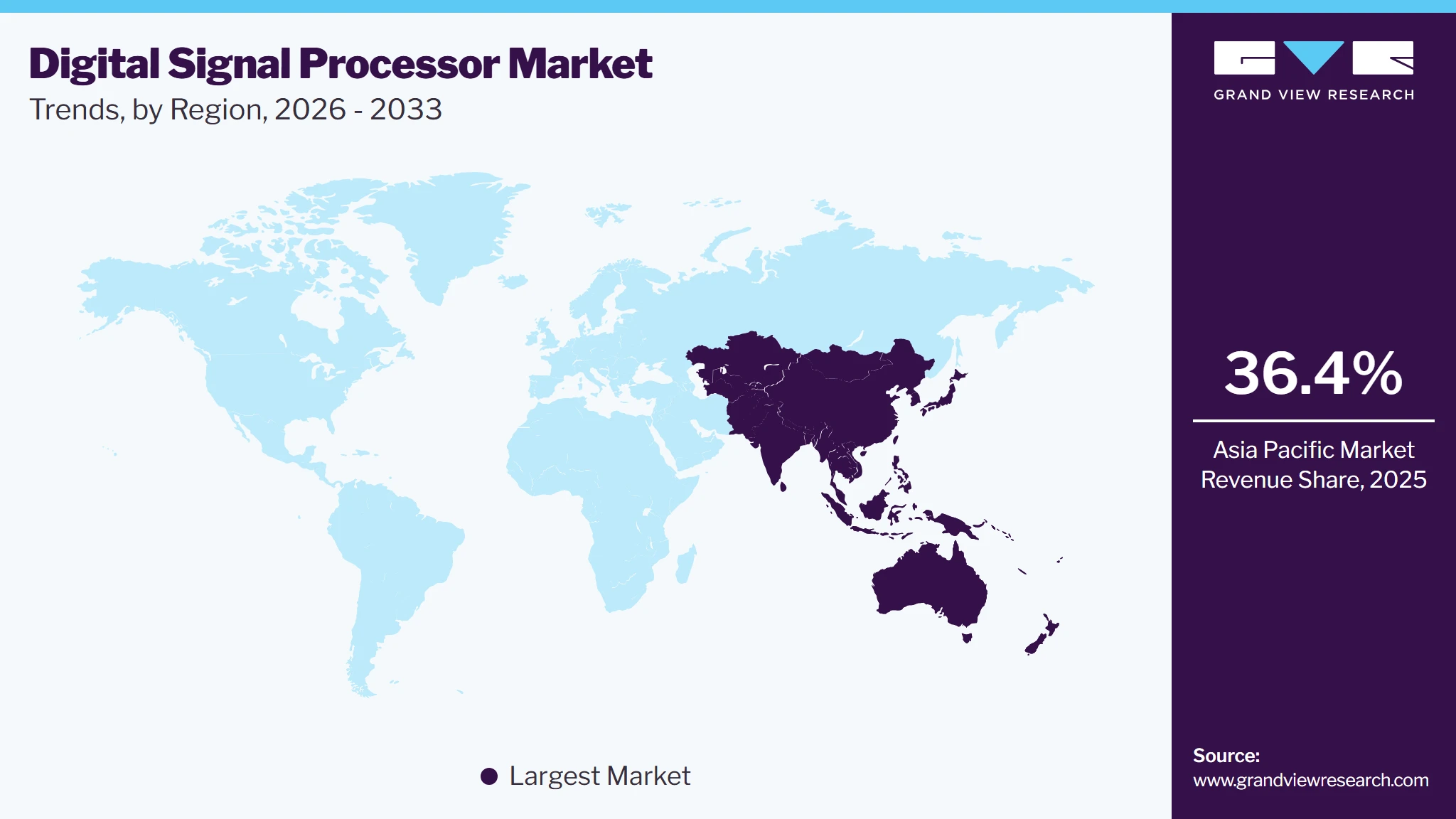
Asia Pacific dominated the market for a revenue share of 36.4% in 2025, supported by its strong electronics manufacturing base and expanding telecommunications infrastructure. The region's established semiconductor supply chains and growing demand for connected devices continue to support DSP adoption. Increasing integration of advanced processors in automotive electronics and industrial equipment is further contributing to regional demand. Ongoing expansion of 5G networks and smart technologies is expected to sustain market growth.
 To learn more about this report, Download Free Sample Report
China Digital Signal Processor Market Trends
China’s digital signal processor market is supported by its extensive electronics manufacturing ecosystem and telecommunications infrastructure. Growing production of automotive electronics, consumer devices, and industrial equipment is supporting DSP adoption. The expansion of electric vehicles and advanced driver-assistance systems (ADAS), including adaptive cruise control (ACC), is creating further demand for specialized processing capabilities and supporting the automotive ACC digital signal processor market. Continued development of 5G networks and smart manufacturing is expected to support market growth.
Japan’s digital signal processor market is supported by its well-established automotive electronics, consumer electronics, and industrial manufacturing sectors. The growing adoption of electric vehicles and advanced driver-assistance systems (ADAS) is increasing demand for efficient signal-processing solutions. The integration of adaptive cruise control (ACC) and other driver-assistance features is creating opportunities for specialized processors, supporting the automotive ACC digital signal processor market. Furthermore, increasing use of radar systems, in-vehicle infotainment, and intelligent safety technologies is expanding DSP applications across the automotive sector. Advancements in robotics, factory automation, and smart manufacturing are also driving DSP adoption across industrial applications. Continued developments in automotive electronics and communication technologies are expected to support market growth throughout the forecast period.
Europe Digital Signal Processor Market Trends
Europe’s digital signal processor market is supported by demand from automotive electronics, industrial automation, and telecommunications. The growing adoption of electric vehicles and advanced driver-assistance systems is increasing the need for efficient signal processing. The increasing integration of adaptive cruise control (ACC) in vehicles is creating further demand for specialized processors, supporting the automotive ACC digital signal processor market. DSPs are also used in industrial equipment, connected devices, and advanced communication systems. Continued development of smart manufacturing and automotive technologies is expected to support regional market growth.
North America Digital Signal Processor Market Trends
The North American digital signal processor market is benefiting from the growing use of DSPs in medical imaging, aerospace, and defense electronics. Demand for high-precision signal processing in diagnostic equipment and radar systems is supporting adoption across these applications. Increasing deployment of satellite communication systems and advanced electronic warfare technologies is further expanding the scope of DSPs. Continued advancements in high-reliability and specialized processing solutions are expected to support regional market growth.
The U.S. digital signal processor market is supported by demand from telecommunications, automotive electronics, and industrial applications. The expansion of 5G infrastructure connected vehicles, and AI-enabled devices is increasing the need for advanced signal-processing capabilities. Growing adoption of advanced driver-assistance systems, including ACC, is further supporting DSP integration and contributing to the vehicle ACC digital signal processor market. In addition, ongoing developments in edge computing and high-performance electronic systems are creating opportunities for market growth.
Key Digital Signal Processor Company Insights
Key players operating in the digital signal processor market include Analog Devices, Inc.; Broadcom; Infineon Technologies AG; Intel Corporation; Microchip Technology Inc.; NXP Semiconductors; Qualcomm Technologies, Inc.; Renesas Electronics Corporation.; STMicroelectronics; Texas Instruments Incorporated.
-
Analog Devices develops digital signal processors for applications requiring high-performance, real-time signal processing. Its DSP portfolio includes SHARC and Blackfin processor families, designed for applications such as audio processing, industrial systems, and communications. SHARC processors are widely used in professional audio equipment, automotive audio systems, and embedded applications requiring precise signal computation. Blackfin processors combine digital signal processing with control capabilities for embedded systems. The company also develops DSP technologies for applications involving sensor processing, instrumentation, and data acquisition.
-
Intel Corporation develops digital signal processing capabilities through its field-programmable gate arrays (FPGAs), including the Agilex and Stratix families. These devices incorporate dedicated DSP blocks designed to perform high-speed arithmetic operations efficiently. Intel’s variable-precision DSP architecture supports fixed-point and floating-point processing for different computational requirements. Its DSP technologies are used in applications such as radar systems, wireless communications, medical imaging, and industrial control. The company also provides DSP Builder software to help engineers design and implement signal-processing systems on compatible FPGAs.
Key Digital Signal Processor Companies
The following key companies have been profiled for this study on the digital signal processor market.
-
Analog Devices, Inc.
-
Broadcom
-
CEVA Logistics
-
Infineon Technologies AG
-
Intel Corporation
-
Microchip Technology Inc.
-
NXP Semiconductors
-
Qualcomm Technologies, Inc.
-
Renesas Electronics Corporation.
-
Retym
-
STMicroelectronics
-
Texas Instruments Incorporated
Competitive Benchmarking
Operating Strategies
Competitive Edge
Weaknesses
Mature Players: Texas Instruments, Analog Devices, NXP Semiconductors
- Focus on product development, application-specific DSP solutions, strategic partnerships, and long-term customer relationships.
- Established market presence, extensive product portfolios, strong R&D capabilities, and established customer networks.
- High R&D expenditure, complex product development, and competition from alternative processing architectures.
Emerging Players: Retym, CEVA Logistics
- Focus on specialized DSP architectures, licensable intellectual property, and energy-efficient processing for AI and edge applications.
- Specialized technology, application-focused solutions, and flexibility to address emerging processing requirements.
- Limited scale compared with established semiconductor companies, dependence on customer adoption, and challenges in expanding market reach.
Recent Developments
-
In September 2026, Cadence Design Systems, a U.S.-based semiconductor design software company collaborated with Analog Devices, Inc. to develop the next-generation SHARC-FX DSP architecture for automotive audio processors. The new architecture delivers five times higher performance than the previous-generation SHARC+ core, supporting AI-enabled noise cancellation, voice assistants, and advanced in-vehicle audio processing.
-
In March 2025, Broadcom introduced its Sian3 and Sian2M DSP PHYs for high-speed optical transceivers used in AI infrastructure, supporting 800G and 1.6T connectivity. Sian3 delivers over 20% lower power consumption for 1.6T optical modules, while Sian2M integrates VCSEL drivers to improve power and cost efficiency for short-reach connections.
-
In February 2025, CEVA launched its Ceva-XC21 and Ceva-XC23 baseband vector DSPs for advanced 5G and 6G-ready applications, including cellular IoT, satellite communications, and wireless infrastructure. The Ceva-XC23 delivers up to 2.4 times the performance, while the Ceva-XC21 offers up to 48% area reduction compared with the Ceva-XC4500, improving processing efficiency and reducing hardware requirements.
Digital Signal Processor Market Report Scope
Report Attribute
Details
Market size in 2025
USD 11.6 billion
Estimated market size in 2026
USD 12.3 billion
Projected market size by 2033
USD 20.5 billion
Growth rate
CAGR of 7.6% from 2026 to 2033
Actual data
2021 - 2025
Forecast period
2026 - 2033
Quantitative units
Revenue in USD million and CAGR from 2026 to 2033
Report coverage
Revenue forecast, company share, competitive landscape, growth factors, and trends
Segments covered
Type, application, end use, region
Regional scope
North America; Europe; Asia Pacific; Latin America; Middle East & Africa
Country scope
U.S.; Canada; Mexico; U.K.; Germany; France; China; Japan; India; South Korea; Australia; Brazil; UAE; KSA; South Africa
Key companies profiled
Analog Devices, Inc.; Broadcom; CEVA Logistics; Infineon Technologies AG; Intel Corporation; Microchip Technology Inc.; NXP Semiconductors; Qualcomm Technologies, Inc.; Renesas Electronics Corporation.; Retym ; STMicroelectronics; Texas Instruments Incorporated
Customization scope
Free report customization (equivalent to up to 8 analyst working days) with purchase. Addition or alteration to country, regional & segment scope.
Pricing and purchase options
Avail customized purchase options to meet your exact research needs. Explore purchase options
Global Digital Signal Processor Market Report Segmentation
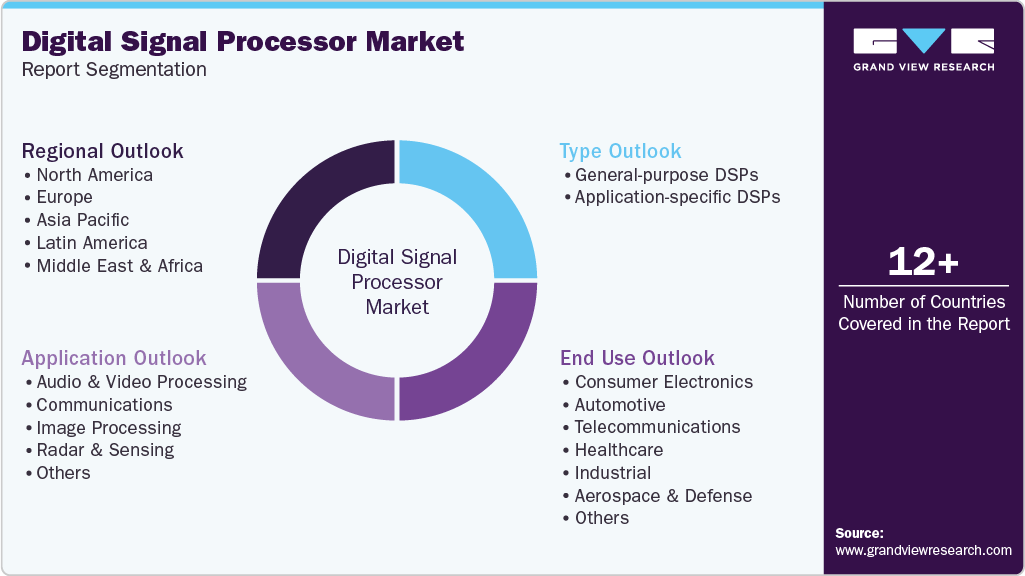
This report forecasts revenue growth at global, regional, and country levels and provides an analysis of the latest industry trends in each of the sub-segments from 2021 to 2033. For this study, Grand View Research has segmented the global digital signal processor market report based on type, application, end use, and region:
 To learn more about this report, Download Free Sample Report
-
Type Outlook (Revenue, USD Million, 2021 - 2033)
-
General-purpose DSPs
-
Application-specific DSPs
-
-
Application Outlook (Revenue, USD Million, 2021 - 2033)
-
Audio and Video processing
-
Communications
-
Image processing
-
Radar and sensing
-
Others
-
-
End Use Outlook (Revenue, USD Million, 2021 - 2033)
-
Consumer electronics
-
Automotive
-
Telecommunications
-
Healthcare
-
Industrial
-
Aerospace and defense
-
Others
-
-
Regional Outlook (Revenue, USD Million, 2021 - 2033)
-
North America
-
U.S.
-
Canada
-
Mexico
-
-
Europe
-
U.K.
-
Germany
-
France
-
-
Asia Pacific
-
China
-
Japan
-
India
-
South Korea
-
Australia
-
-
Latin America
-
Brazil
-
-
Middle East and Africa
-
UAE
-
KSA
-
South Africa
-
-
Research Methodology
The digital signal processor market figures in this report are based on a proven research process that combines executive interviews with secondary research from proprietary databases, company filings, and recognized regulatory and institutional sources. Market size is built through value-chain sizing-reconciling supply-side and demand-side estimates-and triangulated with bottom-up and top-down approaches. Every estimate passes multiple levels of expert validation before publication, with each digital signal processor segment quantified using the revenue-capture definitions in the table below.
Segment Definition
Type
Revenue Capture Definition
General-purpose DSPs
Revenue from programmable DSPs capable of handling diverse signal-processing tasks across multiple applications and industries.
Application-specific DSPs
Revenue earned through the sale of DSPs featuring specialized architectures designed to meet the processing requirements of applications.
Application
Revenue Capture Definition
Audio and Video Processing
Includes revenue associated with DSPs used for sound enhancement, noise cancellation, speech recognition, video encoding and decoding, and multimedia processing.
Communications
Revenue attributable to DSPs incorporated into communication systems for modulation, demodulation, signal filtering, data encoding, decoding, and error correction.
Image Processing
Covers sales of DSPs that perform image enhancement, noise removal, filtering, and real-time processing of visual information.
Radar and Sensing
Revenue generated by processors that analyze radar signals, interpret sensor data, detect objects, and support target tracking.
Others
Accounts for DSP revenue from applications such as biomedical signal analysis, scientific instruments, and specialized embedded systems not included in the categories above.
End Use
Revenue Capture Definition
Consumer Electronics
Encompasses DSP sales for smartphones, televisions, wearable devices, audio systems, and other consumer electronic products.
Automotive
Revenue linked to DSP integration in advanced driver-assistance systems (ADAS), vehicle radar, infotainment, in-car audio, and electronic control systems.
Telecommunications
Covers processors supplied for cellular infrastructure, base stations, broadband networks, and related telecommunications equipment.
Healthcare
Includes revenue from DSPs embedded in medical imaging devices, diagnostic systems, patient-monitoring equipment, and medical signal analysis solutions.
Industrial
Revenue derived from DSP deployment in factory automation, robotics, motor-control applications, predictive maintenance, and industrial equipment monitoring.
Aerospace and Defense
Reflects sales of DSPs for radar, satellite communications, navigation, electronic warfare, and other defense-related signal-processing systems.
Others
Captures DSP revenue from industries and end-use applications that fall outside the specified consumer, automotive, telecommunications, healthcare, industrial, and aerospace and defense categories.
Estimation Model
Layer Name
Key Question
Description
End-user Industry Layer
Which industries and organizations generate demand for third-party AI assurance services?
Identifies demand across BFSI, healthcare and life sciences, technology, government, manufacturing, automotive, retail, telecommunications, energy and utilities, and other industries adopting AI systems.
AI Assurance Service Layer
What types of independent assurance services do organizations require?
Examines demand for independent AI audits and attestation, governance and risk assurance, model validation, responsible AI assessments, security and resilience testing, and compliance and certification services.
Technology & AI System Layer
Which AI technologies and systems require independent assessment?
Evaluates assurance requirements across traditional AI and machine learning, generative AI, large language models, agentic AI, and autonomous AI, considering their technical complexity, risk exposure, and intended use.
Engagement Stage Layer
At which stages of the AI lifecycle are third-party assurance services engaged?
Assesses revenue opportunities across pre-deployment assessments, deployment-stage evaluations, post-deployment reviews, and continuous or recurring external assurance engagements.
Delivered Customizations
This report has been delivered with the following in-depth customizations
Client Objective
Custom Research Modules Delivered
Strategic Value / Business Impact
Technology & Accessibility Capability Assessment
- Analysis of DSP architectures and technology trends.
- Assessment of performance, power efficiency, and programmability.
- Evaluation of DSP requirements across key applications.
- Review of semiconductor developments and supplier capabilities.
- Identified relevant DSP technology and application opportunities.
- Supported processor selection and technology adoption planning.
- Evaluated performance and power-efficiency requirements across target applications.
- Informed technology roadmaps and product development decisions.
Product Positioning & Competitive Intelligence
- Benchmarking of DSP products across major manufacturers.
- Comparison of general-purpose and application-specific processors.
- Evaluation of specifications, performance, power efficiency, and integration.
- Assessment of product suitability across key applications and industries.
- Analysis of competitive positioning, product differentiation, and supplier capabilities.
- Identified competitive strengths and product capability gaps.
- Supported product differentiation and portfolio planning.
- Helped align processor capabilities with application-specific requirements.
- Identified opportunities to address customer needs across target applications.
- Informed competitive positioning and product strategy decisions.
Market Entry & Growth Assessment
- Global and regional DSP market sizing and forecasting.
- Segmentation by type, application, and end-use industry.
- Assessment of regional demand trends and growth drivers.
- Competitive landscape and emerging application analysis.
- Identified growth opportunities across regions and applications.
- Supported market entry and expansion planning.
- Helped prioritize target industries and customer segments.
- Informed business development and growth strategies.
Frequently Asked Questions About This Report
The global digital signal processor market size was estimated at USD 11.6 billion in 2025 and is expected to reach USD 12.3 billion in 2026.
The global digital signal processor market is expected to grow at a compound annual growth rate of 7.6% from 2026 to 2033 to reach USD 20.5 billion by 2033.
Asia Pacific dominated the digital signal processor market with a share of 36.4% in 2025. This is attributable to the strong demand for consumer electronics, rapid 5G adoption, and growing investments in telecommunications infrastructure.
The General-purpose DSPs segment led with a 54.7% revenue share in 2025, while Application-specific DSPs is the fastest-growing segment.
Key factors driving market growth include rising demand for consumer electronics, expanding 5G networks, increasing adoption of automotive electronics, and growing investments in telecommunications infrastructure.
Some key players operating in the digital signal processor market include Analog Devices, Inc.; Broadcom; CEVA Logistics; Infineon Technologies AG; Intel Corporation; Microchip Technology Inc.; NXP Semiconductors; Qualcomm Technologies, Inc.; Renesas Electronics Corporation.; Retym ; STMicroelectronics; Texas Instruments Incorporated
Asia Pacific is the fastest-growing region over the forecast period.
The communications segment accounted for the largest share of 36.1% in 2025. This growth is driven by increasing demand for high-speed data transmission, the expansion of 5G networks, and the rising adoption of advanced communication technologies.
The Telecommunications segment led with a 33.8% revenue share in 2025, while Automotive is the fastest-growing segment.
About the Author(s)
Semiconductors Research Team
Semiconductors & Electronics · SemiconductorsThis report was authored by the semiconductors research team at Grand View Research - comprising two research analysts, one senior research analyst, and one industry expert - with specialized expertise in the semiconductors segment of the semiconductors & electronics industry. All findings are based on proprietary semiconductors & electronics databases, executive interviews, and regulatory analysis, subject to internal peer review prior to publication.
Last Updated:
Speak to Analyst

Customize this report to your needs - add regions, segments, or data points, with 20% free customization.
Or view our licence options:


ISO 9001:2015 & 27001:2022 Certified
We are GDPR and CCPA compliant! Your transaction & personal information is safe and secure. For more details, please read our privacy policy.


