
- Home
- »
- Paints, Coatings & Printing Inks
- »
-
Diols Market Size, Share & Forecast Report, 2026-2033GVR Report cover

Diols Market (2026 - 2033)
Size, Share & Trends Analysis Report By Source, By Product (Ethylene Glycol, Propylene Glycol, 1,3-Propanediol, 1,4-Butanediol), By End Use (Textile and Apparel, Packaging, Automotive and Transportation) By Region, And Segment Forecasts
Market Size, 2025
$50.0BMarket Estimate, 2026
$52.5BMarket Forecast, 2033
$77.7BCAGR, 2026–2033
5.8%Diols Market Summary
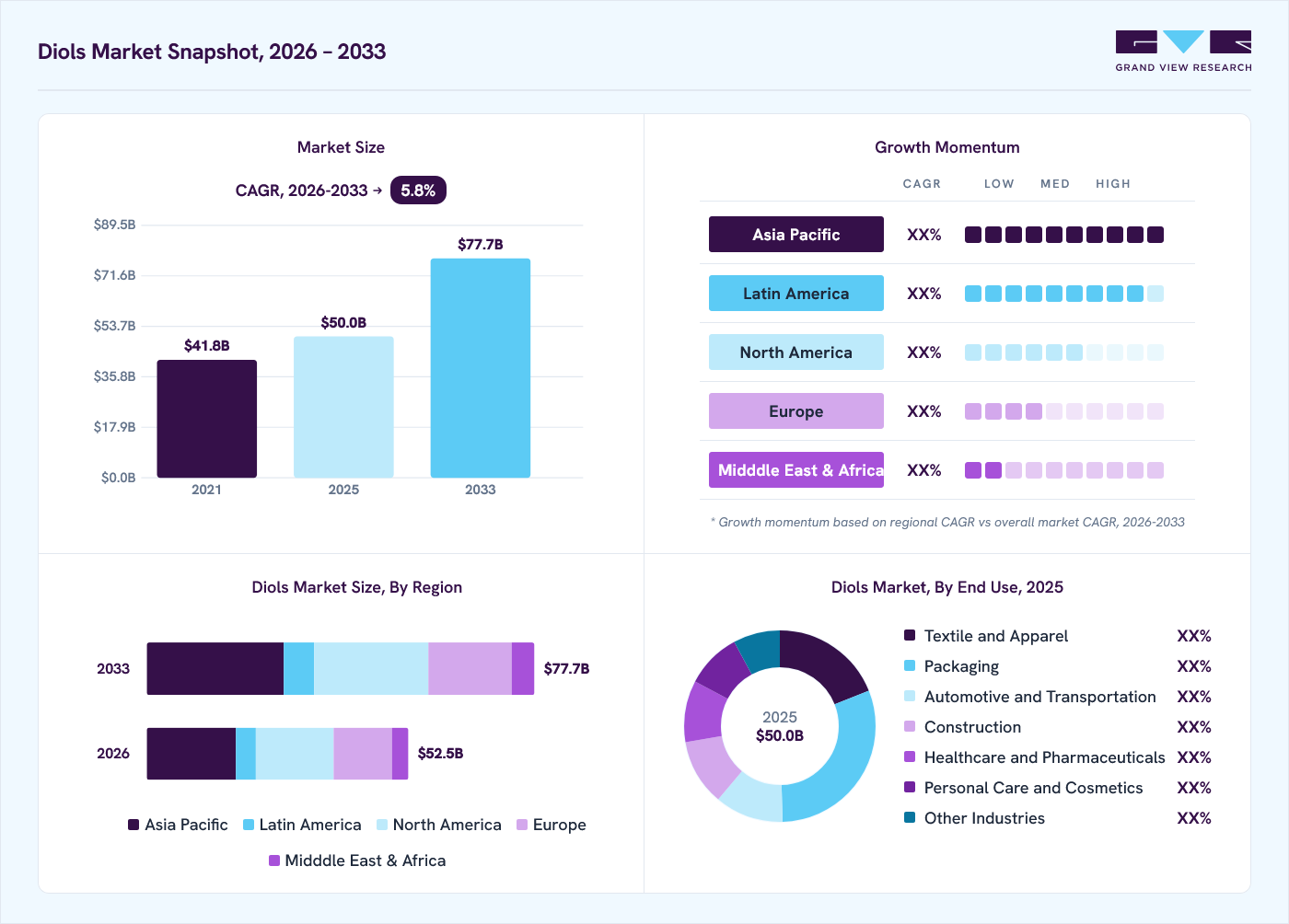
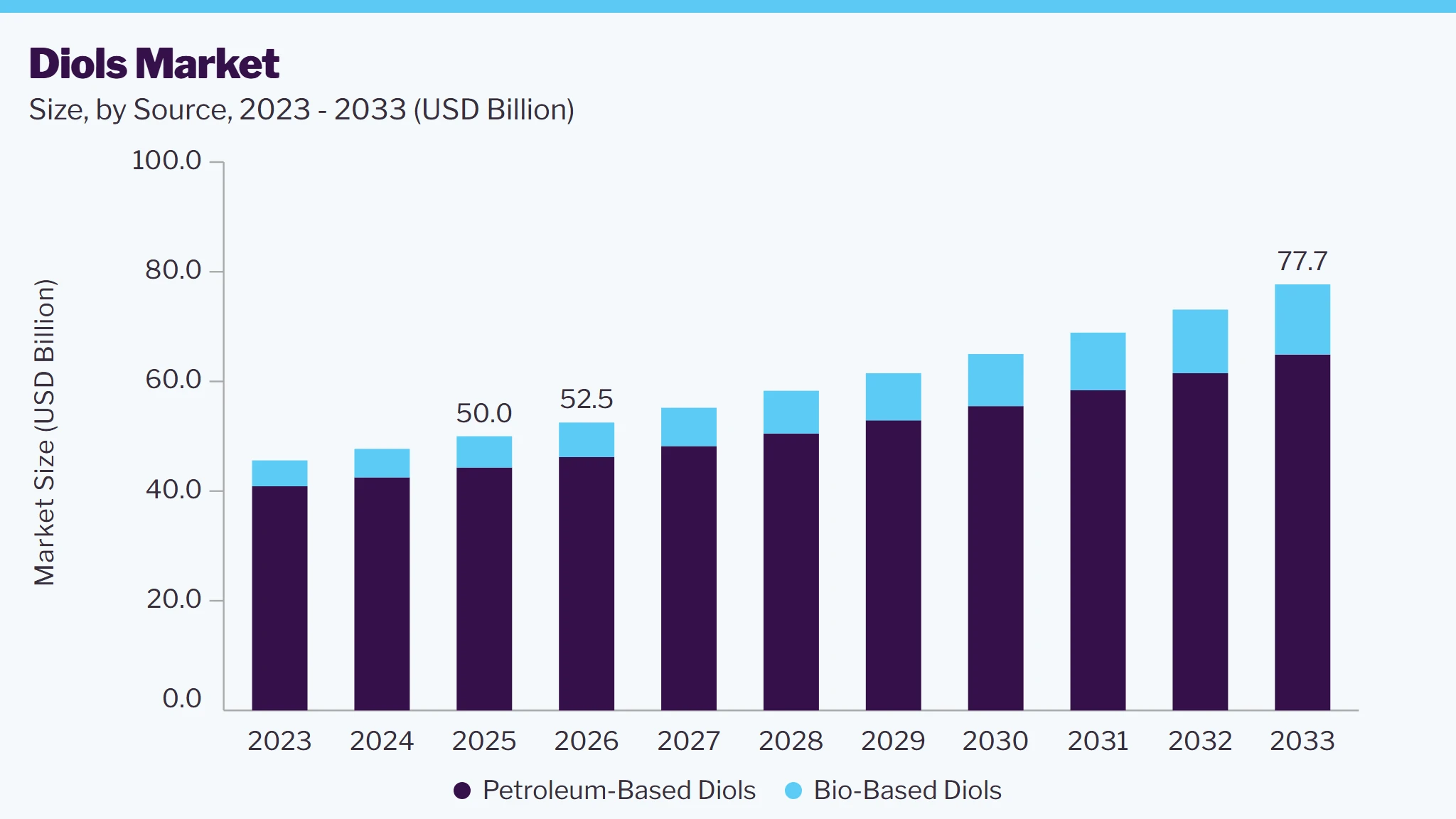
The global diols market size was valued at USD 50.0 billion in 2025 and is projected to grow from USD 52.5 billion in 2026 to USD 77.7 billion by 2033, at a CAGR of 5.8% from 2026 to 2033. The market in Asia Pacific dominated with a revenue share of 33.9% in 2025. Market expansion is supported by growing demand for ethylene glycol and propylene glycol across packaging, textile, automotive, construction, and healthcare applications, rising consumption of polyester fibers and polyethylene terephthalate (PET) resins in manufacturing, and increasing adoption of bio-based diols driven by sustainability initiatives and the need to reduce dependence on petroleum-derived chemical feedstocks.
 Source: Grand View Research, IR Documents, Primary Interviews, Paid DatabasesTo learn more about this report,
 Download Free Sample Report
Key Market Trends & Insights
- By source: Petroleum-based diols segment held the largest market share of 88.5% in 2025.
- By product: Ethylene glycol segment held the largest market share of 75.4% in 2025.
- By end use: Packaging segment held the largest market share of 30.5% in 2025.
Regional Highlights
- Largest regional market: Asia Pacific (33.9% revenue share, 2025)
- By country: China held the largest market share in 2025
Market Size & Forecast
- Market size in 2025: USD 50.0 Billion
- Estimated market size in 2026: USD 52.5 Billion
- Projected market size by 2033: USD 77.7 Billion
- CAGR (2026-2033): 5.8%
GVR research-powered AIAsk Prism AI about the diols marketGet cited answers from GVR research on market growth, segments, regulations and forecasts.Start with✓ Source-linked answers ✓ Market-specific context ✓ Traceable figuresExplore Prism AI ↗Rising demand for polyester-based materials and increasing consumption of chemical intermediates are supporting the adoption of diols across diverse industries. Applications in packaging, textile and apparel, automotive and transportation, construction, healthcare and pharmaceuticals, and personal care are expanding as manufacturers seek reliable feedstocks, consistent product performance, improved material properties, and greater efficiency in producing polymers, resins, fibers, and specialty formulations.
 To learn more about this report, Download Free Sample Report
Market Dynamics
The global diols market is influenced by rising demand for chemical intermediates and polymer feedstocks across packaging, textile and apparel, automotive and transportation, construction, healthcare, and personal care applications. Increasing consumption of polyethylene terephthalate (PET) resins, polyester fibers, antifreeze formulations, and industrial solvents is encouraging the use of ethylene glycol, propylene glycol, and other diol products across manufacturing sectors. Developments in bio-based production technologies and specialty diol applications are expanding opportunities for manufacturers seeking improved material performance and alternative feedstock options.
The growing need for polyester-based materials and chemical intermediates across packaging, textiles, automotive, construction, and healthcare applications is supporting the expansion of the global diols market. Packaging manufacturers rely on ethylene glycol as a key feedstock for polyethylene terephthalate (PET) resins used in beverage bottles, food containers, and flexible packaging films. In textile and apparel production, diols support polyester fiber manufacturing, enabling fabric producers to meet demand for durable, versatile, and cost-effective materials.
Automotive and industrial manufacturing also contribute to market growth through the use of diols in coolants, heat-transfer fluids, polyurethane systems, and specialty chemical formulations. Demand across these applications is shaped by polymer production volumes, material performance requirements, processing efficiency, and end-product durability. Growing packaged goods consumption, synthetic fiber production, vehicle manufacturing, and infrastructure development are sustaining consumption across established markets.
Fluctuations in feedstock prices and production costs present a challenge for the global diols market. Petroleum-based diols rely heavily on petrochemical inputs, including ethylene and propylene, whose prices are influenced by crude oil movements, refinery operating rates, and regional supply-demand conditions. Changes in feedstock availability, energy costs, and manufacturing expenses can affect production margins and selling prices, creating uncertainty for producers and downstream buyers.The transition toward bio-based diols also involves practical considerations related to production economics, feedstock availability, process efficiency, and product consistency. Renewable feedstocks and emerging manufacturing technologies may involve higher production costs compared with established petroleum-based processes, potentially limiting their competitiveness in price-sensitive applications. In addition, producers must maintain consistent purity and performance standards to meet specifications across polymer, textile, packaging, and specialty chemical applications. These factors can increase procurement complexity and influence purchasing decisions, particularly among cost-conscious manufacturers and downstream industries.
The increasing focus on sustainable chemical production, resource efficiency, and reduced dependence on fossil-based inputs presents a significant opportunity for the global diols market. Demand for renewable chemical alternatives is gaining importance across packaging, textile and apparel, automotive, construction, and personal care applications. Bio-based diols offer opportunities in settings where lower fossil feedstock dependence and improved sustainability profiles are valued, including polymer production, specialty materials, and formulations for consumer products.Advancements in fermentation processes, biocatalysis, and renewable feedstock conversion are also expanding the potential uses of bio-based diols. Improvements in production efficiency, product purity, process scalability, and compatibility with existing manufacturing systems can help address performance requirements across different downstream applications. Opportunities extend to polyester fibers, packaging resins, polyurethane materials, personal care ingredients, and specialty chemical intermediates where sustainability considerations influence material selection.
Market Concentration & Characteristics
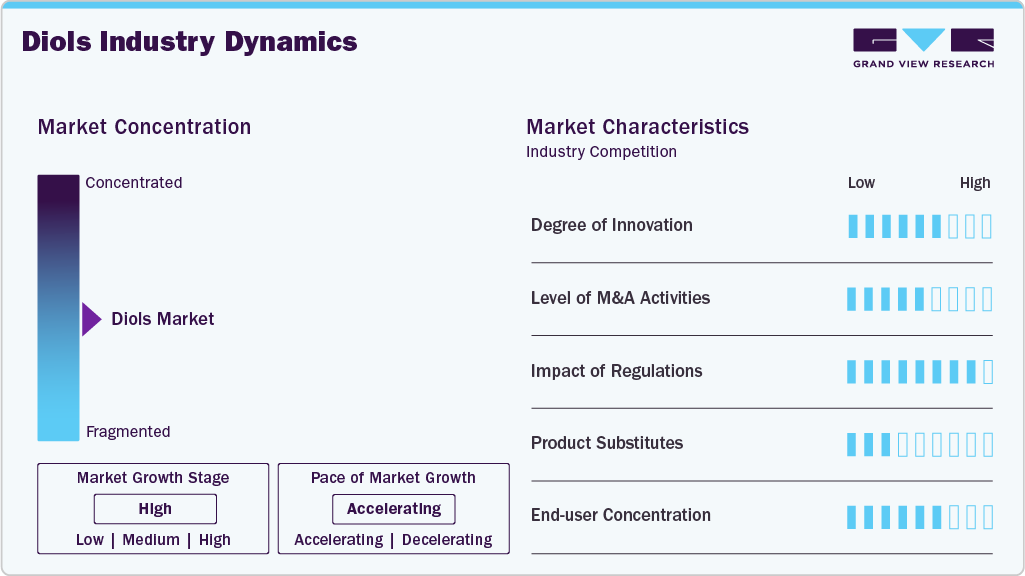
The global diols market features competition based on production capacity, feedstock integration, product purity, manufacturing efficiency, pricing, technological capabilities, and distribution reach. Market participants serve diverse requirements across packaging, textile and apparel, automotive and transportation, construction, healthcare, and personal care applications. Differences in chemical composition, processing compatibility, thermal properties, and performance in downstream formulations influence product selection across End Use categories.
 To learn more about this report, Download Free Sample Report
Competition is also shaped by capacity expansions, feedstock integration, process innovations, and the availability of application-specific diol grades across regional markets. Demand varies according to polymer production requirements, chemical purity specifications, processing conditions, end-product performance, and exposure to temperature fluctuations and industrial environments. Packaging resin manufacturing, polyester fiber production, automotive component manufacturing, and specialty chemical applications each require distinct diol properties, influencing product selection and purchasing patterns.
Analyst Perspective
The global diols market is supported by sustained demand for chemical intermediates and polymer feedstocks across packaging, textile, automotive, construction, and healthcare applications. Increasing requirements for material durability, processing efficiency, product consistency, and specialized chemical performance are shaping product preferences across End Use sectors. Growth in bio-based production technologies, improvements in manufacturing processes, and rising interest in renewable feedstocks are influencing technology adoption and creating opportunities for diol applications across established and emerging markets.
Source Insights
Petroleum-based diols accounted for the largest revenue share of 88.5% in 2025. Their established production infrastructure, extensive availability, and integration with existing petrochemical supply chains support their widespread use across packaging, textile and apparel, automotive, construction, and industrial applications. Ethylene glycol and propylene glycol remain important feedstocks for polyester resins, synthetic fibers, heat-transfer fluids, and specialty formulations. Established manufacturing processes and their suitability for high-volume industrial consumption further reinforce the segment's position in the global diols market.
Bio-based diols are projected to grow at a fastest CAGR of 10.5% from 2026 to 2033, supported by increasing interest in renewable chemical feedstocks and sustainable manufacturing practices. Developments in fermentation, biocatalysis, and biomass conversion are creating opportunities to produce diols from renewable resources for polymer manufacturing and specialty applications. Growing corporate sustainability commitments and efforts to reduce reliance on fossil-derived inputs are encouraging manufacturers to evaluate bio-based alternatives.
Product Insights
Ethylene glycol accounted for the largest revenue share of 75.4% in 2025. Its extensive use in polyethylene terephthalate (PET) resin manufacturing, polyester fiber production, and antifreeze formulations supports its leading position in the global diols market. Demand from packaging and textile manufacturers remains significant, as ethylene glycol serves as a key feedstock for producing polyester materials used in bottles, films, and synthetic fabrics. Established production infrastructure, broad industrial applicability, and consistent consumption across downstream manufacturing sectors further reinforce the segment's dominance.
1,4-Butanediol is projected to be the fastest growing segment, growing at a CAGR of 7.9% from 2026 to 2033, driven by increasing demand for high-performance polymers and specialty chemical intermediates. Its use in producing polytetramethylene ether glycol (PTMEG), thermoplastic polyurethanes, and polybutylene terephthalate (PBT) supports applications in elastomers, engineering plastics, automotive components, and industrial materials.
End Use Insights
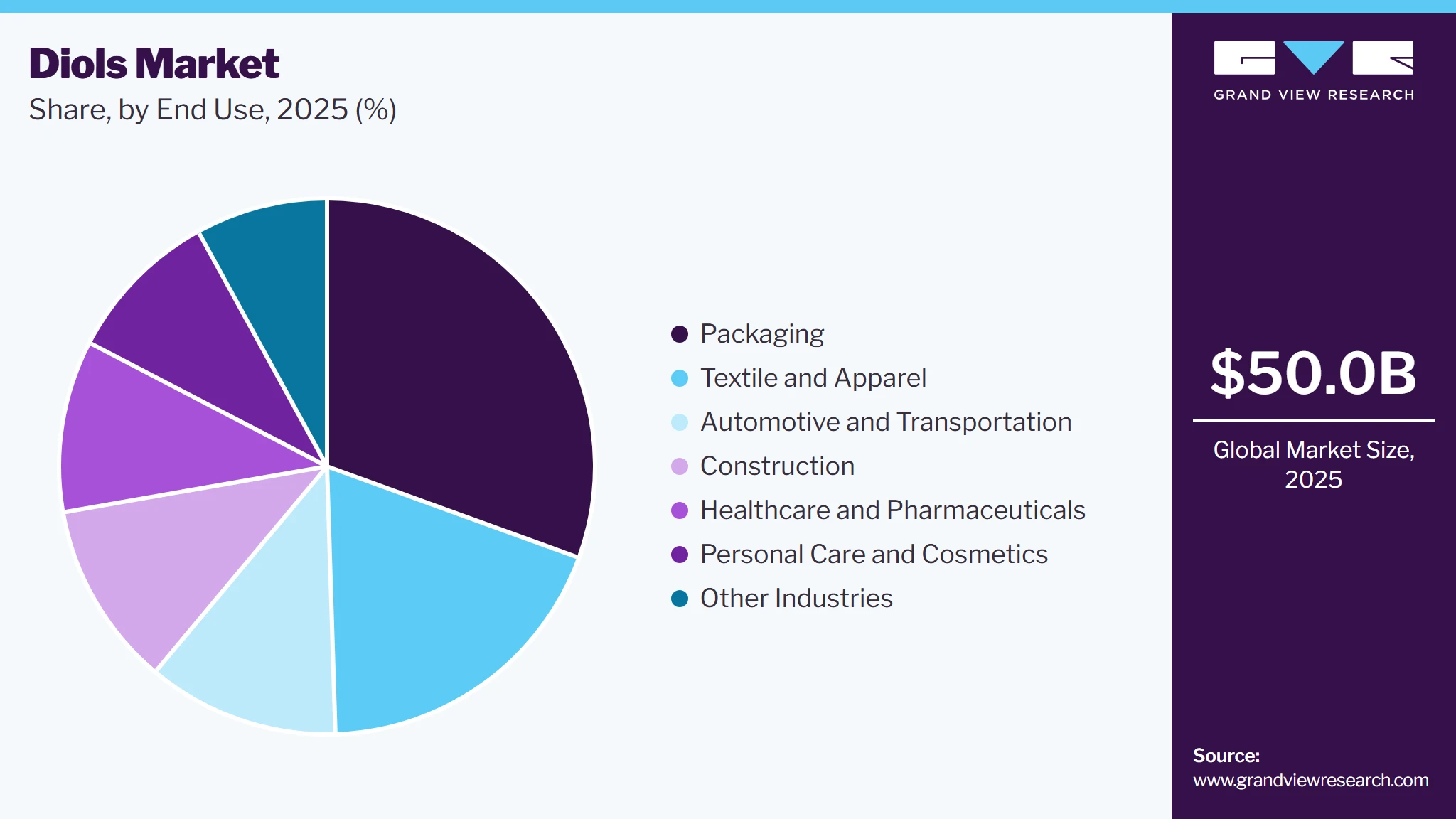
Packaging accounted for the largest revenue share of 30.5% in 2025. Extensive consumption of ethylene glycol in polyethylene terephthalate (PET) resin manufacturing supports its use in beverage bottles, food containers, and packaging films. Increasing demand for packaged food and beverages, combined with the widespread use of PET materials across consumer goods supply chains, reinforces diol consumption in this sector.
 To learn more about this report, Download Free Sample Report
Personal Care and Cosmetics is expected to register the fastest growth, advancing at a CAGR of 7.1% between 2026 and 2033. Increasing incorporation of diols into skincare, hair care, moisturizers, and personal hygiene formulations is contributing to this expansion. Propylene glycol is widely used in cosmetic products as a solvent, humectant, and carrier, helping maintain moisture levels and support the distribution of ingredients.
Regional Insights
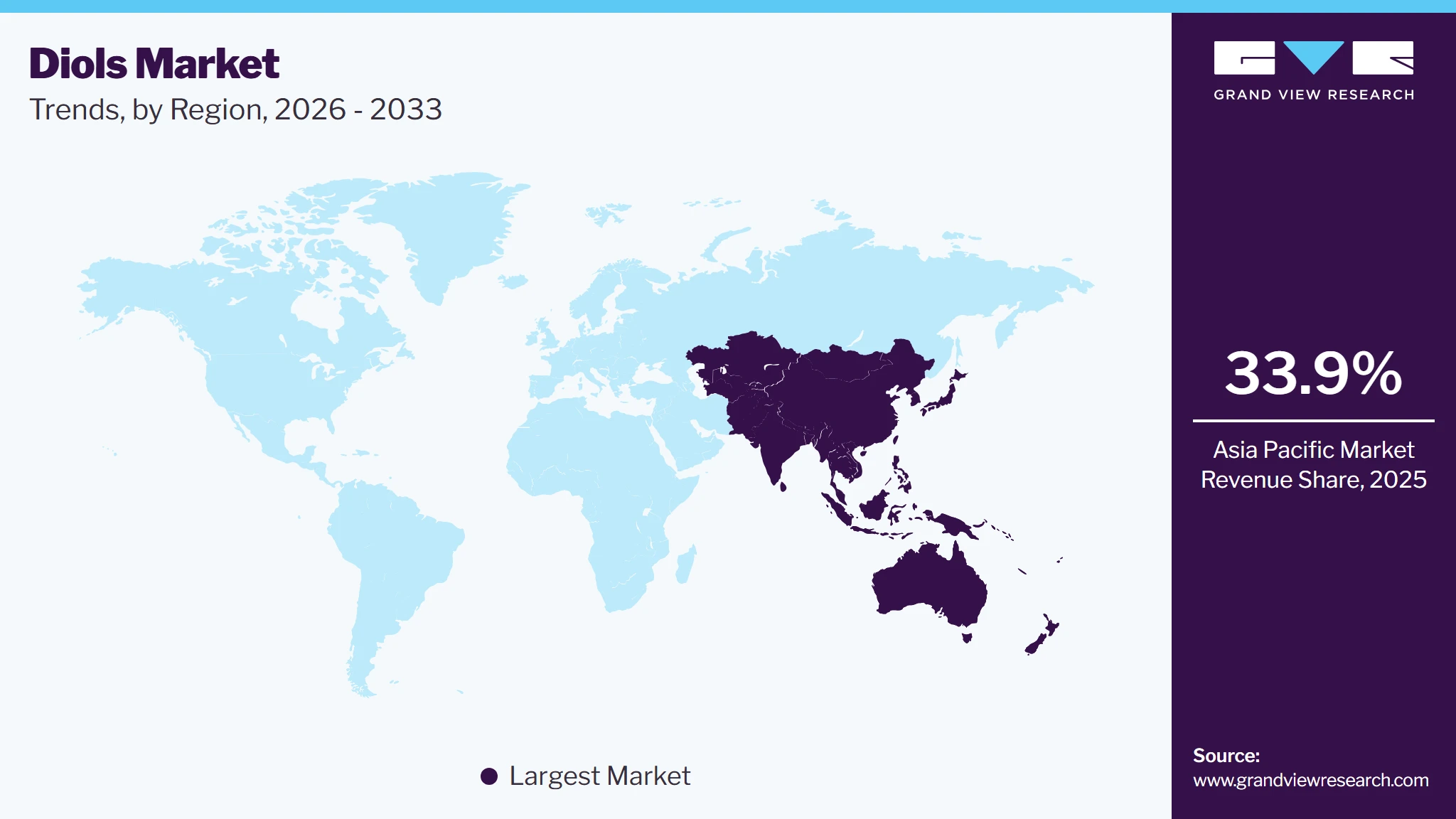
The Asia Pacific diols market accounted for the largest revenue share of 33.9% in 2025, supported by extensive petrochemical production, expanding polymer manufacturing, and rising demand from packaging and textile industries. The region represents a major consumption center due to growing packaged goods production, increasing polyester fiber demand, automotive manufacturing, and infrastructure development. Widespread use of ethylene glycol and propylene glycol in PET resins, synthetic fibers, antifreeze, and industrial formulations continues to support regional demand.
 To learn more about this report, Download Free Sample Report
China Diols Market Trends
China represents a leading market within the Asia Pacific diols landscape, supported by its extensive petrochemical infrastructure, large-scale polymer production, and established textile and packaging industries. Consumption of ethylene glycol is reinforced by its use in polyester fiber and PET resin manufacturing, while propylene glycol serves various industrial and specialty chemical applications. Continued investments in chemical production capacity, downstream processing, and manufacturing infrastructure are sustaining demand for diols across domestic industries. Growing interest in renewable chemical feedstocks is also creating opportunities for bio-based diols as manufacturers explore alternatives to conventional petroleum-derived inputs.
North America Diols Market Trends
The North America diols market is supported by established petrochemical production, demand for polymer feedstocks, and consumption across packaging, automotive, construction, and healthcare industries. The region maintains a significant market position through its developed chemical manufacturing infrastructure, extensive PET resin applications, and established distribution networks. Ethylene glycol consumption across packaging resins, polyester materials, and antifreeze formulations remains an important contributor to regional demand. Meanwhile, increasing interest in sustainable chemical production and specialty formulations is creating opportunities for bio-based diols and higher-value derivatives.
U.S. Diols Market Trends
The U.S. diols market represents a major contributor to North American demand, supported by established petrochemical facilities, polymer manufacturing capabilities, and extensive downstream industrial applications. Ethylene glycol is widely consumed in PET resin production, polyester manufacturing, and automotive antifreeze formulations, while propylene glycol serves food, pharmaceutical, personal care, and industrial applications. Investments in chemical processing infrastructure and continued demand for packaging materials are sustaining market activity.
Europe Diols Market Trends
The Europe diols market is influenced by established chemical manufacturing capabilities, demand for specialty materials, and increasing emphasis on sustainable feedstock sourcing. The region maintains demand across packaging, textiles, automotive, construction, healthcare, and personal care industries, where diols serve as intermediates for polymers, solvents, and formulated products. Ethylene glycol and propylene glycol remain important contributors because of their broad industrial applications and integration into existing manufacturing processes. In parallel, sustainability objectives and efforts to reduce reliance on fossil-derived raw materials are encouraging interest in bio-based diols and alternative production technologies.
Latin America Diols Market Trends
The Latin America diols market is supported by demand for packaging materials, synthetic textiles, automotive products, and industrial chemicals across developing manufacturing sectors. Increasing consumption of packaged food and beverages is supporting the use of PET resins, while textile production and automotive-related applications contribute to demand for glycol-based products. Regional investment in manufacturing facilities, infrastructure, and consumer goods production is creating opportunities for diol suppliers. Growth in downstream polymer applications and broader access to chemical feedstocks are expected to influence regional market development throughout the forecast period.
Middle East & Africa Diols Market Trends
The Middle East and Africa diols market is projected to grow at a CAGR of 4.8% from 2026 to 2033, supported by petrochemical industry development, infrastructure investment, and increasing demand for polymer-based materials. The region's chemical production capabilities and access to hydrocarbon feedstocks support opportunities for petroleum-based diols, particularly in industrial and downstream manufacturing applications. Demand from packaging, construction, automotive, and personal care industries is contributing to consumption across regional markets.
Key Diols Company Insights
Companies in the global diols market are strengthening their market presence through capacity expansion, product portfolio diversification, process optimization, and investments in sustainable production technologies. Competition is shaped by demand for high-volume glycol feedstocks, specialized chemical intermediates, and application-specific diol grades across packaging, textile and apparel, automotive, construction, healthcare, and personal care industries.
-
BASF SE maintains a broad presence in the global chemicals industry, supplying chemical intermediates and glycol products to diverse industrial and consumer markets. Its portfolio includes products used in polymer manufacturing, automotive applications, construction materials, and specialty formulations. Integrated production capabilities, established global distribution networks, and continued investment in chemical innovation support the company's ability to serve downstream industries requiring consistent product quality and reliable feedstock supply.
-
Dow Inc. operates across materials science and chemical manufacturing, supplying glycol-based products and intermediates for packaging, construction, automotive, and industrial applications. Its portfolio supports uses ranging from polyester-related manufacturing and heat-transfer fluids to specialty formulations and consumer applications. Established manufacturing infrastructure, application development capabilities, and a broad commercial presence support the company's position in markets where product consistency, processing performance, and dependable supply are important purchasing considerations.
Recent Developments
-
In February 2026, BASF announced plans to gradually increase 1,4-butanediol (BDO) production at its Ludwigshafen facility in Germany to strengthen supply security for European customers. The initiative aims to ensure consistent availability and reinforce the resilience of its integrated BDO value chain amid ongoing anti-dumping proceedings. Such production increases support diols market growth by improving regional supply reliability and meeting downstream demand for BDO and its derivatives.
-
In March 2026, BASF introduced reduced-carbon-footprint variants of butanediol (BDO), tetrahydrofuran (THF), PolyTHF, and N-methylpyrrolidone (NMP), achieving at least a 10% reduction in product carbon footprint without compromising performance. The products use lower-emission feedstocks and utilities and are available to customers worldwide. This development supports diols market growth by advancing sustainable chemical production and increasing demand for lower-carbon diols and downstream derivatives.
Key Global Diols Companies
The following key companies have been profiled for this study on the diols market.
-
BASF SE
-
Dow Inc.
-
LyondellBasell Industries
-
Shell plc
-
Mitsubishi Chemical Group Corporation
-
INEOS Group
-
SABIC
-
Eastman Chemical Company
-
Mitsui Chemicals, Inc.
-
Sumitomo Chemical Co., Ltd.
Competitive Benchmarking
Operating Strategies
Competitive Edge
Weaknesses
Mature Players: BASF SE, Dow Inc., LyondellBasell Industries, Shell plc, Mitsubishi Chemical Group Corporation, INEOS Group, SABIC, Eastman Chemical Company
- Prioritize production capacity expansion, process optimization, and portfolio diversification to serve demand for ethylene glycol, propylene glycol, and specialty diols across industrial applications.
- Strengthen feedstock integration, supply chain efficiency, and distribution networks to maintain product availability and manage cost fluctuations across regional markets.
- Invest in renewable feedstocks, bio-based production technologies, and higher-value chemical intermediates to address sustainability priorities and evolving customer requirements.
- Established manufacturing infrastructure and extensive chemical portfolios support supply to packaging, textiles, automotive, construction, healthcare, and other downstream industries.
- Integrated petrochemical operations, technical expertise, and established customer relationships support production efficiency, product consistency, and reliable supply.
- Strong financial resources and international distribution networks facilitate capacity investments, technology development, and access to diverse regional markets.
- Exposure to fluctuations in crude oil, natural gas, petrochemical feedstock, and energy prices can affect production costs and profit margins.
- • Capital-intensive manufacturing processes and investments in emissions management, process upgrades, and alternative feedstocks can increase operating and development expenses.
- Competition from regional producers and emerging bio-based diol suppliers may intensify pricing pressure and increase the need for product differentiation.
Emerging Players: Mitsui Chemicals, Inc., Sumitomo Chemical Co., Ltd.
- Focus on renewable feedstocks, fermentation processes, and biocatalytic production pathways to develop alternatives to conventional petroleum-based diols.
- Establish partnerships with biotechnology developers, chemical manufacturers, and downstream polymer producers to accelerate commercialization and expand market access.
- Improve production yields, process scalability, and product consistency to strengthen competitiveness across specialty polymers, personal care, packaging, and other targeted applications.
- Specialized technology platforms and renewable feedstock expertise support differentiation in sustainability-oriented chemical markets.
- Focused product development enables adaptation to specific purity, performance, and downstream application requirements.
- Collaboration with established manufacturers and end users can facilitate technology validation, commercial adoption, and entry into targeted market segments.
- Limited production scale and commercialization experience may constrain cost competitiveness against established petroleum-based diol producers.
- Dependence on renewable feedstock availability, technology performance, and access to capital can create challenges in maintaining consistent production economics.
- Scaling production and meeting customer qualification requirements may require substantial investment in manufacturing infrastructure, technical validation, and supply chain development.
Global Diols Market Report Scope
Report Attribute
Details
Market size in 2025
USD 50.0 billion
Estimated market size in 2026
USD 52.5 billion
Projected market size by 2033
USD 77.7 billion
Growth rate
CAGR of 5.8% from 2026 to 2033
Base year for estimation
2025
Historical data
2021 - 2024
Forecast period
2026 - 2033
Quantitative units
Revenue in USD million/billion, volume in kilotons and CAGR from 2026 to 2033
Report coverage
Revenue forecast, volume forecast, company ranking, competitive landscape, growth factors, and trends
Segments covered
Source, product, end use, and region
Regional scope
North America; Europe; Asia Pacific; Latin America; Middle East & Africa
Country scope
U.S.; Canada; Mexico; Germany; UK; France; Italy; Spain; China; India; Japan; South Korea; Brazil; Argentina; Saudi Arabia; South Africa
Key companies profiled
BASF SE; Dow Inc.; LyondellBasell Industries; Shell plc.; Mitsubishi Chemical Group Corporation; INEOS Group; SABIC; Eastman Chemical Company; Mitsui Chemicals, Inc.; Sumitomo Chemical Co., Ltd.
Customization scope
Free report customization (equivalent up to 8 analysts’ working days) with purchase. Addition or alteration to country, regional & segment scope.
Pricing and purchase options
Avail customized purchase options to meet your exact research needs. Explore purchase options
Global Diols Market Report Segmentation
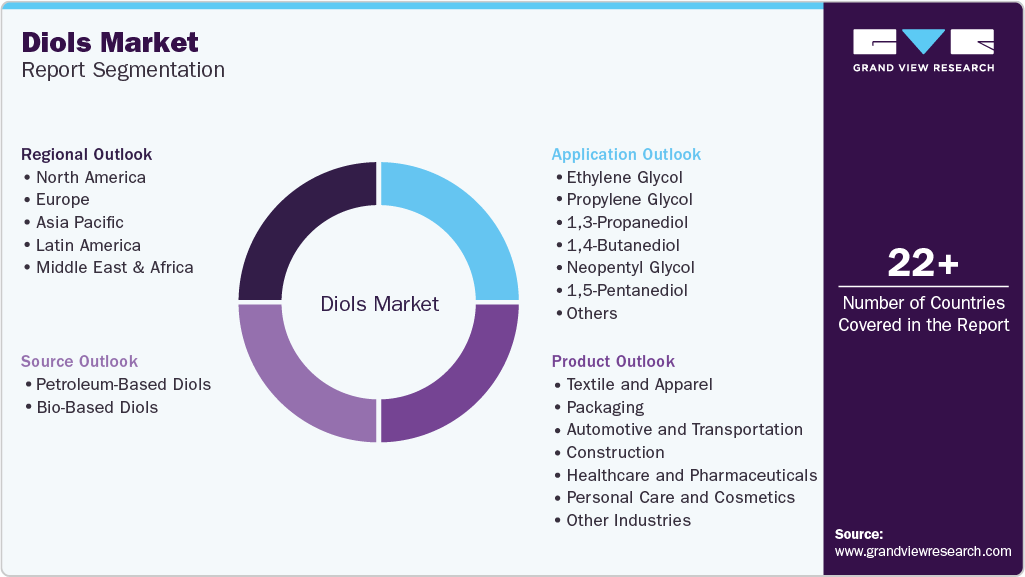
This report forecasts volume & revenue growth at regional, and country levels and provides an analysis of the latest industry trends in each of the sub-segments from 2021 to 2033. For this study, Grand View Research has segmented the global diols market report based on source, product, end use, and region:
 To learn more about this report, Download Free Sample Report
-
Source Outlook (Volume, Kilotons; Revenue, USD Billion, 2021 - 2033)
-
Petroleum-Based Diols
-
Bio-Based Diols
-
-
Product Outlook (Volume, Kilotons; Revenue, USD Billion, 2021 - 2033)
-
Ethylene Glycol
-
Propylene Glycol
-
1,3-Propanediol
-
1,4-Butanediol
-
Neopentyl Glycol
-
1,5-Pentanediol
-
1,6-Hexanediol
-
Other Diols
-
-
End Use Outlook (Volume, Kilotons; Revenue, USD Billion, 2021 - 2033)
-
Textile and Apparel
-
Packaging
-
Automotive and Transportation
-
Construction
-
Healthcare and Pharmaceuticals
-
Personal Care and Cosmetics
-
Other Industries
-
-
Region Outlook (Volume, Kilotons; Revenue, USD Billion, 2021 - 2033)
-
North America
-
U.S.
-
Canada
-
Mexico
-
-
Europe
-
Germany
-
UK
-
France
-
Italy
-
Spain
-
-
Asia Pacific
-
China
-
India
-
Japan
-
South Korea
-
-
Latin America
-
Brazil
-
Argentina
-
-
Middle East & Africa
-
Saudi Arabia
-
South Africa
-
-
Research Methodology
The diols market figures in this report are based on a proven research process that combines executive interviews with secondary research from proprietary databases, company filings, and recognized regulatory and institutional sources. Market size is built through value-chain sizing-reconciling supply-side and demand-side estimates-and triangulated with bottom-up and top-down approaches. Every estimate passes multiple levels of expert validation before publication, with each diols segment quantified using the revenue-capture definitions in the table below.
Segment Definition
Source Revenue capture definition Petroleum-Based Diols Market value is generated through diols manufactured using petroleum-derived feedstocks and conventional petrochemical processes. Ethylene glycol, propylene glycol, and other diol products serve as intermediates for PET resins, polyester fibers, antifreeze formulations, and industrial chemicals. Established production infrastructure and extensive downstream applications support demand across major manufacturing industries. Bio-Based Diols Revenue is generated through diols produced using renewable biological feedstocks, including biomass-derived sugars and other bio-based raw materials. Applications in polymers, specialty chemicals, personal care formulations, and other industrial products support market adoption. Growing interest in renewable feedstocks and reduced dependence on fossil-derived resources is creating opportunities for bio-based diol production. Product Revenue capture definition Ethylene Glycol Market value is generated through ethylene glycol supplied for PET resin manufacturing, polyester fiber production, antifreeze formulations, and industrial applications. Its role as a major feedstock for packaging materials and synthetic textiles supports extensive consumption across downstream manufacturing industries. Propylene Glycol Revenue is generated through propylene glycol used in pharmaceutical formulations, personal care products, food-related applications, industrial fluids, and specialty chemical manufacturing. Its solvent, humectant, and carrier properties support adoption across consumer, healthcare, and industrial applications requiring consistent formulation performance. 1,3-Propanediol Market value is created through powder-based coating technologies applied using spray equipment, typically followed by a curing process to form a protective film. Their ability to provide uniform finishes, mechanical durability, and low solvent emissions supports use in metal components, appliances, furniture, and industrial manufacturing, particularly where compatible application and curing infrastructure is available. 1,4-Butanediol Revenue is generated through 1,4-butanediol used as an intermediate in the production of tetrahydrofuran (THF), polybutylene terephthalate (PBT), and other chemical derivatives. Its applications in engineering plastics, elastomers, spandex-related materials, and specialty polymers support demand across automotive, textile, and industrial manufacturing sectors. Neopentyl Glycol Market value is generated through neopentyl glycol used in manufacturing polyester resins, alkyd resins, lubricants, and specialty chemical products. Its contribution to thermal stability, weather resistance, and chemical performance supports applications in coatings, composite materials, and other industrial formulations. 1,5-Pentanediol Revenue is generated through 1,5-pentanediol used in specialty polymers, plasticizers, solvents, and chemical intermediates. Its molecular structure and functional properties support applications in selected resin systems and specialty formulations, with demand influenced by downstream chemical production and material performance requirements. 1,6-Hexanediol Market value is generated through 1,6-hexanediol used in producing polyurethane and polyester resins, acrylate derivatives, and specialty chemical intermediates. Its contribution to flexibility, chemical resistance, and material durability supports applications in coatings, adhesives, sealants, elastomers, and advanced polymer systems. Other Diols Revenue is generated through diol products outside the specifically defined categories of ethylene glycol, propylene glycol, 1,3-propanediol, 1,4-butanediol, neopentyl glycol, 1,5-pentanediol, and 1,6-hexanediol. These products serve specialized requirements in polymer manufacturing, chemical synthesis, personal care, and other industrial applications. End Use Revenue capture definition Textile and Apparel Market value is generated through diols consumed in producing polyester fibers, textile intermediates, and related synthetic materials used in apparel, home textiles, and technical fabrics. Ethylene glycol supports polyester manufacturing, while selected diol derivatives contribute to specialized fibers and elastomeric materials. Demand is influenced by synthetic textile production, apparel consumption, and requirements for durable and versatile fabrics. Packaging Revenue is generated through diols used as chemical feedstocks for PET resins and other polymer materials incorporated into beverage bottles, food containers, packaging films, and related products. Ethylene glycol plays a central role in PET production, supporting demand from packaged food and beverages, consumer goods, and other packaging applications. Growth in packaged product consumption and polymer manufacturing supports diol demand across this segment. Automotive and Transportation Market value is generated through diols used in manufacturing automotive materials, engineering plastics, polyester components, polyurethane systems, and vehicle-related fluids. Ethylene glycol is utilized in automotive coolants, while 1,4-butanediol and other derivatives support selected polymer and elastomer applications. Vehicle production, component manufacturing, thermal management requirements, and demand for durable materials influence consumption across the sector. Construction Revenue is generated through diols incorporated into construction-related polymers, insulation materials, resins, adhesives, sealants, and specialty formulations. Ethylene glycol also supports applications in heat-transfer fluids and certain building service systems. Infrastructure investment, building activity, and demand for durable construction materials contribute to diol consumption across residential, commercial, and industrial projects. Healthcare and Pharmaceuticals Market value is generated through diols used in pharmaceutical formulations, medical products, and healthcare-related chemical applications. Propylene glycol serves as a solvent, carrier, or humectant in selected medicines and topical preparations, while other diol derivatives support specialized materials and chemical intermediates. Demand is influenced by pharmaceutical manufacturing, formulation requirements, and the need for suitable ingredient quality. Personal Care and Cosmetics Revenue is generated through diols incorporated into skincare, hair care, moisturizers, hygiene products, and cosmetic formulations. Propylene glycol is widely used as a solvent, humectant, and carrier, while selected specialty diols serve additional formulation requirements. Demand is shaped by personal care product manufacturing, formulation development, and requirements for moisture retention, ingredient dispersion, and product stability. Other End Use Market value is generated through diols consumed in applications outside textile and apparel, packaging, automotive and transportation, construction, healthcare and pharmaceuticals, and personal care and cosmetics. These applications include industrial fluids, chemical intermediates, lubricants, solvents, and other specialty products. Demand varies according to manufacturing activity, chemical processing requirements, and the use of diols in specialized industrial formulations. Estimation Model
Layer Name Key Question Description Product & Source Layer What constitutes the diols product base? Identify the production, formulation, manufacturing, and commercial availability of diols across petroleum-based and bio-based sources. Assess key products, including ethylene glycol, propylene glycol, 1,3-propanediol, 1,4-butanediol, neopentyl glycol, 1,5-pentanediol, 1,6-hexanediol, and other diols. Evaluate feedstock origin, production processes, product specifications, purity, manufacturing capacity, and commercial availability to establish the market's product base across global markets. Application & Consumption Layer Which applications drive diols consumption? Assess diol consumption across applications such as PET resin and polyester fiber production, polyurethane materials, engineering plastics, specialty polymers, antifreeze, industrial fluids, pharmaceutical formulations, and personal care products. Evaluate the role of individual diol types in downstream manufacturing, considering processing requirements, material performance, formulation needs, production volumes, and substitution trends to estimate consumption across major applications and industries. End Use Demand Layer Where are diols utilized? Analyze diol consumption across textile and apparel, packaging, automotive and transportation, construction, healthcare and pharmaceuticals, personal care and cosmetics, and other industries. The assessment considers PET packaging and polyester fiber output, vehicle manufacturing, construction activity, pharmaceutical formulation demand, cosmetic product manufacturing, and industrial production trends to estimate annual diol consumption across global markets. Revenue Layer How is market revenue generated? Market revenue is estimated through the commercial sale of petroleum-based and bio-based diols across product categories and End Use industries. The assessment considers annual consumption volumes, prevailing product prices, feedstock costs, production economics, product mix, regional pricing differences, and demand patterns to estimate market value. Revenue projections account for changes in downstream manufacturing activity, bio-based diol adoption, capacity additions, product demand, and pricing trends across global markets. Delivered Customizations
This report has been delivered with the following In-depth customizations
Client Request Customization Delivered Value Adds Regional segmentation The assessment includes country-level market sizing and forecasts, with demand patterns analyzed by source, product, and end use. Coverage includes petroleum-based and bio-based diols; ethylene glycol, propylene glycol, 1,3-propanediol, 1,4-butanediol, neopentyl glycol, 1,5-pentanediol, 1,6-hexanediol, and other diols; and textile and apparel, packaging, automotive and transportation, construction, healthcare and pharmaceuticals, personal care and cosmetics, and other industries. Supports market entry planning, competitor evaluation, and geographic expansion by providing visibility into country-level demand, product mix, source preferences, and End Use opportunities. Helps identify attractive markets, prioritize investments, optimize distribution strategies, and align product portfolios with regional customer requirements and market conditions. Opportunity Assessment Detailed evaluation of emerging growth opportunities across petroleum-based and bio-based diols, with product-level analysis covering major glycols and specialty diols. The assessment examines demand from PET resin and polyester fiber production, polyurethane materials, engineering plastics, antifreeze, pharmaceutical formulations, personal care products, and specialty chemicals. It also evaluates opportunities associated with renewable feedstocks, bio-based production pathways, evolving material requirements, and demand for high-performance downstream products. Enables prioritization of high-growth products, End Use industries, and emerging production pathways while identifying opportunities across the global diols value chain. Supports product development, portfolio diversification, technology investments, distribution expansion, and strategic partnerships through insights into evolving customer requirements, sustainability considerations, and long-term demand trends. Competitive Benchmarking Comparative assessment of leading global diols manufacturers based on product portfolios, feedstock integration, manufacturing capacity, production technologies, geographic presence, distribution networks, research and development capabilities, product innovation, sustainability initiatives, and expansion strategies. The benchmarking evaluates their positioning across major diol categories and downstream markets, including packaging, textiles, automotive, construction, healthcare, pharmaceuticals, and personal care. Supports competitor benchmarking by identifying strengths and gaps in product offerings, manufacturing capabilities, feedstock integration, geographic coverage, and customer reach. Enables informed decisions regarding product differentiation, portfolio expansion, strategic partnerships, capacity investments, supply chain development, and customer targeting to strengthen competitive positioning in the global diols market. Frequently Asked Questions About This Report
Asia Pacific held the largest regional revenue share of 33.9% in 2025, supported by its extensive chemical manufacturing base and demand from packaging, textile, automotive, and construction industries.
The diols market is driven by rising demand for ethylene glycol and propylene glycol in PET packaging, polyester fiber production, and industrial applications. Growing consumption of polymers and specialty chemicals, expanding manufacturing activity, and increasing interest in bio-based diols are further supporting market growth.
Key companies operating in the global diols market include BASF SE; Dow Inc.; LyondellBasell Industries; Shell plc; Mitsubishi Chemical Group Corporation; INEOS Group; SABIC; Eastman Chemical Company; Mitsui Chemicals, Inc.; and Sumitomo Chemical Co., Ltd.
Ethylene glycol accounted for the largest product share, representing 75.4% of global diols market revenue in 2025. Its extensive use in polyethylene terephthalate (PET) resins, polyester fibers, and antifreeze applications supports demand across packaging, textiles, and industrial markets.
The diols market faces challenges from fluctuations in petroleum feedstock prices, production costs, and supply chain conditions. Bio-based diol production also faces constraints related to renewable feedstock availability, manufacturing costs, and process scalability, which may affect wider commercial adoption.
1,4-Butanediol is expected to be the fastest-growing product segment, registering a CAGR of 7.9% from 2026 to 2033. Its use in tetrahydrofuran, polybutylene terephthalate, elastomers, engineering plastics, and specialty polymers supports demand across a range of industrial and material applications.
The global diols market size was valued at USD 50.0 billion in 2025 and is estimated at USD 52.5 billion for 2026.
The global diols market is expected to grow at a CAGR of 5.8% from 2026 to 2033, reaching USD 77.7 billion by 2033.
Petroleum-based diols dominated the source segment, accounting for 88.5% of global market revenue in 2025. Their established production infrastructure, widespread availability, and extensive use in polymer manufacturing and industrial applications support their leading position.
About the Author(s)
Paints, Coatings & Printing Inks Research Team
Bulk Chemicals · Paints, Coatings & Printing InksThis report was authored by the paints, coatings & printing inks research team at Grand View Research - comprising two research analysts, one senior research analyst, and one industry expert - with specialized expertise in the paints, coatings & printing inks segment of the bulk chemicals industry. All findings are based on proprietary bulk chemicals databases, executive interviews, and regulatory analysis, subject to internal peer review prior to publication.
Last Updated:
Speak to Analyst

Customize this report to your needs - add regions, segments, or data points, with 20% free customization.
Or view our licence options:


ISO 9001:2015 & 27001:2022 Certified
We are GDPR and CCPA compliant! Your transaction & personal information is safe and secure. For more details, please read our privacy policy.


