
- Home
- »
- Homecare & Decor
- »
-
Disposable Cups Market Size And Share Report, 2026-2033GVR Report cover

Disposable Cups Market (2026 - 2033)
Size, Share & Trends Analysis Report By Product (Paper, Plastic, Foam), By End-use (Commercial, Institutional, Household), By Region (North America, Europe, Asia Pacific, Latin America, Middle East & Africa), And Segment Forecasts
Market Size, 2025
$18.5BMarket Estimate, 2026
$19.4BMarket Forecast, 2033
$25.0BCAGR, 2026–2033
3.7%Disposable Cups Market Summary
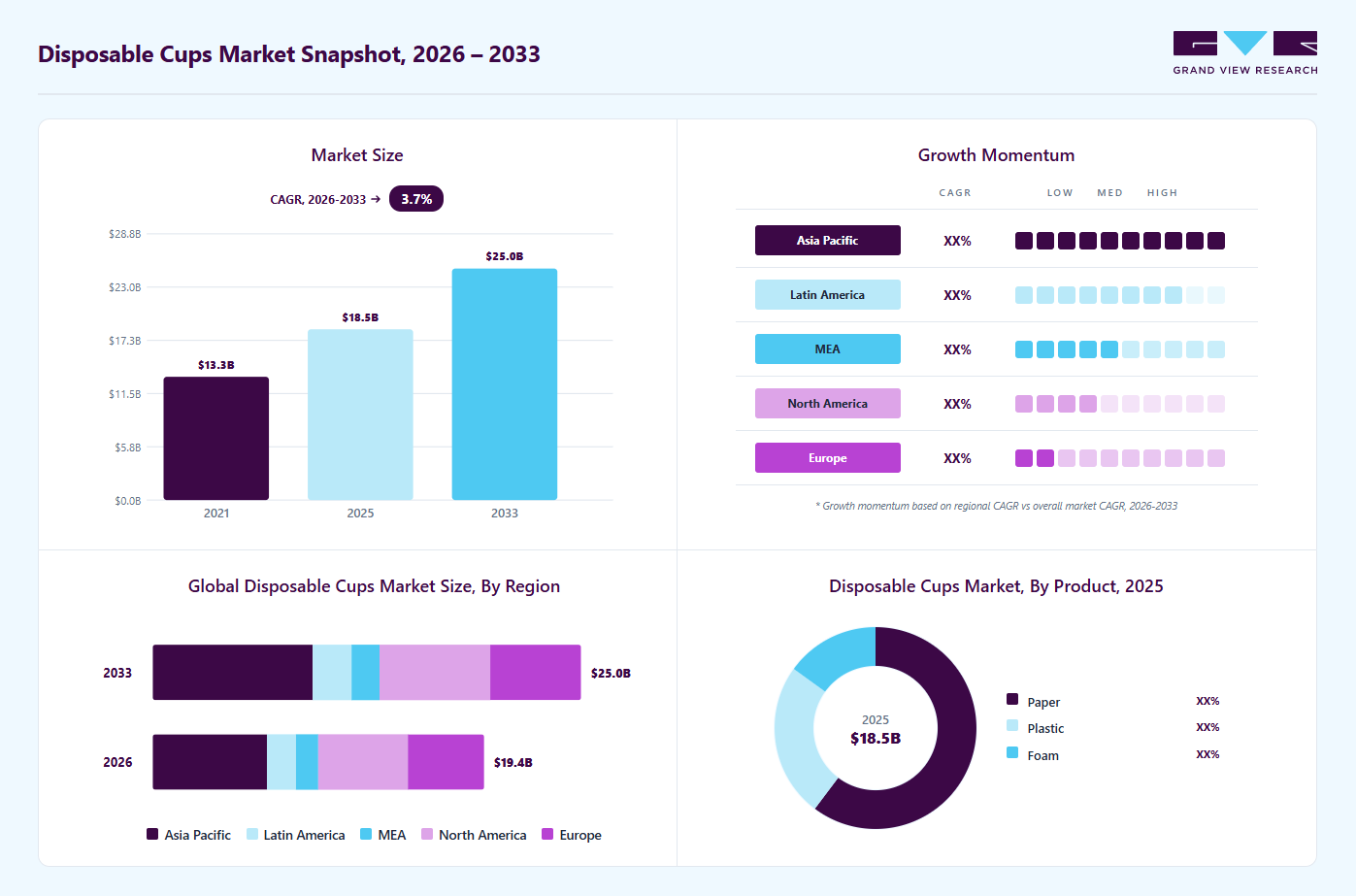
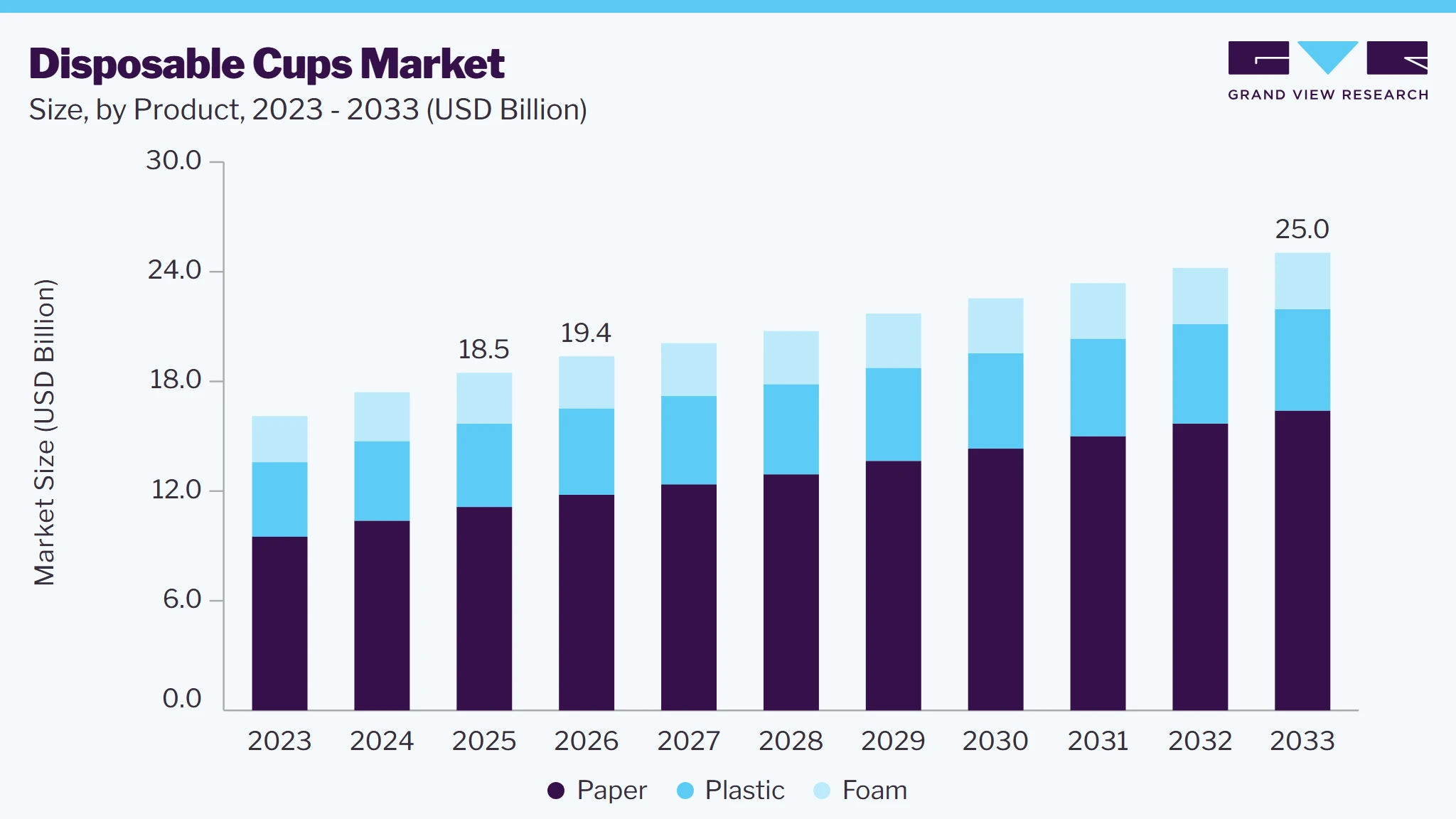
The global disposable cups market size was valued at USD 18.5 billion in 2025 and is projected to grow from USD 19.4 billion in 2026 to USD 25.0 billion by 2033, at a CAGR of 3.7% from 2026 to 2033. The market in Asia Pacific dominated with a revenue share of 34.1% in 2025. The market growth is attributed to the growing preference for on-the-go lifestyle and convenience, which boosted the demand for disposable cups.
 Source: Grand View Research, IR Documents, Primary Interviews, Paid DatabasesTo learn more about this report,
 Download Free Sample Report
 Key Market Trends & Insights
- By product: Paper segment held the largest market share of 60.3% in 2025.
- By end use: Commercial segment held the largest market share of 77.7% in 2025.
Regional Highlights
- Largest regional market: Asia Pacific (34.1% revenue share, 2025)
- By country: China held the largest market share in 2025
Market Size & Forecast
- Market size in 2025: USD 18.5 Billion
- Estimated market size in 2026: USD 19.4 Billion
- Projected market size by 2033: USD 25.0 Billion
- CAGR (2026-2033): 3.7%
Three ways to get this report
Buy it, customize it, or ask a question.Ask an Analyst
Analyst response in 1 business day
- AccessReport author, directly
- Reply timeWithin 1 working day
- No sales callDirect answer only
- FormatEmail reply
- CostFree, no cost
Get the Full Report
What the study covers
- FormatsPDF · Excel · Dashboard
- Timeline2026–2033 annual, 2025 base
- Coverage20+ countries, 5 regions
- Companies10+ key players profiled
Customize the Report
20% free customization
- IncludeCountries, segments, points
- TailorTo your product definition
- ExtendDeeper competitor detail
- OrA fully bespoke study
- Turnaround5–10 working days
Furthermore, the increasing number of quick-service cafes, restaurants, and food trucks, particularly in urban areas, contributes to this trend. Disposable cups are a great alternative to glasses, mugs, and steins, especially if consumers are worried about breaking them or carrying them around. Increasing usage of disposable cups at social gatherings and celebrations is likely to propel their demand in the coming years. Single-serving cups have a multitude of uses in the household. They are perfect for serving beverage samples, dishing out child-friendly portions to kids, and even serving adult refreshments, such as espresso and cappuccino.Thus, several households across the globe are keeping a supply of small disposable cups in the cabinet to prevent the spread of germs when it’s time to rinse with mouthwash or chase back pill and gel-cap medications. Small cups are also handy when mixing paints, stains, or adhesives for home improvement or craft projects.
 To learn more about this report, Download Free Sample Report
 Moreover, the growing awareness about hygiene and sanitation, especially post the COVID-19 pandemic, led consumers to favor single-use cups over reusable ones. Additionally, innovations in materials and designs, such as biodegradable and compostable cups, appeal to eco-conscious consumers and further propel market growth.
For instance, Simply Cups, a paper cup-recycling program, aims to divert paper cups from landfills through over 1500 collection points across Australia. The program develops paper cup solutions, advocates for recycling, and educates the public. With 1.8 billion hot drink cups used annually in Australia, Simply Cups collaborates with businesses and universities to create scalable solutions, such as recycling cups into concrete utility slabs and road materials. The Drop Off Only ARL system supports the initiative, promoting sustainable waste management and a circular economy.
The expansion of e-commerce and food delivery services is another major driver, as these platforms frequently use disposable cups for beverages. In addition, increasing disposable incomes and changing consumer habits in developing regions are creating new growth opportunities for the market.
Market Dynamics
The global disposable cups market is being driven by the continued expansion of foodservice, takeaway beverage consumption, and convenience-oriented lifestyles. Demand remains strong across cafés, quick-service restaurants, offices, institutions, and households, supported by the growing preference for on-the-go food and beverage consumption. However, market growth is increasingly influenced by sustainability concerns, regulatory scrutiny surrounding single-use products, and shifting material preferences across end-use sectors.
A key driver for the disposable cups market is the increasing consumption of hot and cold beverages through cafés, quick-service restaurants, convenience stores, and food delivery channels. Rising urbanization, busy consumer lifestyles, and the expansion of organized foodservice networks continue to support demand for single-use beverage packaging across commercial and institutional settings.
Market growth is constrained by tightening regulations targeting single-use plastics and expanded polystyrene foam products in several countries and municipalities. Environmental concerns related to waste generation and disposal are encouraging end users to reduce consumption of certain disposable cup formats, creating challenges for manufacturers heavily reliant on conventional plastic and foam products.
A significant opportunity exists in the growing adoption of paper-based, recyclable, compostable, and sustainably sourced cup products. Foodservice operators, institutions, and consumers are increasingly seeking environmentally responsible alternatives that align with corporate sustainability goals and regulatory requirements. As a result, manufacturers are investing in innovative materials, barrier coatings, and recyclable packaging solutions to capture emerging growth opportunities within the disposable cups market.
Analyst Perspective
The disposable cups market is primarily foodservice and convenience-driven, with demand closely linked to takeaway beverage consumption, quick-service restaurant activity, institutional foodservice operations, and on-the-go consumption trends. Value is increasingly concentrated in paper-based and sustainable cup solutions that address evolving environmental requirements while maintaining functionality and cost efficiency. However, the market remains highly competitive and subject to regulatory scrutiny surrounding single-use products, making material innovation, sustainability performance, manufacturing efficiency, and distribution scale key competitive differentiators.
Consumer Insights
In 2024, The Scottish Government's single-use beverage cup charge consultation conducted with Savanta, assessed perceptions of single-use items and regulatory impacts. More than half of the respondents in Scotland (56%) believe additional actions are necessary to address single-use items. Measures to reduce single-use cups holds 56%. In addition, 60% of respondents would buy less drinks in single-use cups if a charge was implemented along with 74% stating that charge would initiate them to use reusable cups often.
 To learn more about this report, Download Free Sample Report
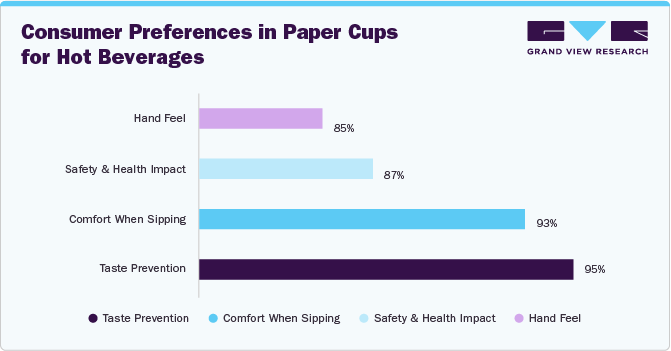
 In 2023, The Shelton Group found that consumers prefer paper cups over clear plastic cups for reduced condensation and better insulation. Moreover, 11% liked seeing their drink in the cups. The consumer rated paper cup performance as “excellent” or “good” based on the research. Key factors include comfort while sipping (93% hot and 88% cold), safety and health impact (87% hot and 86% cold), taste prevention (95% hot and 84% cold), and hand feel (85 hot and 77 cold).
 To learn more about this report, Download Free Sample Report
 Product Insights
Based on paper disposable cups led the market with the largest revenue share of 60.3% in 2025, and grow at the fastest CAGR over the forecast period. Paper is widely used in several industries, including packaging and disposable products, contributing to their substantial market share. Furthermore, there is a growing preference for paper over other materials due to its biodegradability, recyclability, and alignment with sustainable practices.
For instance, in July 2024, The City of Toronto accepted paper beverage cups lined with plastic for recycling at home, in apartment buildings, long-term care homes, retirement homes, and schools. A pilot program allows residents to recycle disposable coffee and fountain drink cups in blue bins, addressing previous confusion. The program, expected to expand across Ontario by 2026, includes containers similar to ice cream cups. This initiative aims to clarify recycling rules and promote sustainable regional waste management practices.
Demand for plastic disposable cups is expected to rise at a CAGR of 2.3% from 2026 to 2033. This anticipated increase reflects the ongoing demand for plastic materials, driven by their versatility, durability, and cost-effectiveness in various applications. Additionally, advancements in recycling technologies and initiatives to improve the sustainability of plastic products contribute to this growth, balancing environmental concerns with practical needs. Furthermore, government support for plastic disposable cups is anticipated to drive market growth. For instance, South Korea's Ministry of Environment withdrew the ban on paper cups at cafes and restaurants and provisionally approved plastic straws and plastic bags at convenience stores.
End-use Insights
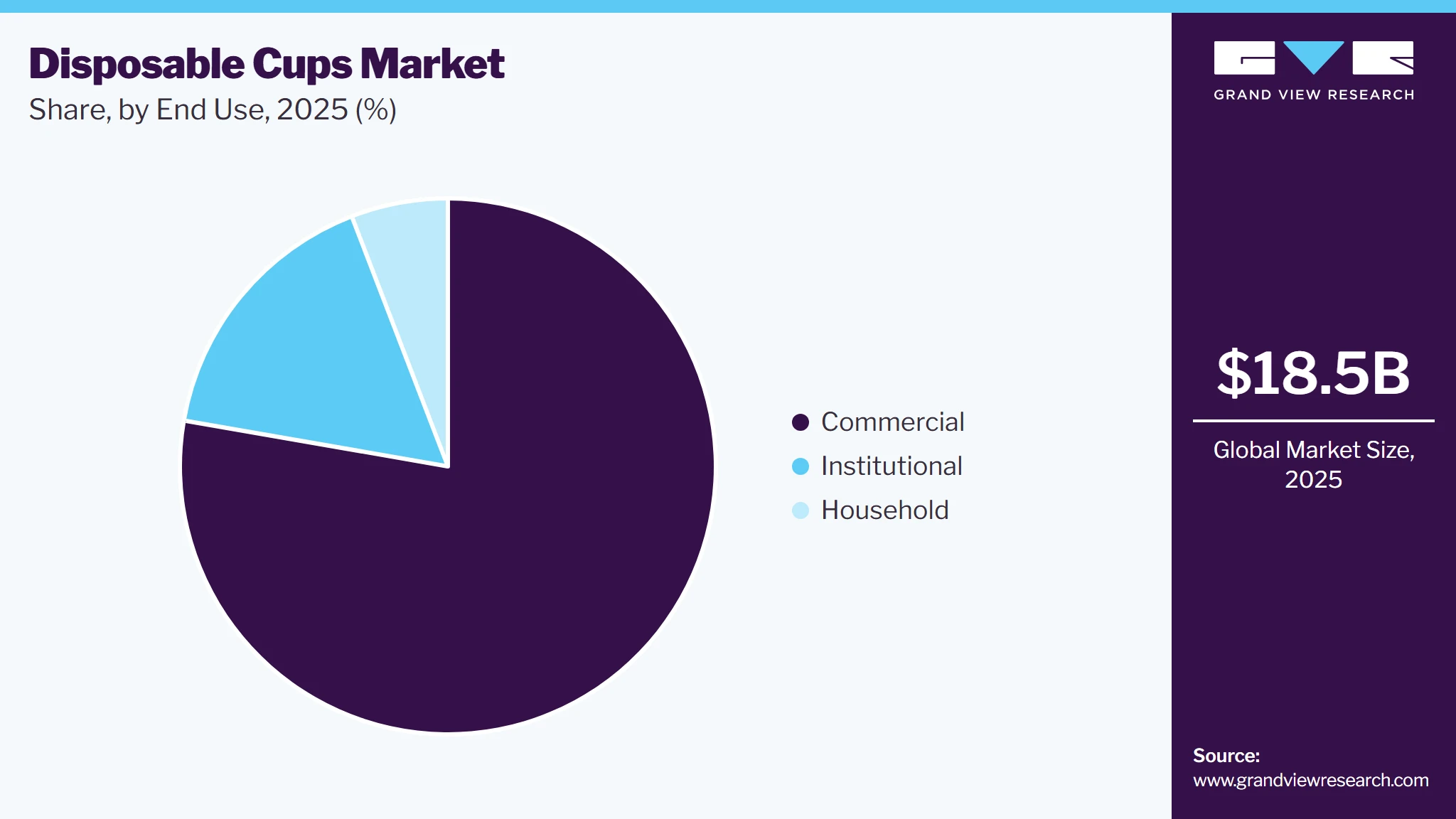
Based on end use, disposable cups for commercial end users led the market with the largest revenue share of 77.0% in 2025, and grow at the fastest CAGR over the forecast period. This is attributed to the high demand for disposable cups in commercial settings such as restaurants, cafes, and catering services, where convenience and hygiene are paramount. The widespread adoption of disposable cups in these environments has significantly contributed to their substantial market share, underscoring the sector's pivotal role in driving market growth.
 To learn more about this report, Download Free Sample Report
 Demand for disposable cups in institutional applications is anticipated to grow at a CAGR of 2.8% from 2026 to 2033. The increasing demand for disposable cups in healthcare facilities, educational institutions, and corporate offices is boosting market growth. Additionally, government regulations promoting sustainable practices and reducing single-use plastics are encouraging institutions to adopt eco-friendly alternatives. These regulations often mandate the use of recyclable or biodegradable cups, further propelling the market. The focus on hygiene and sanitation, especially in healthcare and food service sectors, also contributes to the rising demand for disposable cups.
Regional Insights
The disposable cups market in North America accounted for a revenue share of around 27.0% in 2025 in the global disposable cups industry. The increasing awareness of hygiene and sanitation, coupled with a growing on-the-go lifestyle, has fueled the demand for disposable cups. Furthermore, the widespread use of disposable cups in commercial establishments such as restaurants, cafes, and convenience stores. Additionally, the presence of major market players and innovations in sustainable and eco-friendly cup designs have further contributed to North America's substantial market share.
In November 2024, Berry Global announced its first domestically produced recyclable polypropylene (PP) drink cups to support retailers’ own brands, to be showcased at the Private Label Manufacturers Association’s Trade Show in Chicago. Developed using Bantam technology, these cups are 10-15% lighter than polystyrene (PS) cups. Part of the B Circular Range, the cups are fully recyclable and food-contact safe. They feature enhanced sidewall rigidity, smooth contact points for grip and comfort, and are available in various sizes and designs for a superior consumer experience.
U.S. Disposable Cups Market Trends
In 2025, the disposable cups market in the U.S. held a dominant 79.8% share of the North American market. The increasing demand for convenience and on-the-go consumption is a primary driver, as disposable cups cater to busy lifestyles. Additionally, heightened awareness of hygiene and sanitation, particularly post-pandemic, is contributing to the market's expansion. Government regulations encouraging sustainable practices and the adoption of eco-friendly alternatives are also playing a crucial role. Innovations in recyclable and biodegradable materials further bolster market growth, aligning with environmental goals.
In April 2024, Starbucks introduced more sustainable cold cups in stores across the U.S. and Canada, made with less plastic and designed to reduce emissions and conserve water during production. These new cups streamline the workflow for store partners by consolidating lid combinations and simplifying storage. Developed at the Tryer Center, they reflect Starbucks' commitment to halve its carbon, water, and waste footprints by 2030. By then, Starbucks aims to ensure all customer packaging is reusable, recyclable, or compostable.
Europe Disposable Cups Market Trends
The disposable cups market in Europe accounted for a revenue share of about 23.0% of the overall disposable cups industry in 2025. The region’s growth is driven by the high consumption of disposable cups, especially in countries with established coffee cultures and robust food service industries.
Additionally, the increasing focus on sustainability and the adoption of eco-friendly practices have led to innovations in recyclable and biodegradable cup materials, further supporting market growth. For instance, in February 2024, Faerch Group introduced its new Tumbler range of recyclable beverage containers, containing at least 30% post-consumer recycled material. These cups can be recycled into new food packaging indefinitely, maintaining safety and functionality. The solution aims to streamline supply chains and enhance user experience for businesses and consumers.
Asia Pacific Disposable Cups Market Trends
Asia Pacific dominated the disposable cups market with the largest revenue share of 34.1% in 2025. The region is witnessing increasing urbanization, rising disposable incomes, and the growing popularity of on-the-go consumption, which drives market growth. The expanding food and beverage industry, particularly in emerging economies, is also driving demand for disposable cups. Innovations in sustainable materials and government initiatives promoting environmentally friendly practices also contribute to the market's growth.
 To learn more about this report, Download Free Sample Report
 Key Disposable Cups Company Insights
The disposable cups industry is fragmented primarily due to the presence of several globally recognized players as well as regional players. Some key companies in the market include Huhtamäki, Dart Container Corporation, Berry Global Inc., Pactiv Evergreen Inc., and others.
-
Huhtamäki is a global leader in sustainable packaging solutions, including disposable cups. It offers a wide range of products made from renewable and recyclable materials, focusing on reducing environmental impact. Huhtamäki's disposable cups are used in various sectors, including food service, retail, and healthcare. The company is committed to innovation and sustainability.
-
Dart Container Corporation is another prominent player in the disposable cup industry. It provides a comprehensive range of single use packaging solutions, including paper, foam, and plastic cups. Dart Container emphasizes hygiene and convenience, catering to quick-service restaurants, food delivery services, and large-scale events. Their products are designed to meet the growing demand for on-the-go beverage solutions while maintaining high standards of quality and safety.
Key Disposable Cups Companies
The following key companies have been profiled for this study on the disposable cups market.
-
Huhtamäki
-
Dart Container Corporation
-
Berry Global Inc.
-
Pactiv Evergreen Inc.
-
Duni
-
WestRock Company
-
Genpak
-
Go-Pak Group
-
CONVERPACK INC.
-
Bender Limited
Competitive Benchmarking
Category
Operating Strategies
Competitive Edge
Weakness
Established Players (Huhtamäki, Dart Container Corporation, Berry Global Inc., Pactiv Evergreen Inc., WestRock Company, Duni)
- Focus on expanding product portfolios across paper, plastic, and fiber-based disposable cups, investing in sustainable packaging innovations, strengthening manufacturing capacity, and leveraging global distribution networks to serve foodservice, retail, institutional, and beverage customers.
- Strong global brand presence, extensive manufacturing footprint, economies of scale, diversified customer base, robust R&D capabilities, and long-term relationships with major foodservice chains and distributors.
- Higher capital and operating costs, increasing exposure to regulations on single-use plastics, and greater dependence on fluctuating raw material and energy prices.
Emerging Players (Genpak, Go-Pak Group, CONVERPACK INC., Bender Limited)
- Focus on niche packaging solutions, customized disposable cup offerings, sustainable material adoption, regional market expansion, and responsive customer service through flexible manufacturing and targeted partnerships.
- Greater flexibility in addressing customer-specific requirements, faster product customization, competitive pricing in regional markets, and quicker adoption of innovative packaging materials.
- Limited global market reach, smaller production capacities, lower brand recognition, and fewer financial resources for large-scale expansion and product development compared to established manufacturers.
Recent Developments
-
In April 2024, Duni Group, a sustainable catering firm based in Malmö, acquired the Australian reusable coffee cup company Huskee. Founded in 2017, Huskee manufactures cups from coffee husk waste and operates the HuskeeSwap and Huskee Loop programs for recycling. The acquisition, which aims to strengthen Duni's global packaging business in the Asia Pacific market, follows their recent acquisitions of New Zealand's Decent Packaging and an increased stake in Germany's Relevo.
-
In February 2024, Faerch Group introduced its new Tumbler range of recyclable beverage containers, containing at least 30% post-consumer recycled material. These cups can be recycled into new food packaging indefinitely, maintaining safety and functionality.
Disposable Cups Market Report Scope
Report Attribute
Details
Market size in 2025
USD 18.5 billion
Estimated market size in 2026
USD 19.4 billion
Projected market size by 2033
USD 25.0 billion
Growth rate
CAGR of 3.7% from 2026 to 2033
Base year for estimation
2025
Historical data
2021 - 2024
Forecast period
2026 - 2033
Quantitative units
Revenue in USD million/billion and CAGR from 2026 to 2033
Report coverage
Revenue forecast, company ranking, competitive landscape, growth factors, and trends
Segments covered
Product, end use, region
Regional scope
North America; Europe; Asia Pacific; Central & South America; Middle East & Africa
Country scope
U.S.; Canada; Mexico; Germany; UK; France; Italy; Spain; China; Japan; India; South Korea; Australia & New Zealand; Brazil; and South Africa
Key companies profiled
Huhtamäki; Dart Container Corporation; Berry Global Inc.; Pactiv Evergreen Inc.; Duni; WestRock Company; Genpak; Go-Pak Group; CONVERPACK INC.; Bender Limited
Customization scope
Free report customization (equivalent up to 8 analysts' working days) with purchase. Addition or alteration to country, regional & segment scope.
Pricing and purchase options
Avail customized purchase options to meet your exact research needs. Explore purchase options
Global Disposable Cups Market Report Segmentation
This report forecasts revenue growth at global, regional, and country levels and provides an analysis of the latest industry trends in each of the sub-segments from 2021 to 2033. For this study, Grand View Research has segmented the global disposable cups market report based on product, end-use, and region:
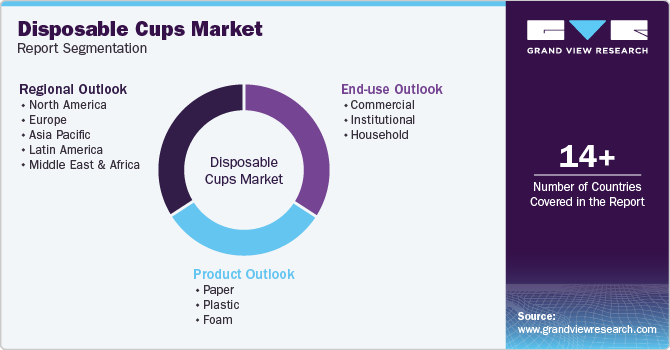 To learn more about this report, Download Free Sample Report
 -
Product Outlook (Revenue, USD Million, 2021 - 2033)
-
Paper
-
Plastic
-
Foam
-
-
End-use Outlook (Revenue, USD Million, 2021 - 2033)
-
Commercial
-
Institutional
-
Household
-
-
Regional Outlook (Revenue, USD Million, 2021 - 2033)
-
North America
-
U.S.
-
Canada
-
Mexico
-
-
Europe
-
UK
-
Germany
-
France
-
Italy
-
Spain
-
-
Asia Pacific
-
Japan
-
China
-
India
-
Australia & New Zealand
-
-
Latin America
-
Brazil
-
-
Middle East and Africa
-
South Africa
-
UAE
-
-
Research Methodology
The disposable cups market figures in this report are based on a proven research process that combines executive interviews with secondary research from proprietary databases, company filings, and recognized regulatory and institutional sources. Market size is built through value-chain sizing - reconciling supply-side and demand-side estimates - and triangulated with bottom-up and top-down approaches. Every estimate passes multiple levels of expert validation before publication, with each disposable cups segment quantified using the revenue-capture definitions in the table below.
Segment Definition
Segment - Product
Revenue capture definition
Paper
Revenue is generated through the sale of disposable paper cups used for serving hot and cold beverages across commercial, institutional, and household applications. Revenue includes purchases by foodservice establishments, cafés, restaurants, offices, educational institutions, healthcare facilities, and consumers through retail and distribution channels.
Plastic
Revenue is generated through the sale of disposable plastic cups used for beverage service in foodservice, hospitality, institutional, event, and household settings. Revenue includes purchases of cups designed for cold drinks, takeaway beverages, catering services, and convenience applications across commercial and residential end users.
Foam
Revenue is generated through the sale of disposable foam cups used for hot and cold beverage consumption where insulation and cost efficiency are key purchasing considerations. Revenue includes purchases by foodservice operators, convenience stores, institutions, catering providers, and consumers through wholesale, retail, and distribution channels.
Estimation Model
Layer Name
Key Question
Description
Population Layer
Who forms the base consumer pool?
Total consumers and organizations generating demand for single-use beverage service solutions, including households, restaurants, cafés, foodservice outlets, offices, educational institutions, healthcare facilities, event venues, and other commercial establishments.
Access Layer
Who has access to disposable cup products?
Consumers and institutions with access to disposable cups through foodservice distributors, wholesalers, retail stores, supermarkets, convenience stores, cash-and-carry outlets, and e-commerce platforms. This layer reflects product availability across commercial, institutional, and household channels.
Behavioral Layer
Who actively uses disposable cups?
Active users regularly utilizing paper, plastic, and foam cups for hot and cold beverage consumption, takeaway services, workplace refreshment programs, institutional catering, events, and household convenience applications, filtered by usage frequency and consumption occasions.
Monetisation Layer
How much revenue is generated?
Revenue derived from commercial, institutional, and household users multiplied by average annual spending on paper, plastic, and foam disposable cups across foodservice, workplace, educational, healthcare, hospitality, and residential applications.
Delivered Customizations
This report has been delivered with the following In-depth customizations
Client Request
Customization Delivered
Value Adds
Material Transition Analysis (Product Type × End-Use Assessment)
Evaluated the adoption of paper, plastic, and foam cups across commercial, institutional, and household applications to identify shifts in material preferences driven by sustainability requirements, cost considerations, and performance needs.
Identifies product categories most exposed to material substitution trends and supports product portfolio and capacity planning decisions.
Regulatory Impact Assessment (Material Type × Compliance Mapping)
Assessed the impact of single-use plastic regulations, foam restrictions, recyclability requirements, and sustainability initiatives on demand across disposable cup categories and end-use sectors.
Helps manufacturers anticipate regulatory risks, prioritize compliant product development, and identify emerging growth opportunities.
End-Use Consumption Intensity Analysis (End Use × Usage Volume Assessment)
Evaluated disposable cup consumption patterns across commercial, institutional, and household environments by analyzing beverage-serving frequency, takeaway demand, catering requirements, and purchasing behavior.
Reveals where volume demand is structurally concentrated and supports customer targeting, sales planning, and production forecasting strategies.
Frequently Asked Questions About This Report
Key factors that are driving the disposable cups market growth include increasing demand for Quick Service Restaurants (QSR) from urban semi-urban market and water shortage to clean utensils is anticipated to use disposables for serving food and beverages.
Asia Pacific dominated with a 34.1% revenue share in 2025.
Key players include Huhtamäki; Dart Container Corporation; Berry Global Inc.; Pactiv Evergreen Inc.; Duni; WestRock Company; Genpak; Go-Pak Group; CONVERPACK INC.; Bender Limited
Disposable cups for commercial end users led the market with a revenue share of 77.7% in 2025, and is the fastest growing segment over the forecast period.
China held the largest market share of 38.3% in 2025 in the Asia Pacific disposable cups market.
The global disposable cups market size was valued at USD 18.5 billion in 2025 and is estimated at USD 19.4 billion for 2026.
The global disposable cups market is expected to grow at a CAGR of 3.7% from 2026 to 2033, reaching USD 25.0 billion by 2033.
Paper disposable cups led with a 60.3% revenue share in 2025, and is the fastest-growing segment over the forecast period.
About the Author(s)
Homecare & Decor Research Team
Consumer Goods · Homecare & DecorThis report was authored by the homecare & decor research team at Grand View Research - comprising two research analysts, one senior research analyst, and one industry expert - with specialized expertise in the homecare & decor segment of the consumer goods industry. All findings are based on proprietary consumer goods databases, executive interviews, and regulatory analysis, subject to internal peer review prior to publication.
Last Updated:
Speak to Analyst

Customize this report to your needs - add regions, segments, or data points, with 20% free customization.
Or view our licence options:


ISO 9001:2015 & 27001:2022 Certified
We are GDPR and CCPA compliant! Your transaction & personal information is safe and secure. For more details, please read our privacy policy.


