
- Home
- »
- Advanced Interior Materials
- »
-
District Cooling Market Size & Share, Industry Report, 2033GVR Report cover

District Cooling Market (2026 - 2033) Size, Share & Trends Analysis Report By Production Technique (Free Cooling, Absorption Cooling, Electric Chillers), By Application (Commercial, Residential, Industrial), By Region, And Segment Forecasts
Market Size, 2025
$32.8BMarket Estimate, 2026
$34.4BMarket Forecast, 2033
$50.3BCAGR, 2026–2033
5.6%District Cooling Market Summary
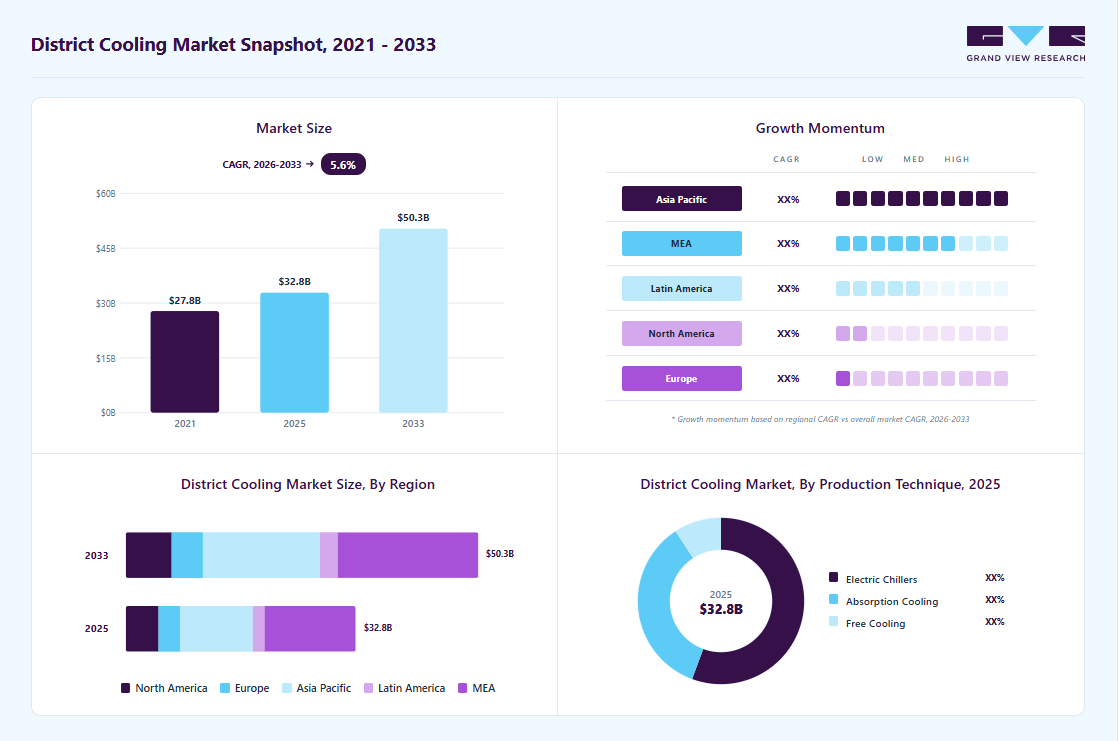
The global district cooling market size was valued at USD 32.8 billion in 2025 and is projected to grow from USD 34.4 billion in 2026 to USD 50.3 billion by 2033, at a CAGR of 5.6% from 2026 to 2033. The Middle East & Africa district cooling market held the largest share of 39.6% of the global market in 2025. The market is driven by rapid urbanization, rising temperatures, and increasing demand for energy-efficient cooling solutions in commercial, residential, and mixed-use developments.
 Source: Grand View Research, IR Documents, Primary Interviews, Paid DatabasesTo learn more about this report,
 Download Free Sample Report
 Key Market Trends & Insights
- By production technique: Electric chillers segment led the market with the largest revenue share of 55.6% in 2025.
- By production technique: Absorption cooling segment is expected to grow at a significant CAGR during the forecast period.
- By application: Commercial segment led the market with the largest revenue share of 51.29% in 2025.
Regional Highlights
- Largest regional market: Middle East & Africa (39.6% revenue share, 2025)
- Fastest-growing regional market: Asia Pacific (highest CAGR, 2026-2033)
- By country: The district cooling market in Saudi Arabia is projected to grow at a significant CAGR over the forecast period.
Market Size & Forecast
- Market size in 2025: USD 32.8 Billion
- Estimated market size in 2026: USD 34.4 Billion
- Projected market size by 2033: USD 50.3 Billion
- CAGR (2026-2033): 5.6%
Three ways to get this report
Buy it, customize it, or ask a question.Ask an Analyst
Analyst response in 1 business day
- AccessReport author, directly
- Reply timeWithin 1 working day
- No sales callDirect answer only
- FormatEmail reply
- CostFree, no cost
Get the Full Report
What the study covers
- FormatsPDF · Excel · Dashboard
- Timeline2026–2033 annual, 2025 base
- Coverage20+ countries, 5 regions
- Companies10+ key players profiled
Customize the Report
20% free customization
- IncludeCountries, segments, points
- TailorTo your product definition
- ExtendDeeper competitor detail
- OrA fully bespoke study
- Turnaround5–10 working days
Governments and municipalities are promoting centralized cooling systems to reduce electricity consumption, peak load pressure, and greenhouse gas emissions. Technological advancements, including thermal energy storage and smart grid integration, are improving system efficiency and reliability.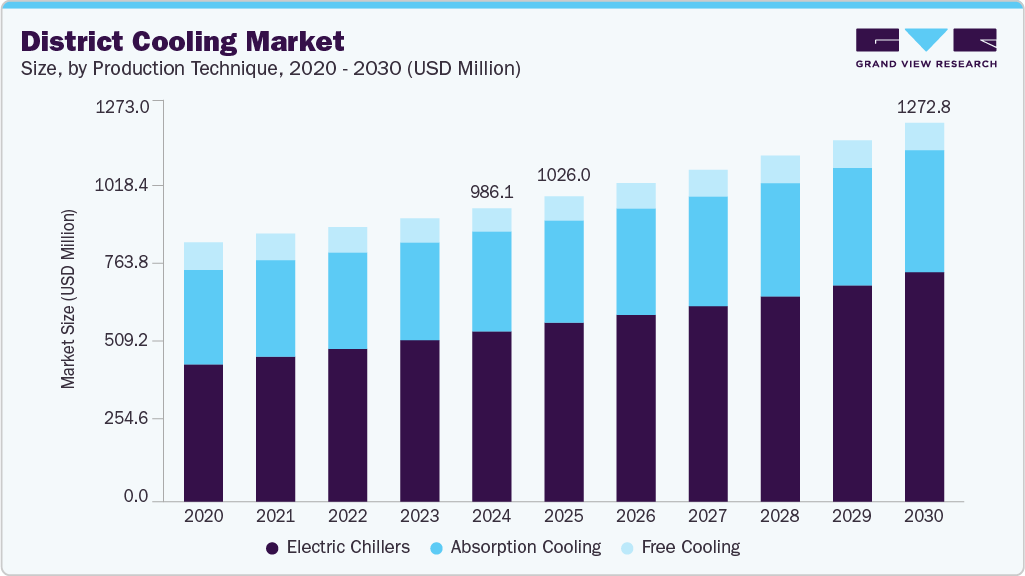 To learn more about this report, Download Free Sample Report
 Growth is particularly strong in the Middle East and Asia-Pacific, where large infrastructure projects and smart city initiatives are expanding. In addition, stricter environmental regulations and sustainability goals are encouraging the adoption of alternative air conditioning systems over conventional systems. Private sector participation and public-private partnerships are further supporting market expansion, making district cooling an increasingly viable long-term solution.
Market Concentration & Characteristics
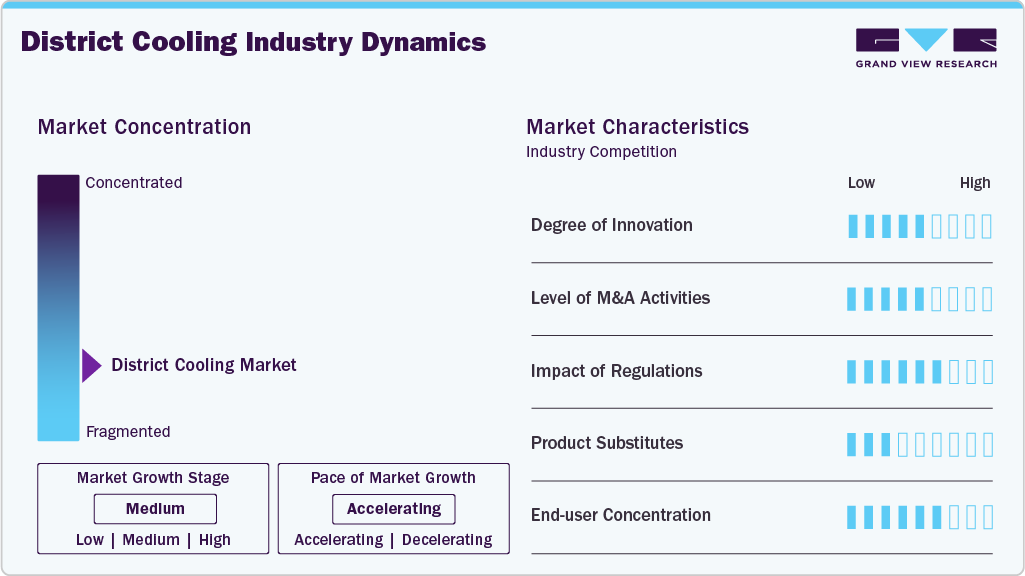
The district cooling industry is fragmented, with a mix of global energy service companies, regional utilities, and specialized local providers operating across different geographies. Large players dominate major urban projects, especially in the Middle East, while smaller firms cater to localized or niche developments. Entry barriers related to high capital investment and infrastructure needs limit new entrants, but partnerships and concessions enable broader participation. Varying regulatory frameworks and project-specific requirements further contribute to market fragmentation.
Innovation in the district cooling industry is high, driven by the need for energy efficiency and sustainability. Companies are integrating thermal energy storage, renewable energy sources, and smart monitoring systems to optimize performance. Digitalization, including IoT-based controls and predictive maintenance, is improving operational efficiency. Advances in pipe insulation and cooling technologies are also reducing energy losses, making systems more reliable and cost-effective across large-scale urban developments.
 To learn more about this report, Download Free Sample Report
 Merger and acquisition activity in the district cooling industry is gradually increasing as companies seek to expand geographic presence and strengthen project portfolios. Large utility providers and infrastructure firms are acquiring smaller regional players to gain access to ongoing projects and long-term contracts. Strategic partnerships and joint ventures are also common, helping firms share investment risks and technical expertise. This consolidation trend is enhancing competitiveness while enabling companies to scale operations in high-growth regions.
Regulations play a significant role in shaping the district cooling industry by encouraging energy efficiency and reducing environmental impact. Governments are implementing policies that promote centralized cooling systems over conventional air conditioning to lower carbon emissions and peak electricity demand. Building codes, energy standards, and sustainability targets are pushing developers to adopt district cooling solutions. Incentives, subsidies, and long-term concession frameworks further support market growth while ensuring compliance with environmental and efficiency goals.
Drivers, Opportunities & Restraints
Several factors drive the district cooling industry, including the increasing demand for energy-efficient cooling solutions, rapid urbanization, and supportive government policies. The growing awareness about climate change and the need for sustainable urban development also contribute to the market growth. Furthermore, district cooling systems offer cost advantages in reduced energy consumption and lower maintenance costs, making them an attractive option for large-scale cooling applications.
However, the high initial investment and the complexity of installing and integrating district cooling systems pose significant challenges. In addition, the need for a well-developed infrastructure for the distribution of cooling energy can limit the adoption of district cooling in certain regions.
Despite these challenges, numerous growth opportunities exist, particularly with the increasing focus on smart cities and sustainable urban development. Integrating renewable energy sources, such as solar and geothermal, into district cooling systems offers significant innovation and market expansion opportunities.
Production Technique Insights
The electric chillers segment led the market with the largest revenue share of 55.6% in 2025 and is projected to grow at the fastest CAGR during the forecast period, due to its high efficiency, reliability, and ease of integration with existing power infrastructure. The increasing adoption of smart grids and renewable energy sources supports their use in sustainable cooling systems. Electric chillers are widely preferred in urban developments for their operational flexibility, lower maintenance requirements, and their ability to efficiently meet varying load demands.
The absorption cooling segment is expected to grow at a significant CAGR during the forecast period, supported by its ability to utilize waste heat and alternative energy sources such as solar or industrial heat. This makes it suitable for improving overall energy efficiency in integrated systems. Growth is driven by rising interest in reducing electricity consumption and carbon emissions.
Application Insights
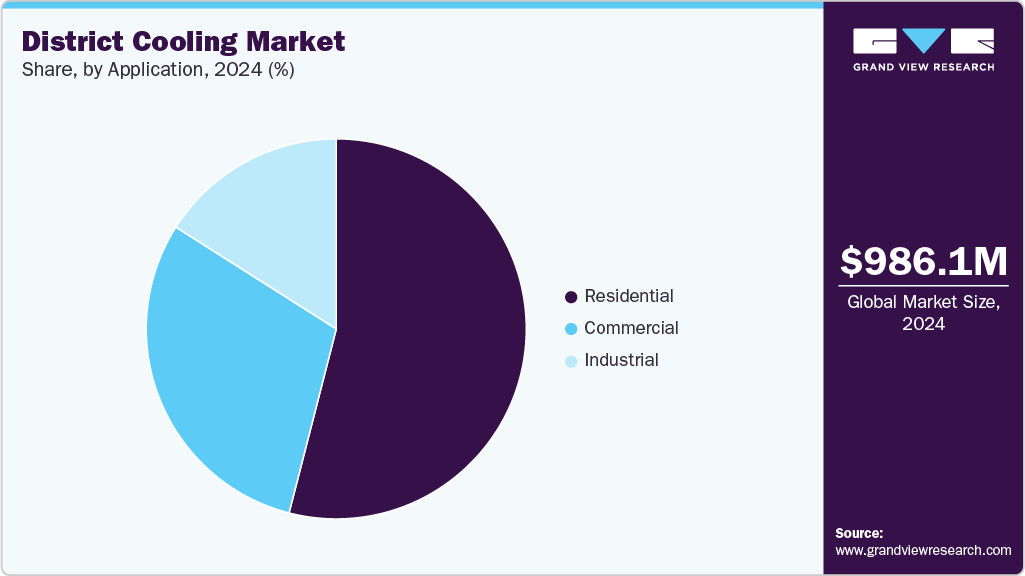
The commercial segment led the market with the largest revenue share of 51.3% in 2025 and is projected to grow at the fastest CAGR during the forecast period, driven by rising demand from offices, malls, airports, hospitals, and hospitality infrastructure. These facilities require continuous, large-scale cooling, making centralized systems more efficient and cost-effective. Increasing construction of commercial complexes and smart buildings, along with sustainability targets and energy regulations, is accelerating the adoption of district cooling solutions across major urban centers.
 To learn more about this report, Download Free Sample Report
 The residential segment is expected to grow at a significant CAGR of 4.5% during the forecast period, as urban housing projects and high-density developments expand. Developers are increasingly integrating centralized cooling to improve energy efficiency and reduce long-term operating costs for residents. Growing awareness of sustainable living and government support for green buildings are also encouraging adoption. However, growth may be comparatively slower due to cost sensitivity and infrastructure requirements.
Regional Insights
The district cooling market in North America is supported by rising demand for energy-efficient building solutions and retrofitting of existing infrastructure. Increasing focus on reducing peak electricity demand and carbon emissions is encouraging adoption in commercial complexes, universities, and healthcare facilities. Technological advancements and integration with smart energy systems are further supporting expansion, particularly in urban areas with high cooling requirements.
U.S. District Cooling Market Trends
The district cooling market in the U.S. is growing as adoption increases in large commercial buildings, campuses, and mixed-use developments. Universities, airports, and downtown districts are key users of centralized cooling systems. Strong emphasis on energy efficiency, sustainability goals, and operational cost reduction is driving investments. In addition, modernizing aging infrastructure and integrating with renewable energy sources are contributing to the steady expansion of district cooling networks.
The Mexico district cooling market is gradually expanding, driven by rising urbanization and growing demand for efficient cooling in the commercial and hospitality sectors. Increasing temperatures and rising energy costs are driving the adoption of centralized cooling systems in large developments. Government initiatives to improve energy efficiency and reduce emissions are also supporting growth.
Middle East & Africa District Cooling Market Trends
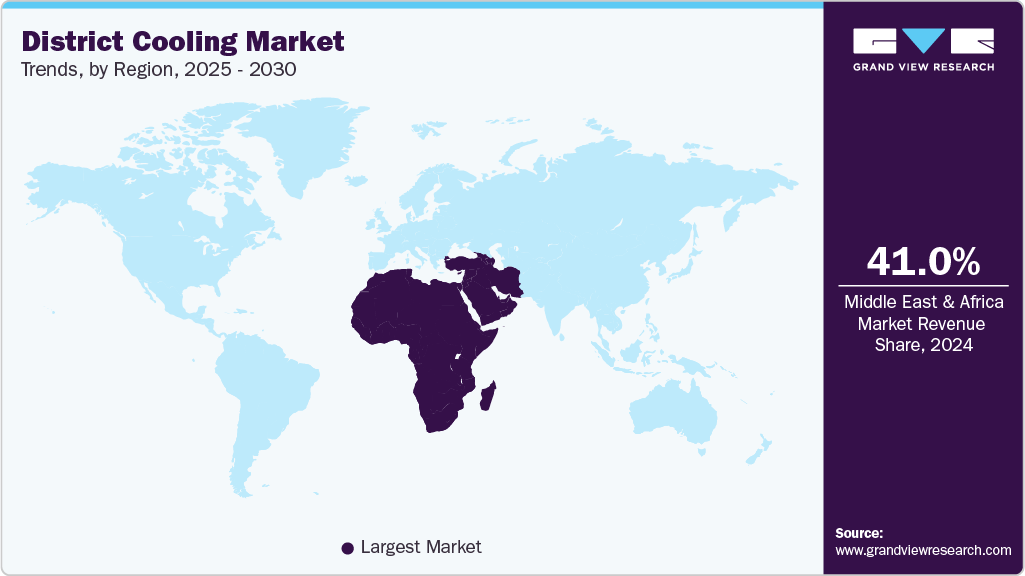
The Middle East and Africa dominated the global district cooling market with the largest revenue share of 39.6% in 2025. Large-scale infrastructure projects, especially in the Gulf countries, are supporting widespread adoption. Governments are focusing on energy efficiency and reducing electricity consumption. Increasing investments in smart cities and commercial developments are further accelerating the deployment of district cooling systems.
 To learn more about this report, Download Free Sample Report
 The district cooling market in Saudi Arabia is growing strongly due to large infrastructure projects and increasing urban development. Rising temperatures and high cooling demand are driving the need for efficient centralized systems. Government initiatives focused on energy efficiency and sustainable infrastructure are supporting adoption. The expansion of commercial, residential, and mixed-use developments is further driving market growth, making district cooling an important part of urban planning.
Asia Pacific District Cooling Market Trends
The district cooling market in the Asia Pacific is anticipated to grow at the fastest CAGR during the forecast period, driven by rapid urbanization, infrastructure development, and rising temperatures. Increasing construction of smart cities, commercial hubs, and high-density residential complexes is boosting demand. Governments are promoting energy-efficient solutions to manage rising electricity consumption. Countries across the region are investing in large-scale district cooling projects, making it a key growth hub for the global market.
The China district cooling market accounted for the largest market revenue share in the Asia Pacific in 2025, due to large-scale urban development and increasing energy demand. Government initiatives focused on energy efficiency and emission reduction are encouraging the adoption of centralized cooling systems. Expansion of commercial infrastructure, industrial zones, and smart cities is driving demand. Integration with renewable energy and advanced cooling technologies is further supporting market growth across major metropolitan areas.
The district cooling market in India is expanding significantly, supported by rapid urbanization and increasing demand for sustainable cooling solutions. Growth in commercial real estate, IT parks, and smart city projects is driving adoption. Government initiatives promoting energy efficiency and reduced peak power demand are encouraging deployment. Rising temperatures and electricity consumption are further supporting market expansion, although high upfront costs and infrastructure challenges may limit faster growth.
Europe District Cooling Market Trends
The district cooling market in Europe is growing steadily, supported by strict environmental regulations and a strong focus on energy efficiency. Increasing adoption in commercial buildings, public infrastructure, and urban redevelopment projects is driving demand. Integration with district heating networks and use of renewable energy sources are key trends. Governments are promoting sustainable cooling solutions to reduce carbon emissions and encouraging the broader deployment of district cooling systems across major cities.
The Germany district cooling market is expanding gradually, driven by sustainability targets and efficient energy management practices. Adoption is increasing in commercial buildings, data centers, and public infrastructure projects. Integration with renewable energy and combined heating and cooling systems supports growth. Government policies promoting energy efficiency and carbon reduction are encouraging investments.
The district cooling market in the UK is experiencing steady growth, supported by urban redevelopment and sustainability initiatives. Increasing adoption in commercial real estate, mixed-use developments, and public infrastructure is driving demand. The government's focus on reducing carbon emissions and improving energy efficiency is encouraging centralized cooling solutions. Integration with district heating systems and smart energy networks is also supporting expansion, particularly in densely populated cities like London.
Latin America District Cooling Market Trends
The district cooling market in Latin America is developing gradually, supported by urbanization and increasing awareness of energy-efficient cooling solutions. Growth is mainly driven by the commercial and hospitality sectors in major cities. Rising temperatures and electricity demand are encouraging the adoption of centralized systems.
The Brazil district cooling market is witnessing gradual growth, driven by increasing demand from commercial buildings, shopping centers, and large infrastructure projects. Urbanization and rising temperatures are driving the adoption of energy-efficient cooling solutions. Adoption is supported by efforts to reduce electricity consumption and improve sustainability.
Key District Cooling Company Insights
Some of the key players operating in the market include Veolia, Danfoss, Emicool, ALFA LAVAL Holding A/S, Qatar District Cooling Company Private J.S.C
- Emirates Central Cooling Systems Corporation PJSC is a district cooling service provider in the Middle East. It offers sustainable and energy-efficient cooling solutions for residential, commercial, and industrial applications. The company's extensive network and innovation focus have solidified its market position.
- Emicool is a district cooling provider in the UAE. It offers energy-efficient and sustainable cooling solutions for residential and commercial buildings. The company's commitment to environmental sustainability and advanced technology integration has driven its market growth.
Key District Cooling Companies:
The following key companies have been profiled for this study on the district cooling market
- Veolia
- Danfoss
- Emicool
- SHINRYO CORPORATION
- ALFA LAVAL
- ADC Energy Systems
- DAIKIN INDUSTRIES, Ltd.
- Tabreed
- AtkinsRéalis
- Emirates Central Cooling Systems Corporation PJSC
- Keppel Ltd
- Qatar District Cooling Company Private J.S.C
- Stellar Energy International
- ENGIE
- Ramboll Group A/S
Recent Developments
-
In November 2025, Emicool, in partnership with Yellow Door Energy, launched four solar power plants in Dubai to support decarbonization of district cooling operations. The initiative aims to reduce reliance on conventional energy sources by integrating renewable power into cooling systems.
-
In January 2025,Emicool, a leading district cooling provider, partnered with Quant Gulf to deploy the Schaeffler OPTIME Ecosystem, enhancing operational efficiency and sustainability.
District Cooling Market Report Scope
Report Attribute
Details
Market size in 2025
USD 32.8 billion
Estimated market size in 2026
USD 34.4 billion
Projected market size by 2033
USD 50.3 billion
Growth rate
CAGR of 5.6% from 2026 to 2033
Base year for estimation
2025
Historical data
2021 - 2024
Forecast period
2026 - 2033
Quantitative units
Revenue in USD million/billion, and CAGR from 2026 to 2033
Report coverage
Revenue forecast, company ranking, competitive landscape, growth factors, and trends
Segments covered
Production technique, application, region.
Regional scope
North America; Europe; Asia Pacific; Latin America; Middle East & Africa
Country scope
U.S.; Canada; Mexico; UK; Germany; France; Italy; Spain; China; Japan; India; Australia; South Korea; Brazil; Argentina; UAE; Saudi Arabia; South Africa
Key companies profiled
Veolia; Danfoss; Emicool; SHINRYO CORPORATION; ALFA LAVAL; ADC Energy Systems; DAIKIN INDUSTRIES, Ltd.; Tabreed; AtkinsRéalis; Emirates Central Cooling Systems Corporation PJSC; Keppel Ltd; Qatar District Cooling Company Private J.S.C; Stellar Energy International; ENGIE; Ramboll Group A/S
Customization scope
Free report customization (equivalent up to 8 analysts working days) with purchase. Addition or alteration to country, regional & segment scope.
Pricing and purchase options
Avail customized purchase options to meet your exact research needs. Explore purchase options
Global District Cooling Market Report Segmentation
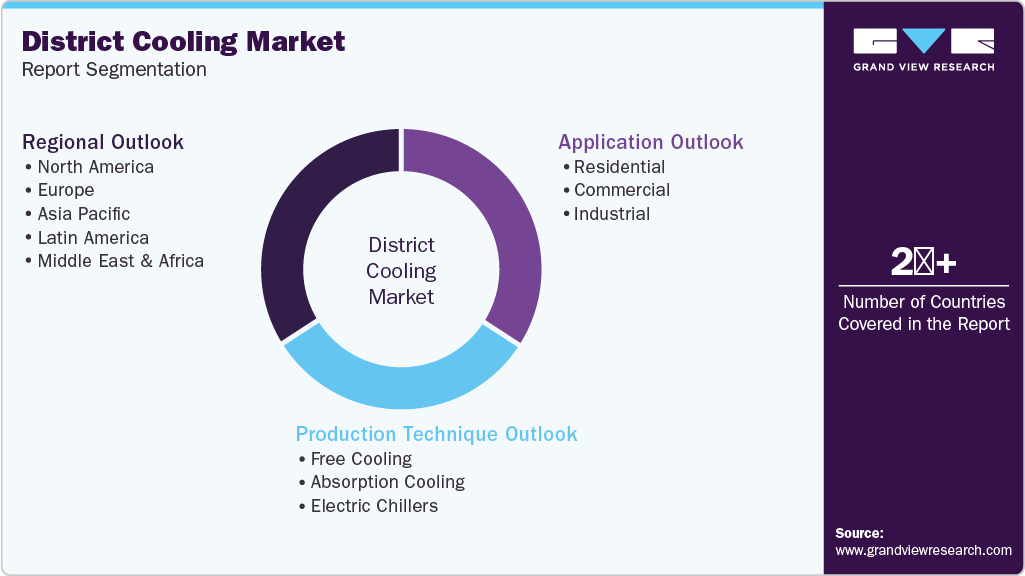
This report forecasts revenue growth at global, regional, and country levels and provides an analysis of the latest industry trends in each of the sub-segments from 2021 to 2033. For this study, Grand View Research has segmented the global district cooling market report based on production technique, application, and region.
 To learn more about this report, Download Free Sample Report
 -
Production Technique Outlook (Revenue, USD Billion, 2021 - 2033)
-
Free Cooling
-
Absorption Cooling
-
Electric Chillers
-
-
Application Outlook (Revenue, USD Billion, 2021 - 2033)
-
Commercial
-
Industrial
-
Residential
-
-
Regional Outlook (Revenue, USD Billion, 2021 - 2033)
-
North America
-
U.S.
-
Canada
-
Mexico
-
-
Europe
-
Germany
-
France
-
Italy
-
UK
-
-
Asia Pacific
-
China
-
India
-
Japan
-
Australia
-
South Korea
-
-
Latin America
-
Brazil
-
Argentina
-
-
Middle East and Africa
-
Saudi Arabia
-
UAE
-
South Africa
-
-
Frequently Asked Questions About This Report
The demand for district cooling is driven by the need for energy-efficient and sustainable cooling solutions, rapid urbanization, supportive government policies, and the integration of renewable energy sources.
Middle East & Africa dominated with a 39.6% revenue share in 2025.
Asia Pacific is the fastest-growing region over the forecast period.
The commercial segment led with a 51.3% revenue share in 2025.
The global district cooling market size was valued at USD 32.8 billion in 2025 and is estimated at USD 34.4 billion for 2026.
The global district cooling market is expected to grow at a CAGR of 5.6% from 2026 to 2033, reaching USD 50.3 billion by 2033.
The electric chillers segment holds the dominant share in the market, accounting for 55.6% in 2025, due to its high efficiency, reliability, and ease of integration with existing power infrastructure. Increasing adoption of smart grids and renewable electricity sources supports their use in sustainable cooling systems.
Key players include Veolia; Danfoss; Emicool; SHINRYO CORPORATION; ALFA LAVAL; ADC Energy Systems; DAIKIN INDUSTRIES, Ltd.; Tabreed; AtkinsRéalis; Emirates Central Cooling Systems Corporation PJSC; Keppel Ltd; Qatar District Cooling Company Private J.S.C; Stellar Energy International; ENGIE; Ramboll Group A/S.
About the Author(s)
Advanced Interior Materials Research Team
Advanced Materials · Advanced Interior MaterialsThis report was authored by the advanced interior materials research team at Grand View Research - comprising two research analysts, one senior research analyst, and one industry expert - with specialized expertise in the advanced interior materials segment of the advanced materials industry. All findings are based on proprietary advanced materials databases, executive interviews, and regulatory analysis, subject to internal peer review prior to publication.
Last Updated:
Speak to Analyst

Customize this report to your needs - add regions, segments, or data points, with 20% free customization.
Or view our licence options:


ISO 9001:2015 & 27001:2022 Certified
We are GDPR and CCPA compliant! Your transaction & personal information is safe and secure. For more details, please read our privacy policy.


