
- Home
- »
- Next Generation Technologies
- »
-
Document AI Market Size, Share, Trends Report, 2026-2033GVR Report cover

Document AI Market (2026 - 2033)
Size, Share, & Trends Analysis Report By Offering (Solution, Services), By Document Type (Semi-structured Documents, Unstructured Documents), By Application, By End Use, By Region, and Segment Forecasts
Market Size, 2025
$14.7BMarket Estimate, 2026
$16.6BMarket Forecast, 2033
$44.8BCAGR, 2026–2033
15.2%Document AI Market Summary
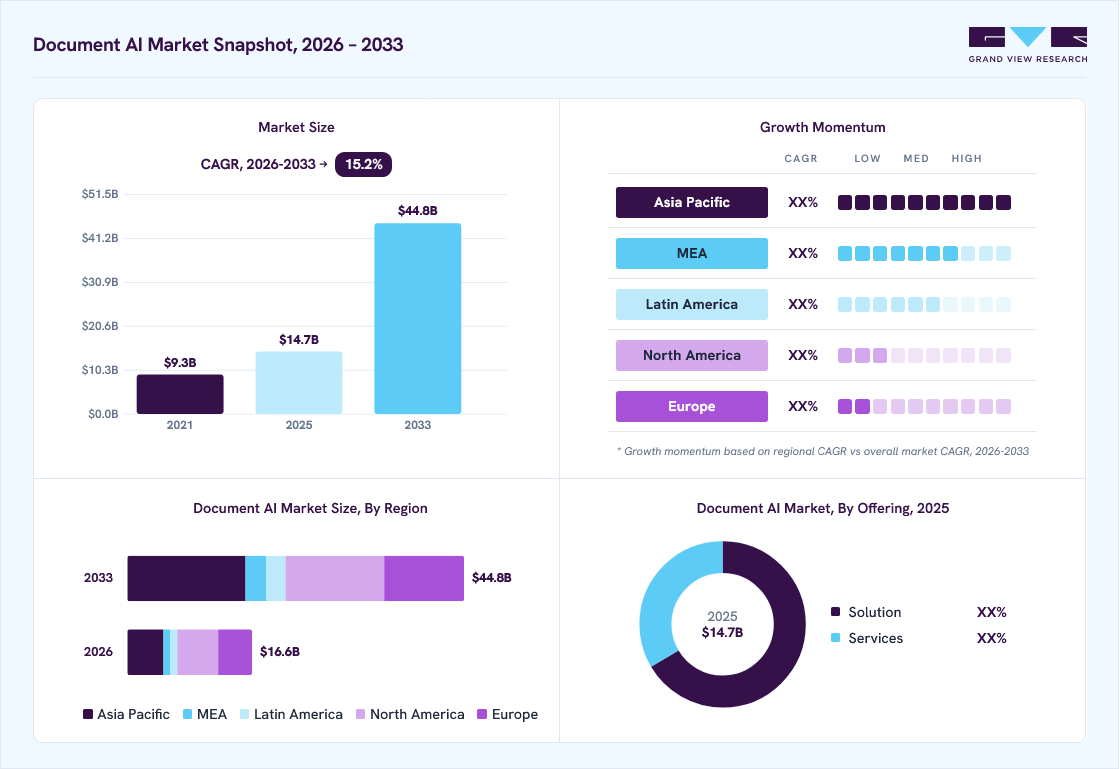
The global document AI market size was valued at USD 14.7 billion in 2025 and is projected to grow from USD 16.6 billion in 2026 to USD 44.8 billion by 2033, at a CAGR of 15.2% from 2026 to 2033. North America dominated the market, accounting for a revenue share of 33.2% in 2025. The rising adoption of AI-powered document processing and data extraction, increasing enterprise demand for automated document classification and workflow optimization, growing integration of generative AI and machine learning into document management systems, expanding digital transformation initiatives across BFSI healthcare and government sectors, increasing regulatory compliance and data accuracy requirements driving investment in intelligent document automation.
 Source: Grand View Research, IR Documents, Primary Interviews, Paid DatabasesTo learn more about this report,
 Download Free Sample Report
Key Market Trends & Insights
- By offering: Solution segment held the largest market share of 66.4% in 2025.
- By document type: Semi-structured documents segment held the largest market revenue share in 2025.
- By application: Data Extraction segment led the market with the largest revenue share in 2025.
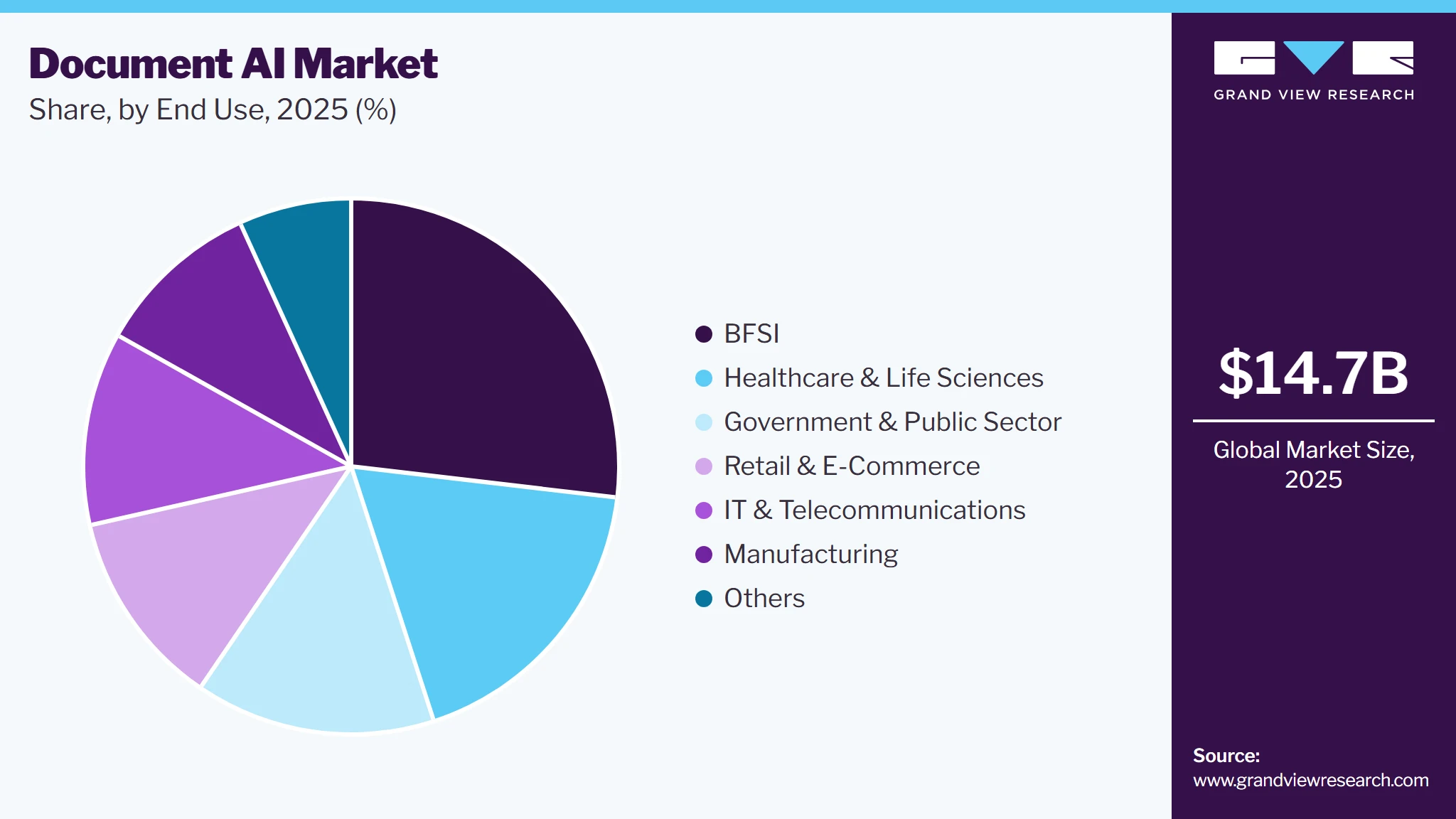
- By end use: BFSI segment held the largest market revenue share in 2025.
Regional Highlights
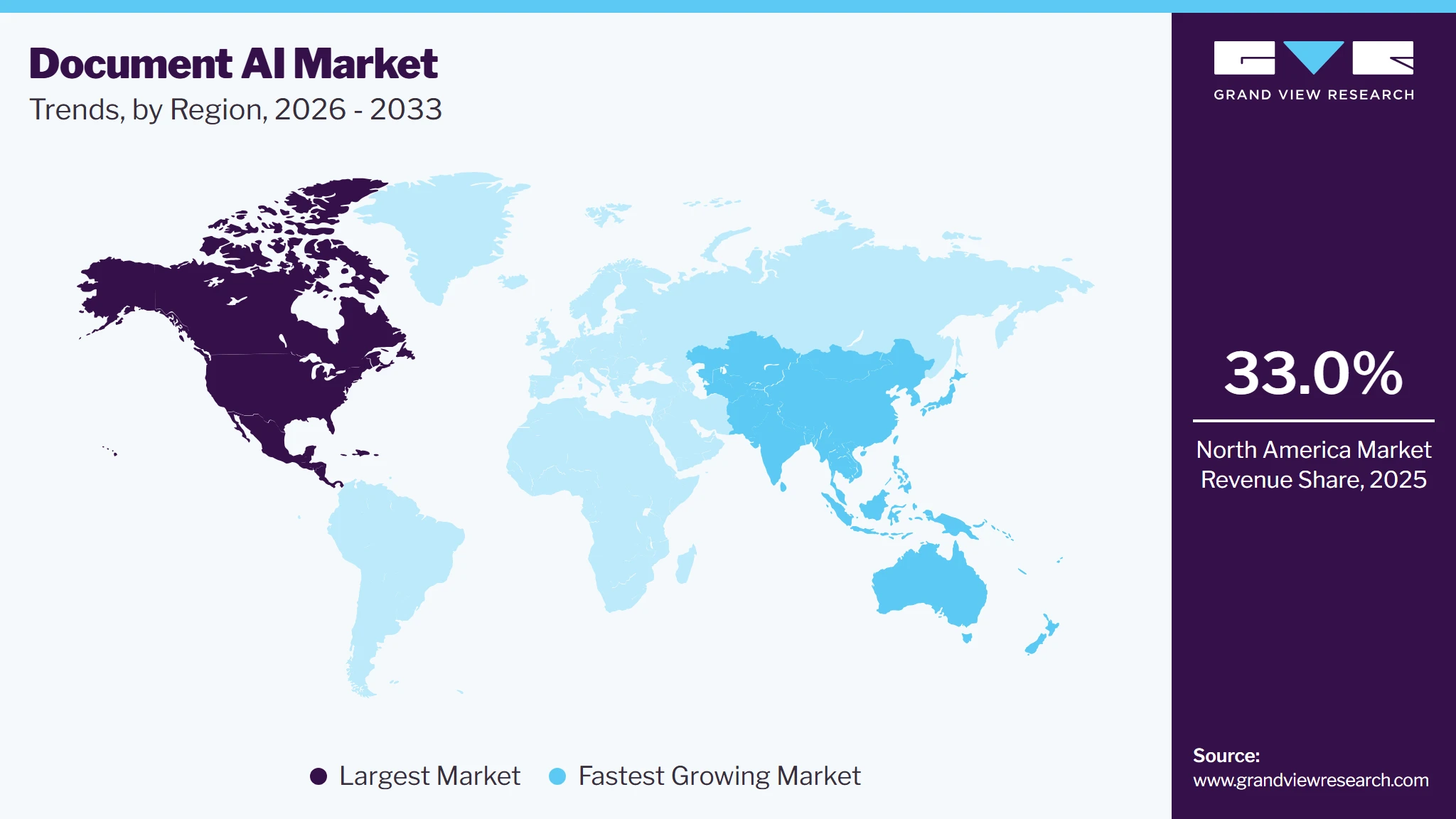
- Largest regional market: North America (33.0% revenue share, 2025)
- Fastest-growing regional market: Asia Pacific (highest CAGR, 2026-2033)
- By country: The U.S. held the largest share in 2025
Market Size & Forecasts
- Market size in 2025: USD 14.7 Billion
- Estimated market size in 2026: USD 16.6 Billion
- Projected market size by 2033: USD 44.8 Billion
- CAGR (2026-2033): 15.2%
Three ways to get this report
Buy it, customize it, or ask a question.Ask an Analyst
Analyst response in 1 business day
- AccessReport author, directly
- Reply timeWithin 1 working day
- No sales callDirect answer only
- FormatEmail reply
- CostFree, no cost
Get the Full Report
What the study covers
- FormatsPDF · Excel · Dashboard
- Timeline2026–2033 annual, 2025 base
- Coverage20+ countries, 5 regions
- Companies10+ key players profiled
Customize the Report
20% free customization
- IncludeCountries, segments, points
- TailorTo your product definition
- ExtendDeeper competitor detail
- OrA fully bespoke study
- Turnaround5–10 working days
Agentic AI is emerging as a key trend as enterprises move from automated document extraction toward systems capable of executing multi-step document-related workflows. These systems can classify incoming documents, extract information, validate records, identify missing information, and route cases to appropriate teams or applications. Organizations are exploring agentic workflows for insurance claims, loan processing, contract management, and regulatory documentation to reduce processing delays. Integration with enterprise applications enables AI agents to initiate follow-up actions and coordinate tasks across existing business systems. This development is increasing demand for Document AI platforms that combine autonomous workflow execution with human oversight, audit trails, and controlled decision-making.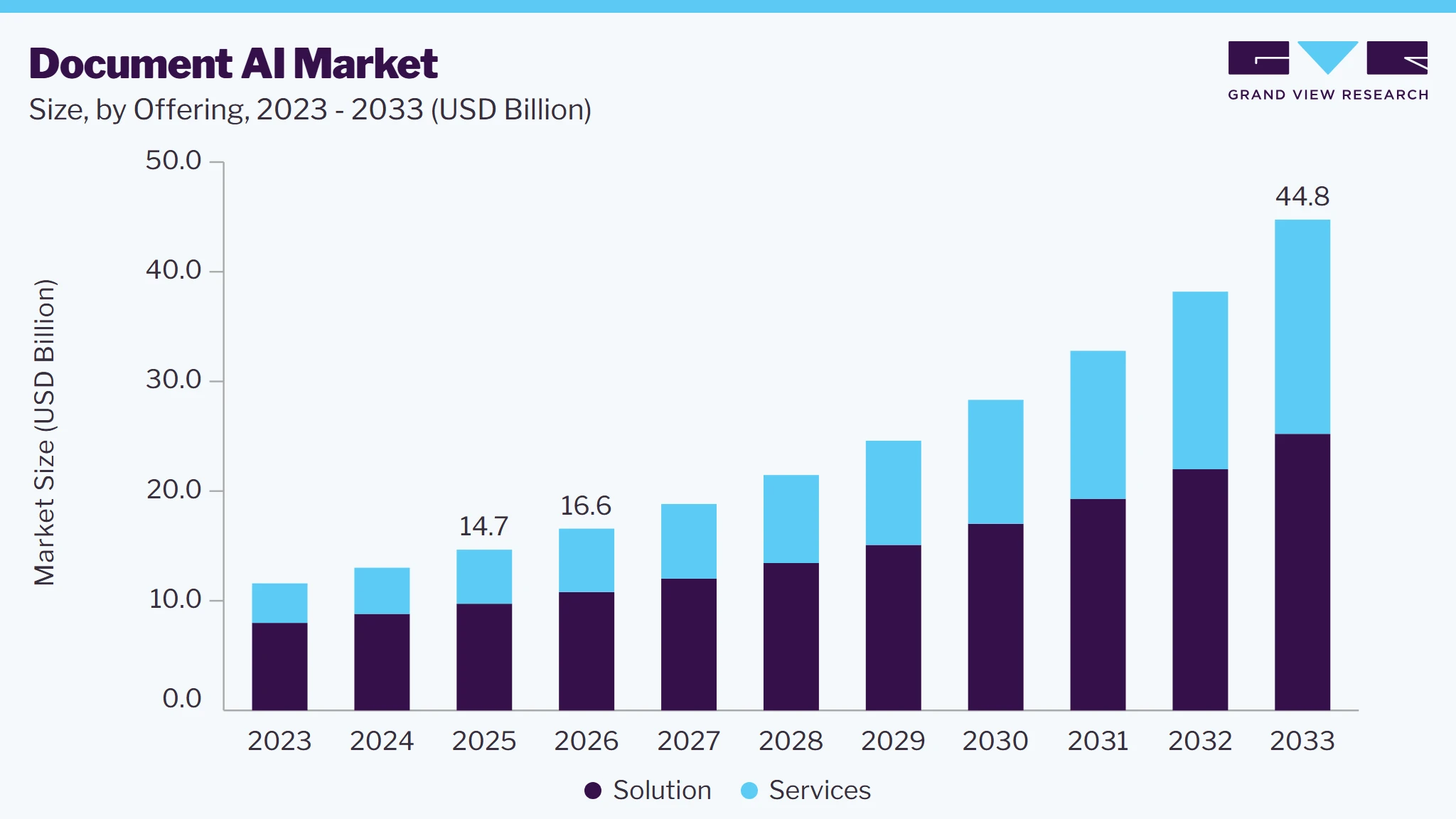 To learn more about this report, Download Free Sample Report
Enterprises are prioritizing secure Document AI deployments as automated systems increasingly process confidential financial records, healthcare information, legal documents, and personally identifiable information. Organizations are implementing access controls, encryption, audit trails, data residency measures, and human-review mechanisms to manage the risks associated with AI-driven document processing. Privacy-preserving approaches, including federated learning and region-specific deployment architectures, are gaining attention where sensitive information cannot be freely transferred across systems or jurisdictions. Businesses are also emphasizing explainability, data lineage, and output validation to improve accountability and support regulatory audits. These requirements are increasing demand for enterprise-grade Document AI platforms that balance automation efficiency with security, transparency, and compliance.
Retrieval-augmented generation (RAG) is gaining traction as organizations connect Document AI platforms with internal repositories, knowledge bases, and enterprise content management systems. This approach enables AI models to retrieve relevant information from approved documents before generating summaries, answering questions, or preparing business reports. Enterprises are applying RAG to contract analysis, policy interpretation, compliance reviews, technical support, and internal knowledge discovery. Integration with customer relationship management, enterprise resource planning, and workflow platforms is further enabling document-derived information to support operational decisions. This trend is driving demand for document AI solutions that convert fragmented enterprise documents into searchable, contextualized, and actionable business knowledge.
Market Dynamics
The document AI market is evolving as organizations increasingly adopt artificial intelligence to automate document-intensive business processes and improve information accessibility. Advancements in generative AI, machine learning, natural language processing, and computer vision are expanding document processing capabilities beyond traditional data extraction and classification. Enterprises are integrating Document AI solutions with enterprise content management, customer relationship management, and enterprise resource planning systems to streamline workflows and improve operational efficiency. Growing requirements for data accuracy, regulatory compliance, and faster information retrieval are strengthening demand across banking, financial services, healthcare, government, retail, and manufacturing. Market development is further supported by cloud-based deployment models, increasing enterprise digitization, and the expansion of AI-enabled document management applications.
The growing volume of business documents is driving enterprises to adopt Document AI solutions that automate information extraction, classification, validation, and processing. Organizations are prioritizing intelligent automation to reduce manual workloads, minimize processing errors, and accelerate document-intensive activities across finance, insurance, healthcare, and supply chain operations. Advances in generative AI and machine learning are enabling systems to interpret complex documents, identify relevant information, and support decisions with limited human intervention. Integration with existing enterprise applications is further improving workflow continuity and enabling organizations to automate processes across multiple departments. These benefits are accelerating investments in document AI platforms as enterprises seek to improve productivity, control operating costs, and scale document processing capabilities.
Concerns regarding data privacy, confidentiality, and regulatory compliance are restraining Document AI adoption, particularly in industries handling sensitive financial, medical, legal, and personal information. Integrating AI-powered document processing platforms with legacy systems, enterprise databases, and established workflows can require substantial technical resources and implementation time. Inconsistent document formats, poor scan quality, handwriting variations, and domain-specific terminology can reduce extraction accuracy and increase the need for manual verification. Organizations may also face challenges in validating AI-generated outputs, maintaining auditability, and managing risks associated with inaccurate or unsupported information. These factors can increase implementation costs, extend deployment timelines, and delay adoption among enterprises with limited technical capabilities or stringent governance requirements.
The increasing adoption of generative AI creates opportunities for document AI providers to expand beyond conventional document capture and data extraction into advanced information analysis and knowledge management. Enterprises can deploy AI-powered solutions to summarize lengthy documents, compare contracts, retrieve information from internal repositories, and generate context-specific insights from unstructured data. Growing demand for automated compliance reviews, contract intelligence, clinical documentation, and financial document analysis is creating opportunities for specialized industry solutions. Integration of retrieval-augmented generation, AI agents, and enterprise knowledge systems can further enable end-to-end workflow automation and contextual decision support. Vendors that deliver accurate, secure, scalable, and domain-specific capabilities are positioned to address emerging enterprise requirements and expand adoption across document-intensive industries.
Market Concentration & Characteristics
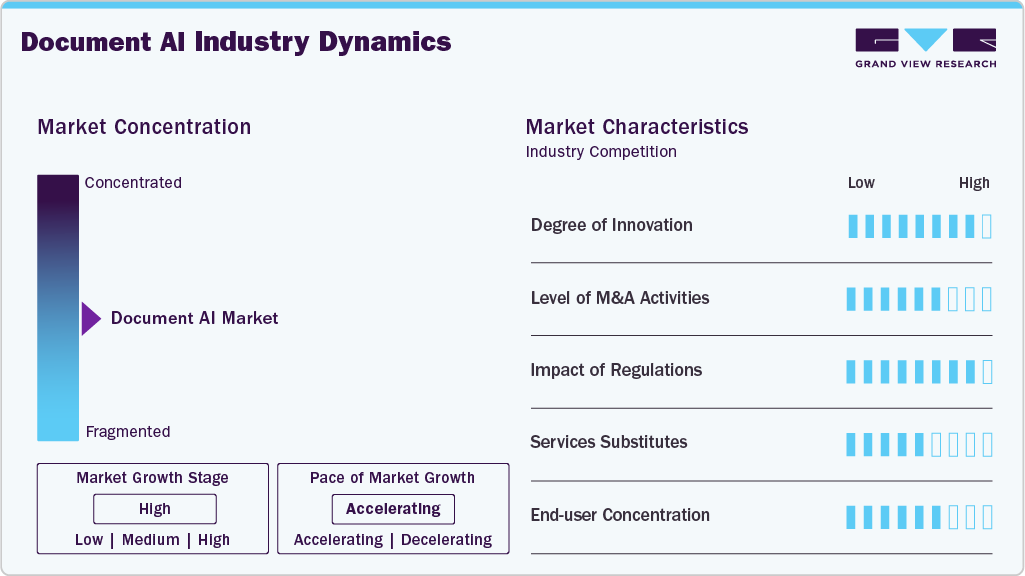
The document AI market is characterized by strong competition among established technology providers, specialized intelligent document processing vendors, and enterprise automation companies offering AI-powered document solutions. Market participants are strengthening their competitive positioning through advancements in machine learning, natural language processing, computer vision, generative AI, and automated data extraction capabilities. Leading vendors are expanding integrated platforms that combine document capture, classification, processing, analysis, and workflow automation to address complex enterprise requirements. Increasing demand for scalable document intelligence, improved processing accuracy, and seamless enterprise integration is driving continuous product development and differentiation across the market.
 To learn more about this report, Download Free Sample Report
The market exhibits a combination of broad technology platforms and specialized document AI providers, with competitive intensity shaped by solution capabilities, deployment flexibility, security, pricing, and industry-specific functionality. Cloud infrastructure providers are leveraging their AI ecosystems to expand document processing capabilities, while specialist vendors are focusing on advanced extraction accuracy, unstructured document understanding, and complex workflow automation. Strategic partnerships, product integrations, and acquisitions are supporting portfolio expansion and strengthening access to enterprise customers across BFSI, healthcare, government, retail, and manufacturing. Growing adoption of generative AI and agentic automation is further driving competition as vendors seek to deliver end-to-end document intelligence solutions that improve operational efficiency and generate actionable insights from enterprise data.
Analyst Perspective
The document AI market is positioned for sustained growth as enterprises increasingly prioritize intelligent automation, accurate information extraction, and efficient management of growing document volumes. Advancements in generative AI, large language models, computer vision, and natural language processing are expanding the market beyond traditional document capture and classification toward contextual understanding and end-to-end workflow automation. Solutions providers that combine high extraction accuracy, seamless enterprise integration, robust data security, and scalable deployment capabilities are expected to strengthen their competitive positioning. Although implementation complexity, data privacy concerns, and inconsistent document quality may constrain adoption, growing investments in digital transformation and AI-enabled enterprise operations are expected to support market expansion. Over the forecast period, the ability to convert structured, semi-structured, and unstructured documents into reliable, actionable business intelligence will remain a key differentiator for vendors across BFSI, healthcare, government, retail, and manufacturing.
Offering Insights
Based on offering, the solution segment dominated the Document AI market, accounting for 66.4% of global revenue in 2025, driven by increasing enterprise demand for automated document processing, data extraction, and classification capabilities. Growing adoption of AI-powered platforms is enabling organizations to streamline document-intensive workflows, improve information accuracy, and reduce manual processing requirements. Integration of generative AI, machine learning, and natural language processing is further enhancing solution capabilities across structured, semi-structured, and unstructured documents. Increasing investments in enterprise digitalization and workflow automation are expected to strengthen demand for comprehensive Document AI solutions throughout the forecast period.
The services segment is anticipated to witness significant growth during the forecast period, driven by increasing demand for consulting, implementation, integration, and managed services to support enterprise-wide Document AI adoption. Organizations are investing in specialized services to integrate AI-powered document processing platforms with existing enterprise systems, streamline workflows, and improve data extraction accuracy. Growing adoption of generative AI and machine learning is further increasing the need for customization, model optimization, employee training, and ongoing technical support. These factors are expected to strengthen demand for Document AI services as enterprises scale deployments and address evolving operational and data governance requirements.
Document Type Insights
Based on document type, the semi-structured documents segment dominated the Document AI market, accounting for 46.1% of global revenue in 2025, driven by increasing enterprise demand for processing invoices, purchase orders, receipts, and financial statements with variable layouts. Growing adoption of intelligent document processing solutions is enabling organizations to extract relevant information from these documents while reducing manual data entry and improving operational accuracy. Integration of machine learning, natural language processing, and layout recognition technologies is further enhancing the ability to process diverse document formats efficiently. Increasing automation across banking, financial services, retail, healthcare, and supply chain operations is expected to sustain demand for semi-structured document processing solutions throughout the forecast period.
The unstructured documents segment is anticipated to witness significant growth during the forecast period, owing to increasing enterprise demand for analyzing contracts, emails, legal records, medical reports, and other documents with inconsistent formats. Growing adoption of generative AI, large language models, and natural language processing is enabling organizations to extract contextual insights from complex documents that traditional rule-based systems struggle to process efficiently. Enterprises are increasingly leveraging Document AI solutions to automate document summarization, information retrieval, content analysis, and knowledge management across business functions. These advancements are expected to accelerate the adoption of unstructured document processing as organizations seek to improve information accessibility, streamline workflows, and derive actionable insights from growing volumes of enterprise data.
Application Insights
Based on application, the data extraction segment dominated the market, accounting for 32.6% of global revenue in 2025, driven by increasing demand for automated information retrieval from invoices, contracts, financial records, and other business documents. The growing adoption of AI document processing market solutions is enabling enterprises to improve data accuracy, reduce manual entry, and accelerate document-intensive workflows. Increasing requirements for regulatory compliance and reliable information management are also driving investments in AI document processing compliance software market solutions across BFSI, healthcare, and government sectors. Advancements in machine learning, natural language processing, and generative AI are further strengthening data extraction capabilities and supporting broader enterprise automation initiatives.
The document processing & analysis segment is anticipated to witness significant growth during the forecast period, driven by increasing demand for contextual document understanding, automated content validation, and AI-powered business intelligence. Growing adoption of intelligent document processing solutions is enabling enterprises to interpret complex information, identify inconsistencies, and generate actionable insights from large volumes of business records. Integration of generative AI, large language models, and semantic analysis is further strengthening capabilities in document summarization, contract review, and knowledge discovery. Increasing enterprise investments in workflow optimization and automated document analysis software are expected to accelerate adoption across financial services, healthcare, legal operations, and manufacturing.
End Use Insights
Based on end use, the BFSI segment dominated the document AI market, accounting for 26.9% of global revenue in 2025, driven by increasing demand for automated loan processing, customer onboarding, insurance claims management, and regulatory documentation. Financial institutions are adopting AI-powered document intelligence to accelerate data extraction, improve verification accuracy, and streamline high-volume transaction workflows. Growing requirements for Know Your Customer (KYC) compliance, fraud detection, and secure financial record management are further encouraging investments in intelligent document automation. Integration of machine learning and natural language processing is enabling financial organizations to process complex financial statements, contracts, and supporting documents more efficiently, supporting continued adoption across banking, insurance, and other financial services.
 To learn more about this report, Download Free Sample Report
The healthcare & life sciences segment is anticipated to witness significant growth during the forecast period, driven by increasing demand for automated clinical documentation, medical record management, insurance claims processing, and regulatory reporting. Healthcare providers and life sciences organizations are adopting AI-powered document intelligence to streamline patient information management, accelerate clinical data extraction, and improve access to critical medical information. Growing volumes of electronic health records, clinical trial documentation, research reports, and compliance-related records are further encouraging investments in advanced document processing technologies. Integration of natural language processing, machine learning, and generative AI is enabling more efficient analysis of unstructured medical documents while reducing administrative workloads. These developments are expected to accelerate document AI adoption across hospitals, pharmaceutical companies, clinical research organizations, and healthcare administration providers.
Regional Insights
North America document AI market accounted for the largest revenue share of 33.2% in 2025, driven by rapid enterprise AI adoption, advanced digital infrastructure, and increasing investments in intelligent automation. Growing demand for automated document processing across BFSI, healthcare, government, and technology sectors is accelerating the adoption of AI-powered data extraction and workflow optimization solutions. The strong presence of leading technology providers and increasing integration of generative AI and machine learning into enterprise applications are expected to support continued regional market growth.
 To learn more about this report, Download Free Sample Report
U.S. Document AI Market Trends
The U.S. document AI market is gaining momentum, driven by increasing enterprise investments in artificial intelligence, workflow automation, and digital transformation initiatives. Growing adoption of AI-powered document processing across banking, healthcare, insurance, and government sectors is accelerating demand for automated data extraction, document classification, and intelligent information management. The strong presence of leading technology providers, combined with advancements in generative AI, machine learning, and cloud-based solutions, is expected to support market expansion throughout the forecast period.
Europe Document AI Market Trends
The Europe document AI market is witnessing robust growth, driven by increasing enterprise digitalization, stringent data protection requirements, and rising adoption of AI-powered workflow automation. Growing demand for automated document processing across banking, healthcare, manufacturing, and government sectors is accelerating investments in intelligent data extraction, document classification, and compliance management solutions. Advancements in generative AI, machine learning, and secure cloud technologies, combined with the need to improve operational efficiency and regulatory compliance, are expected to support regional market expansion throughout the forecast period.
Asia Pacific Document AI Market Trends
The Asia Pacific document AI market is growing rapidly, driven by increasing enterprise digitalization, expanding AI investments, and rising demand for intelligent workflow automation across emerging economies. Growing adoption of AI document processing market solutions is enabling organizations to automate data extraction, document classification, and information management while improving operational efficiency. Increasing regulatory requirements and data governance priorities are further driving demand for AI document processing compliance software market solutions across banking, healthcare, government, and manufacturing sectors. Advancements in generative AI, cloud computing, and machine learning are expected to accelerate regional adoption as enterprises modernize document-intensive operations and strengthen compliance capabilities.
Key Document AI Market Company Insights
Key players operating in the Document AI Market include Amazon Web Services (AWS); Cognizant; Google; HCL Technologies; IBM; Infosys; Microsoft; Rossum; Tungsten Automation (formerly Kofax); UiPath.
-
Amazon Web Services offers Amazon Textract, an AI-powered service that extracts text, handwriting, tables, and structured data from scanned documents. Its capabilities support document processing across financial services, healthcare, insurance, and enterprise operations. AWS specializes in scalable, cloud-based document intelligence that integrates with broader cloud infrastructure, analytics, and machine learning services.
-
Microsoft provides Azure AI Document Intelligence, which extracts text, key-value pairs, tables, and document structures from various document formats. The platform supports prebuilt and custom models for processing invoices, receipts, identity documents, contracts, and other business records. Microsoft specializes in integrating document intelligence with Azure AI services and enterprise applications to streamline document workflows and improve information accessibility.
Key Document AI Market Companies
The following key companies have been profiled for this study on the document AI market.
-
Amazon Web Services (AWS)
-
Cognizant
-
Google
-
HCL Technologies
-
IBM
-
Infosys
-
Microsoft
-
Rossum
-
Tungsten Automation (formerly Kofax)
-
UiPath
Competitive Benchmarking
Operating Strategies
Competitive Edge
Weaknesses
Mature Players: Amazon Web Services (AWS), Google, Microsoft, IBM, Cognizant, HCL Technologies, Infosys
-Mature players focus on expanding end-to-end Document AI capabilities across document capture, data extraction, classification, processing and analysis, workflow automation, and generative AI-enabled document understanding through enterprise-grade platforms and large-scale implementation engagements.
Their competitive advantage lies in established enterprise relationships, extensive cloud infrastructure, proprietary AI technologies, broad technology portfolios, global delivery networks, and the ability to integrate Document AI solutions with existing enterprise applications and business workflows.
These companies face challenges related to complex implementation requirements, higher integration costs for legacy systems, data privacy and regulatory compliance obligations, and competition from specialized vendors offering focused document processing capabilities and faster deployment models.
Emerging Players: Rossum, Tungsten Automation (formerly Kofax), UiPath
Emerging players focus on specialized intelligent document processing, AI-powered data extraction, document understanding, and workflow automation to address document-intensive business processes across finance, insurance, procurement, and shared services operations.
Their strengths include specialized document processing capabilities, purpose-built automation platforms, flexible workflow configuration, and focused solutions designed to improve extraction accuracy, reduce manual intervention, and accelerate document-centric business operations.
Compared with major cloud and technology providers, these companies may face limitations in infrastructure scale, breadth of enterprise technology portfolios, and access to large global customer ecosystems, while competition from integrated cloud platforms and evolving AI technologies can increase pricing pressure and investment requirements.
Recent Developments
-
In June 2026, S2W partnered with ePapyrus to advance Streamdocs AI, an AI-powered expense documentation solution. S2W is responsible for AI development and maintenance, while ePapyrus leads sales, marketing, and public procurement activities. The collaboration aims to strengthen document automation capabilities and expand commercial opportunities across domestic and international markets.
-
In April 2026, Rocket Close collaborated with the AWS Generative AI Innovation Center to combine Amazon Textract and Amazon Bedrock for mortgage document processing. The solution supports document segmentation, classification, and data extraction, with reported processing speeds up to 15 times faster. This development highlights the potential of combining generative AI and document intelligence to improve processing efficiency in mortgage and financial services workflows.
-
In March 2026, NetDocuments introduced Smart Answers and expanded connectivity with AI models and tools to enhance legal document search and information retrieval. The capabilities help legal professionals identify relevant information across enterprise content repositories and improve access to document-based knowledge. This development supports growing demand for AI-powered document analysis and intelligent content management in the legal sector
Document AI Market Report Scope
Report Attribute
Details
Market size in 2025
USD 14.7 billion
Estimated market size in 2026
USD 16.6 billion
Projected market size by 2033
USD 44.8 billion
Growth rate
CAGR of 15.2% from 2026 to 2033
Actual data
2021 – 2025
Forecast period
2026 – 2033
Quantitative units
Revenue in USD million/billion and CAGR from 2026 to 2033
Report coverage
Revenue forecast, company share, competitive landscape, growth factors, and trends
Segments covered
Offering, document type, application, end use, region
Regional scope
North America; Europe; Asia Pacific; Latin America; Middle East and Africa
Country scope
U.S.; Canada; Mexico; UK; Germany; France; China; Japan; India; South Korea; Australia; Brazil; UAE; KSA; South Africa
Key companies profiled
Amazon Web Services (AWS); Cognizant; Google; HCL Technologies; IBM; Infosys; Microsoft; Rossum; Tungsten Automation (formerly Kofax); UiPath
Customization scope
Free report customization (equivalent to up to 8 analyst working days) with purchase. Addition or alteration to country, regional & segment scope.
Pricing and purchase options
Avail customized purchase options to meet your exact research needs. Explore purchase options
Global Document AI Market Report Segmentation
This report forecasts revenue growth at global, regional, and country levels and provides an analysis of the latest industry trends in each of the sub-segments from 2021 to 2033. For this study, Grand View Research has segmented the global document AI market report based on offering, document type, application, end use, and region.
-
Offering Outlook (Revenue, USD Billion, 2021 - 2033)
-
Solution
-
Services
-
-
Document Type Outlook (Revenue, USD Billion, 2021 - 2033)
-
Structured Documents
-
Semi-structured Documents
-
Unstructured Documents
-
-
Application Outlook (Revenue, USD Billion, 2021 - 2033)
-
Data Extraction
-
Document Classification
-
Document Capture
-
Document Processing & Analysis
-
Others
-
-
End Use Outlook (Revenue, USD Billion, 2021 - 2033)
-
BFSI
-
Healthcare & Life Sciences
-
Government & Public Sector
-
Retail & E-Commerce
-
IT & Telecommunications
-
Manufacturing
-
Others
-
-
Regional Outlook (Revenue, USD Billion, 2021 - 2033)
-
North America
-
U.S.
-
Canada
-
Mexico
-
-
Europe
-
UK
-
Germany
-
France
-
-
Asia Pacific
-
China
-
Japan
-
India
-
South Korea
-
Australia
-
-
Latin America
-
Brazil
-
-
Middle East and Africa
-
UAE
-
KSA
-
South Africa
-
-
Research Methodology
The document AI market figures in this report are based on a proven research process that combines executive interviews with secondary research from proprietary databases, company filings, and recognized regulatory and institutional sources. Market size is built through value-chain sizing—reconciling supply-side and demand-side estimates—and triangulated with bottom-up and top-down approaches. Every estimate passes multiple levels of expert validation before publication, with each document AI segment quantified using the revenue-capture definitions in the table below.
Segment Definition
Offering
Revenue Capture Definition
Solution
This segment includes revenues generated from Document AI software platforms and solutions used for document capture, data extraction, classification, processing, analysis, and workflow automation. It covers licensed, subscription-based, and cloud-based solutions that enable automated document understanding and information management.
Services
This segment includes revenues generated from consulting, implementation, integration, customization, training, technical support, and managed services associated with Document AI deployment. It covers services that help organizations configure, maintain, optimize, and scale document processing solutions.
Document Type
Revenue Capture Definition
Structured Documents
This segment includes revenues attributable to Document AI solutions processing documents with predefined formats, consistent fields, and organized data structures. Examples include standardized forms, database-generated reports, and tabular records with fixed layouts.
Semi-structured Documents
This segment includes revenues attributable to processing documents with partially defined structures, variable layouts, and identifiable fields that may differ in position or format. Examples include invoices, purchase orders, receipts, bank statements, and shipping documents.
Unstructured Documents
This segment includes revenues attributable to processing documents without predefined data structures or consistent layouts, requiring contextual interpretation and advanced information extraction. Examples include contracts, emails, research reports, legal correspondence, and narrative medical records.
Application
Revenue Capture Definition
Data Extraction
This segment includes revenues attributable to solutions that identify and extract relevant information, entities, fields, and key-value pairs from digital and scanned documents. These applications convert document content into structured data for downstream analysis, verification, and business operations.
Document Classification
This segment includes revenues attributable to solutions that automatically identify document types, categorize records, and assign documents to appropriate workflows or business functions. These applications use AI-based classification, metadata recognition, and contextual analysis to organize documents efficiently.
Document Capture
This segment includes revenues attributable to solutions that acquire, ingest, scan, digitize, and convert paper-based or electronic documents into machine-readable formats. These applications support optical character recognition (OCR), image preprocessing, handwriting recognition, and document ingestion from multiple sources.
Document Processing & Analysis
This segment includes revenues attributable to solutions that interpret document content, validate information, analyze relationships, summarize text, and generate actionable insights. These applications use AI, natural language processing, and generative AI to support advanced document understanding and automated decision workflows.
Others
This segment includes revenues attributable to Document AI applications not separately classified under data extraction, document classification, document capture, or document processing and analysis. Examples include document verification, enrichment, specialized document comparison, and other supporting capabilities.
End Use
Revenue Capture Definition
BFSI
This segment includes revenues attributable to Document AI solutions deployed by banks, financial institutions, insurers, and other financial service providers. Applications include KYC verification, loan processing, insurance claims, financial statement analysis, transaction documentation, and regulatory reporting.
Healthcare & Life Sciences
This segment includes revenues attributable to Document AI solutions used by healthcare providers, pharmaceutical companies, biotechnology firms, and clinical research organizations. Applications include electronic health record processing, clinical documentation, medical claims management, clinical trial documentation, and regulatory submissions.
Government & Public Sector
This segment includes revenues attributable to Document AI solutions deployed by government agencies, public institutions, and public-sector organizations. Applications include citizen record digitization, tax document processing, permit management, public applications, and administrative record automation.
Retail & E-Commerce
This segment includes revenues attributable to Document AI solutions used by retailers, online marketplaces, distributors, and e-commerce businesses. Applications include invoice processing, purchase order management, supplier documentation, receipts, returns processing, and order-related document automation.
IT & Telecommunications
This segment includes revenues attributable to Document AI solutions used by IT service providers, software companies, telecom operators, and digital service businesses. Applications include contract processing, customer onboarding, service documentation, billing records, technical documents, and enterprise knowledge management.
Manufacturing
This segment includes revenues attributable to Document AI solutions used by manufacturers and industrial businesses to automate the processing of operational, technical, and supply-chain documents. Applications include purchase orders, invoices, quality inspection records, product specifications, maintenance documentation, and shipping records.
Others
This segment includes revenues attributable to Document AI solutions deployed across end-use industries not separately classified in the specified verticals. Examples include education, transportation and logistics, energy and utilities, professional services, and hospitality.
Estimation Model
Layer
Key Questions
Description
Document Digitization & Demand Layer
Who generates demand for Document AI solutions?
Identify organizations processing large volumes of structured, semi-structured, and unstructured documents across industries and business functions.
Document AI Investment Layer
Who invests in Document AI capabilities?
Assess enterprise spending on AI-powered document processing, data extraction, classification, analysis, and workflow automation solutions.
Document AI Adoption Layer
Which Document AI solutions and services are adopted?
Evaluate adoption across offerings, document types, applications, end-use industries, deployment models, and regions.
Document AI Revenue Realization Layer
How much revenue is generated from Document AI?
Estimate revenue captured by Document AI software providers and service vendors across segments, industries, and regions to determine the total market size.
Delivered Customizations
This report has been delivered with the following in-depth customizations
Client Request
Customization Delivered
Value Adds
Document AI Solution & Capability Landscape Assessment
Analyzed Document AI solutions across data extraction, document classification, document capture, document processing and analysis, and other applications, including capabilities offered by leading market participants.
Helps identify high-value solution categories, competitive positioning, technology capabilities, and opportunities for product differentiation and portfolio expansion.
Document Type-Specific Processing Demand Analysis
Assessed Document AI adoption across structured, semi-structured, and unstructured documents, considering processing requirements, extraction complexity, and evolving AI capabilities.
Provides insights into document-specific demand patterns, automation requirements, technology adoption, and growth opportunities to support solution prioritization.
Industry & Enterprise Document AI Adoption Assessment
Evaluated Document AI demand across BFSI, healthcare and life sciences, government and public sector, retail and e-commerce, IT and telecommunications, manufacturing, and other industries.
Supports identification of high-potential industry segments, sector-specific document automation requirements, adoption drivers, and targeted market expansion opportunities.
Frequently Asked Questions About This Report
North America dominated the market with a 33.2% revenue share in 2025.
The data extraction segment led with a 32.6% revenue share in 2025, driven by increasing demand for automated information retrieval from invoices, contracts, financial records, and other business documents.
The global document AI market size was valued at USD 14.7 billion in 2025 and is estimated at USD 16.6 billion for 2026.
The global document AI market is expected to grow at a CAGR of 15.2% from 2026 to 2033, reaching USD 44.8 billion by 2033.
The solution segment led with a 66.4% revenue share in 2025, while services is the fastest-growing segment.
Key factors that are driving the market growth include the rising adoption of AI-powered document processing and data extraction, increasing enterprise demand for automated document classification and workflow optimization, and the growing integration of generative AI and machine learning into document management systems
Some key players operating in the document AI market include Amazon Web Services (AWS); Cognizant, Google, HCL Technologies, IBM, Infosys, Microsoft, Rossum, Tungsten Automation (formerly Kofax), and UiPath
Asia Pacific is the fastest-growing region over the forecast period.
The semi-structured documents segment led with a 46.1% revenue share in 2025, while unstructured documents is the fastest-growing segment.
About the Author(s)
Next Generation Technologies Research Team
Technology · Next Generation TechnologiesThis report was authored by the next generation technologies research team at Grand View Research - comprising two research analysts, one senior research analyst, and one industry expert - with specialized expertise in the next generation technologies segment of the technology industry. All findings are based on proprietary technology databases, executive interviews, and regulatory analysis, subject to internal peer review prior to publication.
Last Updated:
Speak to Analyst

Customize this report to your needs - add regions, segments, or data points, with 20% free customization.
Or view our licence options:


ISO 9001:2015 & 27001:2022 Certified
We are GDPR and CCPA compliant! Your transaction & personal information is safe and secure. For more details, please read our privacy policy.


