
- Home
- »
- Automotive & Transportation
- »
-
Door Control Modules Market Size, Share Report, 2026-2033GVR Report cover

Door Control Modules Market (2026 - 2033)
Size, Share & Trends Analysis By Type (Centralized Door Control Modules), By Functionality, By Vehicle Type (Power Window Control, Door Lock Control, Mirror Adjustment), By Region, And Segment Forecasts
Market Size, 2025
$3.2BMarket Estimate, 2026
$3.4BMarket Forecast, 2033
$5.4BCAGR, 2026–2033
7.1%Door Control Modules Market Summary
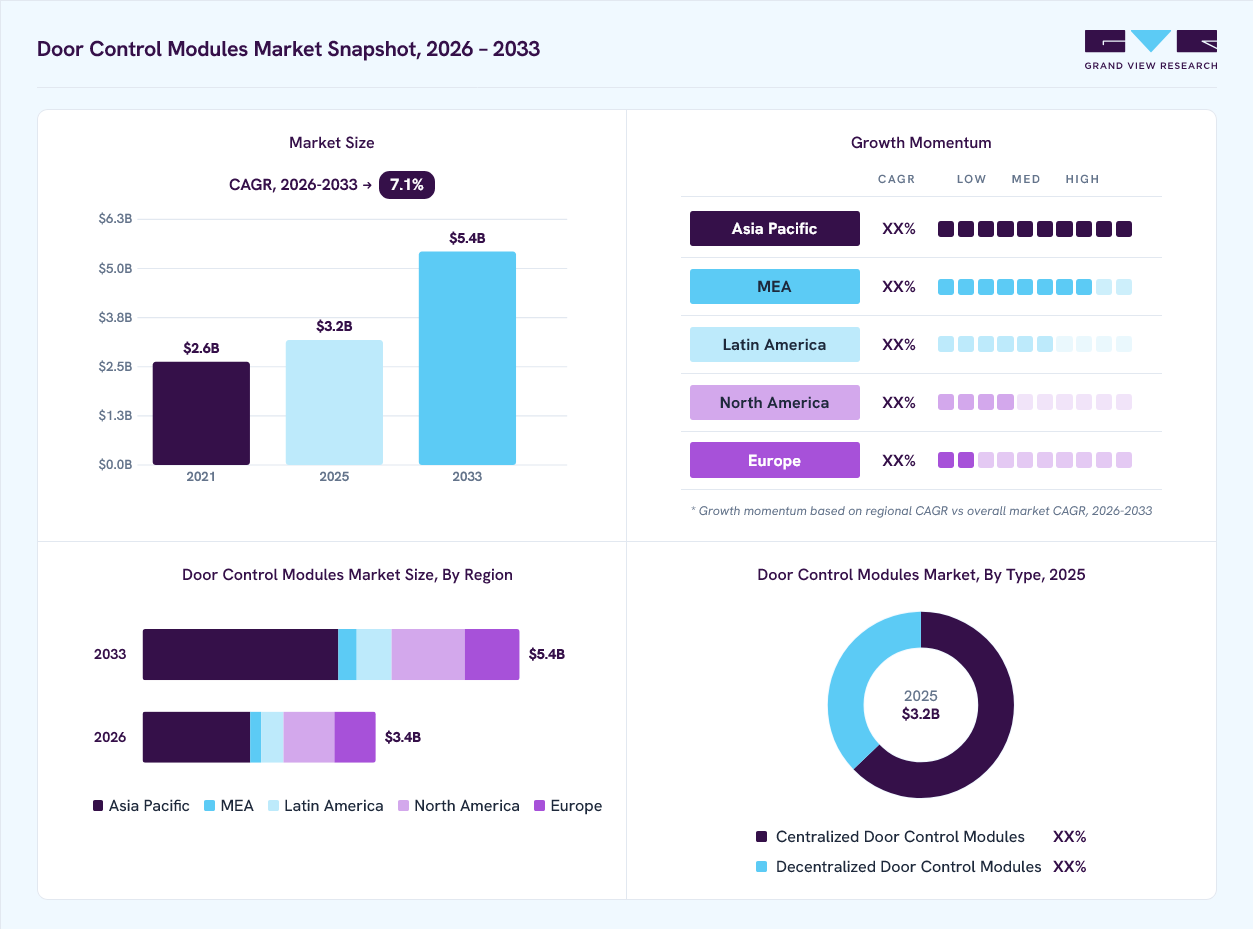
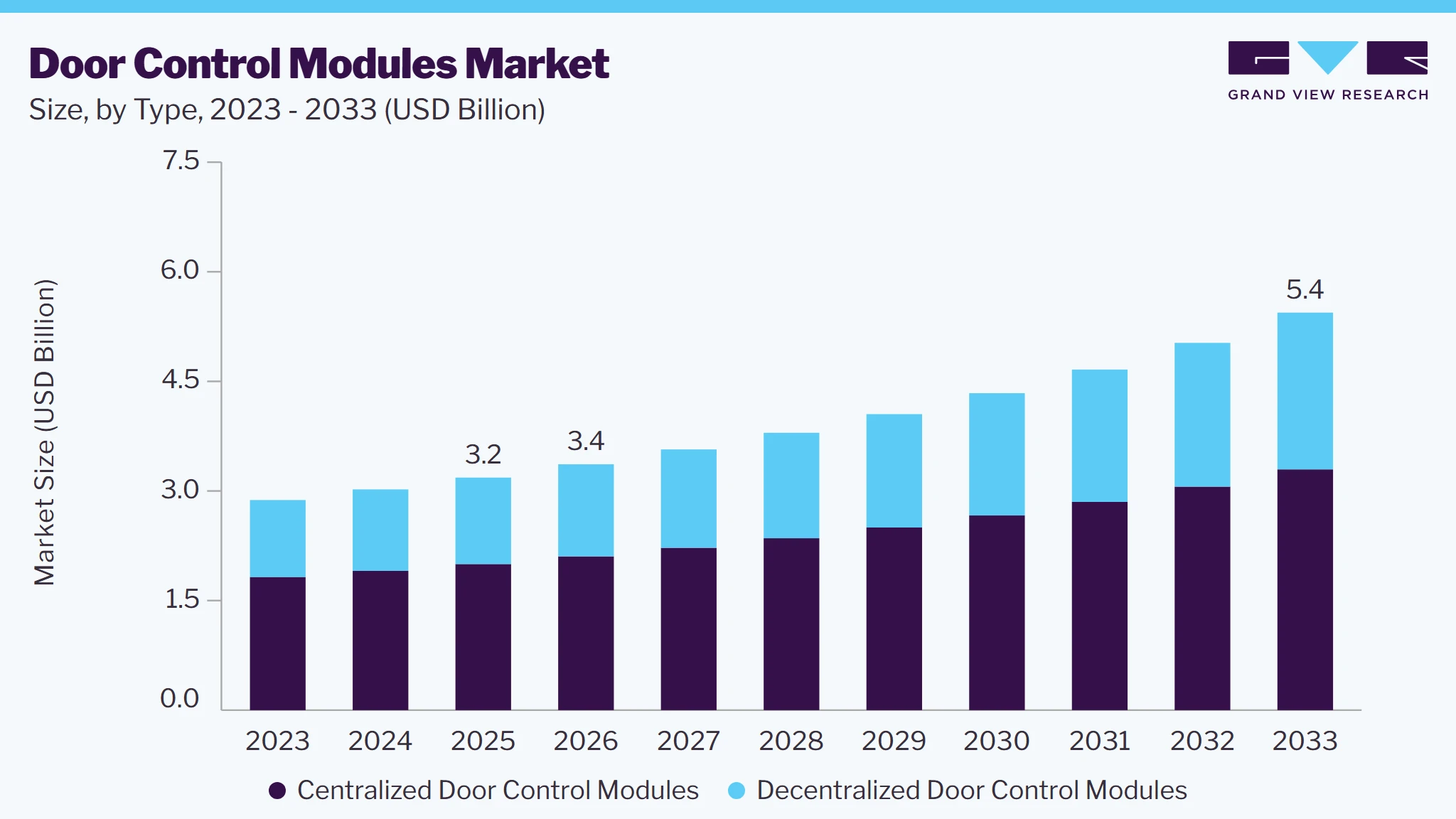
The global door control modules market size was valued at USD 3.2 billion in 2025 and is projected to grow from USD 3.4 billion in 2026 to USD 5.4 billion by 2033, at a CAGR of 7.1% from 2026 to 2033. Asia Pacific dominated the market, accounting for a revenue share of 45.3% in 2025. Rising demand for high-current protection in electric vehicle systems is supporting market growth.
 Source: Grand View Research, IR Documents, Primary Interviews, Paid DatabasesTo learn more about this report,
 Download Free Sample Report
Key Market Trends & Insights
- Based on type, Centralized door control modules segment led the market and accounted for 62.8% of the global revenue in 2025.
- Based on functionality, Power window control segment accounted for the largest share of global revenue in 2025.
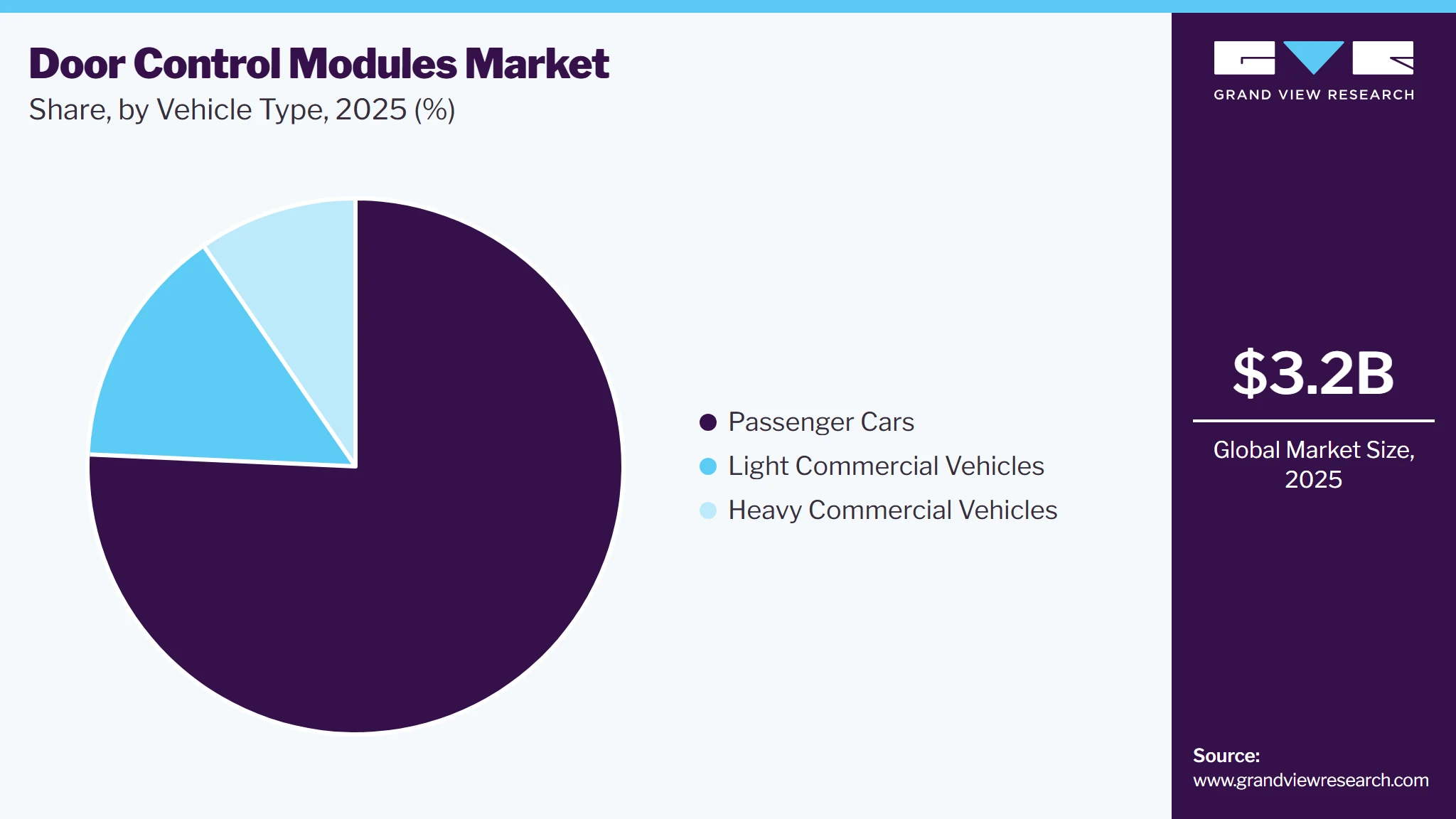
- Based on vehicle type, Passenger cars segment accounted for largest share of global revenue in 2025.
Regional Highlights
- Largest regional market: Asia Pacific (45.3% revenue share, 2025)
- By country: China held the largest market share in 2025.
Market Size & Forecast
- Market size in 2025: USD 3.2 Billion
- Estimated market size in 2026: USD 3.4 Billion
- Projected market size by 2033: USD 5.4 Billion
- CAGR (2026-2033): 7.1%
Prism AI by Grand View Research Free to tryAsk a question about the door control modules marketTry asking✓Every figure cited from GVR research Prefer the report? Download free sample →
The growing integration of power windows, central locking, mirror adjustment, child safety functions, and other electrically operated door features is increasing demand for door control modules. Automakers are using these modules to coordinate multiple door-related functions through a single electronic system, improving convenience and reducing the need for separate controls. The increasing focus on vehicle comfort and premium features is supporting module adoption across passenger vehicles and light commercial vehicles. This trend is particularly relevant as manufacturers seek to differentiate their vehicles by enhancing convenience and the user experience.The integration of several door-related functions into a single control module is trending in the market. Instead of using separate controls for power windows, locking, child safety, and other functions, manufacturers are increasingly adopting integrated solutions to reduce component complexity and improve system coordination. This approach can also support more consistent vehicle design and simplify manufacturing. The trend is encouraging suppliers to develop multifunctional door control modules suitable for different vehicle platforms.
 To learn more about this report, Download Free Sample Report
Regulatory authorities continue to strengthen requirements for vehicle door locks and door retention systems, underscoring the importance of safety and reliability in electronically controlled door functions. According to the, UN Global Technical Regulation No. 1, covering vehicle door locks and door retention components. These developments are encouraging automakers and door control module suppliers to ensure that electronic locking, child-safety, and related door functions comply with evolving vehicle safety requirements.
High system integration and development costs pose a restraint in the market. Door control modules require integration with multiple vehicle functions, which increases development, testing, and validation requirements. Suppliers must ensure reliable operation across different vehicle platforms, operating conditions, and electronic architecture. These requirements can increase engineering and manufacturing costs, particularly for suppliers developing customized modules for individual OEM programs. Higher costs can limit adoption in cost-sensitive vehicle segments where manufacturers prioritize low-cost solutions.
Market Dynamics
The door control modules market is being driven by the increasing electronic content of modern vehicles, rising demand for convenience and security features, and the transition toward software-enabled vehicle architectures. Automakers are integrating more functions, such as door locking, power windows, mirror adjustment, illumination, child safety, and access control into electronically managed door systems. The growing adoption of electric vehicles and premium vehicle features is further increasing the need for integrated door electronics. At the same time, manufacturers are focusing on reducing wiring complexity, improving reliability, and consolidating multiple functions into fewer control units.
The growing adoption of electric and hybrid vehicles is increasing the electronic content of vehicles and creating greater demand for electronically managed door functions. Unlike conventional vehicles, electric vehicles are built around highly integrated electrical and electronic architectures that support functions such as electronic locking, powered windows, electrically adjustable mirrors, and advanced access systems. Automakers are therefore increasingly incorporating electronic door-control functions as part of broader vehicle electrification strategies. This trend is expanding the addressable market for door control modules across both premium and mass-market electric vehicle platforms.
Door Control Modules help manufacturers manage multiple electrically operated door functions and integrate them into the vehicle's broader electronic architecture. As vehicle manufacturers introduce more electric and hybrid models, suppliers can capture additional revenue through modules designed for higher levels of electronic functionality and integration. The increasing number of electronically controlled functions per vehicle can also raise module content and revenue opportunities. Consequently, vehicle electrification is expected to support both volume growth and higher-value opportunities in the Door Control Modules Market.
The increasing number of electronic functions in vehicles is also making vehicle electrical architectures more complex. Door control modules need to communicate with other vehicle systems while reliably managing several functions within a confined door environment. Greater integration increases requirements for testing, software compatibility, wiring management, electromagnetic performance, and long-term reliability. These requirements can increase development time and costs for automakers and suppliers, particularly when new door-control platforms need to be customized for different vehicle architectures.
The impact is more pronounced for manufacturers developing multiple vehicle platforms or operating in cost-sensitive segments where additional electronic complexity can affect overall vehicle costs. Smaller OEM programs may have limited economies of scale to justify highly customized door-control solutions, while suppliers must invest in development and validation before securing production volumes. This can slow the introduction of advanced modules in entry-level passenger cars and commercial vehicles. As a result, suppliers need to balance increasing functionality with simpler architecture, standardized components, and cost-efficient module designs.
The increasing number of electronic door functions creates an opportunity for suppliers to develop integrated modules that manage multiple functions through a common electronic platform. Automakers are increasingly seeking solutions that can reduce wiring complexity, component count, assembly requirements, and overall system integration effort. This creates demand for door control modules that combine locking, window, mirror, illumination, and security functions rather than relying on multiple independent electronic systems. The shift toward more integrated vehicle electronics provides suppliers with opportunities to increase the value captured per vehicle.
Suppliers with strong automotive electronics capabilities and relationships with global OEMs are well positioned to benefit from this trend. Companies such as Robert Bosch, Continental, and Valeo can leverage their broader vehicle electronics portfolios to integrate door functions with other vehicle systems. The opportunity is particularly attractive in premium passenger cars, electric vehicles, and higher-specification vehicle platforms, where manufacturers are more willing to adopt advanced electronic convenience and security functions. Moreover, increasing module integration is likely to shift competition from individual components toward complete door-electronics solutions.
Market Concentration & Characteristics
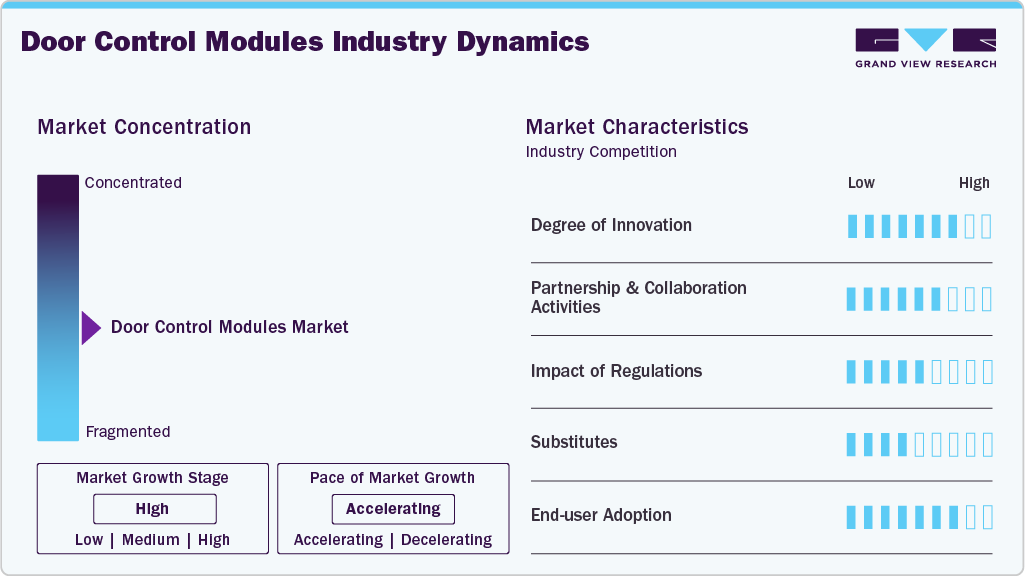
The door control modules market is moderately consolidated, indicating that the market is characterized by a relatively strong presence of established automotive electronics and component manufacturers, while still leaving room for several other suppliers to compete. Leading players benefit from long-standing relationships with vehicle manufacturers, established production capabilities, broad product portfolios, and the ability to supply door electronics across different vehicle models and regions. The market is also supported by the increasing use of electronic content in vehicles, as door control modules are increasingly used to manage functions such as power windows, central locking, mirror adjustment, door lighting, and other door-related features. However, the market is not fully concentrated because multiple Tier-1 suppliers and specialized automotive electronics companies compete for OEM programs, particularly as vehicle manufacturers seek more integrated and flexible electronic systems.
 To learn more about this report, Download Free Sample Report
The market characteristics further support this moderately consolidated structure. The degree of innovation is high, driven by the integration of additional door functions and the transition toward more electronically controlled vehicle systems. Partnerships and collaborations are also relatively high, as suppliers work closely with automakers to develop and customize door control solutions. Regulatory impact is moderate, with safety and vehicle electronics requirements influencing product development, but regulations generally do not create an extremely high barrier to competition. Substitutes are moderate, since alternative electronic architectures or centralized vehicle control systems can perform some functions traditionally handled by individual door modules. Meanwhile, end-user adoption is relatively high, supported by growing adoption of power-operated, connected, and electronically controlled features in passenger and commercial vehicles.
Analyst Perspective
The door control modules market is positioned for steady growth as vehicle manufacturers expand electronic convenience, security, and access functions across vehicle platforms. Increasing vehicle electronic content, electric vehicle adoption, and demand for integrated door functionality are supporting greater module content per vehicle. The market is also moving toward higher functional integration, with suppliers combining multiple door functions into compact electronic solutions. Going forward, investment is expected to focus on integrated architecture, cost optimization, software-enabled functionality, and solutions compatible with evolving vehicle electrical systems. Competitive positioning is likely to increasingly depend on suppliers' ability to provide integrated door electronics while maintaining reliability, scalability, and cost competitiveness.
Type Insights
Based on type, the centralized door control modules type segment accounted for 62.8%, the largest share of global revenue in 2025, Centralized door control modules integrate the control of multiple door functions through a common electronic control unit, reducing the number of individual controllers required across the vehicle. This architecture remains widely adopted in cost-sensitive and high-volume vehicle platforms because it offers lower system complexity, simplified diagnostics, and favorable component economics. Centralized configurations are particularly suitable for vehicles with relatively standardized door functions, including power windows, central locking, and basic mirror controls. However, increasing electronic content, higher feature requirements, and the need to reduce wiring complexity are gradually encouraging OEMs to evaluate decentralized and zonal architectures.
The decentralized door control modules segment is projected to grow at the fastest CAGR over the forecast period. Decentralized door control modules assign dedicated electronic control units to individual doors, allowing door-specific functions to be managed locally. This architecture reduces the length and complexity of vehicle wiring harnesses while providing greater flexibility for integrating advanced functions such as power windows, door locks, mirror adjustment, lighting, and safety features. Adoption is gaining momentum in premium vehicles, electric vehicles, and technologically advanced vehicle platforms where higher functionality and weight optimization are important design considerations. The transition toward software-defined and zonal vehicle architectures is expected to further support demand for decentralized door control solutions.
Functionality Insights
Based on functionality, the power window control segment accounted for the largest share of global revenue in 2025, This segment has core functionality of modern door control modules, enabling electronic operation, position management, and safety-related functions for vehicle windows. Increasing adoption of one-touch window operation, anti-pinch protection, automatic window closing, and advanced motor-control capabilities is raising the electronic content of door systems. Integration of window control into door modules also helps OEMs consolidate components and improve wiring efficiency while supporting additional comfort and convenience features. Demand is expected to remain strong across passenger vehicles as power windows continue to transition from a premium feature to a standard vehicle function.
The Child safety and security systems are projected to grow at the fastest CAGR over the forecast period. Child safety and security systems encompass electronic functions such as child locks, central locking coordination, door status monitoring, and other access-related controls managed through the door electronics architecture. Growing emphasis on occupant protection, vehicle security, and advanced access systems is increasing the importance of reliable electronic control of door-related safety functions. Door control modules can coordinate these functions with the vehicle's broader body electronics and communication networks, enabling improved monitoring and centralized management. The increasing integration of passive entry, electronic locking, and occupant-safety technologies is expected to create additional opportunities for sophisticated door control modules.
Vehicle Type Insights
Based on vehicle type, the passenger cars segment accounted for the largest share of global revenue in 2025, due to their large production volumes and increasing integration of electronically controlled comfort, convenience, and safety features. Demand is supported by the widespread adoption of power windows, central locking, mirror controls, child-safety functions, ambient lighting, and keyless entry systems. Premium and electric passenger vehicles are further increasing the value of door control systems by incorporating more sophisticated electronics and localized control functions. As automotive manufacturers continue to enhance vehicle interiors and user convenience, passenger cars are expected to remain the largest demand center for door control modules.
 To learn more about this report, Download Free Sample Report
The light commercial vehicles are projected to grow at the fastest CAGR over the forecast period. The segment growth is driven by increasingly incorporating electronic door functions as manufacturers improve driver convenience, fleet efficiency, security, and vehicle safety. Door control modules in this segment support functions such as power windows, central locking, mirror adjustment, and electronic access systems, with feature requirements varying according to vehicle configuration and application. Growth in urban delivery, logistics, service, and fleet operations is encouraging greater adoption of electronically controlled features in newer light commercial vehicle platforms. In addition, the electrification and digitalization of commercial fleets are expected to create opportunities for more advanced and networked door control architectures.
Regional Insights
Asia Pacific Door Control Modules Market Trends
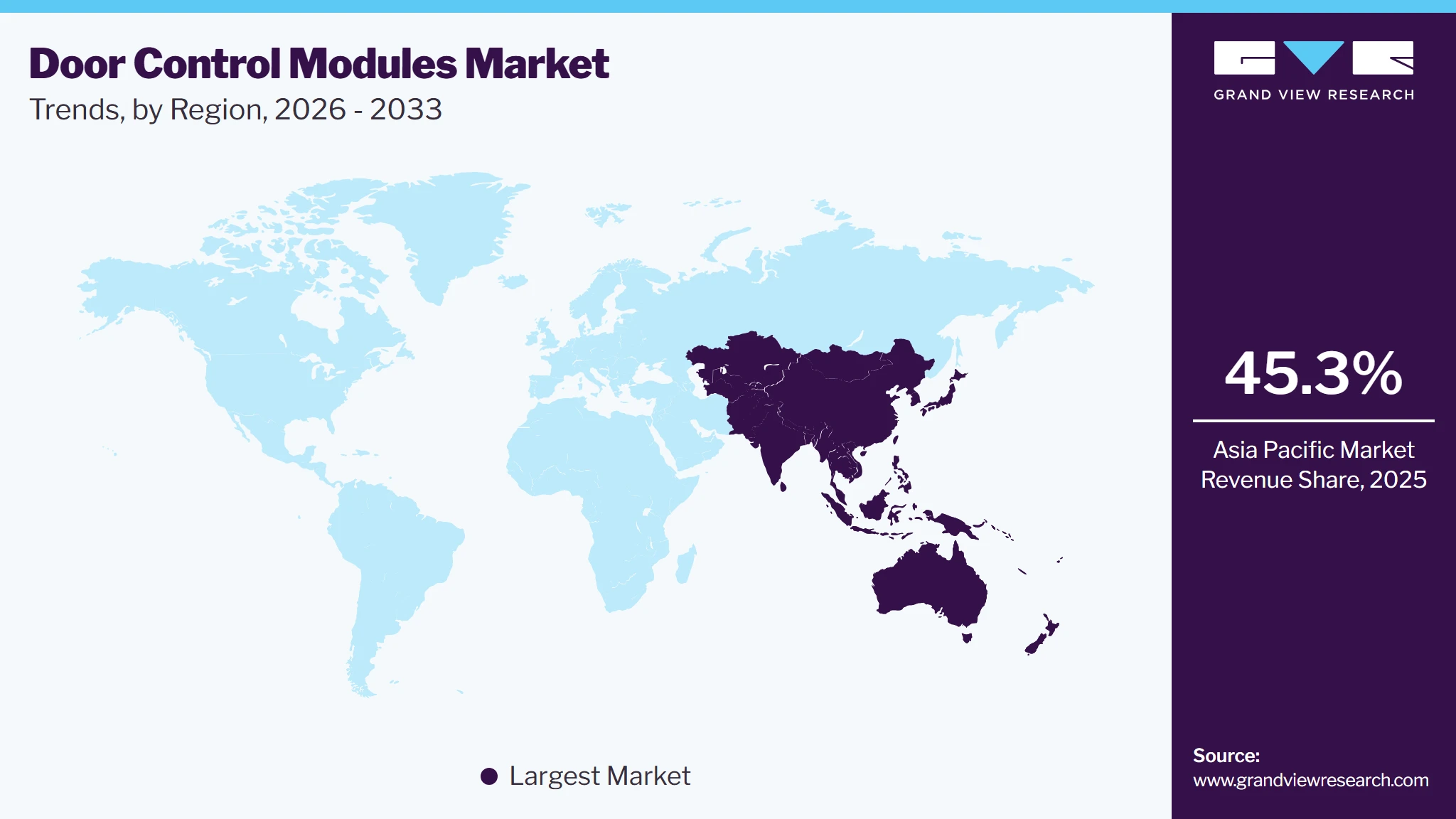
The Asia Pacific door control modules market led the global market and accounted for 45.3% of the global revenue in 2025 and is expected to register the fastest growth from 2026 to 2033, due to its large automotive manufacturing base and increasing penetration of electronic vehicle functions. Expanding adoption of power windows, electronic locking, child-safety systems, and other door-related features is increasing the content of door electronics across vehicle platforms. The region also supports both cost-oriented centralized architectures and more integrated decentralized configurations, depending on vehicle functionality and platform requirements.
 To learn more about this report, Download Free Sample Report
China is the largest automotive producer globally and the leading market for electric vehicles, supported by large-scale vehicle production and the rapid integration of electronic functions into new vehicle platforms. Increasing vehicle electrification and the emphasis on advanced comfort and access features are encouraging greater integration of door controllers with vehicle communication and body-control systems. Demand is consequently shifting toward modules capable of managing multiple functions while supporting compact architectures, improved system integration, and flexible electronic interfaces.
Japan door control modules market is expected to grow at a significant CAGR over the forecast period. Japan represents a mature door control modules market with strong emphasis on reliability, functional integration, and efficient electronic architectures. Door controllers are increasingly required to coordinate power-window, locking, mirror, and safety-related functions while communicating with other vehicle electronic systems. The market is therefore positioned toward higher integration and reliable decentralized architectures for feature-rich vehicles, while centralized configurations continue to serve applications where cost efficiency and simpler system architecture are important.
North America Door Control Modules Market Trends
North America door control modules market held a significant growth in the market, supported by the continued integration of electronic comfort, access, and safety functions into vehicle door architectures. Demand is particularly influenced by the increasing use of electronically controlled power windows, locking functions, mirror controls, and occupant-protection features, which require coordinated control through vehicle electronic networks. The region also has a relatively mature vehicle electronics ecosystem, supporting continued adoption of both centralized and decentralized door-control architectures.
The U.S. door control modules market is anticipated to register a largest growth from 2026 to 2033, characterized by strong demand for electronically integrated vehicle functions across passenger vehicles and light commercial vehicles. Increasing consumer expectations for convenience, power-operated features, and enhanced security are supporting the integration of door electronics into broader vehicle body-control architectures. The market is also moving toward higher functional integration, with door controllers increasingly coordinating window, locking, mirror, lighting, and related functions through vehicle communication networks.
Europe Door Control Modules Market Trends
The Europe Door Control Modules market is poised for significant growth from 2026 to 2033, driven by the increasing electronic content of vehicles and the integration of safety, convenience, and access functions. Vehicle manufacturers are increasingly adopting sophisticated door electronics architectures to accommodate multiple functions while controlling wiring complexity, system weight, and overall vehicle architecture. The region therefore presents demand across both centralized and decentralized configurations, with higher-function vehicles creating greater requirements for integrated and distributed electronic control.
The U.K. door control modules market is supported by the continued penetration of electronic convenience and safety functions across passenger and commercial vehicle platforms. The increasing integration of power windows, locking systems, child-safety functions, and other electronically controlled door features is creating sustained demand for dedicated control electronics. Adoption is also supported by the broader transition toward software-enabled and networked vehicle architectures, which allows door functions to communicate with other vehicle systems.
The Germany held a largest share in the Europe door control modules market, supported by strong vehicle-electronics integration and demand for sophisticated body-control functionality. The market is increasingly oriented toward higher levels of functional integration, where door controllers manage multiple actuators and communicate with wider vehicle networks. This environment supports the adoption of decentralized architectures in vehicles requiring greater functionality while also maintaining demand for centralized solutions where cost and system simplicity remain priorities.
Key Companies & Market Share Insights
Key players operating in the door control modules market include Johnson Controls., Honeywell International Inc, ASSA ABLOY, Robert Bosch GmbH, Siemens, Continental AG, Allegion plc, GALLAGHER GROUP LIMITED, Salto Systems, S.L., and Valeo. Key players in the door control modules market are focusing on expanding product portfolios, developing high-current and high-voltage solutions, and strengthening OEM relationships. Companies are also increasing their focus on electric and hybrid vehicle applications while expanding aftermarket and regional distribution networks to capture emerging growth opportunities.
-
Johnson Controls. is a diversified industrial technology manufacturing company. The company provides products and solutions designed to support the safe and efficient management of electrical energy across industrial, transportation, and electronics markets. In the automotive sector, Johnson Controls. offers circuit protection solutions, including door control modules, for various vehicle electrical and electronic applications.
-
Honeywell International Inc is a global company focused on power management solutions. The company provides products that help customers use and manage power safely and efficiently across different industries. In the automotive sector, Honeywell International Inc offers door control modules products that help protect vehicle electrical systems and support the growing electrical needs of modern and electrified vehicles.
Key Door Control Modules Companies
The following key companies have been profiled for this study on the door control modules market.
-
Johnson Controls.
-
Honeywell International Inc
-
ASSA ABLOY
-
Robert Bosch GmbH
-
Siemens
-
Continental AG
-
Allegion plc
-
GALLAGHER GROUP LIMITED
-
Salto Systems, S.L.
-
Valeo
Competitive Benchmarking
Operating Strategies
Competitive Edge
Weaknesses
Mature Players: Robert Bosch GmbH, Continental AG, Valeo, Johnson Controls
- Mature players in the door control modules market are focus on long-term OEM relationships, broad automotive electronics portfolios, platform-based product development, and integration of multiple vehicle functions. These companies generally pursue global supply agreements and develop solutions that can be deployed across multiple vehicle platforms.
- Mature players gain a competitive advantage through strong OEM relationships, established automotive engineering capabilities, broad product portfolios, global manufacturing networks, and ability to integrate door electronics with wider vehicle systems.
- These companies often face challenges related to high organizational and development costs can make solutions more expensive, while large-scale operations can make rapid customization for smaller vehicle programs more difficult.
Emerging Players: Honeywell International Inc., ASSA ABLOY, Allegion plc.
- Emerging players in the door control modules market are focus on specialized electronic access, security, sensing, control, and connected-system capabilities that can be applied to vehicle access and door-control requirements. These companies can use their expertise in security and electronic access to expand into adjacent vehicle applications.
- Emerging players gain market traction through strong capabilities in security, access management, electronic controls, and connected solutions provide opportunities to address increasingly sophisticated vehicle access requirements.
- Emerging players face limitations due to their automotive door-control exposure is narrower than dedicated automotive electronics suppliers, which can limit OEM penetration and make it harder to compete across complete vehicle door-control architectures.
Recent Developments
-
In October 2025, Johnson Controls. acquired Basler Electric Company, a manufacturer of electrical control and protection products, for grid and utility infrastructure, power generation, and data centers. The acquisition expanded the product range, manufacturing capabilities, and customer base across electrical protection applications, supporting broader growth strategies.
-
In September 2025, Honeywell International Inc launched dozens of new electrified vehicle (EV) fuses to support internal combustion, electrified, plug-in hybrid, commercial, and off-highway vehicles. The launch expanded the fuse portfolio across different vehicle types and voltage requirements, enabling broader coverage of customer applications. It also strengthened the ability to provide both standard and customized fuse solutions for electrified vehicles.
Door Control Modules Market Report Scope
Report Attribute
Details
Market size in 2025
USD 3.2 billion
Estimated market size in 2026
USD 3.4 billion
Projected market size by 2033
USD 5.4 billion
Growth rate
CAGR of 7.1% from 2026 to 2033
Historical data
2021 - 2024
Forecast period
2026 - 2033
Quantitative units
Revenue in USD billion and CAGR from 2026 to 2033
Report coverage
Revenue forecast, company ranking, competitive landscape, growth factors, and trends
Segments covered
Type, Functionality, Vehicle Type, and Region
Regional scope
North America, Europe, Asia Pacific, Latin America, MEA
Country scope
U.S., Canada, Mexico, Germany, U.K., France, China, Japan, India, South Korea, Australia, Brazil, KSA, UAE, and South Africa
Key companies profiled
Johnson Controls., Honeywell International Inc, ASSA ABLOY, Robert Bosch GmbH, Siemens, Continental AG, Allegion plc, GALLAGHER GROUP LIMITED, Salto Systems, S.L., Valeo.
Customization scope
Free report customization (equivalent up to 8 analysts working days) with purchase. Addition or alteration to country, regional & segment scope.
Pricing and purchase options
Avail customized purchase options to meet your exact research needs. Explore purchase options
Global Door Control Modules Market Report Segmentation
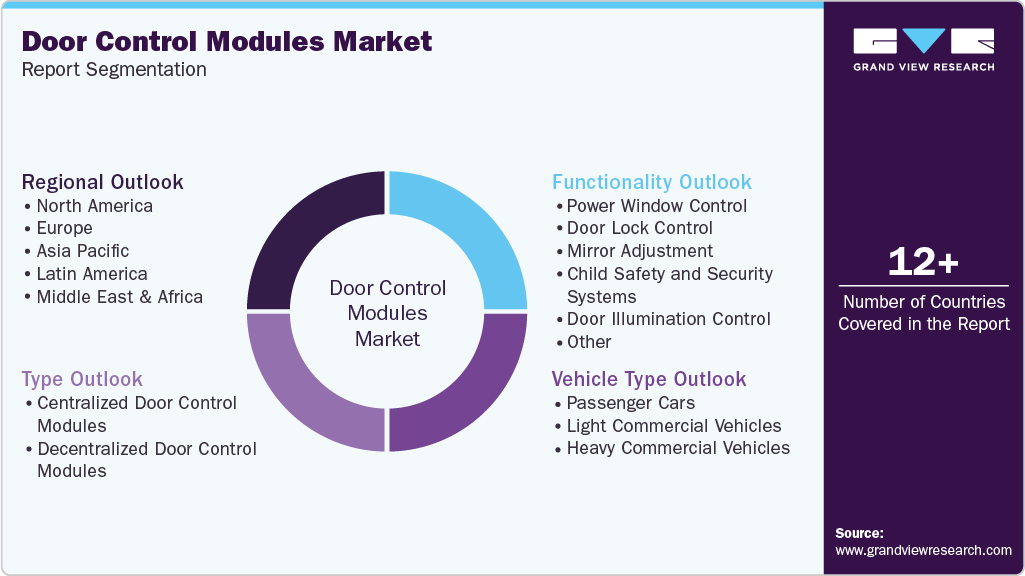
The report forecasts revenue growth at global, regional, and country levels and provides an analysis of the latest industry trends in each of the sub-segments from 2021 to 2033. For the purpose of this study, Grand View Research has segmented the door control modules market based on type, functionality, vehicle type, and region.
 To learn more about this report, Download Free Sample Report
-
Type Outlook (Revenue, USD Billion, 2021 - 2033)
-
Centralized Door Control Modules
-
Decentralized Door Control Modules
-
-
Functionality Outlook (Revenue, USD Billion, 2021 - 2033)
-
Power Window Control
-
Door Lock Control
-
Mirror Adjustment
-
Child Safety and Security Systems
-
Door Illumination Control
-
Other
-
-
Vehicle Type Outlook (Revenue, USD Billion, 2021 - 2033)
-
Passenger Cars
-
Light Commercial Vehicles
-
Heavy Commercial Vehicles
-
-
Regional Outlook (Revenue, USD Billion, 2021 - 2033)
-
North America
-
U.S.
-
Canada
-
Mexico
-
-
Europe
-
Germany
-
U.K.
-
France
-
-
Asia Pacific
-
China
-
India
-
Japan
-
South Korea
-
Australia
-
-
Latin America
-
Brazil
-
-
Middle East & Africa (MEA)
-
UAE
-
Kingdom of Saudi Arabia (KSA)
-
South Africa
-
-
Research Methodology
The door control modules market figures in this report are based on a proven research process that combines executive interviews with secondary research from proprietary databases, company filings, and recognized regulatory and institutional sources. Market size is built through value-chain sizing - reconciling supply-side and demand-side estimates - and triangulated with bottom-up and top-down approaches. Every estimate passes multiple levels of expert validation before publication, with each door control modules segment quantified using the revenue-capture definitions in the table below.
Segment Definition
Segment - Type
Revenue capture definition
Centralized Door Control Modules
The segment revenue is generated from the sale of door control modules in which multiple door-related functions are managed through a centralized electronic control architecture. Revenue includes modules controlling functions such as door locking, window operation, mirror adjustment, illumination, and related security functions through a common control unit.
Decentralized Door Control Modules
The segment revenue is generated from individual or distributed electronic modules positioned closer to specific door functions or individual doors. Revenue includes control units used to separately manage functions such as locking, windows, mirrors, lighting, and safety features where electronic control is distributed across the vehicle door architecture.
Segment - Functionality
Revenue capture definition
Power Window Control
The segment revenue is generated from electronic modules used to control the opening, closing, and automated operation of electrically powered vehicle windows, including associated safety and convenience functions.
Door Lock Control
The segment revenue is generated from modules and electronic control functions used to operate, monitor, and manage vehicle door locking and unlocking functions, including electronically controlled locking mechanisms.
Mirror Adjustment
The segment revenue is generated from electronic control functions used to adjust electrically operated exterior or interior mirrors, including directional positioning and related memory or convenience functions where integrated.
Child Safety and Security Systems
The segment revenue is generated from electronic door-control functions that support child locks, door-status monitoring, intrusion-related functions, and other electronically managed door safety and security features.
Door Illumination Control
The segment revenue is generated from electronic control functions responsible for operating lighting located within or around vehicle doors, including entry, courtesy, warning, and ambient illumination functions.
Other
The segment revenue is generated from other electronically controlled door functions not separately classified above, including door-related convenience, access, warning, and auxiliary control functions.
Segment - Vehicle Type
Revenue capture definition
Passenger Cars
The segment revenue is generated from door control modules installed in passenger vehicles, including sedans, hatchbacks, SUVs, crossovers, and other personal-use vehicles. Revenue includes modules supplied for standard and premium door-control functions across different passenger vehicle configurations.
Light Commercial Vehicles
The segment revenue is generated from door control modules installed in light commercial vehicles such as vans, pickups, and small commercial vehicles. Revenue includes modules supporting door locking, windows, mirrors, security, and other electronically controlled door functions.
Heavy Commercial Vehicles
The segment revenue is generated from door control modules installed in heavy trucks, buses, coaches, and other heavy commercial vehicles. Revenue includes electronically controlled door functions designed for commercial vehicle operating requirements, such as access, locking, windows, mirrors, and safety.
Estimation Model
Layer Name
Key Question
Description
Vehicle Production & Addressable Base
How many vehicles require door control modules?
The first layer estimates the vehicle population relevant to the Door Control Modules Market. It considers passenger cars, light commercial vehicles, and heavy commercial vehicles because door-electronics requirements differ by vehicle type. Vehicle production volumes and electronic feature penetration are used to determine the addressable vehicle base. This layer establishes the fundamental volume opportunity for door control module suppliers.
Module Penetration & Functionality
What proportion of vehicles use door control modules and which functions are integrated?
This layer evaluates the penetration of electronically controlled door systems across different vehicle categories. It considers functions such as door locking, power windows, mirror adjustment, illumination, and child safety and security systems. Higher vehicle specifications generally support greater electronic integration and therefore higher module content per vehicle. The analysis also distinguishes centralized and decentralized door control architectures.
Revenue per Module / Vehicle
How much revenue can suppliers capture from each vehicle?
This layer estimates the value of door control modules installed in each vehicle. Revenue potential varies according to the number of modules, functionality, vehicle segment, level of integration, and system complexity. Premium vehicles and vehicles with greater electronic content generally provide higher revenue opportunities per vehicle. OEM supply agreements and the level of module integration are also considered when estimating revenue capture.
Market Revenue & Validation
What is the final market value and how can it be validated?
The final layer combines vehicle volumes, module penetration, module content, and revenue per module to estimate total Door Control Modules Market revenue. The results are cross-checked using supplier portfolios, OEM sourcing activities, production trends, and regional vehicle electronics adoption. The estimation is further segmented by type, functionality, vehicle type, and geography. This approach helps ensure that market revenue reflects actual vehicle-level demand rather than simply supplier-level sales assumptions.
Delivered Customization
We have successfully delivered the following deep-dive customizations:
Client Request
Customization Delivered
Value Adds
Regional Door Control Modules Market Opportunity Assessment
Country/region-wise market sizing and forecasts
Analysis of demand, adoption trends, and regulatory landscape
Identification of high-growth regions and investment hotspots
Identified region-specific growth opportunities
Supported expansion and go-to-market strategy
Enabled informed regional investment decisions
Cross-Segmentation Analysis for the Door Control Modules Market
Criss-cross market analysis by type, functionality, vehicle type
Demand and adoption assessment across key segments
Segment attractiveness and growth potential passenger benchmarking
Identified high-potential market segments
Supported targeted type positioning and marketing strategy
Improved customer and segment prioritization
Competitive Benchmarking and Strategic Positioning in the Door Control Modules Market
Benchmarking of key competitors across types, pricing, partnerships, and innovation
Comparative assessment of market share, capabilities, and strategies
Analysis of competitive strengths, gaps, and differentiation areas
Identified competitive white spaces and growth gaps
Supported strategic positioning and differentiation
Enabled data-driven competitive strategy development
About the Author(s)
Automotive & Transportation Research Team
Technology · Automotive & TransportationThis report was authored by the automotive & transportation research team at Grand View Research - comprising two research analysts, one senior research analyst, and one industry expert - with specialized expertise in the automotive & transportation segment of the technology industry. All findings are based on proprietary technology databases, executive interviews, and regulatory analysis, subject to internal peer review prior to publication.
Last Updated:
Speak to Analyst

Customize this report to your needs - add regions, segments, or data points, with 20% free customization.
Or view our licence options:


ISO 9001:2015 & 27001:2022 Certified
We are GDPR and CCPA compliant! Your transaction & personal information is safe and secure. For more details, please read our privacy policy.


