
- Home
- »
- Electronic & Electrical
- »
-
Doorbell Camera Market Size And Share Report, 2026-2033GVR Report cover

Doorbell Camera Market (2026 - 2033)
Size, Share & Trends Analysis Report By Product (Wired Doorbell Camera, Wireless Doorbell Camera), By Distribution Channel (Offline Channel, Online Channel), By Region, And Segment Forecasts
Market Size, 2025
$2.3BMarket Estimate, 2026
$2.6BMarket Forecast, 2033
$6.8BCAGR, 2026–2033
14.6%Doorbell Camera Market Summary
The global doorbell camera market size was estimated at USD 2.3 billion in 2025 and is projected to grow from USD 2.6 billion in 2026 to USD 6.8 billion by 2033, growing at a CAGR of 14.6% from 2026 to 2033. North America dominated the doorbell camera market with the largest revenue share of 33.1% in 2025. The market growth is driven by rising cases of burglary and crime worldwide, as well as increasing consumer spending on smart home devices.
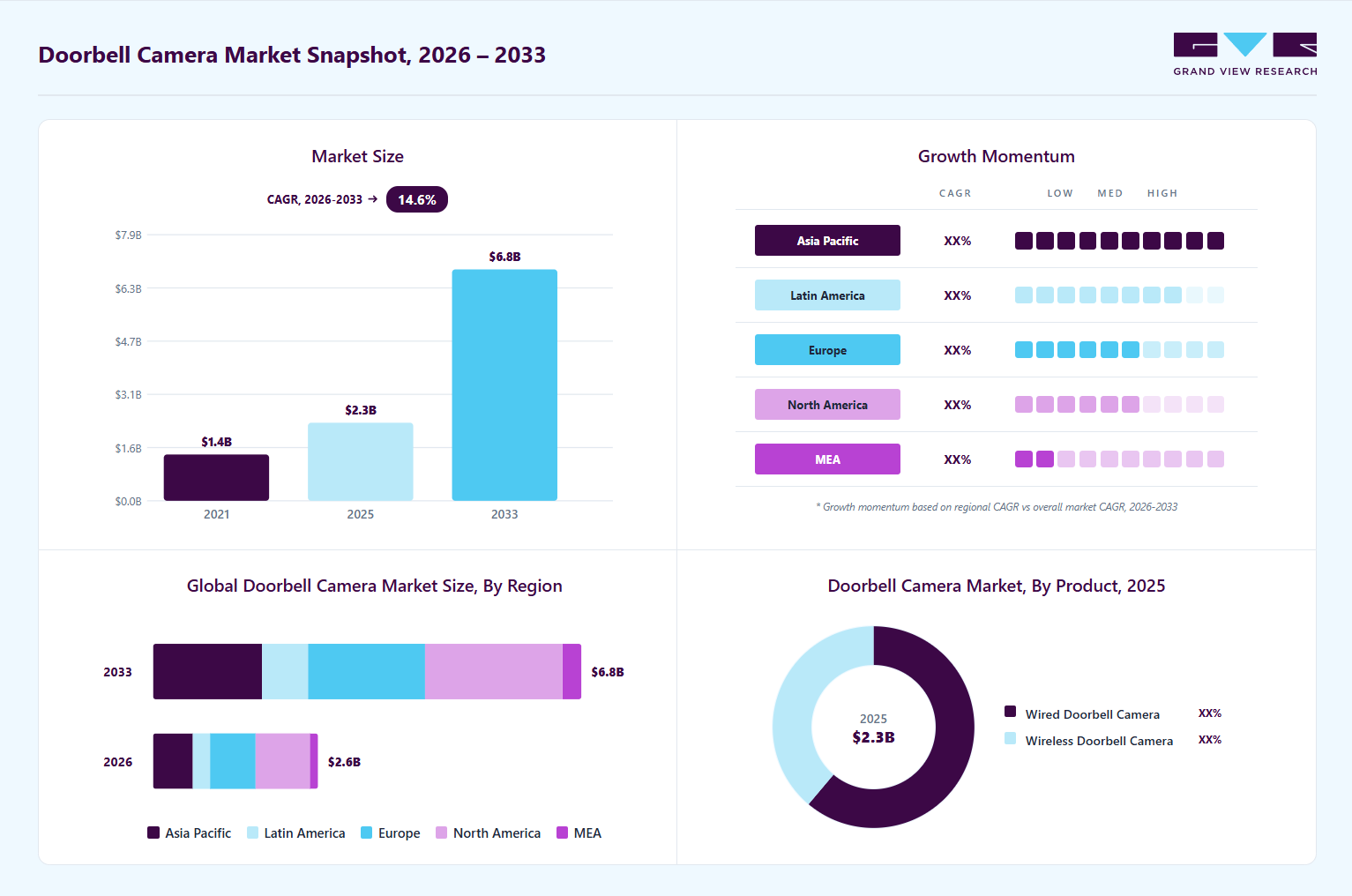 Source: Grand View Research, IR Documents, Primary Interviews, Paid DatabasesTo learn more about this report,
 Download Free Sample Report
 Key Market Trends & Insights
- By product: Wired doorbell camera segment held the largest market share of 61.1% in 2025.
- By distribution channel: Offline channel segment held the largest market share of 67.4% in 2025.
Regional Highlights
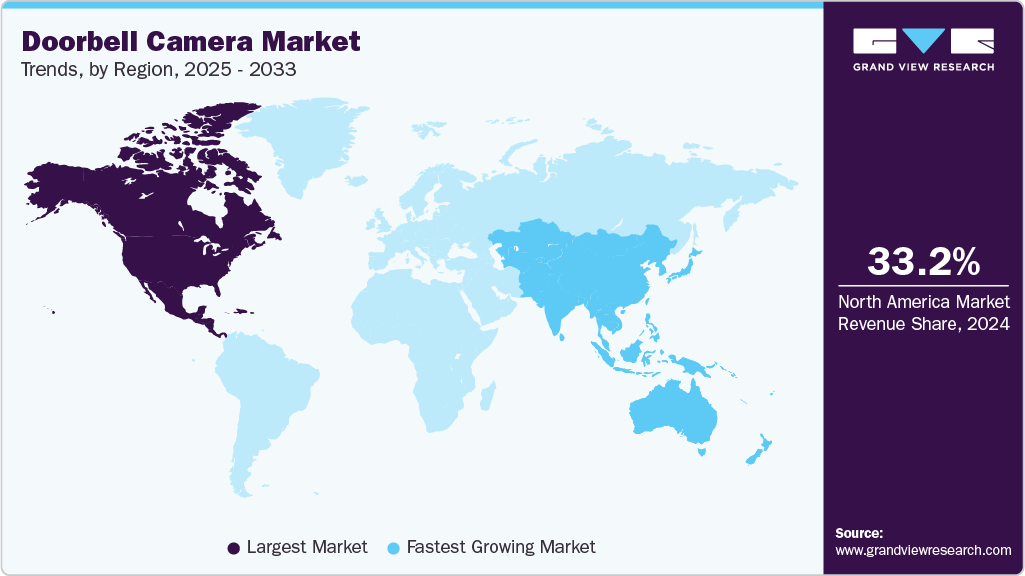
- Largest regional market: North America (33.1% revenue share, 2025)
- Fastest-growing regional market: Asia Pacific (highest CAGR, 2026-2033)
- By country: The U.S. held the largest market share in 2025.
Market Size & Forecast
- Market size in 2025: USD 2.3 Billion
- Estimated market size in 2026: USD 2.6 Billion
- Projected market size by 2033: USD 6.8 Billion
- CAGR (2026-2033): 14.6%
Three ways to get this report
Buy it, customize it, or ask a question.Ask an Analyst
Analyst response in 1 business day
- AccessReport author, directly
- Reply timeWithin 1 working day
- No sales callDirect answer only
- FormatEmail reply
- CostFree, no cost
Get the Full Report
What the study covers
- FormatsPDF · Excel · Dashboard
- Timeline2026–2033 annual, 2025 base
- Coverage20+ countries, 5 regions
- Companies10+ key players profiled
Customize the Report
20% free customization
- IncludeCountries, segments, points
- TailorTo your product definition
- ExtendDeeper competitor detail
- OrA fully bespoke study
- Turnaround5–10 working days
Rising awareness regarding home safety is expected to drive the product demand in the doorbell camera industry. Moreover, growing concerns regarding the security, safety, and well-being of individuals and families are expected to play a key role in increasing the scope of doorbell cameras. The industry's growth is further supported by the growing awareness among the masses regarding the integration of artificial intelligence (AI) into their daily routines for comfort and luxury. Tech hardware companies are manufacturing products that leverage AI features to modify and update their offerings, catering to the evolving needs of consumers. For instance, most doorbell cameras have been integrated with a two-way audio system to assist users with better communication with the visitor.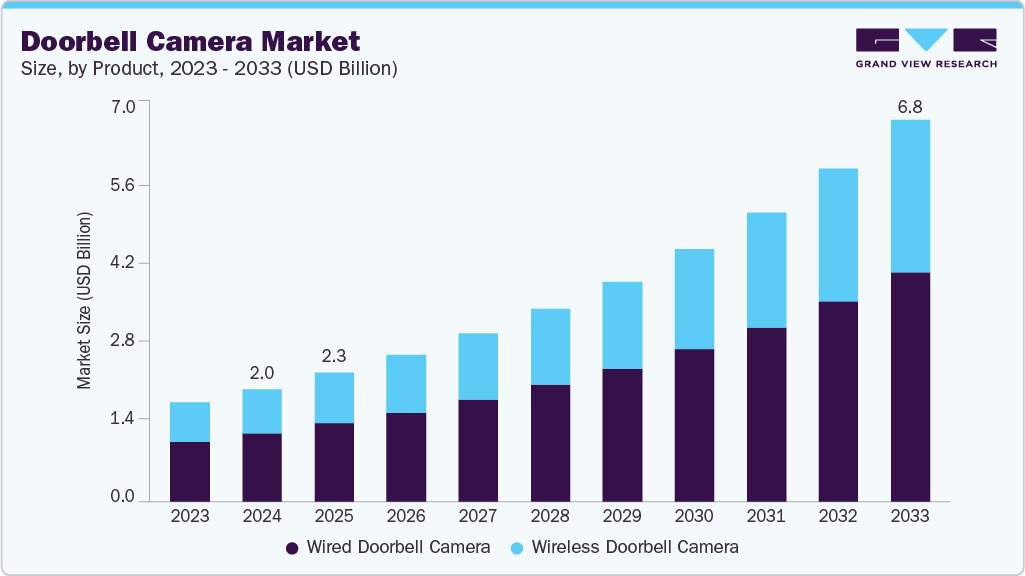 To learn more about this report, Download Free Sample Report
 Integrating high-resolution cameras provides detailed, clear images and videos, which are essential for identifying visitors and capturing important security footage, thereby enhancing the device's overall effectiveness. Moreover, long battery life ensures that doorbell cameras remain operational without frequent recharging or battery replacement, offering continuous surveillance. These features enhance the user experience and increase the perceived importance and utility of the doorbell camera, driving its adoption in both residential and commercial settings. To cater to these demands, companies are introducing advanced doorbell features that provide consumers with clarity and reliability. For instance, in May 2024, Xiaomi launched the Smart Maoyan 2 smart doorbell camera, which has an 8000 mAh battery that lasts up to 300 days. The product features a 3-megapixel camera, providing a resolution of 2048 x 1536 and HDR support. The 180-degree wide-angle lens minimizes blind spots outside the door.
In today’s scenario, security devices are considered a necessity to keep oneself protected and alert, ensuring house safety. A rising number of crimes, including theft and burglary, has increased the prominence of home security devices, including doorbell cameras. Burglaries in the U.S. have been steadily decreasing, with reports dropping by 8.6% in 2024 compared to the previous year and a 19% decline in the first half of 2025. Residential break-ins are now 26% lower than in 2019. However, the theft of non-precious metals has surged by 71% over the last five years. In 2022, the FBI reported 847,522 burglaries, equivalent to 269.8 incidents per 100,000 people. Despite this downward trend, homes without security systems remain highly vulnerable, being 300% more likely to experience a break-in, with a burglary occurring every 26 seconds in the U.S.
Market Dynamics
The doorbell camera market is expanding as consumers increasingly prioritize real-time home monitoring, remote security access, and simple, app-based surveillance, particularly in urban residential settings and rental properties where safety and convenience are key concerns. These devices provide integrated video, audio, and motion detection, enabling users to see and communicate with visitors remotely while maintaining continuous awareness of doorstep activity without complex security installations. Product differentiation is increasingly driven by ecosystem compatibility (battery-powered wireless vs. hardwired systems), AI-enabled detection features such as person recognition and package alerts, cloud vs. local storage options, and compact weather-resistant designs suited for outdoor entry points.
The doorbell camera market is strongly driven by rising adoption of smart home ecosystems, where consumers increasingly integrate security devices with mobile apps, voice assistants, and AI-based monitoring for real-time protection and convenience. Growing concerns about home safety, burglary prevention, and remote property monitoring continue to reinforce demand, even as traditional burglary rates fluctuate, because households without security systems remain significantly more vulnerable. Advancements in AI-powered features such as facial recognition, package detection, and two-way audio enhance usability and perceived safety.
For instance, in 2025, Google Nest introduced upgraded doorbell models with improved HDR video and AI alerts, strengthening ecosystem-based home security adoption. These innovations are making doorbell cameras essential components of modern residential security systems.
The doorbell camera market faces significant restraints due to high upfront device costs and ongoing subscription expenses for cloud storage and advanced AI features, which limit adoption among price-sensitive consumers, particularly in emerging economies. Additionally, concerns around data privacy, unauthorized surveillance, and cybersecurity vulnerabilities reduce consumer confidence, especially as these devices continuously capture footage of private residential spaces. Dependence on stable internet connectivity also restricts performance in areas with weak broadband infrastructure, leading to delayed alerts or reduced video quality. Furthermore, compatibility issues across different smart home ecosystems can create integration challenges, discouraging seamless adoption and slowing market penetration despite growing awareness of home security benefits.
A major opportunity lies in the rapid expansion of AI-driven smart home ecosystems, where doorbell cameras are becoming central nodes in integrated residential security and automation networks. Rising consumer demand for real-time monitoring, intelligent alerts, and seamless connectivity with mobile apps and voice assistants is driving manufacturers to develop more interoperable, feature-rich devices. The growing adoption of subscription-based models for cloud storage, video analytics, and advanced security insights is also creating strong recurring revenue potential for companies. Additionally, increasing urbanization, growth in multi-dwelling housing, and rising disposable incomes in emerging markets are widening the customer base. Continuous innovation in edge AI processing, energy efficiency, and affordable smart devices is further accelerating mass-market penetration and ecosystem lock-in.
Analyst Perspective
The doorbell camera market is shifting toward ecosystem-led home entry management, where value is increasingly captured through ongoing cloud subscriptions, AI-driven monitoring services, and smart home integrations rather than standalone hardware sales. Growth is concentrated in urban apartments, gated communities, and rental housing segments where real-time entry visibility and remote access control replace traditional intercom and doorbell systems. Commercial and semi-commercial adoption is expanding in property management firms, hospitality assets, and small residential complexes, driven by centralized monitoring, multi-unit access control, and reduced on-site security staffing needs. Competitive advantage is moving toward players that integrate always-on connectivity, intelligent motion, and facial recognition alerts, and platform-based security ecosystems, while managing pressures around data privacy compliance, bandwidth dependency, and long-term cloud storage costs.
Consumer Insights for Doorbell Camera:
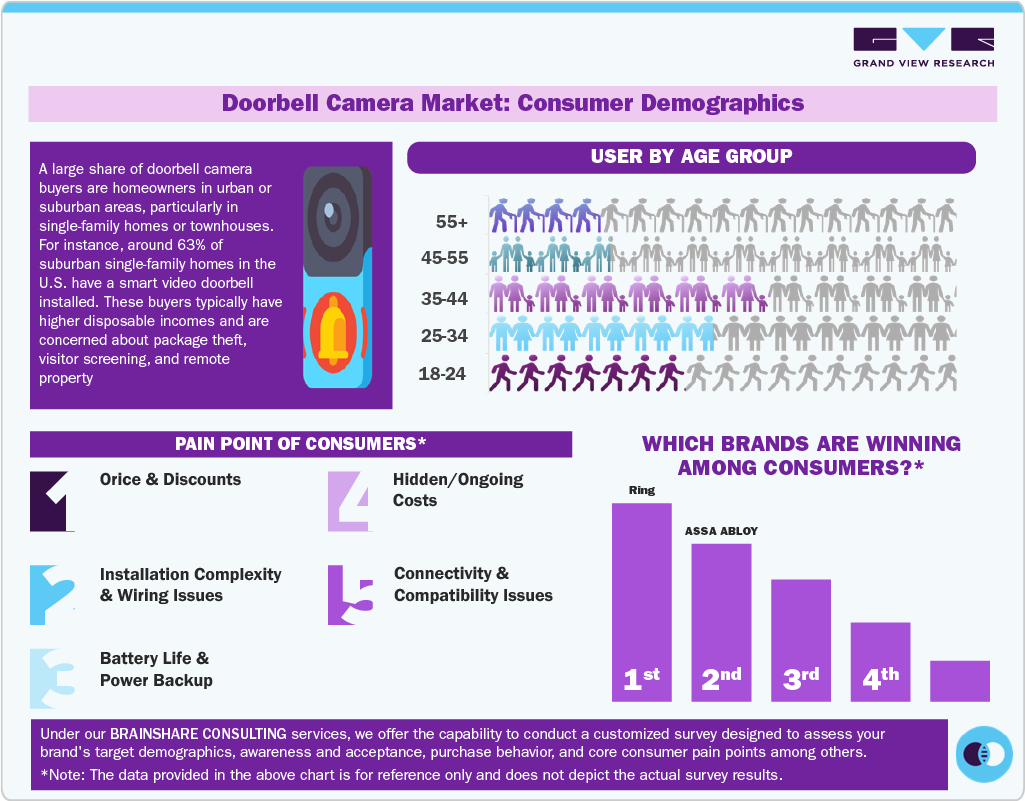 To learn more about this report, Download Free Sample Report
 Product Insights
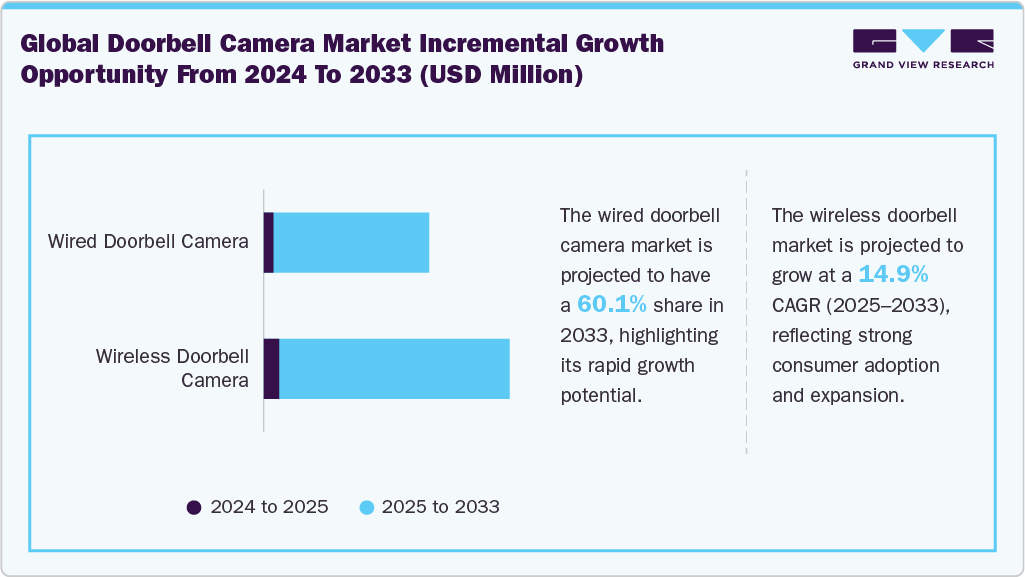
Based on product, the wired doorbell camera segment led the market with the largest revenue share of 61.1% in 2025. Wired doorbell cameras are connected directly to the electrical system, ensuring they receive a constant power source. It eliminates concerns about battery life or the need for frequent recharging, making them dependable for long-term surveillance. The continuous power supply ensures the camera is always operational, providing uninterrupted security coverage and reliability. For instance, in October 2023, Ecobee, a subsidiary of Generac Power Systems, launched the wired Ecobee Smart Doorbell Camera. It is designed to provide homeowners with a better field of view and integrates with Ecobee's Smart Thermostat Premium. It also incorporates several AI-powered features, including advanced radar verification and computer vision, providing homeowners with more accurate detection and meaningful notifications. Users also create customized activity zones to focus on specific areas, such as a porch or walkway.
 To learn more about this report, Download Free Sample Report
 The wireless doorbell camera market is projected to grow at the fastest CAGR of 14.9% from 2025 to 2033. Wireless doorbell cameras do not require complex wiring or professional installation, making them suitable for self-installation for enthusiasts and renters who do not have permission to change their property's wiring. The installation typically involves mounting the camera and connecting it to a Wi-Fi network, allowing users to position the camera at optimal locations without being restricted by existing wiring or electrical outlets. This ease of installation and flexibility is expected to drive the demand in the market.
Distribution Channel Insights
Based on distribution channel, the offline channel led the market with the largest revenue share of 67.4% in 2025. Physical retail stores allow customers to experience and test doorbell cameras before making a purchase. Sales associates in electronics and home improvement stores are often knowledgeable about their products and provide detailed information, answer questions, and offer recommendations based on individual customer needs. Interactive displays and in-store demonstrations help consumers understand the features and benefits of various models, enabling them to make informed purchasing decisions.
 To learn more about this report, Download Free Sample Report
 The sales of doorbell cameras through online distribution channels are projected to grow at a significant CAGR of 15.0% from 2025 to 2033. E-commerce platforms provide a comprehensive range of doorbell camera models, brands, and price points, allowing consumers to find the product that best suits their needs and budget. Detailed product descriptions, specifications, customer reviews, and ratings provide valuable information that enables consumers to make informed purchasing decisions. Additionally, online retailers frequently run promotions, discounts, flash sales, and bundle deals that provide added value to consumers.
Regional Insights
North America dominated the doorbell camera market with the largest revenue share of 33.1% in 2025. The growth is primarily driven by the rising demand for advanced home security solutions, as an increasing number of consumers are incorporating tech-integrated devices into their home security strategies. Heightened security concerns and the growing trend of smart home automation bolster the demand for video doorbells. In particular, North American consumers are increasingly opting for premium doorbell cameras that offer advanced features, such as facial recognition, motion detection, and remote access. This market growth is also supported by the widespread availability of these devices through established retail networks and robust online distribution channels. Furthermore, consumers' heightened interest in home security and smart home systems, along with technological innovations, is fostering strong growth in the region.
 To learn more about this report, Download Free Sample Report
 U.S. Doorbell Camera Market Trends
The doorbell camera market in the U.S. held the largest share in the North America region in 2025. The growth of the U.S. market is driven by strong consumer purchasing power, a growing interest in home automation, and an increasing focus on personal safety. Innovations in AI-powered features, such as real-time alerts and facial recognition, are attracting consumers seeking enhanced security. Retail partnerships and omnichannel strategies have improved the accessibility of these devices, expanding their reach to a broader consumer base. Additionally, the U.S.'s growing focus on mental health and relaxation therapies further supports the adoption of home security devices, including video doorbells.
Europe Doorbell Camera Market Trends
The doorbell camera industry in Europe held a significant share of 27.7% in 2024.The Europe market is being shaped by an increasing preference for smart home devices, as well as a growing demand for energy-efficient and eco-friendly products. Consumers are becoming more conscious of sustainability, and as a result, there is a strong demand for durable, energy-efficient video doorbells. The market is also benefiting from government initiatives aimed at promoting employee wellness, which has contributed to the growing adoption of smart home security devices in the workplace and at home. Additionally, the aging population across Europe, with higher disposable incomes, continues to drive demand for wellness-oriented devices, including video doorbells with features such as two-way communication and real-time video streaming.
The Germany doorbell camera market held the largest share of 21.8% in 2024. The demand for doorbell cameras in Germany is supported by the country’s strong healthcare infrastructure and a focus on high-quality, precision-engineered products. Consumers value durable, premium doorbell cameras that integrate well with other smart home systems. There is also a growing trend of incorporating smart security devices, like video doorbells, into physical rehabilitation and orthopedic care routines, which is further contributing to the market’s expansion in Germany. With the increasing awareness of personal security and preventive wellness programs, households in Germany are increasingly adopting video doorbell solutions to enhance their home security and overall quality of life.
Asia Pacific Doorbell Camera Market Trends
The Asia Pacific doorbell camera industry is projected to grow at the fastest CAGR of 15.5% from 2025 to 2033. The rapid urbanization and rising middle-class income levels in countries like China, Japan, South Korea, and India are driving the adoption of home security solutions, including video doorbells. In these markets, there is a growing awareness of the importance of home security, along with a strong demand for affordable, feature-rich devices that offer seamless integration with other smart home technologies. The availability of low-cost, high-quality devices from local manufacturers is making video doorbells more accessible to a wider consumer base.
Key Doorbell Camera Company Insights
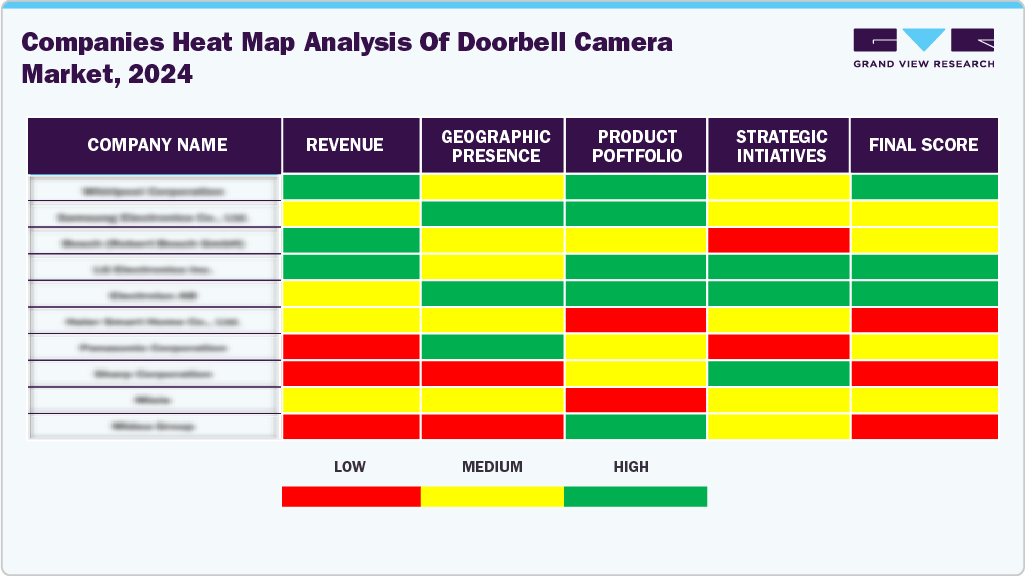
Numerous leading brands in the doorbell camera market have recognized significant opportunities within their product portfolios and are actively working to capitalize on these gaps. These companies are focusing on launching innovative designs, expanding customization options, and tailoring their marketing strategies to better align with evolving consumer preferences and cultural trends. By targeting niche segments and meeting emerging consumer demands, these brands aim to expand their market share and enhance their competitive positioning on a global scale.
 To learn more about this report, Download Free Sample Report
  To learn more about this report, Download Free Sample Report
 Key Doorbell Camera Companies:
The following key companies have been profiled for this study on the doorbell camera market.
-
ASSA ABLOY
-
AUXTRON
-
Hangzhou Hikvision Digital Technology Co. Ltd.
-
IFI Techsolutions
-
Napco Security Technologies, Inc.
-
Ring LLC
-
SkyBell Technologies Inc.
-
Vivint, Inc.
-
VTech Communications, Inc.
-
Zmodo
Competitive Benchmarking
Category
Operating Strategies
Competitive Edge
Weakness
Established Players (Ring LLC; Vivint, Inc.; Hangzhou Hikvision Digital Technology Co., Ltd.; ASSA ABLOY; Napco Security Technologies, Inc.; VTech Communications, Inc.
Expand closed-loop smart home and security ecosystems through proprietary hardware-software integration, AI-enabled surveillance features, cloud storage subscriptions, and bundled home security services. Strong emphasis on enterprise deployments alongside consumer retail penetration.
Strong installed base of devices and monitoring systems, deep integration across security ecosystems, and recurring revenue from subscription services. High brand trust in security-critical applications and strong distribution through both direct-to-consumer and professional installer channels.
High dependence on proprietary ecosystems can limit interoperability with third-party devices. Regulatory scrutiny and data privacy concerns (particularly for large surveillance-focused vendors) may constrain expansion in certain markets. Premium pricing and subscription dependency can reduce adoption in cost-sensitive segments.
Emerging Players (SkyBell Technologies Inc.; Zmodo; AUXTRON; IFI Techsolutions)
Focus on affordable, flexible doorbell camera systems compatible with open or semi-open protocols across smart home ecosystems (Alexa, Google Home, third-party NVRs). Heavy reliance on e-commerce, retail partnerships, and white-label/OEM models. Positioning driven by price competitiveness, plug-and-play installation, and basic-to-mid-tier smart features rather than full security ecosystem lock-in.
Lower price points and greater compatibility flexibility improve accessibility in price-sensitive and emerging markets. Faster product iteration cycles and lighter ecosystem constraints enable rapid feature experimentation. Strong presence in online retail channels and private-label manufacturing partnerships.
Weaker brand equity and limited trust in high-security or enterprise deployments compared to incumbents. Lower switching costs for consumers lead to higher churn. Reduced ability to monetize via subscriptions and weaker end-to-end ecosystem integration constrain the long-term potential for recurring revenue.
Recent Developments
-
In September 2025, Ring unveiled its most advanced lineup of home security cameras and doorbells, introducing new 2K and 4K models featuring Retinal Vision technology for lifelike visual clarity and enhanced low-light performance. These new devices, including Wired Doorbell Pro, Spotlight Cam Pro, Floodlight Cam Pro, and Outdoor Cam Pro (with PoE options), offer detailed imaging powered by AI for sharper and more reliable video surveillance, along with a 10x zoom feature.
-
In August 2025, Philips Hue launched its first video doorbell, the Hue Secure model, priced at $169.99, available in October. It features a 2K image sensor and a fish-eye lens for clear video quality, and operates via wired installation. The doorbell supports both 2.4GHz and 5GHz Wi-Fi and integrates with Hue lights via Zigbee, enabling automatic lighting when someone approaches. It also includes a plug-in chime that acts as a siren but requires the Hue system to function.
-
In August 2025, Aqara unveiled a new lineup of smart home products at IFA 2025 in Berlin, focusing on premium doorbell cameras and outdoor security solutions. The highlight is the Doorbell Camera G400, a wired video doorbell that integrates deeply with Apple HomeKit Secure Video, offering 2K resolution, "head-to-toe" coverage, and on-device facial recognition with Apple's encrypted cloud for privacy.
Doorbell Camera Market Report Scope
Report Attribute
Details
Market size in 2025
USD 2.3 billion
Estimated Market size in 2026
USD 2.6 billion
Projected Market size 2033
USD 6.8 billion
Growth rate
CAGR of 14.6% from 2026 to 2033
Base year for estimation
2025
Historical data
2021 - 2024
Forecast period
2026 - 2033
Quantitative units
Revenue in USD million/billion and CAGR from 2026 to 2033
Report coverage
Revenue forecast, company ranking, competitive landscape, growth factors, and trends
Segments covered
Product, distribution channel, region
Regional scope
North America; Europe; Asia Pacific; Latin America; MEA
Country scope
U.S.; Canada; Mexico; Germany; UK; France; Italy; Spain; China; Japan; India; Australia; South Korea; Brazil; South Africa
Key companies profiled
ASSA ABLOY; AUXTRON; Hangzhou Hikvision Digital Technology Co. Ltd.; IFI Techsolutions; Napco Security Technologies, Inc.; Ring LLC; SkyBell Technologies Inc.; Vivint, Inc.; VTech; Communications, Inc.; Zmodo
Customization scope
Free report customization (equivalent to up to 8 analysts' working days) with purchase. Addition or alteration to country, regional & segment scope.
Pricing and purchase options
Avail customized purchase options to meet your exact research needs. Explore purchase options
Global Doorbell Camera Market Report Segmentation
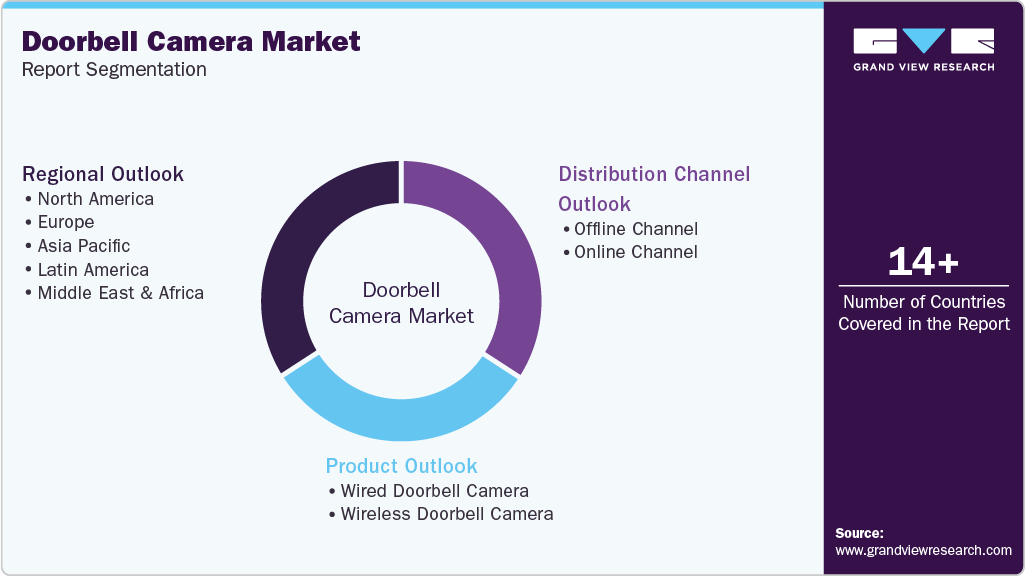
This report forecasts revenue growth at the global, regional & country levels and provides an analysis of the latest industry trends and opportunities in each of the sub-segments from 2021 to 2033. For this study, Grand View Research has segmented the global doorbell camera market report based on product, distribution channel, and region:
 To learn more about this report, Download Free Sample Report
 -
Product Outlook (Revenue, USD Million, 2021 - 2033)
-
Wired Doorbell Camera
-
Wireless Doorbell Camera
-
-
Distribution Channel Outlook (Revenue, USD Million, 2021 - 2033)
-
Offline Channel
-
Online Channel
-
-
Regional Outlook (Revenue, USD Million, 2021 - 2033)
-
North America
-
U.S.
-
Canada
-
-
Europe
-
UK
-
Germany
-
France
-
Italy
-
Spain
-
-
Asia Pacific
-
China
-
India
-
Japan
-
South Korea
-
Australia & New Zealand
-
-
Latin America
-
Brazil
-
Mexico
-
-
Middle East & Africa
-
South Africa
-
-
Research Methodology
The doorbell camera market figures in this report are based on a proven research process that combines executive interviews with secondary research from proprietary databases, company filings, and recognized regulatory and institutional sources. Market size is built through value-chain sizing - reconciling supply-side and demand-side estimates - and triangulated with bottom-up and top-down approaches. Every estimate passes multiple levels of expert validation before publication, with each doorbell camera segment quantified using the revenue-capture definitions in the table below.
Segment Definition
Segment - Product
Revenue capture definition
Wired
As the largest product segment, revenue is generated through the sale of doorbell camera systems that operate without a fixed electrical connection to the building’s existing doorbell wiring, typically relying on rechargeable batteries and Wi-Fi connectivity for installation and operation. This segment includes entry-level battery-powered models, mid-range smart home-integrated devices, and premium AI-enabled video doorbells with cloud storage, motion detection, and ecosystem compatibility. Demand is driven by ease of installation, renter-friendly deployment, flexibility in placement, and integration with broader smart home platforms.
Wireless
Revenue is generated through the sale of doorbell camera systems that are physically connected to existing doorbell wiring, drawing continuous power from the building’s electrical infrastructure and typically offering uninterrupted operation. This segment includes standard wired video doorbells, mid-range smart security models with enhanced connectivity features, and high-end systems integrated into full home security and surveillance setups. Reliability, consistent power supply, reduced maintenance requirements, and stable performance for continuous recording and monitoring drive demand.
Estimation Model
Household & Commercial Base Layer
Purchasing Power Layer
Adoption Layer
Revenue Generation Layer
Who has potential to use doorbell cameras?
Who can afford a doorbell camera system?
Who actively adopts and uses doorbell cameras?
How much revenue is generated?
Identify security-conscious households, urban apartment residents, and premium lifestyle consumers, as well as offices, hotels, gated communities, retail stores, and small commercial units, enabling shared doorbell camera deployment.
Apply income segmentation across developed and emerging markets, identifying urban middle-to-high income consumers, dual-income households, premium offices, hospitality chains, and corporate spending on doorbell systems and subscriptions.
Apply behavioral adoption drivers emphasizing frequent home security monitoring, real-time visitor alerts, and time-constrained users prioritizing safety, responsiveness, and convenience over traditional doorbells.
Multiply active users by device price and recurring subscription revenue to estimate market value, driven by hardware sales, storage plans, monitoring services, ecosystem lock-in, and upgrades.
Delivered Customizations
This report has been delivered with the following In-depth customizations
Client Request
Customization Delivered
Value Adds
Edge AI, Video Intelligence & Event Detection Capability Analysis for Doorbell Cameras
Deep technical assessment of edge-based AI processing capabilities in doorbell camera systems, including on-device object detection (person, vehicle, animal, package), motion classification accuracy, and real-time alert prioritization. Evaluation of false positive reduction techniques, night vision AI enhancement, and adaptive learning algorithms for user-specific activity patterns. Analysis of compute architecture trade-offs between edge processing and cloud inference across leading OEM architectures.
Identify high-value AI feature differentiation opportunities and algorithmic performance gaps across competitors. Support roadmap prioritization for advanced detection features (e.g., package theft prevention, familiar face recognition). Enable benchmarking of latency, accuracy, and compute efficiency across device tiers.
Cybersecurity, Privacy Compliance & Data Governance Analysis for Connected Doorbell Cameras
Comprehensive evaluation of security architectures including end-to-end encryption protocols, firmware integrity mechanisms, authentication frameworks, and cloud storage security models. Assessment of regional privacy compliance requirements (GDPR, CCPA, and emerging biometric surveillance regulations). Comparative analysis of local storage vs cloud storage trade-offs and anonymization techniques for video data handling.
Identify regulatory risk exposure and compliance gaps across geographies. Support privacy-first product positioning and trust-driven differentiation strategies. Enable design optimization for secure-by-design product development and enterprise-grade security benchmarking.
Smart Home Ecosystem Compatibility & Interoperability Analysis for Doorbell Cameras
Evaluation of integration capabilities across major smart home ecosystems including voice assistants, home automation platforms, and unified device management systems. Analysis of protocol compatibility (Wi-Fi, Zigbee, Z-Wave, Thread) and emerging interoperability standards such as Matter. Assessment of cross-device automation use cases, including lighting triggers, smart lock synchronization, and security system orchestration.
Identify ecosystem lock-in vs interoperability-driven growth opportunities. Support partnership and platform alignment strategies with major smart home ecosystems. Enable prioritization of compatibility features that maximize consumer stickiness and cross-device engagement.
Frequently Asked Questions About This Report
The global doorbell camera market size was valued at USD 2.3 billion in 2025 and is estimated at USD 2.6 billion for 2026.
The global doorbell camera market is expected to grow at a CAGR of 14.6% from 2026 to 2033, reaching USD 6.8 billion.
Some key players operating in the doorbell market include ASSA ABLOY; AUXTRON; Hangzhou Hikvision Digital Technology Co. Ltd.; IFI Techsolutions; Napco Security Technologies, Inc.; Ring LLC; SkyBell Technologies Inc.; Vivint, Inc.; VTech; Communications, Inc.; Zmodo
Key factors include rising cases of burglary and crime worldwide, as well as increasing consumer spending on smart home devices.
North America dominated with a 33.1% revenue share in 2025.
Asia Pacific is the fastest-growing region over the forecast period.
U.S. dominated the North America market with a 49.2% revenue share in 2025.
Wired doorbell camera led with a 61.1% revenue share in 2025, while the wireless doorbell camera is the fastest-growing segment.
The offline distribution channel accounted for the largest market share of 67.4% in 2025, while the online distribution channel is the fastest-growing segment.
About the Author(s)
Electronic & Electrical Research Team
Consumer Goods · Electronic & ElectricalThis report was authored by the electronic & electrical research team at Grand View Research - comprising two research analysts, one senior research analyst, and one industry expert - with specialized expertise in the electronic & electrical segment of the consumer goods industry. All findings are based on proprietary consumer goods databases, executive interviews, and regulatory analysis, subject to internal peer review prior to publication.
Last Updated:
Speak to Analyst

Customize this report to your needs - add regions, segments, or data points, with 20% free customization.
Or view our licence options:


ISO 9001:2015 & 27001:2022 Certified
We are GDPR and CCPA compliant! Your transaction & personal information is safe and secure. For more details, please read our privacy policy.


